"One of the most absurd claims in George Akerlof’s and Robert Shiller’s book Phishing for Phools is this one, which appears on page 150:
Just let everyone be “free to choose,” says the mantra, and we will have an earthly paradise, as close to the Garden of Eden as our existing technology, our human capabilities, and the distribution of income will allow.While it’s true that Milton and Rose Friedman, along with other libertarians and free-market conservatives who often use “free to choose” as a shorthand descriptor for a free society, believe that such a society results over time in better outcomes than are likely to be generated by less-free economic arrangements, it is emphatically untrue that the Friedmans – or any other respected libertarian writers – ever argued or even implied that free markets lead to something close to an earthly “Garden of Eden.” The Friedmans understood, and all other respected free-market advocates understand, that our world is one of trade-offs and not “solutions.” And so, indeed, as the options among which we are free to choose become both more numerous and more attractive, the costs that each of us incurs when exercising our freedom to choose rise. If for no other reason, such a world cannot possibly ever be an “earthly paradise.”
Moreover, the case for a free society is very much a case for minimizing the prospect of large-scale harm that is always at risk of being unleashed when societies are directed from the top. It is not a case that promises paradisiacal outcomes. Free-market advocates recognize that people differ in their tastes, their risk preferences, their judgments, their self-discipline, their talents, and their opportunities. And, therefore, free-market advocates recognize and accept the reality that many people will make not only choices that others judge to be ‘wrong,’ but also make choices that those who make such choices themselves later judge to be wrong.
Free-market advocates prefer to let even unwise adults remain free to choose than to use the state to oblige adults to choose as elites would have them choose. There is nothing utopian about such a vision of society. And by falsely accusing free-market advocates of being utopian, it’s as if Akerlof and Shiller are phishing their readers for phools into buying a faulty case for greater government intervention."
Saturday, December 12, 2015
It is not true that the Friedmans ever argued that free markets lead to something close to an earthly “Garden of Eden”
See A Baseless Charge by Don Boudreaux.

Obama routinely ignores the fact that natural gas has driven CO2 emissions from power production to a 22-year low
From Mark Perry.
"From my op-ed this week in Investor’s Business Daily — “Obama’s Blind Faith In ‘Clean’ Energy Will Cost Plenty“:
The other big development on the energy front is natural gas. Although the surge in the use of clean-burning natural gas has driven U.S. carbon emissions from power production to the lowest level in 22 years (see chart above), you’d never know it from listening to the administration. Obama routinely ignores this important accomplishment or treats it as an inconvenience.The U.S. is one of the few countries that has decoupled GDP growth from emissions growth. As the shale revolution demonstrates, the innovative use of new energy technologies along with improvements in energy efficiency not only reduce carbon emissions but also greatly benefit the nation’s economy. Yet the administration continues to hamper natural gas production on public lands, while extending tax credits and incentives for solar and wind power, even though they’re not nearly as effective in carbon mitigation.Renewables won’t be able to get us even halfway to achieving Obama’s target — reducing U.S. carbon emissions over the next decade to a level at least 26% below what they were in 2005.Nuclear power and natural gas aren’t the problem. What should be recognized is that they’re actually two of the key energy sources that will cost-effectively reduce carbon emissions in the United States and worldwide. Together with investments in advanced energy technologies, increasing the use of nuclear power and natural gas — as part of an all-of-the-above energy strategy — could have a major impact on containing global greenhouse gases.
MP: It’s important to note that the reduction in CO2 emission from electric power generation to their lowest level since 1993 wasn’t part of any Washington-based energy plan or policy, and didn’t involve any Congressional fuel mandates or taxpayer subsidies. It happened because of America’s petropreneurs, operating in the private sector with private capital and largely on private lands, who pioneered the development of revolutionary “Made in the USA” drilling and extraction technologies that were able to access the oceans of shale gas miles below the ground in states like Pennsylvania, Texas and North Dakota."
Wednesday, December 9, 2015
Regulatory Dark Matter
By Ryan Young of CEI. Excerpt:
"How do regulations get made? Agencies have to follow specific procedures, first outlined in the 1946 Administrative Procedure Act. The trouble is that many agencies simply ignore the law. Wayne Crews documents several cases of such procedural abuse in his new paper, “Mapping Washington’s Lawlessness 2016: A Preliminary Inventory of ‘Regulatory Dark Matter.’”
The rulemaking process has been updated and amended over time, and it can get technical. But the basic principles are pretty simple. For a detailed look at the process, see Susan Dudley and Jerry Brito’s excellent primer. Wayne’s point is that more and more often, agencies are ignoring proper procedure. Perhaps folks at the EPA, HHS, and other agencies should read Dudley and Brito.
The first principle is that only Congress can legislate. Agencies can’t just unilaterally issue regulations; Congress has to pass legislation directing them to issue rules. Agencies do have some discretion, but their regulations do have to have statutory authority. More and more, agencies are flouting Congress and acting on their own. In 2014, Congress passed 224 laws—while agencies issued 3,554 regulations. Recent examples of non-congressional legislating include net neutrality, carbon emissions, and subsidies to health insurance exchanges—which led to the King v. Burwell Supreme Court case.
Another principle is public participation and transparency. Before a new regulation can take effect, an agency has to publish a proposed version of the rule in the daily Federal Register. Once it’s published, that opens a comment period where anyone, from the general public to policy experts, can submit comments about the rule. Comment periods vary, but typically last from 30 to 90 days. Agencies are required to respond and take into account the public’s comments before the final version of the regulation takes effect.
The TSA’s body scanner policies openly violated this legal requirement, leading CEI and two other groups to sue the TSA. A proposed regulation for full-body scanner use never appeared in the Federal Register. The public never had a chance to comment on the rule. The TSA just went ahead and installed the scanners without telling anybody how they were going to use them, and what safeguards they would have against abuse. This complete lack of transparency is a serious form of regulatory dark matter.
Guidance documents are another increasingly popular form of dark matter. Regulations aren’t always clearly written, and the people drafting them can’t anticipate every problem or question that might come up. If a court has a question, an agency can issue a guidance document spelling out the agency’s intention or clearing up an ambiguous clause. Since many regulations are specialized and technical, judges routinely defer to the guidance documents, which means they have de facto force of law. Agencies know this, and will take advantage of it to sneak through regulatory requirements without having to put them before the public.
There are still other forms of dark matter, which Wayne documents in his paper. Agencies have issued about half a million Notices in the Federal Register over the last twenty years, many of which contain backdoor regulations. Presidential documents and memoranda, only some of which appear in the Federal Register, are also used to regulate outside of the proper rulemaking process.
The quantity and quality of regulatory dark matter is a threat not just to the economy, but to bedrock principles of government such as separation of powers, checks and balances, and public transparency."
Word games: Krugman's odd definition of tight money
From Scott Sumner.
"Some Keynesians define the stance of monetary policy in terms of interest rates. This is of course a really bad idea, as it implies monetary policy is highly contractionary during periods of hyperinflation. Give Paul Krugman credit for avoiding that trap, but I'm not much happier with his criterion:
Ted Cruz somewhat surprised Janet Yellen by accusing the Fed of causing the Great Recession by tightening monetary policy in 2008; David Beckworth sort-of-kind-of supports Cruz by arguing that the Fed did in fact "passively" tighten by failing to do enough to offset falling spending. Uh-oh: it's starting to look a bit like the Friedman two-step, only this time done at internet speed.
By the Friedman two-step, I mean the process of argument that began with Friedman and Schwartz on the Great Depression, in which they argued that the Fed could have prevented the Depression by aggressively expanding the monetary base to prevent a sharp fall in broader monetary aggregates. This was a defensible argument, although it looks much weaker in the light of more recent developments; as I warned in 1998, in a liquidity trap the central bank loses control of monetary aggregates as well as the real economy; it's by no means clear that the Fed really could have prevented the Depression. Still, that remains a live argument.
But what happened over time -- and Friedman himself was very culpable -- was that the claim "the Fed could have prevented the depression" turned into "the Fed caused the depression." See? Government is the root of all evil!
I'm really having trouble making sense of this. First of all, Krugman frequently complains that market monetarists have no influence in the conservative policy establishment. So why is he complaining when a prominent conservative takes seriously our claim that money was too tight in 2008? After all, interest rates were not yet at zero. Surely Krugman agrees with this complaint, so why is he not applauding our success?
Second, where did this idea come from that changes in the monetary base represent the Fed "doing something" and non-changes mean monetary policy is doing nothing? Suppose the hoarding of US dollars in Eastern Europe had risen strongly after the collapse of the Soviet Union. And suppose the Fed had not accommodated that increased demand with more base money. And suppose that as a result interest rates in the US spiked upward, and we went into recession. Would Krugman claim the Fed did nothing to cause the recession, because the base didn't change? Or would he point to the rise in the fed funds target as a big policy mistake. "The Fed did it." In other words, does Krugman only see inaction by looking at the monetary base in cases where the interest rates also suggest the Fed is not to blame? I suspect the answer is yes, but if you can find counterexamples I'll amend this claim.
Also, the monetary base in the US fell by 7.2% between October 1929 and October 1930, and then subsequently increased strongly as the Fed partially, but not fully, accommodated the increased demand for base money during the banking panics. So does Krugman believe the Fed triggered the Depression with tight money, but that it got worse due to banking instability? That seems to be the implication of his claim, but I don't recall him saying that.
In addition, the monetary base rose by 33% between August 2001 and August 2007. That's a rate of just under 5%/year, which is pretty consistent with trend NGDP growth. But then over the next 9 months it was basically flat, or perhaps 0.1% higher. Why did the Fed suddenly slow the growth rate of the monetary base? In Krugman's worldview is that sudden slowdown a tight money policy? It would seem so. Does that count as doing something? I don't know. Does anyone recall Krugman complaining about the sharply slowing growth in the monetary base in late 2007 and early 2008? I don't recall him complaining. So then why is the monetary base suddenly the criterion for the Fed doing something?
Yes, just as in the 1930s, the initial slowdown in the base led to near zero interest rates, which increased base demand sharply in late 2008. So just as with interest rates, the base is not a reliable indicator of the stance of policy.
If the Fed had adopted a steady growth target for the monetary base, then I suppose I could understand Krugman's claim. But the Fed claims to be targeting inflation, which began plunging in late 2008. They also target stable employment, and employment also began plunging in late 2008. Shouldn't we hold them accountable to their actual announced policy goals, and not some monetary base aggregate that no one pays attention to, and even the old school monetarists didn't want to target?
If a bus driver careens off the road at a sharp turn, is the driver exonerated if he was steering straight ahead, and the road suddenly curved? Krugman seems to think that libertarians believe bus drivers should never turn the steering wheel. That's a caricature of our views. And he suddenly seems awfully forgiving of the Fed when anti-government conservatives make attacks on it. Suddenly Ben Bernanke is his ally again. The Fed's not to blame. And this despite the fact that at no time between June and mid-December was the economy even at the zero bound, and yet almost all the damage was done in that 6-month period:
[Monthly estimates from Macroeconomics Advisors]"

Tuesday, December 8, 2015
Atlantic Canada has longest health care wait times: reports
By Michelle McQuigge, THE CANADIAN PRESS. Excerpt:
"Two separate reports being released Tuesday have used different strategies to reach the same conclusion -- Canada's health care wait times leave much to be desired.
The Wait Time Alliance, a group consisting of major doctor's associations across the country, has analysed data from provincial health care ministries.
The Alliance says there's been some improvement in wait times for certain services like cardiac or radiation treatments, but many others are unacceptably high.
The Fraser Institute reached its conclusion by surveying 2,382 medical specialists across the country to determine the length of time between when a patient is referred to them and when they receive treatment.
That survey pegs the median wait time is 18.3 weeks, nearly the same as the number reported last year and more than double the length of wait times in 1993.
Both surveys say Saskatchewan and Ontario offer the shortest wait times while patients languish longest in Atlantic Canada.
Both report authors agree that measuring wait times in Canada is a challenge complicated by a lack of universal standards across the country.
Alliance chair Dr. Chris Simpson said the data collected by provincial health ministries varies widely, since different regions and even individual hospitals track different numbers according to their own criteria.
No matter what figures are being presented, however, Simpson said the message is clear -- the system as a whole needs to be fixed.
Delays in one area, he said, have immediate repercussions across the rest of the health care sector.
"We have now situations where patients flow from primary care to hospital to home care to long-term care," he said in a telephone interview. "And every time there's a wait for one of these components in the system, the rest of the system backs up."
Both reports suggest patients can expect an expedited timeline when seeking one of the five priority treatments flagged in the now lapsed 2004 health accord, a $41 billion funding agreement between the federal government and the provinces.
The alliance said wait times for hip and knee replacements, cataract surgeries, bypass surgeries, radiation therapy and diagnostic imaging have all improved since the accord was introduced.
The Fraser Institute survey found that radiation oncology and elective cardiovascular surgeries boast some of the shortest median wait times in the country at 4.1 weeks and 9.9 weeks respectively.
Both reports also agree that health care lag times are significantly shorter in Saskatchewan than anywhere else in the country, saying the province has adopted new measures in recent years that have brought about a remarkable turnaround.
Fraser Institute senior economist and report author Bacchus Barua said wait times in the province have more than halved since 2011 when median times stood at 29 weeks. The 2015 figure stands at 13.6 weeks, he said, crediting Saskatchewan's willingness to partner with private medical providers and set up a pooled referral system that matches patients with the physician that has the shortest waiting list.
Such "outside the box" thinking, he said, is common among countries such as Germany and Switzerland whose universal health care systems offer shorter turnaround times than those found in Canada.
He said such systems all feature private sector partnerships and cost-sharing arrangements to keep the patient cue moving.
Canada could be well-served by similar strategies, he said, adding that addressing inefficiencies in the current system would do more good than increasing health care spending."
Monetary policy became extremely tight in the second half of 2008
See Kevin Drum on Fed policy during 2008 by Scott Sumner.
See also The Wicksellian Natural Rate of Interest by Scott Sumner. Excerpt:
"Here’s Kevin Drum:
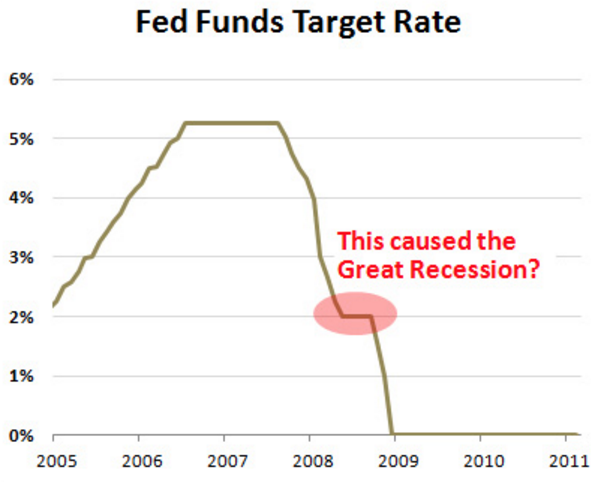
I think you can argue that the Fed should have responded sooner and more forcefully to the events of 2008, but the problem with Cruz’s theory is that it just doesn’t make sense. Take a look at the chart on the right, which shows the Fed Funds target rate during the period in question. In April 2008, the Fed lowered its target rate to 2 percent. Then it waited until October to lower it again.So the idea here is that if the Fed had acted, say, three months earlier, that would have saved the world. This ascribes super powers to Fed open market policy that I don’t think even Scott Sumner would buy. Monetary policy should certainly have been looser in 2008, but holding US rates steady for a few months too long just isn’t enough to turn an ordinary recession into the biggest global financial meltdown in nearly a century.Actually, according to New Keynesian (NK) economic theory (not my theory) it certainly could be enough. According to NK theory, when interest rates are positive the central bank controls the path of NGDP. Notice that interest rates were positive throughout 2008 (until mid-December.)
Also, according to NK theory, you can’t look at the path of the fed funds target to figure out the path of monetary policy. Ben Bernanke says you need to look at NGDP growth and inflation.
According to NK theory what really matters is the gap between the policy rate and the Wicksellian equilibrium rate. According to NK theory you’d expect the Wicksellian equilibrium rate to fall sharply in a housing crash/recession. And it did. According to NK theory that means Fed policy tightened sharply in 2008. According to Vasco Curdia (a distinguished NK economist who has published papers with Michael Woodford) the policy rate rose far above the Wicksellian equilibrium rate in 2008.
In other words, according to NK theory Kevin Drum is wrong; policy got a lot tighter. Now we can debate what the Fed might have accomplished with various counterfactual policies, but there is no doubt that the actual policy became extremely tight in the second half of 2008. Recall that in mid-year the Fed did not expect a severe recession, they thought the economy would grow between 2008 and 2009. So something unexpected went wrong in the second half of 2008, and we know from high frequency output data that the sharp deterioration of the crisis preceded the intensification of the financial crisis in October. Not for the first time, a crash in NGDP expectations led to a crash in asset prices, which led to the failure of highly leveraged banks.
Drum presents this graph:
and then wrongly assumes it tells us something useful, that it helps us to understand how policy played out in 2008. It does not. Yes, the rate cuts of April and October made policy less contractionary on those days than if rates had not been cut, but it doesn’t tell us anything about the overall stance of policy, and how that stance evolved over the course of 2008. As Frederic Mishkin says in his best-selling money textbook (and Ted Cruz agrees) for that you need to look at a wide range of asset prices.
Both the NK and MM models tell us that money got much tighter in the second half of 2008. Ironically, Ted Cruz seems more aware that fact than many of his critics."
See also The Wicksellian Natural Rate of Interest by Scott Sumner. Excerpt:
"The natural rate of interest is one of the key concepts for understanding and interpreting macroeconomic relationships and the effects of monetary policy. Its modern usage dates back to the Swedish economist Knut Wicksell, who in 1898 defined it as the interest rate that is compatible with a stable price level. An increase in the interest rate above its natural rate contracts economic activity and leads to lower prices, while a decline relative to the natural rate has the opposite effect. In Wicksell's view, equality of a market interest rate with its natural counterpart therefore guarantees price and economic stability."
Monday, December 7, 2015
Climate aid is a poor response to global challenges
Money being earmarked for climate aid would improve the lives of more people if spent on health and education programs
By Bjorn Lomborg. Excerpts:
By Bjorn Lomborg. Excerpts:
"Prime Minister Malcolm Turnbull's diversion of $1 billion of development funds to climate aid might please climate activists at the Paris summit, but it's one of the least effective ways of helping the world's poor.
What would help is support for an end to the $680 billion wasted on annual fossil fuel subsidies that not only increase CO₂ but suck dry the public purse in many developing countries, keeping funds from areas that need it."
"Those opposed to the Copenhagen Consensus approach of comparing different uses of development money like to claim that it's a "false dichotomy" to contrast climate spending with other investments. But that's exactly what politicians are doing: taking money from child health, girls' education, infrastructure, or strengthening grassroots organisations, and spending it instead on so-called "climate aid". The OECD analysed about 70 per cent of global development aid and found that now about a quarter goes to climate-related aid.
Of course, some activists argue that all problems should be seen through the "prism" of climate change because it exacerbates other issues, such as malaria or educational attendance. There can be such a link, but this does not make climate change exceptional. The scourge of malaria, for example, directly reduces school attendance, depletes health systems, erodes economies, and makes the world's poorest more vulnerable to other problems.
Subscribe to:
Posts (Atom)