Showing posts with label Working Conditions. Show all posts

Sunday, March 23, 2025

Why Maids Keep Dying in Saudi Arabia

East African leaders and Saudi royals are among those profiting off a lucrative, deadly trade in domestic workers.

By Abdi Latif Dahir and Justin Scheck. From The New York Times. This article shows that exploitation of workers can result from the actions of government officials. Excerpts: 

"Lured by company recruiters and encouraged by Kenya’s government, the women have reason for optimism. Spend two years in Saudi Arabia as a housekeeper or nanny, the pitch goes, and you can earn enough to build a house, educate your children and save for the future."

"Hollow-cheeked women return, often ground down by unpaid wages, beatings, starvation and sexual assault. Some are broke. Others are in coffins.

At least 274 Kenyan workers, mostly women, have died in Saudi Arabia in the past five years — an extraordinary figure for a young work force doing jobs that, in most countries, are considered extremely safe. At least 55 Kenyan workers died last year, twice as many as the previous year."

"Autopsy reports are vague and contradictory. They describe women with evidence of trauma, including burns and electric shocks, all labeled natural deaths."

"One of them, Margaret Mutheu Mueni, said that her Saudi boss had seized her passport, declared that he had “bought” her and frequently withheld food. When she called the staffing agency for help, she said, a company representative told her, “You can swim across the Red Sea and get yourself back to Kenya.”"

"Members of the Saudi royal family are major investors in agencies that place domestic workers. Politicians and their relatives in Uganda and Kenya own staffing agencies, too."

"Mr. Muli’s labor committee (Fabian Kyule Muli, vice chairman of the labor committee in Kenya’s National Assembly), for example, has become a prominent voice encouraging workers to go overseas."

"Even after other countries negotiated deals with Saudi Arabia that guaranteed worker protections, East African countries missed opportunities to do the same"

"worker-protection efforts had been hindered by “interference by politicians who use proxies to operate the agencies.”"

"A director of a Saudi government human rights board serves as vice chairman of a major staffing agency. So does a former interior minister, an Investment Ministry official and several government advisers."

"these agencies paint a rosy picture of work in Saudi Arabia. But when things go wrong, families say, the workers are often left to fend for themselves."

"Using employment contracts, medical files and autopsies, reporters linked deaths and injuries to staffing agencies and the people who run them. What became clear was that powerful people profit off the system as it exists."

"African governments stood to benefit from remittances. Mr. Muli’s committee called on Kenya in 2019 to “embark on a rigorous campaign to market Saudi Arabia as an important destination country for foreign employment.”

“The current notion that foreign workers in Saudi Arabia go through suffering” needed “to be corrected,” the committee added."

"“Under no circumstances does a worker bear any financial responsibility for repatriation,” wrote Mr. Goldstein, the Saudi ministry spokesman.

But workers and worker-rights advocates say that laborers are often forced to pay. Those without money can be detained."

Saturday, October 19, 2019

The Myth That People Work Harder Under Capitalism

Capitalism has been the great engine of unimagined prosperity and unimagined improvements in worker conditions

By Barry Brownstein. Heis professor emeritus of economics at the University of Baltimore.
"In the not so distant past, people didn't work hard, but not for the reasons the ahistorical or socialists think. There were no happy peasants laboring a few hours in the fields and spending the rest of the day in leisure. They were starving and had no energy to work hard. Far from an idyllic life, watching one’s children suffer from malnutrition and being too weak to help must have been a hellish experience.
In his book The Great Escape, Nobel laureate in economics Angus Deaton explains the “nutritional trap” Britain’s population once experienced:
The population of Britain in the eighteenth and early nineteenth centuries consumed fewer calories than they needed for children to grow to their full potential, and for adults to maintain healthy bodily functioning and to do productive and remunerative manual labor. People were very skinny and very short, perhaps as short as at any previous (or subsequent) time.
Deaton explains how the lack of nutrition affected the body. Workers centuries ago were not strapping; a stunted body offered the best hope for survival:
Throughout history, people adapted to a lack of calories by not growing too big or too tall. Not only is stunting a consequence of not having enough to eat, especially in childhood, but smaller bodies require fewer calories for basic maintenance, and they make it possible to work with less food than would be needed by a bigger person. A six-foot-tall worker weighing 200 pounds would have survived about as well in the eighteenth century as a man on the moon without a spacesuit; on average there simply was not enough food to support a population of people of today’s physical dimensions.
The average 18th-century Englishman got fewer calories than the average individual living today in sub-Saharan Africa. Because they couldn’t eat, these poor Englishmen worked little. Deaton writes:
The small workers of the eighteenth century were effectively locked into a nutritional trap; they could not earn much because they were so physically weak, and they could not eat because, without work, they did not have the money to buy food.
Johan Norberg in his book Progress reports the research findings of economic historian and Nobel laureate Robert Fogel:
Two-hundred years ago some twenty percent of the inhabitants of England and France could not work at all. At most they had enough energy for a few hours of slow walking per day, which condemned most of them to a life of begging.
And then, everything began to change. Deaton explains:
With the beginnings of the agricultural revolution, the trap began to fall apart. Per capita incomes began to grow and, perhaps for the first time in history, there was the possibility of steadily improving nutrition. Better nutrition enabled people to grow bigger and stronger, which further enabled productivity to increase, setting up a positive synergy between improvements in incomes and improvements in health, each feeding off the other.
By the end of my teaching career, ahistorical undergraduate students were becoming disturbingly common. They did not know the hellish poverty the vast majority of humanity had endured for millennia. They didn’t believe the past could have been as brutal as writers such as Matt Ridley described in his book The Rational Optimist. Even worse, exposed to hard evidence, some students refuse to question their positions.

Camille Paglia explains that because “Everything is so easy now, [undergrads] have a sense that this is the way life has always been.” Paglia continues, “Because they've never been exposed to history, they have no idea that these are recent attainments that come from a very specific economic system."
Capitalism, she continues, has "produced this cornucopia around us. But the young seem to believe in having the government run everything.”

Individuals, ignorant of economics and history, believe today’s cornucopia always has been. It is understandable why they might be enamored with their favorite democratic socialist. Believing they will get to keep their cornucopia, they dream of obtaining even more as a socialist government passes seized wealth on to them. Perhaps also they dream of the world, promised by socialists, where they work less.
The democratic socialist Jacobin magazine argues we work too many hours and blames capitalism for this “problem.” They wonder, “how would we organize time differently if we were free from the demands of capitalism?” Writing in the Jacobin, Matt Bruening calls for forced reductions in the hours Americans work:
There is a good case for redistributing the work in the US a bit more broadly. The best way to do that would be to decrease the amount of hours people currently employed have to work by providing more holidays, vacation, paid leave, and sick leave, and then increasing the ability of others to work by providing social care for children, the elderly, and the disabled and by implementing active labor market policies.
Ann Jones, writing in Salon, claims “American capitalism has failed us,” in part because we are “overworked.” Jones was a correspondent in Afghanistan. Returning to America, she imagined she saw similarities between Afghanistan and America: “It felt quite a lot like stepping back into that other violent, impoverished world, where anxiety runs high and people are quarrelsome.”

Jones longs for what she sees as a Scandinavian utopia, where they work “at producing things for the use of everyone—not the profit of a few.” What Jones refuses to understand is that Scandinavians say theirs is a capitalist economy.
Contrary to mythology, 19th-century factory jobs were great jobs; today’s jobs are even better. Writing in Reason, Arthur M. Diamond Jr. shares the testimony of an eight-year-old English girl who worked 14 hours a day on a farm: "It was like heaven to me when I was taken to the town of Leeds and put to work in a cotton factory."

The move from the farm to a better life in the factory was true in America, too. In my FEE essay “Stephen Hawking's Final Warning: Why His Worries Were Unwarranted,” I tell the story of Lucy Larcom, a 19th-century American poet who, at age 11, out of economic necessity, worked in the textile mills of Lowell, Massachusetts:
In Lucy’s book, A New England Girlhood, she writes of her experience at the mill. In the mill, she encountered other poets, singers, and writers who, like her, were hungry for education and eagerly attended the Lyceum lectures of the day.
She couldn’t have imagined today’s America—a much higher standard of living with fewer mill workers and more people pursuing their dreams. Yet, she was keenly aware that her world was already changing. “Things that looked miraculous” to her parents were commonplace to her.
“Our attitude—the attitude of the time,” wrote Larcom, “was that of children climbing their dooryard fence, to watch an approaching show, and to conjecture what more remarkable spectacle could be following behind.”
“All was expectancy.” Larcom added, “Changes were coming. Things were going to happen, nobody could guess what.”
If you believe such testimony is merely anecdotal, Diamond relates that
Charles Dickens, famous for defending the poor in his bestselling novels of the mid-1800s, praised the clean, comfortable working conditions of former farm girls in a Boston textile factory.
Farm work was more exhausting and more dangerous. Those, like Lucy Larcom, seized the opportunity of a better life.

Diamond observes that entrepreneurial capitalism “has a long history of creating new, better jobs and also of nudging old jobs toward the challenging, meaningful peak of [Maslow’s] hierarchy of needs.” Diamond gives an excellent 19th-century example:
An early specific example of innovative dynamism improving jobs happened when kerosene replaced whale sperm oil for high-quality lighting. Collection of sperm oil required the collectors to spend days scraping spermaceti from the brain cavity of the decomposing carcass of a huge whale. Work in oil fields was far from perfect, but it was better than work in decomposing brain cavities.
Similarly, building and repairing refrigerators is better and higher-paying work than was the dangerous work of harvesting ice in brutal temperatures.

If progress continues, those living in the future, using the yardstick of their own time, might write of today’s “deplorable” working conditions and working hours. Such is progress. Capitalism has been the great engine of unimagined prosperity and unimagined improvements in worker conditions."

Monday, September 17, 2018

How the Market Helped to Make Workplaces Safer

It is in the interest of the employers not to expose their workers to unnecessary risks.

By Marian L. Tupy.
"The free market, some people allege, is incompatible with workplace safety. Competition drives down profits, the German philosopher Karl Marx asserted, which forces business owners to cut corners and expose their workers to growing risks. Yet, by historical standards, work-related fatalities are at an all-time low. Labor activism and government regulations deserve part of the credit for that happy state of affairs. But, a general improvement in living standards and, consequently, higher expectations on the part of the laborers, also played a part in improving workplace safety. Plainly put, a safer workforce is a more contented workforce. As so often, Marx had it backwards. It is in the interest of the employers not to expose their workers to unnecessary risks.

All economic activity involves some degree of physical risk. That has always been the case. Our hunter-gatherer ancestors had to contend with wild animals, poisonous snakes and other vagaries of nature that surely make the modern workplace a much safer alternative. Credible data on work injuries and fatalities during the agrarian era is difficult to come by, because most farm laborers were self-employed. Simply put, no entity, official or otherwise, had an incentive to collect occupational safety statistics. Yet agricultural work must have been quite unappealing, considering that most people preferred factory work over life on the farm.

Even today, notes the U.S. Department of Labor, agriculture “ranks among the most dangerous industries.” In 2011, the “fatality rate for agricultural workers was 7 times higher than the fatality rate for all workers in private industry; agricultural workers had a fatality rate of 24.9 deaths per 100,000, while the fatality rate for all workers was 3.5.” Likewise, the Workplace Safety and Health (WSH) Institute in Singapore found that global fatality rates per 100,000 employees in agriculture ranged from 7.8 deaths in high-income countries to 27.5 deaths in South-East Asia and Western Pacific regions in 2014. Manufacturing deaths ranged from 3.8 in high-income countries to 21.1 in Africa.

Collection of statistics came about as a result of industrialization and the birth of modern labor relations in the 19th century. Labor unions started to collect workplace safety statistics in order to achieve more advantageous working conditions for their members, while employers kept work safety data, because they were legally liable for injuries in the workplace. By modern standards, it is clear that working conditions in mines and factories during the first 100 years of the Industrial Revolution were appalling. As the then-U.S. President Benjamin Harrison put it in 1892, “American workmen are subjected to peril of life and limb as great as a soldier in time of war.”

In the United States, estimates Harvard University psychologist Steven Pinker in his 2018 book Enlightenment Now: The Case for Reason, Science, Humanism, and Progress, 61 workers per 100,000 employees died in work-related accidents as late as 1913. That number fell to 3.2 in 2015. That’s a 95 percent reduction in work fatalities over a little more than 100 years. A similarly encouraging trend can be observed globally. According to the WSH Institute estimates, 16.4 workers per 100,000 employees died worldwide in 1998. By 2014 that number fell to 11.3. That’s a 31 percent reduction over a remarkably short period of 16 years. Considered in a slightly different way, workplace fatalities around the world seem to be falling by almost 2 percentage points each year.

What accounts for those improvements? Labor union activism, including strikes and protests, has been traditionally credited with making the workplace safer. But, improving working conditions cannot be divorced from the overall improvement in the standard of living. The massive economic expansion in the second half of the 19th century, in particular, tightened the labor market and workers started to gravitate toward more generous employers. It was only after a certain critical mass of workers achieved more tolerable working conditions that more general workplace regulations became imaginable and, more importantly, affordable. 

Thus, at least in the American context, the reduction in workplace fatalities preceded the Wagner Act of 1935, which enabled private sector employees to organize into trade unions, engage in collective bargaining and take collective action. By the time that the U.S. Occupational Safety and Health Administration was created in 1971, worker fatalities were roughly two-thirds lower than what they have been prior to World War I. Thus, as with working hours, government regulations tend to affirm that which is already happening in the labor market place anyway."

Sunday, March 11, 2018

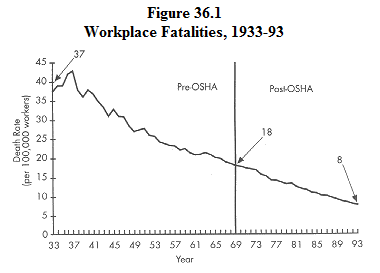
Did OSHA save lives?

From Scott Sumner.

"Matt Yglesias recently had this to say about the decline in workplace injuries since  OSHA:
All-in-all, though, it looks like an impressive achievement to me and one the hard-working folks at the National Institute for Occupational Safety and Health deserve some credit for, along with overall economic progress and structural shifts into safer occupational categories.
Update 3/20/11:  Matt pointed out in the comments that I didn’t read his post very carefully:
The agency I actually mentioned in my post is the National Institutes of Occupational Safety and Health (part of the CDC) not OSHA.
NIOSH is an agency dedicated to collecting and disseminating information about workplace industries. They do statistics, they do some of the “information brochures being distributed to workers” stuff you recommend, and they do some kind of training.
[So whatever value the rest of my post might or might not have, it shouldn’t be viewed as a comment on Yglesias.]

This reminded me of a graph I saw years ago in a paper by John Leeth and Tom Kniesner:

They look at a wide variety of evidence (much of which is in other papers, not this one) and conclude that OSHA should be cut back, or perhaps abolished.  Just so you don’t think they are mindless anti-government libertarians, they also argue that workplace compensation insurance is somewhat effective in reducing injuries.  They argue that compensating wage differentials (a market force) is the single most effective deterrent to injuries:
Alternatives to OSHA
In light of its ineffectiveness, giving OSHA more money, personnel, and power is not the way to cost-effective workplace safety. Most protection on the job comes from state workers’ compensation insurance programs and market-determined compensating wage differentials.
State-run workers’ compensation insurance programs are currently the most influential public attempt to promote workplace safety. Insurance premiums that take account of workplace safety encourage firms to establish safe and healthy work environments. As the frequency of claims rises, the price of workers’ compensation insurance increases, thereby penalizing firms for poor safety records. Michael Moore of Duke University and W. Kip Viscusi of Harvard University estimate that, without workers’ compensation insurance, the number of fatal accidents and diseases would be 48 percent higher in the United States.
BTW, there is no obvious “market failure” that would call for regulation.  (And please don’t drag out the tired old argument that companies know the risks, but workers don’t.  That’s not true, and if it were it would call for government information brochures being distributed to workers, not OSHA.)  I find a lot of safety regs to be very annoying.  When I was young I often worked up on ladders.  The newer Skilsaws required two hands to operate, presumably so you wouldn’t cut off some fingers.  That necessitated gripping the ladder with one’s knees.  Power mowers can no longer be operated without holding the handle–forcing contorted body positions when trying to clear debris in the mower’s path.

Matt Yglesias also has a very interesting post on the similarities between some “big government” models (such as the Nordic states) and some “small government” models, such as Singapore, Hong Kong and Chile.  He points out that Singapore’s mandatory savings plan, which has a 35.5% rate, is something like a tax, and the money is deposited in a government run investment fund. I don’t entirely agree with his post (he underestimates the difference between taxes and forced saving), but it’s hard to disagree with the general thrust of his argument .  There isn’t all that much difference between the Nordic economies and the economy cited by the Heritage Foundation as the second most economically free country in the world (and number one if one recalls that HK isn’t really a “country.”)  My initial reaction is to despair that the US is simply too big to adopt either model.  But maybe that’s giving up too easily.

Update:  Commenter Joe pointed to a Bryan Caplan post that cited a David Henderson encyclopedia entry that discussed some Kip Viscusi research on OSHA (did I miss anyone?)
Fun facts from Kip Viscusi‘s article on “Job Safety” in David Henderson’s encyclopedia:
Annual OSHA penalties for safety violations (2002): $149,000,000
Annual Workers Compensation Premiums (2001): $26,000,000,000
Estimated Annual Wage Premiums for Risky Activities (2004 dollars): $245,000,000,000
Bryan suggests that OSHA probably has little effect on injuries."

Tuesday, February 2, 2016

The new airborne silicaregs are going to save several times more lives than are actually lost

See Proposed Stricter OSHA Regulations on Airborne Silica Exposure Seem Needless by Paul C. "Chip" Knappenberger of Cato.
"The U.S. Department of Labor’s Occupational Safety and Health Administration (OSHA) is soon set to release new exposure limits to air-borne silica dust. The rulemaking has been in the works for about three years with a final rule scheduled to be announced this year. The silica industry is not enthused. 
Silica dust is known to cause respiratory illnesses (e.g., silicosis, lung cancer, other airways diseases) that may contribute to or lead directly to death when it is breathed in high enough concentrations over long enough time periods.

OSHA explains that exposure to respirable silica “occurs in operations involving cutting, sawing, drilling and crushing of concrete, brick, block and other stone products and in operations using sand products, such as in glass manufacturing, foundries and sand blasting.”

OSHA’s proposal, generally, is to lower the existing permissible exposure limits (adopted in 1971) by about 50%, dropping them from around 0.1mg/m3  to 0.05mg/m3 (specific details here). OSHA explains:
The agency currently enforces 40-year-old permissible exposure limits (PELs) for crystalline silica in general industry, construction and shipyards that are outdated, inconsistent between industries and do not adequately protect worker health. The proposed rule brings protections into the 21st century.
And, as the government likes to claim with all of its regulations, the added restrictions will save lots of lives, and in doing so, will save lots of money:
OSHA estimates that the proposed rule will save nearly 700 lives and prevent 1,600 new cases of silicosis per year once the full effects of the rule are realized.
The proposed rule is estimated to provide average net benefits of about $2.8 to $4.7 billion annually over the next 60 years.
Interestingly, a visit to the Centers for Disease Control in search of deaths from silica inhalation produces this chart graphing silicosis mortality over time. The numbers have dropped considerably over the past 40+ years, and by 2010 had fallen to about 100 or so deaths per year (U.S. residents over the age of 15) attributed to silicosis as either the underlying or contributing cause.

Figure 1. Silicosis: Number of deaths, crude and age-adjusted death rates, U.S. residents age 15 and over, 1968–2010 (Source: CDC).

Figure 1. Silicosis: Number of deaths, crude and age-adjusted death rates, U.S. residents age 15 and over, 1968–2010 (Source: CDC).

The CDC data shows that silicosis deaths have been declining and although the decline has slowed, it continues to drop while under the current OSHA guidelines. And further, the 100 or so deaths that are occurring annually are several times less than the annual number of deaths that OSHA predicts will be saved by the new regulations. That’s a pretty neat trick—the new regs are going to save several times more lives than are actually lost!

This means not only that the OSHA mortality benefits from the new regulations are questionable, but so too must be the economic benefits (as they are tied directly to the mortality savings).

The silica industry isn’t taking this lightly.

They contend that the OSHA mortality projections are based on dose-response relationships that are not truly indicative of what is really going on, for several reasons, primarily that they are based upon poor and inadequate data and analyses.

Dose-response curves used by the federal government are notorious for producing forecasts of a much greater health benefit than actually occurs. For one reason, often, the federal dose-response curves aren’t actually curves at all, but are rather straight lines. Which means that the response is the same for all dosage increments. This allows government regulatory agencies to claim the continually cranking down the exposure limits will continually produce positive health outcomes.

But, more and more research is proving that this is not the case. As the dose gets lower, the response often flattens out (i.e. there is a threshold) or may in fact become positive (low dosages are actually good for you). While this sounds like common sense to most of us (consider sunshine or alcohol), it is a ground-breaking notion in the field. And much of the research on this groundbreaking theory is being done by Dr. Edward Calabrese at University of Massachusetts, also an adjunct scholar to Cato’s Center for the Study of Science.

A leading industry group (the National Industrial Sand Association, NISA) makes a strong case that the existing OSHA standards are quite effective at greatly reducing, or even eliminating, occurrence of silicosis. So really, all OSHA needs to do is unify the existing regulations and better insure that they are enforced.

NISA has commissioned a scientific study of the dose-response behavior that is wider in scope and includes a greater and more detailed amount of epidemiological data than the existing studies relied upon by OSHA. From a NISA report:
While the association between silicosis and exposure to respirable crystalline silica is indisputable, there is still considerable uncertainty regarding the dose/response relationship of this association, particularly in the case of chronic simple silicosis, which is the most common form of silicosis.  It is unclear, for example, whether there is an effect threshold, or whether instead the dose/response curve is linear at even the lowest doses.  The slope of that curve is also uncertain.  As a result, there is uncertainty regarding the degree of risk remaining at various 8 hour time-weighted average exposures, including, most importantly, the current PEL of [0.10 mg/m3].
In NISA’s view, this degree of uncertainty is unacceptable for a rulemaking of this magnitude.
The industry is being up-front about their commission (involving scientists at major universities involved in silica research) and has taken steps to be open and transparent about their involvement—or rather lack of involvement—in the study’s outcome.

But, the results of the new study, instigated several years ago, are still forthcoming and consequently the industry has asked OSHA to wait until they are available (expected later this year) before issuing its final rule.

It’ll be interesting to see how this plays out, but preliminarily, this looks like another case of the government solving a problem that doesn’t really exist, in that existing regulations are sufficient to address the health concerns if they were better applied and enforced, and further, the promise of the new regulations is being greatly overplayed, saving many times more lives than our CDC says silicosis takes away.

But that’s the government at work—if some regulations are good, more must be better. Sadly, for the taxpayers and the regulated industries, it doesn’t always work out that way."

Wednesday, August 5, 2015

Does the Market Underprovide Safety for Workers Who Are Poor?

Not necessarily, says David Henderson.
"In a comment on a recent post of mine on worker safety, in which I highlighted the "Job Safety" entry by W. Kip Viscusi in The Concise Encyclopedia of Economics, MikeDC wrote:
If you've got an impoverished and hungry subsistence or near subsistence level population, you don't have much have to worry about their safety. You just replace them if they get hurt or die.
So I take that as a fairly legitimate moral limitation. Maybe one of the few where a free market doesnt push in the right direction.
I had promised to respond with a further post saying why the market would provide the optimal level of safety even to poor people. This is that post. 
 Throughout the analysis, I assume that workers have good knowledge of risks and I assume that employers want to maximize profits.

I recommend, if you have trouble following the reasoning below, that you go back to the "Job Safety" article."

Start with the employer providing less than the optimal amount of safety to low-income workers. What does it mean to say that the safety is less than optimal? It means that they would value an increment in safety more than it costs to provide. A profit-maximizing employer would see that he can provide that increment and increase his profits. The reason is that he can cut the employees' pay by more than the cost of providing the safety. That's what it means to say that the workers value the increment in safety more than the cost of provision.

So the employer provides that increment in safety. He is better off and the workers are the same off. Now let's say safety is still suboptimal. Then the employer can provide another increment of safety and pay less for it than the amount by which he can reduce workers' wages. This continues until the employer hits the optimal amount of safety.

I should point out that I'm also assuming no income or payroll taxes. If there are income or payroll taxes, which, in the United States, of course, there are, then the amount of safety for all workers will be more than optimal. Why? Because income is taxed and safety is not."

Saturday, May 9, 2015

What The New York Times Gets Wrong About Cheap Nail Salons

By Elizabeth Nolan Brown of Reason.
Even if Asian nail salons are as exploitative and toxic as the Times says, the answer isn't more government oversight.

"In the 1970s, American actress Tippi Hedren was visiting a Vietnamese refugee camp in California when women there began admiring her nails. Hedren brought in her manicurist to train refugees on giving manicures. "We were trying to find vocations for them," Hedren told the BBC recently. "I brought in seamstresses and typists—any way for them to learn something." Apocryphal or not, Hedren is now credited as the reason "why so many nail technicians are Vietnamese."

"Forty years after the fall of Saigon, 51% of nail technicians in the United States—and approximately 80% in California—are of Vietnamese descent," the BBC reports. Tam Nguyen, president of Advance Beauty College in Laguna Hills, California, said nearly every Vietnamese-American nail technician he knows still sends some money home to support relatives.

These stories present one view of the nail-salon industry in the America: an avenue of opportunity for immigrant workers with low skills and little English. As Asian nail salons have proliferated—often offering manicures, pedicures, and acrylics at a fraction of the cost of high-end salons—immigrant women have trained and employed one another, providing new arrivals with a means of making a living, a way help out families back home, and a community. They have also helped drastically grow the manicure market, making what used to be only a luxury for the rich an affordable and accessible habit for middle-income Americans.

"In the story of nail salon competition, we can see [how] ... immigrants expand markets, rather than just taking existing jobs," wrote Virginia Postrel in Reason in 1997.
Twenty years ago, manicurists mostly worked in obscure corners of hair salons or catered to the wealthy. Cher got her nails done; the rest of us did not. Today, free-standing nail salons dot the commercial blocks and strip malls of cities from Southern California to South Carolina.
[...] That's the industry hidden in plain sight. There's also the business you don't see as you walk down the street: the manufacturers and distributors that supply the salons. Nailpro, another trade magazine, lists nearly 400 manufacturers in its 1997 Gold Book directory. These companies make everything from polishes, nippers, and acrylic nail-sculpting compounds to manicure tables, polish racks, and toeless pedicure socks.
But The New York Times this week presents a very different narrative of the nail industry. In a multi-part series by reporter Sarah Maslin Nir, the Times suggests that the real "price of nice nails" is an underclass of immigrant women subject to high rates of exploitation, abuse, fertility issues, and other health problems. New York City manicurists work "10- to 12-hour shifts, hunched over fingers and toes," writes Nir in part one.
Asian-language newspapers are rife with classified ads listing manicurist jobs paying so little the daily wage can at first glance appear to be a typo. Ads in Chinese in both Sing Tao Daily and World Journal for NYC Nail Spa, a second-story salon on the Upper West Side of Manhattan, advertised a starting wage of $10 a day. The rate was confirmed by several workers.
In part two, Nir explores the health problems that seem to plague nail-salon employees: asthma, skin rashes, persistent coughs, a history of failed pregnancies. "Chemicals that make nail and beauty products useful—the ingredients that make them chip-resistant and pliable, quick to dry and brightly colored, for example," are the culprits, Nir notes. Of course, research on these chemicals and any potential hazards is scarce, and the FDA has deemed several of them safe. But Nir seems certain that a lack of FDA oversight combined with indifferent manufacturers are to blame.

"Many owners said they were helping new immigrants by giving them jobs," but Nir is skeptical of this claim based on their low wages. In the mutual-aid services and shared living spaces that spring up around the communities of immigrant salon workers, Nir sees only the tragic consequences of poverty, not the resourcefulness, resiliency, and capability of those forced by U.S. immigration policy into an underground economy.

In the apprenticeship system for that's sprung up in nail salons, she sees only exploitation—the women pay $100 to $200 in training fees and then work for tips for a probationary period before getting a regular wage. But in the formal economy, cosmetologists of all sorts must pay to attend schools and certification programs, pay the government for a licence, and take internships or training programs before salons let them do hair/nails/makeup on their own. Is the apprenticeship system really so different? At least salon workers can still make tips while they train.

In fact—though Nir doesn't mention this until at least half-way through the first article—nail salon workers are, like waiters, considered "tipped workers" under New York State and federal law, which means they're permitted to be paid less than the state's $8.75 hourly minimum. Of course, tipped workers often take home much more than the minimum wage (and often do so off the books in cash heavy businesses), which is why all kinds people continue to seek tipped jobs. In some instances, when the tip-only system has effectively amounted to no wages, salon workers have filed class action lawsuits against salon owners and won. One of the major impediments to doing so, however—or to seeking employment outside these salons—is workers' immigration status. They have trouble participating in the formal economy or legal system because they are in America illegally.

Nir fails to indict U.S. immigration policies for their poor conditions. Instead, she would actually see more government agents visiting the nail salons. "Only a small number of the workers interviewed by The Times said they had ever seen an investigator, from any government agency, at their salon," the article notes with dismay.

Getting more government involved when it's not at the behest of these workers, however, is only going to lead to more hardship for those most marginalized. When state investigators find a bunch of undocumented immigrants working as unlicensed manicurists—yes, being a manicurist in New York technically requires a state permission slip—for under the minimum wage, do you think they're going to stop with forcing employers to institute a pay hike? Do you think salon owners under more investigative scrutiny from government agents are going to be more attune to requests from their underground employees?

I don't want to diminish the concerns of workers in these communities. But this top-down, outsider, progressive, law-and-order view concerns me. Would workers be better off with no jobs or means to support themselves? Living back in their home countries? Maybe in some cases, yes, but we don't know because we are not them. And I tend to believe that immigrant salon workers, being as intelligent and rational as the rest of us, are capable of weighing their own interests and situations and acting accordingly.

Of course, rationality only goes so far as the realities you're aware of. Part two of the Times series focuses on the "poison" nail salon workers are unwittingly exposed to regularly. A woman may consent to long hours but not to constant exposure to chemicals that will cause birth defects, one might say.

Yet for all of Nir's hand-wringing about how the FDA only has the power to ban harmful chemicals (not approve all chemicals going into all products before they go on the market), she fails to make much of a case for how increased FDA oversight would help here. Two of the three nail-polish chemicals health advocates suspect of being most harmful to salon workers have already been declared non-toxic by the FDA. Either they really are non-toxic, or we need outside research, not more of the same. And the nail-salon ingredients that may cause harm to developing fetuses aren't a concern for non-pregnant workers, meaning the issue isn't ousting them entirely but keeping pregnant women away.

Increased FDA oversight can't educate nail workers about the importance of leaving the job when they're pregnant, or help make doing so financially feasible; it can't instill simple best practices, like wearing gloves, that could mitigate skin problems; it can't encourage salon owners to install work on better ventilation systems. These sorts of education and outreach efforts are best undertaken by public health nonprofits and people in these communities. And they would have a much more immediate effect than the years or decades it could take to get accomplish similar feats via federal regulation.

The market can also play a part. We don't know for sure that many nail salon ingredients pose health risks, but if consumers are concerned, they can vote with their dollars. And if consumers aren't concerned enough, it's up to advocates to make the case for why they should be.

As a way to raise consumer awareness, I think Nir's piece works well. But she makes the all-to-common and immediate leap to calling for stricter governmental scrutiny. It's a solution as seemingly simple as it is lazy: just send the government in to help! But when we're talking about communities of people whose very existence here has been deemed illegal, the government doesn't help, it fines and arrests and deports. The best way to actually help people in these communities is to help them help themselves."


Tuesday, February 15, 2011

Apparel Exports and Education: How Developing nations Encourage Women’s Schooling

This was by William C. Gruben and Darryl McLeod. From Economic Letter (Dallas Fed). Vol. 1 No. 3, March 2006.

“We find that clothing and shoe production requires more education than the average woman has attained in many developing nations (3).”

“In Bangladesh and other major apparel-exporting nations, to qualify for these jobs, more women stay longer in school (3).”

“Female workers’ commitment to seek more education delays child-bearing and lowers the incidence of child labor (3).”

“In short, the maligned suppliers of Nike, Gap and Wal-mart encourage governments to educate women, give women a reason to stay in school and pay them well by local standards (3).”

“For the average country, a doubling of exports as a share of GDP raises female secondary-school attendance by 20 to 25 percent (5).”

“If you make Nikes, you earn more. The shoe company’s Indonesian shop-floor workers on average earn more than four-fifths the working population. In Bangladesh, garment export firms generally pay more than firms not oriented to selling outside the country (7).”