"The Great Depression led to dramatic increases in bank regulation.
One study looks at an instance of bank deregulation during this period: state-level sanctioning of
bank branching, which allowed banks to operate multiple offices within a state. … [S]tates with extensive branching in 1940 … experienced long-run gains in manufacturing productivity.
The study also
assessed the role of capital reallocation using bank and branch-level balance sheet data from 1937. … Branch offices located in capital-constrained counties … were twice as likely to receive funding on net from other banks and branches than comparable stand-alone banks in the same areas.
In addition, the new
branch networks improved capital allocation by directing funds to where they were most scarce, a function that stand-alone banks could not perform.
All in all, these
findings provide evidence that the institutional structure of branching—rather than simply expanded banking access—improved capital allocation and integrated financial markets to fuel manufacturing productivity growth, especially in underserved areas."
Thursday, May 14, 2026
Can De-Regulation of Branch Banking Improve Capital Allocation?
Monday, December 22, 2025
We Haven’t Stopped Paying for the New Deal
‘Far from ‘right-sizing’ the government, FDR expanded it into areas it was never supposed to tread,’ writes Robert E. Wright.
"Younger generations have learned—despite what their history textbooks have repeated ad nauseam—that government policies caused and exacerbated the Great Depression. The New Deal wasn’t only unnecessary to achieve what David M. Kennedy calls “the conditions of modern society” (Letters, Dec. 10). It hurt many Americans then and continues to do so today.
Far from “right-sizing” the government, FDR expanded it into areas it was never supposed to tread, including retirement annuities, healthcare and higher education, all of which unsurprisingly constitute the most dysfunctional parts of the modern economy. In the process, he also weakened the Bill of Rights, impoverished blacks and stymied women’s return to the workplace.
Devaluation of the dollar alone induced the economy to rebound strongly off the March 1933 bottom. All the rest, including the National Recovery Administration, gold confiscation, the Tennessee Valley Authority and endless other top-down tinkerings slowed or reversed the initially robust expansion.
Many other New Deal programs stymied subsequent market development. Most tragically, perhaps, rural electrification held back green-energy technologies, including windmills and batteries, for decades. In many areas, like southern Alabama, the program subsidized the electrification of the summer homes of the wealthy more than it aided farmers. I could go on.
Robert E. Wright
Mount Pleasant, Mich.
Mr. Wright is author, most recently, of “FDR’s Long New Deal.”"
Saturday, December 13, 2025
Scott Sumner on The Great Depression.
See The Great Depression: Elevator pitch. Excerpts:
"Between 1929 and early 1933, NGDP in the US fell by roughly 50%. So why didn’t all wages and prices also fall by 50%, leaving output and employment unchanged?"
"The answer is “sticky wages and prices”, which is the key assumption in business cycle theory."
"when smaller and more unpredictable changes in the purchasing power of money occur, wages and prices are slow to reflect this reality. The economy moves into “disequilibrium”, with either labor shortages (as in 2022), or huge labor surpluses (as in 1933.) A surplus of labor is called unemployment. When NGDP fell in half during the early 1930s, wages and prices did move somewhat lower, but the adjustment was far too small to prevent a major fall in output and employment."
"You can say that the Great Depression was “caused” by sticky wages and prices, but to me that’s like saying an airplane crash was caused by gravity. Sticky wages and prices are a given, what we need is a monetary policy that stabilizes total nominal spending and income, i.e., a stable path of NGDP. We didn’t have that policy in the early 1930s, and this policy failure resulted in the Great Depression."
"In the early 1930s, there were two media of account, US currency notes and gold. There was a fixed exchange rate between them at $1 = 1/20.67 ounces of gold (which is smaller than a dime)."
In 1929, changes in US nominal variables could be modeled in one of two ways, changes in the value of US currency or changes in the value of gold. I found the gold modeling approach to be more useful, as it was a global gold standard and a global depression, so the best explanation needs to look beyond what was happening in the US. For example, the Canadian currency stock fell sharply during the early 1930s. But it’s not useful to think in terms of Canadian monetary policy causing the Canadian Great Depression. Their dollar was also tied to gold, and Canada was an innocent bystander, dragged into depression by monetary disturbances in bigger countries like the US and France, which boosted the global purchasing power of gold.
The US price level fell by roughly 25% during the early 1930s (depending how you measure it.) That means the two media of account (currency and gold) gained much more purchasing power. One ounce of gold could buy a lot more stuff in 1933 than in 1929, as the purchasing power of money is inversely proportional to the price of goods and services. But wages and prices did not fall anywhere near as much as the 50% decline in NGDP and as a result, real output and employment also fell sharply.
In a sense, the economic slump of 1929-33 was caused by a nominal shock—a sharp increase in the value of currency and gold, which depressed spending and output. To explain what “caused” the Great Depression, therefore, we need to explain what caused this nominal shock. Why did the purchasing power of gold rise so sharply during the early 1930s?
Supply and demand is our workhorse model for explaining changes in the value of any good, service, or asset, and gold is no different. Each year, the global supply of gold (the total stock of existing gold) gets a little bit bigger due to the output from gold mines, combined with the fact that very little gold is lost. Gold supply was not the problem.
If there was no decline in the total stock of gold, then any big increase in its value had to be due to an increase in gold demand. (The same is true of Bitcoin.) I argued that the Great Depression was caused by a big increase in gold demand between 1929 and 1933. But it doesn’t take 500 pages to make that simple point. Therefore, I also analyzed the various factors that led to increased gold demand.
During the early 1930s, major central banks held huge reserves of gold, indeed they held most of the gold that had been mined since the beginning of human history. This gold was held as “reserves”, backing up paper money. People could take a $20 bill to the US government and redeem it for roughly an ounce of gold. A typical government might hold a 40% gold reserve ratio—$4 million worth of gold backing up each $10 million in currency. But the gold reserve ratio was not constant. So why did global gold demand rise so sharply during the early 1930s? Three reasons:
Individuals and banks were hoarding currency due to fear of bank failures, and more gold was needed in reserve to back up this extra currency demand.
Central banks also hoarded gold, by increasing their gold reserve ratios. They became “cautious”, which individually might make sense but at the global level was counterproductive.
Individuals hoarded gold in fear of currency devaluation, especially after countries such as Britain and German left the gold standard in 1931.
The decision of people, banks, and governments to hoard gold was often prudent at an individual level, but socially destructive. The first year of the Depression is the easiest to explain, as it was almost entirely caused by central bank gold hoarding—a higher gold reserve ratio—especially in the US, France and the UK. In each case the motivation for hoarding was complex and it differed from one country to another. After late 1930, bank failures increased and people began hoarding more currency. After mid-1931, private gold hoarding began increasing due to devaluation fears.
In the early 1930s, there was an almost perfect storm of bad luck and bad decision-making, which is why “Great Depressions” are so rare. When you look at other theories of the Great Depression, they generally imply that huge depressions should happen quite often, but they don’t. Thus the 1987 stock market crash was almost identical in size to the late 1929 stock crash but had no measurable impact on the broader economy. The stock crash didn’t cause the depression.
In late 1937, there was a smaller (but still sizable) secondary depression, partly caused by a renewed bout of gold hoarding. You can think of 1929-33 and 1937-38 as the two parts of the Depression that were caused by adverse nominal shocks. Gold hoarding increased for a variety of complex reasons, and this led to lower NGDP and a lower price level. Because nominal wages are slow to adjust, falling NGDP generally leads to much higher unemployment and lower real output, at least in the short run.
Part 3: Counterproductive wage policies
Both President Hoover and President Roosevelt misdiagnosed the Depression. But Roosevelt’s policies were more successful. That’s because while both had counterproductive labor market policies, Roosevelt had an expansionary monetary (gold) policy.
Although wages were “sticky” (slow to adjust) during pre-WWII depressions, workers eventually would accept wage cuts. After 1929, however, Hoover pressured large corporations to refrain from their usual nominal wage cuts, and thus wages were even stickier than during the previous depression of 1920-21. Hoover probably thought that stable wages would help to maintain aggregate demand (NGDP), but in fact the policy reduced aggregate supply, as companies laid off workers when prices fell below the cost of production.
After taking office in March 1933, Roosevelt gradually devalued the dollar, from 1/20.67 ounces of gold to 1/35 ounces in early 1934. To use the analogy at the beginning of this post, this is like making the measuring stick smaller, in order to make all objects you measure appear larger. Normally, that would be pointless, as nothing changes in real terms. But when wages and prices are sticky, a less valuable dollar leads to more output and employment.
By March 1933, industrial production had fallen to roughly one half of its pre-depression level. Just 4 months later, industrial production had risen by 57%, regaining over half of the ground lost during the previous 4 years. That brief boomlet was mostly due to dollar depreciation. If that had been Roosevelt’s only policy, the Depression likely would have ended within a couple more years. Instead, Roosevelt took other (counterproductive) actions, and the Depression dragged on until 1941.
Like Hoover, Roosevelt believed that higher wages would boost aggregate demand. He was confusing cause and effect. Yes, wages often decline somewhat in a deep slump. But that’s an effect of the depression, not the cause. Rich people often have Rolls Royces. But buying a Rolls Royce makes you poorer.
In mid-July 1933, Roosevelt issued a proclamation that essentially forced employers to raise nominal wages by 20% almost overnight. The explosive economic recovery immediately ground to a halt, and by the time the Supreme Court declared this policy unconstitutional in May 1935, industrial production was actually lower than in July 1933. But the Supreme Court was doing Roosevelt a favor, as industrial production immediately began rising rapidly after the Orwellian named National Industrial Recovery Act was rejected by the Court. (Will our Supreme Court do Trump a similar favor on tariffs?)
In my book, I discussed no less than five different wage shocks imposed by the Roosevelt administration, each of which led to a pause in the recovery."
"What are the policy lessons?
"During and after the Depression, the gold standard was gradually weakened, before being phased out entirely in March 1968. Today, we no longer need to worry about gold hoarding causing a depression. When there is currency hoarding, the central bank can now meet the extra demand by supplying additional fiat currency. And US government no longer uses wage policies in the aggressive fashion employed by Hoover and Roosevelt. Yes, we technically have a $7.25 federal minimum wage, but it’s largely meaningless. In many states, wages are now set by the market.
Monetary policy continues to be more erratic than I would like. It was much too contractionary in 2008-09 and much too expansionary in 2021-22. Even so, it has become more stable than earlier in US history. That’s why we haven’t seen a repeat of the Great Depression."
Here is what Timothy Cogley said in 1999 when he was at the Federal Reserve Bank of San Francisco (1999). He is now at New York University:
"First, stock prices were not obviously overvalued at the end of 1927. Second, starting in 1928 the Fed shifted toward increasingly tight monetary policy, motivated in large part by a concern about speculation in the stock market. Third, tight monetary policy probably did contribute to a fall in share prices in 1929. And fourth, the depth of the contraction in economic activity probably had less to do with the magnitude of the crash and more to do with the fact that the Fed continued a tight money policy after the crash. Hence, rather than illustrating the dangers of standing on the sidelines, the events of 1928-1930 actually provide a case study of the risks associated with a deliberate attempt to puncture a speculative bubble."
See Monetary Policy and the Great Crash of 1929: A Bursting Bubble or Collapsing Fundamentals?
Friday, December 5, 2025
False Dawn by Cato’s George Selgin Ranked Among “10 Best Books of 2025” by The Wall Street Journal
"False Dawn: The New Deal and the Promise of Recovery, 1933–1947, by former Cato Senior Fellow George Selgin, was ranked among the “10 Best Books of 2025” by The Wall Street Journal this week. Selgin, also the director emeritus of the Center for Monetary and Financial Alternatives at the Cato Institute and professor emeritus of economics at the University of Georgia, retired this year.
The ten best books of fiction and nonfiction from 2025 were selected by the Journal’s book editors. For False Dawn, the Journal wrote,
“The New Deal, George Selgin suggests, did not work the way most historians claim. This economist’s eye-opening analysis shows that the increased government centralization of the 1930s rarely resulted in on-the-ground stimulus or sustained growth. The war effort did eventually put the economy back on its feet, but equally important was President Roosevelt’s choice, in a time of crisis, to finally work with, rather than vilify, America’s businesses.”
In a June 15 review of the book, Judge Glock wrote in the Journal, “In dispassionate, careful, and finally devastating detail, False Dawn shows that, with a few exceptions, FDR’s experiments did not work…. Using decades of economic research, False Dawn should long remain the definitive word on the New Deal’s effectiveness.”
The University of Chicago Press, which published the book, notes that Selgin “draws on both contemporary sources and numerous studies by economic historians to show that” FDR’s actions raised hopes of a quick recovery from the Great Depression, but “subsequent New Deal policies proved so counterproductive that over seventeen percent of American workers—more than the peak unemployment rate during the COVID-19 crisis—were still either unemployed or on work relief six years later.”
Should America experience another severe downturn, like the Great Depression, policymakers and experts will “cast about for ways out,” says Selgin, and no doubt look to some of FDR’s policies. They would be wise, however, “to treat most of the New Deal episode as a warning about steps best avoided and to look elsewhere for better ones,” says the author.
Read an excerpt of False Dawn here.
Buy First Dawn here.
“Selgin mines a mountain of scholarship to prove this: New Deal measures failed to achieve, and often impeded, recovery from the Depression.” ― The Washington Post
“Norman Thomas, six-time presidential candidate of the American Socialist Party and for decades the second most popular speaker in America behind whoever was president, used to complain that the Democrats and FDR had stolen the Socialist Party Platform of 1928. Thomas was right. Read Selgin’s new book and learn why that was a false dawn for the US economy.” — Vernon Smith, Chapman University, winner of the Nobel Prize for Economics
“False Dawn is an extraordinary achievement. Economists, historians, and others have been researching the New Deal’s recovery programs and policies since the 1930s, but no one has ever done so as comprehensively and astutely as Selgin. False Dawn will be required reading for all who seek to understand how the New Deal affected the course of the Great Depression.” — Robert Higgs | author of Depression, War, and Cold War"
Sunday, July 6, 2025
‘False Dawn’ Review: The Mirage of Recovery
America’s leaders in the 1930s subjected the country to a series of bizarre economic experiments. Most of them backfired.
By Judge Glock. He reviewed the book False Dawn: The New Deal and the Promise of Recovery, 1933–1947 by George Selgin. Excerpts:
"Franklin Delano Roosevelt . . . and his advisers had no clear explanation for the collapse and his subsequent New Deal would amount to a series of experiments."
"with a few exceptions, FDR’s experiments did not work."
"by 1939 the unemployment rate was still 17%."
"the Roosevelt administration mistakenly worried that there was too much money in the economy."
"In the early part of the New Deal the amount of money the Fed pumped into the economy shrank."
"deficits as a percent of the economy were hardly different during Roosevelt’s time in office than they had been at the end of Herbert Hoover’s. While the New Deal spent more, it also imposed new taxes on food and payrolls. The result was a bigger federal government, but not one that relied on deficits as stimulus."
"The earliest solution they hit on . . . was to restrict production and thus raise prices. The National Industrial Recovery Act that passed in mid-1933 turned much of the American economy over to giant cartels. Industries colluded to raise prices and unions colluded to raise wages. The result was fewer goods on the market and an immediate economic collapse that would still be remembered today if it hadn’t been surrounded by so many others."
"It paid some farmers to plow their cotton back underground and others to kill their breeding sows before they could produce too much pork. Later economic studies confirm what common sense would suggest: Destroying crops and livestock isn’t an ideal route to prosperity."
"he administration’s tight-money preoccupation led the Treasury Department in 1936 to start buying up the incoming gold just to bury in its vaults. That, together with a series of union strikes inspired by New Deal labor policies, produced the “Roosevelt Recession,” which reversed most of the modest gains the nation had made since FDR assumed office."
"John Maynard Keynes noted in 1934 that the administration’s wild swings in policy kept investors on edge. “The important but intangible state of mind, which we call business confidence,” Keynes wrote, “is signally lacking.”"
Sunday, June 22, 2025
‘The Triumph of Economic Freedom’ Review: A Few Lessons From History
Economic nationalists insist that tariffs were central to the economy’s takeoff in the late 19th century. The evidence suggests otherwise.
By Samuel Gregg. He is the president of the American Institute for Economic Research. He reviewed the book The Triumph of Economic Freedom: Debunking the Seven Great Myths of American Capitalism by Phil Gramm and Donald J. Boudreaux. Excerpts:
"When making their case for protectionism, for example, today’s economic nationalists insist that tariffs were central to the U.S. economy’s takeoff in the late 19th century. Critics of that position (Douglas A. Irwin of Dartmouth, among others) contend, with better evidence, that America’s explosive growth in those decades had little to do with tariffs. If anything, tariffs retarded growth in the sectors in which they were highest."
"The writing of American economic history, they argue, has long been dominated by skeptics of capitalism peddling myths that nonetheless retain potency and, predictably, populate high school and college textbooks."
"Far from being the laissez-faire dogmatist portrayed by historians such as Arthur Schlesinger Jr. and economists such as John Kenneth Galbraith and Paul Samuelson, President Herbert Hoover was, the authors contend, effectively a proto-New Dealer who tried to beat the Depression with the heavy hand of government. Hoover’s attempts to keep prices and wages from falling, and his willingness to sign the Smoot-Hawley Tariff Act in 1930—which taxed some 20,000 imported goods—did nothing to promote growth and much to impede it."
"The 1933 National Industrial Recovery Act . . . allowed the federal government effectively to cartelize American industry with, Messrs. Gramm and Boudreaux state, “the objective of preventing prices and wages from falling.” Combined with Roosevelt’s empowerment of unions and his demonization of business, the U.S. government compromised the economy’s capacity to adjust and recover. Contrary to popular wisdom—and what our children read in U.S. history classes—aggressive interventions turned what would have been a recession into a decadelong economic cataclysm."
Thursday, March 13, 2025
What is causing the stock market slump? Trump's policies or the globalists?
See Two Excuses by Scott Sumner.
"During the mid-1930s, FDR pursued an aggressive set of policies including various actions intended to raise wages, as well as an undistributed profits tax. These actions were widely seen as anti-business, a view reinforced by FDR’s frequent attacks on the “economic royalists”.
In the second half of 1937, the US economy fell into a deep secondary depression, despite the fact that it had not yet recovered from the severe 1929-33 slump. The Roosevelt administration blamed the downturn on a lack of investment in the business sector, asserting that there was a “capital strike” motivated by hatred of New Deal policies. In fact, the slump was mostly caused by various New Deal policies, which pushed up wages at a time when monetary policy was reducing prices.
I was reminded of this event when I saw the following story:
After signing an executive order granting Canada and the US another temporary tariff reprieve, the US president blamed “globalist” nations and corporations for market-wide declines and shrugged off spooked markets.
The Treasury secretary also chimed in:
“There’s going to be a natural adjustment as we move away from public spending to private spending,” Bessent said Friday on CNBC. “The market and the economy have just become hooked and we’ve become addicted to this government spending, and there’s going to be a detox period.”
It is possible that this sort of lagged effect might be true for the overall economy, but it is certainly not true for the financial markets, which are forward looking. Policy initiatives that produce short-term pain and an even greater long-term benefit should be a positive for the stock market.
That’s not to say that markets won’t bounce back—as stock prices are almost impossible to predict. Think of a scenario where a policy initiative was put forward that other things equal might be expected to reduce stock prices by 10%. Also assume that the market thought there was a 50% chance that the initiative would be quickly reversed, with no damage done. In that case, you might expect stock prices to fall by roughly 5%. But that would merely represent the initial reaction, as more information came in stocks would either fall further, or (if the initiative was reversed) would regain lost ground.
On a related note, the Atlanta Fed has been forecasting a drop in real GDP during Q1. The media suggests that this forecast is based on a recent surge in imports, particularly gold imports. That may be true, but if so it is quite odd. A $20 billion surge in gold imports to beat expected tariff increases would not be expected to have any effect on actual GDP. The import category would move $20 billion in a negative direction while gold inventories would move $20 billion in a positive direction. If the media reports are correct (and I have no reason to doubt them), this suggests the government does not know how to measure GDP. It suggests that they are treating imports as a negative, but not applying an equal positive to investment (or consumption.) Why would they do this?"
Friday, November 24, 2023
Things that didn't cause the Great Depression
"The following tweet caught my eye:
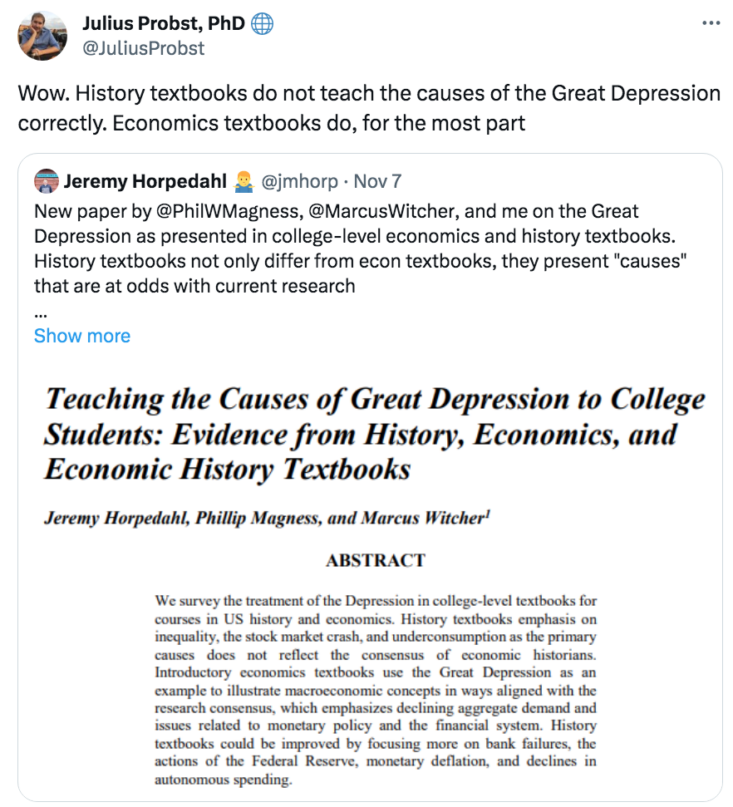
I once wrote an entire book on the causes of the Great Depression, focusing on the role of the interwar gold standard and FDR’s labor market policies. In doing this research, I discovered that the question of causation is quite tricky. One can look for proximate causes, such as bad macroeconomic policy, or deeper causes, such as institutional failures. (In theory, a depression might also be caused by a natural phenomenon such as a plague or drought, but that was not the case with the Great Depression. It was clearly a human created problem.) Although we do not precisely know all of the factors that caused the Great Depression, we have a pretty good idea as to which hypotheses are not helpful.Many people associated the stock market crash with the Depression due to the fact that it occurred at about the time it became apparent we were sliding into a deep slump. Note that I said “became apparent”; the Depression actually began a few months before the crash. In October 1987, we had a nice test of the theory that the stock crash was a causal element in the Depression. A crash of almost equal size occurred at almost exactly the same time of year, after a long economic expansion. Many pundits expected a depression, or at least a recession. Instead, the 1987 stock market crash was followed by a booming economy in 1988 and 1989.
Of course it’s possible to explain some difference in outcome to other factors at play, but when the difference is this dramatic (booming economy vs. the greatest depression in modern history), one has to wonder whether the hypothesis is of any value at all.
The same is true of the inequality/underconsumption hypothesis. Over the last 45 years, we’ve seen an interesting test of this theory. China has experienced a huge increase in economic inequality. More importantly, it has seen some of the lowest levels of consumption (as a share of GDP) ever observed. Even lower than other fast growing East Asian economies such as South Korea. Pundits have claimed that China’s consumption levels are too low, and that too many resources are being devoted to investment in areas of dubious merit.
That may all be true. Perhaps China should invest less and consume more. But it’s also clear that low levels of consumption in China have not caused a Great Depression. Indeed China’s had one of the fastest growing economies in the world since 1978.
Again, what impresses me about these two counterexamples (the US in 1987-89 and China since 1978) is not that things didn’t play out exactly as the historians might have expected based on their theory of the Great Depression. Rather what impresses me is that the results were almost 180 degrees removed from what might have been expected. That tells me that theories that stock market crashes and underconsumption cause depressions are essentially useless. They are ad hoc explanations with no real supporting economic theory and no predictive power. Why should a stock market crash cause 25% of workers to stop working? What is the mechanism? Why should high levels of investment cause real GDP to decline by 30% over 4 years? What is the mechanism? If they have no theoretical support and no predictive power, then why should we care what historians believe?
If you get creative enough you could find a causal mechanism running through aggregate demand. But then why not argue that a decline in aggregate demand caused the Great Depression? After all, that’s what actually did happen.
You might say that it’s important to know the cause of the Great Depression. But why? If the theories offered by historians provide no help in understanding the modern world, then how are they of any use?
More broadly, I distrust all theories of economic causation developed by non-economists (not just historians). These theories tend to rely on “common sense”. Thus many average people think that countries are rich because they are big, or because they have lots of natural resources. (Perhaps because that theory sort of fits the US.) But looking more broadly, rich countries don’t tend to be places with large populations or high levels of natural resources. They tend to be smaller countries in East Asia and Western Europe. The actual (institutional) factors that explain the varying wealth of nations are much harder to see, and hence tend to be ignored by non-economists."
Related post:
Monetary Policy and the Great Crash of 1929: A Bursting Bubble or Collapsing Fundamentals?
Conclusion
In retrospect, it seems that the lesson of the Great Crash is more
about the difficulty of identifying speculative bubbles and the risks
associated with aggressive actions conditioned on noisy observations. In
the critical years 1928 to 1930, the Fed did not stand on the sidelines
and allow asset prices to soar unabated. On the contrary, its policy
represented a striking example of The Economist’s
recommendation: a deliberate, preemptive strike against an (apparent)
bubble. The Fed succeeded in putting a halt to the rapid increase in
share prices, but in doing so it may have contributed one of the main
impulses for the Great Depression."
Sunday, August 6, 2023
FDR Made the Depression Great Again
How the blue eagle, symbol of a 1933 law, had its wings clipped
By Jason Taylor. He is an economics professor at Central Michigan University and author of “Deconstructing the Monolith: The Microeconomics of the National Industrial Recovery Act.” Excerpts:
"The tragedy is that during Roosevelt’s first months in office the U.S. economy made tremendous strides. Between March and July 1933, employment, production and spending all increased sharply. The nation seemed to be on a highway to recovery, largely thanks to Roosevelt’s policies.
But what good policy giveth, bad policy taketh away. In June 1933 Roosevelt signed the National Industrial Recovery Act (NIRA), which required firms to meet with competitors and construct a “code of fair competition.” Over two years, 557 codes were implemented in industries ranging from steel to fishing tackle.
These codes permitted collusive actions that would otherwise violate antitrust law. Businesses that were found violating the codes—say, charging a price below the code-specified one—could face hefty fines and imprisonment. For their membership in government-enforced cartels, firms were forced to raise hourly wages."
"Companies that violated the act’s labor or cartel rules were barred from publicly displaying the Blue Eagle. FDR urged Americans to boycott them."
"Companies responded to forced wage increases by scaling back employment. And colluding firms did what cartels generally do—they restricted output and raised prices."
"While manufacturing output rose an unprecedented 78% between March and July 1933, it fell sharply after the Blue Eagle’s arrival. By November two-thirds of the recovery gains were lost. Output didn’t pick up until a year later, when business owners, irritated by the Blue Eagle, quit “doing their part” and openly violated the codes, overwhelming the enforcement offices.
By the time the Supreme Court ruled the NIRA unconstitutional in May 1935, even Roosevelt had acknowledged privately that this “whole thing is a mess.” After the Blue Eagle’s demise, the nation’s recovery resumed and manufacturing output rose 50% over the next 18 months."
Thursday, March 9, 2023
Proponents Of Fiscal Stimulus Need To Stop Using World War II As An Example – OpEd
"Each time a recession nears, some call for governments to step in to “stimulate” the economy. Not through monetary means (printing money), but through fiscal ones. If the government initiates more projects, places more orders, and hires more workers, the reasoning goes, it stimulates consumption and thus facilitates the recovery.
The imagery that is frequently used to make that case is that of the wartime spending in the United States during World War II. When it entered the war in 1941, the American government spent large sums to equip soldiers to fight overseas. According to this political imagery, this meant that factories were running full time. That farmers had a strong and steady demand for foodstuffs. That there was no unemployment. Saved from the physical destruction observed in European countries like France, Germany, Poland and Britain, the American economy was stimulated out of the shadow of the Great Depression.
Essentially, the war was a boon to the economy in the United States.
This imagery, however, is incorrect. Those who use it are being fooled by the data’s flaws and limitations. In no way can wartime spending be used to justify fiscal stimulus.
We know this thanks to the work of economic historians Alexander Field, Richard Vedder, Lowell Gallaway, and Robert Higgs, who picked apart this narrative by pointing out three facts.
The first is that the price indices needed to adjust income for inflation were plagued by the problems that wartime price controls created. Once adjusted price deflators were used, more than two thirds of the wartime gains commonly reported in the data were eliminated.
The second is that many assumptions needed to estimate economic output in the form of Gross Domestic Product (GDP) vanish or are weakened in wartime. One must account for, for example, the depreciation of capital goods, which means selecting a depreciation rate. Qualitative and quantitative evidence at the firm level suggest that businesses used capital more intensively during the war, and thus that capital depreciated faster — something that is not taken into account. Corrections for the rising depreciation rate during the war only lower the estimated growth rates.
The third is the most important. In wartime, the government’s mandates drafts, seizures, taxes) make the prices used to weigh the quantities produced somewhat meaningless. They do not reflect prices that clear markets for consumers and producers, they reflect prices that bureaucrats and some producers agree to. As a result, these economic historians suggest removing government spending on the military from GDP in order to better estimate the wellbeing of American consumers and workers. Once this is done and added to the previous improvements, there was no wartime boon.
In fact, if these adjustments are extended to 1949 (after the war’s end), one finds that the recovery started once the war ended. In contrast, the unadjusted data suggest that the war’s end brought about a depression, something that is telling, as no economist today is willing to talk about the “Great Depression of 1946”.
One could reply that the American data are hopelessly flawed and that these rebuttals are in no way conclusive. Moreover, it could also be argued that it failed to account for the fact that the war started two years before the American government joined it. During that interceding period, foreign demand for military equipment could have stimulated the economy.
These rebuttals fall flat, as I argue in an article co-authored with Casey Pender that is forthcoming in Social Science Quarterly and which uses data from Canada instead of the United States. This confers two strong advantages. First, Canadian GDP numbers can be argued to be comparatively better than American data in large part due to the early census of manufacturing that was made in Canada, where population censuses asked questions about income far earlier than the United States census (and these questions can be used to assess the plausibility of GDP numbers). Second, Canada joined the war in 1939, rather than 1941. Its involvement was also far more intensive as a small, open economy that was strongly tied to Britain.
We made the same adjustments as Higgs, Vedder, Gallaway, and Field did to Canadian GDP numbers to see if the Canadian experience mirrors that of the United States starting two years earlier. We find that, yes, it did. Adjusting the GDP deflators and removing wartime expenditures suggest that the living standards of Canadians fell during the war. By 1943, Canadians were 10 percent poorer than at the start of the war. From 1945 to 1947, however, they saw their income per capita increase by 50 percent as the economy expanded rapidly.
Proponents of fiscal stimulus may think that large government outlays can pull an economy out of a recession. This is a debatable theoretical proposition. If they want to use wartime spending as an empirical illustration that makes their case, however, they need to be aware that doing so relies on a bad understanding of economic facts.
*About the author: Vincent Geloso, senior fellow at AIER, is an assistant professor of economics at George Mason University. He obtained a PhD in Economic History from the London School of Economics."
The myth of wartime prosperity: Evidence from the Canadian experience
By Vincent Geloso and Casey Pender.
"Abstract
This paper investigates therelationship between prosperity and national account data during wartime, focusing on Canada. In particular, we build off of existing literature arguing that military outlays must be excluded for real output measures to reasonably approximate economic prosperity. We analyse all non-war components of Canadian gross national product during both world wars and estimate a novel price deflator for World War II in order to take into account wartime price controls. This allows us to obtain a new estimate of real output in Canada excluding military outlays. We then compare the trends in our new real output series with domestic private investment and stock market trends, all three of which either fell or grew at an anemic pace in Canada during both world wars. Combined, we argue that this provides evidence against the idea of wartime prosperity and more specifically, against the notion of World War II ending the Great Depression in Canada."
Wednesday, November 2, 2022
The U.S. Postal Savings System and the Collapse of B&Ls During the Great Depression
By Sebastián Fleitas, Matthew S. Jaremski & Steven Sprick Schuster.
"Building and Loan Associations (B&Ls) financed over half of new houses constructed in the U.S. during the 1920s but they lost their predominance within the following decades as they were pushed to convert into Savings and Loans (S&Ls). This study examines whether the U.S. government-insured Postal Savings System attracted funds away from B&Ls precisely when they needed them the most in the Great Depression. Annual town- and county-level data from 1920 through 1935 for 3 states show that the sudden rise in local postal savings was associated with local downturns in B&Ls. Using a panel vector autoregression, we find that postal savings significantly reduced the amount of money in B&Ls, yet B&Ls had no significant effect on postal savings banks. Alternatively, postal savings had no significant effect on commercial banks. The results suggest that this competitive dynamic prevented B&Ls from rebounding in the mid-1930s and helped contribute to Great Depression’s local real estate lending decline."
Friday, April 22, 2022
How the National Industrial Recovery Act made the Great Depression worse
"In July 1933, FDR implemented the National Industrial Recovery Act by ordering firms to cut weekly hours from 48 to 40, while keeping nominal wages unchanged. This effectively boosted nominal hourly wages by roughly 20%, almost overnight. The stock market crashed on the announcement.
Between March and July of 1933, industrial production had soared by 57% under the influence of FDR’s dollar devaluation program. After July 1933, industrial production started declining due to the high wage costs imposed by the NIRA. When the program was repealed in May 1935, industrial production was actually lower than in July 1933. Immediately after the NIRA was repealed, industrial production began rising extremely rapidly. You don’t get more clearcut policy experiments.
But many California legislators seem unaware of the NIRA’s history. Alex Tabarrok directed me to this WSJ article:
A bill moving through the Legislature would shorten California’s normal workweek to 32 hours from 40 for companies with more than 500 employees. Workers who put in more than 32 hours in a week would have to be paid time-and-a-half. And get this: Employers would be prohibited from reducing workers’ current pay rate, so they would be paid the same for working 20% less.
That’s very similar to the failed NIRA policy of 1933."
Wednesday, April 6, 2022
The Depression You've Never Heard Of: 1920-1921
The 1920-1921 depression was a textbook example of how to handle an economic downturn
"When it comes to diagnosing the causes of the Great Depression and prescribing cures for our present recession, the pundits and economists from the biggest schools typically argue about two different types of intervention. Big-government Keynesians, such as Paul Krugman, argue for massive fiscal stimulus—that is, huge budget deficits—to fill the gap in aggregate demand. On the other hand, small-government monetarists, who follow in the laissez-faire tradition of Milton Friedman, believe that the Federal Reserve needs to pump in more money to prevent the economy from falling into deep depression. Yet both sides of the debate agree that it would be utter disaster for the government and Fed to stand back and allow market forces to run their natural course after a major stock market or housing crash.
In contrast, many Austrian economists reject both forms of intervention. They argue that the free market would respond in the most efficient manner possible after a major disruption (such as the 1929 stock market crash or the housing bubble in our own times). As we shall see, the U.S. experience during the 1920–1921 depression—one that the reader has probably never heard of—is almost a laboratory experiment showcasing the flaws of both the Keynesian and monetarist prescriptions.
The 1929–1933 Great Contraction
Despite what many readers undoubtedly “learned” in their history classes as children, Herbert Hoover behaved like a textbook Keynesian following the 1929 stock market crash. In conjunction with Treasury Secretary Andrew Mellon, Hoover achieved an across-the-board one percentage point reduction in income tax rates applicable to the 1929 tax year.
Hoover didn’t stop with tax cuts to bolster “aggregate demand”—though analysts at that time would not have used the term. He also signed into law massive increases in the federal budget, with fiscal year (FY) 1932 spending rising 42 percent above 1930 levels. Hoover ran unprecedented peacetime deficits, which stood in sharp contrast to his predecessor Calvin Coolidge, who had run a budget surplus every year of his presidency. In fact, in the 1932 election, FDR campaigned on a balanced budget and excoriated the reckless spending record of the Republican incumbent.
It wasn’t merely that Hoover spent a bunch of money. He spent it on just the types of things that we associate today with Roosevelt’s New Deal. For example, he signed off on numerous public-works projects, including the Hoover Dam. Of particular relevance today is the Reconstruction Finance Corporation (RFC) established under Hoover, which quickly injected more than $1 billion to prop up troubled banks that had made bad loans during the boom years of the late 1920s—and this was when $1 billion really meant something.
It is true that Hoover eventually blinked and raised taxes in 1932, in an effort to reduce the federal budget deficit. Today’s Keynesians point to this move as proof that reducing deficits is a bad idea in the middle of a depression. Yet an equally valid interpretation is that it’s horrible to hike tax rates in the middle of an economic disaster. After the bold tax cuts pushed through by Andrew Mellon in the 1920s, the top marginal income-tax rate in 1932 stood at 25 percent. The next year, because of Hoover’s desire to close the budget hole, the top income tax rate was 63 percent. Given this extraordinary single-year rate hike, it is no wonder that 1933 was the single worst year in U.S. economic history. (For what it’s worth, the FY 1933 budget deficit was still huge, coming in at 4.5 percent of GDP. Despite the huge rate hikes, federal tax revenues only increased 3.8 percent from FY 1932 to FY 1933.)
So we see that the standard Keynesian story, which paints Herbert Hoover as a do-nothing liquidationist, is completely false. Yet Milton Friedman’s explanation for the Great Depression is almost as dubious. Following the stock market crash, the New York Federal Reserve Bank immediately slashed its discount rate—how much it charged on loans—in an attempt to provide relief to the beleaguered financial system. The New York Fed continued to slash its discount rate over the next two years, pushing it down to 1.5 percent by May 1931. At that time, this was the lowest discount rate the New York Fed had ever charged since the establishment of the Federal Reserve System in 1913.
It wasn’t merely that the Fed (along with other central banks around the world) was charging an unusually low rate on loans it advanced from its discount window. The entire mentality of central bankers was different during the early years of the Great Depression. Writing in 1934, Lionel Robbins first noted that during previous crises, the solution had been for central banks to charge a high discount rate to separate the wheat from the chaff. Those firms that were truly solvent but illiquid would be willing to pay the high interest rates on central-bank loans to get them through the storm. Firms that were simply insolvent, on the other hand, would know the jig was up because they couldn’t afford the high rates. Yet this tough love was not administered after the 1929 crash, as Robbins explained:
“In the present depression we have changed all that. We eschew the sharp purge. We prefer the lingering disease. Everywhere, in the money market, in the commodity markets and in the broad field of company finance and public indebtedness, the efforts of Central Banks and Governments have been directed to propping up bad business positions.”
We, therefore, see an eerie pattern. When it came to both fiscal and monetary policy during the early 1930s, the governments and central banks implemented the same strategies that the sophisticated experts recommend today for our present crisis. Of course, today’s Keynesians and monetarists have a ready retort: They will tell us that their prescribed medicines (deficits and monetary injections, respectively) were not administered in large enough doses. It was the timidity of Hoover’s deficits (for the Keynesians) or the Fed’s injections of liquidity (for the monetarists) that caused the Great Depression.
The 1920–1921 Depression
This context highlights the importance of the 1920–1921 depression. Here the government and Fed did the exact opposite of what the experts now recommend. We have just about the closest thing to a controlled experiment in macroeconomics that one could desire. To repeat, it’s not that the government boosted the budget at a slower rate, or that the Fed provided a tad less liquidity. On the contrary, the government slashed its budget tremendously, and the Fed hiked rates to record highs. We thus have a fairly clear-cut experiment to test the efficacy of the Keynesian and monetarist remedies.
At the conclusion of World War I, U.S. officials found themselves in a bleak position. The federal debt had exploded because of wartime expenditures, and annual consumer price inflation rates had jumped well above 20 percent by the end of the war.
To restore fiscal and price sanity, the authorities implemented what today strikes us as incredibly “merciless” policies. From FY 1919 to 1920, federal spending was slashed from $18.5 billion to $6.4 billion—a 65 percent reduction in one year. The budget was pushed down the next two years as well, to $3.3 billion in FY 1922.
On the monetary side, the New York Fed raised its discount rate to a record high 7 percent by June 1920. Now the reader might think that this nominal rate was actually “looser” than the 1.5 percent discount rate charged in 1931 because of the changes in inflation rates. But on the contrary, the price deflation of the 1920–1921 depression was more severe. From its peak in June 1920, the Consumer Price Index fell 15.8 percent over the next 12 months. In contrast, year-over-year price deflation never even reached 11 percent at any point during the Great Depression. Whether we look at nominal interest rates or “real” (inflation-adjusted) interest rates, the Fed was very “tight” during the 1920–1921 depression and very “loose” during the onset of the Great Depression.
Now some modern economists will point out that our story leaves out an important element. Even though the Fed slashed its discount rate to record lows during the onset of the Great Depression, the total stock of money held by the public collapsed by roughly a third from 1929 to 1933. This is why Milton Friedman blamed the Fed for not doing enough to avert the Great Depression. By flooding the banking system with newly created reserves (part of the “monetary base”), the Fed could have offset the massive cash withdrawals of the panicked public and kept the overall money stock constant.
But even this nuanced argument fails to demonstrate why the 1929–1933 downturn should have been more severe than the 1920–1921 depression. The collapse of the monetary base (directly controlled by the Fed) during 1920–1921 was the largest in U.S. history, and it dwarfed the fall during the early Hoover years. So we hit the same problem: The standard monetarist explanation for the Great Depression applies all the more so to the 1920–1921 depression.
The Results
If the Keynesians are right about the Great Depression, then the depression of 1920–1921 should have been far worse. The same holds for the monetarists; things should have been awful in the 1920s if their theory of the 1930s is correct.
To be sure, the 1920–1921 depression was painful. The unemployment rate peaked at 11.7 percent in 1921. But it had dropped to 6.7 percent by the following year and was down to 2.4 percent by 1923. After the depression, the United States proceeded to enjoy the “Roaring Twenties,” arguably the most prosperous decade in the country’s history. Some of this prosperity was illusory—itself the result of subsequent Fed inflation—but nonetheless the 1920–1921 depression “purged the rottenness out of the system” and provided a solid framework for sustainable growth.
As we know, things turned out decidedly different in the 1930s. Despite the easy fiscal and monetary policies of the Hoover administration and the Federal Reserve—which today’s experts say are necessary to avoid the “mistakes of the Great Depression”—the unemployment rate kept going higher and higher, averaging an astounding 25 percent in 1933. And of course, after the “great contraction” the U.S. proceeded to stagnate in the Great Depression of the 1930s, which was easily the least prosperous decade in the country’s history.
The conclusion seems obvious to anyone whose mind is not firmly locked into the Keynesian or monetarist framework: The free market works. Even in the face of massive shocks requiring large structural adjustments, the best thing the government can do is cut its own budget and return more resources to the private sector. For its part, the Federal Reserve doesn’t help matters by flooding the shell-shocked credit markets with green pieces of paper. Prices can adjust to clear labor and other markets soon enough, in light of the new fundamentals, if only the politicians and central bankers would get out of the way."
Friday, December 3, 2021
Scott Sumner argues that a tight money policy by the Fed in 2008-09 largely caused the Great Recession
See A boringly conventional contrarian by Scott Sumner.
"In my new book entitled The Money Illusion, I argue that a tight money policy by the Fed in 2008-09 largely caused the Great Recession. I’d guess that 99% of economists don’t agree with me on that point. That makes me a contrarian.
But if I am a contrarian, it’s of a type that is quite common throughout history. Consider:
1. In the 1930s and 1940s, almost all economists believed that the Great Depression was not caused by a tight money policy at the Fed. In the 1960s, Milton Friedman and Anna Schwartz convinced many economists that an excessively tight money policy was largely to blame for the Depression. By 2002, even Fed officials like Ben Bernanke acknowledged the Fed’s guilt:
Let me end my talk by abusing slightly my status as an official representative of the Federal Reserve. I would like to say to Milton and Anna: Regarding the Great Depression. You’re right, we did it. We’re very sorry. But thanks to you, we won’t do it again.
2. In the 1960s and 1970s, most economists did not blame the Fed for the Great Inflation. A few decades later, most economists thought the Fed was to blame. (Ben Bernanke among them.)
3. In the 2010s, most economists did not blame the Fed for the Great Recession. Market monetarists did.
What do the first two cases have in common? In both cases, an economist focusing on interest rates would be unlikely to blame the Fed. Rates were very low in the 1930s, and hence money did not look tight. Rates rose sharply in the 1970s, and hence monetary policy did not look expansionary.
So why did economists change their mind? In both cases, NGDP signaled a problem. NGDP fell roughly in half during the early 1930s, which sure looks like tight money. NGDP growth averaged 11% during 1971-81, which sure looks like easy money.
This is why my contrarianism is so boringly conventional. I’m merely trying to do for the Great Recession what other economists have already done for the Great Depression and the Great Inflation. I’m attempting to get people to see that a “Great” economic problem, which didn’t look monetary in real time, actually was monetary. I am trying to get people to believe that money was tight in 2008, even though it didn’t look tight. I hope to convince people that the huge drop in NGDP growth during 2008-09 is prima facia evidence of an excessively tight monetary policy. I am trying to get people to see the post-Lehman banking crisis as being caused by falling NGDP, just as the 1930s banking crises were caused by falling NGDP.
In fact, my contrarian take on the Great Recession is so similar to previous reappraisals of the Great Depression and the Great Inflation that I’m tempted to say that it is I that is actually the conventional economist and all those who have not come around to my view are the true contrarians.
It’s a longstanding tradition for economists to initially blame “Great” problems on non-monetary factors, and then later see them as monetary policy failures. Why stop now? Keep the tradition alive!"
Saturday, October 30, 2021
Heather Cox Richardson's False History (Hoover raised, not reduced taxes during the Depression)
"Historian Heather Cox Richardson, on her public Facebook page on October 28, 2021, wrote a long post about the Great Depression, Herbert Hoover, and FDR.
Her story about Hoover’s tax policy is false.
She writes:
President Hoover knew little about finances, let alone how to fix an economic crisis of global proportions. He tried to reverse the economic slide by cutting taxes and reassuring Americans that “the fundamental business of the country, that is, production and distribution of commodities, is on a sound and prosperous basis.” But taxes were already so low that most folks would see only a few extra dollars a year from the cuts, and the fundamental business of the country was not, in fact, sound. When suffering Americans begged for public works programs to provide jobs, Hoover insisted that such programs were a “soak the rich” program that would “enslave” taxpayers, and called instead for private charity.
What in fact did Hoover do? The opposite. Here are some excerpts from economist Steve Horwitz in “Hoover’s Economic Policies,” in David R. Henderson, ed. The Concise Encyclopedia of Economics.
First, on taxes on imports, aka, tariffs:
Even those with only a casual knowledge of the Great Depression will be familiar with one of Hoover’s major policy mistakes—his promotion and signing of the Smoot-Hawley tariff in 1930. This law increased tariffs significantly on a wide variety of imported goods, creating the highest tariff rates in U.S. history. While economist Douglas Irwin has found that Smoot-Hawley’s effects were not as large as often thought, they still helped cause a decline in international trade, a decline that contributed to the worsening worldwide depression.
Second, on his massive increase in income tax rates:
On top of these spending proposals, most of which were approved in one form or another, Hoover proposed, and Congress approved, the largest peacetime tax increase in U.S. history. The Revenue Act of 1932 increased personal income taxes dramatically, but also brought back a variety of excise taxes that had been used during World War I. The higher income taxes involved an increase of the standard rate from a range of 1.5 to 5% to a range of 4 to 8%. On top of that increase, the Act placed a large surtax on higher-income earners, leading to a total tax rate of anywhere from 25 to 63%. The Act also raised the corporate income tax along with several taxes on other forms of income and wealth.
If you want to know more about how income tax rates increased at each level of income, go here. Before the web existed, the go-to guy who documented income tax rates at each income level from the early 1900s to the late 1980s was the late Joe Pechman of the Brookings Institution. Fortunately, the Tax Foundation has made that so much easier."
Wednesday, August 28, 2019
How FDR’s New Deal Harmed Millions of Poor People
"Democratic presidential candidates as well as some conservative intellectuals, are suggesting that Franklin Delano Roosevelt’s New Deal is a good model for government policy today.
Mounting evidence, however, makes clear that poor people were principal victims of the New Deal. The evidence has been developed by dozens of economists — including two Nobel Prize winners — at Brown, Columbia, Princeton, Johns Hopkins, the University of California (Berkeley) and University of Chicago, among other universities.
New Deal programs were financed by tripling federal taxes from $1.6 billion in 1933 to $5.3 billion in 1940. Excise taxes, personal income taxes, inheritance taxes, corporate income taxes, holding company taxes and so-called “excess profits” taxes all went up.
The most important source of New Deal revenue were excise taxes levied on alcoholic beverages, cigarettes, matches, candy, chewing gum, margarine, fruit juice, soft drinks, cars, tires (including tires on wheelchairs), telephone calls, movie tickets, playing cards, electricity, radios — these and many other everyday things were subject to New Deal excise taxes, which meant that the New Deal was substantially financed by the middle class and poor people. Yes, to hear FDR’s “Fireside Chats,” one had to pay FDR excise taxes for a radio and electricity! A Treasury Department report acknowledged that excise taxes “often fell disproportionately on the less affluent.”
Until 1937, New Deal revenue from excise taxes exceeded the combined revenue from both personal income taxes and corporate income taxes. It wasn’t until 1942, in the midst of World War II, that income taxes exceeded excise taxes for the first time under FDR. Consumers had less money to spend, and employers had less money for growth and jobs.
New Deal taxes were major job destroyers during the 1930s, prolonging unemployment that averaged 17%. Higher business taxes meant that employers had less money for growth and jobs. Social Security excise taxes on payrolls made it more expensive for employers to hire people, which discouraged hiring.
Other New Deal programs destroyed jobs, too. For example, the National Industrial Recovery Act (1933) cut back production and forced wages above market levels, making it more expensive for employers to hire people - blacks alone were estimated to have lost some 500,000 jobs because of the National Industrial Recovery Act. The Agricultural Adjustment Act (1933) cut back farm production and devastated black tenant farmers who needed work. The National Labor Relations Act (1935) gave unions monopoly bargaining power in workplaces and led to violent strikes and compulsory unionization of mass production industries. Unions secured above-market wages, triggering big layoffs and helping to usher in the depression of 1938.
What about the good supposedly done by New Deal spending programs? These didn’t increase the number of jobs in the economy, because the money spent on New Deal projects came from taxpayers who consequently had less money to spend on food, coats, cars, books and other things that would have stimulated the economy. This is a classic case of the seen versus the unseen — we can see the jobs created by New Deal spending, but we cannot see jobs destroyed by New Deal taxing.
For defenders of the New Deal, perhaps the most embarrassing revelation about New Deal spending programs is they channeled money AWAY from the South, the poorest region in the United States. The largest share of New Deal spending and loan programs went to political “swing” states in the West and East - where incomes were at least 60% higher than in the South. As an incumbent, FDR didn’t see any point giving much money to the South where voters were already overwhelmingly on his side.
Americans needed bargains, but FDR hammered consumers — and millions had little money. His National Industrial Recovery Act forced consumers to pay above-market prices for goods and services, and the Agricultural Adjustment Act forced Americans to pay more for food. Moreover, FDR banned discounting by signing the Anti-Chain Store Act (1936) and the Retail Price Maintenance Act (1937).
Poor people suffered from other high-minded New Deal policies like the Tennessee Valley Authority monopoly. Its dams flooded an estimated 750,000 acres, an area about the size of Rhode Island, and TVA agents dispossessed thousands of people. Poor black sharecroppers, who didn’t own property, got no compensation.
FDR might not have intended to harm millions of poor people, but that’s what happened. We should evaluate government policies according to their actual consequences, not their good intentions."
Tuesday, January 8, 2019
Hoover did far more than any previous president to alleviate economic suffering during a depression
"In fact, Hoover did far more than any previous president to alleviate economic suffering during a depression. As early as the spring of 1930, long before the Great Depression had begun to really bite, he proposed increasing federal construction spending by a whopping $140 million (more than 4% of the total federal budget) while urging state governments to increase their own construction spending. In 1931, he proposed a moratorium on both Germany’s payment of war reparations to the Allies and on loan repayments by the Allies to the United States. It was a politically brave thing to do, for while it was the right thing to do—easing budgetary pressures on hard-pressed European countries—it would inevitably be seen domestically as a move that would force America to bear more of the costs of World War I. In the event, Congress never acted on Hoover’s proposal, but the payments stopped of their own accord and never resumed.
Hoover also pushed for the Home Loan Bank Act, finally passed in the summer of 1932, which allowed banks to greatly increase their liquidity by using their mortgage portfolios as collateral. His Reconstruction Finance Corp. was empowered to make emergency loans to banks, farm mortgage associations, railroads and insurance companies to prevent their collapse. Fiorello La Guardia, then a New York congressman, called the Reconstruction Finance Corp. a dole for millionaires, but it would do much to prevent still greater economic collapse. Mr. Rauchway barely mentions the RFC, which in many ways was a precursor of several New Deal programs, and doesn’t even mention other Hoover efforts.
If Hoover and Roosevelt are to be compared, it should be noted that Hoover never had FDR’s political freedom. Hoover had to work hard to get his proposals through Congress, especially after Republicans lost the House in the election of 1930. Roosevelt had overwhelming majorities in both houses of Congress and sky-high public backing. The result, for FDR, was the remarkable “hundred days” when no fewer than 16 major bills passed Congress. Just consider: Roosevelt’s banking bill was presented to the House at 1 p.m. on March 9, 1933. It was signed into law that evening at 8:36. No member of Congress could have had time to read it. No president, and certainly not Hoover, had ever had such power (or would again, not even Roosevelt)."
Sunday, June 4, 2017
The history of deposit insurance in the United States and internationally has been a process of increasing systemic risk in the name of reducing systemic risk
"I’ve always thought that the 2008 financial crisis was basically tight money plus moral hazard, with the latter factor playing the biggest role. I’m no expert on banking, but I’d guess that these three factors increased moral hazard (in order of importance):
1. FDIC (deposit insurance)
2. The GSEs (Fannie and Freddie)
3. Too Big to Fail
I’ve already spent a lot of time discussing the role of tight money, but I also believe that deposit insurance is a massively underrated problem.
A new NBER working paper by Charles W. Calomiris and Matthew S. Jaremski relied on rich set of panel data for banks in states with and without deposit insurance. They found that states that created deposit insurance during the early 1900s tended to see faster than normal rates of deposit growth, and then higher than average levels of bank failures after WWI:
First, we are able to show that deposit insurance increased insured banks’ deposits and loans, and lowered their cash to asset ratios and capital to asset ratios. Second, we find that deposits flowed from relatively stable banks to risky banks. Deposit insurance increased risk by removing the market discipline in the deposit market that had been constraining erstwhile uninsured banks. . . . Deposit insurance encouraged banks to increase their insolvency risk because doing so did not prevent them from competing aggressively for the deposits of uninsured banks operating nearby. In fact, increasing risk was necessary to fund the higher interest payments that presumably attracted depositors. The extent to which insured banks attracted deposits away from uninsured banks, and used those funds to expand their lending, depended on the risk opportunities available in their local economic environment. Variation across in counties in the extent to which they produced commodities that appreciated during the World War I agricultural price boom explains between one-third and two-thirds of the observed effects of deposit insurance on deposit growth, loan growth and increased risk taking by insured banks. The fact that a large part of the moral hazard associated with deposit insurance is dependent on the time-varying and location-specific opportunities for risk taking has important implications for empirical analysis of the consequences of deposit insurance in other contexts. The potential costs of deposit insurance may appear low in environments that are relatively lacking in risk-taking opportunities, but those costs can appear much higher when greater risk taking opportunities present themselves. (Emphasis added)That’s final sentence is a warning not to become complacent. Just because deposit insurance didn’t cause many problems in the decades after WWII (when borrowers were bailed out by higher than expected inflation), doesn’t mean that it could not do so in the 1980s or 2000s.They also show that voluntary insurance systems were less destabilizing than mandatory insurance systems, presumably because they created less moral hazard.Their paper ends with a warning:The history of deposit insurance in the United States and internationally has been a process of increasing systemic risk in the name of reducing systemic risk."
Wednesday, May 18, 2016
Artificial wage inflation (like minimum wage laws) slowed recovery of the Great Depression
"there seems to have been a sea change in attitudes toward the minimum wage, not just among Democrats in the United States, but throughout the world. In 2004, Germany instituted a highly successful set of labor market reforms, which dramatically brought down the unemployment rate by controlling wage costs. Despite this success, Germany recently began reversing these reforms, instituting a new minimum wage law. The Conservative government in Britain recently enacted a dramatic increase in the minimum wage, and Republicans such as Mitt Romney have also advocated a higher minimum wage.
I have no answer to the question of why the minimum wage has suddenly become so popular, but I have done some research that suggests that we need to be very careful in this area. In my new book on the Great Depression, “The Midas Paradox,” I found five examples of New Deal policies that pushed up hourly wage rates in the United States.The first, and most dramatic, occurred in July 1933, when President Franklin D. Roosevelt ordered an across-the-board 20 percent increase in hourly wages, despite high unemployment. In the previous four months, industrial production had soared by 57 percent. Unfortunately, the dramatic wage increase seems to have aborted the recovery, and industrial production would not reach July 1933 levels for another two years, after the Supreme Court ruled his wage-fixing policy unconstitutional in May 1935.The other four wage shocks were not quite as dramatic, but in each case a promising recovery in industrial production was temporarily derailed. As a result, the United States did not recover from the Great Depression until the end of 1941, whereas recovery would have occurred years earlier if the growth had continued at the rapid rate that occurred during periods when wages were not being artificially inflated, such as the period right before July 1933 and right after May 1935.There are some puzzling features associated with the push for a $15 an hour minimum wage in states like California. Many of the progressives that favor this initiative also oppose trade pacts with poor countries, worrying that apparel workers in Texas making $7.25 an hour can't possibly compete with Mexican workers making $3.50 an hour. That's not necessarily true if the differences reflect productivity. Ironically, it's a much better argument against an attempt to artificially boost the pay of apparel workers in California to $15 an hour, when workers with presumably comparable productivity in Texas could be paid $7.25 an hour.It's also puzzling that labor unions in California have asked to be exempted from the minimum wage law. These groups were among the strongest proponents of this legislation. Why then, would they not want their own workers to benefit from this law? And even if they didn't think union workers needed the protection, perhaps because they could negotiate wages above $15 an hour without any help from the government, why bother to ask for an exemption? What harm could the law do?Perhaps union leaders are aware of the impact of artificial attempts to push wages much higher during the 1930s."