Showing posts with label wealth. Show all posts

Wednesday, September 2, 2026

Reflections on Americans’ Net Worth

By Bryan Caplan. Excerpt:

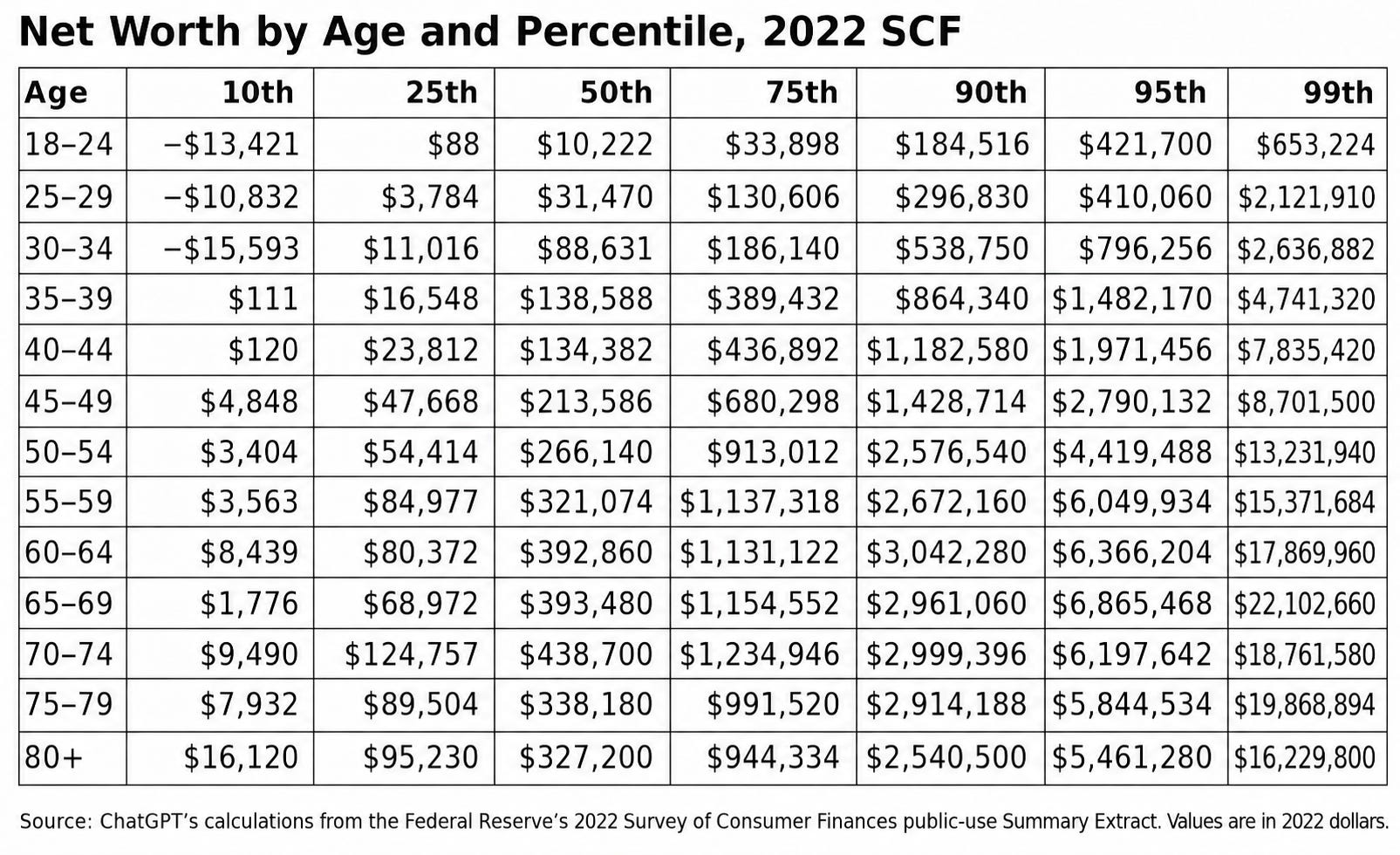
"I’ve been an economics professor for almost 30 years, but I don’t think I’ve ever before seen anything like the table below. I knew that claims that “58% of Americans can’t afford a $1,000 car repair” were laughable clickbait. I knew that — measured by income — the middle class is disappearing… by becoming upper-middle class. But only recently did I start to fully appreciate the chasm between populist pessimism and actual data on Americans’ net worth. From the 2022 Survey of Consumer Finances: 


"Main reflections:

  1. Economists have long known that inequality is relatively low for consumption, medium for income, and high for wealth. What they rarely emphasize, however, is how much wealth depends on age. The richest Americans aged 65-69 are worth about 30x as much as the richest Americans aged 18-24.

  2. Net worth is very high in absolute terms. The median is over six figures by the mid-30s. Americans at the 75th percentile are millionaires by their mid-50s. Americans at the 90th percentile are millionaires by around 40. Claims about middle-class, middle-aged Americans who “can’t afford” eggs or gas or beef are nonsense.

  3. The most sensible argument for worrying about trade deficits is that we’re “living beyond our means.” Trade deficits represent borrowing, and we can’t keep borrowing forever. But given Americans’ extraordinary net worth, the most sensible argument for worrying is still senseless. After 50 years of unbroken trade deficits, we’re wealthier than ever."


Tuesday, July 7, 2026

Did median wealth in the U.S. fall nearly 20% from 2020-2025?

See The U.S. Added 1,200 New Millionaires a Day Last Year by Miriam Gottfried of The WSJ. Excerpt:

"While average wealth per U.S. adult climbed by almost 10% between 2020 and 2025 net of inflation, median wealth fell by nearly 20%."

This was based on a report from UBS, A Swiss multinational investment bank and financial services firm (according to Wikipedia). 

But I am skeptical. I looked at some data from the Federal Reserve on the wealth of the bottom 50% over these years and even if we adjust for population growth and inflation, it is clear that per person wealth of the bottom 50% has gone up over these years (and it is possible that the numbers at the Fed site are adjusted for inflation but it just does not say).

The Fed site is Distribution of Household Wealth in the U.S. since 1989. (Hat Tip to Timothy Taylor for this link-his blog is The Conversable Economist).

This graph shows that wealth for the bottom 50% in the U.S. about doubled from $2 trillion in 2020 to $4 trillion in 2026


It might be hard to see but it does say "Bottom 50%." You can got to the link and select bottom 50% to see for yourself. They also have an option to see a table with these numbers. This link will take you directly to the table.

In the 2nd quarter of 2020, the bottom 50% had $2.21 trillion in wealth. In the 2nd quarter of 2025 it was $4.13 trillion. So it was up 87%. The U.S. was up just 3.3%. See US Population by Year.

So if the total is up 87% and the number of persons is up just 3.3%, the wealth per person must be way up. And this is for the bottom 50%. Median means that half are below a certain number and half are above. The article says the median wealth went down. But that seems unlikely if the per person wealth of the bottom 50% is up.

If we adjust for inflation (and the numbers might have already been adjusted, I just can't tell), let's use the CPI increase of 24% from 2020-25. See Consumer Price Index Data from 1913 to 2026. I got the % increase by using the yearly average for each year.

So let's reduce the $4.13 trillion wealth owned by the bottom 50% in the 2nd quarter of 2025 by 24%. That gets us about $3.14 trillion. That is 42% higher than the $2.21 trillion in the 2nd quarter of 2020. Which is still much higher than the 3.3% increase in the U.S. population. That means per capita wealth increased for the bottom 50%. That makes me skeptical that the median wealth went down.

Friday, June 26, 2026

Is Entrepreneurialism Bad?

By David R. Henderson. Excerpts:

"Imagine a product that costs $1.80 to make and sells for $2. Imagine also that the average household in America buys one of these items per week. There are approximately 134 million households in America. That means that in a given year, US households will buy 6.968 billion units and will spend $13.936 billion on this product.

Then along comes an innovator who has figured out how to produce the item at a cost of only $1.50 per unit. The innovator would ideally like to have a patent and might well get a patent. But even if he doesn’t, it will take time for competitors to notice his innovation, figure out how it works, and implement it. Let’s say it takes a year. For products with a complicated production method, that could well be an underestimate.

What will the innovator do during that year? Cut price? Maybe a little but not much. For one year, all his competitors are using a method that costs $1.80 per unit and are charging $2.00. What the innovator could do is cut the price to, say, $1.90 per unit and take a large share of the market. Let’s say he takes half the market. Then 67 million households will buy 3.484 billion of his units and will spend $6.62 billion on his product.

On each unit, the innovator makes 40 cents, the difference between the price of $1.90 and the cost of $1.50 per unit. For that year, therefore, he will make $1.394 billion. Voila! He’s a billionaire."

"Starting a successful startup is the most common way to become a billionaire"

a 2004 study he (Nobel prize winner William D. Nordhaus) wrote for the National Bureau of Economic Research, Nordhaus wrote:

Only a minuscule fraction of the social returns from technological advances over the 1948–2001 period was captured by producers, indicating that most of the benefits of technological change are passed on to consumers rather than captured by producers.

How minuscule? 2.2 percent. The remaining 97.8 percent of the gains from innovation go to consumers."

"Once other competitors imitate the innovator, the price falls and the unusual gains to the innovator go away. Consumers then get the benefits from the innovation year after year." 

Thursday, June 18, 2026

Wealth tax equilibrium accounting

By John H. Cochrane.

"The recent Piketty-Saez-Stiglitz revival of wealth taxes, ostensibly to improve the lot of the poor, makes many mistakes. I’ll focus on one: the difference between wealth and consumption. The poor wish consumption. Turning capital into consumption must destroy the capital that produces consumption. Taxing wealth in the name of inequality will make the world, including the poor, much poorer.

Why should billionaires live high on the hog while so many still live such wretched lives? “Tax the rich, feed the poor / Til there are no rich, no more” sang the rock band 10 Years After in 1971. It’s a centuries-old answer looking for new questions. (They made a lot of money on that song! The song is more like Lennon’s “Revolution,” expressing some skepticism. I remembered the lyrics as “till there are no poor no more,” but the actual lyrics are more accurate descriptions, both of the intention and the likely effect.)

However, the vision of high lifestyle amid destitution imagines great inequality of consumption. The current outrage, and demand for confiscatory taxation, is over inequality of wealth. (And that, largely mark-to-market wealth driven by high prices.) There is a big difference.

The hard fact: Our billionaires, and now trillionaire, own wealth that is almost exclusively stock in companies they created. That wealth is almost entirely left reinvested in those companies. And the companies produce great products, innovate, and employ thousands. Just what is the problem, you might ask, but that’s not our point today.

For example, suppose Elon Musk consumes $10 million a year. It’s hard for any human to consume that much. Still, that’s 1/1000 of 1% of a trillion. At 10% per year, Musk earns that much in less than an hour.

The wealthy do not swim in Scrooge McDuck pools of money that can be handed out. And even if they did, that money, redistributed, would swiftly drive up prices rather than feed everyone. Musk’s trillion is not the ready inventory of a huge grocery store that can be handed out to feed people. And if it were, once the store was empty, the poor would be hungrier again, and there would be no store to buy from.

What would the government do if it took over Musk’s SpaceX stock? At best, the government would use SpaceX earnings to buy and hand out, say, food, rather than invest in the company. Others must then produce food and not rocket ship parts. That means reorienting the productive capacity of the economy away from investment and to consumption. It means less capital going forward. Certainly no rocket ships or AI, and all the benefits those stand to bring.

But most of SpaceX value is not a stream of profits like a railroad’s. Most of its market value is investor’s hope that in the future SpaceX will dream up new and profitable ventures. That value would go poof the minute the government took it and stopped investing. It may go poof anyway.

Perhaps you think the government, by taxing Musk and demanding cash, can force Musk to sell his stock to others who won’t implode SpaceX’s value. But where do others get money to buy SpaceX stock? In the end, it must come from other company’s earnings that won’t be invested in other companies. Again, the economy reorients from investment to consumption. Tax the rich feed the poor, till there are no businesses no more.

Perhaps you think the government can manage SpaceX “for people, not for profits.” It used to. And NASA, though one of the best government agencies, was never able to do what SpaceX can do. Socialism never did turn much of a profit for consumers.

The world’s rich consume very little of their wealth. The worlds’ poor consume a lot of whatever they have. Being poor is not fun. If we split up Musk’s $1 trillion and gave about $100 in Tesla stock to each of the world’s nearly 10 billion people, it’s a good bet they would not be content to consume only 1/10 of a cent extra per year.

There are plenty of other reasons that wealth taxation will not help. Even the billionaires’ wealth, even if it could be transferred and consumed without destroying the seed corn of our economy, is trivial. 


This is simply false, and innumerate. 15% of a Trillion is $150 billion. The US alone spends $1.8 Trillion on anti-poverty programs each year, to little effect. (Wolfgang Richter is probably a parody account but alot of people have been saying things like this-CM)

The biggest reason it will not work is the simple one: incentives. If you tax wealth, you tax the activities that create wealth.

Taxing billionaires is not enough. Piketty, Saez, and Stiglitz now want the rest of us to “degrowth” in order to transfer resources to the poor. That doesn’t add up either. Degrowth means producing less too. What are the poor to eat? Penury and depopulation used to be embarrassments of the socialist left. I guess they now features.

I too would love to raise the prosperity of the world’s poor. The goal is not the issue. The issue is whether the wealth tax will help or hurt.

What helps? This graph from Max Roser at Ourworldindata makes the point beautifully: 


The x axis is GDP per capita, not time. The y axis is the share living in extreme poverty. In fact, our lifetime has seen the greatest decline in global inequality and global poverty ever seen. What helps the poor? Growth. Capitalism and growth. Degrowth and wealth taxation will push us right back up that slope."
Wednesday, June 17, 2026

There was a huge collapse in wealth inequality in the UK between 1900 and 1980 (another refutation of Piketty)

By Sylvain Catherine.

"The UK graph is one of the most interesting because the historical graph with the correct denominator — % of total wealth rather than % of GDP — from the World Inequality Database, Piketty’s lab, looks so different.

There is a clear upward trend since the 1980s, but:
1⃣ The levels are far less impressive, since the top 0.001% owns roughly 2% of the nation’s wealth.
2⃣ In retrospect, levels remain much lower than the average for the 20th century.

This, of course, does not take into account that the UK has since developed a large welfare state. In particular, these graphs leave out the value of accrued pension claims from the UK state pension, something that most workers in the early 20th century could not count on.

If, instead of looking specifically at the top 0.001%, we look at the top 1%, which is more relevant for 99% of people, there was a huge collapse in wealth inequality in the UK between 1900 and 1980, and basically no change since then. And that is before taking state pensions into account. The same thing is true when you look at the top 10%.

Again, these are not my numbers, but those reported by Piketty and Zucman’s lab. The only difference is that I compute the shares correctly: the wealth of the top 1% as a share of total wealth of the UK rather than its GDP.

Every group’s wealth has increased as a percentage of GDP since 1980 because asset prices have increased: house prices notably. Using GDP as the denominator does all the heavy lifting here and is a fallacy."


The Myth of Dynastic Wealth: The Rich Get Poorer

By Robert Arnott, William Bernstein,and Lillian Wu

"Thomas Piketty’s Capital in the Twenty-First Century rocketed to the top of the best-seller lists the moment it was published in 2013, and remained there for months. While this feat is quite remarkable for a weighty tome on economics, it’s no mystery why Piketty’s magnum opus created such a sensation; it is clearly articulated, is accessible to the non-economist, and contains a trove of historical insights. 

We believe Piketty’s core message is provably flawed on several levels, as a result of fundamental and avoidable errors in his basic assumptions. He begins with the sensible presumption that the return on invested capital, r, exceeds macroeconomic growth, g, as must be true in any healthy economy. But from this near-tautology, he moves on to presume that wealthy families will grow ever richer over future gener- ations, leading to a society dominated by unearned, hereditary wealth. Alas, this logic holds true only if the wealthy never dissipate their wealth through spending, charitable giving, taxation, ill-advised invest- ments, and splitting bequests among multiple heirs. As individuals, l as families, the rich generally do not get richer: after a fortune is first built, the rich often get relentlessly and inexorably poorer."

Thursday, June 4, 2026

Europe Demands Family Dynasties

By Alex Tabarrok.

"In the US, someone with wealth is free to give it away more or less as they see fit (spousal claims excepted, which partly reflect marital co-ownership). In much of Europe, however, there is forced heirship–a large fraction of wealth must be handed down to children which makes it harder to direct large portions of wealth to charities, foundations, or non-family causes compared to the US. (Louisiana, with its French-Spanish civil law roots, is the one state with forced heirship and even it mostly gutted it in 1995.)

Here is an excellent post by John Arnold who, if he were European, would be required to give 75% of his wealth to his three children instead of spending it on philanthropy as he and his spouse are now doing.

America’s cultural ideal has been the self-made entrepreneur while Europe’s was rooted in aristocracy, with status inherited rather than earned. Europe’s inheritance laws show this divide.

Many European countries have “forced heirship” laws that require people to leave 50-75% of their estates to their children. Want to leave the majority of your wealth to charity? not allowed. Your kids are estranged from you, struggling with addiction, or irresponsible? still required to give them the money. Want your kids to avoid a life of entitlement? tough.

Incredibly, these laws look back at transfers made during your lifetime. If you have 3 children in France, you’re required to bequeath them a minimum of 75% of your estate. Because French law calculates this based on your assets at death plus all lifetime gifts, giving away more than 25% of your wealth while alive means your heirs can legally sue to force charities or foundations to return the funds. This has limited the development of the nonprofit sector on the continent.

The cultural gap between an entrepreneurial society and one shaped by dynastic wealth is enormous. If you make it yourself, you tend to want your kids to do the same. If you inherit it, the primary goal is protecting the estate for the next gen.

Countries like Spain, France, and Italy legally entrench family dynasties, while America has historically sought to limit them through estate taxes. The result is not only a weaker culture of philanthropy and civil society in Europe, but also less economic dynamism.

It’s interesting that in Capital Piketty discusses required equal division to children as an egalitarian legacy of the revolution but, as far as I recall, never reflects on the fact that forced heirship prevents a French entrepreneur from giving his fortune away to charity. A case for laissez-faire, no?"

Sunday, April 5, 2026

California’s Golden Goose Is Already Flying the Coop

The state’s tax base is being hollowed out even before the ‘wealth tax’ qualifies for the ballot

By Hank Adler. He is a professor of accounting at Chapman University. Excerpts:

[they would] "would impose a 5% one-time tax on the wealth of individuals who were California residents on Jan. 1, 2026, and whose net worth exceeds $1 billion"

"the top 1% of taxpayers generate roughly 40% of the state’s personal income-tax revenue"

"Although California doesn’t currently tax wealth directly, it heavily taxes the income generated by wealth—particularly capital gains"

"Earlier this decade, Larry Ellison and Elon Musk—then among California’s wealthiest residents—relocated to Hawaii and Texas respectively. Apparently in reaction to the proposed billionaires tax, Sergey Brin and Larry Page late last year became Florida residents, and Mark Zuckerberg reportedly established a residence there early this year. Together these five men once accounted for roughly $1.7 trillion of the more than $1.8 trillion net worth held by California’s six richest residents earlier in the decade."

"The ballot measure would amend the state constitution to lift California’s limit on taxes on wealth, opening the door to future levies"

"Supporters suggested the tax could raise as much as $100 billion, which the bill pledges to fund education, food assistance and healthcare. The Hoover Institution estimated a much lower figure, about $40 billion, largely because of taxpayer mobility and the likelihood that wealthy residents have and will relocate regardless of whether such a tax is imposed. The facts so far support Hoover’s estimate much more than the tax’s supporters’ figure."

Thursday, March 26, 2026

Average Wealth for Younger Generations Continues To Exceed Past Generations

By Jeremy Horpedahl.

"Today I am posting an update to the generational wealth chart that I have posted many times in the past. This update brings the data through the 3rd quarter of 2025 for the youngest cohort, which includes both Millennials and a growing part of Gen Z in the data from the Federal Reserve. I am somehow hesitant to post this chart, as it is starting to be data that is less useful as the younger generations age, for two reasons.

The first problem with the data is that the Fed is lumping everyone from ages 18-43 together as one generation. Given that the youngest Millennials were 29 in 2025, we are now including a significant part of Gen Z, which is OK in itself, but it becomes harder to compare with generations that encompass only 16 or 17 years of birth cohorts. Secondly, the data from the Fed’s Distributional Financial Accounts is only benchmarked every three years with the Fed’s more detailed Survey of Consumer Finances. Currently only the 2022 version of the survey is available, which is now probably a bit out of date. Based on past updates, it is entirely possible that it is underestimating wealth for the youngest cohort. But I think we will have much more certainty about this data once the 2025 SCF is available and used as a benchmark for the DFA data.

With all of those caveats aside, here is the updated chart:


As I am currently working on a book manuscript using the Survey of Consumer Finances, I will be very excited to finally have the 2025 data available. Until then, this is probably the best intergenerational comparison we can do, and it continues to look very positive for the youngest cohorts. With an average of almost $146,000 of wealth for the combined Millennial/Gen Z cohort, they are well ahead of where Gen X was even in their late 30s, and ahead of Boomers at around age 37 as well. All of this bodes well for young people, despite frequent expressions of pessimism, but we should hold off judgement until the 2025 data is fully updated." 

Monday, February 16, 2026

Two Confusions About the California Wealth Tax

Unrealized capital gains aren’t classified as taxable income in the U.S. for good reason

Letter to The WSJ

"At least two confusions discredit Mayra Castañeda’s attempted defense of California’s proposed wealth tax in her letter “Billionaire Tax Would Save Calif. Healthcare” (Feb. 4). She claims that “billionaires pay less in taxes on their overall wealth than working families do.” She gets away with this because the research that she cites, although it postures as measuring the taxation of incomes, in fact measures the taxation of paper wealth by classifying unrealized capital gains as taxable income.

But unrealized capital gains aren’t classified as taxable income in the U.S. for good reason. Were these gains treated as such, taxpayers—including many middle-class families—would have to liquidate assets whenever tax season rolled around to pay their bills. One result, in addition to this annual hardship, would be a shrinkage of America’s capital stock which, in turn, would slow wage growth as workers, having less capital to work with, would be less productive than otherwise.

Ms. Castañeda also ignores the most prominent argument against the proposed tax—namely, that it will drive billionaires, along with their taxable incomes and wealth, to states that are less greedy to seize the fruits of high-earners’ efforts. This exodus of billionaires would occur even if, contrary to fact, counting unrealized capital gains as taxable income were a sound idea.

Prof. Donald J. Boudreaux

Mercatus Center

George Mason University

Tuesday, February 10, 2026

Gavin Newsom Opines on Wealth and Taxes

The California Governor finally admits who pays for Sacramento’s spending—billionaires. 

WSJ editorial. Excerpts:

"He now admits that taxes affect where people choose to live and invest."

"The union claims the measure would raise $100 billion in revenue. That’s doubtful given that it has already spurred many billionaires to decamp."

"“The impact of a one-time tax does not solve an ongoing structural challenge,” the Governor said Thursday. “You would have a windfall one time, and then over the years, you would see a significant reduction in taxes because taxpayers will move.”"

"Mr. Newsom said he is very “mindful” that “we rely on a very small number of people that allows us to do historic things”—i.e., spend at historic levels. His recently proposed budget includes $539 billion in spending, up 68% from 2019."

"the top 1% of earners pay about half of state income tax."

"California’s federal Medicaid dollars this year are projected to increase by $18 billion (15%)." 

Wednesday, June 4, 2025

Large earnings disparities to be the primary source of US wealth concentration

By BariÅŸ Kaymak, David Leung & Markus Poschke. From American Economic Journal: Macroeconomics.

"Abstract

We assess the empirical relevance of different macroeconomic modeling approaches to wealth concentration, using the joint distribution of earnings, capital income and net worth in combination with an OLG model of household heterogeneity. We find large earnings disparities to be the primary source of US wealth concentration. This reflects the fact that labor income, from salaries but also from entrepreneurship, is a major income source for top income and wealth groups in the data. Bequests and differences in rates of return on capital together explain about half the holdings of the wealthiest of households."

Thursday, September 19, 2024

The Economic Consequences of the French Wealth Tax

From Tyler Cowen.

"By Eric Pichet, here is the abstract:

Despite attempts to ‘unwind’ the Impôt de Solidarité sur la Fortune (‘Solidarity Wealth Tax,’ the French wealth tax) during the last legislature (2002-2007), ISF yields had soared by 2006, jumping from €2.5 billion in 2002 to €3.6 billion. Analysis of the economic consequences of this ISF wealth tax has raised the following conclusions: Tax collection costs remain low (around 1.6% of proceeds); Not raising the threshold in line with inflation between 1998 and 2004 created windfall revenues for the French State of €400 million in FY 2004 alone; ISF fraud mainly involving an under-assessment of property assets has stabilised over time at around 28% of total revenues, equivalent; (had the legal framework remained unchanged) to a shortfall for the State of €700 million in 2004; Capital flight since the ISF wealth tax’s creation in 1988 amounts to ca. €200 billion; The ISF causes an annual fiscal shortfall of €7 billion, or about twice what it yields; The ISF wealth tax has probably reduced GDP growth by 0.2% per annum, or around 3.5 billion (roughly the same as it yields); In an open world, the ISF wealth tax impoverishes France, shifting the tax burden from wealthy taxpayers leaving the country onto other taxpayers.

Via Fredrik.  I would describe this work as a very loose estimate, nonetheless pointing in the proper direction."

Tuesday, September 17, 2024

You Would Pay Harris’s Wealth Tax

The selloff caused by a levy on unrealized capital gains would devastate ordinary investors and 401(k)s.

By Hal Scott and John Gulliver. Mr. Scott is an emeritus professor at Harvard Law School and director of the Committee on Capital Markets Regulation. Mr. Gulliver is the committee’s research director. Excerpts:

"Billionaires alone own more than $5 trillion in stock, or 7% of the entire stock market. Public stock represents 66% of their wealth, so they would need to sell hundreds of billions of dollars worth of stock to fund their wealth-tax payments. These sales would drive down stock prices and, therefore, returns for all investors. The largest, most innovative and fastest-growing U.S. tech companies would be hit the hardest. Unrealized capital gains are concentrated in these companies."

"Stock sales would need to continue each year to pay the annual wealth tax. This would be a long-term drag on the returns of all investors, while also reducing the skin in the game of the innovative founders who built these companies. The wealthiest Americans would be entitled to tax refunds in future years if the value of their remaining stock holdings goes down, but that wouldn’t diminish the effect of the tax on capital markets.

U.S. taxpayers with assets of more than $100 million hold approximately $4 trillion in unrealized capital gains in the shares of private companies. Selling these investments to cover a tax bill is even more difficult than selling stock in public companies. Private companies generally don’t have active trading markets, so finding a buyer can be difficult and the cost of selling high. These sales can also disrupt the growth of private companies, which are often managed by their owners.

The Biden-Harris tax therefore includes an exemption from the proposed wealth tax for ultrarich investors who have 80% of their wealth in nontradable illiquid assets, such as investments in private companies. This would create a major incentive for the wealthiest Americans either to delist the public companies that they control or to keep their private companies from going public in the first place. If the ultrarich respond this way, it would reduce projected tax revenue and hurt all investors by shrinking the size of public markets."

Sunday, November 12, 2023

Older Americans Are Better Off Than Ever

They invested for decades, are working longer and get bigger Social Security checks than past cohorts

By John F. Cogan and Daniel L. Heil

"inflation-adjusted income of the median household headed by someone 65 or older rose by 94% from 1982 to 2021. The increase was nearly three times the 35% increase among younger households."

"As of 2018, the adjusted median household income of seniors equaled that of younger households. In 2021, despite Covid, seniors’ adjusted income continued to equal that of younger households."

"over the past four decades, incomes of the poorest 25% of senior households grew faster than those of middle-income senior households. Also, the inflation-adjusted median income of senior households headed by people 75 and older increased by 140%."

"The typical senior household’s inflation-adjusted net wealth in mid-2022 was nearly 200% higher than it was in 1983. Households headed by people now 55 to 64 are positioned to continue this improvement. Their median wealth level is more than double that of today’s retirees when they were the same age."

"The increase in income from investing household savings and higher earnings from working past 65 account for 80% of the growth in the average senior household’s income. News reports that baby boomers weren’t saving enough for retirement were wrong."

"Had Social Security benefits remained at their inflation-adjusted 1982 level, the typical senior household’s income would still have increased by 78%, more than twice as fast as the income of the typical younger household."

"In 2021 the richest 10% of seniors received more than twice as much from Social Security as the bottom 10%."

"Maintaining healthy financial trends for senior citizens requires robust labor and capital markets. Keeping tax rates on work, saving and capital formation low is the best way to ensure that these gains continue."

Thursday, March 25, 2021

Elizabeth Warren's and Bernie Sanders' 'Wealth Tax' Would Be Terrible for Low-Income Workers

And it has failed in almost every country where it's been tried

By Veronique de Rugy.

"With Democrats now in control of the House, Senate, and White House, many of the most significant policy battles of the next two years will be determined by intraparty fights within the Democratic Party's various factions.

Although not a moderate in any meaningful sense, President Joe Biden has always positioned himself strategically at the center of his party. Nevertheless, his defeat of the party's left wing in the last presidential primary won't be the end of a populist insurgence. Sadly, one fight will be between those, such as Treasury Secretary Janet Yellen, who want to raise taxes significantly, and those who, like Sen. Bernie Sanders (I–Vt.), want to raise taxes even more significantly.

Sen. Elizabeth Warren (D–Mass.) would prefer the latter and has reintroduced her proposal for destructive wealth taxation. Her tax would impose a 2 percent annual levy on wealth over $50 million, going up to 3 percent for wealth over $1 billion. This purely class-warfare scheme is advertised as a way to close the U.S. wealth gap.

My Mercatus Center colleague Jack Salmon and I recently published a paper that looks at the economic literature on this issue to evaluate the arguments of wealth tax proponents. We found that they generally exaggerate wealth inequality in the United States, overestimate the potential revenue a wealth tax would raise, and minimize the negative impact of such a levy.

In a study done for the Center for Freedom and Prosperity, Rice University economists John Diamond and George Zodrow examined the expected impact of Warren's previously proposed wealth tax (a 2 percent annual tax on wealth over $50 million, rising to 6 percent for wealth over $1 billion). They found long-run GDP loss of 2.7 percent, thanks in large part to a 3.7 percent decline in the capital stock. Economists Douglas Holtz-Eakin and Gordon Gray of the American Action Forum also found that Warren's wealth tax would cost workers 60 cents of earnings for every dollar of revenue raised, or approximately $1.2 trillion in lost earnings over the first 10 years.

If you're skeptical of economic predictions, consider that these scenarios have already played out in the real world. A detailed analysis by the Tax Foundation shows that while many Organization for Economic Cooperation and Development (OECD) countries have tried a wealth tax, only five of those countries still have one today.

Wealth taxes weren't widely abandoned because these governments suddenly embraced free-market principles. Instead, implementing the tax put reality on a collision course with the same theoretical myths now being spread in the United States. These taxes don't rake in the revenue or solve the supposed problem of inequality. For starters, wealth taxes aren't paid by rich people who reduce their consumption as a consequence. They reduce their investments, which reduces capital formation, which slows productivity and wage growth. In other words, wealth taxes may be originally paid by wealthy folks, but the economic burden falls heavily on workers.

Previous wealth taxes also triggered capital flight to other countries, which explains the relatively small amount of revenue actually collected. Declining capital stocks then slowed economic growth and depressed overall tax revenues. The Tax Foundation notes, "Among those five OECD countries collecting revenues from net wealth taxes, revenues made up just 1.2 percent of total revenues on average in 2019." And high administrative costs due to a more complex tax made even the little bit of revenue raised unappealing. That's why so many countries gave up.

Preventing the inevitable capital flight that follows the imposition of a wealth tax would require authoritarian measures. Indeed, to go hand in hand with his proposed wealth tax last time around, Sanders called for the creation of a "national wealth registry," a major expansion of the Internal Revenue Service, and the imposition of an "exit tax" that would confiscate 40 percent of a rich person's wealth under $1 billion and 60 percent over $1 billion if they renounce their citizenship and try to escape the tax. Is this the world we really want to live in?

I'm sure Biden is under tremendous pressure to acquiesce to these progressive demands. He also needs loads of revenue for his big spending plans. He must resist. History tells us that he won't raise much money from a wealth tax, and he won't even deliver on a class warfare agenda, since workers will pay the price at a time when they can least afford it."

Thursday, October 29, 2020

The Wealth Gap Shrinks: The three years before the pandemic saw big gains for lower earners

WSJ editorial. Excerpts:

"Between 2016 and 2019 . . . Real median incomes grew 9% for Americans who haven’t completed high school and 6.3% for those with only a high-school diploma while declining 2.3% among those with a college degree."

"Net worth (assets minus debt) increased 32.5% among the lowest income quintile and 30.7% among the second lowest,"

"Net worth also increased among blacks (32.1%) and Hispanics (63.6%) compared to whites (4%)."

"One explanation is that lower-income Americans are saving more. The share of families that saved increased to 59% from 55% from 2016 to 2019. Savings took a variety of forms, but Americans in the lower rungs notably invested in stocks and their own businesses."

"Home ownership declined across the socioeconomic spectrum during the Obama Presidency despite near-zero interest rates, but it ticked up 1.4 percentage points overall from 2016 to 2019, including among Hispanics (1.8 points) and blacks (2.3 points)."

Wednesday, February 12, 2020

The underlying data behind recent calls for a wealth tax significantly overestimate the share of wealth held by the richest 1 percent

See Revisiting the Proposal for a Wealth Tax by Veronique de Rugy & Jack Salmon.
"In the run-up to this year’s presidential election, the wealth tax has become central to the debate over income inequality. Indeed, some candidates are not only debating the merits of a progressive wealth tax, but also drawing up plans to implement one if elected. This is despite the fact that a number of European countries have already tried wealth taxes and in most cases abandoned them. Their experience suggests that a US wealth tax (a) would deliver fewer benefits than anticipated and (b) might actually make economic conditions worse for most Americans.

A Closer Look at The Wealth of the Top 1 Percent

How wealthy are they? Advocates of a wealth tax claim that the top 1 percent of US income earners hold as much as 42 percent of the nation’s total wealth. This percentage has been disputed, with other estimates putting it closer to one-third.

How do they use their wealth? The wealthy do not hoard their wealth and spend only a small percentage of it on luxury consumption. They use much of it to invest in companies, fund R&D that contributes to the creation of better consumer goods and services, or provide capital for innovators to grow their businesses. In these ways, the wealthiest are creating new products, raising workers’ wages, and driving down consumer prices.

How much would a wealth tax raise? It has been claimed that a tax on wealth above $50 million could raise $212 billion (1 percent of GDP in 2019). This estimate was made assuming a tax avoidance and evasion rate of 15 percent.

How realistic is the projected $212 billion?
$212 billion would represent about 6 percent of total US government revenue. Compare this to three European countries:
  • Switzerland raises 3.3 percent of its revenues from a wealth tax
  • Luxembourg raises 1.6 percent
  • Norway raises 1.1 percent
Replicated in the United States, these percentages would represent tax revenues of $40–120 billion.

Lessons Learned from Other Countries

Fifteen European countries have implemented a wealth tax, but only three still have one. Their experience is out of sync with the $212 billion estimate of potential revenues from a proposed US wealth tax.
  • Sweden: When abolished in 2016, Sweden’s wealth tax was generating a small amount of revenue (0.16 percent of GDP), with levels of tax avoidance and evasion significantly higher than 15 percent. Abolishing the tax was an attempt to boost low levels of investment, encourage entrepreneurial activity, and increase employment.
  • France: From the inception of France’s wealth tax in 1988 until its end in 2006, about €200 billion was lost in capital flight every year. It is estimated that the tax reduced GDP growth by 0.2 percent per annum while shifting the tax burden from wealthy taxpayers leaving France onto other taxpayers.
  • Germany: The country eliminated its failing wealth tax in 1996. One study estimates that reintroducing it would decrease annual GDP growth by 0.33 percentage points, production by 5 percent, and investment by 10 percent.
  • United Kingdom: The United Kingdom considered a wealth tax in the 1970s but decided against it. One reason was the cost of compliance and administration that comes with regularly compiled valuations of wealth. According to the country’s chancellor of the exchequer, “I found it impossible to draft [a tax] which would yield enough revenue to be worth the political hassle.”

Key Takeaways

Proponents have exaggerated the benefits that would result from a US wealth tax. The experience of countries that have implemented wealth taxes indicates the following:
  1. Wealth taxes contribute to a lower capital stock, promoting the flight of capital out of a country and discouraging foreign investors from coming in.
  2. The high administrative costs of regular valuations can reduce net revenue, so wealth taxes rarely yield more than 0.2 percent of GDP.
  3. A wealth tax often results in reduced economic growth and lower wages, which further depress tax revenues while detracting from the welfare of many households."

Monday, December 30, 2019

Tyler Cowen on Piketty's latest book

See *Capital and Ideology*, by Thomas Piketty
"This book is more than 1000 pp., here are my impressions:

1. About 600 pp. of this book is a carefully done history of the accumulation and sometimes dissipation of wealth and property.  You can evaluate that material without reference to any particular set of political views.

2. At some point the book veers into partisan issues such as the wealth tax.  Many of those parts remain interesting, but it also becomes clear that Piketty is “out to lunch,” to wit (p.591):
To return to the Soviet attitude toward poverty, it is important to try to understand why the government took such a radical stance against all forms of private ownership of the means of production, no matter how small.  Criminalizing carters and food peddlers to the point of incarcerating them may seem absurd, but there was a certain logic to the policy.  Most important was the fear of not knowing where to stop.  If one began by authorizing private ownership of small businesses, would one be able to set limits?
I can think of a less naive explanation of Soviet attitudes toward the private sector.  Piketty also calls for “participatory socialism” (p.592), a dubious doctrine not to be confused with say Nordic social democracy.  For instance, Sweden (among other countries) seems to have fairly extreme wealth inequality.

3. The sentence “Real wages are much higher in America than in Western Europe” does not come easily to his pen.  Nor does “The United States is a remarkably successful innovator, let’s see what we can learn from that.”  Or even “Raising wages is more important than merely limiting inequality.”  Those seems to be banished thoughts in the Piketty intellectual universe.

4. The sections on Soviet and socialist experience can only be called “delusional.”  In his account, if only a few political decisions had gone the other way, the USSR might have ended up on a path similar to that of Norway (p.603 and thereabouts).

You know, maybe you think that the inequalities of the current day are much worse than people had been expecting.  but that should not revise your view of socialism and the Soviet Union, two matters fairly well settled by historical research.

5. Give these lenses, it is impossible for Piketty to offer any commentary on recent events (about the last 400 pp. of the book) that is anything other than distorted and unreliable.  There is massive distrust of the wealthy in this book, and virtually no distrust of concentrated state power.

6. There is a considerable sum of useful and valuable material in this book, and I would not try to dissuade anyone inclined from reading it.  Nonetheless I suspect its main import is as another sign of the growing compartmentalization of academic discourse — good work intermingled with highly questionable partisan material — and how so many academics, if the mood affiliation tilts in the right direction, will tolerate or even encourage that."

Wednesday, December 18, 2019

Top Wealth Is Business Assets

By Chris Edwards of Cato.

"Anti-wealth fever grips the Democratic Party and seems sure to carry into the election year. Bernie Sanders and Elizabeth Warren are leading the billionaire bashing binge, but even rising star Pete Buttigieg says that he is “all for a wealth tax.”

Leftist politicians dish out lots of rhetoric about wealth, but they seem ignorant of how it is created and used. They assume that top wealth is just expensive toys such as luxury yachts.

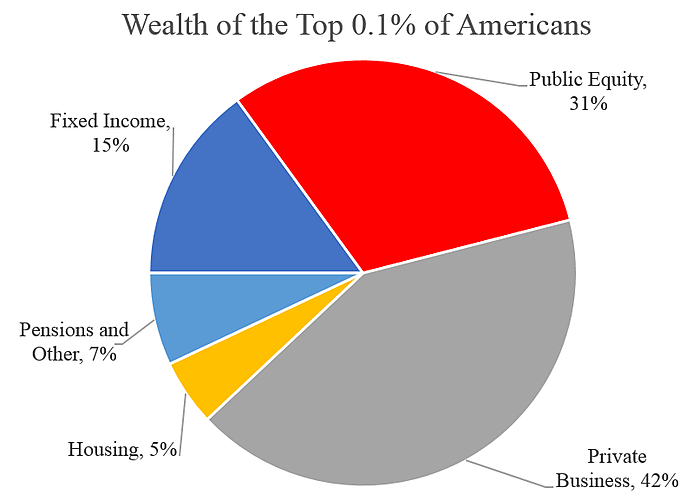
Actually, most wealth of the wealthy is business assets, not personal assets, as discussed in my op-ed in The Hill today. The chart below shows the components of wealth of the richest 0.1 percent of Americans. Forty-two percent is equity in private businesses and 31 percent is equity in publicly traded businesses. Another 22 percent is bank deposits, debt, pensions, and other assets. Just 5 percent of this group’s wealth are their homes. 

A rough guess is that one quarter of the deposits, debt, pensions, and other assets are holdings of government debt. That means almost 90 percent of the wealth of the top 0.1 percent of Americans consists ultimately of equity and debt in businesses, which in turn funds the capital investments that create jobs and spur economic growth. 

Leftists often claim or imply that wealth at the top comes at our expense, but the reality is the opposite. Wealth at the top supports jobs, opportunities, and incomes for millions of other Americans.
My Hill piece is here. A full discussion of wealth inequality is here and wealth taxation here."

p