Evaluating the free market by comparing it to the alternatives (We don't need more regulations, We don't need more price controls, No Socialism in the courtroom, Hey, White House, leave us all alone)
"Yesterday the Census Bureau released their annual treasure trove of data from the Current Population Survey, Annual Social and Economic Supplement. Loads of new data are now available for 2025 on income, poverty, and health insurance coverage. This new data allows me to update one of my favorite charts, showing the distribution of family income in the U.S. since 1967. Census releases this data by grouping families into nine different income groups, which I have collapsed into three groups, each being as close to one-third of the total as I can get using the publicly available data.
Figure 1
See also a similar chart from Mark Perry which uses household income (rather than family income) over the same time period.
Figure 1 shows that, adjusted for inflation, the proportion of families with income over $150,000 has grown almost seven-fold since 1967. There has been a roughly constant one-third of the population between $75,000 and $150,000, and the ranks of those under $75,000 has been cut in half since 1967. Again, these dollar figures all adjusted for inflation, using the preferred deflator of the Census Bureau.
What’s even more astonishing is when we look at the number of families at various thresholds, rather than just the share, as seen in Figure 2.
Figure 2
In 1967 there were fewer than 3 million families with incomes over $150,000 (in 2025 inflation-adjusted dollars). By 2025, that had grown to over 31 million families. If we look at the highest income threshold in this Census data — over $200,000 — the number of families has grown from just 1 million in 1967 to over 20 million in 2025. And there are fewer lower-income families too: the number of families under $75,000 shrunk, not just as a proportion of the total as seen in Figure 1, but even in absolute terms by almost 3 million families from 1967 to 2025.
Of course, some of these families do have more earners than in 1967, though we shouldn’t overstate that too much. Using other data from Census, we can see that the share of families with multiple earners hasn’t increased much since 1967, and especially hasn’t since the mid-1990s.
Table 1
As seen in Table 1, as far back as 1967 the majority of families in the U.S. had multiple earners. Now it’s true these were not all married couples with both spouses working full-time, and hours of work in the household have risen over time — but not much since the 1990s. This data is somewhat skewed by the aging of the population, as evidenced by the rising number of families with no earners. But even if we drop those families with no earners, multiple-income families haven’t grown much: from 58% of the total in 1967 to 63% in 2025."
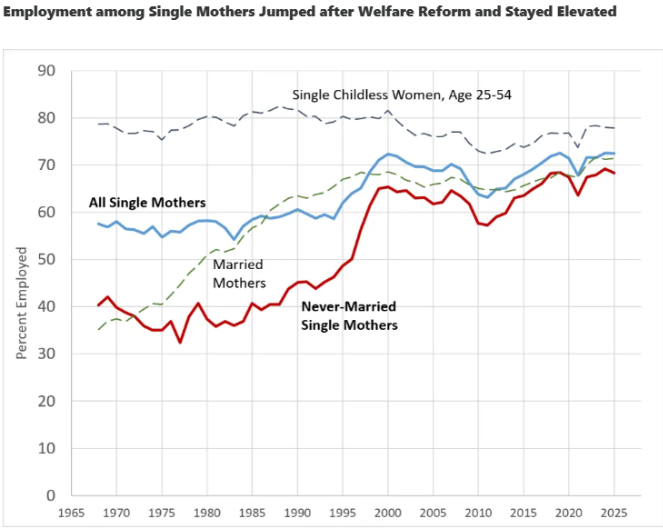
"Welfare Reform's Success Holds Up 30 Years Later. The positive effects of the 1996 welfare reforms on work and poverty still hold three decades later, argues AEI scholar Scott Winship. At a recent House Work & Welfare Subcommittee hearing, Chairman Darin LaHood (R-IL) noted that the law replaced “an open-ended 'no strings attached' cash entitlement” with a program that “included work requirements, time limits, enforced the principle of work in exchange for benefits, and capped federal funding for benefits.” In his testimony before the committee, Winship pointed out that child poverty fell by roughly half to more than three-quarters between 1996 to 2022. As Winship says, earnings among families with children since welfare reform have grown so large, that “if the entire safety net disappeared tomorrow, the child poverty rate would still be lower than in 1993.” Winship credits part of this to the employment gains after welfare reform, especially among single mothers, which rose so dramatically that they have “never returned to pre-[reform] levels. Even in the depths of the Great Recession, single mothers were more likely to be employed than they had ever been before 1995.” To read more about the impacts of welfare reform, including how states circumvented the law’s spending constraints by shifting beneficiaries off TANF and onto other, open-ended entitlements, read the statement we submitted for this hearing here."
In 2010 an employment tribunal ruled that Birmingham City Council had
discriminated against thousands of female workers — cooks, cleaners,
care assistants, caretakers — who were denied bonuses paid to the mostly
male binmen, gardeners, and gravediggers. Why were the binmen given
bonuses? Well, refuse collection is filthy, heavy, outdoor work and not
many people want to be gravediggers. Thus, these jobs command a premium
for exactly the reason Adam Smith gave in 1776 — compensating differentials.
Or was it sexism? Well, note first that there is nothing stopping women
from becoming “binpersons” and indeed there are female binpersons and
they earn the same bonuses as their male counterparts (just as with the Next case). Moreover, we can test the sexism versus compensating differentials theory. Let’s see what happened.
Here’s the problem, which contributed to Birmingham going bankrupt in
2023. The council employs roughly 400 binmen and something like 6,000
women in comparable graded roles. Every extra pound paid to a binman
therefore implied about fifteen pounds owed to the cooks and cleaners.
The council simply didn’t have the money to pay everyone binman wages so
they cut the binmen’s wages. But the market wage for collecting rubbish
is what it is, so when Birmingham finally deleted the premium in
January 2025, the binmen went on strike — and they are still on strike,
nearly eighteen months later. The rubbish piled up, 17,000 tonnes of it,
and the city declared a major incident.
Here’s the most amazing part. The council hired an outside contractor
to take over its rubbish collection and it now pays roughly triple its
pre-strike outsourcing bill–more than it was paying its own employees.
So much for sexism. Apparently the premium wasn’t a favor to men; it was
the price of the job. If you want your rubbish picked up and your
graves dug, you must pay the market wage. This was pure regulatory
arbitrage, of course. Because the new binmen were contractors they
legally had a different employer than the Council’s female caregivers
and the Act’s comparator rules stop at the employer’s nexus.
The government mandarins, of course, want to close the “loophole” adding yet another bureaucratic requirement to push the equal pay madness up the supply chain. The rubbish piles up."
"In my post Equality Act 2010 I discussed the UK’s absolutely insane wage policy:
In short, supply and demand have been replaced by judges
and labor boards with the authority to deem which jobs are “equal” and
therefore should be paid equally….No one is alleging that male and
female warehouse workers were paid unequally or that male and female
retail workers were paid unequally or that there was any direct or
indirect discrimination. The only claim is that warehouse workers, who
are less likely to be female than retail workers, earn more than retail
workers. And since these jobs have been judged “equal,” the company has
violated Equality Act 2010.
…The warehouse workers were almost 50% female (47.25%). So females
were not barred from the higher paying jobs. The fact that 77.5% of the
retail workers were female suggests that retail work has special appeal
to females relative to males and thus that there are compensating
differentials. Any of the three female plaintiffs could have taken jobs
in the warehouse. If the jobs are equal and the warehouse jobs pay more
this is, on the plaintiffs’ theory, “puzzling”. [Or, as Ayn Rand would
say, blank out.]
In fact, the court case
reveals that Next was struggling to fill the warehouse positions and
offered any retail employee—including the plaintiffs—the opportunity to
switch to warehouse work. On cross-examination, one of the plaintiffs
admitted that, given the unpleasant conditions in the
warehouse—described by the court as “the drone of machinery,…vibration,
alarm sirens and the screeching of machinery, wheels and rollers,
continuously present in all areas”—the warehouse job “did not seem
particularly attractive” compared to the greater autonomy and more
appealing environment of the retail job. The plaintiff added that she
would only have considered the warehouse job if it paid “a lot more money.”
Well, here is the update. The outgoing Keir Starmer government is trying to massively expand
these laws. The “equal value” framework previously applied only to sex
discrimination; under the proposed law, employees could also bring
equal-value claims based on race and disability. Remember, these laws
have nothing to do with discrimination—they are about demanding, at the
point of a gun, that apples and oranges sell for the same price because
they’re both fruit.
The new law would also establish an Equal Pay Regulation and Enforcement Unit. As I said, Orwellian.
One study examines whether this disparity reflects, in part, access to financing, which
has long been recognized as a major obstacle to business success, particularly for racial minorities.
By measuring the availability of credit before and after passage of major banking bills, the study finds that
the
deregulation of interstate banking in the United States between 1994
and 2021 narrowed gender and racial disparities in entrepreneurship by
expanding and improving banking services, reducing discrimination in the
financial market, and narrowing gaps in firm performance.
Once more, deregulation enables positive change through the free market."
"But as “Motherland” also shows, the
Soviet men who controlled the country weren’t always so keen on
encouraging or even maintaining radical egalitarianism. And when they
were intent on so-called equality, it was often to punish women because
of their connection to men who happened to run afoul of the Kremlin. In
Kazakhstan, the Akmolinsk Camp for Wives of Traitors to the Motherland
was just one node in the sprawling network of the Gulag. Children born
in captivity were sent to an orphanage where they were sometimes so
neglected that they didn’t learn how to speak. One mother compared the
sounds such children made to “the muted moans of pigeons.”
Having
children, it turned out, would be a consistent obsession of the Soviet
regime. Abortion was legalized, then outlawed, then legalized again.
Stalin introduced a tax on childlessness. After the demographic disaster
of World War II, the new superpower needed an expanding population.
Ioffe notes that Stalin’s strategy for development relied mostly on
“vast human sacrifice.” Men would make the big political decisions,
while women would make more babies: “They would give up their sons for
the country, pretend their children were heroes rather than cannon
fodder, and when those sons fell in battle, they would have more.”
Alongside
this official history, Ioffe traces a private one. One of her
great-grandmothers survived a pogrom. Another, the pediatrician, was
forced by the secret police to work at a military hospital during World
War II. The women in her family would eventually learn that their
stellar professional achievements did not mean a break from domestic
work.
As the Soviet economy sputtered
in the 1970s and ’80s, a dearth of consumer goods also made household
tasks infinitely harder. It was impossible to procure disposable diapers
or washing machines. (Politburo wives, by stark contrast, had access to
special stores filled with otherwise scarce goods at discounted
prices.) Women with Ph.D.s and full-time jobs spent their evenings
pickling mushrooms and mending clothes. Even basic menstrual products
were scarce."
"Mr. Albertus also argues that the struggle over land ownership has
produced “racial hierarchy, gender inequity, underdevelopment and
environmental degradation.” Maybe. The conquest of the Americas and the
use of enslaved labor for farming was indeed catastrophic for Africans
and Native Americans, but Wyoming, Utah, Colorado and Idaho were the
first four states to give women the vote. Farming the Amazon is still
producing “environmental destruction on a massive scale” but, as Mr.
Bird’s chapter on Singapore reminds us, development can soar without
land as long as there are strong property rights and accessible,
excellent schools."
"But even if we accept Mr. Albertus’s view that “our lives today are
determined by the choices that were made when the land shifted hands”
over the past two centuries, it does not follow that shifting land
around is more effective an antipoverty tool than, say, investing in
education or urban sanitation. Mr. Albertus’s own work, cited by Mr.
Bird, finds that “land reform actually lowered
levels of human capital accumulation” in Peru and that “under certain
conditions it also has the potential to stunt urbanization, wealth
accumulation, and ultimately education by encouraging land reform
beneficiaries to remain in the countryside and employ their children on
the farm rather than migrating to urban areas where opportunities for
upward mobility are greater.”"
"Missing from both books is a serious discussion about the connection
between property rights and the value and use of land. The powers of a
landowner can range from the almost full sovereignty enjoyed by a mighty
feudal noble to the essentially nonexistent rights I have over the
protected swampland outside my window. Over the past 60 years, the
nature of land ownership in the U.S. has changed because land-use
regulations have increasingly limited the right to build. In 1763,
William Pitt the Elder trumpeted the rights of the small English
landholder: “The poorest man may in his cottage bid defiance to all the
forces of the Crown. It may be frail—its roof may shake—the wind may
blow through it—the storm may enter—the rain may enter—but the King of
England cannot enter—all his forces dare not cross the threshold of the
ruined tenement.” That proud sentiment, linking freedom with land, feels
increasingly untrue."
While there are decades of evidence that economically
free economies grow faster and are more productive than less free ones,
there is less knowledge about the effect of economic freedom on groups
that have traditionally been disadvantaged. I study the causal effects
of large and sustained jumps in economic freedom on women's labor force
participation and primary school enrollment. I find that these jumps
have a positive and statistically significant effect in both
cases–economic freedom is good for women's labor force opportunities and
female education."
States were more likely to pass labor laws purportedly meant to protect women when more voters stood to benefit economically from restricting women’s employment.
"These protective labor laws, enacted by almost all states, imposed work
restrictions on women that did not apply to men. They included maximum
working hours, bans on night work, seating requirements, weight-lifting
limits, and minimum wage provisions. These were presented as measures to
protect women’s health and well-being, but in practice, they often
curtailed women’s access to employment and economic independence. Most
remained in place until the civil rights era, when anti-discrimination
legislation rendered gender-specific laws unconstitutional."
"the answer primarily lies not in social norms or gendered values but in
economic incentives and shifting labor market dynamics. Particularly,
these laws found support among specific segments of the population that
benefited from reduced competition in the workforce."
"Protective labor legislation limited women’s employment, thereby
increasing the income of households that depended primarily on male
earnings."
"a crucial force behind the rise and fall of protective labor
legislation was these changing concerns about labor market competition
from women."
"we developed a model in which women and men (single or married) can
participate in the labor market and vote on protective labor
legislation. In this model, two household types are key: single
lower-skilled men and married couples consisting of a lower-skilled
husband and a stay-at-home wife. For these groups, household income
depends entirely on the male earner, who benefits from the exclusion of
women from competing jobs."
"households where women contribute to family income—single working women
or dual-earner couples—and households with higher-skilled men are more
likely to oppose protective labor laws. Higher-skilled men benefit when
women enter the workforce because women often perform roles that support
and enhance the productivity of higher-skilled jobs."
"the two household types favoring restrictions did constitute the
majority of the voting population when protective labor laws were
introduced. In contrast, when these laws were dismantled, the share of
the population opposing them had regained the majority. Further analysis
shows that states were more likely to pass restrictive labor laws when a
larger share of their voting population consisted of households that
would economically benefit from limiting women’s employment."
"states were more likely to support equal rights amendments when the
proportion of households that stood to benefit from eliminating
gender-based labor restrictions was larger."
"Our research does not find support for the claim that states where women
gained the right to vote earlier were more likely to introduce
protective legislation. This finding confirms that the primary reason
protective labor laws were passed was not because women pushed for their
own protection. Similarly, we found little support for the idea that
organized labor played a decisive role in promoting these laws."
Matthias Doepke
London School of Economics, Northwestern University, and IZA—Institute of Labor Economics
Hanno Foerster
Boston College and IZA—Institute of Labor Economics
Anne Hannusch
University of Bonn and IZA—Institute of Labor Economics
Michèle Tertilt
University of Mannheim and IZA—Institute of Labor Economics
"For decades, economists and journalists have discussed the “Pink
Tax”: the idea that products marketed to women price higher than
identical ones for men. In 1992, the New York City Department of
Consumer Affairs released a study asserting that women were routinely
charged higher prices for haircuts, dry cleaning, and other services.
Then-Mayor Bill de Blasio commissioned a second study
in 2015, which found that women’s products were more expensive for 43
percent of a representative sample (this figure is slightly misleading:
of 800 products with distinct male-female versions, fewer than 350 had
higher prices for women). These studies influenced legislation in New
York and California, aiming to ban gender-based price differences for
similar goods and services.
But lawmakers and economists have missed a key question: why don’t
women switch to the same products men use? If we assume they don’t
switch and are worse off because of it, we’re also assuming women can’t
make the best choices for themselves.
On the contrary, any sound economic explanation must assume that
women are no less capable than men of making decisions that maximize
their well-being. The so-called Pink Tax (to the exclusion of explicit taxes
on feminine products) can be understood as a difference of cost, even
for identical products. As I’ll show below, this approach also correctly
predicts which types of products are likely to cost more for women.
Legislation to “fix” this issue, as I’ll show, may actually harm female
consumers more than help them.
Some Price Theory
Imagine a product that varies in certain features — it could be more or less “X,” very “X,” or not very “X” at all. A potato could have a lot of bruises, or not
a lot of bruises; it could be very brown, or barely brown. John
approaches the potatoes and selects at random, not caring about these
traits. As he continues picking, the average potato in his bag starts to
look like the typical one: mid-brown, lightly bruised. But John doesn’t
care about these characteristics. He cares only about one thing: is it a
potato or not?
Jane, however, wants a more specific potato: mid-brown, and lightly bruised. She’s willing to spend time searching for
her preferred potato. But as economics teaches us, costs are shared
between buyers and sellers. A six-percent sales tax does not mean buyers
pay exactly six percent more, and a $100,000 fine on pollution does not
fall entirely on the producer. Even if all potatoes are identical, and
every potato in the bin meets Jane’s specifications, John and Jane are
effectively searching for different things. Jane’s potato must have
certain characteristics. John’s potato must simply be a potato.
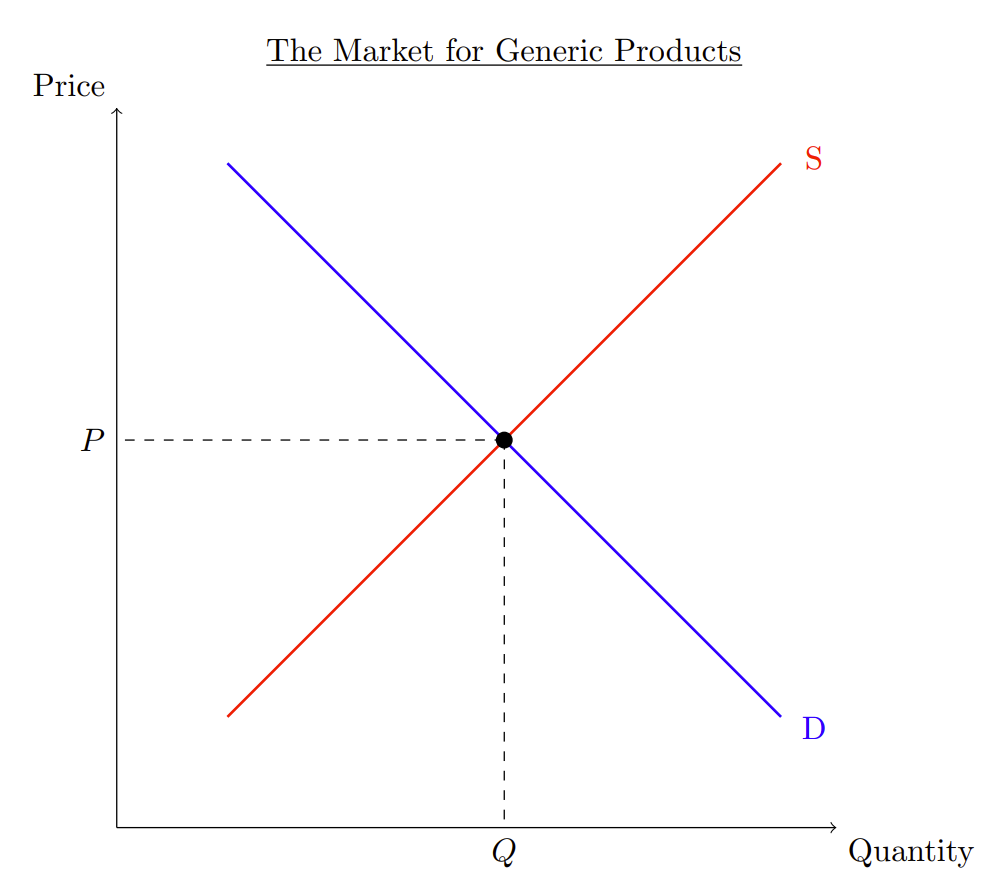
We can therefore model these two distinct markets, and evaluate what
happens when a “generic” good is replaced with a more “specific” good.
Put another way, we shift from a consumer with John’s preferences to one
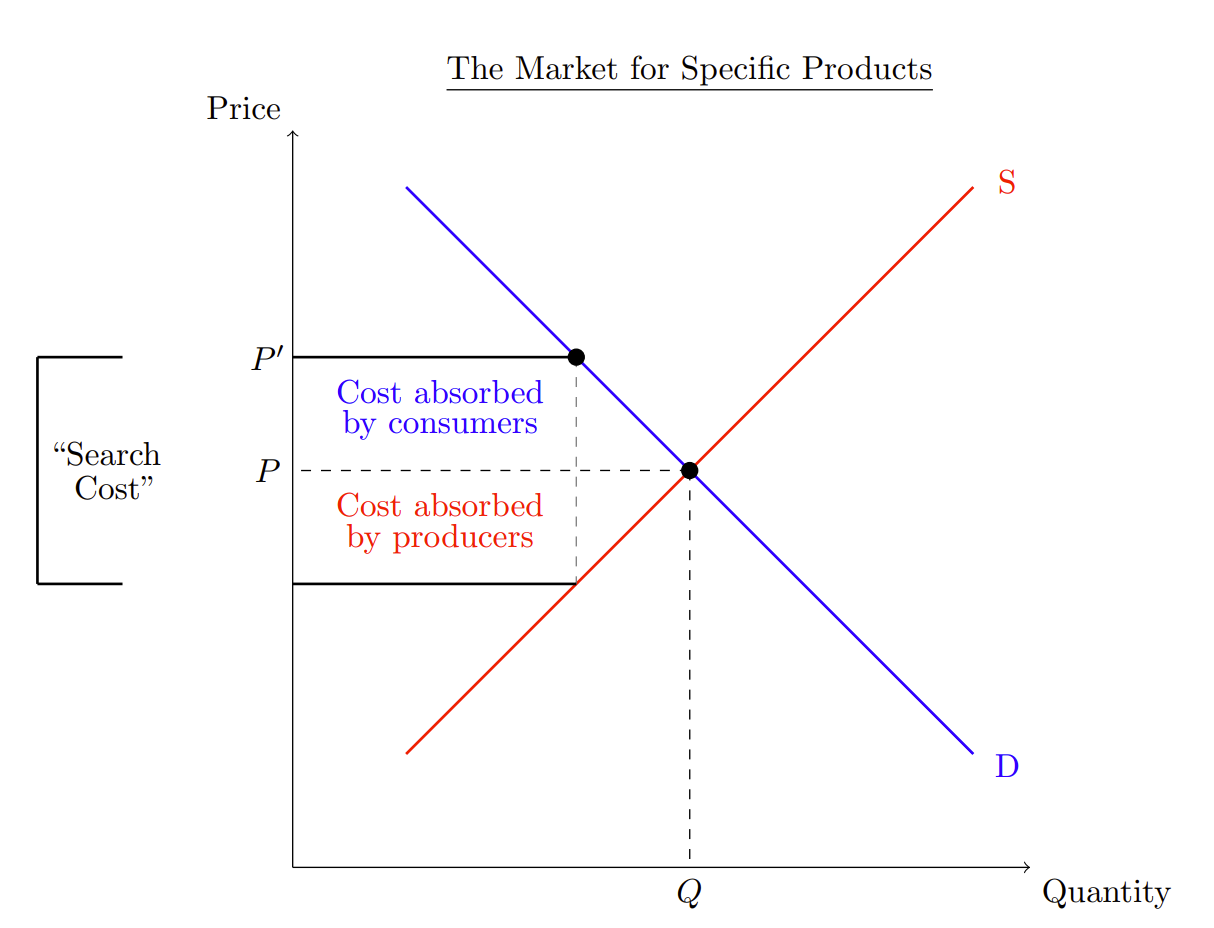
with Jane’s, all else held equal. See below:
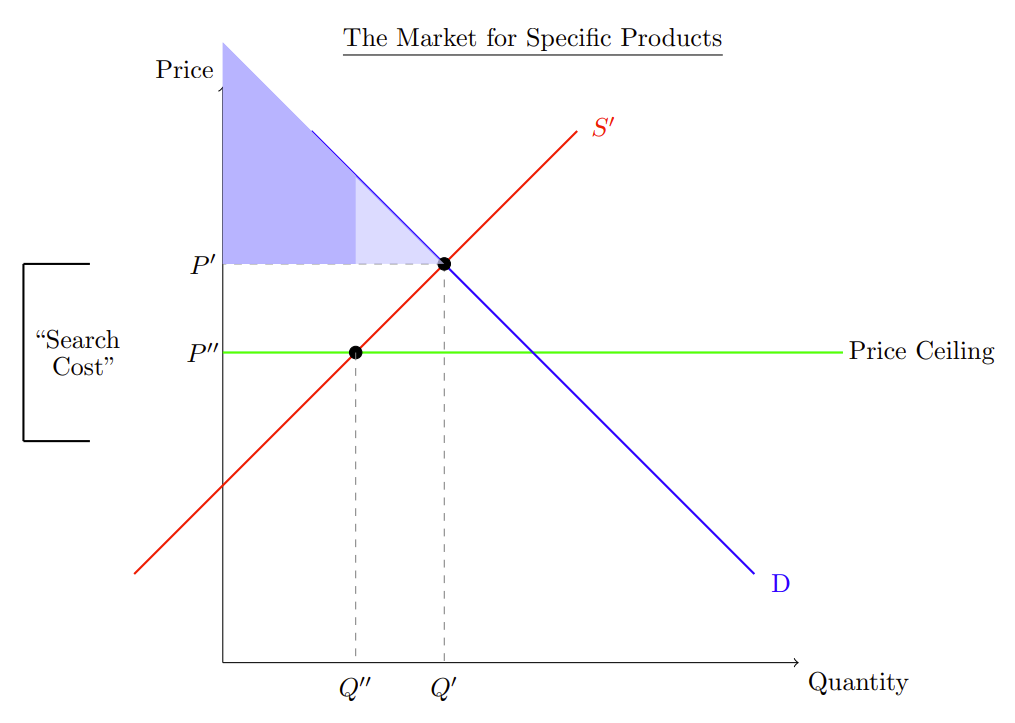
In the example above, an introduced “search cost” is shared by both
consumers and producers, raising the equilibrium price compared to
markets with lower search intensity. Producers absorb part of this cost
by investing in or renting assets that mitigate the “search” burden;
for example, a potato producer may build a brand for a specific type of
potato, or may package potatoes in ways that help consumers recognize
the right potatoes sooner. Consumers absorb some of the search cost by
increasing the reward to suppliers for providing a more correct product,
paying a premium for a more suitable product.
As economists Klein, Crawford, and Alchian have described, consumers
are willing to pay a premium to suppliers who fulfill expectations.
Without the price premium, sellers are more induced to “cheat,”
misidentifying their products to consumers.
Prices rise when they include added search costs. We should expect,
then, slightly higher prices for products that women search for
characteristics, while men do not. The aforementioned studies explicitly
mention three products with the largest gender disparity: cosmetics
(shampoo, etc.), haircuts, and dry cleaning. These are all products
where men clearly search for more generic goods than women. It would be
no rash generalization to describe men’s haircuts as “make it shorter,”
and men’s shampoo choices as utterly indiscriminate of ingredients,
specific use, or even scent. Two shampoos may have the same ingredients,
but women’s shampoo might be branded more specifically (‘sulfate free,’
or ‘color protecting,’ or ‘all natural ingredients’) because they
search relatively more.
But we needn’t rely only on the most obvious cases. Why, as one study
shows, does a girl’s bicycle helmet have an equilibrium price higher
than a nearly identical helmet for boys? One explanation is market
segmentation — charging different groups according to their (presumably
different) willingness to pay. But there’s another possibility: women
face, and are willing to pay, higher search costs.
Why women might have these preferences and be willing to pay a
premium for them where men and boys are not — for example, to achieve a
particular hair texture, to have a basket and a bell included on a bike,
or because they really do enjoy using a pink product more than a black
one — is not the economist’s to examine. It is enough to know women
reveal the preference of being willing to search and pay slightly more
for their particular, preferred potato.
Consumer Welfare Implications
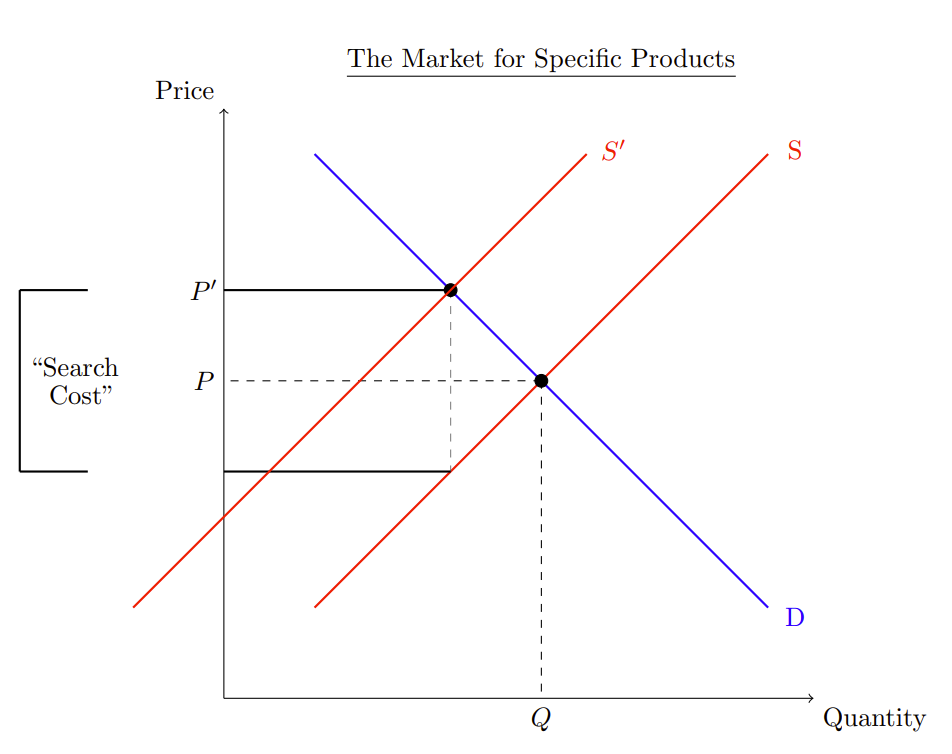
Legislation that bans price premiums for women’s products has
predictable consequences. We can model the market for specific products
resulting in a higher equilibrium price. I previously omitted this step
for clarity, but show it below (along with a price ceiling) to
illustrate the impact on consumer welfare.
Consumer surplus (a measure of how much satisfaction buyers gain from
a purchase) shrinks from the blue triangle to the darkly shaded
trapezoid. Producer surplus also declines. A price ceiling might
improve welfare if firms were mistakenly overpricing products for women.
But, as shown earlier, that doesn’t appear to be the case. Women tend
to pay more for products they search for more intensively. Producers, in
turn, invest in branding that reduces those search costs — like making
the product pink or highlighting desirable traits more clearly. A price
ceiling only creates a relative shortage, further shrinking women’s
consumer surplus.
Unless we assume women consistently fail to substitute away from
more-expensive products they do not actually prefer, a price ceiling is
unlikely to enhance their well-being."
During the first half of the twentieth century, many US
states enacted laws restricting women’s labor market opportunities,
including maximum hours restrictions, minimum wage laws, and night-shift
bans. The era of so-called protective labor laws came to an end in the
1960s as a result of civil rights reforms. In this paper, we investigate
the political economy behind the rise and fall of these laws. We argue
that the main driver behind protective labor laws was men’s desire to
shield themselves from labor market competition. We spell out the
mechanism through a politico-economic model in which singles and couples
work in different sectors and vote on protective legislation.
Restrictions are supported by single men and couples with male sole
earners who compete with women for jobs. We show that the theory’s
predictions for when protective legislation will be introduced are well
supported by US state-level evidence.
That is by Matthias Doepke, Hanno Foerster, Anne Hannusch, and Michèle Tertilt."
This year’s Women and Progress report explains the construction
of the Gender Disparity Index (GDI), which estimates the degree of
gender disparity in economic freedom in each of 165 countries around the
world.
It also illustrates the effects of restricting female economic freedom.
We
compare the gender-adjusted measure of economic freedom to a broad
sample of economic indicators of women’s well-being such as health,
labor market, and educational outcomes. Countries are sorted into
quartiles according to their gender-adjusted economic freedom scores and
the average outcomes are compared across quartiles, from most free to
least free. Countries with greater economic freedom tend to have more
desirable scores on the measures of well-being.
15 countries
moved towards gender parity under the law by permitting women to make
more of their own economic choices. Gabon showed the greatest overall
improvement since 2020, as it removed barriers to a woman’s ability to
own property, open a bank account, head a household, work a job, and
choose where to live. It also ended the legal requirement that a woman
must obey her husband. In 2020 Gabon was among those countries with the
most pervasive restrictions on women’s economic rights. It now has
complete gender parity in economic freedom.
There have been
setbacks: Niger and Saudi Arabia both showed decreases in their overall
GDI scores. Saudi Arabia reinstated formal restrictions on women’s
mobility, removing a woman’s right to choose where to live or travel
outside the country, while Niger imposed new barriers to women working
industrial jobs.
"The labor force participation rate among working-age men is now about
five percentage points lower than in the early 1980s. As a result, there
are about 3.5 million fewer men between the ages of 25 and 54 in the
workforce, and 1.3 million between the ages of 25 and 34, than there
would have been were it not for this decline."
"So where have all the good working men gone? Some are subsisting on
government benefits or living off their parents. About 17% of
working-age men are on Medicaid, 7.4% on food stamps and 6.3% on Social
Security (many claiming disability payouts), according to the Census
Bureau. Many spend their days playing videogames and day-trading."
"Only about 41% of men complete a bachelor’s degree in four years, and about a quarter take more than six.
Many high-paying vocations don’t require college degrees, but
government subsidies and public K-12 schools nonetheless steer
high-school students to that track."
"Federal student loans won’t pay for apprenticeships, but they will cover
the cost (including living expenses) of worthless graduate degrees in
community organizing, creative writing, tourism, dance and more. Rarely
does one need an advanced degree to enter such fields"
"The unemployment rate among recent college grads with a sociology degree
is 6.7% and their median wage is $45,000, according to the New York
Federal Reserve Bank. Sociology grads could earn twice as much working
on an auto assembly line, which pays on average $100,000 a year. Good
gig, but not many want it."
"Only 31% of blue-collar workers feel that their type of work is respected"
"March is Women’s History Month, a time to acknowledge and celebrate
many “firsts” for women in public life. One of those “firsts” is the
ability for American women to open a credit card independently, without a
husband or father’s cosignatory, following the passage of The Equal Credit Opportunity Act
(ECOA) by Congress in 1974. This bill prohibited discrimination in
credit transactions based on sex or marital status and is generally
considered a landmark for women’s financial independence. However, this
is only partly true.
The ECOA made it illegal for banks to discriminate based on sex or
marital status. The law didn’t grant women access to credit but, rather,
formalized their ability to sue for discrimination. Much like women had
been voting in American elections since the 1700s, before passage of the 19th
Amendment to the US Constitution, women had also been navigating loans,
credit, and the financial system long before the 1974 law.
In the 19th century, both single and married American
women relied on local stores and small businesses for credit. These
businesses often granted credit based on personal trust and reputation,
allowing women to purchase necessary items even without ready cash. A
charge account at a general store, restaurant, or similar establishment
could be settled at the end of the week or paid periodically. Like in
the TV show Cheers, at a place “where everybody knows your name,” it’s
harder to skip out on a bill and easier for businesses to give grace to
customers who need it. This non-mandated, localized credit access was
particularly important to women.
Prior to the 1970s, marriage too often dictated the terms by which
women accessed credit. Since married women’s property was also owned by
their husbands, “only unmarried women could independently form contracts
and engage in litigation…” the author of To Her Credit writes in her book examining the finances of women during America’s 18th century Revolutionary period. She found that“[women
in Boston and Newport] appeared in debt litigation as creditors and
debtors in roughly equal proportions,” however, “women’s credit networks
were predominantly local.” Women routinely made purchases on credit,
signed contracts, participated in court cases, and settled debts. At
that time, married women also commonly extended lines of credit to their
unmarried friends.
A hallmark example of a Revolutionary-era woman navigating the financial system is Abigail Stoneman, a widow who opened and operated inns and teashops in New England in the 1700s. She also extended
lines of credit to other business owners and her own customers. In
fact, there are many documented appeals in local newspapers by creditors
like Stoneman requesting repayment from debtors.
But credit access differed from state to state. For example, in 1848, the Married Woman’s Property Act
passed in New York, and established that a woman was no longer liable
for her husband’s debts, could enter contracts on her own, was able to
collect rents or receive an inheritance in her own right, and could file
a lawsuit on her own behalf. The act became a model for other states.
The rise of department stores and catalogs
By the late 19th and early 20th centuries came the emergence of department stores and mail-order clothing catalogs. Larger businesses were able to offer more formalized credit options, catering to women’s shopping experiences. The “charge plate,” akin to an in-store card, was somewhat of a predecessor to modern credit cards. Although single women faced more challenges
in securing credit, they could still apply and receive credit by
providing proof of financial stability. Over time, these store accounts,
costly to maintain and collect on, gave way to portable credit cards
managed by banks that could be used at other stores.
Leading up to the ECOA
In the early 1970s, women’s organizations gathered testimony from
women nationwide describing their hassles receiving letters of credit
and financial services from local banks. These letters were presented in
a hearing before the National Commission on Consumer Finance in May
1972. This and subsequent hearings helped inform the 1974 bill.
Although the bill was passed, it did not guarantee that women or
women-owned businesses would be considered creditworthy by banks. It
merely allowed them to pursue legal recourse for discrimination based on
sex.
Women’s banks
Still, in response to the need for women’s creditors, bank
entrepreneurs opened a small number of women’s banks following the
bill’s passage. The First Women’s Bank in New York City opened in 1975.
Principal advocates for the ECOA Stephanie Lipscomb and Jeanne Hubbard
were instrumental in its founding. Similarly, The Abigail Adams National
Bank, originally known as the Women’s National Bank, was founded in
1977 in Washington, D.C.
Although both banks have since changed their names and pivoted their
financial services away from primarily serving women, these banks helped
challenge societal perceptions about women’s roles in the economy,
enabling women to take control of their economic destinies and
contribute more fully to the economy.
Women in finance
During Women’s History Month, it is important to recognize that women
had been creatively and successfully navigating the financial system in
the United States long before Congress intervened in the 1970s. This
historical context underscores the resilience and ingenuity of
generations of women who forged a path to success that included access
to credit. The passage of the ECOA was a significant milestone, but it
built upon a foundation of determined women who had already made
substantial strides in business and entrepreneurship."
"There’s growing evidence that girls and women aren’t pursuing STEM
careers because they’d simply prefer not to. That is, that sex
differences in the STEM workforce may largely be a product of sex
differences in interests and priorities."
"if discrimination were preventing women from entering STEM fields, then
women in countries with less gender equity, such as in the Middle East
and South Asia, would surely be less likely to pursue STEM careers than
women in countries with greater gender equity, such as in Scandinavia.
After all, there must be more barriers for women who want to be
scientists in Algeria than in Finland. In fact, we see the opposite:
Women make up over 40% of the STEM graduates in Algeria and only 20% in
Finland. This pattern can be seen around the world."
"Countries with less gender equity tend to be poor, and careers in STEM
are one of the clearest routes to financial success anywhere. Women with
strong quantitative skills in poor countries have good reason to enter
the sciences to make a living. Women in relatively rich countries can
afford to pursue less lucrative careers without risking a life of
poverty."
"Why are women consistently more likely to become sociologists than chemical engineers?"
"A better
explanation for lasting sex differences in various disciplines, I
believe, is that they reflect the inherent attractiveness of different
fields to men and women.
"women tend to be more
interested in careers that involve working with other people while men
prefer jobs that involve manipulating objects, whether it is a hammer or
a computer."
"Studies
published in the Personality and Social Psychology Bulletin in 2016, for
example, found that women were more responsive to pictures of people,
while men were more responsive to pictures of things."
"the STEM fields with more men, such as engineering and computer science,
focus on objects while those with more women, such as psychology and
biomedicine, focus on people."
"girls on average
outperformed boys in both STEM and non-STEM subjects but rarely pursued
STEM in college if they were just as strong in other things."
"women are generally more likely than
men to have skills in non-STEM areas, while men who are strong in math
and science are often less skilled elsewhere."
"In every country, female students outperform male students in verbal tasks."
"It is likely, then, that girls who are strong in STEM subjects have more
options for what careers to pursue, given their strengths elsewhere."
"Some say
that diversity in and of itself is good for business. Consulting firms
and activists have advised that adding women and minorities to a
company, especially its board, will magically cause profits to grow.
Credible research has always shown this was wishful thinking.
Frequently
cited McKinsey studies have found a strong link between firms’ earnings
and the racial and ethnic diversity of their executives. The consulting
firm doesn’t make its data public, but in 2024 business researchers Jeremiah Green and John R.M. Hand were unable to replicate the results with data from S&P 500 companies. In 2020, Robin J. Ely and David A. Thomas
further debunked the “add diversity and stir” approach in Harvard
Business Review: “We know of no evidence to suggest that replacing, say,
two or three white male directors with people from underrepresented
groups is likely to enhance the profits of a Fortune 500 company.”
The
available research focuses overwhelmingly on correlations between
diversity and performance, rather than causation. Another Harvard
Business Review article notes a link between businesses’ DEI rankings
and various measures of their dynamism and culture, which in turn are
linked to performance. But the authors concede that causation is
“difficult to prove.” If the most successful businesses also face the
most pressure to improve DEI metrics, it’s plausible that increased
profits may cause diversity efforts, not the other way around."
"Girls
have lost ground in reading, math and science at a troubling rate,
according to a Wall Street Journal analysis of student test scores
across the country.
Since
2019, girls’ test scores have dropped sharply, often to the lowest
point in decades. Boys’ scores have also fallen during that time, but
the decline among girls has been more severe. Boys now consistently
outperform girls in math, after being roughly even or slightly ahead in
the years before 2020. Girls still tend to perform better in reading,
but their scores have dropped closer to boys.
The
findings suggest that pandemic learning loss hit girls particularly
hard in ways that haven’t been addressed by schools. The most recent
test scores show that girls haven’t yet recovered. This comes following
longstanding gains for girls and women in educational attainment.
Teachers, parents and education researchers aren’t sure what is driving
the gender gap in learning loss, but some suspect the rise in behavior problems during the pandemic years prompted teachers to pay more attention to boys, who tend to act out more in class. Another factor may be the caregiving and household responsibilities many girls took on during and after the pandemic, sapping their time and energy for school."
"Shutting down schools might have hurt girls more because they tend to do better in school generally, said David Figlio,
a professor of economics and education at the University of Rochester
who has studied gender gaps in education. “Girls have a comparative
advantage in school and you take schools away, they’ll suffer more,” he
added.
Another
hypothesis is that girls took on more household duties during the
pandemic—including taking care of younger siblings—so were less able to
focus on school.
On some tests, this gender gap in learning loss was larger in later grades and in math, the Journal’s analysis found."