"When the lights went out in Texas earlier this year, corporate media
and the left swiftly developed a narrative and stuck to it: Texas failed because it didn’t regulate enough and it wasn’t part of the national grid.
This storyline also claimed a lack of electricity from wind and solar had nothing to do with the disaster that claimed 111 lives.
Instead, the blackouts were the failure of normally reliable thermal
power—natural gas, coal, and nuclear—due to a reluctance to spend
billions of dollars to winterize facilities throughout a state more
known for persistently hot summers than for transient polar vortices.
A variant of this liberal argument was posited by Pedro Gonzalez at
American Greatness. The headline echoed the corporate media’s main gloat
over Texas’s misfortune: “When the Free Market Freezes Over.” Unfortunately, Gonzalez, as with leftist media and the environmentalists he draws upon, make a few assertions that turn out to be not quite so.
Correcting the record is important since assigning the wrong reasons
for Texas’s electric blackouts will lead to the wrong solutions.
How Much to Blame Wind
Gonzalez starts with the observation that at the root of Texas’s
failure is “an indictment of a bought, unresponsive, ruling class.” This
is likely his essay’s most correct statement, although not quite in the
way he thinks. Gonzalez then repeats the oft-claimed charge that the
blackouts were driven by thermal power failures with “wind shutdowns
account(ing) for less than 13 percent of the outages.”
It is true that natural gas production in Texas, much of it in the
Permian Basin in the west, dropped by about 75 percent soon after the
cold front hit. Unfortunately, a cloud of disinformation peddled by the
unreliables lobby (for wind and solar) and corporate media fed a false
narrative that the failures were due solely to a lack of weatherization.
The reason for the drop in natural gas available for power generation
is complicated, but a partial picture of what happened emerged from
some 50 hours of sworn testimony before both houses of the Texas
legislature on Feb. 25 and 26. Those hearings indicated there may have
been some loss of gas supply due to wellhead freeze-offs and cold
pipeline problems.
But unmentioned by critics was that ERCOT (Electric Reliability
Council of Texas) and Oncor, the Texas grid operator and one of its two
large regulated electric transmission and distribution providers,
respectively, inexplicably decided to cut power to the oil and gas fields, compressors, and pipeline infrastructure responsible
for fueling the gas-fired power plants that were laboring mightily to
keep the lights and heat on in Texas. Thus, human error played a role.
Additional natural-gas supplies were diverted to home heating needs
during the record cold. Gas supply ramped up commensurate with
electricity provided to the gas production infrastructure. The loss of
power to oil and gas infrastructure was also made worse by an Obama
administration environmental edict that forced the oil and gas industry
to replace natural gas pipeline compressors powered by natural gas with
electric compressors.
That regulated industries and the regulators who oversee them—ERCOT
and the Public Utilities Commission of Texas (PUC)—failed to recognize
the critical nature of Texas natural gas infrastructure was hardly a
failure of the free market, as Gonzalez and the left allege. It was a
failure of government regulators.
The Failures Accumulated Into One Big Storm
Gonzalez quotes me: “Chuck DeVore, vice president of the Texas Public
Policy Foundation, took a similar line as Abbott. ‘Blackouts are a
feature of the push to have more unreliable renewables on the grid,’ he
tweeted, adding that energy subsidies are bad, too.”
Gonzalez quotes from ERCOT, the very grid operator responsible for
much of Texas’s disaster, noting that, “wind shutdowns accounted for
less than 13 percent of the outages. ‘It appears that a lot of the
generation that has gone offline today has been primarily due to issues
on the natural gas system…’” But focusing on the days of the power
outage is a strawman. Texas’s energy history didn’t start with
February’s blackouts. Rather, it is the culmination of 20 years of bad
policy.
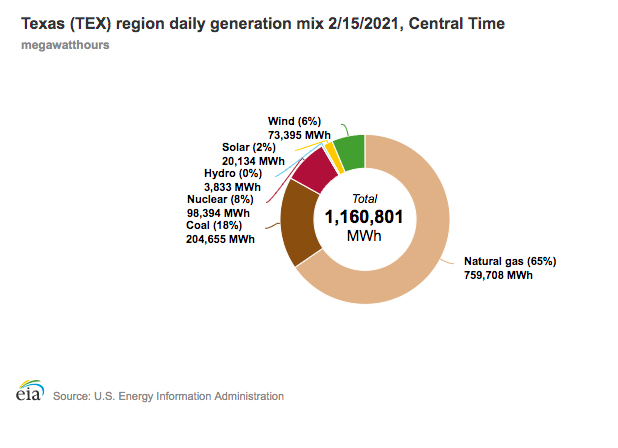
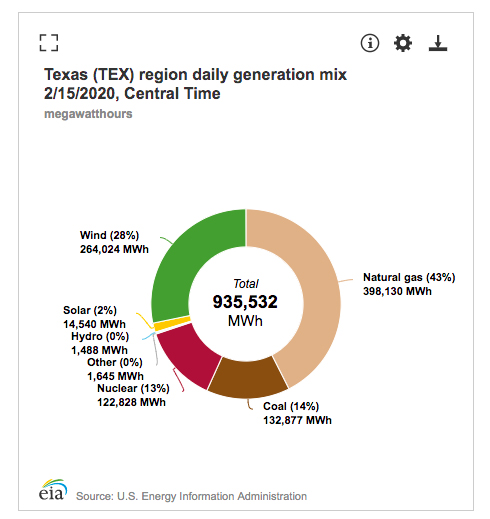
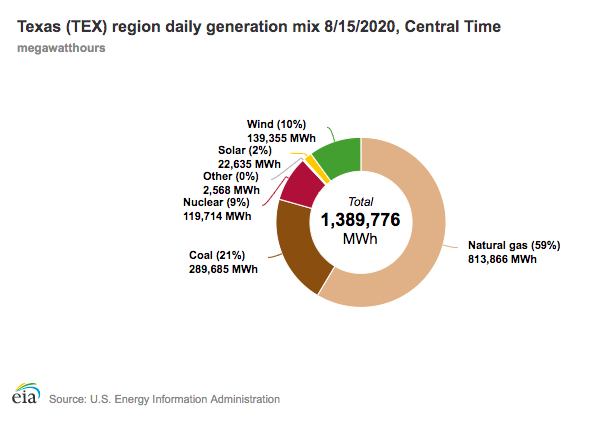
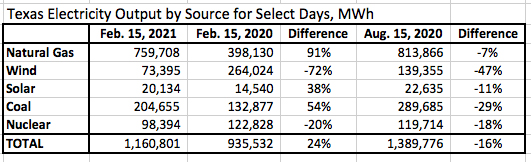
It’s true that of 31,000 megawatts of installed mostly wind and some
solar capacity in Texas, only about 300 megawatts were producing at a
critical time during the storm. It’s also true that not much was
expected from the unreliables—they generally don’t do well in adverse
conditions.
Yes, some 16,000 megawatts of thermal (gas, coal, and nuclear) went
offline early morning on Feb. 15, with another 14,000 megawatts offline
due to maintenance to prepare for Texas’s long, hot summer. But the
focus on what happened just after 1 a.m. on Feb. 15 misses how we got to
this point over decades.
Texas Has Substituted Unreliable for Reliable Backups
In the last five years
alone, Texas added some 20,000 megawatts of installed capacity of wind
and solar while losing a net of 4,000 megawatts of coal and natural gas.
This fact alone meant that had every thermal plant operated flawlessly
during the height of the polar vortex, Texas still would have been short
some 2,000 megawatts of potential demand—a new record in a state that
is used to setting electricity consumption records in the summer.
Texas has rapidly become the nation’s leader in wind power largely
due to a federal tax incentive called the Production Tax Credit (PTC).
First enacted in 1992, the PTC expired in June 1999. It was extended for
two more years in late 1999 with an expiration of Dec. 31, 2001. The
PTC was expected to be dead by 2001 when, in 1999, the Texas legislature
debated and passed its electricity deregulation bill, SB 7. SB 7 went
into effect on Jan. 1, 2002. The PTC lay dormant until it was again
revived by Congress in March 2002.
The PTC has a significant share of blame in Texas’s recent blackouts
in that it incentivizes wind generators to push electricity into the
grid even when an abundance of wind, typically in the middle of the
night, pushes wholesale electricity prices into negative territory. Wind
generators, some owned by foreign governments, can pay the grid to take their power
and still make money because the PTC pays them federal tax money for
every megawatt they produce. This economic distortion, deepened by
Texas’s own property tax abatements for wind and solar, have acted to
discourage investment in reliable thermal power plants.
This isn’t the free market in operation, as The New York Times and Gonzalez allege—quite the contrary.
Lack of Weatherization Isn’t the Whole Story
So, about those thermal plant failures, were they due to a lack of
weatherization, as the unreliables lobbyists and Gonzalez suggest, or
was something else at play? In sworn testimony before the Texas
Legislature, it became very clear that cold weather failures were only a
portion of the problem, likely less than half.
Most of the thermal plants either tripped offline due to power grid
frequency fluctuations—likely ERCOT’s fault for not load shedding
quickly enough—or because they were starved of fuel. Importantly,
neither problem would have been solved by billions of dollars more in
weatherization.
Gonzalez moves next to the unfortunate stories of Texans who used
their ability to select their retail electric provider—about 80 percent
of Texans within the ERCOT grid have retail choice—to choose Griddy as
their provider. These customers were slammed with bills that in some
cases exceeded $10,000.
But context is key. ERCOT manages the flow of electric power to 26
million Texas customers, with about 7.5 million meters in that region
having retail choice. Griddy served about 30,000 meters, or 0.4 percent
of the competitive market. Griddy filed for bankruptcy on March 15 and the $29 million in high electric charges it passed on to its customers will be forgiven.
Lastly, Gonzales repeats the false refrain that Texas’s winter storm
of 2011 was “nearly identical” to the St. Valentine’s Day storm of 2021.
But February’s storm was substantially worse, and the duration of the
cold lasted far longer.
In San Antonio, for example, the 2011 storm saw a low of 19F with
temperatures remaining below freezing for two days. In 2021, the low
dipped to 9F, with temperatures below freezing for four solid days.
Dallas, Austin, and San Antonio broke seven record lows over three days
during the event—not at all “identical” circumstances.
Even in the face of a record-breaking storm, most of the power
failures can be traced to human error—both in regulatory management of
the grid and in a failure to account for how subsidies encourage
over-building unreliable wind and solar while discouraging the
construction of new thermal plants.
Weakening the Grid for Politics Hurts Texans
So, when Gonzalez concludes by observing that, “the bigger picture
comes into view as an indictment of a bought, unresponsive ruling class,
weaseling its way from one bubble to the next, letting everyday
Americans socialize the cost one way or another,” he’s right, after a
fashion, but not in the way he says.
Rather, Texans have suffered as the unreliables lobby has linked up
with huge industrials to provide subsidized wind power while
destabilizing Texas’s grid. Manufacturers get two things out of this
deal: cheap electricity and virtue signaling about their “no-carbon”
footprint.
Meanwhile, the cost of reliability gets pushed to everyday
Texans—socialized—with the tab going up as more extreme measures come
into play to keep the lights, heat, or air conditioning on in a grid
with increasingly more unreliables and less thermal year after year.
Unfortunately, Texas—and California and the other 12 states on the
Western Interconnection grid—are at high risk for blackouts this summer
for much the same reason: Texas has overbuilt wind while California has
overbuilt solar. Both have placed enormous financial pressure on
reliable thermal generation, causing many thermal power plants to be
retired prematurely or not built at all.
The more dependent the entire U.S. grid becomes on unreliables, the
more it is increasingly at risk of blackouts. One way to prevent this is
to assign a value to reliability and resiliency, forcing intermittent
sources of electricity to pay for the cost of ensuring backup—whether
through massive battery farms or via contracting with thermal plants
that may remain idle until needed—thus ending the dangerous fiction that
unreliables are cheap.
As a postscript, Public Utility Commission of Texas Chairman DeAnn
Walker resigned on March 1 with the other two commissioners tendering
their resignations soon after. At ERCOT, seven of its 14 board members,
including all five of the nonprofit’s out-of-state members, have
resigned and its CEO was fired.
Meanwhile, the Texas legislature is considering two bills—SB 1278 by Sen. Kelly Hancock and HB 4466 by Rep. Phil King—to
assign the cost of rebuilding grid reliability to the wind and solar
installations that have done so much to undermine it, leaving Texans
shivering in the dark.
Chuck DeVore is vice president of national
initiatives at the Texas Public Policy Foundation and served in the
California State Assembly from 2004 to 2010."