"A recent posting at the American Compass describes a trade
problem that is not really a problem and then prescribes three bold
solutions that are not really solutions. If implemented, their proposals
would in fact create real problems for an American economy struggling
to tame inflation and dodge a recession.
Like many skeptics of trade, American Compass focuses on the trade deficit as a sign of failure of U.S. trade policy. Here’s how it summarizes the problem:
“America imports massively more than it exports, leaving us deeply
indebted to our trading partners. Rather than exchange American goods
for foreign goods, we import on credit, sending back IOUs and ownership
of our economy, which future generations will pay for. In the process,
we allow the erosion of American industry and innovation, the decline of
manufacturing employment, and the collapse of communities.”
To combat the deficit, the American Compass proposes three sweeping
new tax and licensing systems on international commerce: 1) a Global Tariff on all U.S. imports starting at 10 percent; 2) a licensing system of Import Certificates that would ration the value of U.S. imports to equal the value of U.S. exports; and 3) a Market Access Charge of 50 basis points or more on all foreign purchases of U.S. assets, i.e. inward foreign investment.
Before I count the ways that each of these prescriptions would damage
the economy and the well‐being of Americans, let’s examine what’s
wrong with the diagnosis.
The Non‐problem of the Trade Deficit
The U.S. trade deficit is not a problem to be solved, but a basic
feature of a U.S. economy that excels at attracting foreign investment
from around the world. That investment, which even American Compass folks occasionally celebrate, keeps domestic interest rates lower than they would be otherwise and fuels job creation, innovation, and the construction or modernization of plant and equipment at U.S. factories.
American Compass complains that years of trade deficits have only
succeeded in piling up “more than $13 trillion of trade debt.” That
figure is a misleading way of describing America’s “net international investment position”—the
difference between the value of assets abroad owned by Americans and
the value of U.S.-based assets owned by foreigners. At the end of 2020,
the difference was indeed more than $13 trillion, with foreign‐owned
assets in the United States totaling $46.7 trillion and U.S.-owned
assets abroad $32.0 trillion. But that difference is not “debt” in any
normal sense. Most of the assets that foreigners own in the United
States are in the form of foreign direct investment (FDI) in U.S.
companies and portfolio investment in equities. When people outside the
United States invest $1 billion in Apple Inc. stock or an automobile
factory in Tennessee, this is not debt our children need to repay, but
an infusion of new capital into the American economy.
The critics push back that almost all inward FDI comes in the form of
mergers and acquisitions rather than “greenfield” investment in new
plants. But as my Cato colleague Scott Lincicome has argued,
this misses the important fact that those mergers and acquisitions
allow U.S. sellers to reinvest those funds in other enterprise,
injecting additional capital into the U.S. economy. Those transactions
also encourage further investment in domestic firms that may then draw
foreign partners in the future. Foreign acquisitions also typically lead
to improved production methods, better marketing and customer service,
and greater investment in research and development. The net inflow of
FDI enhances the productivity of the nearly 8 million Americans who work for foreign‐owned affiliates in the United States, boosting their wages and benefits.
Whatever its composition, the $13 trillion in “trade debt” is
economically sustainable. Americans routinely earn about $200 billion
more each year on their investments abroad than what foreigners earn on
their investments in the United States. And $13 trillion may seem like
a big number, but according to the Federal Reserve Board’s quarterly
“Financial Accounts of the United States,” the net worth of American households, non‐profits, and businesses (corporate and non‐corporate)
at the end of 2020 was a whopping $170 trillion. Far from selling off
our assets to fund consumption, the net worth of Americans has been
growing impressively since the Great Recession of 2008-09. The inflow of
foreign capital has made America a wealthier place.
The American Compass critique is even flimsier when it claims that
trade deficits have been bad for American industry. It’s true that
manufacturing employment has been on a downward trend, but that has been
true for decades. The decline is driven more by rising productivity in
manufacturing rather than by rising imports—and it’s been happening (often even more steeply) in countries such as Japan and Germany with persistent trade surpluses. Meanwhile, total manufacturing value‐added in the United States, adjusted for inflation, has increased 36 percent since 2000—reaching a record $2.5 trillion in 2021. The struggles of certain communities tied to heavy industry, such as Youngstown, Ohio, date back to the 1970s, before trade deficits became an issue.
To address this non‐problem of the trade deficit, American Compass
calls on the federal government to dramatically extend its powers to tax
and regulate America’s international commerce. Leaving aside the
obvious conflicts these policies would have with U.S. international
trade agreement commitments, each suffers from serious economic flaws:
Non‐solution #1: The Global Tariff
The first club American Compass would wield is a “Global Tariff.” The
tariff would start at 10 percent on all imports, rising by another
5 percentage points each year if the trade deficit persists. If the U.S.
runs a trade surplus, the global tariff would fall by 5 percentage
points in the following year.
This crude sledgehammer would do nothing to “cure” the trade deficit.
As the American Compass authors acknowledge, such a tariff would not
alter the net inflow for foreign investment, which by necessity mirrors
the trade balance. Despite the tariff, foreign investment would continue
to flow into the United States, filling the gap between the level of
domestic savings and investment. That’s why the U.S. goods deficit remained high under the Trump administration, around $800 billion a year, despite its escalating tariff war with China and other major trading partners.
A global tariff on U.S. imports would reduce overall trade but not
the trade deficit. To the extent it discourages imports, it will cut the
flow of dollars into the foreign exchange market, driving up the
dollar’s value and discouraging exports, while likely spurring
retaliatory tariffs as well. Both imports and exports would fall in
roughly equal measure, leaving the trade deficit fundamentally
unchanged. Without a change in the trade deficit, the global tariff
would continue to rise unchecked until it would virtually cut the United
States off from international trade.
The global tariff would drive up the cost of living for American
workers and families and the cost of business for American producers.
U.S. businesses would be forced to pay more for imported components,
commodities, and capital machinery, making them less competitive in
global markets. For American households, the tariff would fall
disproportionately on lower‐income households, which spend a higher
share of their incomes on more tradable goods such as food, clothing,
footwear, and housewares. It would further reduce the real wages of
American workers, who are already struggling under the highest inflation
rate in 40 years.
Proponents of the global tariff wistfully claim that the higher
prices would be offset by the redistribution of tariff revenue. They
claim, for example, that the tariff revenue could be used to offset
sales taxes, but of course it’s the federal government that collects the
tariff revenue while it is states that impose sales taxes. Do they
assume the debt‐ridden U.S. treasury will send billions to California,
New York and other states so they can reduce their sales taxes? That is
not likely. In practice, their tariff would act as a regressive tax that
would widen income inequality.
Non‐solution #2: The Import Certificate
Under this second club, Congress would create a licensing system that
would allow U.S. companies to import only when they can present
a government certificate authorizing the transaction. Companies could
earn certificates by exporting, and then sell them for the going price
on an open market—similar to “cap and trade” markets for pollution
control. A company that exports $100 million in, say, wheat or
semiconductors could then sell the certificate it earned to another
company that wants to import $100 million in bananas or shoes. The
system, if rigorously enforced, would in theory reduce the value of
imports to match the value of exports. Hocus Pocus, Alakazam, no more
trade deficit!
In practice, import certificates could be an even worse restriction
on international trade than the global tariff. It would create a kind of
“licensing raj” that was a sad feature of pre‐reform India, longtime economic basket‐case Argentina,
and other developing countries forced to ration foreign exchange
reserves. It would expand the power of the administrative state,
encourage smuggling, complicate supply chains and potentially create
shortages on retail shelves as well as factory assembly lines. Like the
global tariff, it would raise costs for U.S. households and producers
but without producing any tariff revenue that could—in theory, at
least—be used to compensate households or invest in public
infrastructure.
Like a tariff, import certificates would also fail to address
the underlying causes of the trade deficit. The national level of
savings and investment that drive cross‐border investment flows would
not be fundamentally altered. If the government attempted to enforce
such a licensing scheme, the value of U.S. imports would almost
certainly drop, but so too would the outflow of dollars from the United
States into global currency markets. This in turn would drive up the
value of the dollar, making U.S. exports and U.S. assets more expensive
and less attractive to foreign buyers. Imports and exports would both
fall in a death spiral, depriving the U.S. economy of the gains from
both international trade and investment.
Non‐solution #3: A Market Access Charge on Inward Investment
The third club proposed by American Compass would empower the Federal
Reserve Board to impose a “Market Access Charge” on the purchase of
domestic assets by foreign entities. Under their plan, the Fed would
start by charging 50 basis points (0.5 percent) on the value of any
foreign purchase of a U.S. asset. As with the global tariff, the Fed
would be directed to vary the charge depending on the size of the
deficit, “increasing it while the trade balance remains in deficit and
decreasing it once trade is balanced.” Banks would collect the charge
from cross‐border financial transactions and deposit the revenue in an
“American International Competitiveness Account” at the U.S. Treasury
“to be used for improving global competitiveness”—whatever that means.
A tax on inward capital flows is arguably the most serious of the
three “solutions.” It at least has the virtue of aiming at the
underlying cause of the trade deficit—the persistent net inflow of
foreign capital to the United States. A bill has been introduced in the U.S. Senate
that closely resembles the American Compass proposal. But like the two
clubs aimed at imports, it’s hard to imagine how making U.S. assets less
attractive to foreign investors will make Americans more wealthy and
prosperous. Russia’s war in Ukraine has made its assets less attractive,
downright toxic, to foreign investors. This may have even contributed
to an “improvement” in Russia’s trade balance, but the flight of foreign capital has caused real damage to its domestic economy and living standards.
If the access charge were to work as advertised, it would deprive the
U.S. economy of investment capital. Domestic savings would need to
rise, or the level of domestic investment to fall, for there to be any
real change in the trade balance. With U.S. household savings low, and
the federal government still borrowing a trillion dollars or more per
year, less inward foreign investment would likely translate into a lower
level of domestic investment (with federal borrowing crowding out
private investment). Less foreign demand for Treasury bills would put
downward pressure on bond prices, leading to higher interest rates,
driving up borrowing costs for the federal government, businesses, and
homebuyers.
In reality, the inward investment tax may have less impact than its
advocates predict. The United States remains the most popular “safe
haven” for global savings. The U.S. economy, and in particular Treasury
bills, offer global investors safety and liquidity in times of economic
or geopolitical uncertainty. In effect, the United States acts as “banker to the world,”
paying a lower interest rate on global inward investment while earning
higher returns by re‐investing those funds at home and abroad. An
access charge on U.S. assets is unlikely to fundamentally alter the
global appeal of U.S. assets, leaving the trade deficit intact while
expanding the taxing power of the federal government.
For all the reasons above, a persistent trade deficit at current
levels would be far preferable for the U.S. economy and the welfare of
Americans than any of the three radical interventions proposed by the
American Compass and its fellow travelers."

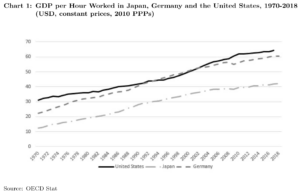 – GDP per hour worked in America remains above that in Germany and
Japan, which is strong evidence against Varoufakis’s claim that starting
in the 1960s and ‘70s factory productivity in America “fell behind
those of Germany and Japan, causing the US trade balance to slip into
the red.” And not only do American workers produce more output per hour
than do workers in Germany and Japan, Americans work more hours than do
the Germans and Japanese.* Therefore, Varoufakis’s suggestion that we
Americans for a half-century now have produced so little that we’re
compelled to import is ludicrous.
– GDP per hour worked in America remains above that in Germany and
Japan, which is strong evidence against Varoufakis’s claim that starting
in the 1960s and ‘70s factory productivity in America “fell behind
those of Germany and Japan, causing the US trade balance to slip into
the red.” And not only do American workers produce more output per hour
than do workers in Germany and Japan, Americans work more hours than do
the Germans and Japanese.* Therefore, Varoufakis’s suggestion that we
Americans for a half-century now have produced so little that we’re
compelled to import is ludicrous.