Showing posts with label Europe. Show all posts

Sunday, November 30, 2025

Europe Must Look Inward to Drive Growth, ECB’s Lagarde Says

Its growth model is ‘geared towards a world that is gradually disappearing’

By Paul Hannon of The WSJ. Excerpts:

"Instead of relying on fading external demand, Lagarde said the European Union must quickly lower its internal barriers, which prevent businesses from offering goods and services in other countries without costly efforts to comply with local regulations.

“ECB analysis finds that internal barriers in services and goods markets are equivalent to tariffs of around 100% and 65%, respectively,” Lagarde said." 

"“Reforms such as harmonizing VAT rules or establishing a common consolidated corporate tax base remain stuck because of national vetoes, leaving firms to navigate a maze of fragmented tax regimes,” she said.

Lagarde also advocated for the creation of what are known as “28th regimes”, or legal frameworks that apply across the EU which businesses could choose over national laws."

Parts of Europe at Risk of Downward ‘Spiral’ if Older Voters Stymie Reforms, EBRD Warns

By Paul Hannon of The WSJ. Excerpts:

"the EBRD [European Bank for Reconstruction and Development] concluded that later retirement, higher immigration and the adoption of new technologies to boost productivity could help offset much of the hit to growth from a shrinking working-age population." 

"political support for those measures may be weak in countries where older voters are dominant"

"Fertility rates in most post-Communist countries are below the 2.1 children per woman that would ensure a stable population. In parts of central Europe, the fertility rate is between 1.3 and 1.6 children"

"Fewer workers also mean that the annual growth of gross domestic product per head will be lower on average by 0.4 percentage points through 2050"

"governments should embrace overhauls that increase immigration, extend working lives, restructure pensions and harness technological innovation to boost productivity" 

Is Europe Awakening at Last to Its Economic Peril?

Milder-than-expected regulations, pro-business thinking. Something may be happening in the EU.

By Joseph C. Sternberg. Excerpts:

"on Nov. 13 [the EU] passed a tranche of climate regulations"

"lawmakers greatly reduced the number of European companies that would face onerous new reporting requirements by increasing the company-size thresholds at which the rules kick in."

"the European Commission (the European Union’s bureaucratic arm) proposed a weakening of Europe’s digital regulations. The goal is to make the Continent safe-ish for artificial intelligence—and for American tech companies."

"more permissive approach to regulating new AI technology."

"Ms. von der Leyen and other leaders are starting to demonstrate a capacity for self-reflection and reform"

"The steady productivity convergence with the U.S. that marked the decades after 1945 stopped around 1990 when European output per capita was 80% of America’s. Since then Europe has been drifting backward in relative terms, with per-capita output these days around 70% of the U.S."

"Taxes across the Continent are far too high to be consistent with investment and job creation."

"an impassioned plea for a looser regulatory approach to new technologies, less hostility to successful companies and financial reforms to let Europe funnel more capital toward its own entrepreneurs."

"Mr. Draghi’s warning that if Europe does not deregulate, it will not prosper."

"last year’s Continent-wide election for that body [European Parliament]. The result was a majority for parties of the political right" 

"Europeans will have to abandon the safetyism that created their regulatory morass and the magical thinking that spawned their net-zero climate policies." 

Sunday, November 23, 2025

Europe Aimed to Set Standards for Tech Rules, Now It Wants to Roll Them Back: Backed by France and Germany, the EU thinks easing back on legislation will make the bloc less dependent on U.S. tech

By Bertrand Benoit, Kim Mackrael and Sam Schechner of The WSJ. Excerpts:

"Europe is moving to relax some of the world’s tightest digital regulations in a bid to boost growth and reduce its reliance on U.S. tech."

"The European Commission . . . introduced a proposal to pare back some elements of its sweeping digital laws."

"measures that aim to make it easier for companies to use data to train AI models and delays to the enforcement of certain provisions in the EU’s new AI law."

"German Chancellor Friedrich Merz [said] . . .“Unnecessary regulation…must not inhibit Europe’s innovative strength.”"

"France and Germany would push for . . . EU’s AI rules to be postponed by a year and for Europe’s stringent data-privacy rules, known as the General Data Protection Regulation, or GDPR, to be relaxed."

"business leaders across Europe have grown frustrated at the torrent of legislation that has been gushing from Brussels"

"the resulting red tape a bigger obstacle to growth than President Trump’s tariffs."

"the simplest client question—does this rule affect me?—can take several lawyers two days to answer."

"the EU is now pushing to make the bloc more attractive for investment, seeking to ease the regulatory burden"

"European leaders also think a regulatory rollback will help the region’s economy reduce its dependence on" [the U.S. and China]

"“We have to innovate before regulating . . . said Macron."

"onerous regulations, especially on the handling of data, and political disagreements within Europe have hobbled the emergence of European players on a scale to rival their U.S. competitors."

"the top French and German business organizations wrote  . . . Europe . . . should focus on “creating a supportive investment climate" 

Sunday, August 31, 2025

Europe Is Losing

European nations have fallen far behind in economic dynamism and military clout. Will the continent that once ruled the world become a bystander to history?

By David Luhnow and Tom Fairless of The WSJ. Excerpts:

"The continent’s economies have been largely stagnant for about 15 years, likely the longest such streak since the Industrial Revolution, according to calculations by Deutsche Bank. Germany’s economy is 1% bigger than it was at the end of 2017, while the U.S. economy has grown 19%."

"Europe’s share of global economic output, measured in current dollars, fell from roughly 33% to 23% between 2005 and 2024, according to World Bank data. Much of that relative decline is due to the rise of China and India (and is less drastic using other measures of output), but the U.S. share of global output held up much better. Europe’s proportion of the global economy is now likely the lowest since the Middle Ages"

"European household wealth has grown by a third as much as Americans’ since 2009. Per capita GDP in the U.S. is now $86,000 a year, versus $56,000 for Germany and $53,000 for the U.K."

"Americans . . . have over 50% more living space on average per person. More than four in five Americans have air conditioners and clothes dryers at home, compared with between one-fifth and one-third of Europeans. Executive assistants in New York City earn around the same as specialist doctors in London."

"The average European is nearly 45 years old, compared with 39 for the average American, and the continent’s working-age population is predicted to fall by nearly 50 million by 2050"

"But Europe’s lack of economic dynamism has deeper roots, too. Taxes and regulations have risen inexorably; the volume of EU regulations has doubled since 2010. Sprawling rules protect old buildings, incumbent firms and aging consumers, limiting the creation of new infrastructure and industries. As Italy’s prime minister Giorgia Meloni puts it, “America innovates, China imitates, Europe regulates.”

Red tape in Britain is so bad that it took electricity firm Scottish Power 12 years to get permits for a high-voltage transmission line across Scotland. A project to build a new tunnel under the Thames river outside London has so far spent $340 million just on planning permits—documents that total 359,000 pages. Games Workshop, a fast-growing gaming company, is facing delays to build a new parking lot on its headquarters because a single bat lives there."

"In Germany, industrial electricity costs three times as much as in the U.S.; in the U.K., four times as much. Britons now consume less electricity per person than the Chinese, and Germany’s overall electricity consumption is lower than it was before the Berlin Wall fell. Yet Germany has banned nuclear energy, and the U.K. has scrapped new offshore oil and gas exploration."

"“In many sectors, Europe is uninvestable,” says Peter Huntsman, the CEO." [of Huntsman Corp., a Texas-based chemicals manufacturer]

"Ten years ago, four European companies ranked in the global top 10 by revenues. Today, the continent’s biggest company by market value, German software firm SAP, ranks 28th. America’s share of global stock market valuations has held steady at 48% since 2000, but the EU’s has fallen from 18% to 10%, and the U.K.’s from 8.3% to 2.6%"

"Mario Draghi, a former top European central banker, proposed a series of such steps in a landmark EU report last year, including pan-European capital, savings and energy markets; a lower regulatory burden on startups" [to "exploit economies of scale and unleash entrepreneurial vigor"]

"National trade unions and industrial lobbies often don’t want competition from neighboring European firms and workers, so they block the completion of Europe’s single market. While the EU has harmonized many regulations, national rules vary when it comes to business and professional licenses, taxes, and environmental and health standards. These frictions make it harder for a German consultant or electrician to work in France, for example, or for an Italian food producer to sell goods in Spain."

"Yet Germany’s roughly $1 trillion sugar rush of new spending won’t change the underlying dynamics of a manufacturing sector struggling with sky-high energy prices, greater competition from China and too much red tape. “You will get some splashy highways, but it’s not the treatment that will fix what’s wrong with the German economy,” said Robin Brooks, an economist at the Brookings Institution."

"the continent has been better at allowing in low-skilled asylum seekers and their families than high-skilled engineers and doctors."

"Tax revenue as a share of economic output is already around 38% in Germany, 43% in Italy and 44% in France, compared with 25% in the U.S."

"Sweden has quietly spurred economic growth by cutting back its welfare state—tightening government spending, revamping the pension system and slashing corporate and personal tax rates. Per capita incomes are now climbing, and the country has seen a burst of entrepreneurship. Sweden even moved ahead of the U.S. in the number of billionaires per capita, thanks to a thriving tech startup scene and a video-game industry"

"Europeans consistently vote for politicians who protect the status quo and expand the welfare state"

"In France . . . government spending is around 57% of GDP, compared with 36% for the U.S." 

Wednesday, June 11, 2025

German Business Is Tangled in Red Tape

Companies in Germany complain that the demands of bureaucracy are costing them time and money that would be better spent building their businesses.

By Melissa Eddy of The NY Times. Excerpts:

"Last year, four new laws and 14 amendments to existing ones governing energy use took effect, each bringing fresh demands for data to be reported and forms to be submitted — in many cases to prove the same standards that the company has already been certified as reaching since 2012, Mr. Wingens said [Markus Wingens who runs a metal heat-treatment company].

“We have the Renewable Energy Act, we have the Energy Efficiency Act, we have the Energy Financing Act, and each comes with an administrative burden,” he said. “It’s madness.”"

"In a report last month, the International Monetary Fund called “too much red tape” one of the major impediments to reviving the German economy.

For example, it takes 120 days to obtain a business license in Germany — more than double the average in other Western economies. Germany also lags behind the rest of the European Union in the digitization of government services, still requiring written forms for certain tax refunds and building permits."

"German companies spend 64 million hours every year filling out forms to feed the country’s 375 official databases, according to industry estimates. When the Stuttgart chamber of commerce asked its 175,000 members to name their biggest challenges, red tape topped the list.

Even Germany’s chancellor, Olaf Scholz, has publicly acknowledged that the demands have become too much. “We have reached a situation where, in many places, no one can carry out all of the laws that we have created,” Mr. Scholz said last month."

"The red tape drain on time and resources is felt especially by small and midsize firms — those with fewer than 500 employees and annual revenue below €50 million (about $54 million) — that are the backbone of the German economy.

These businesses often lack in-house legal departments dedicated to filing audits, recording statistics and deciphering which information is wanted by which authorities"

[at one store] "deli workers would take cold cuts that were nearing their expiration dates and use them in sandwiches for quick sale, until a regulation that required detailed lists of all ingredients in all items sold took effect. Now, instead of making new sandwiches — and lists — every day based on what is about to expire, they have a more limited sandwich offering and throw away more meat."

"At the seafood counter, fishmongers must now ensure that each variety of fish is labeled in both German and Latin. They also must take the temperature of every fish or fillet, as well as the overall temperature inside refrigerator cases, twice a day."

"To set up an online registration system for 20 school districts, his firm needed the approval of five regional data protection officers. Each had a separate interpretation of the European Union’s data security regulations; one told Mr. Wirkner [Michael Wirkner, who founded an advertising agency in Göppingen nearly two decades ago.] that he could use a Google tool, while another insisted it was not allowed." 

He noted that German regulators had imposed the European Union’s sweeping data privacy law on rules governing even professional etiquette. “In Germany, we have regulations about handing over business cards at business meetings and whether it’s still allowed,” he said. [said Andreas Kiontke, a lawyer who works with the chamber of commerce.]

Related posts:

The Soul-Sapping Grind of Doing Business in Bureaucratic Germany (2025) 

EU Aims to Cut Red Tape, Boost Funding to Lure Tech Startups: Officials want to simplify labor and tax laws so startups can launch rapidly in Europe (2025)

The Tech Industry Is Huge—and Europe’s Share of It Is Very Small: A risk-averse business culture and complex regulations have stifled innovation on the continent, weighing on its future  (2025)

Sunday, June 8, 2025

The Soul-Sapping Grind of Doing Business in Bureaucratic Germany

Entrepreneurs warn that the country’s thicket of red tape has grown so dense it could choke a planned $1.1 trillion stimulus package

By Bertrand Benoit of The WSJ. Excerpts:

"Germany’s economy has barely grown for the past five years. The new government wants to change that by spending one trillion euros on defense and infrastructure in the next decade. But economists warn the stimulus could be wasted without a crucial step that costs nothing: Rid the economy of the red tape that is smothering growth and discouraging investment.

“We urgently need to decide where obstructive, paralyzing rules should be abolished and which need amending,” said Veronika Grimm, one of five economists who advise the government on economic policy. The group flagged bureaucracy as a key hindrance to growth in their yearly report in May."

"A well-run state can make life predictable and provide services to companies. Yet too much state can gum up the system. Excessive bureaucracy exists everywhere, but Europe is particularly affected because governments there tend to follow the precautionary principle."

[It says] "the state should seek to prevent risks before they arise. Initially limited to environmental legislation, the principle is now increasingly applied to other areas"

"the burden has increased over time—despite parliament passing several anti-bureaucracy laws. Employees in Germany spent 1.02 billion work hours fulfilling state-mandated bureaucratic tasks last year"

"Bureaucracy . . . costs German businesses €146 billion a year"

"the volume of economic, financial and tax legislation had roughly doubled in Germany since 2009"

"Only 10% [of German executives] said Germany was welcoming for business"

Related posts:

EU Aims to Cut Red Tape, Boost Funding to Lure Tech Startups: Officials want to simplify labor and tax laws so startups can launch rapidly in Europe (2025)

The Tech Industry Is Huge—and Europe’s Share of It Is Very Small: A risk-averse business culture and complex regulations have stifled innovation on the continent, weighing on its future  (2025)

Monday, June 2, 2025

EU Aims to Cut Red Tape, Boost Funding to Lure Tech Startups

Officials want to simplify labor and tax laws so startups can launch rapidly in Europe

By Mauro Orru of The WSJ. Excerpts:

"The European Union laid out plans to slash regulation and set up a special fund to attract tech startups as the bloc plays catchup with the U.S. on financing and innovation.

The European Commission, the EU’s executive arm, said regulatory fragmentation across the EU’s 27 countries and inadequate financing were holding back growth for startups. Officials now hope to lower the administrative burden and launch a new fund to make it easier for startups to set up shop in the EU.

Under the plans, the commission will seek to simplify rules, including on labor and tax law, so that startups can launch rapidly in Europe, ideally within 48 hours. Officials also plan to work with private investors to launch a new fund. The so-called Scaleup Europe Fund, privately managed and co-financed, will be part of the existing European Innovation Council Fund."

[they want to] "narrow the financing and innovation gap with the U.S."

"startups in the bloc have roughly seven times less capital available to grow than in the U.S. Speed is another factor holding back growth"

"the EU can be “very slow” in granting approvals."

[the EU plans to] "remove those barriers that hold back entrepreneurs." 

Monday, May 26, 2025

The Tech Industry Is Huge—and Europe’s Share of It Is Very Small

A risk-averse business culture and complex regulations have stifled innovation on the continent, weighing on its future

By Tom Fairless and David Luhnow of The WSJ. Excerpts:

"The world’s technology revolution is leaving Europe behind. 

Europe lacks any homegrown alternatives to the likes of Google, Amazon or Meta. Apple’s market value is bigger than the entire German stock market. The continent’s inability to create more big technology firms is seen as one of its biggest challenges and is a major reason why its economies are stagnating."

"Investors and entrepreneurs say obstacles to tech growth are deeply entrenched: a timid and risk-averse business culture, strict labor laws, suffocating regulations, a smaller pool of venture capital and lackluster economic and demographic growth."

one entrepreneur 'hoped he could help build a European tech giant to compete with the Americans. He was shocked by what he saw. Colleagues lacked engineering skills. None of his team had stock options, reducing their incentive to succeed. Everything moved slowly."

"Having largely missed out on the first digital revolution, Europe seems poised to miss out on the next wave, too."

"In Europe, venture capital tech investment is a fifth of U.S. levels."

"“This is an existential challenge,” wrote Mario Draghi, the former European Central Bank president who was tasked by the European Union’s top official to help diagnose why Europe’s economy is stagnating. In a report published last September, Draghi pinpointed the lack of a thriving tech sector as a key factor. “The EU is weak in the emerging technologies that will drive future growth,” he wrote. 

Only four of the world’s top 50 tech companies are European, despite Europe having a larger population and similar education levels to the U.S. and accounting for 21% of global economic output. None of the top 10 companies investing in quantum computing are in Europe."

"It isn’t creating its share of new, disruptive companies that shake up markets and spur innovation.'

"Over the past 50 years, the U.S. has created, from scratch, 241 companies with a market capitalization of more than $10 billion, while Europe has created just 14"

"Europe is dominated by old-school industries like autos and banks that extracted productivity gains long ago. The typical company in the top 10 publicly traded U.S. firms was founded in 1985, while in Europe, it was in 1911"

"By the late 1990s, when the digital revolution got under way, the average EU worker produced 95% of what their American counterparts made per hour. Now, the Europeans produce less than 80%. 

The EU economy is now one-third smaller than the U.S.’s and is stuck in low gear, growing at a third of the U.S. pace over the past two years."

"Entrepreneurs complain that everything takes longer in Europe: raising money, complying with local regulations, and hiring and firing workers."

"“What is different in America is the speed of almost everything,” said Fabrizio Capobianco, an early tech entrepreneur from Italy who lived for decades in Silicon Valley. “Americans make decisions very fast. Europeans need to talk to everybody—it takes months.”"

"In Europe, most business financing still comes from banks, which generally require physical collateral—a building, perhaps—in the event of losses. Other forms of financing include risk-averse public-pension funds. Early venture capital investors also demanded terms that left founders hamstrung, say entrepreneurs."

"while Europe has dozens of countries with their own language, laws and taxes. Labor laws slow down worker mobility by making it harder to hire and fire workers."

"Taxes are higher, and regulations designed to corral big business become a costly and time-consuming headache for startups."

"Europe’s love of regulation is one reason why Han Xiao started to think about moving his Berlin-based AI startup to the U.S."

"“When Germans talk about AI, the first topic is ethics and regulation,” whereas investors in the U.S. and China focus on innovation, Xiao said."

"Xiao’s attempts to fire underperforming workers have landed in court."

"European businesses spend 40% of their IT budgets on complying with regulations"

"European cities crowd the top spots on quality of life rankings, far ahead of their American counterparts. That lifestyle might contribute to less appetite for risk, along with a culture of equality that frowns on naked ambition."

"The Draghi report, said McAfee at MIT [Andrew McAfee, a principal research scientist at the MIT Sloan School of Management], did a great job diagnosing Europe’s lagging tech sector, but then urged governments to spend more public money spurring the sector, missing the point that it was private money that was absent—most likely due to regulation and other problems. 

Said McAfee: “That’s when I went from nodding my head in agreement to banging it on the table.”"

Saturday, February 15, 2025

Europe’s internal barriers are equivalent to a tariff of 45 per cent for manufacturing

See European Union fact of the day from Tyler Cowen.

"The IMF estimates that Europe’s internal barriers are equivalent to a tariff of 45 per cent for manufacturing and 110 per cent for services. These effectively shrink the market in which European companies operate: trade across EU countries is less than half the level of trade across US states. And as activity shifts more towards services, their overall drag on growth becomes worse…

Europe has been effectively raising tariffs within its borders and increasing regulation on a sector that makes up around 70 per cent of EU GDP.

This failure to lower internal barriers has also contributed to Europe’s unusually high trade openness. Since 1999, trade as a share of GDP has risen from 31 per cent to 55 per cent in the eurozone, whereas in China it rose from 34 per cent to 37 per cent and in the US from 23 per cent to just 25 per cent. This openness was an asset in a globalising world. But now it has become a vulnerability.

That is from Mario Draghi in the FT.  Canada too!  Even Trudeau is now saying there should be free trade across the provinces.  I do appreciate the willingness of those political units to try to counter the Trump tariff proposals.  But it would go better if they were themselves practitioners of free trade internally, never mind externally."

Tuesday, February 11, 2025

Europe’s Climate Almost-Epiphany

Brussels all but admits the continent needs a net-zero carbon emissions rethink

WSJ editorial. Excerpts:

"Brussels’s attempt to meet economic challenges from the U.S. and China while assuaging European voters worried about stagnating economic growth. One of the flashier proposals is to rethink the EU’s electric-vehicle mandate, which currently requires all new cars and vans to be zero-emissions by 2035."

"hints at some new flexibility in the intermediate targets that already are taking effect."

"Brussels is all but admitting its mandates are killing Europe’s auto industry"

[the EU] "wants to reduce by 25% the cost of filling in EU-mandated paperwork and other administrative hassles for businesses, and to cut that cost by 35% for small businesses. In the cross-hairs are recent EU rules requiring companies to report on carbon emissions and other environmental effects along their global supply chains."

"Brussels wants to reform financial regulations to make it easier for Europeans to invest in growing companies as Americans can via U.S. capital markets."

Monday, February 10, 2025

The Darkening Skies Over Europe’s Economy

Pessimism prevails on the continent as businesses turn their eyes to Trump’s America. Will this be the shock the EU needs to reform?

By Greg Ip. Excerpts:

"Since the end of 2019 the EU has grown 5% while the U.S. has expanded 12%. Seven U.S. stocks are worth more than the stock markets of Britain, Germany, France, Italy, Spain, the Netherlands and Switzerland, combined."

"sometime in the last 15 years, the bloc’s priorities shifted, from prosperity toward protection—of privacy, of data, of the climate. A tsunami of regulation on everything from website disclosures to carbon emissions followed."

"Having pushed so hard to rein in big tech companies, Europeans now lament that they have none of their own."

"The only aspect of AI where Europe leads is its regulation, like the AI law passed last year. The AI regulation is “sometimes so contradictory that you don’t even know how to fulfill it,” said Roland Busch, chief executive of German technology company Siemens."

"Apple, Meta and Google all delayed or withheld some AI product features from Europe out of regulatory concerns."

"The eurozone lacks truly pan-European banks comparable to America’s big four. Siemens must deal with four or five telecom companies in each of the EU’s roughly two dozen markets, Busch said."

"Exxon Mobil has roughly twice the sales but six times the market value of BP. The reason, according to one investment banker: Exxon’s shareholders expect it to prioritize oil and gas production while BP’s expect it to prioritize renewable energy, which isn’t as profitable. That could make BP a takeover target."

"in the past year, the U.S. has grown to account for nearly half of Ericsson’s net sales" [Swedish telecom equipment giant Ericsson]

"finding alternatives to Russian energy had cost Europe more than a year of growth."

"In European capitals, a rethink of regulation is already under way. Britain is delaying implementation of the latest bank capital rules. Germany has proposed delaying for two years European green disclosure rules that would have required companies to report at least a thousand data points." 

Tuesday, February 4, 2025

Europe ‘Must Fix’ Weaknesses to Compete Globally, European Commission President Says

The EU’s plan is based on recommendations made by former Italian Prime Minister and European Central Bank President Mario Draghi

By Edith Hancock of The WSJ. Excerpt:

"European Union nations must work together quickly to put a strategy in place to help the bloc compete against global economic powerhouses like China and the U.S., European Commission President Ursula von der Leyen said.

“Europe has everything it needs to succeed in the race to the top. But, at the same time, we must fix our weaknesses to regain competitiveness,” von der Leyen said on Wednesday as the EU executive unveiled a long-awaited proposal to boost the region’s industry.

Von der Leyen was introducing the bloc’s so-called Competitiveness Compass: a 26-page document detailing policy reforms and new pieces of legislation the commission plans to table over the next five years to boost the region’s economy and attract investment.

Core to the plan is a desire to make life easier for businesses in the bloc to grow and compete with foreign rivals, and to wean the region off of its dependence on non-EU countries for things like critical raw materials and semiconductors."

Friday, January 24, 2025

Why the US Grows While the EU Slows: Adam Smith’s Recipe

By David Hebert of AEIR. 

"What explains the curious lack of economic progress in the EU over the past 16 years?

In 2008, the economies of the European Union and the United States were roughly equal in size in terms of GDP. Fast forward through a global financial crisis and pandemic and the US economy has nearly doubled while Europe’s has barely grown at all. How can we explain this?

One answer is to point out the glaring problem with comparing EU GDP in 2008 to EU GDP in 2023: Brexit. Recall that GDP is defined as the value of all the production that takes place within an economy. In 2016, the EU lost its second largest economy and with it, a significant portion of its overall GDP. Still, with a GDP of between $2.5 and 3 trillion, Britain’s exit from the EU cannot, by itself, explain the nearly $10 trillion gap in GDP.

First, we must remind ourselves that wealth does not happen automatically, bestowed from above as if it were manna from heaven. It has to be created through the conscious and deliberate efforts of workers, business leaders, and entrepreneurs. Notice one group of people missing from this list: policymakers. Despite their claims to the contrary, policymakers cannot create wealth. Indeed, they cannot do so. However, their role in wealth-creation cannot be understated, for they wield the simultaneous power to foster growth and to inhibit it.

Adam Smith gave us the blueprint for growth all the way back in 1776. He writes, “Little else is requisite to carry a state to the highest degree of opulence from the lowest barbarism, but peace, easy taxes, and a tolerable administration of justice; all the rest being brought about by the natural course of things.”

Comparing the US and the EU on these dimensions reveals differences.

Peace

To classify the current US climate as “peaceful” seems disingenuous, especially considering recent attacks, murders, and the bellicose election cycle. Indeed, “reducing crime” is a growing concern for all Americans across the entire political spectrum. Interestingly, crime rates have fallen precipitously in the last several decades. Despite the growing concerns, in a very real sense, Americans have never been safer in their homes and their communities.

Internationally, the US is also much more peacefully engaged than it has been in decades. The US is not currently engaged in any large-scale, direct combat roles in any international conflicts. To the extent that the US is involved (in Ukraine or the Israel-Hamas War), it is through providing political backing, economic aid, military intelligence, and diplomatic support. In other words, the US is engaged in supportive activities, not combative.

Looking at the EU, we see similar results. Crime rates, in general, have mostly fallen throughout the Union, with some cross-country variation. Though, it should be noted that rates of some crimes have been rising in recent years in the EU and some have fallen only slightly and nowhere near the levels to which they have fallen in the US.

Advantage: United States

Easy Taxes

“Easy taxes” could be interpreted many ways. The most obvious interpretation would be the overall tax rate. Because the EU is made up of so many different countries, each of which has their own constellation of policies, direct comparisons can be difficult to make. Looking at top marginal income tax rates, the US comes in at roughly 42.3 percent. Countries in the EU range from 55.9 percent (Denmark) to 10 percent in Romania and Bulgaria, with the average being 42.8 percent. On this dimension, taxes seem to be roughly similar in terms of ease.

One could also consider taxes “easy” if the compliance costs are relatively low and do not disproportionately benefit political cronies or large corporations. Here, both countries largely fail. The US Chamber of Commerce reported in 2024 that 73 percent of small businesses spent either “a great deal” or “a fair amount” of time on issues related to tax compliance. The European Parliament itself, in a 2023 report (PDF), admits as much, saying, “smaller enterprises are burdened with relatively larger compliance costs. Such additional burden does not appear to stem from special allowances for small firms, rather from the general design of a tax system.” Smaller businesses typically do not have access to a dedicated, in-house team of tax experts who are able to handle the administrative and compliance burdens of a tax system.

Finally, we could also consider taxes to be “easy” if they are applied in a way that is equitable. In this context, “equitable” means that people or companies in similar financial or economic situations pay the same amount of taxes. In the US, it is no secret that many companies enjoy special tax abatements and exemptions and that many will choose to incorporate in Delaware for certain tax and business advantages. But the same is true of countries in the EU, especially if we consider that companies can locate their headquarters in a particularly tax-advantaged country and that workers can come from neighboring countries with relative ease. Since tax rates, exemptions, and interpretations of statute vary by country in the EU, it can easily be the case that clever companies can find (unintended or not) loopholes allowing them to save on their tax bill.

Advantage: United States (but only slightly)

A Tolerable Administration of Justice

Whenever even just two people live in close proximity, conflict will occur. This conflict need not necessarily be violent; it could be a simple disagreement between parties requiring outside adjudication. Customers and merchants can disagree on the terms of a warranty, companies can believe that they have complied with various laws and regulations where the public might disagree, or neighbors might disagree on noise levels that are permissible at certain hours of the night.

What is necessary, then, is some means of resolving conflicts in a way that is understood to be fair and impartial to both parties. This conflict resolution mechanism must also be easily accessible so that when disputes happen, a resolution can be reached quickly and at (relatively) low cost. In most countries, this service is performed by courts and other mediation services.

In the US, The National Center for State Courts provides analyses of public opinions of the court system. In their 2023 report, they find that, broadly speaking, the public trusts the court system, finds it to be generally accessible, but that there is growing concern that the court system has become politicized.

For the EU case, the European Commission publishes an EU Justice Scoreboard report, which analyzes the court system on the bases of “efficiency, quality, and independence.” While they find evidence of general improvements being made within the Union, they also acknowledge that much work remains and that there is tremendous cross-country variation in the quality of the judiciary.

We can also get a sense of the overall administration of justice by looking at The Fraser Institute’s Economic Freedom of the World Index, specifically the legal system score by country over the last twenty years. While both the US and the EU score highly in absolute terms, of the twenty-seven countries in the EU, only seven (Austria, Denmark, Finland, Germany, Netherlands, Luxemburg, and Sweden) score higher than the US and only just barely. The other twenty countries are all significantly lower than the US scores.

This matters because having reliable, affordable, and quick access to an impartial court system allows for conflicts to be resolved and for both parties to move forward with their lives — and businesses.

Advantage: United States

Conclusion

Overall, the United States has greater peace, both domestically and internationally, easier taxes, and a more tolerable administration of justice than the European Union. The disparate economic growth between the two is understandable in those terms.

What does remain a mystery, though, is the magnitude of the disparity. If we include the UK’s GDP into the EU’s GDP, there would still be a $7 trillion gap. And while some may point out that Brexit caused reduced economic growth for the entire European region, it is hard to imagine anyone seriously arguing that voting against Brexit would have nearly doubled every single EU member’s GDP. Much remains to be examined.

Still, Adam Smith remains correct: peace, easy taxes, and a tolerable administration of justice are vital for economic progress. With these securely in place, the rest, as he says, will follow and indeed it has."

Friday, December 27, 2024

Why Don’t EU Firms Innovate? The Hidden Costs of Failure

From The Conversable Economist. Excerpt:

"A simple-minded view of a business trying to innovate might go like this: You spend some money, hire some workers, give it a try–and if it fails to produce revenue, you take your losses, close the books, and shut it down. But what if the act of shutting something down imposes additional future costs? In that situation, a business may become reluctant to innovate, because of the higher costs for failure.

Yann Coatanlem and Oliver Coste argue that this dynamic can help to explain the lack of innovation among European technology firms in “Cost of Failure and Competitiveness in Disruptive Innovation” (Institute for Economic Policymaking at Bocconi University, Policy Brief, September 2024.

They write: “It is now widely understood that the R&D intensity gap of the European Union against the United States is driven by tech sectors: the United States private R&D in tech is now 6 time higher than in the EU.” They argue that Europe’s employment protection laws are a major factor driving this difference.

The details of employment protection laws vary across European countries, but in general, they make it harder to fire workers and often require that fired workers be paid for several months after firing. (OECD data comparing employment protection across countries is available here.) When a firm is faced with such laws, it reacts over time by finding ways to hire outside contract workers not covered by these laws, engaging in additional outsourcing and offshoring, and also investing in physical capital to reduce the need for future hiring.

If a firm is in a mature industry, where it is making money and its employment levels are not going to vary substantially over time, then employment protection laws may have only a moderate effect. But a new high-tech firm is a riskier proposition. It may involve hiring a substantial number of workers now, but given the uncertainty it faces, there is a realistic change that it will also need to fire those people. The authors note: “In a seminal paper, Gilles Saint-Paul has shown that high firing costs tend to direct R&D investment towards mature products rather than new ones. In an open economy, countries with high levels of employment protection tend to specialize in well established industries and leave innovation of new products to countries with less employment protection.”

How much higher are these firing costs in a country with substantial employment protection legislation? “Leveraging a combination of financial analysis, empirical observations, and limited existing literature, we estimate that restructuring costs (that include much more than severance packages) are approximately 10 times higher in countries with high labor protection, such as in Western Europe, than in countries with low labor protection such as in the United States.” It’s not just monetary costs, either: “In many European countries, such as Germany, France, Italy, the Netherlands, Sweden, and the UK, large companies must engage in extensive negotiations with trade unions and works councils. These discussions cover the scope, motivations, timing, team selection for redundancies, severance pay, and in some cases, employee retraining or support for finding new jobs.”

The resulting cost gaps show up in firm behavior.

The recent wave of tech layoffs illustrates key structural differences between the European and American models. For instance, in the U.S., Microsoft laid off 10,000 employees in January 2023, with severance costs totaling $800 million, or $80,000 per employee, equivalent to 5.9 months of median compensation. Similar figures were observed for Meta (4.2 months), 38 Google (7.5 months), and Twitter (3 months). What stands out in the American model is the agility of corporate decision-making. The rapid success of ChatGPT triggered immediate responses: Microsoft streamlined its workforce, invested $10 billion in OpenAI, and more in its own AI infrastructure. Meta paused its metaverse efforts, laid off 20,000 employees within months, and boosted its AI investments, spending a whopping $37 billion on computing infrastructure in 2024. Similarly, Google, facing challenges in search, halted major projects, laid off 12,000 employees, and accelerated on AI by ramping up its R&D investments to $43bn in 2023, including hiring tens of thousands of engineers with AI background. In Europe, the three tech leaders – Nokia, SAP, and Ericsson – also announced restructuring plans. Nokia, the largest European tech investor, presented a headcount reduction of up to 14,000 employees. Despite a sharp 21% sales decline last year necessitating immediate action, regulatory constraints in Germany, France, and Finland mean it won’t complete the restructuring until 2026. Similarly, SAP, Europe’s software leader, announced 8,000 layoffs, provisioning over 18 months of compensation globally, with more than three years required in Europe."

Tuesday, December 10, 2024

Why Europe’s Vaunted Car Industry Is in Crisis, in Charts

New tariffs under Donald Trump would pose yet another challenge for Volkswagen, Mercedes-Benz and BMW

By Stephen Wilmot of The WSJ. Excerpts:

"Europe’s carmakers used to rule the world. Now they are fighting battles on every front.

At home, tougher emissions rules are forcing them to sell more electric vehicles, which are less profitable."

"European carmakers planned for a rapid adoption of electric vehicles, spurred by regulators. But after an early burst of enthusiasm, consumers haven’t cooperated, wary of high prices and patchy charging infrastructure."

"Starting next year, carmakers will have to sell many more EVs or hybrids in the EU to comply with new limits on carbon-dioxide emissions, or else pay fines. In the U.K., manufacturers face hefty penalties if EVs account for less than 22% of their sales this year."

Saturday, October 12, 2024

Ordinary People Lose with European-Sized Government

By Dan Mitchell.

"There are three important things to understand about Western Europe.

Today, let’s further look at what we can learn from Europe.

Adam Michel of the Cato Institute authored a new study that compares Europe and the United States.

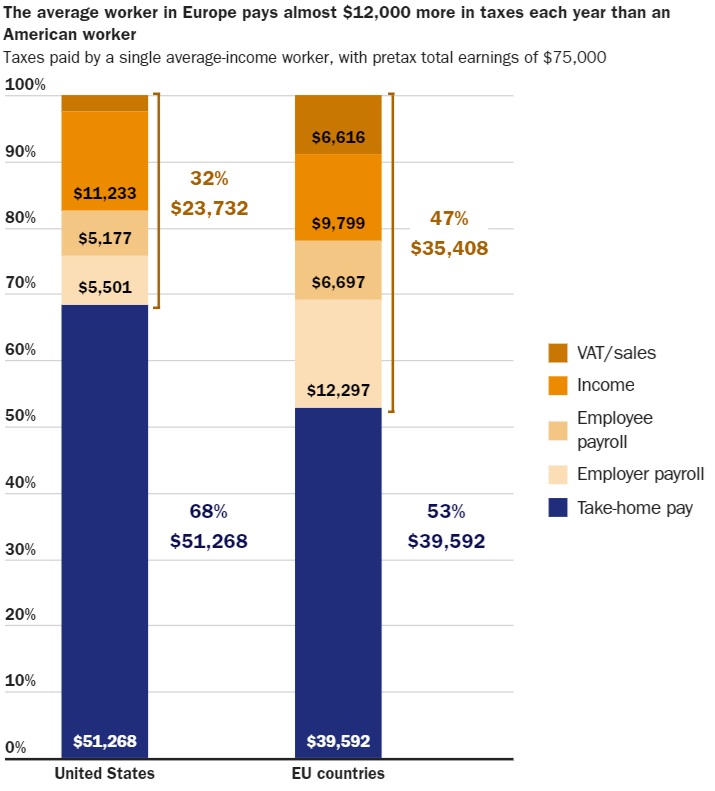
As part of his report, he calculated that the a middle-class European pays nearly $12,000 more in taxes than an American at the same income level.

The huge gap is due mostly to Europe’s value-added taxes and employer payroll taxes (which companies pay on behalf of workers).

Needless to say, this is not good news for European households.

But that’s just part of the bad news. You also have to consider that Europeans are much less likely to earn as much money as their American counterparts.

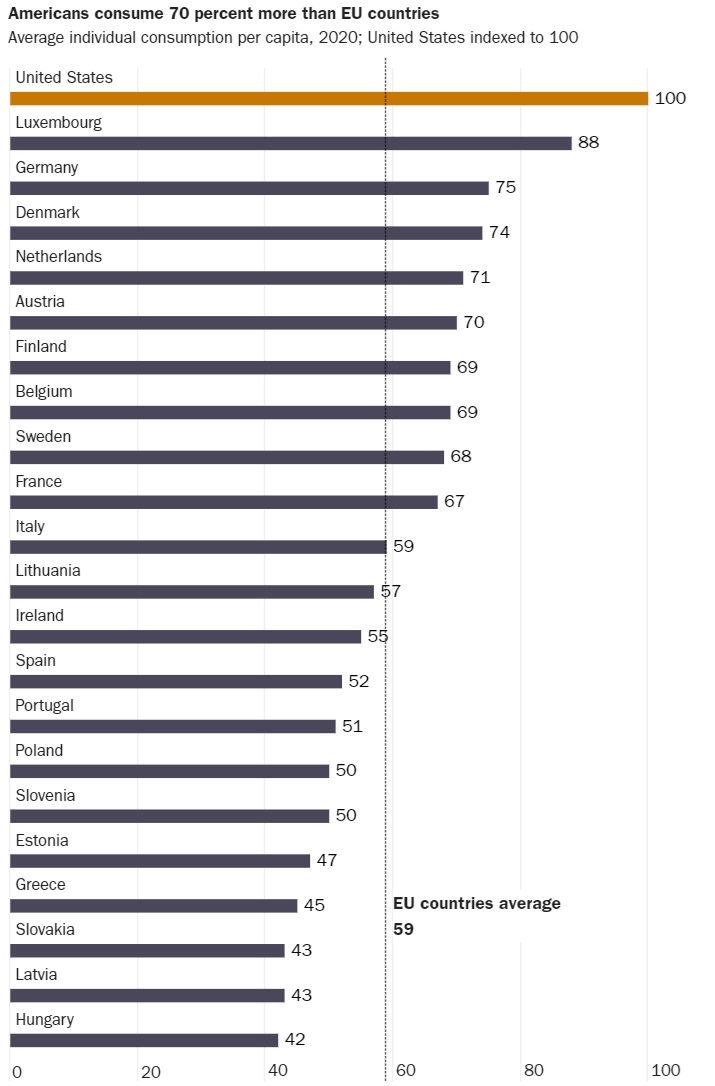
There’s an enormous gap between the U.S. and E.U. when looking at per-capita GDP. But GDP doesn’t directly translate into living standards, so let’s look at another chart from Adam’s paper.

Here’s a comparison of per-capita consumption (using the same AIC data I’ve shared in 2012, 2014, 2017, 2019, and 2022). Only the tiny tax haven of Luxembourg is close to the United States.

By the way, I don’t blame Eastern European nations for being way behind the United States. They still have to catch up after suffering from communist enslavement (though some of them are doing a much better job than others).

But I’m digressing. The main lesson to be learned from today’s column is that America should not become more like Europe. That’s a recipe for earning less income and paying higher taxes. I hope Trump and Harris are paying attention."


Friday, September 27, 2024

Why Europe’s ‘Farm to Fork’ policies collapsed

By Bill Wirtz of CEI.

"The new European Commission, the European Union’s executive body, will soon be tasked with “simplifying” agricultural regulations within the Union. “The Commission is taking strong and swift action to support our farmers at a time when they are facing many challenges and concerns,” explained Ursula von der Leyen, the current President of the European Commission.

What this German politician calls “simplification measures” are in fact deregulation efforts linked to agricultural subsidies. Following massive farmer protests this year, the European Union has scaled back most of its ambitions for agricultural reform, just four years after this same Commission presented them to great fanfare.

In the 2019 European election, Europe lived up to its environmental ambitions. Four years after the conclusion of the 2015 Paris Climate Agreements, Europe intended to become a global benchmark in environmental protection by radically reforming agricultural systems. This meant greater monitoring of farming practices, drastically reducing pesticide use, cutting back on fertilizers, reducing farmland use to allow for greater biodiversity, and massively increasing organic food production.

In the first year of these plans, there was little opposition. Europe and the global community were in the midst of a viral pandemic and farmers’ representatives were carefully assessing the Commission’s seriousness about these plans. Given the success of green parties in the 2019 elections, it seemed that this strategy dubbed “Farm to Fork,” was the logical next step in a political trend.

For months, the Commission didn’t even bother to publish an impact assessment. 

Eventually, the USDA published its own independent assessment in November 2020, showing that Farm to Fork would increase consumer food prices, reduce European exports, and decrease overall agricultural production by 7-12 percent. The report attracted little attention.

It was first the farmers’ protests in the Netherlands, then in Germany, France, and the rest of Europe for most of this year, that brought the issue to the attention of policymakers. As it turned out, many of the stated aims of the Farm to Fork program were political and unscientific.

Take, for example, the goal to reduce the use of pesticides by 50 percent by 2030. Europe has by far one of the strictest regulatory regimes for plant protection products, thanks to the use of the “precautionary principle.” Chemicals, including the very commonly used glyphosate, have to be authorized by the European Council despite safety assessments provided by the European Food Safety Authority (EFSA). 

The sustainability objective behind the 50 percent target remains a mystery. 

Are synthetic chemicals used in conventional agriculture harmful to human health? Not in the way they are currently used, or else regulators would have stopped their use already. 

It is understandable how the European Commission’s approach would upset farmers, because instead of proposing a viable and affordable alternative to the chemicals in question, the Commission argued that farmers could choose organic alternatives. But with organics accounting for only as much as 10 percent of European consumers’ purchasing decisions, farmers faced the precarious risk of not finding buyers for their products, on top of the fact that compliance costs for organic products were even higher than those they were already facing. 

All these factors, combined with the shortage of fertilizers and livestock feed, as well as the pressure exerted by retailers on the purchase prices of all agricultural products, made the situation untenable for producers.

Frustrations are running high for European farmers, because for decades every new regulatory burden has been solved with money. 

The message is always the same. “Are you affected by the banning of a plant protection product and the resulting drop in yields? What if we gave you more subsidies?” Farmers aren’t interested in a business model that keeps them afloat with public funds, and consumers are looking for greater transparency. 

Shoppers want to know the real price of food in the supermarket and when it is heavily subsidized. As it stands today, over 35 percent of the EU’s total budget is devoted to agricultural subsidies. 

The EU has since moved far away from its 2019 ambitions. The latest “simplification” measures mean that farmers are subject to less oversight in order to access subsidies, and pesticide reduction regulation has been scrapped altogether. The Commission is now hustling to authorize genetically modified crops on the European market, a measure that would have been impossible to pass just a few years ago. The tone has changed in Brussels. 

It’s no longer a question of reducing farmland but reducing the man-made barriers to managing them. Farmers have won the battle for hearts and minds, but the war to reduce Europe’s mountain of regulations on food production is just beginning."

Tuesday, March 26, 2024

GDPR & European Innovation Culture: What the Evidence Shows

By Adam Thierer. Excerpt:

"In an earlier essay, I explored “Why the Future of AI Will Not Be Invented in Europe” and argued that, “there is no doubt that European competitiveness is suffering today and that excessive regulation plays a fairly significant role in causing it.” This essay summarizes some of the major academic literature that leads to that conclusion.

Since the mid-1990s, the European Union has been layering on highly restrictive policies governing online data collection and use. The most significant of the E.U.’s recent mandates is the 2018 General Data Protection Regulation (GDPR). This regulation established even more stringent rules related to the protection of personal data, the movement thereof, and limits what organizations can do with data. Data minimization is the major priority of this system, but there are many different types of restrictions and reporting requirements involved in the regulatory scheme. This policy framework also has ramifications for the future of next-generation technologies, especially artificial intelligence and machine learning systems, which rely on high-quality data sets to improve their efficacy.

Whether or not the E.U.’s complicated regulatory regime has actually resulted in truly meaningful privacy protections for European citizens relative to people in other countries remains open to debate. It is very difficult to measure and compare highly subjective values like privacy across countries and cultures. This makes benefit-cost analysis for privacy regulation extremely challenging — especially on the benefits side of the equation.

What is no longer up for debate, however, is the cost side of the equation and the question of what sort of consequences the GDPR has had on business formation, competition, investment, and so on. On these matters, standardized metrics exist and the economic evidence is abundantly clear: the GDPR has been a disaster for Europe.

Summary of Major Studies on Impact of EU Data Regulation

Consider the impact of E.U. data controls on business startups and market structure. GDPR and other regulations greatly limit the flow of data to innovative upstarts who need it most to compete, leaving only the largest companies who can afford to comply to control most of the market. Benjamin Mueller of ITIF notes that it is already the case that just “two of the world’s 30 largest technology firms by market capitalization are from the EU,” and only “5 of the 100 most promising AI startups are based in Europe,” while private funding of AI startups in Europe for 2020 ($4 billion) was dwarfed by US ($36 billion) and China ($25 billion). These issues are even more pressing as the E.U. looks to advance a new AI Act, which would layer on still more regulatory restrictions.

In concrete terms, this has meant that the E.U. came away from the digital revolution with “the complete absence of superstar companies,” argue competition policy experts Nicolas Petit and David Teece. There are no European versions of Microsoft, Google, or Apple, even though Europeans clearly demand the sort of products and services those US-based companies provide. Entrepreneurialism scholar Zoltan Acs asks: “What has been the outcome of E.U. policy in limiting entrepreneurial activity over recent decades?” His conclusion:

It is immediately clear… that the United States and China dominate the platform landscape. Based on the market value of top companies, the United States alone represents 66% of the world’s platform economy with 41 of the top 100 companies. European platform-based companies play a marginal role, with only 3% of market value.

Several recent studies have documented the costs associated with the GDPR and the E.U.’s heavy-handed approach to data flows more generally. Here is a rundown of some of the academic evidence and a summary of the major findings from these studies.

“There is a growing body of economic literature and commentary showing that the costs of implementing the GDPR benefit large online platforms, and that consent-based data collection gives a competitive advantage to firms offering a range of consumer-facing products compared to smaller market actors. This in turn increases concentration in a number of digital markets where access to data is important, by creating barriers to entry or encouraging market exit.” (p. 2–3)

“this paper examines how privacy regulation shaped firm performance in a large sample of companies across 61 countries and 34 industries. Controlling for firm and country-industry-year unobserved characteristics, we compare the outcomes of firms at different levels of exposure to EU markets, before and after the enforcement of the GDPR in 2018. We find that enhanced data protection had the unintended consequence of reducing the financial performance of companies targeting European consumers. Across our full sample, firms exposed to the regulation experienced a 8% decline in profits, and a 2% reduction in sales. An exception is large technology companies, which were relatively unaffected by the regulation on both performance measures. Meanwhile, we find the negative impact on profits among small technology companies to be almost double the average effect across our full sample. Following several robustness tests and placebo regressions, we conclude that the GDPR has had significant negative impacts on firm performance in general, and on small companies in particular.” (p. 1)

“We show that websites’ vendor use falls after the European Union’s General Data Protection Regulation (GDPR), but that market concentration also increases among technology vendors that provide support services to websites. We collect panel data on the web technology vendors selected by more than 27,000 top websites internationally. The week after the GDPR’s enforcement, website use of web technology vendors falls by 15% for EU residents. Websites are more likely to drop smaller vendors, which increases the relative concentration of the vendor market by 17%. Increased concentration predominantly arises among vendors that use personal data such as cookies, and from the increased relative shares of Facebook and Google-owned vendors, but not from website consent requests. Though the aggregate changes in vendor use and vendor concentration dissipate by the end of 2018, we find that the GDPR impact persists in the advertising vendor category most scrutinized by regulators. Our findings shed light on potential explanations for the sudden drop and subsequent rebound in vendor usage.” (p. 1)

“GDPR creates inherent tradeoffs between data protection and other dimensions of welfare, including competition and innovation. While some of these effects were acknowledged when constructing the legal data regime, many were disregarded. Furthermore, the magnitude and breadth of such effects may well constitute an unintended and unheeded welfare-reducing consequence. As this article shows, the GDPR limits competition and increases concentration in data and data-related markets, and potentially strengthens large data controllers. It also further reinforces the already existing barriers to data sharing in the EU, thereby potentially reducing data synergies that might result from combining different datasets controlled by separate entities.” (pp. 3–4)

“Using data on 4.1 million apps at the Google Play Store from 2016 to 2019, we document that GDPR induced the exit of about a third of available apps; and in the quarters following implementation, entry of new apps fell by half. We estimate a structural model of demand and entry in the app market. Comparing long-run equilibria with and without GDPR, we find that GDPR reduces consumer surplus and aggregate app usage by about a third. Whatever the privacy benefits of GDPR, they come at substantial costs in foregone innovation.”

“this paper empirically quantifies the effects of the enforcement of the EU’s General Data Protection Regulation (GDPR) on online user behavior over time, analyzing data from 6,286 websites spanning 24 industries during the 10 months before and 18 months after the GDPR’s enforcement in 2018. A panel differences estimator, with a synthetic control group approach, isolates the short- and long-term effects of the GDPR on user behavior. The results show that, on average, the GDPR’s effects on user quantity and usage intensity are negative; e.g., the numbers of total visits to a website decrease by 4.9% and 10% due to GDPR in respectively the short- and long-term. These effects could translate into average revenue losses of $7 million for e-commerce websites and almost $2.5 million for ad-based websites 18 months after GDPR. The GDPR’s effects vary across websites, with some industries even benefiting from it; moreover, more-popular websites suffer less, suggesting that the GDPR increased market concentration.”

“This paper investigates the impact of the General Data Protection Regulation (GDPR for short) on consumers’ online browsing and search behavior using consumer panels from four countries, United Kingdom, Spain, United States, and Brazil. We find that after GDPR, a panelist exposed to GDPR submits 21.6% more search terms to access information and browses 16.3% more pages to access consumer goods and services compared to a non-exposed panelist, indicating higher friction in online search. The implications of increased friction are heterogeneous across firms: Bigger e-commerce firms see an increase in consumer traffic and more online transactions. The increase in the number of transactions at large websites is about 6 times the increase experienced by smaller firms. Overall, the post-GDPR online environment may be less competitive for online retailers and may be more difficult for EU consumers to navigate through.”

“Privacy regulations should increase trust because they provide laws that increase transparency and allow for punishment in cases in which the trustee violates trust. […] We collected survey panel data in Germany around the implementation date and ran a survey experiment with a GDPR information treatment. Our observational and experimental evidence does not support the hypothesis that the GDPR has positively affected trust. This finding and our discussion of the underlying reasons are relevant for the wider research field of trust, privacy, and big data.”

“We follow more than 110,000 websites and their third-party HTTP requests for 12 months before and 6 months after the GDPR became effective and show that websites substantially reduced their interactions with web technology providers. Importantly, this also holds for websites not legally bound by the GDPR. These changes are especially pronounced among less popular websites and regarding the collection of personal data. We document an increase in market concentration in web technology services after the introduction of the GDPR: Although all firms suffer losses, the largest vendor — Google — loses relatively less and significantly increases market share in important markets such as advertising and analytics. Our findings contribute to the discussion on how regulating privacy, artificial intelligence and other areas of data governance relate to data minimization, regulatory competition, and market structure.”

William Rinehart of the Center for Growth and Opportunity has compiled and summarized many additional studies that document the costs associated with restrictions on data, including many state privacy laws imposed in the United States.

“The Biggest Loser”: Innovation Culture Gone Wrong

Taken together, this evidence makes it clear that, “Well-meaning privacy laws can have the unintended consequence of penalizing smaller companies within technology markets.” It can also have broader geopolitical ramifications for continental competitive advantage and engagement between countries. Some have argued that the United Kingdom’s so-called “Brexit” from the EU can be viewed as not only an effort to reclaim its sovereignty but more specifically “to escape its crippling regulatory structure.” The E.U.’s approach to emerging technology regulation likely had some bearing on this. Acs argues that Britain’s move was logical, “because E.U. regulations were holding back the U.K.’s strong DPE (digital platform economy).” “If the United Kingdom was to realize its economic potential,” he says, “it had to extricate itself from the European Union,” due to the growing “dysfunctional E.U. bureaucracy.”"

Sunday, February 4, 2024

Europe Regulates Its Way to Last Place

From mergers to AI, the EU’s aggressive rule-making hampers its ability to compete with China and the U.S.

By Greg Ip. Excerpts:

"For example, to preserve competition, European regulators have resisted mergers that leave just a handful of mobile phone carriers per market. As a result Europe now has 43 groups running 102 mobile operators serving a population of 474 million, while the U.S. has three major networks serving a population of 335 million, according to telecommunications consultant John Strand. China and India are even more concentrated.

European mobile customers as a result pay only about a third of what Americans do. But that’s why European carriers invest only half as much per customer and their networks are commensurately worse, Strand said: “Getting a 5G signal in Germany is like finding a Biden supporter at a Trump rally.” Putting European networks on a par with the U.S. would cost about $300 billion, he estimated.

This has knock-on effects on Europe’s tech sector. Swedish telecommunications equipment manufacturer Ericsson’s sales in Europe suffer in part because many carriers are too small and unprofitable to update to the latest 5G networks. “Europe has prioritized shorter-term low consumer prices at the expense of quality infrastructure,” chief executive Börje Ekholm told me in Davos earlier this month. “I’m very concerned about Europe. We need to invest much more in infrastructure, in being digital.”"

"U.S. regulators aren’t exactly hands-off. Still, they tend to act on evidence of harm, whereas Europe’s will act on the mere possibility. This precautionary principle can throttle innovation in its cradle.  

Starting in 2018, Europe’s General Data Protection Regulation, or GDPR, imposed strict requirements on websites’ collection and use of personal data with fines of up to 4% of global sales. A study by University of Maryland economist Ginger Jin and two co-authors found this depressed European venture-capital investment relative to the U.S. over the next two years. Investors might have shunned business models that weren’t in compliance with, or less valuable because of, GDPR, they said."

"Since 2021, AI-related venture-capital deals have raised $44 billion in Europe, roughly equal to China but just a quarter of the U.S."

"European startups rarely become giants, and even established companies are smaller than their U.S. counterparts. 

“I don’t think that the lack of winners in recent decades can be attributed to a single monocausal factor,” one European-born founder of a U.S. tech company told me. But Europe’s regulatory culture, including prosaic tax and labor laws, is near the top, he said. “Simply granting stock options, for example, is pretty difficult in most European countries. It’s famously difficult to part ways with hires that turn out to be misfits.”"

"Europe’s internal market is larger than China’s and almost as big as the U.S.’s. But when it compared companies with more than $1 billion in revenue, the U.S. firms spent 80% more on research and development, boasted 30% higher return on capital, and 1.3-percentage points faster revenue growth."

"As German economy minister Robert Habeck observed last fall: “If Europe has the best regulation but no European companies, we haven’t won much.”"