Showing posts with label International Trade. Show all posts

Monday, August 3, 2026

How “Liberation Day” Cost America Its Tourists

By Alfredo Carrillo Obregon of Cato.

"Perhaps one of the most puzzling developments in the aftermath of the Trump administration’s multiple tariff salvos has been the lack of retaliation by the governments of affected countries. Most US trading partners have (so far) refused to impose duties on American exports, and many have even negotiated “reciprocal” trade agreements with the administration. Yet, as my colleague Scott Lincicome explained in a column for The Dispatch last year, amid this lack of tit-for-tat response by foreign governments, private individuals abroad are pushing back against Trump’s trade policies by limiting their consumption of American goods and services—most notably, tourism in the United States. 

While survey and government data already pointed to declines in foreign visits to the United States (see figures 1 and 2), a recent working paper finds that the “Liberation Day” tariff announcements in April 2025 led to a significant decline in tourism to the United States, costing the sector over $1 billion in lost revenue per month.

Using the “Liberation Day” announcements as a quasi-experiment and benchmarking tourist arrivals in the United States against those in Canada, the study measures the impact of singling out 75 countries and assigning them a “reciprocal” tariff rate higher than the universal 10 percent baseline. Controlling for origin-country income and bilateral exchange rates, the authors calculate that 315,000 fewer tourists from these 75 countries (i.e., “Annex I countries”) visited the United States each month through September 2025, relative to tourists from countries subject only to the 10 percent baseline rate. 

The finding that Trump’s announcement of the “reciprocal” tariffs led to substantial declines in tourist arrivals from these countries—and thus tourism revenue for the US economy—also holds when the authors alternatively benchmark US tourist arrivals against those in Spain. The authors also rule out increased Immigration and Customs Enforcement (ICE) arrests, USAID cuts, and other Trump-era policy changes as alternative explanations. Importantly, because the authors’ estimates only capture the incremental effect of the “reciprocal” tariffs above the 10 percent baseline, the actual tariff-driven decline in tourist arrivals to the US might be even larger.

More notable than the study’s topline estimates, though, is its finding that the tariff-induced decline in tourism in the United States resulted less from foreigners being unable to afford US travel and more from foreigners having a diminished view of the United States following the “Liberation Day” announcements. On the one hand, other studies have found that Americans bore most of the tariffs’ costs and that the dollar weakened in the aftermath of the 2025 tariffs. On the other hand, the authors calculate that among tourists from the 75 countries assigned a higher “reciprocal” tariff rate than 10 percent, those from North Atlantic Treaty Organization (NATO) countries (i.e., “long-standing US allies”) reduced their travel to the US more than tourists from non-NATO countries. 

The authors also find that tourists from countries assigned an above-median “reciprocal” tariff rate reduced their travel to the US to a similar degree as tourists from countries assigned a below-median “reciprocal” tariff rate. In sum, the authors’ results, differing “by the strength of existing geopolitical relationships but not by the magnitude of the tariff rates,” suggest that the decline in US tourism from these 75 countries is connected to a decline in America’s reputation abroad.

Having estimated a substantial reduction in monthly tourists due to the administration’s tariffs[i], the authors then calculate that the tourism sector lost more than $1 billion in monthly revenue after April 2025. But as if this were not enough, the authors also calculate that tourism firms—“firms where inbound foreign tourism plausibly represents a meaningful share of revenue (e.g., hotels, airlines, entertainment)”—experienced lower stock returns (by two to three percentage points) than other firms one to three days after “Liberation Day.” In sum, the decline in visitors also translated to financial hardship for the sector—both from actual foregone revenue and from negative investor expectations.

With more US tariffs coming down the pipeline and more uncertainty about the future of bilateral trade deals negotiated by the Trump administration with foreign countries, we will see whether foreign governments retaliate more aggressively against US exports. Yet, studies like the one discussed in this blog post confirm what anecdotal evidence has long suggested: Private individuals abroad are not waiting for their governments to respond before they adjust their consumption of US goods and services. More concerningly for the US and Americans, if such actions stem from a diminished US reputation abroad, repairing the damage from the Trump administration’s trade policies might be less straightforward than simply removing existing tariffs.


[i] In addition to estimating 315,000 fewer monthly travelers from the 75 countries subject to “reciprocal” tariff rates higher than 10 percent, the study finds that the implementation of “fentanyl” tariffs on Canada and Mexico in March 2025 led to a 20 percent decrease in the average number of monthly visitors from Canada and to slower growth in monthly visits from Mexico. Though these results are less definitive than those of the authors’ main model given the limited sample size and the absence of control destinations, their findings on Canadian tourism are consistent with other evidence that Canadians avoided travel to the US in 2025 in response to Trump’s tariffs. In fact, a recent Statistics Canada report finds that leisure-related visits by Canadians to the United States declined by 21.5 percent in 2025 (about 3.2 million visits) while leisure-related visits by Canadians to overseas destinations increased by 12.2 percent in 2025 (about 1.1 million visits). The same report finds that spending on leisure-related visits by Canadians to the United States decreased by $2.2 billion in 2025, while spending on leisure-related visits by Canadians to overseas destinations increased by $3.6 billion."

Sunday, July 26, 2026

Trump’s New Tariffs Aren’t About Forced Labor—They’re About Restoring the Tariff Wall

By Scott Lincicome and Chad Smitson of Cato.

"The “Section 122” tariffs, imposed after February’s Supreme Court ruling against President Trump’s “emergency” tariffs, expired last night and were immediately replaced by “Section 301” tariffs of roughly the same amount. The new duties range from 10 to 12.5 percent, cover goods from 60 economies, and are justified as a crackdown on “forced labor.” 

In my new column at The Dispatch, I show why these tariffs have almost nothing to do with forced labor and instead are just “a ham-fisted way to reinstall Trump’s tariff wall and protect it from another IEEPA-like defeat in federal court.” Five issues stand out:

  1. The administration said the tariffs were coming before the investigation ended. President Trump, Treasury Secretary Bessent, and US Trade Representative Greer all publicly and explicitly promised that the tariffs and their revenue would replace the struck-down IEEPA regime before the investigations even started.
  2. The requisite report on “forced labor” is remarkably thin. USTR’s investigation only took 82 days and generated a 98-page report to cover 60 economies, devoting little more than half a page to each, much of it the exact same empty passages copied and pasted 60 times—far short of the rigor demanded of such a consequential and far-reaching trade action. The report also contained no evidence or analysis – none – of targeted economies’ forced labor policies causing actual harm to US companies or commerce. It’s all just assumed. Nor did the USTR explain why it applied the same punitive 12.5 percent tariff rate to Angola, Libya, Russia, Venezuela, and Kazakhstan—developing countries that rank low on the Walk Free forced labor index (and have other issues!)—as it did to developed, “good actor” countries like Norway, Japan, Switzerland, and Australia.
  3. The United States is hardly a forced labor angel. Section 307 of the Tariff Act of 1930 has prohibited imports made with forced labor, but was lightly enforced for over 80 years due to wide exceptions, and the Trump administration’s enforcement of the law has been much more lenient than the Biden administration’s efforts. Furthermore, the US ranks 19th among the 60 economies for the prevalence of forced labor. 
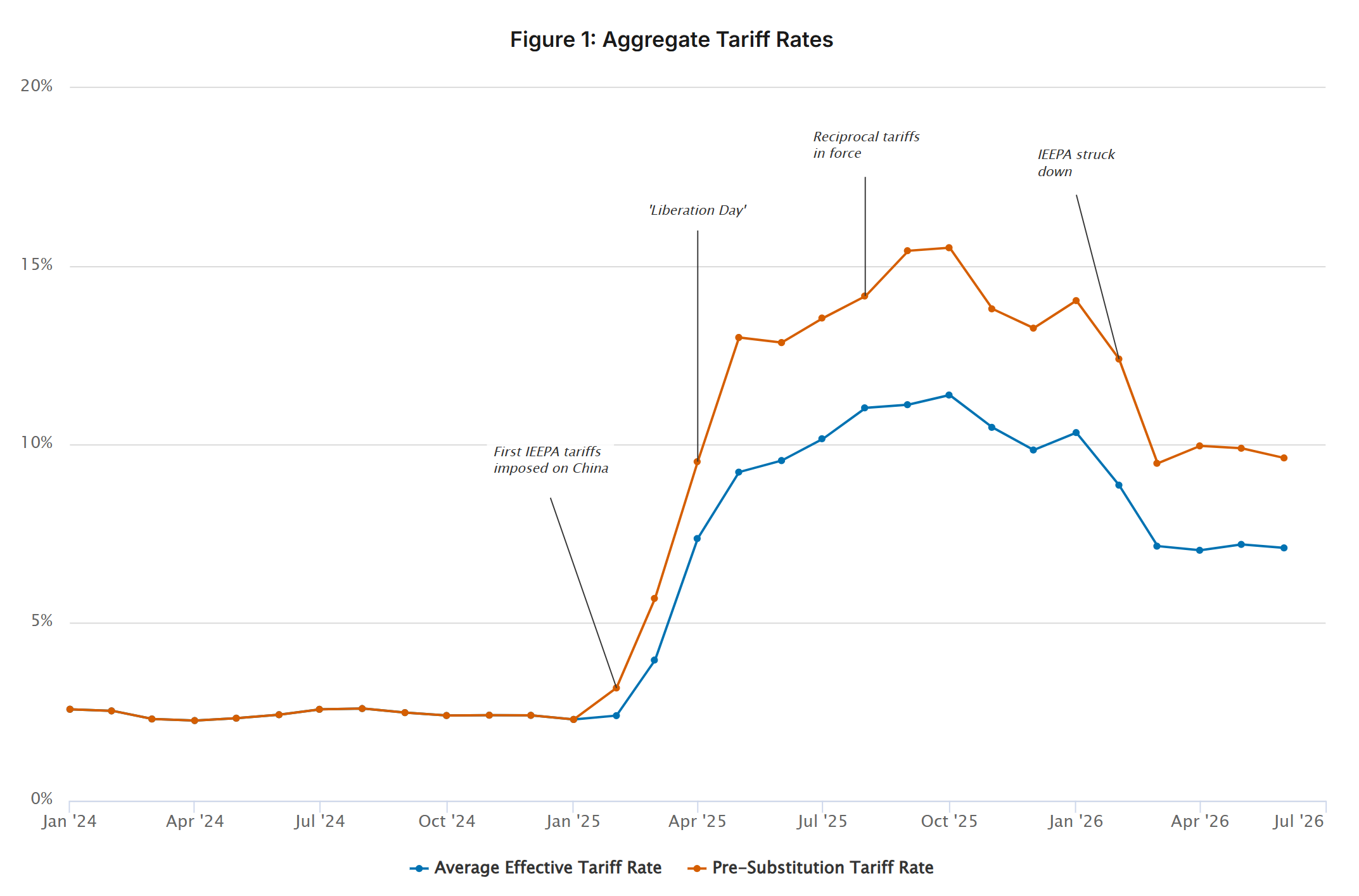
  4. The tariff cure dramatically overshoots the forced labor disease. Some back-of-envelope math puts a proportionate tariff at 0.5 to 0.84 percent; Peterson Institute economist William Cline, using a different model, gets 0.23 to 0.25 percent. USTR is proposing 10 to 12.5 percent, a rate and resulting revenue (see figure below) that far exceed what could be considered a proportional response to the problem.
  5. There’s no off-ramp. Section 301’s statutory goal is the removal of the offending foreign policy, yet USTR offers no benchmarks for compliance that would remove the tariffs. Indeed, a country with the United States’ exact forced-labor framework could still get slapped with duties.

As I explain, the Section 301 tariffs on Chinese imports that Trump imposed during his first term provide a telling contrast: 

Trump’s case against Chinese intellectual-property and industrial policy wasn’t without fault, but it still required an eight-month investigation and produced a nearly 200-page report on a single country. And the recommended tariffs—initially set at $50 billion to match/​offset the alleged harm from the targeted Chinese policies—came only after U.S.-China negotiations collapsed.

Forced labor is a real and complicated problem, but disingenuously dressing tariff revenue recovery in human rights language discredits the tools that might actually address it, setting a precedent for Section 301 to be an all-purpose tariff generator that any future president can invoke for any reason. Congress should fix the law before President Trump—or his successor—does even more damage.

Read the full column here.

Note: On July 24, the Liberty Justice Center filed a lawsuit in the US Court of International Trade challenging the administration’s replacement tariffs imposed under Section 301 of the Trade Act of 1974."


Wednesday, July 22, 2026

The China dish industry claimed it was a militarily strategic good in 1951

Tweet from Daniel J. Smith.

"A representative from the fine China dish industry lobbying for protectionism as a militarily strategic good during congressional testimony in 1951"


Friday, July 17, 2026

The Macroeconomic Effects of Tariffs

From Jeffrey Miron

"A recent study points out the dearth of historical research on the macroeconomic effects of tariffs, especially as a tool to analyze modern-day tariffs. The study

addressed this challenge by analyzing all major US tariff rate changes from 1840 to 2024. Drawing on historical research, congressional records, and statutes, we identified … 21 tariff rate changes, which we used to examine the macroeconomic effects of tariffs.

These examples

reveal that increasing tariff rates contracted the US economy. … tariff increases did not shield domestic industry despite their protective intent. Additionally, trade contracted markedly.

While tariffs might be expected to cause large price increases,

[o]verall prices increased [only] by around 0.5 percent at their peak. … [T]he simultaneous presence of supply-side inflationary pressures and demand-side pressures that slowed price growth could explain the muted overall change in aggregate prices.

To sum up, the

research indicates that tariff increases reduce domestic output and trade. While tariffs may protect some domestic industries, they ultimately reduce aggregate output, manufacturing activity, and the global competitiveness of US goods."

Tuesday, July 14, 2026

How Trump’s Tariffs Really ‘Work’

He hails Toyota’s investment, but what about the higher costs and manufacturing job losses?

WSJ editorial. Excerpts:

"Toyota may have made the decision for business reasons unrelated to his tariffs."

"The Japanese car maker’s press release lavished praise on Texas’s pro-business environment and included statements from the state’s political leaders (Attorney General Ken Paxton excepted). No mention of Mr. Trump or his tariffs. Toyota says the new plant will provide “flexibility” from “advanced manufacturing technologies,” which may offset the relatively higher labor costs in Texas."

"The U.S. has lost some 75,000 manufacturing jobs since January 2025, including 25,900 in motor vehicle and parts production. Manufacturing jobs have been declining since early 2023, so not all of these job losses stem from Mr. Trump’s border taxes."

"there’s no question his tariffs are raising costs for U.S. manufacturers. At the same time, foreign retaliation has hurt America’s farmers"

"evidence shows that U.S. companies, workers and consumers are picking up most of the tab."

"auto tariffs on Canada and Mexico alone added about $1,600 to the cost of each car made in the U.S. last year."

"tariffs drove a 10.4% increase in the average suggested retail price of a new car."

"Auto dealers—most of which are small businesses—absorbed about 4.5% of the manufacturer’s price increase."

"Dealers have shed 6,100 jobs since Mr. Trump became President."

"New vehicle sales have averaged 15.9 million in the first half of this year, down from the 17 to 18 million in the five years before the pandemic." 

Monday, July 13, 2026

‘How to Win a Trade War’ Review: The Times of Tariffs

Germany before World War I provoked backlash because of its rise in exports and overproduction, similar to China today.

By Theodore Bunzel. He is the head of Lazard Geopolitical Advisory. He has worked in the political section of the U.S. Embassy in Moscow and at the U.S. Treasury Department. Excerpts:

"“How to Win a Trade War” shows us that, even in the age of Trump, many of today’s trade tensions are a historical rerun. Germany before World War I provoked backlash because of its sharp rise in exports and overproduction, similar to China today. Its cornering of an “extraordinary 90 percent of global production” of chemicals and dyes sparked fears of dependency among the Allies. Even the White House’s coercive Liberation Day tariffs have an echo in history: 1870s France hiked tariffs 24% on its neighbors and demanded they negotiate more favorable trade deals within six months, a gambit that—like Mr. Trump’s—largely succeeded in forcing trade partners to submit to new treaties.

With protectionism becoming more fashionable, Ms. Keynes and Mr. Bown provide a helpful reminder that tariffs are, generally speaking, economically destructive and rarely achieve their stated goals. Such policies impede growth, chill investment and—outside of commodities—are overwhelmingly paid for by the importing country. Even on trade deficits, the authors remind us, tariffs have historically had largely insignificant effects. While the evidence on tariffs and their effects on industrialization is more mixed, for every Japan or South Korea—which used barriers to turbocharge manufacturing in the postwar era—there are the smoldering examples of Brazilian personal computers or Indian autos."

Sunday, July 12, 2026

Hamilton Was No Protectionist

The first Treasury secretary backed tariffs mostly to raise revenue and promote free trade

By Phil Gramm And Donald J. Boudreaux. Excerpts:

"the 21st century, when the average trade-weighted tariff rate of Organization for Economic Cooperation and Development member countries was below 3% and almost identical to that of the U.S., and the OECD found that the nontariff barriers of U.S. trading partners aren’t significantly higher than America’s nontariff barriers, it’s highly doubtful that Hamilton would support Trump policies."

"It’s true that Hamilton endorsed some elements of the infant-industry argument for tariffs, but he did so because American industry then was indeed in its infancy. America today occupies a completely different position"

"The conditions that led Hamilton to support tariffs have long since disappeared. He never saw protection of domestic manufacturing as a long-term policy but rather insisted that “continuance of bounties on manufactures long established must almost always be of questionable policy.”"

"among the greatest forces fostering U.S. industrialization was its trade deficit and resulting capital surplus"

"Hamilton described net inbound foreign capital as “a precious acquisition . . . a most valuable auxiliary, conducing to put in Motion a greater Quantity of productive labour, and a greater portion of useful enterprise than could exist without it.”"

"the British and Dutch invested heavily in America. They grew wealthy on those investments, and so did America."

"Hamilton knew that high protective tariffs, by discouraging importing and encouraging smuggling, suppressed those [tax revenue] collections."

"From 1816 through 1830, industrial production grew at an average annual rate of 4% as tariffs rose. From 1831 through 1860, industrial production exploded by 6.7% a year as tariffs fell." 

"between 1866 and 1900 average tariff rates fell from 41.8% to 27.6% and industrial production grew at an average annual rate of 5.6%."

"Frank Taussig concluded in 1915, it [industrialization] was fueled by “the intelligence and inventiveness of the people; these being promoted again by the breath of freedom and competition in all their affairs.”" 

Saturday, July 11, 2026

It’s Time To Legalize Kei Trucks

Restrictions on kei trucks are another way government drives up the cost of living

By Scott Beyer of The Independent Institute

"If you’ve spent time traveling the Third World—or Japan—you’ve seen them: tiny pickup trucks, built for cargo, hauling lumber, produce, construction materials, or even groups of workers. They’re ubiquitous in developing countries because they’re inexpensive, fuel-efficient, and well-suited for certain types of work. Yet for decades they’ve been largely absent from U.S. roads. That’s a shame, because the humble Japanese kei truck represents the kind of practical vehicle that would benefit Americans.

Kei trucks originated in Japan after World War II as part of the country’s “kei” (or light vehicle) classification. Manufacturers such as Suzuki and Mitsubishi designed them to meet strict size and engine limits while remaining surprisingly capable work vehicles. Although they typically produce around 50 horsepower, and sometimes only have top speeds of 60mph, they can haul loads approaching 1,000 pounds while achieving fuel economy that exceeds 35mpg. 

The reason Americans rarely see kei trucks has to do with regulation, not lack of demand. Federal law prevents newer kei models because imported vehicles must comply with the same crashworthiness, lighting, and emissions standards that apply to vehicles originally sold in the U.S. Meeting those standards is not worth it for Japanese manufacturers who never intended to sell kei trucks in the American market. 

There is one notable exception: once a vehicle reaches 25 years of age, it is exempt from many of those federal safety requirements. That means Americans who want a kei truck are largely limited to importing vehicles that are at least a quarter-century old. Even then, ownership is not straightforward. Several states—including Rhode Island and Georgia—have refused to title or register many kei trucks for normal highway use, while Maine has enacted restrictions that effectively bar them from public roads. Other states permit registration only under limited classifications, such as off-road, farm, or low-speed vehicle designations. 

The Trump administration has broadly emphasized cutting regulations and boosting domestic industry, and has directed that energy towards kei trucks. During the rollout of the “Freedom Means Affordable Cars” initiative, President Trump called the trucks “cute” and “beautiful” while criticizing barriers that prevent them from reaching U.S. soil. He tasked Transportation Secretary Sean Duffy with clearing obstacles to domestic production, so that kei-style trucks could bypass import tariffs like the 25% Chicken Tax (which specifically targets light trucks). However, this directive remains in early stages and faces hurdles within the federal code.

At state level, a wave of reforms has at least expanded access to the 25+ year-old kei trucks. Last year, Texas Senate Bill 1816 formally legalized titling, registration, and on-road use after earlier DMV inconsistencies. Such reforms typically enable operation, but mandate lower speed limits, require standard insurance/safety inspections, and can vary by jurisdiction. Meanwhile in other states, such as Oregon, reform efforts failed and kei trucks remain illegal to use on public roads. 

There are compelling economic reasons to welcome these vehicles. A brand-new full-size pickup truck now sells for $66,000 on average in America. It’s hard to find even quality used trucks nowadays for under $20,000. Brand new kei trucks are often sold in Japan for under $10,000. Many plumbers, electricians, landscapers, carpenters, farmers, and other small business owners would benefit from this cheaper option and don’t need massive four-door pickups that tow 15,000 pounds. 

Kei trucks are also at times more practical. Some models feature fold-down bed sides that allow forklifts to load pallets directly from either side of the truck. Their small footprint allows them to maneuver through tight alleys, narrow driveways, and crowded work sites that would frustrate drivers of a large pickup.

The most common argument against kei trucks concerns safety. Critics point out that they lack many of the crash protections found in newer American vehicles. That observation is true, but it also raises an obvious question: are kei trucks really so dangerous that Americans cannot be trusted to choose them, while motorcycles—which offer no crash protection whatsoever—remain legal? Society routinely allows adults to accept varying risk levels. 

Environmental objections are similarly unpersuasive. Some critics argue that kei trucks fail to meet modern emissions standards. Yet this argument actually highlights the inconsistency of current policy, which allows 25-year-old vehicles but not cleaner, newer versions. Kei trucks also achieve far better fuel economy than most full-size pickups.

Ultimately, kei trucks serve as a reminder that government regulations make everyday life more expensive. Here is a vehicle that has proven itself on farms, construction sites, and city streets worldwide, and is used by millions. Yet Americans cannot purchase a new one, even though their retail value starts at about 1/10th the average price of a new pickup truck. Nor can they purchase a 25-year-old one without paying thousands in extra taxes and duties. That is because regulators have more say in what consumers can drive than consumers themselves. The Trump administration should move forward with its kei truck deregulation efforts."

Friday, July 3, 2026

The Incidence of the "Liberation Day" Tariffs

From Jeffrey Miron.

"Reporters and economists alike spilled much ink predicting the impacts of Trump’s “Liberation Day” tariffs. New analysis offers clarity on the actual impact of these tariffs.

First,

enacted policies remain much smaller than announced policies. This is a key reason why the price effects of the tariffs remain below many forecasts made in April 2025.

Second,

most of the incidence of recent US tariff hikes has fallen on US consumers. And given the significance of imported inputs in US manufacturing, domestic producers have also shouldered much of the burden.

Third, the tariffs have also

led to striking changes in sourcing patterns. … [For example, t]he share of Chinese goods in US imports collapsed from 22 percent at the end of 2017 to about 12 percent at the end of 2024.

Lastly, while

[e]conomic theory posits that increasing US import tariffs should appreciate the dollar … [it instead] depreciated significantly after the 2025 tariffs. … [This may be because] other policies and macroeconomic forces counterbalanced the effects of tariff hikes on the dollar exchange rate."

Saturday, June 27, 2026

Don Boudreaux on Miran on Tariffs

See Musing on Miran

"Here’s a letter to the Wall Street Journal.

Editor:

Stephen Miran attempts to justify Trump’s tariffs by insisting that these levies will shift much of Americans’ tax burden onto foreigners and thus enable significant cuts in distortionary domestic taxes (“The Low-Tax Case for Tariffs,” June 27). His case, alas, is a string of howlers.

Consider, for example, his mention of the Congressional Budget Office’s estimate that Trump’s tariffs will raise $4 trillion over the next decade (and overlook the fact that this average annual amount of revenue is a paltry 5.4 percent of current U.S. government spending). Not only does the CBO’s estimate ignore the tariffs’ negative impact on economic growth, most of those tariff revenues will be paid by Americans. Mr. Miran conveniently leaves unmentioned the overwhelming amount of empirical research showing that foreigners are paying only a tiny fraction of Trump’s tariffs – by one credible estimate only four percent.

It must also be said that the greater the burden of the tariffs that is shifted to foreigners, the lesser are the price increases that Americans pay for imports and, hence, the more muted are the tariffs’ protective effects. Yet these protective effects are ones that Mr. Trump and other tariff supporters, including Mr. Miran, routinely cite as core justifications for the tariffs.

This inconsistency in his case for tariffs is itself sufficient to discredit all that Mr. Miran says on the matter."

Tuesday, May 19, 2026

U.S. Airlines and Carmakers Need to Go Global

Policies that insulate them from competition created the conditions that led to bailouts and bankruptcies

By Clifford Winston of the Brookings Institution. Excerpts:

"While we rightly celebrate the 1978 Airline Deregulation Act, airports and foreign competitors that could serve U.S. routes weren’t deregulated. Public airport monopolies and duopolies allow airlines to raise fares. With foreign carriers prohibited from flying domestic U.S. routes, domestic fares have been kept artificially high even while load factors approached 85% just before the Iran war. As a result, when a domestic shock hits, the system lacks the diversified global networks and capital depth needed to absorb the blow.

The car industry suffers from a similar condition. While the automakers aren’t currently liquidating, they are operating on a margin-over-volume strategy that has pushed the average transaction price of a new car to a record $50,000. This wasn’t a natural market evolution. It was manufactured by decades of trade barriers.

From the 1964 “Chicken Tax” to the 100% tariffs on Chinese electric vehicles in 2025, Washington has walled off the American consumer. These barriers have allowed domestic makers to abandon the low-cost econobox segment entirely, focusing instead on $80,000 SUVs. Because they are shielded from the $15,000-a-car global competitors that are modernizing fleets in Europe and Asia, automakers have become addicted to a narrow, affluent demographic."


Monday, May 11, 2026

Globalization’s Overlooked Economic Benefits

Antiglobalist ideas have motivated many Trump voters, but free trade benefits the average American

Letter to The WSJ.

"In his column “What Happened to the Pragmatic Trump of the First Term?” (Editor At Large, May 5), Gerard Baker wisely decries President Trump’s second-term pursuit of a misguided and extreme ideological agenda. Mr. Baker points out that antiglobalist ideas motivated voters in 2016—views that globalism “facilitated mass migration and the elevation of international capital that ravaged communities at home.”

A better name for “the elevation of international capital” is “free trade.” This term reveals the increased freedom of ordinary people to spend their incomes as they choose, while avoiding the mistaken suggestion that lowering trade barriers benefits only Davos-vacationing capitalists at the expense of the masses.

And where are these “ravaged communities at home” that voters were so worried about? Politicians and pundits still talk incessantly about these communities, but scholars who make serious attempts to locate them encounter difficulties. Economist Jeremy Horpedahl studied the 10 metropolitan statistical areas in the U.S. that suffered the largest negative hits during the infamous “China Shock” of the early 2000s. According to Mr. Horpedahl, all of the metropolitan statistical areas “hit hard by the China Shock still managed to have significant and positive real wage growth across the distribution since 2001 . . . Wage gains in several of these places, in fact, are better than the national trends.”

Whenever economic change occurs, some particular workers lose jobs, and some particular locations lose business and population. Economic growth requires economic change and adjustment. This has always been and will continue to be the case. But the story of America is that ordinary people recover over time and become wealthier. It’s an error to single out the freer trade of the past few decades as a unique source of economic change that justifies greater skepticism of globalization.

Prof. Donald J. Boudreaux

George Mason University

Fairfax, Va.

Friday, May 1, 2026

The AI Boom Is Being Fueled by Imports—and Free Trade

By Scott Lincicome, Alfredo Carrillo Obregon, and Chad Smitson of Cato.

"Data published today by the US Bureau of Economic Analysis show that domestic investment in artificial intelligence is currently acting as a massive tailwind for US economic growth (gross domestic product). The data also show that this American investment boom is being fueled by imports of the servers and other things that datacenters and related AI technologies need:


Separate data show, moreover, that imports of these AI-related inputs are entering the country almost entirely free of tariffs, thanks in large part to a mid-2025 decision by President Trump to exempt these items from his global tariff regime:


Surely, the AI boom isn’t solely due to free trade, and we wouldn’t expect it to cause every other US industry to boom like AI is today. But one still must wonder how many other American industries might similarly benefit from the same “special” treatment that the AI industry enjoys today—i.e., the treatment almost every industry received before the Trump tariff wall was erected last year." 

Sunday, April 26, 2026

Tariffs Have Long Been a Corruption Magnet

Transparency is a hallmark of good tax policy; opacity is its enemy

Letter to The WSJ

"Paul Rahe’s justifications for tariffs fail under scrutiny (“There’s a Case for Tariffs,” op-ed, April 16).

Mr. Rahe assumes tariffs boost resiliency, but recent history shows the opposite. National security might justify narrow trade restrictions, but tariffs have not insulated Americans from economic disruptions and have frequently made things worse. The baby-formula crisis of 2022 and automakers’ recent struggles to obtain aluminum, each triggered by the sudden closure of a tariff-protected U.S. factory, show that localized supply chains are vulnerable to local shocks—and tariffs block alternatives. Research from the pandemic finds that globalized supply chains performed better and adjusted faster than nationalized ones.

Mr. Rahe also errs on tariffs’ ability to promote manufacturing. Decades of protection failed to create thriving U.S. steel, shipbuilding, textile and footwear industries. More recent duties on solar panels did the same. With around half of imports being manufacturing inputs, tariffs raise American producers’ costs and undermine competitiveness. Combined with uncertainty surrounding executive branch tariffs, this explains why surveys consistently reveal manufacturers opposed to new protectionism.

Mr. Rahe is correct about the intrusiveness of income taxes, but tariffs can’t replace them because import volumes are far too small. Their invisibility, meanwhile, isn’t the benefit Mr. Rahe thinks. Since the 19th century, tariffs have been a breeding ground for rent-seeking and corruption and have persisted after decades of failure, precisely because their costs are hidden and diffuse. Transparency is a hallmark of good tax policy; opacity is its enemy.

Alfredo Carrillo Obregon and Scott Lincicome

Washington

Mr. Carrillo Obregon is a trade policy analyst and Mr. Lincicome is vice president for economics and trade at the Cato Institute

Understanding Tariffs and Their Trade-Offs

Although the economy was severely damaged during the pandemic, the culprits were price controls and lockdowns

Letter to The WSJ

"Flaws mar Paul Rahe’s op-ed arguing that, in a world subject to war and other disruptions, tariffs can protect an economy’s resilience (“There’s a Case for Tariffs,” April 16). It’s untrue that the pandemic showed that, with free trade and global disruptions, “supply chains collapse.”

Although America’s economy was severely damaged during the pandemic, the culprits were price controls and lockdowns. Yet despite these obstructions, as Scott Lincicome explains, “a December 2020 U.S. International Trade Commission (ITC) report found that U.S. manufacturers and global supply chains responded quickly to boost supplies or make new drugs, medical devices, PPE, cleaning supplies, and other goods, and that the pharmaceutical, medical device, N95 mask, and cleaning products (including hand sanitizer) industries were particularly ‘resilient’ (in the ITC’s own words).”

Economically, tariffs can’t increase the domestic capacity to produce particular goods without decreasing the domestic capacity to produce other goods. Because private businesses themselves have strong incentives to assess accurately the risks of global disruptions and optimally diversify their sources of supply to minimize supply-chain troubles, tariffs likely create excess capacity in protected, politically powerful industries as they drain resources away from other, politically weaker industries. This political determination of which industries are essential and which aren’t weakens the economy’s ability to respond effectively to global shocks.

Prof. Donald J. Boudreaux

George Mason University

America Is in the Middle of a Stealth Manufacturing Boom

Factory jobs are down, but factory output has risen briskly. Credit goes not to tariffs, but to the most basic economic force of all: demand

By Greg Ip. Excerpts:

"Since January 2025, manufacturing jobs have indeed fallen by about 100,000 workers, or roughly 0.6%. In the same period, though, manufacturing production rose 2.3%, and manufacturing shipments, unadjusted for inflation, climbed 4.2%."

"several sectors that where domestic production was strong, so were imports. Where production was down, so were imports."

"domestic production of computer and electronic products last year was up 7.7%. (All its figures are from the fourth quarter compared with a year earlier.) But imports in this sector were up even more, by 40.5%."

"Behind this: an artificial intelligence revolution"

"Aerospace and transportation equipment (which excludes trucks and cars) also boomed last year, with domestic output up 28%."

"Now consider motor vehicles and parts, around which Trump erected steep tariff barriers. Imports duly fell 14%. But domestic output also dropped 3%. In furniture and related products, imports were down 22% while domestic output fell 3%. Relatively high interest rates last year were likely a factor."

"Production of primary metals, including steel and aluminum, did benefit from tariffs which are now as high as 50%. Production rose, and imports fell. With prices well above global levels, capacity utilization, profits and investment should all rise. But Trump’s first-term tariffs didn’t yield sustained prosperity. Even now, primary metals production is more or less back to 2023 levels"

"Food and beverages contribute the largest share of domestic manufacturing output at 18%."

"Foreign competition isn’t that consequential. And production last year was basically flat."

"production can rise simply because existing factories are ramping up capacity. But durable improvement requires investment in new capacity, which is visible in semiconductors, pharmaceuticals and aerospace. If tariffs have led to new investment, the effect on production might not show up for a while." 

Tuesday, April 21, 2026

The WTO Isn’t Dead, but America Is Breaking It

Reform can’t happen if the U.S. keeps pretending it didn’t help cripple the institution it’s now eulogizing

Letter to The WSJ

"Jamieson Greer’s frustration with the World Trade Organization is understandable, but his op-ed ignores how the U.S. unwisely accelerated the organization’s decline (“Another Fish Story From the WTO,” April 8).

The American middle class has prospered in the era of open trade, and U.S. manufacturing job declines—driven mainly by productivity gains—long predate China’s WTO accession. The U.S. was the WTO’s chief architect and reaped significant economic and geopolitical value from the system. Its retreat, which began before the administration, ignored these realities and instead prioritized U.S. farm subsidies and trade remedies, often resisting the disciplines Washington demanded of others.

Fealty to these and other insular political issues stymied multilateral negotiations and motivated four separate U.S. administrations to neuter the WTO dispute settlement by blocking Appellate Body appointments. Washington’s participation in disputes has also ground to a halt. You can’t complain about the rules of the game after you stop playing and strangle the referee.

Worst of all, the U.S. has been a bad-faith abuser of the rules it helped write, blowing through tariff bindings and invoking narrow WTO exceptions for national security and balance-of-payments crises to maintain President Trump’s global tariff wall.

Mr. Greer is right to decry the WTO’s consensus problem and the abuse of certain rules by other WTO members. The institution does need reform. But members’ continued participation shows the institution isn’t dead. And reform can’t happen if the U.S. keeps pretending it didn’t help cripple the institution it’s now eulogizing.

Clark Packard and Scott Lincicome

Washington

Mr. Packard is a trade policy fellow and Mr. Lincicome is Vice President for Economics and Trade at the Cato Institute."

Saturday, April 18, 2026

America’s industrial capacity has continued to grow during a time of free trade agreements and trade deficits

See “As Compared to What?” – Exhibit #3,4593e17 by Don Boudreaux. Excerpt:

"Oren [Cass] laments “our failure to attend to industrialization.” What failure? When Pres. Trump returned to the White House in January 2025 America’s industrial capacity had been on the rise since the pandemic and that month reached an all-time high. This capacity has continued to grow. Today, America’s industrial capacity is 13 percent larger than when China joined the World Trade Organization in December 2001, 66 percent larger than when NAFTA took effect in January 1994, and 148 percent larger than in 1975, the last year the U.S. ran an annual trade surplus.

Oren might respond that the precise kind of capacity that we now have prevents us from producing the most-important stuff. Using the example featured in the piece you sent, Oren would likely point out that because we import many transformers of the sort used in data centers, our reliance on foreign producers for transformers is slowing our completion of data centers and, hence, hampering our development of AI. Perhaps. (Never mind that domestic politics is now the highest obstacle to data-center construction, and also threatens to thwart AI directly.) Oren’s solution is to produce more transformers domestically.

How simple! This conclusion appears to be a no-brainer. But appearances here deceive. Like all protectionists, Oren never asks: What outputs will America therefore produce less of? He supposes that the capital and resources that tariffs or subsidies draw into transformer production will be drawn away only from domestic industries producing goods or services that are less important (according to criteria preferred by Oren) than are transformers. But Oren can’t possibly know just what other domestic industries will shrink as a result of transformer tariffs or subsidies, or by how much they’ll shrink.

We might all agree that an engineered increase in the production of transformers would be worthwhile if the only consequence were reduced American production of deodorant and dog biscuits. But what if increased production of transformers reduces American production of semiconductors or jet engines or software for running AI?

Of course, I have no idea what we Americans would produce less of if the government uses tariffs or subsidies to increase American transformer production. But nor does Oren have any idea. He naively points to something – transformers – that would be good to have more of were that something costless, and then he leaps to the unwarranted conclusion that free trade has failed because we currently don’t have more of that something.

To overcome, for any product, the strong presumption in favor of a policy of free trade – a policy with a proven record not only of raising living standards but also of enhancing national defense – requires compelling argument and solid evidence. But all that Oren gives here, as in his other writings, are half-told tales detached from the important considerations that serious economists habitually take note of."

Sunday, April 5, 2026

‘Liberation Day,’ One Year Later

Trump’s tariffs didn’t spur economic growth but did encourage trade between spurned U.S. partners

By Phil Gramm and Donald J. Boudreaux. Excerpts:

"our trading partners  . . . pivoted toward other trading partners"

"they have mutually lowered barriers and increased trade with each other" 

"“the world [is] . . . reglobalizing around partners who commit to rules" 

"U.S. households, denied access to the lowest-priced goods on global markets, will have less purchasing power"

"tariffs will also make American goods less competitive globally and more expensive at home" and 

"raise the prices of inputs used by U.S.-based producers"

"more than half of U.S. imports are inputs used in producing goods and services in America"

[Tariffs] "divert capital and labor away from uses that would have yielded higher returns to capital and higher wages for workers" 

"in 2025 the three major U.S. stock indexes underperformed"

"2025’s 1.2% increase in inbound foreign direct investment was considerably less than the 2.7% increase in 2024 and the 7.6% increase in 2017, the first year of Mr. Trump’s first presidency"

"Real gross private domestic investment last year grew by only 2% after growing in 2024 by 3% and 4.4% in 2017"

"Real U.S. gross domestic product grew by only 2.1% in 2025, compared with 2.8% in 2024 and 2.5% in 2017"

"job growth in 2025, at 0.5%, was slower than job growth of 1.2% in 2024 and 1.6% in 2017"

"in 2025 the pace of losing manufacturing jobs accelerated to 1.2%, faster than the decline in 2024 of 0.7%. In 2017 manufacturing jobs actually increased by 0.7%" 

Friday, April 3, 2026

Taxing Medicines Is Bad Medicine

By Michael F. Cannon.

"President Trump has announced he will impose a 100 percent tax (tariff) on imports of both on-patent medicines and active ingredients for domestic production of such medicines. He will lower the tax rate to 20 percent if the manufacturer presents the administration with a plan to relocate the manufacturing to the United States. He will further knock the tax rate down to 0 percent if the manufacturer also submits to the president’s price controls.

The president has determined that the patented medicines and the active pharmaceutical ingredients that go into the domestic production of on-patent medicines “are being imported into the United States in such quantities or under such circumstances as to threaten to impair the national security.” A foreign spy is a threat to national security. The medicine that cured your kid is not. 

This tax scheme will make US citizens poorer and make critical medicines—for “cancer, rare diseases, autoimmune disorders, infectious diseases, and other critical health challenges”—more expensive and scarce. It will raise prices on many of the 53 percent of on-patent drugs that US buyers purchase from abroad and raise prices for many of the rest by increasing input prices. 

The new taxes will increase prices for insulins, statins (e.g., Atorvastatin, the single most frequently prescribed drug in the United States), some second-generation antihistamines, pain-relieving opioids, pseudoephedrine, monoclonal antibodies (which treat cancer, autoimmune disorders, and other diseases), and antidepressants. The last time the federal government imposed unnecessary restrictions on non-sedating second-generation antihistamines, those restrictions caused airplanes to fall from the sky. 

If producing these drugs and inputs domestically could deliver the same or greater quantity and/​or at the same or lower cost, manufacturers would already be doing so. The fact that the president must force them to do it indicates that domestic production will be costlier and will make these medicines more expensive and scarce. Even where manufacturers fully comply and avoid the administration’s explicit taxes, consumers will still pay a hidden tax in the form of higher prices for medicines and health insurance."