"It’s been a while so time to re-up my 2004 post on thanksgiving and the lessons of political economy. Here it is with no indent:
It’s one of the ironies of American history that when the Pilgrims first arrived at Plymouth rock they promptly set about creating a communist society. Of course, they were soon starving to death.
Fortunately, “after much debate of things,” Governor William Bradford ended corn collectivism, decreeing that each family should keep the corn that it produced. In one of the most insightful statements of political economy ever penned, Bradford described the results of the new and old systems.
[Ending corn collectivism] had very good success, for it made all hands very industrious, so as much more corn was planted than otherwise would have been by any means the Governor or any other could use, and saved him a great deal of trouble, and gave far better content. The women now went willingly into the field, and took their little ones with them to set corn; which before would allege weakness and inability; whom to have compelled would have been thought great tyranny and oppression.
The experience that was had in this common course and condition, tried sundry years and that amongst godly and sober men, may well evince the vanity of that conceit of Plato’s and other ancients applauded by some of later times; that the taking away of property and bringing in community into a commonwealth would make them happy and flourishing; as if they were wiser than God. For this community (so far as it was) was found to breed much confusion and discontent and retard much employment that would have been to their benefit and comfort. For the young men, that were most able and fit for labour and service, did repine that they should spend their time and strength to work for other men’s wives and children without any recompense. The strong, or man of parts, had no more in division of victuals and clothes than he that was weak and not able to do a quarter the other could; this was thought injustice. The aged and graver men to be ranked and equalized in labours and victuals, clothes, etc., with the meaner and younger sort, thought it some indignity and disrespect unto them. And for men’s wives to be commanded to do service for other men, as dressing their meat, washing their clothes, etc., they deemed it a kind of slavery, neither could many husbands well brook it. Upon the point all being to have alike, and all to do alike, they thought themselves in the like condition, and one as good as another; and so, if it did not cut off those relations that God hath set amongst men, yet it did at least much diminish and take off the mutual respects that should be preserved amongst them. And would have been worse if they had been men of another condition. Let none object this is men’s corruption, and nothing to the course itself. I answer, seeing all men have this corruption in them, God in His wisdom saw another course fitter for them.
Among Bradford’s many insights it’s amazing that he saw so clearly how collectivism failed not only as an economic system but that even among godly men “it did at least much diminish and take off the mutual respects that should be preserved amongst them.” And it shocks me to my core when he writes that to make the collectivist system work would have required “great tyranny and oppression.” Can you imagine how much pain the twentieth century could have avoided if Bradford’s insights been more widely recognized?"
Friday, November 29, 2024
Thanksgiving and the Lessons of Political Economy (when Pilgrimn Governor William Bradford ended corn collectivism)

Sunday, October 27, 2024
‘To Overthrow the World’ Review: Communists in Control
Long before the founding of the Soviet Union, communist thinkers became convinced that without violence they would never achieve power
By Nicholas Clairmont. He reviewed the book To Overthrow the World: The Rise and Fall and Rise of Communism by Sean McMeekin.
Mr. Clairmont is the Life and Arts editor of the Washington Examiner Magazine. Excerpts:
"In 1797, as the revolution in France cooled down following the Reign of Terror, François-Noël “Gracchus” Babeuf stood trial for organizing a putsch against the governing directorate running Paris at the time."
"what he had in fact done—recruit insurrectionists from the ranks of the police and military units to join his so-called Conspiracy of the Equals, with the intent to seize weapons and food stores, take control of Paris neighborhood by neighborhood, and execute France’s new rulers, along with any foreigners, royalists and other named enemies."
"he introduces us to some nonviolent utopian socialists. Robert Owen, for instance, sought to set up a planned community in 1820s Indiana that would have abolished all private possession, including marriage. It failed."
"“communists nowhere came to power through the ballot box.”"
"there were other, earlier revolutions, notably those across many parts of Europe in 1848 and in Russia in 1905, that, while not ending in successful communist takeovers, revealed to Europe’s communist thinkers that without violence they would never achieve power."
"“The real secret of Marxism-Leninism,” he tells us, “was not that Marx and Lenin had discovered an immutable law of history driven by ever-intensifying ‘class struggle,’ but that Lenin had shown how Communist revolutionaries could exploit the devastation of war” to seize and maintain power. Here the death count becomes eye-watering: Hundreds of thousands of kulaks—a name coined to scapegoat those peasants who had failed to turn over enough grain—are killed; a famine beginning in 1921, exacerbated by poor central planning, leaves so many dead that it is impossible to accurately calculate the toll to the nearest million. All this before Stalin takes over."
"nearly 23,000 Polish elites and military officers purged, their bodies deposited in a Russian forest; more than 34,000 Latvians killed or disappeared by the Soviet secret police."
"“Many famous Soviet ‘public works’ projects,” Mr. McMeekin points out, “were built by conscripted, unpaid workers—that is, slave laborers. Children worked, too, particularly on the collective farms, where the twelve-hour day was common for farmhands under fourteen"
"The story of communism is more accurately read as a history of violence than as a history of ideas."
Thursday, September 12, 2024
Socialism Is Not Neighborly
By Christopher Freiman. Christopher Freiman is a Business Professor at West Virginia University.
"Minnesota Governor Tim Walz, the Democratic vice presidential nominee, recently urged his supporters to not “shy away from our progressive values. One person’s socialism is another person’s neighborliness.” Socialism is sharing a cup of sugar with the family across the street, and who could object to that?
Walz’s identification of socialism with neighborliness is reminiscent of Bernie Sanders’s remark that, “to me, socialism doesn’t mean state ownership of everything, by any means, it means creating a nation, and a world, in which all human beings have a decent standard of living.” Here Sanders equates socialism not with any particular set of economic institutions, but rather with the uncontroversial idea that we should create a world in which everyone has a decent standard of living.
Even socialist philosophers and writers are guilty of this kind of rhetorical sleight of hand. G.A. Cohen once argued that voluntarily sharing food and equipment with one’s friends on a camping trip is an embodiment of socialist principles. And according to George Orwell, socialism is the notion that “everyone does his fair share of the work and gets his fair share of the provisions;” he says that the merits of socialism so defined are “blatantly obvious.”
I agree with Orwell—to a point. It is obvious that we should want an economic system that fairly distributes burdens and benefits. But it’s not obvious that socialism is this system. Merely identifying socialism with a fair economic system is no more of a convincing defense of socialism than merely identifying capitalism with a fair economic system is a convincing defense of capitalism. This is a bit like someone arguing that the paleo diet is the healthiest diet because they’ll simply label whatever foods turn out to be the healthiest as “paleo.” To fruitfully compare capitalism and socialism, then, we need an understanding of the specific economic institutions that characterize socialism and capitalism.
At the most general level, socialist economies are those that mandate the collectivization of productive property. That is, they allow you to privately own “personal property” like your shoes, but not “productive property” like a shoe factory. Collectivization can be institutionalized in different ways. For instance, old-school socialists would favor state ownership of the shoe factory. But that style of socialist economy is less popular today given the overwhelming evidence that it is not prosperous, kind, or fair (see Venezuela for a recent example).
Contemporary socialists have therefore taken to advocating for workplace democracy: roughly, workers collectively own firms and make decisions democratically. This arrangement allows for market competition—worker-owned firms may openly compete with one another—and so avoids some of the traditional Hayekian critiques of socialism.
Still, it’s not clear to me that this style of socialism is all that neighborly. Sure, some people might prefer to become worker-owners of a democratically-run firm, just as some people might prefer to work remotely rather than in an office. But others might prefer a capitalist firm—and those people are out of luck under socialism. As the philosopher Robert Nozick points out, capitalism allows socialist-minded people to pool their resources together to create democratic worker cooperatives if they so choose, but socialism does not allow capitalist-minded people to create capitalist firms.
And there are plenty of good reasons why people might prefer capitalist firms. For example, as Don Lavoie notes, workers “may not want to take on the risk, expense, and responsibility involved in managing a firm.” He continues, “After all, there are potentially several advantages to workers who choose to specialize in earning wage income in order to be insulated from the vicissitudes of market competition. There is often an advantage in allowing someone else to be the boss and thereby reducing one’s concerns to the fulfillment of a wage contract, letting the management fret about the firm’s profit and loss statements.”
To illustrate the point, suppose Lance wants to start his own landscaping business and needs to hire an employee. Moe just wants stable employment and a steady wage; he doesn’t want a piece of the business and the headaches that come along with it. So Lance hires Moe to mow some customers’ lawns.
As a result of the wage contract, both Lance and Moe get what they want. Yet, as Nozick would say, this is one of many “capitalist acts between consenting adults” that must be prohibited by a socialist regime if it is to remain socialist. A socialist regime would compel Lance to give Moe a share of the business if he’s hired even though both parties would be worse off as a result. But forcing people into workplace arrangements they’d rather avoid is not kind or friendly; to the contrary, it sounds downright unneighborly."
Friday, June 21, 2024
No, Women Don't Need a 'New Economic World Order.' We Just Need Freer Markets
"In the middle of a presidential election year, there is now talk of a "new economic world order." Some believe that free trade and other free-market principles have failed workers over the decades, with U.S. Trade Representative Katherine Tai claiming workers need a "positive vision" for the future.
While positivity is certainly important, the global economy doesn't need a revolutionary reset. We just need capitalism to be unhindered by government, reaffirming the value of entrepreneurship for men and women. When it comes to addressing poverty and the poor, "prosperity" almost seems like a dirty word. Yet prosperity-building is the only real solution to poverty, and you can't build prosperity without the free market—the government can't do that job.
This is especially true for female entrepreneurs like me and other women, millions of whom are desperate to be uplifted by the free market. They can only be empowered by an entrepreneurial mindset, which helps people find the right jobs or create them for others.
Two questions are important: How do we create jobs in the places without them? And how do we create sustainable jobs for women?
Lest we forget: Before capitalism, most of the global population was living in extreme poverty. Most human beings were struggling to survive, let alone thrive. In 1820, the extreme poverty rate was 90 percent.
Today, the rate of extreme poverty is 10 percent, and dropping. In recent decades, since the end of communism in Russia and other countries, poverty has declined faster than at any previous point in human history. The transformative nature of capitalism—predicated upon individual liberty, entrepreneurship, and the access to work—is especially empowering to female entrepreneurs, who have historically encountered fewer opportunities to contribute economically than their male counterparts.
Many of the world's poorest countries are poor in part because their governments impose undue restrictions on private-sector economic activity. Nearly two-thirds of the world's extremely poor women and girls live in just one region: Sub-Saharan Africa.
But why is Africa so poor? Why is my birth country Senegal struggling? It is not for lack of economic potential, given our population of more than 18 million?
The government's stifling of entrepreneurship is the problem, speaking as a Senegalese small business owner myself. To legally bring skincare ingredients into Senegal, I must reckon with import tariffs of 45 to 70 percent. I am forced to pay more than $4,400 in annual duties to import such goods into Senegal, whereas comparable U.S. businesses enjoy frictionless access to these same materials.
Beyond my home country, Zimbabwe requires over 20 different procedures to start and formally operate a business. Developed economies, on the other hand, generally require four to five streamlined steps. In Nigeria, business registration takes at least 34 days, and that is only the time part of the equation. The money part is even costlier. It costs over 60 percent of the average annual income, compared to mere hours in Canada or Singapore, which have no fees to boot.
Then there is the Central African Republic, where it takes 17 documents, 55 days, and $5,555 per container to import goods. In Angola, entrepreneurs must undertake 44 procedures requiring 1,296 days to enforce a contract, while Sierra Leone levies nearly 40 types of taxes on companies large and small.
Women are set up to fail in such economic ecosystems. Not only does the government stifle entrepreneurs, but it also reduces the multiplying effect of entrepreneurship. After all, in addition to business owners themselves, entrepreneurship supports their workers, their families, their communities, and their country. Undermine the innovator, and their innovation is not allowed to benefit countless others.
Common-sense policy reforms can break down poverty and build prosperity. Seemingly small reforms that make it easier to build a business or hire employees can have a cumulative impact that grows in one generation.
There are many issues to address in creating prosperity. Corruption, lack of government transparency, and armed conflict all contribute to poverty. Establishing an environment friendly to entrepreneurship is the place to start, and the evidence is abundant—anecdotal and empirical.
We don't need revolutionary economics; we just need freer markets around the world. There is nothing more positive than that.
Magatte Wade is founder of Skin Is Skin, a cosmetics company based in Africa. She is author of the new book The Heart of a Cheetah, and shares her experiences in the newly released documentary film She Rises Up."
Thursday, June 13, 2024
Muller on Capitalism
"Jerry Z. Muller, author of the classic , is my favorite intellectual historian. Evidently I am not alone as the Journal of Applied Corporate Finance has brought together Five Essays by Muller, these are:
- The Neglected Moral Benefits of the Market
- Capitalism and Inequality
- Capitalism and Nationalism
- The Threat of Democracy to Capitalism
- Capitalism and the Jews Revisited
All are excellent and to the point. Here is one bit from The Neglected Benefits of the Market (no indent);
Adam Smith famously wrote that
It is not from the benevolence of the butcher, the brewer, or the baker, that we expect our dinner, but from their regard to their own interest. We address ourselves, not to their humanity but to their self-love, and never talk to them of our own necessities but of their advantages. Nobody but a beggar chooses to depend chiefly upon the benevolence of his fellow-citizens.
This passage is almost invariably cited as a statement of the potential social efficacy of self-interest. But notice the strength of its suggestion that dependence upon the benevolence of others is morally degrading and, hence, something to be avoided if possible. Thomas Carlyle—and later Marx and Engels—would deplore this system of mutual appeals to self-interest as evidence of the tyranny of “the cash nexus.” But the flip side of the cash nexus is, first of all, the freedom and self-determination that comes from having cash. Second, the fact that relations based on cash do not involve the total subordination of one individual to the will of another represents significant progress when set against the older, prevailing characteristic forms of human relations under slavery, serfdom, or indentured servitude. Nor does the use of cash involve the subordination of the individual to the will of the state and its officials, one of the defining characteristics of socialism. That is why Hegel, who certainly appreciated the role of the state, insisted that supporting oneself by earning a living is one of the most important ways in which men get a sense of themselves as autonomous individuals. What Hegel called “the ethic of bourgeois society,” includes a commitment to “the activity of supporting oneself through reason and industriousness."
Monday, June 3, 2024
How the Soviet Union destroyed permafrost
See A Giant Crater in Siberia Is Belching Up Russia’s Past by Sophie Pinkham, a professor at Cornell. Excerpt:
"In the 20th, hungry for minerals and isolated from global trade networks, the Soviets searched desperately for resources to fuel their rapid industrial and technological expansion; diamonds, gold, silver, tungsten, nickel, tin, coal and, of course, oil and gas had to be wrested as quickly as possible from the vast eastern territories. The Soviets sent gulag prisoners to labor in permafrost country because that was where the treasure was buried. Prisoners died as they helped extract it from the earth — and many ended up in the ground themselves.
In 1937 a Moscow geologist discovered tin ore near the present-day town of Batagay. As the Soviets settled and mined the area, they cut down the forest that shielded the land from warming sunlight and held the earth in place. The permafrost survived previous warming cycles without melting, but this deforestation, it seems, pushed it over the edge. In his largely autobiographical collection of short stories, “Kolyma Tales,” Varlam Shalamov, a former gulag prisoner, described a mass grave that had burst out of the stony ground. “The earth opened,” he wrote, “baring its subterranean storerooms, for they contained not only gold and lead, tungsten and uranium, but also undecaying human bodies.” The permafrost can keep secrets, but it can also testify to crimes."
Sunday, May 19, 2024
Excessive Communist Party control helped create a dead-end Chinese economy of weak domestic consumer demand and slowing growth
See China’s Dead-End Economy Is Bad News for Everyone by Anne Stevenson-Yang. She is a co-founder of J Capital Research and the author of “Wild Ride: A Short History of the Opening and Closing of the Chinese Economy.” From the NY Times. Excerpts:
"Years of erratic and irresponsible policies, excessive Communist Party control and undelivered promises of reform have created a dead-end Chinese economy of weak domestic consumer demand and slowing growth."
"The root of the problem is the Communist Party’s excessive control of the economy"
"New strategies for fixing the economy always rely on counterproductive mandates set by the government: Create new companies, build more industrial capacity. The strategy that most economists actually recommend to drive growth — freeing up the private sector and empowering Chinese consumers to spend more — would mean overhauling the way the government works"
"When economic or social threats reared their heads, like global financial crises in 1997 and 2007, Chinese authorities poured money into industry and the real estate sector to pacify the people. The investment-driven growth felt good, but it was much more than the country could digest and left China’s landscape scarred with empty cities and industrial parks, unfinished bridges to nowhere, abandoned highways and amusement parks, and airports with few flights."
"Much of the Chinese economic “miracle” was powered by American, European and Japanese companies that willingly transferred their technical know-how to their Chinese partners in exchange for what they thought would be access to a permanently growing China market."
"Beijing allowed local authorities to collateralize land — all of which is ultimately owned or controlled by the state — and borrow money against it. This was like a drug: Local governments borrowed like crazy, but with no real plan for paying the money back. Now many are so deep in debt that they have been forced to cut basic services like heating, health care for senior citizens and bus routes."
"In one county in northern China, a village secretary eager to comply with Beijing’s wishes reportedly asked relatives and friends to open fake companies. One villager opened three tofu shops in a week; another person applied for 20 new business licenses."
"When monthly government data revealed last year that 21 percent of Chinese youth in urban areas were unemployed, authorities stopped publishing the figures."
"China won’t be able to innovate its way out of this. Its economic model still largely focuses on cheaply replicating existing technologies, not on the long-term research that results in industry-leading commercial breakthroughs."
Saturday, May 18, 2024
Lithuania’s Recovery from Communism…and More
"From an economic perspective, the world is a laboratory and nations are experiments.
Some countries show the wrong approach, while others serve as role models.
Today, let’s look at the relative success of Lithuania, a small nation on the Baltic Sea in Northeastern Europe. It was forcibly annexed into the Soviet Union after World War II and suffered from decades of communist oppression.
But after the Evil Empire collapsed, it became independent and quickly shifted to market-oriented policies.
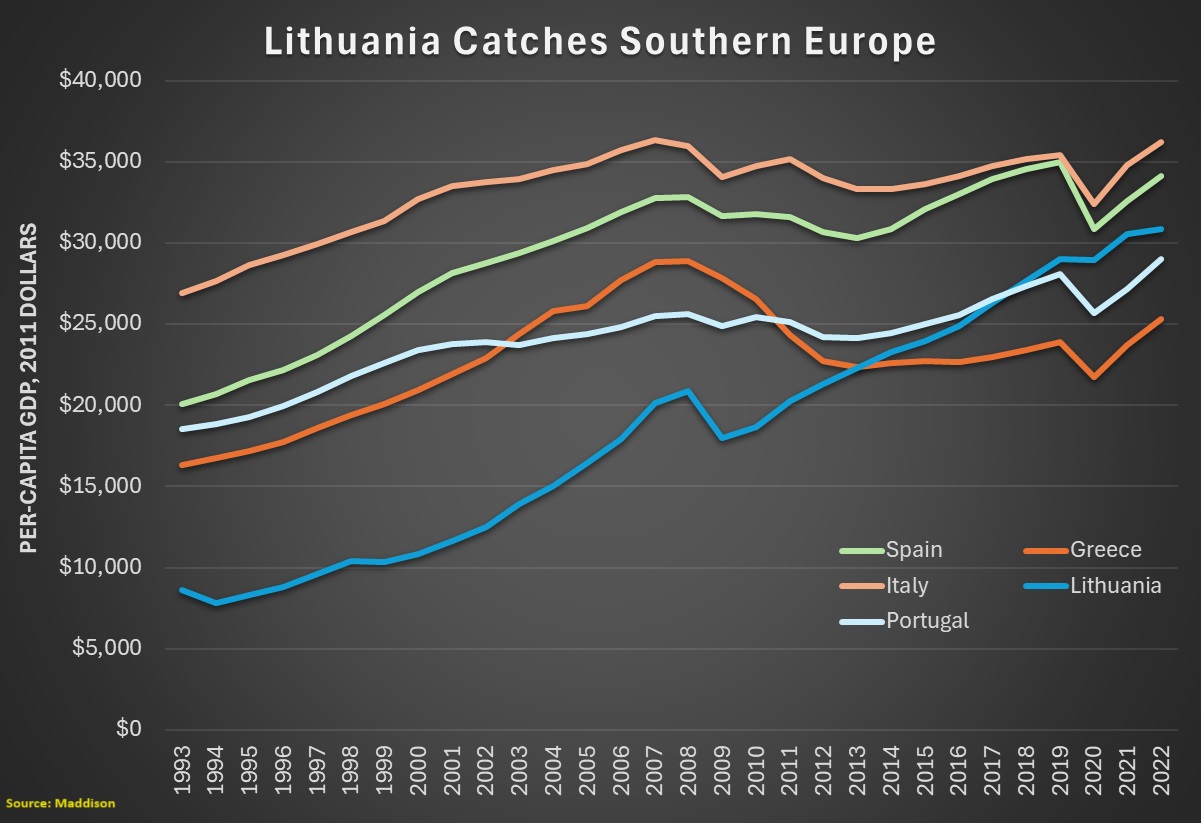
The results have been impressive. Here’s’ a chart, based on Maddison data, comparing per-capita GDP in Lithuania with per-capita GDP in the major nations of Southern Europe.
An impressive case of convergence in a relatively short period of time.
I’m motivated to write about Lithuania because of a Bloomberg column by Adrian Wooldridge.
Here’s some of what he wrote about the Baltic nation.
Forty years ago, Lithuania was an impoverished province of the Soviet Empire. Today its GDP (adjusted for purchasing power parity) is 90% of the European average — on a par with Southern European countries. …the country is no longer playing catch-up with the West but instead producing world-class companies of its own.
…The transition from being part of a command economy to being a part of a market economy is never easy. The Lithuanian transition involved a succession of shocks: the collapse of the Soviet Union; the 2008 financial crisis… Since Lithuania joined the EU in 2004, its real GDP per capita has grown faster than any EU country other than the Czech Republic. In terms of purchasing power parity GDP per capita grew by 229% between 2004 and 2020. …Lithuania is…a great success story…for liberal ideas such as democracy and the free market that have taken root in Russia’s shadow.
By the way, the author’s use of “liberal” refers to classical liberalism rather than modern-day, U.S.-style leftism.
But let’s not digress.
Although it was not a major focus of the article, the article’s headline suggested that Ukraine should follow Lithuania’s example.
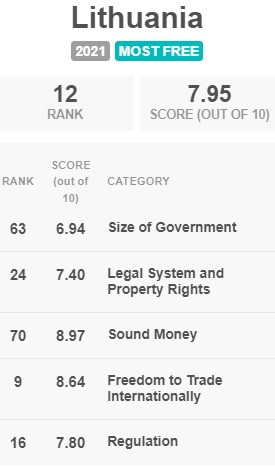
That would be an excellent idea. Lithuania is ranked #12 by Economic Freedom of the World, while Ukraine is a lowly #112.
Does this matter?
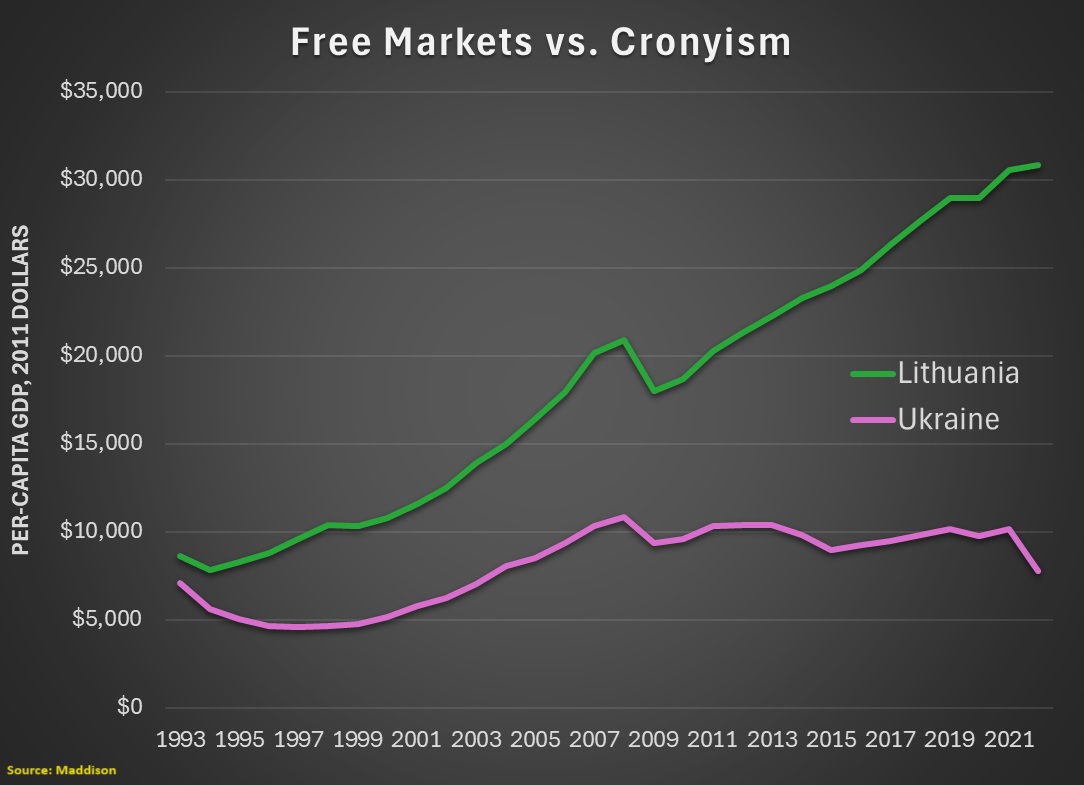
Very much so. Here’s a chart comparing per-capita GDP in the two countries. As you can see, Ukraine’s statist approach has produced stagnation.
I wrote about Ukraine’s problem with statism 10 years ago.
But Russia’s brutal invasion has made the issue even more important.
Establishment types will want to shower Ukraine with foreign aid when the only thing that will work is economic liberalization."
Friday, May 10, 2024
Famine deaths much higher under socialism than capitalism
From Daniel J. Smith. He is a Professor of Economics at MTSU.
"This is total famine deaths (from @OurWorldInData) under socialism and capitalism as measured by state ownership of the economy (from @vdeminstitute) from 1848-2011:
I use the midpoint mortality rate estimates."

Monday, April 1, 2024
Capitalism and Labor Shares: A Cross-Country Panel Study
By Andrew T. Young & Robert Lawson. European Journal of Political Economy.
"Abstract
We examine the empirical relationship between the institutions of economic freedom and labor shares in a panel up to 93 countries covering 1970 through 2009. We find that a standard deviation increase in the Fraser Institute’s Economic Freedom of the World (EFW) score is associated about 1/3 standard deviation increase in a country’s labor share. Starting from the sample mean labor share in our panel, this amounts to about 4.26 percentage points. This relationship is robust to considering OECD and non-OECD samples separately. It is also (both qualitatively and quantitatively) robust to controlling for differences in human capital levels, labor productivity, trade union density, and international economic flows. Breaking the EFW into its individual component areas, the regulation of credit, business and labor appears to be the most important source of the positive EFW-labor share relationship.
Keywords: labor share, income shares, economic freedom, political economy, democracy, capitalism, institutions, distribution of income"
Sunday, March 31, 2024
Cuba Is Starving Its People
The island’s latest hunger crisis is made in Havana. Don’t believe the propaganda blaming U.S. sanctions.
By Mary Anastasia O’Grady. Excerpts:
"Cubans are hungrier and more desperate than any time during the revolutionary dictatorship launched in 1959. The online newspaper Diario de Cuba reported on March 7 that the nongovernmental organization Food Monitor Program claims it has evidence of a black market for cat meat. The newspaper said it couldn’t verify the story, but for sure eggs, chicken, fish and beef are rarities, as is basic medication. Food often spoils because of repeated and prolonged electricity outages."
"The regime could reduce the suffering if it wished. The sea around the island is filled with protein but for most Cubans, owning a boat is prohibited. Farmers could feed people but aren’t allowed to market their produce."
"U.S. policy blocks . . . doesn’t stop Havana from buying food from the U.S."
"The problem is a shortage of hard currency. Much of what Cuba is able to get its hands on is spent on bribing the military, secret police and brown-shirts to do their dirty work against civilians. The NGO Cuba Archive says it has documented 79 “deaths and disappearances attributed to the Cuban state in 2023.”"
"The economic pie never grows because it’s controlled by a small number of Communist Party elites. A foreign investor can easily find himself in a Cuban dungeon, as did British citizen Stephen Purvis in 2011. His crime was running a business that regime honchos wanted."
"There are no property rights. A “small business” reform is little more than the parceling out of the state-run companies to Castro friends and family. Those getting fat off Cuban misery include Manuel Marrero, a ruthless enforcer of the totalitarian state rumored to be waiting in the wings to succeed Mr. Díaz-Canel.
Communist Cuba once relied on the Soviet Union and later Hugo Chávez’s Venezuela to pay its bills. Both are now bust, and Cuba has reneged on billions of dollars in loans to more than 20 countries."
See also The Communist Party Has Devastated Cuba: Six decades of orthodox, incompetent Marxist economic policies have impoverished the country. Letter to WSJ.
"Mary Anastasia O’Grady is correct to warn against the Cuban regime’s spin blaming the U.S. embargo for the current situation in the island (“Cuba Is Starving Its People,” Americas, March 25). A country that uses 30% of its land for crop cultivation can’t feed its population, but somehow the U.S. is responsible. Never mind that the Cuban government spends scarce hard currency buying food from the U.S.
This latest crisis is nothing more than the chickens coming home to roost for the Cuban Communist Party, which for more than 65 years has ruled the island ruthlessly. Six decades of orthodox, incompetent Marxist economic policies have devastated the economy and impoverished a country that Leland H. Jenks once called “the richest colony in the world.”
Incapable of satisfying the population’s needs and refusing to implement the necessary reforms, the regime is facing a terminal crisis like the one that brought down communism in Europe. Good riddance. The U.S. better prepare for a double crisis in the Caribbean, as Cuba and Haiti both experience a sorely needed regime change.
Sebastian A. Arcos
Cuban Research Institute"
Friday, March 29, 2024
Singapore is not China—and some U.S. politicians should study the difference
By Matthew D. Mitchell & Steven Globerman of The Fraser Institute.
"U.S. Senator Tom Cotton is confused about Singapore. In a recent exchange with TikTok CEO Shou Zi Chew, the Arkansas Republican repeatedly grilled Chew about his associations with China and communism.
“Have you ever been a member of the Chinese Communist Party?” asked Cotton.
“Senator,” replied Chew. “I’m Singaporean. No.”
“Have you ever been associated or affiliated with the Chinese Communist Party?”
“No Senator, again I’m Singaporean.”
“Of what nation are you a citizen?” You get the gist.
Putting aside the debate over TikTok itself and the extent of its ties to China, the irony is that Cotton and others in populist Washington could learn a thing or two from Singapore.
In just six decades as an independent country, the tiny country has grown from one of the poorest in the world to one of the wealthiest. In 1965, the average Singaporean earned about one-fifth as much as the average American (as measured by GDP per person). Today, according to the Penn World Table, the average Singaporean earns about 30 per cent more than the average American (and about 50 per cent more than the average Arkansan).
How did this happen? It wasn’t Chinese-style communism.
In fact, according to the latest Economic Freedom of the World report, Singaporeans are the most economically free people in the world (Americans are fifth). In other words, Singapore’s people make more of their own economic decisions without interference from others. This approach is increasingly out of favour in Washington, where both Democrats and Republicans seem to prefer to micromanage the economic decisions of others.
Compared with the rest of the world, Singaporeans are freer to exchange with whomever they want on whatever terms they want. They are freer to start their own businesses and run them with minimal interference from the state. They can also acquire and use property without fear that the government or other people will take it from them or diminish its value.
The report assesses economic freedom through 45 indicators gathered from each of 165 jurisdictions worldwide. According to the latest data, Singaporeans face the second-lowest regulatory burden in the world. They also face the second-lowest barriers to international trade. Because of this, Singapore’s consumers can buy products from the rest of the world without paying the sorts of tariffs that Cotton would prefer to levy on American consumers.
Singaporeans also benefit from stable and sound monetary policy, strong protection of persons and property, and a relatively low tax burden. As a per cent of the economy, the Singapore government spends about half as much as the average market-oriented democracy belonging to the OECD. Singapore’s top personal income tax rate is 22 per cent, much lower than America’s top personal income tax rate, which ranges from 37 per cent in states without the tax and up to 50.3 per cent in California.
Of course, no country is ideal. Despite its relative economic freedom, Singapore is no democracy. If one accounts for personal freedom, the country is only the world’s 44th-freest. And like Cotton and other populist politicians, Singapore’s leaders haven’t shied away from promoting some industries.
Still, as documented in a new book, industrial policy as practised in Singapore tries to avoid the main flaws of the industrial policies implemented elsewhere. Government-linked companies are expected to be efficient, internationally competitive and profitable rather than dependent on government help. In addition, industrial policy in Singapore focuses on growing the overall economic pie rather than benefiting narrow special interest groups.
Unlike America’s populists, Singapore’s policymakers understand that imposing tariffs on foreign imports impoverishes a country. Politicians who are infatuated with subsidizing their favourite U.S. industries and elbowing out foreign competition should be more knowledgeable about Singapore’s economic story. They might come to understand that populist policies will lower living standards of working Americans whose political support they court."
Wednesday, March 27, 2024
How Capitalism Beat Communism in Vietnam
By Rainer Zitelmann of Reason. Excerpts:
"The amount of food you got depended on your family's status. State employees received more, factory workers less. If there was not enough rice, people received wheat instead, though hardly anyone knew what to do with it: Even if they knew how to bake bread, they couldn't normally get hold of the other ingredients. In any case, they needed electricity to heat an oven, but electricity was available only a few hours a day.
Today the Vietnamese call this era Thoi Bao Cap—"the subsidy period." It was the time of a socialist planned economy, before the free market reforms of the late 1980s.
In 1990, with a per capita gross domestic product (GDP) of $98, Vietnam was the poorest country in the world, behind Somalia and Sierra Leone. Every bad harvest led to hunger, and Vietnam relied on food aid from the United Nations and financial assistance from the Soviet Union and other Eastern Bloc countries. As late as 1993, 79.7 percent of the Vietnamese population was living in poverty.
By 2020, the poverty rate had fallen to 5 percent. Vietnam is now one of the most dynamic countries in the world, with a vibrant economy that creates great opportunities for hardworking people and entrepreneurs. Once a country unable to produce enough rice to feed its own population, it has become one of the world's largest rice exporters, and a major electronics exporter too."
In 1977, the government started collectivizing agriculture and nationalizing nearly 30,000 privately owned small businesses. Many peasants in the South regarded collectivization as particularly unjust because the communists had given them land during the war to secure their support and now wanted to take it away from them again. Many of them resisted collectivization, and some left their land or sold their animals rather than work in collectives. By 1980, only 24.5 percent of the rural population in the South worked in collectives, compared to 97 percent in the North.
"The peasants in South Vietnam reacted by restricting production, which was primarily oriented towards their own needs," Claudia Pfeifer explained in her book Konfuzius und Marx am Roten Fluss (in English, Confucius and Marx on the Red River). "Within a few months, the agricultural sector almost completely collapsed."
"Less than 10 percent of the cultivated area for annual crops could be artificially irrigated and drained, even though pumps were available for about 40 percent of the area—power shortages and blackouts often made their use impossible. Only 30 percent of the agriculture sector's electricity demands were satisfied.
State-owned cooperatives received 40 percent of the government's funds, though they contributed only 5 percent of total agricultural production. The state collectives did not reward members for the amount of rice they produced, but instead counted how many days they had worked. If you worked 30 days, you got 30 points, which gave you the right to a defined share of the harvest. If you worked 20 days, you got 20 points and correspondingly less.
In 1980, Vietnam produced only 14 million tons of rice, though the country required 16 million tons to meet its population's basic needs. Every failed harvest led to immediate food shortages, and to rationing. The second Five-Year Plan envisaged an increase in GDP of 13 percent to 14 percent per year for 1976 to 1980. In fact, it went up only 0.4 percent—and this with a rapidly growing population. Agricultural production was to increase by 8 percent to 10 percent per year; it went up by 1.9 percent. The plan envisaged annual increases in industrial production of 16 percent to 18 percent; the actual annual average was just 0.6 percent. In the entire northern half of the country, the per capita supply of paddy rice declined by about a third in the second half of the 1970s.
Most of the yield was produced on the fraction of the land that was privately farmed. From 1976 to 1988, more than 60 percent of cooperative members' income came from the 5 percent of land they were allowed to keep after 95 percent of the land had been collectivized.
At first, South Vietnam's new rulers declared that they wanted to nationalize only foreign-owned enterprises. Vietnamese-owned enterprises were transformed into so-called parastatals (enterprises with state participation). But this was meant to be a temporary measure: The plan was that all enterprises would gradually become fully state-owned. The same problems arose in industry as in agriculture. Production stagnated, and state-owned industrial production actually declined by 10 percent from 1976 to 1980."
"The Vietnamese reformers' initial focus was on agriculture, at the time the most important economic sector by far. In 1981, for example, the state introduced Directive 100, which allowed individual families to use cooperative land. In the words of Vu Le Thao Chi, this "placed the unwritten custom of family-based production into an officially sanctioned framework."
In the early 1980s, a number of other reforms were introduced in Vietnam. Firms would now be responsible for their own profits and losses. Enterprises could decide for themselves what to do with any excess profits. Planners maintained strong controls, but if nothing else this legalized what had already been taking place illicitly. "For instance," the political scientist David Wurfel found, "when materials were short, goods could be sold in the open market to raise cash to buy supplies, or perhaps to pay bonuses to workers and thus raise productivity. Though largely illegal, these initiatives became more and more widespread. Thus, the first key reform decree for state industry in January 1981 required factories to register all activities they conducted outside the plan at the same time that it allowed them to acquire and dispose of resources as needed to increase their supply of inputs."
"at the Sixth Party Congress in December 1986, large numbers of representatives from South Vietnam supported market reforms."
"The reforms adopted in the next couple of years included permission for private manufacturers to employ up to 10 workers (later increased), abolition of internal customs checkpoints, elimination of the state foreign-trade monopoly, reduced restrictions on private enterprise, elimination of virtually all direct subsidies and price controls, separation of central banking from commercial banking, dismantling major elements of the central planning and price bureaucracies, the return of businesses in the South that had been nationalized in 1975 to their former owners or their relatives, and the return of land seized in the '70s collectivization campaign if it was "illegally or arbitrarily appropriated.""
"At the end of 1987, family farmers won the right to lease land from cooperative and state farms on a long-term basis. These farmers' rights of disposal over land were expanded in the 1992 constitution and the 1993 Land Law. Although land could not be bought and sold as private property, the transferability and inheritability of land on long-term leases (up to 75 years) was guaranteed.
The character of the agricultural cooperatives changed. The collectives were dissolved, and farmers now joined together voluntarily. The new cooperatives became providers that offered certain services to the farmers, much more cheaply than the collectives had done in socialist times. Their services became both better as well as cheaper.
In the industrial sector, too, enterprises enjoyed much more autonomy. The state headquarters' ability to intervene directly in economic activity was restricted. Economic relations between the enterprises were to be regulated by mutual contracts. The planned economy was not abolished entirely, but planning now only meant setting strategic goals over extended time frames. The setting of wages and the exploitation of profits became a matter for the individual enterprises to determine. As Pfeifer notes, "Enterprises were even granted the right to sell, lend, or rent out capacities that could not be used by the enterprise at a specific moment in time" (though the business's assets remained state property)."
"Previously, the only private enterprises allowed in Vietnam had been family businesses, which were not allowed to employ wage labor—at least officially. Now companies were allowed to hire as many workers as they wanted or needed. In 1990–1991, the legal structures of sole proprietorship, limited liability company, and public limited company were introduced. This development culminated in 1992 with Article 21 of the new constitution, guaranteeing the protection of private ownership of the means of production against expropriation.
Before 1989, the state had fixed all prices. Now such regulations applied only to electricity, petrol, cement, steel, and transport services. This liberalization of prices led to an improvement in the supply of goods. Although many prices continued to rise sharply for a while, the prices of basic foodstuffs actually remained stable, and in the case of rice they fell.
Until the reforms began, the state dominated every aspect of Vietnam's foreign trade, which was mainly with the socialist bloc, first and foremost with the Soviet Union. Opening the country meant welcoming foreign investment and integrating Vietnam into the world economy. After a Foreign Investment Law was passed in 1989, money started to flow into Vietnam from Western Europe, Singapore, South Korea, Thailand, Hong Kong, Japan, Australia, and other countries.
One of the most important reforms involved abolishing the system of centrally planned specifications and letting companies manage their own exports and imports. The private import and export of goods was allowed and, in almost no time at all, Vietnam had compensated for its lost trade with socialist countries by increasing its trade volumes with capitalist countries, especially in Asia (Taiwan, South Korea, Hong Kong, Singapore, Japan) and Australia. A series of trade agreements followed, including one with the United States.
In 1999, a new Enterprise Law removed yet more bureaucratic hurdles for private companies."
"Vietnam's gross domestic product grew by 7.9 percent a year from 1990 to 1996, faster than any other Asian country but China. Poverty fell sharply. By the World Bank's standard for extreme poverty—living on less than $1.90 a day—52.3 percent of the Vietnamese population was living in extreme poverty in 1993. By 2008, the figure had fallen to 14.1 percent. By 2020, it was only 1 percent. That indicator was developed for "low-income economies," though, and Vietnam has now moved to the "lower-middle-income" category, where poverty is defined as living on less than $3.20 a day. By that measure, the poverty rate dropped from 79.7 percent to just 5 percent.
In 1980, life expectancy in Vietnam was 62 years. Today it is 73.6 years. Vietnam has also risen in the United Nations' Human Development Index, which aims to comprehensively measure the quality of life of people in a country. The index score for Vietnam increased from 0.463 in 1980 to 0.704 in 2020, putting it only slightly below the global average of 0.723."