Showing posts with label Behavioral Economics. Show all posts

Friday, January 5, 2024

CAUSE, EFFECT, AND THE STRUCTURE OF THE SOCIAL WORLD

"This paper surveys 50+ years of randomized control trials in criminal justice and shows that almost no interventions have lasting benefit -- and the ones that do don't replicate in other settings."

By MEGAN T. STEVENSON. From BOSTON UNIVERSITY LAW REVIEW.

"ABSTRACT 

This Article is built around a central empirical claim: most reforms and interventions in the criminal legal space are shown to have little lasting effect when evaluated with gold standard methods. While this might be disappointing from the perspective of someone hoping to learn what levers to pull to achieve change, I argue that this teaches us something valuable about the structure of the social world. When it comes to the type of limited-scope interventions that lend themselves to high-quality evaluation, social change is hard to engineer. Stabilizing forces push people back toward the path they would have been on absent the intervention. Cascades—small interventions that lead to large and lasting changes—are rare. And causal processes are complex and context dependent, meaning that a success achieved in one setting may not port well to another. This has a variety of implications. It suggests that a dominant perspective on social change—one that forms a pervasive background for academic research and policymaking—is at least partially a myth. Understanding this shifts how we should think about social change and raises important questions about the process of knowledge generation."

"CONCLUSION

 Some might see the central claims of this Article as depressing. A world characterized by stabilizing forces that resist change could be seen as a trap, a vortex of inescapable and oppressive social forces. I have a slightly different perspective, one which harks back to an argument presented when discussing the scope of my claim. In an indirect way, this Article celebrates the strength and creativity of the human spirit. The fact that outside forces—interventions— are largely unsuccessful at engineering change in people’s lives does not necessarily mean that humans are powerless beings in the throes of social forces. Rather, it suggests that people have already fought to create the best lives they could for themselves given the circumstances. Any barriers to success that were readily moveable had already been moved—by people themselves and their communities. In econ-speak, people had maximized their utility subject to constraints. That being said, the constraints that remain appear to be deep, structural, and hard to shift. That doesn’t mean they are immovable, but just that they usually aren’t moveable with the type of intervention evaluable via RCT. As for how to move them—I don’t know. Moreover, I don’t think we can know, or at least not with the high levels of confidence promised by the engineer’s view. We will proceed, but must do so with the humility of uncertainty."

Tuesday, February 7, 2023

Time for behavioral political economy? An analysis of articles in behavioral economics

By Niclas Berggren. From The Review of Austrian Economics.

"Abstract

This study analyzes leading research in behavioral economics to see whether it contains advocacy of paternalism and whether it addresses the potential cognitive limitations and biases of the policymakers who are going to implement paternalist policies. The findings reveal that 20.7% of the studied articles in behavioral economics propose paternalist policy action and that 95.5% of these do not contain any analysis of the cognitive ability of policymakers. This suggests that behavioral political economy, in which the analytical tools of behavioral economics are applied to political decision-makers as well, would offer a useful extension of the research program. Such an extension could be related to the concept of robust political economy, according to which the case for paternalism should be subjected to “worst-case” assumptions, such as policymakers being less than fully rational."

Saturday, January 21, 2023

Hobo Economicus

From Marginal Revolution.

"The central implication of maximising behaviour amid competition is that rates of return tend toward equality. We test that implication in a market whose participants have the traits that behavioural economics suggests should make it hardest to find evidence of maximisation: the market for panhandling at Metrorail stations in Washington, District of Columbia. We find that stations with more panhandling opportunities attract more panhandlers and that cross-station differences in hourly panhandling receipts are statistically indistinguishable from zero. Panhandling rates of return thus tend toward equality. Extreme ‘behavioural’ traits do not prevent maximisation in this market.

That is a new Economic Journal article by Peter T. Leeson, R. August Hardy, and Paola A. Suarez."

Thursday, October 27, 2022

Paul Krugman Thinks You'll Be Happier With Fewer Choices. Nonsense.

It's true that the freedom to make your own decisions comes with both benefits and consequences, but Krugman is squarely focused on just one side of that equation.

By Eric Boehm of Reason.

"Writing in The New York Times, Nobel Prize-winning columnist Paul Krugman offers a unified theory of everything wrong with America: We're just too free to choose.

Krugman says this is the lesson to be learned from last month's energy crisis in Texas that left some of the state's residents—people who had freely chosen to sign-up for variable rate offerings from their electric service providers—with sky-high bills when demand surged as the state's generating supply crashed. People can't be trusted to choose their electric service, he argues, because some will make ill-informed decisions that come with unexpected costs. From there, he expands this thesis to a general principle, one that he says is to blame for everything from rising health insurance premiums to the subprime mortgage meltdown of a decade ago.

"Many of us are actually offered too many choices, in ways that can do a lot of harm," Krugman argues. "Sometimes people offered too much choice will make bigger mistakes than they imagined possible." That's grounds for denying someone the right to take out a risky mortgage or refusing to deregulate electricity markets, Krugman argues, even though the outcomes he's proposing would leave people with fewer options for obtaining home-ownership and likely paying higher prices for energy.

Indeed, to understand the consequences of limiting choice, just take a look at the Obamacare health insurance marketplaces, which prohibit the purchase of cheap insurance plans that would otherwise be available. They are set up this way for exactly the reasons that Krugman is outlining: because some people might make the "wrong" choice and end up with massive medical bills. The result of that policy is higher premiums for everyone.

But the real kicker is Krugman's contention that "an excess of choice is taking a psychological toll on many Americans, even when they don't end up experiencing disaster."

Nonsense. Krugman is pushing an only slightly more sophisticated version of Sen. Bernie Sanders (I–Vt.) complaints about the wide variety of deodorants available at any American supermarket. Or, if you prefer a more academic take, he's peddling a warmed-over version of The Paradox of Choice, in which psychologist Barry Schwartz argued that a proliferation of choices "no longer liberates" but rather "debilitates" and "might even be said to tyrannize."

That claim has been challenged in subsequent social experiments, including one that reviewed 50 experiments into "choice overload" and found no evidence to support the idea. In fact, a 2009 study found that increasing the number of choices actually leads to people making more reasonable—not riskier or more indulgent—choices, because it is more difficult to justify the outlandish option when so many sensible ones exist.

Psychology aside, it should be obvious that restricting individuals' choices is not a pathway to greater satisfaction. Krugman is right that the freedom to make your own decisions about life's most important things—how to finance a house, how to save for retirement—comes with benefits and consequences, and plenty of stress to boot. But Krugman's argument would suggest that gay Americans were generally happier in the days when the choice to get married was denied to them. By the same token,  were women more content when laws and customs denied them many of the choices they are now free to make every day?

The same is true when it comes to consumption. There aren't 19 flavors of Pop-Tarts and a billion different types of breakfast cereal because Kellogg's is run by a mad scientist who enjoys nothing more than discovering new ways to mash together carbs and food coloring. They exist because the revealed preferences of consumers show that we like having lots of choices.

To be sure, there will always be people who make poor choices—and that includes major, life-altering choices. But Krugman is wrong to fret over the "ideology" of ever-greater choices that "has turned America into a land where many aspects of life that used to be just part of the background now require potentially fateful decisions. You don't get a company pension, you have to decide how to invest your 401(k)."

Before extolling the benefits of having someone else handle your retirement account, however, Krugman might want to take a look at how that's working out. State-run pension plans for government employees are a collective $1 trillion in the red, thanks to a combination of deliberate under-funding and poor investment decisions. Private sector pension systems didn't go nearly extinct because of Milton Friedman's "ideology;" they did so because companies often ran them poorly and left retirees with less than what had been promised.

This is the real blind spot in Krugman's argument, and the question he never bothers asking: namely, who should be making these decisions, if not the individuals subject to the risks?

When it comes to mortgages, electric bills, pensions, health care, and anything else, the person who is going to try their best to make the right choices is the person taking the risk. Putting someone else in charge is no way to reduce the stress of making major life decisions, as Krugman seems to believe it would—it just leaves you powerless.

Human beings are fallible, of course, and some of us like to take risks more than others, so there will always be both winners and losers. That's why the size, scope, and cost of the public safety net—that is, how much the rest of us should invest in helping those who make poor choices or fall on bad luck—is a matter of never-ending debate. And, of course, the government has a role to play in ensuring that outright fraud is not occurring in any marketplace.

But let's not confuse a debate over the government's limited role as a prosecutor of fraud and provider of emergency support to the truly needy for a normative debate over whether we should prefer a world with more or fewer choices.

On that question, there is no debate to be had. A world of proliferating choice is one that includes more possibilities for individual and societal flourishing. Not all choices are beneficial and some consequences of freedom can be painful, but it is beyond bizarre for Krugman to wish away the benefits of the modern world because of a few costly mistakes. It's worse for him to suggest that you shouldn't get to make your own decisions because someone else might have screwed up."

Sunday, March 22, 2020

My Chronicle of Higher Education letter on Thaler and Sunstein

See I Think, Therefore I Grow.

"June 06, 2008 Premium 
 

To the Editor:

I enjoyed Evan R. Goldstein's "The New Paternalism" (The Chronicle Review, May 9) about Richard H. Thaler and Cass R. Sunstein, authors of Nudge. Who could disagree that "human perception is flawed," or that we all have "cognitive limitations"? This suggests enacting policies that "nudge" people in the right direction.

But it seems like a straw man is being used when Thaler and Sunstein say that policy makers previously assumed that all people can think like Albert Einstein and can exercise the patience of Mahatma Gandhi. Surely no neoclassical economist would believe that. Even Milton Friedman, in Capitalism and Freedom, said that "there is no avoiding the need for some measure of paternalism." But he also said that the principle that "some shall decide for others" is very troubling and that "there is no formula that can tell us where to stop."

Coincidentally, Alan Wolfe summarized John Stuart Mill's view in the same issue: "The purpose of liberty is not to give us what we want but to help us grow so that we can best understand our wants" ("The Forgotten Philosopher," The Chronicle Review). Let us hope that the "new paternalism" does not end up stifling such human growth. In understanding our wants, we get to know ourselves. If someone else is always nudging us in the right direction, we will never figure anything out on our own.

Cyril Morong Associate Professor of Economics San Antonio College San Antonio

http://chronicle.com Section: The Chronicle Review Volume 54, Issue 39, Page B27"

Wednesday, May 1, 2019

The Problem With Nudging People to Happiness

Cass Sunstein's latest book puts a lot of faith in the efficacy of government to structure our choices.

By Randy Barnett. Excerpt:
"Sunstein effectively challenges us to consider how individuals can be made better off, by their own lights, not by coercing them in ways that violate their rights but by structuring their environment in ways that lead them to make the choices that will end up pleasing them the most. His approach builds on the insight that most decisions are already structured by the ways that options are presented to us. From grocery store layouts with end-cap specials to websites featuring seductive links and advertisements, we are constantly and inevitably being nudged in a thousand different directions. We're free to resist these nudges, but we usually do not. So, Sunstein proposes, we might as well think about how best to nudge people to make good choices.

One revealing example he offers is the "food pyramid" designed by the federal Department of Agriculture (USDA). The idea was to nudge people to exercise their freedom to make healthier dietary choices, with the assistance of (mandatory) nutritional information on all packaged foodstuffs. Here is the pyramid as it appears in the book:

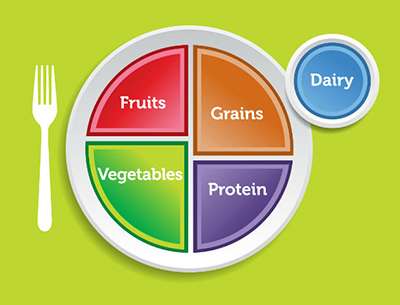
According to Sunstein, the problem with this pyramid is that it "is organized by five stripes. (Or is it seven?) What do they connote? At the bottom, you can see a lot of different foods. But it's a mess. Some of the foods appear to fall into several categories. Are some grains or vegetables?" For Sunstein, the obvious problem is that people "are unlikely to change their behavior if they do not know what to do." Thus, the government "consulted with a wide range of experts, with backgrounds in both nutrition and communication, to explore what kind of icon might be better." In 2011, they came up with this:
U.S. Department of Agriculture
The plate "doesn't require anyone to do anything," Sunstein says. Instead, "it makes clear that if half your plate is fruits and vegetables, you'll be doing well, and if the rest of your plate is divided between rice and meat (or some other protein), you're likely to be having a healthy meal." What could go wrong?
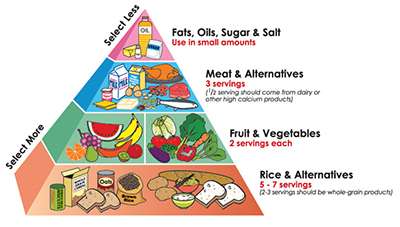
But Sunstein starts his story in the middle, with the "new" food pyramid that was introduced in 2005. He neglects the original, promulgated by the USDA in 1992:
U.S. Department of Agriculture
That pyramid recommended seven servings of good old carbs such as bread, pasta, and potatoes for every three servings of protein. It lumped fats, oils, and salts together with sugars. (The latter, we now know, is made by your body from all the bread and pasta you're eating.) Unsurprisingly, because it was issued by a government agency, the content was heavily influenced by food industry groups. Many nutritionists now blame it for fattening Americans like cattle, leading to chronic obesity, diabetes, and possibly even an explosion of dementia. Oops.

Of course, the new high-protein, low-carb recommendations might be as wrong as the old low-fat, high-carb diets. But let's say, for the sake of argument, that the new diet is right. (I'm now 30 pounds lighter because of it.) If so, generations of Americans—and the whole food industry—were "nudged" astray for decades to the detriment of their health.

What, Sunstein would respond, is the alternative? If choices are to be made, should they not be made with the best information currently at hand?

One obvious option is not to let a bigfoot like the Department of Agriculture do the nudging. Another would be to have more respect for spontaneous order, which in this case was the traditional American diet of meats, cheeses, and a side of veggies. Instead, we were urged toward a diet of partially hydrogenated fats as an alternative to supposedly unhealthy butter—"trans" fats that later were banned entirely.

"Let the market decide" is not necessarily a recipe for correct answers. But a decentralized order of freedom within the boundaries of our legally protected rights allows a diversity of choices from which better results can emerge "as if by an invisible hand." Knowledge can evolve instead of being stipulated by a Leviathan. Labeling is fine; consumers cannot identify for themselves what's put into processed food. But food recommendations—nudging—by enlightened experts empaneled by the government has been as likely to be wrong as to be right.

When I was a research fellow at the University of Chicago Law School, my office was next to Sunstein's, who was then in his first year of teaching. We became good friends. During one of our many conversations, I recall him asking what I would say if one of the greatest thinkers of the 20th century turned out to be Jürgen Habermas and not Friedrich Hayek.

Since then, Sunstein has become a bigger fan of Hayek. In this book, he quotes the Austrian economist as saying that "the awareness of our irremediable ignorance of most of what is known to somebody [who is the chooser] is the chief basis of the argument for liberty." And yet, Sunstein asks, "Might people's freedom of choice fail to promote their own well-being" from the perspective of their own desires? "Every member of the human species knows that the answer is sometimes yes." So he proposes nudging people to make the choices that will better achieve their own goals.

I would like to see him seriously confront the problem of knowing how to nudge people to get what they want. He might then consider whether government experts, panels, and boards will always have the interests of the people, rather than those of powerful interest groups, in mind. On Freedom is a stimulating read that should nudge libertarians to stop and think harder about nudging. But it could use a little more Hayek and a little less Big Mother."

Saturday, March 2, 2019

Richard A. Epstein reviews latest book by Cass Sunstein

See Nudged to Be Free: We can lose our way when offered too many choices. But are we at liberty when social forces can step in to correct all our personal blunders? The book is On Freedom. Excerpts:
“On Freedom,” which is more of a pamphlet than a book, focuses largely on the psychological states of people grappling with illness, smoking, drinking, drugs and economic insecurity. His opening passage asks a rhetorical question: “Does freedom of choice promote human well-being? Many people think so.” But he sees a huge catch: “What if people do not know how to find their way?” In the modern world, he suggests, individuals lose their way when confronted with too many choices, about everything from where to live to whom to marry.

At this point he introduces his key notion: “navigability”—the best way to get from here to there. “When life is hard to navigate,” Mr. Sunstein writes, “people are less free.” Indeed, for Mr. Sunstein, these obstacles “create a kind of bondage.” Bondage, however, without a taskmaster. By that one verbal ploy, the author turns to talking about all-too-human mistakes that have nothing to do with political freedom.

A system of laws keyed to force and fraud maintains a relatively narrow scope. But preserving freedom becomes much more fraught if social and legal forces mean that someone—the reader is never quite clear who—has the right to step in to correct the full range of individual blunders. For Mr. Sunstein, two arcane tools help achieve his ambitious ends: “nudges” and “choice architecture.” Neither works.

By nudges, Mr. Sunstein means interventions that supposedly leave individuals freedom of choice but subtly steer them in certain desirable directions. These nudges can take the form of simple reminders to stop overeating; of automatic savings plans that employees are enrolled in unless they opt out; even of physically placing healthy foods more prominently on supermarket shelves. Taken together, Mr. Sunstein’s small “nudges” add up to a broad and ambitious agenda to uplift human conduct.pose nudges on others, and for what ends? Mr. Sunstein rightly warns against an Orwellian world, and quotes the famous last line of “1984,” about the fallen hero Winston Smith: “He had won the victory over himself. He loved Big Brother.” Yet Mr. Sunstein never quite explains why nudges couldn’t be used to steer people into an Orwellian state.
Mr. Sunstein’s notion of “choice architecture” fares little better. He defines this term loosely as “the environment in which choices are made.” But which social planners should be allowed to play the role of shaping that environment and how long can they keep that role? What institutional norms and safeguards will protect everyone else against these overseers’ own cognitive impairments, ideological blind spots or corrupt motivations? Mr. Sunstein never tells us who is fit to correct the mistakes of others.

Indeed, the author avoids any systematic account of his subject, instead invoking multiple rhetorical devices that make the argument painfully difficult to follow. His exposition is punctuated by a flurry of literary quotations, copious references to Adam and Eve, and just-so stories of how fictional individuals (Ted and Joan) may be “glad” to be induced to quit smoking and drinking by socially chosen guardians. He makes no reference to the extensive literature about how best to (voluntarily) treat these common problems. Ted and Joan can ask friends for advice, go online, check into rehab or privately hire life coaches, trainers and psychiatrists. Court-appointed guardians can be provided in extreme cases. Mr. Sunstein never explains why these decentralized market strategies are inferior to his preferred choice architects.

Sadly, Mr. Sunstein’s emphasis on personal disorders like smoking or alcoholism leads him to ignore or understate real threats to human freedom from private force, or fraud, or political faction. How does a free society best regulate pollution? Does a free society need, or should it even tolerate, labor market regulation? How should it design and pay for physical infrastructure? Enforce antitrust laws? Readers will have to look elsewhere for answers to such questions, all of which turn crucially on questions of individual freedom."

Tuesday, February 19, 2019

Four year olds are rational

Young Children Make Good Scientists: Even 4-year-olds are able to use evidence to change their beliefs about how the world works by Alison Gopnik. Excerpts:
"Over the past 15 years, my lab and others have shown that, to a surprising extent, even very young children reason in this way. The conventional wisdom is that young children are irrational. They might stubbornly cling to their beliefs, no matter how much evidence they get to the contrary, or they might be irrationally prone to change their minds—flitting from one idea to the next regardless of the facts.

In a new study in the journal Child Development, my student Katie Kimura and I tested whether, on the contrary, children can actually change their beliefs rationally. We showed 4-year-old children a group of machines that lit up when you put blocks on them. Each machine had a plaque on the front with a colored shape on it. First, children saw that the machine would light up if you put a block on it that was the same color as the plaque, no matter what shape it was. A red block would activate a red machine, a blue block would make a blue machine go and so on. Children were actually quite good at learning this color rule: If you showed them a new yellow machine, they would choose a yellow block to make it go.

But then, without telling the children, we changed the rule so that the shape rather than the color made the machine go. Some children saw the machine work on the color rule four times and then saw one example of the shape rule. They held on to their first belief and stubbornly continued to pick the block with the same color as the machine.

But other children saw the opposite pattern—just one example of the color rule, followed by four examples of the shape rule. Those children rationally switched to the shape rule: If the plaque showed a red square, they would choose a blue square rather than a red circle to make the machine go. In other words, the children acted like good scientists. If there was more evidence for their current belief they held on to it, but if there was more evidence against it then they switched."

"A new paper in PNAS by Gordon Pennycook and David Rand at Yale shows that ordinary people are surprisingly good at rating how trustworthy sources of information are, regardless of ideology. The authors suggest that social media algorithms could incorporate these trust ratings, which would help us to use our inborn rationality to make better decisions in a complicated world."

Wednesday, January 9, 2019

Why Is Behavioral Economics So Popular? The recent vogue for this academic field is in part a triumph of marketing

By David Gal in The New York Times. David Gal is a professor of marketing at the University of Illinois at Chicago.
"For example, in a classic experiment, participants who were given a mug demanded, on average, about $7 to sell it, whereas participants who were not given a mug were willing to pay, on average, about $3 to acquire one. This finding has been interpreted by behavioral economists as evidence for loss aversion: The loss of the mug was anticipated to be more painful than its gain was anticipated to be pleasurable.

But Dr. Rucker and I note that there is an alternative explanation: The participants may not have had a clearly defined idea of what the mug was worth to them. If that was the case, there was a range of prices for the mug ($4 to $6) that left the participants disinclined to either buy or sell it, and therefore mug owners and non-owners maintained the status quo out of inertia. Only a relatively high price ($7 and up) offered a meaningful incentive for an owner to bother parting with the mug; correspondingly, only a relatively low price ($3 or below) offered a meaningful incentive for a non-owner to bother acquiring the mug.

In experiments of our own, we were able to tease apart these two alternatives, and we found that the evidence was more consistent with the “inertia” explanation. Dr. Thaler has dismissed our argument as a “minor point about terminology,” since the deviant behaviors attributed to loss aversion occur regardless of the cause. But a different account for why a behavior occurs is not a minor terminological difference; it is a major explanatory difference. Only if we understand why a behavior occurs can we create generalizable knowledge, the goal of science.

The lack of sufficient attention to understanding why behavior occurs matters in practical contexts, too. For example, advertisers influenced by the idea of loss aversion have focused on framing their messages in terms of loss (“you will lose out by not buying our product”) rather than in terms of gain. But such framing techniques have been shown to be ineffective: A meta-analysis of 93 studies found “no statistically significant differences” in the persuasive power of public-health messages when framed in terms of loss as opposed to gain.

The effects of this kind of intervention are often small. Recent studies have found that providing households with information on how their electricity usage compared to that of other households — a classic “nudge” — reduced electricity consumption by only 2 percent or less."

Monday, December 31, 2018

Let's not emphasize behavioral economics

By Scott Sumner.
"The Atlantic has an article decrying the fact that economists are refusing to give behavioral economics a bigger role in introductory economics courses. I’m going to argue that this oversight is actually appropriate, even if behavioral economics provides many true observations about behavior.
The core ideas of economics are extremely counterintuitive and are not accepted by most people.  Thus economists face a difficult challenge in teaching the subject to non-economists.  As an analogy, quantum mechanics seems very counterintuitive to me, and thus I have great difficulty in understanding the subject.  It’s hard work teaching basic economics.

Most people find the key ideas of behavioral economics to be more accessible than classical economic theory. If you tell students that some people have addictive personalities and buy things that are bad for them, they’ll nod their heads.  And it’s certainly not difficult to explain procrastination to college students. Ditto for the claim that investors might be driven by emotion, and that asset prices might soar on waves of “irrational exuberance.”  Thus my first objection to the Atlantic piece is that it focuses too much on the number of pages in a principles textbook that are devoted to behavioral economics.  That’s a misleading metric.  One should spend more time on subjects that need more time, not things that people already believe.

The article suggests that behavioral economics could be very useful to policymakers.  I see little evidence for this claim.  The author mentions the housing bubble, but how would behavioral economics have helped policymakers in that scenario?  If even the “masters of the universe” on Wall Street struggle to come up with behavioral finance theories capable of beating the market, does anyone seriously believe that bureaucrats in Washington will be able to “market time” well enough to spot asset price bubbles and regulate accordingly?  If so, we should provide them with a nest egg to invest and tell them that from now on they’ll earn no salary, rather they’ll have to survive on their profits from shorting asset price bubbles.

Seriously, the problems in 2008 were due to things like moral hazard in the financial system and unstable NGDP growth, which are well covered by conventional, non-behavioral economics.  And even if housing prices in 2006 were a bubble, it certainly didn’t cause the 2008 recession.  The Fed could have offset the effects of the housing slump with easier money in 2007 and 2008.

Politicians already tend to believe behavioral economic theories. Indeed there are many public policies that are almost entirely based on behavioral economics, most notably the war on drugs.  Politicians believe that people foolishly consume addictive drugs, which is why they have enacted laws that led to the imprisonment of 400,000 Americans in an attempt to stop this “irrational behavior”.  Has it worked?

Behavioral theories are sometimes used to justify policies that encourage saving.  And indeed some companies now make the adoption of a company pension the default option for newly hired employees.  Unfortunately, our government actually has a policy of discouraging saving.  Behavioral economics tells us that public policy should be more pro-saving, but then so does conventional economics.

Whenever I speak with non-economists, they almost always seem more enthusiastic when the discussion comes around to behavioral economics.  “That’s what economists should focus on!”  They all seem to think that economists assume too much rationality, and that we should switch to a more behavioral approach.  But here’s the problem.  Non-economists also tend to reject the central ideas of basic economics, and for reasons that are not well justified.  For the economics profession, our “value added” comes not from spoon feeding behavioral theories that the public is already inclined to accept, rather it is in teaching well-established basic principles of which the public is highly skepticalThus we should try to discourage people from believing in the following popular myths:

1.    People don’t respond very strongly to economic incentives.  (I.e., the demand for life-saving drugs is very inelastic.)
2.    Imported goods, immigrant labor, and automation all tend to increase the unemployment rate.
3.    Most companies have a lot of control over prices.  (I.e. oil companies set prices, not “the market”.)
4.    Policy disputes over taxes and regulations are best thought of in terms of who gains and who loses.
5.    Experts are smarter than the crowd.
6.    Speculators make market prices more unstable.
7.    Price gouging hurts consumers.
8.   Rent controls help tenants.

These myths are all widely believed by the general public.  Teaching behavioral economics is not a good way to get people to “think like an economist”, indeed it gets in the way.  Our primary goal should not be to add new information, it should be to have people unlearn false ideas about the world.  I’m not knowledgeable enough to have a good overview of the utility of behavioral economics.  But even if it is useful it doesn’t really belong in a principles of economics course, except as a way of briefly acknowledging that the rational choice model is a useful fiction and not a perfect description of human behavior.  We first need to teach basic economic principles.

That doesn’t mean that I agree with the way that economics majors are currently being taught.  Our intermediate level courses are far too theoretical; they waste students’ time on lots of minor theories that would only be useful for people planning to do graduate work in economics.  (Most students do not.)  Too many homework problems with Cobb-Douglas utility, Hicksian demand, marginal rates of substitution, Giffen goods, gross substitutes, indifference curves, etc.  Some of that is appropriate, but all economics courses should focus heavily on applied economics.  Outside of grad school, every course should be taught as if it’s the last time students will ever encounter those theories, because it usually is. Just teach enough theory for students to handle the applied courses in their major.

When I was young, an intermediate micro textbook by Deirdre McCloskey was less mathematical than many current books, and did a nice job of providing an interesting set of applications.  When I look at what young economics students are forced to learn today, I feel sorry for the millennials.

Indeed we’d probably be better off using principles texts for our intermediate economics courses.  Teach out of the exact same book as in the principles courses, but do so at a higher intellectual level.  Just as a literary scholar might re-read Hamlet 50 times, each time gaining a deeper understanding."

Wednesday, December 19, 2018

The Critics’ Misplaced Love for Behavioral Economics

By James R. Rogers. He is an associate professor of political science at Texas A&M University.
"Haldar holds a Ph.D. in economics, so she must know this assessment caricatures modern microeconomic theory beyond recognition. In her telling, economists assume people are “infinitely rational.” This means they possess “both unlimited cognitive capacity and access to information.” On this view, people make irrational decisions when they do not have full information, or when they face uncertainty, or when they need to search or learning.

As Haldar surely knows, there are entire subfields in economics, all entirely mainstream, devoted to understanding decision making with incomplete or imperfect information, decision making under uncertainty, and when people search and learn. The field of computational economics allows scholars to impose knowledge and cognitive constraints on actors, operating as “finitely rational” as the converse of Haldar’s curious phrase can imply. All of these theories proceed under the standard rationality assumption; all inconsistent with Haldar’s view of the assumptions mainstream economics makes.

Haldar’s suggestion that rationality requires full information conflates making a decision which one regrets ex post with making an irrational decision. But even very smart bets ex ante can fail to materialize ex post. These can nonetheless eminently reasonable. For example, very few people would turn down this gamble: For a wager of $100 you might receive $100,000 with 90 percent probability and $0 with ten percent probability. For most of us that’s an eminently reasonable gamble; the expected payoff is far greater than the wager. Many risk-averse people would be willing to take this gamble. The fact that ten percent of us end up with a payoff of nothing in return for our wager of $100 does not mean the gamble was irrational for those ten percent. It was a rational gamble ex ante, we just happened to lose. If offered the same gamble again, however, we would take it, no question.
Haldar further suggests mainstream economists assume people are “Ruggedly self-centered . . . and a complete lone ranger.” But what about the theory of games, distinctive because it describes interaction between two or more people? The point is precisely that people in groups make decisions differently than the Lone Ranger or Robinson Crusoe. Or the huge literature in economics on altruism? 

Consider too Haldar’s assertion that economic theory paints actors as “relentlessly materialistic.” Even if one does not consider rational choice models in political science or sociology, even in economics, scholars model individuals seeking to maximize achievement of policy preferences, which are manifestly non-materialistic. If of interest, economic models can easily accommodate altruistic or spiritual preferences as well. That most economists are substantively interested in understanding economic behavior means they make simplifying assumptions about goals, such as work, earn, and consume, to make analysis easier. Those assumptions are conveniences, however, not ontologies.

When economists assume people seek to maximize income (relative to the constraints and trade-offs they face), they have no need to make assumptions regarding why people do this. While some people may seek to maximize income to spend on themselves, others may seek to maximize income to provide for their families, or to give away to the poor or to save the planet. Economics makes no assumptions about these types of personal goals. As the British evangelist, John Wesley, famously preached, “make all you can . . . save all you can . . . give all you can.” A decent microeconomic model of an individual choosing between labor and leisure works just as well for this person as for the hedonist.

But none of the advances in economics regarding information, uncertainty, or the like flow from behavioral economics. Mainstream economics abandoned the view of human rationality Haldar ascribes to it some time ago, relaxing their views to encompass a wide range of actors’ motives and assumptions. All this work is consistent with traditional economic views of rationality."

Monday, July 2, 2018

McKenzie on behavioral economics

By Alberto Mingardi of EconLog. Excerpt:
"A couple of weeks ago, The Wall Street Journal run a splendid piece by Richard B. McKenzie entitled “People Aren’t Rational, and That’s Why We Need Free Trade”. That was an excerpt from a longer article by McKenzie on the new issue of Regulation, which is now online.

There is much to ponder in McKenzie’s article, which maintains that
In real-world markets inhabited by decisionmakers who have evolved flawed mental resources and thinking processes, competitive market forces can reduce decision-making flaws and thus lower production costs and raise real incomes by more than conventional economists have heretofore claimed. Flawed decisionmakers are led by competitive pressures, as if by an “invisible hand,” toward (not to) improved (not perfect) decision heuristics that, when adopted—even grudgingly—add to the otherwise achievable gains from trade.
If “behaviorists see their catalog of irrationalities or decision-making failures as show-stopping evidence of the bankruptcy of conventional economics and as a scientific foundation for calls for added government market intrusions”, McKenzie argues that “competitive market pressures can improve the brain’s allocation of its own resources through the development of less-flawed heuristics (and fewer irrational decisions than behaviorists have found in noncompetitive market settings)”. This line of reasoning looks powerful and a promising approach to reconciling behavioral economics’ insight and neoclassical economics – or perhaps not to allow behavioral economics to become “the applied theory of bossing people around”, to borrow Deirdre McCloskey’s whit.

In a sort of Chinese box, this article is, in turn, the synthesis of a book. I wonder if Professor McKenzie engages, there, with Nassim Taleb’s view that some simple heuristics are actually better suited to help one navigate in a complex world, than ever-more complicated rules. Are perhaps, in his view, trade and the division of labour proper instruments to develop such heuristics?"

Wednesday, February 14, 2018

The Applied Theory of Bossing People Around: Richard Thaler's prize isn't noble

By Deirdre Nansen McCloskey.
"Richard Thaler won the 2017 Nobel Memorial Prize in Economics. It's not an original Nobel prize, as recipients in the other fields will be glad to inform you. Alfred Nobel detested economics. Nonetheless, since 1969, some 79 prizes have been given by the Swedish National Bank to economists, and one to a psychologist in economists' clothing.

Thaler is distinguished but not brilliant, which is par for the course. He works on "behavioral finance," the study of mistakes people make when they talk to their stock broker. He can be counted as the second winner for "behavioral economics," after the psychologist Daniel Kahneman. His prize was for the study of mistakes people make when they buy milk.

Thaler's is the 10th Nobel for finance. (What, labor economics doesn't exist? Public finance is chopped liver? One lonely prize for economic history?) It's also the 29th for an economist associated in one way or another with my beloved University of Chicago. Yet Thaler is not of the famed "Chicago School," which thinks the mistakes people make when buying milk or talking to their stock brokers are not all that important for how and why markets and trade work.

The Committee wrote that by "exploring the consequences of limited rationality, social preferences, and lack of self-control, he has shown how these human traits systematically affect individual decisions as well as market outcomes." I object to the market outcomes part. His work is not about markets. It's about the mistakes you make all the time, you idiot. Along with his fellow behavioral economists, Thaler is reinventing individual psychology.

One might wonder why he would go to the trouble of doing so, and then claim, with no evidence, that individual mistakes discernible with the methods of individual psychology matter greatly for market outcomes.

Yet the politics is clear. Once Thaler has established that you are in myriad ways irrational it's much easier to argue, as he has, vigorously—in his academic research, in popular books, and now in a column for The New York Times—that you are too stupid to be treated as a free adult. You need, in the coinage of Thaler's book, co-authored with the law professor and Obama adviser Cass Sunstein, to be "nudged." Thaler and Sunstein call it "libertarian paternalism."

Adam Smith spoke of "the man of system" who "seems to imagine that he can arrange the different members of a great society with as much ease as the hand arranges the different pieces upon a chess-board." Thaler and his benevolent friends are men, and some few women, of system. They hate the Chicago School, have never heard of the Austrian School, dismiss spontaneous order, and favor bossing people around—for their own good, understand. Employing the third most unbelievable sentence in English (the other two are "The check is in the mail" and "Of course I'll respect you in the morning"), they declare cheerily, "We're from the government and we're here to help."

We humans face a choice of treating people as children or as adults. A liberal society, Smith's "liberal plan of [social] equality, [economic] liberty, and [legal] justice," treats adults as adults. The principle of an illiberal society, from Thaler's to the much worse kind, is that you are to be corrected not through respectful dialog that treats you as an equal, but by compulsion or trickery, which treats you like a toddler about to walk into traffic.

Wikipedia lists fully 257 cognitive biases. In the category of decision-making biases alone there are anchoring, the availability heuristic, the bandwagon effect, the baseline fallacy, choice-supportive bias, confirmation bias, belief-revision conservatism, courtesy bias, and on and on. According to the psychologists, it's a miracle you can get across the street.

For Thaler, every one of the biases is a reason not to trust people to make their own choices about money. It's an old routine in economics. Since 1848, one expert after another has set up shop finding "imperfections" in the market economy that Smith and Mill and Bastiat had come to understand as a pretty good system for supporting human flourishing.

The Progressive economists believed they saw monopolies, spillovers, informational asymmetry, consumer ignorance, producer ignorance—in short, everyone's folly and ignorance except the nudging government's—to the number of over one hundred imperfections. They imagined a new one every year or so, and lately have been getting Nobels for discovering allegedly fresh market failures. Paul Krugman, for example, received the prize in 2008, supposedly for reinventing monopolistic competition for international trade. He deserved it eventually, though he got it embarrassingly prematurely (compare Obama's for peace) because the social democratic Swedes wanted to buck up a left-of-center columnist. Krugman tweeted about Thaler: "Yes! Behavioral econ is the best thing to happen to the field in generations." He would say that.

The great essayist Lionel Trilling wrote in 1950 that the danger is that "we who are liberal and progressive know that the poor are our equals in every sense except that of being equal to us." The same may be said of Burkeans or conservatives, too. He also wrote that "we must be aware of the dangers that lie in our most generous wishes," because "when once we have made our fellow men the object of our enlightened interest [we] go on to make them the objects of our pity, then of our wisdom, ultimately of our coercion."

How to convince people to stand still for being bossed around like children? Answer: Persuade them that they are idiots compared with the great and good in charge. That was the conservative yet socialist program of Kahneman, who won the 2002 Nobel as part of a duo that included an actual economist named Vernon Smith. (The Committee amuses itself by pairing opposites. Vernon, like the earlier Smith, believes that people can and should be trusted to make decisions.) It is Thaler's program, too.

Like with the psychologist's list of biases, though, nowhere has anyone shown that the imperfections in the market amount to much in damaging the economy overall. People do get across the street.

Income per head since 1848 has increased by a factor of 20 or 30. It is a scientifically bizarre oversight, as though a geologist offered an alternative theory of plate tectonics without showing that her ideas do a better job of explaining the shape of mountains or the alignment of the continents.

The amiable Joe Stiglitz says that whenever there is a "spillover"—my ugly dress offending your delicate eyes, say—the government should step in. A Federal Bureau of Dresses, rather like the one Saudi Arabia has. In common with Thaler and Krugman and most other economists since 1848, Stiglitz does not know how much his imagined spillovers reduce national income overall, or whether the government is good at preventing the spill. I reckon it's about as good as the Army Corps of Engineers was in Katrina.

Thaler, in short, melds the list of psychological biases with the list of economic imperfections. It is his worthy scientific accomplishment. His conclusion, unsupported by evidence?

It's bad for us to be free."

Monday, November 6, 2017

Don’t Nudge Me: The Limits of Behavioral Economics in Medicine.

By Aaron E. Carroll. Aaron E. Carroll is a professor of pediatrics at Indiana University School of Medicine. Excerpts:
"Researchers randomly assigned more than 1,500 people to one of two groups. All had recently had heart attacks. One group received the usual care. The other received special electronic pill bottles that monitored patients’ use of medication. Those patients who took their drugs were entered into a lottery in which they had a 20 percent chance to receive $5 and a 1 percent chance to win $50 every day for a year.

That’s not all. The lottery group members could also sign up to have a friend or family member automatically be notified if they didn’t take their pills so that they could receive social support. They were given access to special social work resources. There was even a staff engagement adviser whose specific duty was providing close monitoring and feedback, and who would remind patients about the importance of adherence.
This was a kitchen-sink approach. It involved direct financial incentives, social support nudges, health care system resources and significant clinical management. It failed.
The time to first hospitalization for a cardiovascular problem or death was the same between the two groups. The time to any hospitalization and the total number of hospitalizations were the same. So were the medical costs. Even medication adherence — the process measure that might influence these outcomes — was no different between the two groups."

"The problem is that health has so many moving parts. The health care system has even more. Trying to improve any one aspect can make others worse. Behavioral economics may offer us some fascinating theories to test in controlled trials, but we have a long way to go before we can assume it’s a cure for what ails Americans."

Monday, October 23, 2017

The Dangers Posed by Behavioral Economics

By James Broughel of Mercatus.
"Last week, Richard Thaler won the Nobel Prize in economic sciences for his pioneering work in the field of behavioral economics. His research applies insights from a different field — psychology — by focusing on various “cognitive biases” that explain how people’s behavior deviates from that of the purely rational beings in economic models.

Dr. Thaler’s contributions to the field of economics should be celebrated. However, the value of behavioral economics in a public policy context is more nuanced. There are some clear benefits, but there are dangers as well.

An example of a cognitive bias is the “endowment effect.” After walking past a furniture shop, you might be willing to pay up to $100 for the table you see in the shop window. But after you’ve taken it home for a week, you refuse to sell the table to your neighbor for anything less than $200. In other words, ownership sometimes changes the value that people place on items. Such behavior seems to defy what traditional economic models would predict, which is that an item’s usefulness to a person is what matters, rather than who owns it.

Countless quirks like this have been identified by researchers, and governments are beginning to take advantage of these quirks when designing policies. One policy application of behavioral economics is to make enrollment into certain programs, such as organ donation, automatic. People can always opt out if they want to, but if people are enrolled by default, more tend to participate.

In response to such findings, former President Obama issued an executive order in 2015 encouraging government agencies to look for ways to incorporate behavioral science insights into their policies and programs. He created a Social and Behavioral Science Team with a similar mission.

Alongside some positive policy developments, however, there are warning signs. Behavioral economists such as Dr. Thaler are quick to criticize the assumption that people act rationally. But, ironically, many of these same scholars hold up perfect rationality as an ideal against which real-life human decisions should be judged. Any deviation from perfect rationality, the logic goes, is grounds for government regulation. It would seem to follow that any decision people make could justify regulation.

Consider a bachelor deciding whether to propose to his long-time girlfriend. Several cognitive biases will make it more likely that he proposes, even if it is a poor decision. The bachelor might be overly attached to his girlfriend due to the endowment effect. He might be too optimistic about the prospects of marriage, given that so many marriages end in divorce. Or, he might choose to marry his girlfriend out of sheer inertia, when in fact he should be exploring his options.

But we should not forget about the cognitive biases that may discourage the bachelor from proposing, even if marriage is actually in his best interests. He might remember his own parents’ divorce, a salient event in his life clouding his judgment. He might place too much weight on what he loses in marriage, such as the freedom to date other women, and downplay the gains from having a life partner and perhaps also a family. Or, he might simply procrastinate and put off proposing, putting his relationship at risk and postponing the benefits of marriage.

Whatever choice the bachelor makes, one can cherry pick from a list of more than 180 cognitive biases to argue that it was a bad decision.

Sound like a silly example? Perhaps, but regulators and academics are already criticizing the public’s decisions in a similar manner. Behavioral rationales have been put forth to justify the regulation of everything from payday loans to sugary drinks and even home appliances.

Behavioralists often point to “present bias” — putting too much emphases on the present relative to the future — in such cases. In the context of payday loans, borrowers might later regret agreeing to a high interest rate. With sugary drinks, Coca Cola drinkers might downplay the health repercussions of obesity. With home appliances, maybe consumers should be willing to pay more upfront for energy efficient appliances if in the long run they save money through lower utility bills.

These arguments may have some validity. But which behavioral biases are being ignored in these cases? Perhaps some people have an irrational aversion to debt. Perhaps some are overconfident that future energy prices will be high. Cognitive bias is real, but no regulator has all of the pertinent information about peoples’ purchasing decisions.

Take, for example, recent regulations setting energy and fuel efficiency standards for appliances and automobiles. Energy usage is certainly a legitimate concern, but according to the federal government’s own analyses, these rules will produce negligible environmental benefits for Americans. They are justified instead primarily because they “correct” the supposed irrationality of U.S. consumers and businesses.

President Trump would be wise to set boundaries on the government’s use of behavioral economics. President Obama’s executive order failed to make the important distinction between using behavioral science insights to address real problems in the marketplace — such as a shortage of organs available for transplants — and using behavioral findings to correct supposed cognitive biases found in the public. The president could repeal this order, or he could ask the Office of Management and Budget to issue guidance that clarifies this distinction.

Behavioral economics has made valuable contributions to the social sciences, which is why Richard Thaler’s Nobel is well-earned. But this research also poses dangers, depending on how it is applied. The government should put reasonable limits on the use of behavioral economics to help prevent the abuses that will inevitably occur in the hands of overzealous regulators."

Wednesday, October 11, 2017

Mario Rizzo reflects on the newly minted Economics Nobel laureate, Richard Thaler, and behavioral economics

From Cafe Hayek.

"Nevertheless, the emphasis on the limits of the standard rational paradigm, as pioneered by Thaler, has been a very refreshing and useful thing. And yet behavioral economics remains wedded to this narrow conception of rationality as a normative and prescriptive standard of evaluation. It drives the critique of many market outcomes and is the basis of policy prescriptions. It is precisely because people are not narrowly rational that their behavior must be fixed. Their behavior must be taxed, regulated or nudged in the direction of the behavior of the perfectly rational neoclassical man. For example, it is alleged that people are obese because they fail to take “full account” of the negative effects of their unhealthful eating habits. What is full account? They must reckon or discount these effects at the rational rate of discount – the long-run rate, the rate one would use if one were super-rational and calm in making a diet plan to be implemented in, say, six months or a year. But how the agent looks at things now, at the moment of deciding what to eat, is wrong. It is impetuous. It is “present biased.” The individual needs help. And, in practice, it is the government’s help.
Aside from the policy implications, there is an incredible irony here. Standard economics is mocked for its rationality assumptions and yet those assumptions are held up as an ideal for real human beings."

Tuesday, October 10, 2017

Thaler on Price Gouging

By David Henderson.

"In a segment on the economics of price gouging on NPR Marketplace last Friday [it starts at about the 11:40 point], my former University of Rochester colleague Richard Thaler points out that merchants who price gouge create ill will among their regular customers that will come back to bite them later. He's right. In response, Don Boudreaux lays out clearly both the fact that Thaler is right and, more important, the fact that this does not undercut the case for allowing price gouging. Don writes:

Yet surely no one is more aware of this downside of "price gouging" - and more interested in avoiding it - than are merchants themselves. Therefore, if after a natural disaster we nevertheless witness significant price hikes, we must ask why the price-hiking merchants are knowingly risking their reputations with consumers. The obvious answer is that the natural disaster caused supplies of goods to fall so extremely that it pays merchants to raise prices even though doing so imperils these merchants' good reputations.

There's another point to make too. We economists point out, as I did here, that the higher prices during emergencies attract resources--water, plywood, etc.--from other parts of the country. Think about who those people are who are supplying the resources. The obvious point is that they probably wouldn't do it if they were not allowed to charge higher-than-normal prices. The more-subtle point is that they don't have to worry about lost good will from future customers because many of them are engaged in one-time transactions. The guy who thinks to buy a lot of cases of water in advance and then sell them to others may not even be in the water business. He's simply trying to make a buck by doing something that buyers show by their actions is very valuable. 
 As I pointed out in my interview, by allowing price gouging, we get, to some extent, the best of both worlds. We get the traditional merchants like Wal-Mart, who worry about reputation, stocking certain supplies in advance and not raising prices. We also get the fringe, one-time suppliers, bringing in more supplies in response to the higher prices they can charge.

I found this quote from Thaler, at the 15:09 point, economically illiterate:

A time of crisis is a time for all of us to pitch in; it's not a time for all of us to grab.
Remember that he said this in the context of opposition to price gouging. But what price gouging does, as Don Boudreaux points out, is cause people far from the crisis spot to pitch in by temporarily foregoing buying the water, plywood, etc. that, due to price gouging, are priced higher even outside the directly affected area. 
P.S. If you're inclined to dis NPR Marketplace, then listen to the whole thing. It goes only about 4 minutes. They do a nice job, calling on two economists and one philosopher, of laying out the beneficial economics of price-gouging before going to Thaler to give an alternate, if badly thought out, counterpoint. My one criticism is that the host, Kai Ryssdal, leads by saying that "the free market is cold-blooded, heartless." He never says why, assuming, as he probably knows he can, that most of his listeners will agree with him."
Here is something from the comments
"Don Boudreaux writes:
David: Nicely done (and thanks for the plug). Reading your post brings another, related point to mind. Thaler famously endorses the findings of behavioral economics (I believe with good reason). Behavioral economists are fond of pointing out how people's alleged 'irrationality' prompts them to behave in ways that both run counter to the standard predictions of neoclassical economic theory and that are often less individually and socially beneficial than would be actions more in accord with neoclassical predictions.

Yet in this case we have Thaler bemoaning the fact that individuals behave in accordance with the predictions of neoclassical economic theory! We have Thaler arguing for actions (and policies?) that cause the market to perform more poorly than it would perform if Thaler's advice were ignored.
Thaler might respond that merchants who raise prices in emergencies in fact - because of cognitive limitations of the sort highlighted by behavioral economists - behave contrary to their own best long-run interests. But as I point out in the Cafe Hayek post that you link to above, it's at least an open question if such price-hikes run counter to merchants' long-run best interests. Either way, the consumer hostility to "gouging" prices that Thaler identifies is one that has the peculiar property of suggesting to behavioral economists that people's behavioral quirks and irrationalities spark an irrational demand for more government intervention than is wise. This is peculiar because the typical behavioral economist concludes that correcting for people's behavioral quirks and irrationalities requires more government intervention rather than less."

Monday, October 9, 2017

Behavioral Public Choice: The Behavioral Paradox of Government Policy

By W. Kip Viscusi & Ted Gayer of Mercatus.

"In order to justify new regulations, government agencies often argue that consumers are irrational. Unfortunately, these same regulators fail to recognize that policymakers themselves are subject to behavioral biases and political influences.

A new paper for the Mercatus Center at George Mason University examines several examples in which government actors are subject to behavioral and political biases, leading to inefficient policies.
To learn more about the paper and its authors, W. Kip Viscusi and Ted Gayer, please see “Behavioral Public Choice: The Behavioral Paradox of Government Policy.”

SUMMARY

Behavioral economists have identified certain biases in decision-making that lead to irrational decisions. These findings are important contributions to the field of economics. While biases in decision-making by private parties could justify government intervention in some circumstances, policies should take into account the fact that regulators are themselves behavioral agents subject to psychological biases, based both on their own behavioral biases and on biases reflected in political pressures. An understanding of “behavioral public choice” suggests a more cautious approach to government intervention—one that incorporates the insights of behavioral economics in a way that is less dismissive of the merits of individual choice.

Policymakers are public agents subject to political pressures and biases commonly observed in the political process. Indeed, government policies are subject to a wide range of behavioral biases that in many cases have been incorporated in the overall policy strategy. The paper documents many examples of government policies institutionalizing rather than overcoming behavioral biases, and in some cases justifying inefficient “hard” regulations (such as mandates) based on weak or nonexistent evidence of consumer irrationality that is specific to the particular area of consumer choice.

KEY EXAMPLES

There are several examples of government agencies attempting to correct consumer behavior but failing to consider the regulatory agency’s own biases.

Consumer Irrationality

In recent years, agencies such as the Environmental Protection Agency (EPA), Department of Energy, and Department of Transportation have justified regulations that mandate energy-efficiency standards for durable goods based on the presumption that consumers irrationally underweight the future cost savings from an energy-efficient product. However, there is no strong, credible evidence that consumers are persistently irrational in their purchasing decisions for energy-consuming products. In fact, choosing a less-energy-efficient appliance may be a rational choice for more consumers than regulators realize. Consumers are a heterogeneous group with different preferences and needs.

Irrational Calculation of Risk

Behavioral economics suggests that people are prone to underestimating large risks while overestimating small risks, leading to alarmism about extraordinary cases—strange diseases, freak accidents, and violent events—rather than ordinary occurrences, such as heart attacks and car accidents. This bias shows up in numerical calculation biases present in government regulatory agency risk calculations, which tend to overestimate small risks, as well as in the EPA’s bizarre practice of treating as equal both real and hypothetical exposure risks:
  • Supreme Court Justice Stephen Breyer, as an appellate court judge, criticized the EPA in a Superfund case for cleaning a site in order to prevent children from eating contaminated dirt, despite the fact that the area was unoccupied swamp land.
  • The EPA treats all exposure risks the same in its risk assessment practices, leading to incorrect valuations that find the risk to one hypothetical exposed individual equal to the current risk to a large population.
Aversion to Loss at the Expense of Greater Gain

People often focus more on losses than gains. This phenomenon has been incorrectly used to justify government policies for products with competing risk effects, such as prescription drugs:
  • The Food and Drug Administration avoids adverse consequences by placing a greater emphasis on losses than on gains.
  • As a result, a slower, more burdensome regulatory process has been created to avoid the potential risk of some drugs, despite the fact that there are drugs which may have tremendous benefits for patients if only they did not have to wait for the drug to be approved by the government regulator.
RECOMMENDATIONS

Given that government policymakers are not immune to behavioral biases, government agencies should take a more cautious approach to incorporating the insights of behavioral economics, one that is less dismissive of the merits of individual choice:
  • Rather than assuming that any class of bias provides a sufficient rationale for overriding consumer preferences, government agencies should assess the empirical prevalence and magnitude of the bias as it specifically pertains to the policy context.
  • In the design of subsequent intervention, government regulators should recognize the legitimate differences in consumer preferences that may account for the purportedly irrational behavior.
  • Regulators should thoroughly reexamine the policy approach to many risk and environmental problems, because fundamental behavioral failures are often embedded in the current policy strategies."

Tuesday, January 10, 2017

Behavioural economics – a critique of its policy conclusions

By Philip Booth. He is professor of finance, public policy and ethics at St Mary’s University, Twickenham and senior academic fellow at the Institute of Economic Affairs. Philip was formerly the IEA's Academic and Research Director between 2002-2016. 
"Behavioural economics is not a challenge to neo-classical ways of thinking. It sits firmly within the neo-classical framework. It simply gives us a new way of analysing how markets might deviate from some textbook perfect-market, welfare-maximising equilibrium. That is not to understate its importance. It leads to a new set of what people like to call ‘market failures’ and a new set of tools for resolving the problems – tools, by the way, that many of the original authors in this field (such as Richard Thaler) believe should reduce rather than increase the burden of regulatory interventions.

Austrians school economists, on the other hand, believe that markets simply cannot and will not ever follow the perfect market model of the textbook. So, we should not even look for deviations from some mythical perfection which regulators can fix using the contents of the regulatory tool box.

Austrians would describe the situation that confronts us more as follows…

People in markets go around in a purposeful way trying to maximise their welfare, which is not only monetary welfare. How they do that and how their welfare is measured are subjective matters known only by the persons themselves. People have different preferences for loss aversion, sticking with the status quo (or staying with what you know and trust to put it another way) and so on. Markets help us find ways to improve welfare over time. Entrepreneurs find new products and new ways of producing products. Consumers also find new products and services that satisfy their needs better. They don’t necessarily go about this in the way that neo-classical economists assume (rationally comparing costs and benefits), but they do it in their own way. Sitting at home and watching football and not stressing about whether to move one’s bank account may well be welfare maximising for some – for good reasons to do with how we have evolved, by the way.

The question that faces those of us interested in policy is how confident we can be, when we give a regulatory bureau the power to intervene, that it will improve matters. We should not assume that, because some interventions might have a high probability of success, we should favour giving government the power to intervene so that we can have just the good interventions. When you give the power to government to intervene, you get both the good and the bad just as you get both the good and the bad in markets. And from where might that bad come in the case of regulation?

Firstly, things might go wrong simply because regulators lack the information that is dispersed in markets to understand properly the problem they are trying to solve and also to understand the consequences of their actions. Indeed, it should be rather sobering for any regulator that there are close to 0.25 million academic articles that respond to the search term ‘unintended consequences regulation’ listed on google scholar.

Secondly, regulation might not be shaped by the general public interest, but by private interests. This is one of the areas of research for which James Buchanan won his Nobel Prize in 1986. One of the authors of the TV series, Yes Minister, the late Anthony Jay, was very much influenced by Buchanan’s work.

These private interests might be regulators themselves. They might be politicians. Or they might be the regulated industry which may try to capture the regulatory process for its own benefit.

In addition, politicians and regulators may have cognitive biases that lead them to over-estimate the efficacy of government regulation. They are not neutral arbiters.

These are all manifestations of the reality of human imperfection which it is foolish to ignore and the fact that regulators are using behavioural analysis does not change this at all. The giving of powers to a regulator creates a new institutional situation that leads to the bad stuff as well as the good stuff that we would like to see. We should not compare markets as corrected by an assumed perfect regulator with markets and all their imperfections, we should compare the reality of markets before and after the introduction of a regulatory bureau with all the imperfections that come with it.

Not only that, markets – and society in general – can develop institutions to deal with all sorts of difficulties, including those identified by behaviourists, that might prevent people from improving their welfare.

Until the Social Security Act 1986, it was possible for an employer to require employees to join their pension scheme. This was a voluntary paternalistic device which overcame the supposed myopia of potential members. The government not only made that illegal, they retrospectively over-wrote freely negotiated employment contracts that allowed employers to require their employees to join their pension scheme. This ruling was responsible for about 90 per cent of the pension mis-selling crisis in the early 1990s. Eventually, 30 years on, of course, we have auto-enrolment whereby the government requires all employees to be enrolled in their pension scheme regardless of their preferences and to go through a bureaucratic process to opt out. This is despite the fact that many of those being enrolled may simultaneously be in debt and also saving and therefore paying two sets of intermediation costs whilst having no net assets.

In other words, the government is nudging people very hard – using a behavioural mechanism – to do something that a government in the recent past actually made illegal with retrospective force.

A second example comes from life insurance. Large numbers of people (perhaps even the majority of the population) used to have life insurance and savings policies sold by door-to-door salesmen. ‘Know your customer’ and the mis-selling of insurance being compensated has put paid to that because such insurance was never in the customer’s best financial interests. But, what about other possible preferences for consumers? These may have included the self-respect that came from being able to provide for one’s funeral even if this was not the most rational way to save according to economics 101; the ability to talk to somebody each week who themselves talked to a number of other people in the community – in other words it was a mechanism of socialisation; or, it may be a device that families – generally the women in the family – used to discipline themselves (or their husbands) to save: even at zero interest rates that might have been better than not locking away that money.

Of course, regulators are especially smart. And I am not being sarcastic in saying that – it is almost certainly true, they are. However, regulators cannot know people’s preferences except on average – or at the margin. But, regulators’ actions affect the behaviour of all consumers and not simply those of a ‘representative agent’. We cannot treat people as averages.

In these two examples, we find ways in which people themselves solved their own problems using institutions that developed within the market. Regulators tried to second-guess what these people really wanted with catastrophic consequences in both cases. Regulators now realise that behaviour they effectively banned 30 years ago, that had been going on for 150 years, can now be rationalised according to a new-fangled set of theories which are now being used to enact more regulation to try to reverse the trend they set in train in 1986!

So, what is the fundamental question we need to ask? I think it is this. In general, is it better to allow the market and civil society to come up with solutions, experimenting, trying different things, copying what works and so on; or is it better to vest power in a monopoly government or regulator to deal with these problems? On balance, I believe it is better to let market institutions and civil society solve consumers’ problems including those that seem to have behavioural roots.

Firstly, as mentioned above, regulators can simply get things wrong or enact bad policy because they are motivated not by the general interest but by the interests of rent seekers or the regulators themselves.

Secondly, allowing market institutions to deal with the problem allows experimentation. It means that, if something goes wrong with one solution, something else can be tried. When regulators make mistakes, they make big mistakes that affect everybody.

Thirdly, we cannot rely on regulators to know their own behavioural biases and correct them – they will, I believe, systematically over-estimate their own ability to improve market outcomes.

Fourthly, regulators do not know as much as they think they know about the real underlying preferences of consumers. As such, we get the situation of people being nudged in the wrong direction! Indeed, very often further investigation of tendencies that behaviourists posit as being sub-optimal turn out to be reasonable – especially in the long term.

Fifthly, regulators have a tendency to under-estimate the costs they are imposing on others (I believe they do this systematically because they understand the regulation better than any of the millions of people or businesses on which it has been imposed). So nudging into pensions has turned into a mountain of paperwork, for example.

A key feature of a realistic picture of human nature as opposed to the economics textbook is that we need to learn. Information is acquired by making mistakes. That is how we progress – by making errors and learning. When we try to regulate markets, both in conventional ways and through the application of behavioural economics to try to hit some kind of welfare maximising equilibrium, we need to ask whether we are we undermining this learning process and infantilising consumers. Dose action in one area make consumers more lethargic and less able to make judgements in other areas?

This does not mean that I don’t think there is some role for behavioural economics in public policy.

It might be important in public administration. If supermarkets can use what they know about people’s behaviour to increase sales then those who manage the roads or collect the taxes might want to do the same.

The second area where behavioural economics can be useful is as a replacement for other forms of regulation. It is interesting that Thaler and Sunstein often talk about their ideas in this context. I am not a great fan of how they frame things, but they make a lot of good points. When challenged, those authors always argue that they are in favour of nudges instead of regulation that directs behaviour. That is why they call their set of ideas ‘libertarian paternalism’. I have only seen behavioural economics put forward by regulators either as an additional justification for regulation or as a regulatory option when a new intervention is being tried. What about a whole programme of replacing regulation with nudges? Wouldn’t it be nice to see that coming out of the FCA?

We need a bit more humility amongst regulators in general. And, perhaps it is appropriate that this is my last public statement as Academic and Research Director at the IEA. We seem to have gone from banning and having the state directly control large amounts of economic activity when the IEA was founded in 1955 to a situation where we have regulators who use economics 101 supplemented with behavioural economics to try to bring perfection to markets that simply cannot be perfected and perhaps cannot be improved. The end result is more pages of regulation than it is even possible to count. The question we have to ask is whether that approach is raising the fixed costs of business operation, providing a bar to new entrants, discouraging innovation, treating information like a commodity and therefore preventing the communication of tacit information, and preventing the evolution of the very institutions and habits that might help resolve the problems that regulators seek to solve. I will repeat what I said a few moments ago. We cannot choose only good regulations. We can only choose institutions and those institutions will give us both the good and the bad in a mix that will depend on the individuals who control them and the institutional background within which they work. As Hayek said: ‘the curious task of economics is to teach people how little they know about what they believe they can control.’"

Thursday, June 16, 2016

Does “I, Pencil” Need to be Revisited?

Two authors try to play up government's role in pencil-making

By George C. Leef at FEE. George Leef is the former book review editor of The Freeman. He is director of research at the John W. Pope Center for Higher Education Policy.
"In a book I recently read, Complexity and the Art of Public Policy by David Colander and Roland Kupers, I was surprised to find a chapter entitled “I Pencil Revisited.” Yes, they meant Leonard Read’s famous essay showing how market prices and competition work to coordinate production in a way that no single person, however powerful or intelligent, possibly could.
The authors aren’t exactly hostile to Read’s message but say that it leaves out something important — the role of government.
They write,
For me to be produced, someone had to protect the property rights upon which the market is based, someone had to guarantee that the contracts between individuals would be enforced, and someone had to be on the lookout for lead, for the safety of machines, and similar problems, which if not addressed might well lead to a society to undermine the institutional structure that produced me.
And, again writing through the voice of a pencil, Colander and Kupers say,
The reason I, Pencil downplayed government’s role is that he was afraid its inclusion would lead some people to expand the role of government to solve the inevitable problems that come about in coordinating production.
I believe that they are mistaken on that. The reason why Leonard Read focused exclusively on the remarkable story of voluntary market cooperation and did not expand the piece to discuss the proper role of government was that he figured most people already had some understanding of the need to protect property, enforce contracts, and settle disputes.

What very few people had any comprehension of was the way individuals all across the globe are brought into cooperation by the market for pencils.

Going into the role of government in the essay would have been like Mozart adding a few extra movements to his Jupiter Symphony.

Here is why the authors make this argument. They don’t like what they call the “market fundamentalism” of Leonard Read, former FEE president Don Boudreaux, and others (like me) who argue that the people of any society will be the most productive, happiest, and best able to deal with the problems they see if the government is kept only to the functions of protecting the rights of life, liberty, and property.

Instead of laissez-faire, Colander and Kupers favor what they call “laissez-faire activism.”
In short, they want us to believe that there is an ideal middle ground between unsophisticated “market fundamentalism” and top-down government planning and control of the economy. The latter, they understand, is bad because such authority will squelch innovation and competition, but the former supposedly doesn’t do enough to allow people to realize their “collective goals.” Here is a crucial passage:
What simplistic or fundamentalist free market advocates sometimes miss is that a complex system works only if individuals self-regulate, by which we mean that they do not push their freedom too far, and that they make reasonable compromises about benefiting themselves and benefiting society.
Of course, the common law framework that thinkers in the Adam Smith, Frederic Bastiat, Leonard Read line advocated does put limits on individual action. Rights and the sphere of legitimate action are clearly established, and to the extent that people have collective goals, they are free to pursue them voluntarily. But Colander and Kupers think government can and should do just a bit more.

One of their ideas is that government should adopt policies that will “nudge” people to do what they “really want to do,” but can’t sufficiently discipline themselves to do. They extol the book Nudge by Cass Sunstein and Richard Thaler, which purports to show how government can “encourage” people to act in preferable ways, without dictating behavior to them.

But why can’t we rely entirely on voluntary efforts by concerned individuals and organizations to do that encouraging? Churches, for example, have been encouraging people to behave better for millennia; Alcoholics Anonymous has been helping people recover from alcohol abuse since 1935; parents have been “nudging” children to make wiser decisions since time immemorial. Why look to government policy?

Sometimes, the reason why people seem to need “nudging” is that current government policy encourages undesirable behavior. Few Americans save much these days, for instance. But instead of trying to “nudge” them to save more, why not change the tax laws that discourage thrift? Going back towards “laissez-faire fundamentalism” would solve or ameliorate many of our problems.

Moreover, Colander and Kupers ignore the great and, I maintain, insuperable problem of keeping government interference within bounds. If the state has the authority to “nudge” people, what keeps politicians from ratcheting up the power if it doesn’t work? Nudging turns into pushing, then shoving. Interest groups will importune politicians with arguments for policies they favor, crafting them as merely helping “the people” to realize the social goals they “really” favor.

The way democratic politics tends to be captured by interest groups is the big message of Public Choice theory, but Colander and Kupers never think to explain how they’d prevent their “laissez-faire activism” from turning into plain old activism.

After reading Complexity and the Art of Public Policy, I fail to see how government can improve upon capitalism combined with the host of voluntary organizations that spring up in a free society. I, Pencil does not need to be revisited."