Romina Boccia and Tyler Turman of Cato.
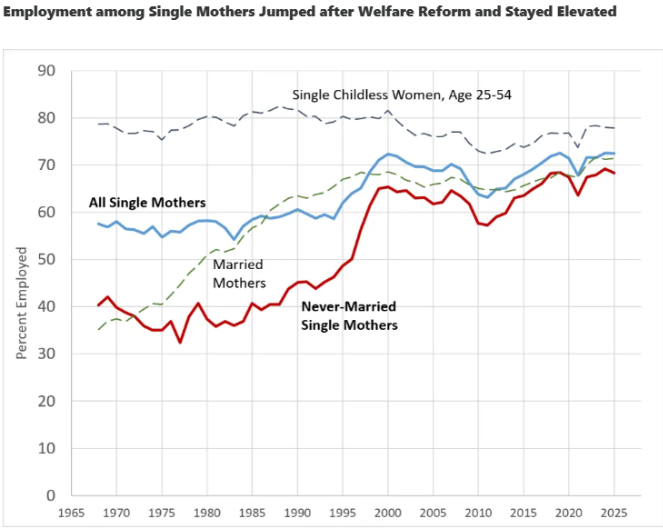
"Welfare Reform's Success Holds Up 30 Years Later. The positive effects of the 1996 welfare reforms on work and poverty still hold three decades later, argues AEI scholar Scott Winship. At a recent House Work & Welfare Subcommittee hearing, Chairman Darin LaHood (R-IL) noted that the law replaced “an open-ended 'no strings attached' cash entitlement” with a program that “included work requirements, time limits, enforced the principle of work in exchange for benefits, and capped federal funding for benefits.” In his testimony before the committee, Winship pointed out that child poverty fell by roughly half to more than three-quarters between 1996 to 2022. As Winship says, earnings among families with children since welfare reform have grown so large, that “if the entire safety net disappeared tomorrow, the child poverty rate would still be lower than in 1993.” Winship credits part of this to the employment gains after welfare reform, especially among single mothers, which rose so dramatically that they have “never returned to pre-[reform] levels. Even in the depths of the Great Recession, single mothers were more likely to be employed than they had ever been before 1995.” To read more about the impacts of welfare reform, including how states circumvented the law’s spending constraints by shifting beneficiaries off TANF and onto other, open-ended entitlements, read the statement we submitted for this hearing here."


No comments:
Post a Comment
Note: Only a member of this blog may post a comment.