Showing posts with label Food. Show all posts

Wednesday, July 29, 2026

Who's Paying for the Discounts in Mamdani's City-Run Grocery Stores?

This week, Mamdani announced his city-run grocery stores will sell core goods at a 30 percent discount.

Meagan O'Rourke of Reason

"This week, New York City Mayor Zohran Mamdani gave more details about his administration's plan to open five city-owned, city-run grocery stores across all five boroughs. Although Monday's press conference provided some more clarity about the stores' discount rates and inventory, the plan is still no better than before (despite New York magazine's declaration that the stores "Sound Pretty Good").

The Mamdani administration has announced the locations of two stores: The first will open in Hunts Point in the Bronx by the end of next year, and another will open in East Harlem by 2029. In total, the city plans to spend $70 million in capital costs, with $30 million funding the ground-up construction of the East Harlem location. The city will cover the rent and property taxes for the five grocery stores located in each borough, and private operators will run the day-to-day operations of each store. Those operators will be "contractually required" to pass on savings to customers by offering discounts on a core basket of staples.

Until Monday's press conference, it was unclear which goods would be discounted and by how much. The core set of goods, Mamdani revealed, will include produce, meat, and seafood, along with 20 other items such as milk and bread. These items will be discounted by 30 percent compared to "typical retail prices" with "no exceptions, no gimmicks." Mamdani told reporters he arrived at the 30 percent figure because food prices have risen roughly 30 percent since 2019.

When asked whether the city-run grocery stores would threaten surrounding businesses, Mamdani told reporters that the city's stores would not pose a threat to bodegas and other grocery stores because they would not sell hot food or cigarettes, items he says drive revenue for existing bodegas and stores.

Even if the public stores do not threaten privately run businesses, there are few clear upsides to the plan. As philosophy and economics professor Daniel Muñoz noted on his Substack, if the goal of Mamdani's stores is progressive redistribution, a government-owned grocery store is an inefficient and "negative sum" solution.

"Notice that anyone can shop there—there is no means testing," Muñoz wrote. "By contrast, food stamps are designed to help the poor, and they don't cause long lines or put more efficient grocers out of business."

Mamdani has said that government intervention for food distribution is nothing new. On Monday, he explained that former New York City Mayor Fiorello La Guardia was inspired to create municipally owned markets after witnessing food riots several years earlier.

"He did so because he believed in a simple definition of the task of government to make people's lives better," Mamdani said.

La Guardia may have been partially motivated to create municipally owned markets to make goods affordable, but Mamdani conveniently left out another part of the story. La Guardia wanted to create municipal markets (like Essex Market in the Lower East Side) to get pushcarts off the streets.

According to a New York Times article from 1938, La Guardia wrote in a letter to commercial associations: "It is my policy, where a market is necessary, to build a proper covered market so that these same peddlers may be permanently placed in such market under proper and wholesome sanitary conditions." While municipal markets, like Essex Market, are still in use today, they are not proof of concept for city-run grocery stores. The vendors at Essex Market pay below-market rent, but the vendors are still private businesses subject to market fluctuations.

Even if the city-run stores push other grocers out of business, create resale markets, or produce other unintended consequences, the city will have little incentive to shut them down because taxpayers will always be there to foot the bill. Plus, the city can take credit for making life more "affordable" for New Yorkers."

Monday, April 27, 2026

‘Feed the People!’ Review: In Praise of the Supermarket

Eating locally grown meat and vegetables is a nice aspiration, but it’s no way to get a satisfying meal in the winter.

By Daniel Akst. He reviews the book Feed the People! Why Industrial Food Is Good and How to Make It Even Better by Jan Dutkiewicz and Gabriel N. Rosenberg. Excerpts:

"There is no shortage of access to Brussels sprouts; people simply prefer to eat the wrong things. Local is fine, but not if you live in Chicago and want good produce in winter. Oh, and if you’re on a tight budget, Walmart is your best bet for healthy victuals."

"nostalgia for the food culture of our grandparents overlooks the prevalence of rickets, pellagra and food-poisoning in those days, to say nothing of hunger. Nor do the authors believe processed food is inherently evil. They disdain raw milk as dangerous and ask instead that we appreciate the role of pasteurization and fortified bread"

"urban community gardens, those itty-bitty lots where neighbors grow snap peas and the like, don’t amount to a hill of beans. “Qualitatively invaluable, quantitatively valueless,” they write."

"nobody should call our food system “broken”"

"the claim “offers no real vision of a better future and only vague gestures at systemic change.”"

"a vast modern society can only be fed safely and affordably by means of an efficient, industrial-scale food-production apparatus"

"pleasure deserves to be considered"

See this related post: Stop Worrying, and Learn to Love Industrial Food

Here is the beginning:

See We Shouldn’t Want to Eat Like Our Great-Great-Grandparents by Dr. Dutkiewicz and Dr. Rosenberg are the authors of the forthcoming book “Feed the People: Why Industrial Food Is Good and How to Make It Even Better.” From The NY Times.

Friday, February 27, 2026

The Editorial Board of the Washington Post explains what shouldn’t – but, alas, what nevertheless today does – need explaining: Government-run grocery stores will fail to improve the lives of their customers

From Cafe Hayek.

"The economics of public stores are fraught. By lowering prices below the market rate, stores struggle to fulfill surging demand and shortages become inevitable. That was the case at Kansas City’s Sun Fresh Market, which closed last year after wasting $18 million of taxpayer money.

Sourcing and stocking perishable food products is a complex business with notoriously thin profit margins. Despite claims by progressives that grocery stores price-gouge, profit margins usually fall between 1 to 3 percent. Partly that is due to shoplifting. Finding good real estate will also be costly in a city with scarce availability. (Whole Foods is owned by Amazon, which was founded by Post owner Jeff Bezos.)

Promising free stuff sounded nice on the campaign trail, but someone needs to pay for it. When his predecessor tried to trim spending on libraries, Mamdani called it “cruel.” Now that he’s in charge, his preliminary budget plan calls for nearly $30 million in library cuts. Those and many other cuts are probably necessary to get the bloated city budget on a more sustainable footing.

…..

The mayor has said before that his grocery idea would be “political experimentation.” But as the Big Apple faces a $5.4 billion budget shortfall and Mamdani threatens a 9.5 percent hike in property taxes, it’s foolish to spend money studying a foregone conclusion."

Sunday, February 15, 2026

Stop Worrying, and Learn to Love Industrial Food

See We Shouldn’t Want to Eat Like Our Great-Great-Grandparents by Dr. Dutkiewicz and Dr. Rosenberg are the authors of the forthcoming book “Feed the People: Why Industrial Food Is Good and How to Make It Even Better.” From The NY Times. Excerpts:

"But before you hurl that bagel into the trash, consider that it represents much that is good about our food system: It is affordable, convenient and nutritious. Virtually all the food we eat, junk and vegetables alike, is part of an industrial system. Acknowledging that fact and embracing the system’s scale, reliability, safety standards and abundance is a far better path to improving it than chasing a fantasy of Edenic premodern food that never existed.

Your morning bagel is, in fact, a small miracle made possible by conventional, mass-produced and enriched ingredients, like flour and salt. At the turn of the 20th century, when our great-great-grandparents had no choice but to eat “real food,” malnutrition was rampant. Anemia was common, as was iodine deficiency, which could cause a disfiguring swelling of the thyroid gland known as a goiter; in one Michigan county on the eve of World War I, nearly a third of potential Army recruits were rejected because of such thyroid problems. Enrichment — such as the addition of iron to wheat flour and iodine to salt — and easier access to grain and fresh produce, made possible by productive industrial farming, reduced anemia and virtually banished not only goiters but also illnesses like rickets, scurvy and pellagra.

Perhaps you want a slice of tomato on that bagel? If it’s January on the East Coast, it won’t be local. Your tomato will come from Florida or, more likely, Mexico, where it will have been grown on high-yield farms using conventional fertilizers and pesticides. Want it organic? It will still take industrial supply chains to get it to you. Shunning those globe-spanning supply chains in favor of sparse and often more expensive local and seasonal alternatives is likely to result in everyone eating less produce.

Adding fruit will make your breakfast even healthier. Here, too, modern food technology can help. Half a century of worry about the safety of genetically modified organisms, or G.M.O.s, often derided as “frankenfoods,” has not yielded a shred of compelling evidence that they endanger human health. The genetically modified Rainbow papaya, which is resistant to the ringspot virus, saved Hawaii’s papaya crop. Arctic apples from Washington State, genetically modified to brown more slowly, reduce food waste."

"the idea that ultraprocessed foods are categorically unhealthy is an oversimplification." 

"many ultraprocessed foods, such as yogurt, whole-grain bread or ready-to-eat plant-based burgers, are not linked to worse health outcomes and may even be beneficial."

"dumping industrial food from your plate would do little to change things for the better and, in some cases, would actually make it worse. Food that is local, organic and low-tech is vastly more expensive than food grown through conventional methods. There is little evidence that it is healthier. And when it comes to environmental impact, it matters much more what is produced than how it is produced; tofu is going to have a smaller ecological footprint than beef. That holds true even if the tofu comes from soybeans grown on giant farms using pesticides, and the beef is grass-fed and organic."

"There are plenty of premade options you can grab that are just as nutritious as the fresh-cooked version, like Starbucks egg white bites, Trader Joe’s palak paneer or frozen microwavable vegetables." 

Saturday, January 17, 2026

Why are groceries so expensive in NYC?

By Tyler Cowen.

"The lowest-hanging fruit is to simply legalize selling groceries in more of the city. The most egregious planning barrier is that grocery stores over 10,000 square feet are not generally allowed as-of-right in so-called “M” districts, which are the easiest places to find sites large enough to accommodate the large stores that national grocers are used to. Many of these districts are mapped in places that are not what people have in mind when they think “industrial” — mixed-use neighborhoods with lots of housing like stretches of Williamsburg’s Bedford Avenue and almost all of Gowanus, even post-rezoning, are in fact mapped as industrial districts.

To open a full-sized grocery store in these areas, a developer must seek a “special permit,” which requires the full City Council to get together and vote for an exception to the rules. This is a long, uncertain process, and has in the past even been an invitation to corruption.

Most famously, the City Council uses this power to keep out Walmart at the behest of unions and community groups. Thwarted in its plans to open a store in East New York — a low-income Brooklyn neighborhood that could desperately use more grocery options — the nation’s largest grocer instead serves New Yorkers with a store just beyond the Queens/Nassau line in Valley Stream, rumored to be the busiest Walmart in the country. New Yorkers with a car and the willingness to schlep beyond city limits — or pay the Instacart premium — get access to cheaper groceries; the rest get locked out.

When politicians are willing to approve a grocery store, the price can be high.

That is by Stephen Smith, via Josh Barro."

Friday, January 16, 2026

Groceries in November 2025 are the Most Affordable They Have Ever Been

By Jeremy Horpedahl.

"In surveys more than two-thirds of Americans say they are are struggling with the cost of groceries. And yet, relative to average wages:


The chart shows a simple measure of relative grocery affordability. Starting with the levels of wages and grocery prices in 1947, if in any year wages increase more than prices, the line goes up (it can also go down, as it does in some years). Cumulatively, you can see that today groceries are over twice as affordable as in 1947.

You could reasonably complain that there hasn’t been much progress since the early 1970s. Fair enough. But there has been significant progress since the 1990s. Even if the progress is less than we would have liked, groceries are still, right now, the most affordable they have ever been in the US relative to average wages. And since US consumers spend by far the lowest share of their income on groceries in the world, we might be tempted to say that right now groceries in the US are the most affordable they have ever been in human history. Period.

This is not just a trick of using average wages, which can be distorted by outliers. First, we are already using an average wage series that strips out the highest earners (supervisors, managers, etc.). But we can show this more clearly by using a median-wage series, such as the CPS series (calculated by EPI) starting in 1973. Notice this affordability trend gets slightly better if we use median wages from 1973-2024


It’s true that using the median wage series, 2020 and 2021 look more affordable than 2024 — but that’s because the compositional effects of the job losses in the pandemic really throw off the median wage. But the growth rate since 1973 is slightly better for median rather than average wages — it’s not a trick! And when we have the median wage data for 2025, it will also likely be the most affordable measure on this chart.

So why are people so pessimistic if wages have been rising faster than grocery prices? One theory: availability bias. People focus on the prices where they notice goods becoming less affordable, but ignore the ones that are more affordable. Many consumers could probably tell you that a dozen eggs increased from $1.40 per dozen in November 2019 to $2.86 today, and at times was much higher, topping $6 briefly in early 2025. Likewise they could tell you that a pound of ground beef soared from $3.81 in late 2019 to $6.54 today. Both of these prices increases vastly exceed wage increases over the same timeframe (about 33 percent for wages), but most consumers probably couldn’t tell you that these were outliers and most major categories of food increased by less than average wages since late 2019:


While the “beef and veal” category has clearly outpaced wages — by almost twice as much! — nearly every other category of meat and as well as other food product prices increased less than wages. Poultry is the one exception, though here it is almost equal to wage increases. But if we are talking about pork or fish, or the non-meat categories, most food is more affordable than in late 2019 relative to wages. Consumers won’t as easily identify these more affordable categories, and they probably have no idea how much average wages increased." 

Wednesday, January 7, 2026

On every continent, food supplies have grown faster than the population

By Pablo Rosado & Max Roser

"We just lived through the period with the fastest population growth in human history. Six decades ago, there were three billion people on our planet. Since 2022, there have been more than eight billion people — an increase of five billion over this period.

It would have been impressive if food supplies had merely kept pace with population growth. But as the chart above shows, they grew even faster. On every continent, food supplies — measured by calories — grew faster than the population. This rise in food production per person was a major reason for the decline of extreme poverty and hunger.

To us, this chart documents one of humanity’s most extraordinary achievements."


Friday, October 31, 2025

3 Reasons Why Zohran Mamdani's City-Run Grocery Stores Will Fail

Zohran Mamdani’s plan to open government-run grocery stores would waste taxpayer money solving a problem NYC doesn’t have

By Natalie Dowzicky of Reason

"New York City Mayoral candidate Zohran Mamdani says City Hall needs to get into the grocery business because New Yorkers are being "priced out" of private supermarkets. If elected, Mamdani says he'll spend $60 million on opening one government-run grocery store in each of the five boroughs that would deliver healthier produce at lower prices. Here's why that's a terrible idea.

1. Mamdani-Marts Can't Compete With Discount Grocery Chains

Mamdani says that New Yorkers should think of city-run grocery stores as a "public option" that would deliver cheaper food by saving on rent and taxes. And they wouldn't need to make a profit.

Except profit margins for grocery stores are typically below 2 percent, and private grocers keep costs down by utilizing complex supply chains and economies of scale that Mamdani's stores won't have access to.

"The grocery business is really tough," says Scott Lincicome, who is the vice president of general economics at the Cato Institute. Private grocery stores provide "a vast variety of fresh frozen produce and other goods that everybody wants all the time, which is actually really difficult to do, particularly at reasonably low prices." In Kansas City, a government-run grocery store scheme lost nearly $900,000 just last year. 

Lincicome says that if New York politicians want to give their constituents access to cheaper groceries, they could allow Walmart in the Big Apple. But New York politicians have used zoning regulations to keep the nation's largest and most affordable supermarket from opening a store anywhere in the five boroughs. 

"Walmart is the absolute leader in supply chain efficiencies," Lincicome told Reason. It "does this via a truly global network of warehouses and trucks and airplanes and all of these amazing things that shave off fractions of a penny off of every transaction." The idea that New York "could somehow try to replicate Walmart's global supply chain and entire business model is just laughable."

2. New York Has Fewer "Food Deserts" Than Any Other City 

Mamdani says his grocery stores will help address the problem of neighborhoods lacking easy access to fresh food. But Lincicome cites a recent study showing that "ranked the Big Apple the No. 1 U.S. metro area in terms of residents' 'equitable access' to a local supermarket."

"You can basically walk almost everywhere in New York City in 10 minutes and find a grocery store," he told Reason.

Lincicome cites multiple studies (1, 2, 3) showing that new grocery stores don't improve food access. But this is old news: In 2012, Reason covered three earlier studies that exploded the myth that adding neighborhood supermarkets improves the diets of their surrounding communities.

3. It's a waste of money

Mamdani said that he is going to pay for his grocery stores by "redirecting" $140 million worth of city funding that is already being spent subsidizing corporate grocers. As the Washington Examiner's Timothy Carney was the first to notice, that number is based on a misreading of a city website. The city subsidizes some private grocery stores at a cost of about $3.3 million per year. As some Bronx residents told Fox News' Kennedy in a new video published by Reason, the city should focus instead on helping the homeless, dealing with "rats the size of cats," and cleaning "all of the needles on the street."

Direct assistance is a more cost-effective and less destructive way to support low-income households than government-run supermarkets, and it's something the federal government already does in abundance. Through the Supplemental Nutrition Assistance Program (SNAP), or food stamps, 1.79 million New Yorkers—20 percent of the city's population—receive help purchasing groceries each month.

As one New Yorker told Kennedy in Reason's latest video, "you're focusing on the wrong things, Mamdani.""

Saturday, July 26, 2025

Could 2% of Elon Musk's wealth solve world hunger?

See  2025’s Counter-Tweet of the Year? by Dan Mitchell.

"I’ve already shared four contestants for the counter-tweet of the year.

Today, I’m going to add another contestant. Excepts I’m breaking the rules.

That’s because this counter-tweet is from 2021. But a reader sent it to me a few weeks ago and I can’t resist sharing it more widely.

You can read the CNN report by clicking here.

What makes this tweet so appealing is that it exposes the utter hypocrisy and vapidity of David Beasley, the official from the United Nations who seems to think stealing Elon Musk’s wealth would solve world hunger.

Yet the U.N.’s budget for supposedly solving world hunger was already greater than 2 percent of Musk’s wealth at the time.


So why hadn’t Mr. Beasley’s bureaucracy already ended hunger?

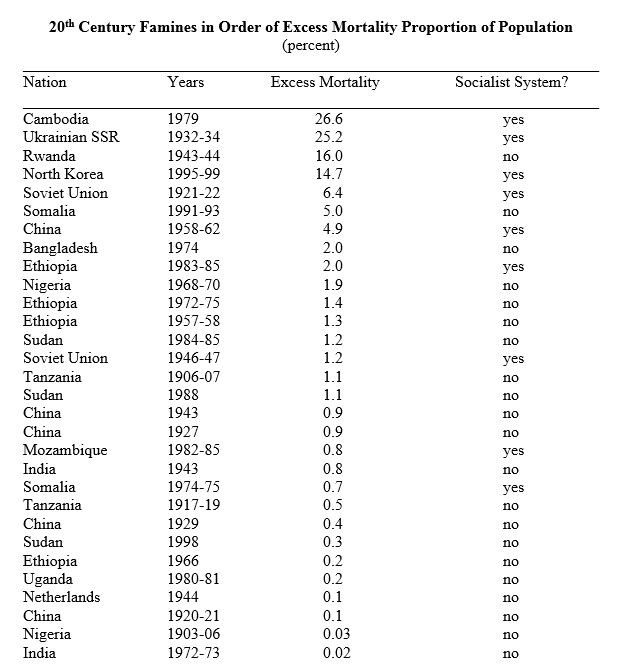
By the way, I can’t resist pointing out that governments almost always are the cause of starvation, either because of wars or catastrophic socialist policies.

Needless to say, the two CNN reporters ( and ) did not even mention any of these points in their article.

Yet another example of statist bias in the media, with journalists basically acting at stenographers for the left.

And I suppose this is a good reminder that the United Nations is infamous for wasting money."

Wednesday, February 26, 2025

Stop Blaming Rising Egg Prices on Market Power

By Brian Albrecht. Excerpt:

"But nothing in economics says large price changes require large reductions in supply. The size of the price change depends on both supply AND demand elasticities, which are about how easily the quantity supplied and quantity demanded respond to price changes.

In egg production, supply is essentially vertical in the short run due to chicken lifecycles. You can’t instantly produce more eggs when prices rise; you need to raise more chickens first, which takes months. This means that even small supply disruptions can generate large price changes.

Eggs are a perfect example of inelastic demand in practice. Jayson Lusk wrote a great post during the last major bout of avian flu. He said that a commonly assumed value for egg-demand elasticity is -0.15, meaning a 1% increase in price only reduces quantity demanded by 0.15%.[1] Put differently, if the quantity supplied drops by 1%, prices will rise by about 6.67%. In this case, the quantity of eggs dropped around 10%, which would generate a 67% increase in prices. Prices have been volatile, so it’s hard to get a true comparison, but prices have about doubled over the past year. That’s not far off the crude estimate.

This makes intuitive sense when you think about how people use eggs. They’re a dietary staple that’s difficult to substitute. You can’t easily switch to another product when making an omelet or baking a cake. Restaurants with egg-heavy breakfast menus can’t quickly overhaul their offerings. And since eggs are typically a small part of a household’s total food budget, price changes may not drive large consumption changes. When demand is inelastic like this, it takes bigger price increases to reduce the quantity demanded enough to match the lower supply.

Think about your Econ 101 graphs. With a vertical supply curve, any leftward shift of supply (from avian-flu losses) results in the same quantity reduction, but potentially huge price increases. This isn’t evidence of market manipulation but exactly what we expect to see in competitive markets with highly inelastic short-run supply.


There’s an impulse to believe massive price swings must reflect market power. I said “swings.” That’s not accurate. Only massive price hikes actually get blamed on market power. Price cuts don’t get attributed to cost savings being passed through by a monopolist.

There’s also a tendency to conflate high prices with rising prices when discussing market power. A firm with market power will typically charge high prices, but that doesn’t mean price increases indicate existing market power.

Conversely, firms in perfectly competitive markets may see dramatic price increases when faced with supply disruptions or demand spikes. The egg market illustrates this perfectly; we see rapidly rising prices, but that tells us nothing definitive about market power. We need to look at price levels relative to costs, not just price changes, to draw conclusions about competition.

But economic theory suggests that swings don’t clearly suggest market power. In fact, competitive markets often show larger cost pass-through than monopolistic ones. For simplicity, let’s assume a linear demand curve and a constant marginal-cost curve. These aren’t trivial assumptions, but the point is to show the mechanism, not to prove it is always true (it isn’t).

With perfect competition and a flat marginal cost curve, you’d see complete pass-through.


But if it were a monopoly seller, you’d only see 50% pass-through.


It’s maybe more intuitive to think of a drop in marginal cost and why that isn’t passed through. Marginal revenue drops faster than price. With a linear demand curve, the monopolist’s marginal-revenue curve is twice as steep as the demand curve. A $1 decrease in price would mean marginal revenue drops by $2. The monopolist really does not want to pass through that cost saving, which makes more sense. But if the logic applies when moving from c’ to c, it applies in the exact opposite way if we move from c to c’.

The takeaway here is that, even with identical cost changes, market structure significantly affects how much of that cost increase gets passed on to consumers."