"Payment errors in the Supplemental Nutrition Assistance Program (SNAP, formerly food stamps) have received considerable attention in recent months. While much of the debate has revolved around the One Big Beautiful Bill Act’s (OBBBA) new requirements surrounding SNAP payment errors and the impact on states, many have overlooked the people most affected by improper payments—low-income households.
The national SNAP payment error has hovered around 10 percent in recent years, accounting for almost $10 billion in erroneous SNAP benefits yearly. Some of this is fraud, but much of it involves correctable mistakes by participants or government eligibility workers. Thanks to the OBBBA, states are now financially incentivized to lower their payment error rates because states are required to fund a portion of SNAP benefits if they climb above a payment error rate threshold.
Facing the prospect of substantial financial penalties if they do not lower their error rates, states have begun to tighten their eligibility process. As Congress works toward reauthorizing SNAP through a new farm bill, it must resist calls to weaken this cost-sharing requirement or otherwise alter SNAP’s payment error formula.
The OBBBA requires states to contribute a share of total SNAP benefits issued in their state starting in fiscal year (FY) 2028, unless their SNAP payment error rates fall below a 6 percent threshold or they are otherwise exempt. Only 10 of the 53 states or territories met this threshold in FY2025. If a similar trend holds for FY2026, states will be required to pay up to $11 billion collectively in annual SNAP benefit costs in future years. This stands in stark contrast to the period preceding the OBBBA, in which the federal government covered benefit costs entirely, leaving states to face little to no penalty for high payment error rates.
Given this blunt reality, some have called for delaying the payment error cost share or ending it entirely. Some have even suggested that states will discontinue SNAP if the payment error cost share is not delayed. Other arguments have pointed to a lack of symmetry in the payment error calculation itself, which penalizes underpayments. These arguments may fall on sympathetic ears, with Senate Republicans proposing to delay OBBBA’s payment error requirements in an attempt to pass a farm bill. However, these arguments overlook the negative effects that SNAP payment errors have on low-income families. The best approach is to leave the SNAP payment error formula as it is and fully implement the payment error cost-share requirement as OBBBA intended in FY2026.
Delaying or eliminating the cost-sharing requirement accepts the current high level of SNAP payment errors. While it is true that the vast majority of SNAP payment errors are overpayments rather than underpayments, SNAP households are still negatively affected by overpayments. For example, federal regulations require that state agencies establish a claim against households that receive an overpayment, in an attempt to collect on those claims. Once overpayments are discovered, recouping them can happen by reducing the amount of future SNAP benefits, which can put a strain on a household’s budget or potentially discourage them from participating altogether.
Although research suggests that less than 20 percent of overpayments are eventually recovered, this process can disrupt assistance, requiring recipients to submit additional paperwork or lose eligibility. Avoiding overpayments will ensure that families consistently receive the resources that they need to meet their food needs.
Furthermore, while changing the payment error formula could create symmetry in the treatment of overpayments and underpayments, the consequences of underpayments are immediate and directly harmful to low-income households. This is likely why overpayments will always be more common than underpayments. State workers may be particularly sensitive to underpayments due to the immediate consequences they can have for recipients—an important consideration for treating underpayments differently than overpayments. However, state workers also need strong incentives to avoid overpayments. Requiring a state financial contribution when payment errors exceed a certain threshold will save the federal government money, but it will more importantly avoid disrupting SNAP benefits for participating households.
The Agriculture Improvement Act of 2018 has been operating on a one-year extension since FY2023, making Congress overdue to pass a new farm bill. The farm bill not only sets agriculture policy for the country but also authorizes SNAP, including the treatment of payment errors. The House of Representatives passed a new farm bill in April 2026 that maintained OBBBA’s payment error approach, but the Senate failed to pass a companion bill even after agreeing to delay the payment error cost share. The Senate’s failure offers a good opportunity to leave OBBBA’s payment error approach as intended."
Friday, September 11, 2026
Why Congress Shouldn’t Change SNAP’s New Payment Error Approach

Tuesday, September 8, 2026
Welfare Digest | Welfare Reform's Success Holds Up 30 Years Later
Romina Boccia and Tyler Turman of Cato.
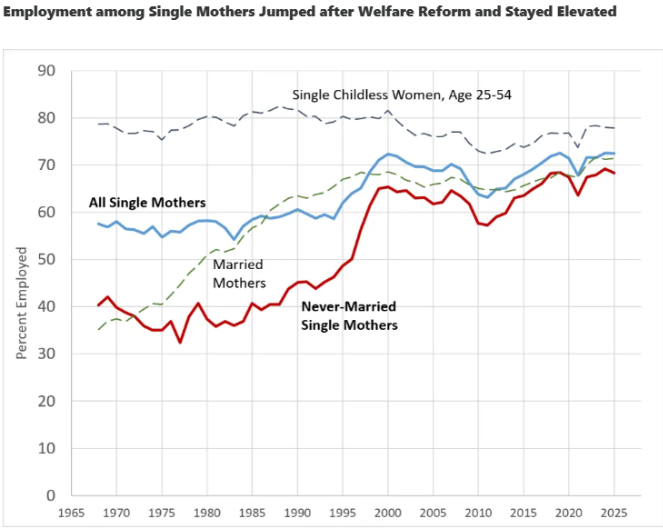
"Welfare Reform's Success Holds Up 30 Years Later. The positive effects of the 1996 welfare reforms on work and poverty still hold three decades later, argues AEI scholar Scott Winship. At a recent House Work & Welfare Subcommittee hearing, Chairman Darin LaHood (R-IL) noted that the law replaced “an open-ended 'no strings attached' cash entitlement” with a program that “included work requirements, time limits, enforced the principle of work in exchange for benefits, and capped federal funding for benefits.” In his testimony before the committee, Winship pointed out that child poverty fell by roughly half to more than three-quarters between 1996 to 2022. As Winship says, earnings among families with children since welfare reform have grown so large, that “if the entire safety net disappeared tomorrow, the child poverty rate would still be lower than in 1993.” Winship credits part of this to the employment gains after welfare reform, especially among single mothers, which rose so dramatically that they have “never returned to pre-[reform] levels. Even in the depths of the Great Recession, single mothers were more likely to be employed than they had ever been before 1995.” To read more about the impacts of welfare reform, including how states circumvented the law’s spending constraints by shifting beneficiaries off TANF and onto other, open-ended entitlements, read the statement we submitted for this hearing here."

Wednesday, September 2, 2026
Reflections on Americans’ Net Worth
By Bryan Caplan. Excerpt:
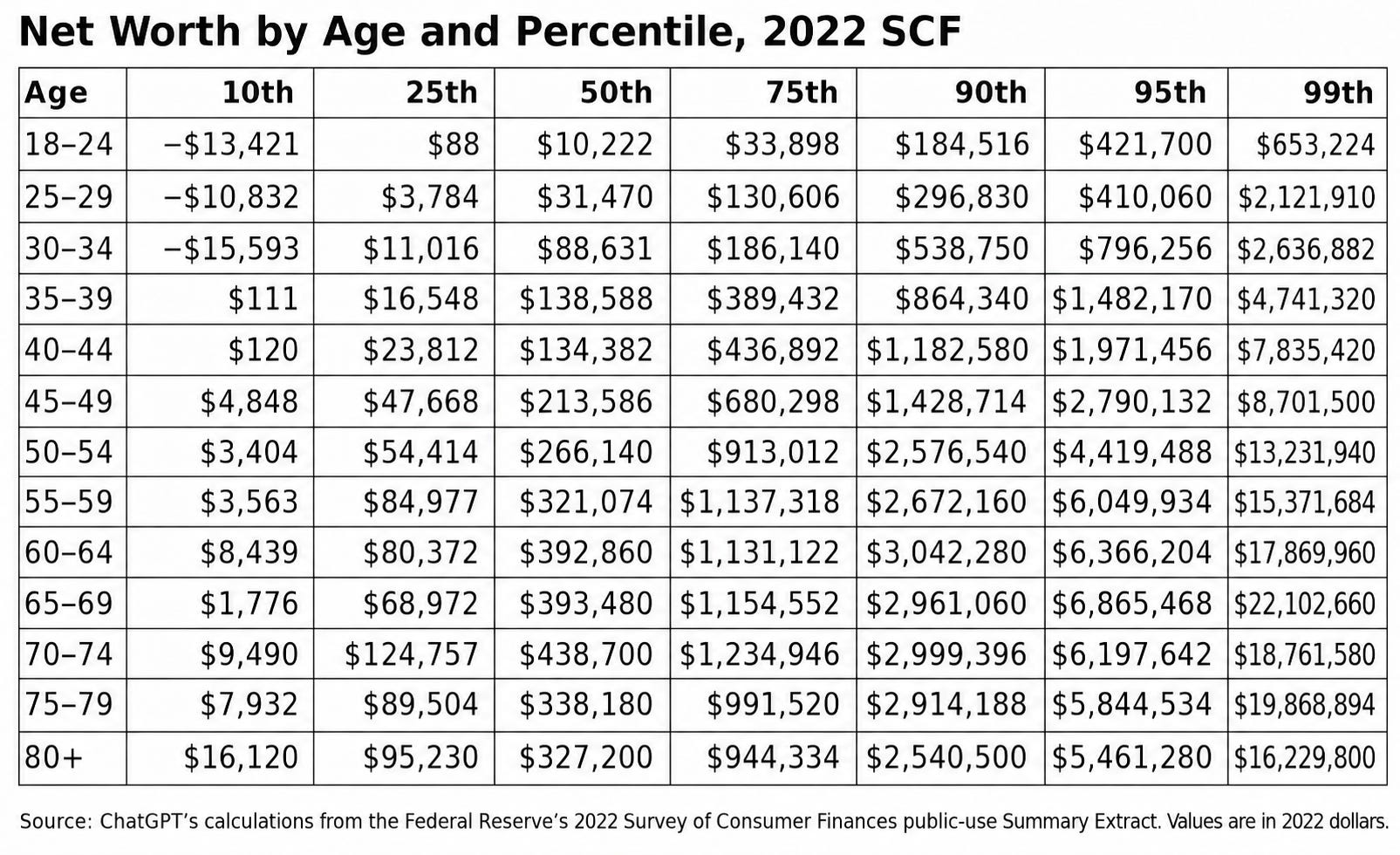
"I’ve been an economics professor for almost 30 years, but I don’t think I’ve ever before seen anything like the table below. I knew that claims that “58% of Americans can’t afford a $1,000 car repair” were laughable clickbait. I knew that — measured by income — the middle class is disappearing… by becoming upper-middle class. But only recently did I start to fully appreciate the chasm between populist pessimism and actual data on Americans’ net worth. From the 2022 Survey of Consumer Finances:
"Main reflections:
Economists have long known that inequality is relatively low for consumption, medium for income, and high for wealth. What they rarely emphasize, however, is how much wealth depends on age. The richest Americans aged 65-69 are worth about 30x as much as the richest Americans aged 18-24.
Net worth is very high in absolute terms. The median is over six figures by the mid-30s. Americans at the 75th percentile are millionaires by their mid-50s. Americans at the 90th percentile are millionaires by around 40. Claims about middle-class, middle-aged Americans who “can’t afford” eggs or gas or beef are nonsense.
The most sensible argument for worrying about trade deficits is that we’re “living beyond our means.” Trade deficits represent borrowing, and we can’t keep borrowing forever. But given Americans’ extraordinary net worth, the most sensible argument for worrying is still senseless. After 50 years of unbroken trade deficits, we’re wealthier than ever."

Sunday, August 23, 2026
Wealth Tax 2.0
By John H. Cochrane. Excerpts:
"If you invest an extra dollar today, how much extra do you get in a year? A 5% wealth tax drags down the rate of return by 5 percentage points. If you earn 10% on your investments, but then pay a 5% wealth tax, you only get a 5% after-tax rate of return. Starting from a 10% return, a 5% wealth tax is the same as a 50% tax on interest, dividends, and capital gains."
"The wealth tax applies on top of corporate taxes, property taxes, and taxes on dividends, interest, and capital gains. Inflation acts as another wealth tax, running 3% a year now. My guesstimate is that the government takes all the return and more."
"Should they (billionaires) bet the farm on a new venture, investing time and effort as well as their money? Should young Elon Musk take his $175 million PayPal payout and retire on it, or plow it all into electric cars and rockets? We often think of saving vs. consumption here, but I think we underestimate the disincentive to take risk and invest effort that comes from progressive taxation. If the government taxes away the upside to investing, people take less risk."
"Billionaires do not have a pot of gold that can be costlessly handed out. Billionaires’ wealth stays re-invested in companies. Redirecting their wealth to social spending lowers national investment and raises national consumption, dollar for dollar. That’s not even hidden; it’s the point. But less investment mechanically means less capital for the future, fewer businesses, less productivity, lower wages."
"less investment also drives up interest rates as people with profitable ventures look for investors. Companies could finance investment with foreign money, but that raises the trade deficit"
"Structuring businesses to avoid taxes rather than generate profit might be the most insidious effect of high taxation."
"We have a wealth tax, the estate tax. It tries to charge 40% of wealth once in a generation, or about 1% a year. (You pay double if you pass it to grandkids, so really about once every 30 years.) The estate tax attracts a beehive of perfectly legal avoidance. (Avoidance, not evasion. “Tough enforcement” and audits do nothing here.) Though the estate tax applies above a lowly $11 million, the CBO reports that it yields only $18 billion, or 0.1 percent of GDP. A recent study—by wealth tax backers—reports that the estate tax collects only three to four hundredths of a percent (0.03%–0.04%) annually of the Forbes 400 wealth, not 1% or so."
[the bill] includes “a $3,000 direct payment to every man, woman and child living in a household making $150,000 or less.” $1.1 trillion for Medicaid and Obamacare subsidies. Free dental, vision and hearing. $856 billion of government-provided homes to “abolish homelessness.” A childcare entitlement. A minimum salary for teachers. And so on. This is proudly a bill to turn investment into consumption."
"Free market wealth did not install Putin, nor did it create US crony capitalism under the regulatory state."
"What’s the right question? There is only one question — long run growth. Redistributing Rockefeller’s wealth would not have made your family better off. We’re all immensely better off because of long-run growth. Even if your concern is entirely at the lower end of the economic spectrum, long-run growth is the question. Ask of any policy, what does this do to long-run growth? For the wealth tax, not much!"
Saturday, August 22, 2026
Did UBI make people happier? (only in the short run)
"Eh, only in the short run:
We study the causal impacts of income on a rich array of employment outcomes, leveraging an experiment in which 1,000 low-income individuals were randomized into receiving $1,000 per month unconditionally for three years, with a control group of 2,000 participants receiving $50/month. We gather detailed survey data, administrative records, and data from a mobile phone app. The transfer caused total individual income excluding the transfers to fall by about $1,900/year relative to the control group and a 4.2 percentage point decrease in labor market participation. Participants reduced their work hours as a result of the transfers by 1-2 hours/week and participants’ partners reduced their work hours by a comparable amount. Among other categories of time use, the greatest increase generated by the transfer was in time spent on leisure. Despite asking detailed questions about amenities, we find no impact on quality of employment, and our confidence intervals can rule out even small improvements. Treated participants broadly increase expenditures, led by spending on non-durable goods and services, with smaller increases in spending on durable goods and human capital. We observe no significant effects on degree attainment, though the magnitudes of the estimated effects generally appear larger among younger participants. Measures of subjective well-being are higher among treated participants in the first year of the transfers but then revert to control group levels. Overall, our results suggest a moderate labor supply effect that does not appear offset by other productive activities.
That is from the QJE by Eva Vivalt, Elizabeth Rhodes, Alexander Bartik, David Broockman, Patrick Krause, and Sarah Miller. Via Matt Yglesias."
Thursday, August 20, 2026
A Reality Check on the Inequality Panic
Calls for wealth redistribution rest on a faulty premise about inequality
"Summary: Widespread claims of rapidly worsening global inequality are unsupported by the evidence. Long-term data show significant declines in inequality across income, health, education, and other important metrics, largely driven by rising prosperity in poorer countries. Popular policy proposals to address inequality, such as wealth taxes and expanded foreign aid, are misguided and dangerous. Policies that sustain economic growth and market stability are better guarantors of progress.
Anthropic CEO Dario Amodei called for far higher taxation in a recent blog entry, arguing that current wealth concentration is higher than that of the Gilded Age and is about to get worse globally. The chart-topping singer Billie Eilish implored billionaires to give away their money, while New York City mayor Zohran Mamdani has gone further, opining, “I don’t think we should have billionaires” because we live in “a moment of such inequality.” If anything is having a moment, it is the conviction that inequality has grown urgent enough to justify a muscular policy response.
But the facts don’t support this. Not only has global income inequality fallen over the long run — contrary to the popular narrative — but inequality has also declined in education, health, and a host of other areas. The world is now more equal across a range of factors, from lifespan and childhood survival to internet access and schooling. The more broadly one examines inequality, the more encouraging the data appear. It turns out that even the shock of COVID-19 failed to erase decades of progress toward a wealthier and more equal world.
Indeed, the data show a pronounced decline in global inequality over the past few decades, driven largely by rising prosperity in poorer countries. During the pandemic years of 2020 and 2021, progress slowed sharply. Some indicators stalled and a few modestly worsened. But the gains accumulated before the crisis were not undone.
In short, the damage to human well-being was more limited than many feared.
Another recent analysis published in The Economist finds that global inequality in consumption spending is falling. In 2000, the richest 10% of humanity spent 40 times more than the poorest 50%. In 2025, they spent around 18 times more. Using data from World Data Lab, they find that the poorest 50% now out-consume the richest 1%, breaking from past trends.
Yet many think that only large-scale redistribution can stop runaway worldwide inequality. Figures as diverse as Amodei, Eilish, and Mamdani are far from alone in embracing this view. Over the past few years, calls for a worldwide wealth tax, a vast increase in foreign aid spending, and other unprecedented measures are gaining steam across academia, non-profits, the press, and international organizations like the United Nations.
That conclusion is premature. Getting the facts straight is essential, because misunderstanding global inequality can push policymakers toward harmful solutions.
The record on foreign aid is far less encouraging than its advocates suggest: decades of evidence show that aid frequently fails to deliver sustained development and bears no reliable relationship to long-term economic growth. Worse, the fixation on ever larger aid flows often crowds out the harder work of domestic reform. In some cases, foreign aid has been shown to weaken political institutions, entrench bad governance, and slow the process of democratization.
Wealth taxes have their own problems, from high administrative costs and enforcement challenges to low revenue production and invasion of financial privacy. These problems help explain why so many of the countries that have implemented wealth taxes in the past — such as France, Germany, and Sweden— later abolished the tax. Perhaps the worst of all, by discouraging risk-taking, wealth taxes suppress investment and growth, effects that would be felt in both rich and poor countries and would likely prove especially damaging to development in the world’s poorest economies.
Recent work on multidimensional inequality suggests that the world has not been drifting toward ever greater gaps, but that the rich and the poor have been converging in material comfort. Calls for global wealth taxes or massive new aid programs often rest on the assumption that international trade and economic freedom have failed to deliver broadly shared gains. Yet the long-term evidence suggests the opposite.
The pandemic offers two lessons here: First, it highlights just how sensitive progress is to disruptions in markets. It depends on conditions that allow growth to occur and persist, including functioning markets and stable institutions. Many of the proposed policy solutions risk undermining that progress.
The second lesson is that while the pandemic represented a hurdle in the path of progress, the long-term trend toward lower global inequality is holding strong.
Alarmist narratives shape public opinion and encourage policymakers to pursue sweeping interventions that may do more harm than good. A clearer view of the data counsels caution rather than panic."
Monday, August 17, 2026
Who Will Pay for Democratic Socialism’s $200 Trillion Cost?
"The Democratic Socialists of America (DSA) propose new spending that could more than triple federal outlays. They propose the government pay for health care, housing, higher education, and electricity. Jobs are government-guaranteed, retirement benefits are expanded, paid family leave is universal, fossil fuels are eliminated, and reparations are paid.
The DSA platform claims that the bill for all this will be sent to “the richest individuals and corporations.” Tally up that bill, and it ballparks between $71 trillion and $212 trillion in new spending over the next decade. Confiscating every dollar of high-end wealth and corporate profits would cover only a fraction of those costs. The DSA agenda necessitates high taxes on middle-class Americans.
$200 Trillion in New SpendingTotaling up nine of the largest proposals in the DSA platform would mean new federal spending equivalent to between 18 percent and 53 percent of GDP.
Table 1 reports various low-end and high-end estimates of proposals for programs that approximate the DSA’s vague descriptions. Each proposal’s original spending estimate is converted to a share of GDP and then applied to the 2027–2036 projected GDP, so all estimates are in current dollars.

Medicare-for-All-style proposals for universal healthcare would increase federal spending by $40 trillion to $75 trillion over 10 years. Reparations, a federal jobs guarantee, infrastructure, green energy investment, larger retirement benefits, free housing, paid family leave, and no-cost college would increase spending by tens of trillions of dollars more. In total, the DSA’s new spending would cost between $71 trillion and $212 trillion over the next decade.
This exercise is inherently imperfect, which is why the estimates vary so widely and should be understood as orders-of-magnitude estimates. They likely overstate the cost where programs overlap with each other or existing spending. They understate the cost by failing to fully capture behavioral responses, broader economic effects, and the comprehensive scope contemplated by the DSA. Each estimate comes from different authors using different methods and assumptions, and builds on a similar methodology by David Burton.
Internationally High Spending
In the US, federal, state, and local governments spent almost 40 percent of GDP in 2024. The average across the European Union is 49 percent, ranging from 58 percent in Finland to 22 percent in Ireland.
Using the lower-bound estimates, the DSA agenda would raise US spending to more than 57 percent of GDP. Among large, industrialized countries, only Finland would have a larger government. France comes in a third of a percentage point under the US’s low estimate. Add the high-end estimates, and US government spending would reach 92 percent of GDP.
No comparable country on Earth spends anywhere close to that amount. The DSA agenda’s spending could give the government a claim on national output much closer to estimates of state control under Soviet-style communism than to today’s European welfare states.

Who Pays?
The federal government is projected to collect $70 trillion in taxes over the next decade, roughly 18 percent of GDP. Paying for the DSA agenda would require roughly doubling federal revenue at the low end and quadrupling it at the high end, in addition to the revenue needed to cover the Congressional Budget Office’s $24 trillion projected ten-year deficit.
The DSA suggests that the richest Americans and corporations will pay for all these new outlays. The problem is, there simply aren’t enough resources at the top to make this plan work.

The 400 wealthiest Americans were worth a record $6.6 trillion in 2025. Confiscating all of their wealth would cover only about 9 percent of the low-end revenue requirement and 3 percent of the high-end estimate. Their wealth could be seized only once, and attempting to liquidate trillions of dollars in assets would, in turn, drive their value down.
Domestic corporate profits after federal taxes are projected to be about $35 trillion over the next decade. Seizing every additional dollar of corporate profits would fund half of the low-end estimate and 17 percent of the high end. This also assumes that firms continue operating normally while the government takes every cent of profit. Without a profit motive, businesses would cease to exist.
Higher earners are also not a source of vast untapped revenue. A recent report by economists at the Joint Committee on Taxation concluded that raising top federal income tax rates to their revenue-maximizing level would result in revenue gains of less than 0.1 percent of GDP, equivalent to roughly $400 billion over a decade at today’s projected GDP levels.
The entire wealth of the richest Americans, plus every dollar of corporate profit and maximum top income tax rates, still leaves the DSA agenda between $29 trillion and $169 trillion short.
The only remaining source of revenue large enough to cover the DSA agenda is the same one every large European welfare state relies on: the middle class. France and Finland don’t fund their large governments by only taxing billionaires. They impose high income, payroll, and consumption taxes on ordinary households.
To cover the DSA’s high-end spending estimate and current deficits, every $1 the federal government collects today would need to become about $4.36. Mechanically applying that increase to individual income-tax rates would push the 24 percent bracket above 100 percent and the top rate above 160 percent.
The DSA is promising Americans a world in which someone else will pay for potentially hundreds of trillions of dollars in new benefits. The problem is that there aren’t enough rich people or corporations to pay for Democratic Socialism. Eventually, the bill will come for the rest of us."
Sunday, July 19, 2026
Food Stamps Don’t Help National Wellbeing
No matter how much the government might give poor families, the official measure of poverty would remain unchanged
"Crystal FitzSimons’s letter “Fewer People on Food Stamps Isn’t Good News” (June 23) claims that SNAP lifts 3.6 million out of poverty. That is impossible because the Census Bureau refuses to count $1.6 trillion in government subsidies, including SNAP, as income. No matter how much the government might give poor families, the official measure of poverty would remain unchanged.
Ms. FitzSimons’s claim uses an experimental poverty measure that counts SNAP as income while omitting $1 trillion in other welfare, arbitrarily subtracts some spending, and capriciously raises the income defining poverty thresholds.
The $100 billion spent on SNAP in 2024 added nothing to national well-being. It merely redistributed it. If left with the original earners, it would either be consumed with the same effects, or it would be saved and invested, creating additional well-being, which it wouldn’t with SNAP.
While decrying the minimal adjustments to SNAP to prevent abuse, Ms. FitzSimons ignores the 60% of food stamp recipients who aren’t poor, even by the overstated Census metric.
John Early
Adjunct scholar, Cato Institute"
Sunday, July 12, 2026
Socialism and the Decline of the Black Family
Children need fathers, but social fragmentation gives an advantage to those who seek centralized power
By Jason Riley. Excerpts:
"socialism’s impact on the traditional family structure is no less concerning. Children from intact families are more likely to finish school and avoid poverty. The absence of fathers is strongly correlated with teen parenthood, drug addiction and involvement with the criminal justice system. The cultural anthropologist Margaret Mead wrote that “every known human society rests firmly on the learned nurturing behavior of men” and that civilization “depends upon social inventions that will make each generation of males want to nurture women and children.”"
"socialists such as Karl Marx and Friedrich Engels dismissed the traditional family as a tool of oppression"
"many of the social and economic problems in low-income black communities stem from the sad fact that some 70% of black children are born to unwed parents and nearly 45% live with a single mother."
"Asians are the highest earners, followed by whites, Hispanics and blacks. Similarly, Asians have the highest marriage rates, followed by whites, Hispanics and blacks. Maybe it’s no coincidence."
"Following emancipation, one of the first things black people did was seek out spouses and children from whom they had been forcibly separated during slavery."
"Between 1890 and 1950, black men and women married earlier and were more likely to be married by 35 than their white peers, Mr. Squires writes. That suggests black attitudes toward marriage and child rearing today are the product of incentives and circumstances that developed long after the end of slavery. “More than 70 percent of black children were born to married parents in 1965—a century after the abolition of slavery,” Mr. Squires writes. “Today, only 30 percent are."
"The black family was more intact after three centuries of chattel slavery than after three generations of the federal government’s ‘war’ on poverty.”"
Thursday, July 9, 2026
Friedman on Immigration: Setting the Record Straight
"Even people who are otherwise enthusiastic about a free market in labor can get cold feet about immigration once redistribution enters the picture. Some are fond of quoting Milton Friedman, who famously (or infamously) said:
“It’s just obvious you can’t have free immigration and a welfare state.”
On this view, immigration is fine under fully free market institutions, but in the actual world with its abundant government-provided benefits, immigration restrictions are justified to protect taxpayers from the added expense that could arise if immigrants consume these benefits. But this conclusion is too quick, and even Friedman’s position is more nuanced than people on both sides of the immigration debate tend to realize.
An initial point, though: the concern about the fiscal cost of immigration is overstated. For one reason, in the United States, most welfare spending goes to the very young or the very old. Immigrants, by contrast, are disproportionately of working age.
Setting that point aside, Friedman’s own view wasn’t that immigration as such is harmful. He argued that legal immigration is the problem, precisely because it allows immigrants to access government benefits. By contrast, he thought illegal immigration was beneficial. As he put it: “It’s a good thing for the illegal immigrants. It’s a good thing for the United States. It’s a good thing for the citizens of the country. But it’s only good so long as it’s illegal.” Friedman’s reasoning was that illegal immigration enables mutually beneficial market exchange while limiting immigrants’ access to government benefits.
Now, many fiscal conservatives balk at Friedman’s recommendation—namely, if the overconsumption of government resources is the problem with lawful immigration, the solution is to encourage people to break the law. I understand this reaction, but I admit I don’t share it. In my view, whether it’s okay for someone to do something doesn’t depend on whether lawmakers give them written permission. For instance, did you know that it’s against the law to drive on Cape Cod’s National Seashore’s beach if there’s not a tire-pressure gauge in your car? Nevertheless, I have no moral objection if you drive on the beach gaugelessly. Regardless of whether government officials approve, this is just a peaceful activity that doesn’t violate anyone’s rights.
Maybe you disagree with me. Still, as others have suggested, there’s another way to accommodate Friedman’s general idea: admit immigrants as lawful permanent residents but restrict their access to certain government resources. Economists sometimes call this a “keyhole solution”—if the problem is immigrants’ consumption of benefits, then design a policy that narrowly targets that problem rather than restricts their freedom to immigrate entirely.
The main objection to this sort of policy seems to be moral rather than economic. Indeed, Friedman himself was asked about it and he replied that he found the proposal unappealing partly because it’s not “desirable to have two classes of citizens in a society.” That’s a good point. It’s unfair for a government to give some citizens taxpayer-financed benefits but not others. If two people live, work, and pay taxes within a country, government officials should treat them equally, which involves giving them both equal access to government resources.
Notice, though, that a policy of immigration restriction also treats citizens and prospective immigrants differently—it gives citizens, but not immigrants, access to domestic labor markets, private associations, educational opportunities, and more. Consequently, a principle of equal treatment actually seems to imply open borders. Given that Friedman rejects this option, the task becomes that of identifying the second-best solution. (Also, it’s not clear that Friedman can square his objection to keyhole solutions with his endorsement of illegal immigration, which would presumably also create two classes in a society.)
Why think that a policy of open immigration with restricted access to benefits is better than outright exclusion? The reason, in brief, is that admission with conditions treats prospective immigrants better than exclusion. A policy of open immigration with restricted benefits at least gives people the option to move, and it’s hard to see how giving someone a new option could make them worse off.
Here’s an analogy. Suppose John is entering the job market. One employer offers him a job with health insurance and a retirement plan. The next day, he receives another offer—this one comes with no benefits, but a much higher salary. Even if you think he should take the first job, it seems perfectly permissible to offer him the second. John is no worse off for having another option. If he doesn’t want to take it, he can simply decline it. And if he does prefer higher pay without benefits, he’s clearly better off for having the option.
John’s case is analogous to the case of a prospective immigrant who expects to earn significantly more by moving to a country where her access to government benefits is limited. If she prefers having access to a wider range of government-provided benefits in her current country to having higher earnings but fewer benefits in a new country, she can decline to move; in this case, she is no worse off for having the option. But if she prefers higher earnings with fewer benefits, the option makes her better off. Just as it’s permissible—indeed, probably good—to offer John the extra option, so too is it permissible to offer prospective immigrants the extra option.
It’s also worth highlighting another important aspect of restricting immigrants’ access to benefits rather than restricting their movement entirely. Admitting immigrants as lawful permanent residents removes the threat of deportation, among other consequences, that accompanies undocumented entry into a country. Even if you agree with Friedman (as I do) that the keyhole solution of admitting immigrants with reduced access to benefits isn’t totally fair, it’s still more fair than denying prospective immigrants the option of safely moving at all."
Monday, June 15, 2026
The Food Stamp Rolls Decline—Hurray
GOP reforms are paying off as more recipients work or volunteer
WSJ editorial. Excerpts:
"the food-stamp program is now returning to the levels of the bad old days of . . . 2019. Some 42.8 million Americans were enrolled in the program in January 2025, which is more than 12% of the U.S. population. The figure in January 2026 was 38.5 million. The social safety net scholar Angela Rachidi notes the program was “due for a decline” after elevated enrollment during the pandemic."
"those who receive help should hold up their end of the social contract—and work, train or volunteer at least 20 hours a week. That’s the work requirement in the program for able-bodied adults without children."
"those who leave the program because of the expanded work requirement do so for one of two reasons. One: Their earnings increase. That’s good news. Two: They refuse either to work, look for a job, or volunteer at a place like the local library part-time."
"The Agriculture Department ferreted data from 28 states and says it found nearly 186,000 dead recipients. Some 355,000 recipients were enrolled in more than one state."
Tuesday, June 9, 2026
American Idle: The Work Ethic Goes Out of Style
One in 3 working-age American men aren’t so much as looking for a job
By Jason Riley. Excerpts:
"1 in 3 men were neither working nor looking for a job in April. Among males 20 and older, the 66% labor-force participation rate is down from 73% in 2006"
"the work rate for men 20 and older fell by more than 13 percentage points between 1965 and 2015."
"the fraction of men without jobs of any sort in the broad twenty-to-sixty-four group went from 10 percent of the total to almost 22 percent"
"the percentage of wholly jobless prime-age men shot from 6 percent to nearly 16 percent"
"It results . . . from an unwillingness to search for work"
"work rates and LFPRs for white men today are decidedly lower than they were for black men in 1965"
"labor participation rates of married black men twenty-five-to-fifty-four are higher than for never-married white men in the same age group"
"foreign-born males who come to the U.S. in search of work also tend to have higher work rates"
"Neither married men nor immigrants are stealing these jobs"
"The more likely culprit is a social safety net full of generous government benefits that allow men who won’t work to subsist"
"Welfare and disability programs . . . are easily gamed by design"
Sunday, June 7, 2026
Gavin Newsom Wants an AI New Deal
The California Governor is tilting toward an even larger entitlement state
WSJ editorial. Excerpts:
"He suggested imitating Europe’s generous wage replacement programs and job protections. Perhaps he has missed Britain’s debate, notably of late even in the Labour Party, over why a million young men and women have left the workforce while on the government dole."
"If the government makes it hard for businesses to lay off workers, they will be more reluctant to add other jobs and hire young people with less experience. That’s why the youth unemployment rate in France is upward of 20%."
"if workers can make nearly as much unemployed as they do working, many will stay home. That was one lesson from the pandemic when Congress juiced unemployment benefits and transfer payments."
"The top marginal tax rate in California on wage income over $72,725 (including a disability payroll tax) is 10.6%."
"state’s $20-an-hour minimum wage for fast-food workers"
"California is tied with Nevada and Delaware for the nation’s highest unemployment rate (5.3%), followed by Oregon and Washington (5.2%), Illinois (5.1%), Connecticut and Michigan (5%). You don’t need AI to discern what they have in common. With the exception of Nevada, the states are run by Democrats heavily influenced by public unions."
Friday, June 5, 2026
Why Has Poverty Declined in the U.S.?
"Was President Lyndon Johnson’s “war on poverty” the main driver of declining poverty rates after 1964?
Not according to a new study. The researchers examined a measure of poverty
that accounts for all taxes and government benefits … [and] anchored [the] poverty measure to the official poverty rate in 1963. ... [They also] adjusted income thresholds for inflation and the size of each person’s household.
Using this measure, they found that
poverty fell substantially prior to the War on Poverty, primarily due to increases in market income, without a substantial rise in the dependency of working-age adults and their children on government transfers for most of their income. … These trends were particularly stark for black people, who experienced a steep decline in poverty before the War on Poverty."
Monday, June 1, 2026
Britain’s Lost Generation of Workers
Nearly a million youth aren’t working, in school or job training
WSJ editorial. Excerpts:
"one in eight of its working-age youth currently aren’t employed, in school or in job training."
"Nearly 60% of these youth aren’t even looking for work, and more than half have never held a job."
"Nearly half of Britain’s idle youth now claim to have a work-limiting disability. And more than 42% cite mental health problems as their primary condition"
"The U.K. spent £52 billion in the 2024-2025 fiscal year on overall working-age, health-related benefits, up from £36 billion five years earlier"
"the cumulative annual cost of a million idle youth at £125 billion, or nearly $168 billion—more than Britain spends on education each year."
"opportunity costs from lost revenue and economic potential."
"Steadily rising payroll taxes for employers—and a minimum wage that has increased by as much as 84% since 2019 for some younger age cohorts—are pricing young, inexperienced workers out of the job market."
Monday, April 27, 2026
America Loses Its Will to Work
From the War on Poverty to ‘quiet quitting,’ we’ve stopped appreciating the value of honest labor
By Barton Swaim. Excerpts:
"Did the “war” bring victory? On the one hand, today’s poor live vastly more prosperous lives by any material measure than the poor of the 1960s. Talk of citizens living over or under a “poverty line” is meaningless, Mr. Eberstadt shows (Nicholas Eberstadt of the American Enterprise Institute), the de facto line having risen so dramatically upward—a fact that has little to do with government transfer payments and almost everything to do with rapid economic growth in the postwar period."
"Three decades after the War on Poverty began, congressional Republicans passed, and a Democratic president signed, the most sweeping reform yet made to America’s welfare state. The Personal Responsibility and Work Opportunity Reconciliation Act of 1996 conditioned the most important forms of direct welfare payments on employment or the search for employment. Opponents predicted disaster. New York Sen. Daniel Patrick Moynihan, formerly a critic of America’s welfare state, predicted that his colleagues who voted for the bill would “take this disgrace to their graves.” In fact, the reform succeeded. It moved millions off welfare rolls and into the labor market."
"The law mainly reformed Aid to Families With Dependent Children, which it renamed Temporary Assistance for Needy Families. But expansions and liberalizations of other safety-net programs in succeeding years have negated the gains made by the 1996 law."
"We’ve known for years about the slow flight of working-age men from gainful employment. Mr. Eberstadt’s “Men Without Work” (2016) documents in painful detail the moral and psychological costs of men leaving the labor force since the mid-1960s. New and frightening is the phenomenon of “disconnection” among the young, both male and female. About 1 in 7 Americans 18 to 24, according to a recent Rand study, are neither working nor looking for work. Many young people support a “universal basic income”—a government payment to every American, regardless of income or employment status."
Sunday, March 29, 2026
AI Titans Work Hard to Discourage Working
New studies demonstrate what should be obvious: Universal basic income programs kill initiative.
By Jason L. Riley. Excerpts:
"Weavers and bank tellers feared for their livelihoods at the time, but the Industrial Revolution led to significantly more hiring in the textile sector, and banks increased employment after ATMs were introduced."
"In recent years more than 150 basic-income pilot programs in 35 states have been initiated. One of the pilots, backed by Mr. Altman, began in 2020 and provided low-income participants in Texas and Illinois with $1,000 a month, while a control group received $50 a month. After three years of payments, researchers found that both groups worked slightly more—which may have resulted from the pilot’s starting during the pandemic and ending as the economy bounced back. But they also found that people who received $1,000 put in fewer hours on the job than people who received $50, suggesting that the higher payments provided a disincentive to work.
Last month, economist Kevin Corinth and Hannah Mayhew of the American Enterprise Institute released a survey of 122 basic-income pilots that took place between 2017 and 2025 in 33 states and the District of Columbia. They reported mixed results. Employment increased in some programs and decreased in others, and the role of the pandemic was difficult to assess.
The pilot programs varied “in their designs, data collection and study quality,” and only 30 of them provided employment outcomes. Hence, the authors counsel against sweeping policy conclusions based on the results. Most experiments were small, and the evaluations “rely exclusively on survey data and are thus subject to reporting bias and non-response bias.” Yet Mr. Corinth and Ms. Mayhew did find that the larger and more credible studies—such as the one Mr. Altman backed—showed that unearned income has a negative impact on a person’s willingness to work."
"President Lyndon Johnson’s War on Poverty in 1964 launched the modern social safety net"
"The welfare system attempted to replace family breadwinners, but it turned out that those breadwinners were providing more than money. The result of these government interventions was more broken homes, antisocial behavior and blighted neighborhoods."
Thursday, March 19, 2026
Understanding Demonic Policies (concentrated benefits and dispersed costs lead to an expensive welfare state)
"Matt Yglesias has a good post on the UK’s Triple Lock, which requires that UK pensions rise in line with whichever is highest: wages, inflation, or 2.5 percent. Luis Garicano calls this “the single stupidest policy in the entire Western world” — and I’d be inclined to agree, if only the competition weren’t so fierce.
The triple lock guarantees that pensioner incomes grow at the expense of everything else, and the mechanism bites hardest when the economy is weakest. During the 2009 financial crisis wages fell and inflation declined, for example, yet pensioner incomes rose by 2.5 percent! (Technically this was under a double-lock period; the triple lock came slightly later — as if the lesson from the crisis was that the guarantee hadn’t been generous enough.)
Now, as Yglesias notes, if voters were actually happy with pensioner income growing at the expense of worker income, that would be one thing. But no one seems happy with the result. The same pattern is clear in the United States:
As I wrote in January, there is a pattern in American politics where per capita benefits for elderly people have gotten consistently more generous in the 21st century even as the ratio of retired people to working-age people has risen.
This keeps happening because it’s evidently what the voters want. Making public policy more generous to senior citizens enjoys both broad support among the mass public and it’s something that elites in the two parties find acceptable even if neither side is particularly enthusiastic about it. But what makes it a dark pattern in my view is that voters seem incredibly grumpy about the results.
Nobody’s saying things have been going great in America over the past quarter century.
Instead, the right is obsessed with the idea that mysterious forces of fraud have run off with all the money, while the left has convinced itself that billionaires aren’t paying any taxes.
But it’s not some huge secret why it seems like the government keeps spending and spending without us getting any amazing new public services — it’s transfers to the elderly.
The contradictions of “Elderism” are an example of rational irrationality. Individual voters bears essentially no cost for holding inconsistent political beliefs — wanting generous pensions and robust public services and low taxes is essentially free, since no single vote determines the outcome. The irrationality is individually rational and collectively ruinous. Voters are not necessarily confused about what they want; they simply face no price for wanting incompatible things. Arrow’s impossibility theorem adds another layer: even if each voter held perfectly coherent preferences, there is no reliable procedure for aggregating them into a coherent social choice. The grumpiness Yglesias documents may not reflect hypocrisy so much as the incoherence of demanding that collective choice makes sense — collective choice cannot be rationalized by coherent preferences and thus it’s perfectly possible that democracy can simultaneously “choose” generous pensions and “demand” better services for workers, with no mechanism to register the contradiction until the bill arrives."
Friday, March 6, 2026
Why Blaming Walmart and Amazon for Public Assistance Is Misguided
"With SNAP funding in the news, we’re seeing a revival of a familiar complaint against big business. The reason millions of Americans need public benefits like SNAP, critics say, is that their employers don’t pay them enough.
As one columnist recently put it, corporations “have taken advantage of Medicaid, food stamps, and other safety net programs for years to get out of paying their workers a living wage by sticking the taxpayers with the expense.” These corporations are to blame for people’s need for public assistance, and they should pay their workers more so that they’ll rely less on safety net programs funded by taxpayers.
But this complaint is morally confused. To see why, let’s start with a simple point: an employer is a buyer of labor. So when critics say that big corporations should raise their employees’ wages to the point where they don’t need public assistance, what they’re really saying is that corporations should pay more for what they buy. But we shouldn’t assume that merely buying something from someone obligates you to pay them so much that they never need public assistance, rather than simply paying them the mutually agreeable price.
Here’s an analogy. Scarlett likes to buy scarves from Wes on eBay. Whenever Wes lists a scarf for auction, Scarlett makes the highest bid. In short, she’s his best customer. But times get tough for Wes. He begins to struggle to pay rent and buy groceries. Scarlett keeps winning the auctions for Wes’s scarves and sending payments his way, but it’s not enough to keep him off SNAP.
Politicians and commentators learn about Wes’s situation and place the blame squarely on one person: Scarlett.
If only she had paid more than the auction price for his scarves, they argue, Wes wouldn’t need SNAP benefits. According to one columnist, “Scarlett is taking advantage of the government’s safety net to get out of paying Wes enough to live on and sticking taxpayers with the expense.”
The moral condemnation of Scarlett would be downright bizarre, and it’s not hard to see why. Remember, Scarlett is Wes’s best customer — she offers more for his scarves than anyone else. If anything, we should have the least complaint against her. She’s already given Wes thousands of dollars while other customers have given him less or nothing at all. Scarlett is doing more than anyone else to benefit Wes, so it’s strange to single her out for blame.
Now turn back to big businesses like Walmart and Amazon. Just as Scarlett is Wes’s best customer, so too is Walmart its employees’ best customer — that is, it made them the best offer for their labor.
We know this because if Walmart hadn’t made them the best offer, those employees would be working somewhere else instead. Workers accept the best offer for their labor just as weavers accept the best offer for their scarves. So, as with Scarlett, we should have the least complaint against Walmart, not the most. Other employers either made Walmart workers worse offers or made them no offer at all. Since Walmart is doing more than anyone else to benefit Walmart workers, it’s strange to single it out for blame.
You might reply that I’m overthinking things. The simple truth is that Walmart should pay its employees more because it can afford to pay them more. But this view assumes you’re obligated to pay more for something simply because you can afford to do so — and that’s a dubious assumption.
Think back to Scarlett. Suppose that she could afford to pay Wes more for his scarf than what turned out to be the winning bid. While it might be generous of her to do so, that seems more like charity than fulfilling an obligation. When someone sells you a scarf, a cup of coffee, a gym membership, or an hour of labor, you don’t thereby incur a duty to pay them whatever it takes to fix their personal finances. You simply owe them the agreed-upon price.
And that agreed-upon price isn’t arbitrary — it reflects supply and demand in the case of labor just as it does for anything else. A scarf sells at a price where someone is willing to buy it and someone else is willing to let it go. Labor is no different: wages settle where workers are willing to offer their time and employers are willing to buy it. If the wage is set too high, people will be less likely to hire workers; if it’s too low, people will be less likely to work.
Even if you insist that rich customers like Scarlett do have a moral obligation to pay Wes more for his scarves, it doesn’t follow that government officials should force her to do so. The mere fact that you should do something — be it paying more for a scarf, driving a good friend to the airport, or visiting your sick sibling in the hospital — doesn’t establish that it’s the government’s job to make you do it. Plus, forcing Wes to raise his prices would likely backfire: if the government required Scarlett and other customers to pay more for his scarves, they’d be less likely to buy them, leaving Wes even worse off than before.
The parallel to employers is clear. Even if you think that buyers of labor should pay more if they can afford to do so, it doesn’t follow that the state should make them. And here again, the proposed policy would probably backfire: by making workers costlier to hire, it would discourage employers from buying their labor at all — leaving them not with higher wages, but with no job. At the bare minimum, we should ensure that any policy intended to benefit workers doesn’t harm the very people it aims to help."
Sunday, February 15, 2026
How a $30 Billion Welfare Program Became a ‘Slush Fund’ for States
Republicans and Democrats alike decry the lack of oversight for America’s famous antipoverty experiment. ‘Fraud by design.’
By Cameron McWhirter, Dan Frosch and Scott Calvert of The WSJ. Excerpts:
"Temporary Assistance for Needy Families, or TANF, has long been plagued by poor financial oversight and questionable spending in states led by both Republicans and Democrats.
"Auditors in numerous states . . . . have uncovered problems with TANF"
"TANF funds flow annually through block grants to states, which have wide latitude to spend them and minimal reporting requirements—a structure critics say hampers oversight."
"States now award most of the money to nonprofits, companies and their own state agencies. An average of about 849,000 families got direct cash aid each month in fiscal 2025, federal data shows, down from about 1.9 million in fiscal 2010."
"states inaccurately reporting large expenditures and disbursing millions of dollars to contractors without tracking how the cash was spent."
"states . . . have directed hundreds of millions of dollars to programs with tenuous—or no—connections to TANF’s goals."
"college scholarships that benefited middle- or upper-income families, antiabortion centers, a volleyball stadium in Mississippi, and an Ohio job-training nonprofit where leaders and employees were later sentenced to prison after prosecutors said they used TANF money for vacations, real estate and salaries for people who didn’t work there."
"the GAO identified 37 states where recent audits found 162 deficiencies in financial oversight, “56 of which were severe.”"
"“opaque accounting practices”"
"States often use TANF money as a “slush fund” to plug budget shortfalls and finance initiatives that don’t help poor people"
"The most prominent scandal involving TANF funds, at least $77 million, took place several years ago in Mississippi."
"officials have often failed to track where the money goes or whether it is spent properly."
"Louisiana . . . state employees didn’t verify or document the hours worked by some TANF enrollees"
"hadn’t accurately documented TANF distributions to contractors."
"In Connecticut, auditors said the state in 2024 didn’t sufficiently review the financial reports of 131 subcontractors who received $53.6 million in TANF funds"
"states don’t have to spend all their TANF money in a single year, and many have built up large surpluses. In times of fiscal pressure, such as the 2007-09 recession, many states used TANF funds for purposes that had little to do with the program’s original goals"
"Several states have also used TANF money for programs available to people well above the poverty threshold.
Between 2011 and 2024, Michigan faced criticism for pumping more than $750 million in TANF funds into two college scholarship programs that aided many students from middle-income and even affluent families"