Showing posts with label consumer goods. Show all posts

Wednesday, March 26, 2025

The Growing Abundance of Finished Goods: 1971-2024

1971 did not mark the beginning of an overall decline in US standards of living

Marian L. Tupy. Marian L. Tupy is a senior fellow in the Cato Institute’s Center for Global Liberty and Prosperity and editor of HumanProgress.org. Excerpts:

"Summary: Productivity, competition, and innovation have dramatically reduced the “time price” of consumer goods in the United States since 1971. The time required for a blue-collar worker to afford 75 finished goods has fallen dramatically, increasing the personal abundance available to these workers. This trend highlights the power of markets to enhance prosperity far beyond population growth, underscoring the importance of preserving economic freedom." 

"properly measured US income distribution (i.e., one that takes into account taxes and social welfare transfers) is less unequal than was the case all the way back to the late 1940s."

"“pay of the median worker . . . has risen much more slowly since the early 1970s” but noted that “the pay of American workers has tracked productivity trends.”"

"Americans must work . . . must work fewer hours to afford housing (yes, you read that correctly), food and beverages, new cars, household furnishings, clothing, cellphone services, computer software, and toys."

"In our 2022 book Superabundance: The Story of Population Growth, Innovation, and Human Flourishing on an Infinitely Bountiful Planet, Gale L. Pooley and I looked at the time prices (i.e., the number of hours and minutes of work an American blue-collar worker has to work to buy something) of a variety of foods, fuels, minerals, and metals. One table (p. 172) is devoted to time prices of 35 finished goods between 1979 and 2019, the average time price of which fell by 72.3 percent."

"We divided the 2024 nominal prices of 75 finished goods by $37.15, which was the approximate average hourly compensation rate of the US blue-collar worker in 2024.

We found that the average time price of menswear, childrenswear, womenswear, furniture, appliances, electronics, sporting goods, and power tools and garden equipment fell 80.7 percent."

"Mostly deregulated markets, where production is subject to competition and automatization, can result in substantial reduction in time price and consequent increase in abundance."


Wednesday, March 5, 2025

Defaming Businesses Doesn't Protect Consumers (the case of weighted baby swaddles)

If the Consumer Product Safety Commission doesn't have enough data to enact a rule, it shouldn't be making informal recommendations either.

By Jack Nicastro of Reason

"Richard Trumka, a commissioner of the Consumer Product Safety Commission (CPSC), announced in April 2024 that major retailers, including Target and Walmart, would stop selling weighted baby swaddles. Trumka had sent letters to companies using his official CPSC letterhead, falsely insinuating that the Commission had determined the product to be unsafe and associated with Sudden Infant Death Syndrome. Dreamland Baby, a popular manufacturer of weighted infant sleep products, is suing the CPSC and Trumka for circumventing the formal rulemaking process to baselessly malign their product.

The CPSC rejected Trumka's proposal to mandate standards for weighted infant sleep products in November 2023, according to the New Civil Liberties Alliance, the public interest law firm representing Dreamland Baby in the case. Though the CPSC did not promulgate product safety standards, the Commission informally updated its Safe Sleep guidance in January 2024 to say, "Don't use weighted blankets or weighted swaddles."

The CPSC is tasked with protecting the public against unreasonable risks of injury associated with consumer products. To this end, the CPSC is charged with implementing rules and conducting "research, studies, and investigations on the safety of consumer products and on improving the safety of such products." The CPSC may not delegate product safety determinations to other federal agencies. The CPSA requires public disclosures about the safety of products to be "accurate and not misleading," but the Commission's guidance is both inaccurate and misleading.

During the Commission's FY 2024 planning meeting, Chairman Alexander Hoehn-Saric admitted that the CPSC had "not conducted the research necessary" to publish a mandatory safety standard regarding infant weighted sleep products. Despite this admitted lack of data, the Commission issued a product safety determination on such products by updating its Safe Sleep guidance. By circumventing the rulemaking process, the CPSC exceeded its statutory authority, flouted the Administrative Procedure Act, and deprived Dreamland Baby of its Fifth Amendment Due Process Clause, according to the lawsuit.

Invoking the CPSC's Safe Sleep guidance, Trumka issued an official statement encouraging retailers to "take precautions today," citing an agreement between the Commission, the Centers for Disease Control and Prevention (CDC), the National Institutes of Health (NIH), and the American Academy of Pediatrics (AAP) about the danger posed by infant weighted sleep products. On the basis of this supposed scientific unanimity, he also claimed on X that weighted infant sleep products "pose serious threats to the lives of babies."

The science supposedly backing up this inter-agency agreement is dubious, not rigorous. The CDC and NIH did not research the relationship between infant weighted sleep products and infant deaths but credulously echoed the AAP's 2022 Guidance, according to the suit. The AAP's guidance itself is predicated on a single randomized study of 16 infants suffering from neonatal abstinence syndrome, which "found no adverse events when a 1-pound weighted blanket was placed on each infant for 30 minute observed episodes," as summarized by health economist Emily Oster.

In August 2024, the CPSC found five fatalities associated with weighted infant sleep sacks and swaddles between January 2011 and April 2024, three of which occurred in the presence of "multiple unsafe…sleep practices." This means that, out of the 160-incident dataset, weighted swaddles may be responsible for at most two deaths.*

Two infant deaths over any period of time is two too many. Still, it's important to remember that no product or human activity is perfectly safe. Discouraging retailers from selling and parents from using weighted sleep products for infants (especially through informal guidance and letters) may put more children in harm's way by perversely incentivizing parents to use inferior substitutes instead of weighted swaddles.

Despite fearmongering from the CPSC, weighted swaddles have been used to take care of sick children. Dreamland Baby has donated their weighted swaddles to over 250 neonatal intensive care units (NICUs), according to Ellie Miller, the company's vice president of marketing and communications. These NICUs use weighted infant sleep products to soothe infants suffering from Neonatal Abstinence Syndrome. Presuming fidelity to the Hippocratic Oath, medical professionals would not accept such products from Dreamland Baby if they believed them to be deleterious to infant health.

*CORRECTION: The original version of this article misstated the number of deaths for which weighted baby swaddles were causally responsible. The CPSC incident dataset was associational and does not make causal claims."

Wednesday, February 5, 2025

Abolish the CFPB

This rogue agency stifles innovation, drives up costs, and infantilizes consumers—all while operating without accountability

By Veronique de Rugy

"Picture this: a government agency that operates with little accountability, spends taxpayers' money without congressional oversight, and enforces regulations based on flimsy theories about consumer behavior. That's the Consumer Financial Protection Bureau (CFPB), an institution so misguided in both mission and execution that it does not deserve mere reform—it should be abolished outright.

Heralded as the savior of consumers after the 2008 financial crisis, the CFPB has instead become a regulatory monster that stifles innovation and drives up costs for the very people it claims to protect.

When the CFPB was created, Congress transferred authority to it for approximately 50 existing rules and orders coming from 20 different statutes. For fiscal year 2024, it has an estimated budget of $762.9 million, a 9.5 percent increase from the previous year. The agency's funding structure allows it to operate independently of the congressional appropriations process: The bureau's budget is funded through transfers from the Federal Reserve System.

This funding mechanism has been a point of contention, with critics pointing out that it grants the agency excessive autonomy and insufficient accountability. In October 2022, the Fifth Circuit Court ruled the funding structure unconstitutional, but the U.S. Supreme Court reversed this decision in May 2024.

The CFPB isn't just unaccountable—it's practically untouchable. Because it receives its funding directly from the Federal Reserve rather than from Congress, it operates outside the normal checks and balances that keep most government entities in line. The agency isn't even required to comply with Office of Management and Budget guidelines. Even the agency's leadership structure was designed to concentrate power: Until the Supreme Court stepped in, it was headed by a single director with sweeping authority and little oversight.

What was the CFPB given all this power to do? In theory, it is to protect and empower consumers, promote fair and competitive markets, and stabilize the financial system. In practice, it has reduced access to credit cards for lower-income consumers and jacked up bank fees and mortgage costs. CFPB bureaucrats also love price controls and excessive regulations, and they despise financial arrangements that they view as unconventional.

At the heart of the CFPB's misguided decisions is its leaders' apparent belief that consumers are helpless, irrational beings incapable of making good financial decisions without bureaucratic intervention. Armed with this condescending mindset, the CFPB justifies heavy-handed regulations based on what George Mason University professor Todd Zywicki calls "trendy behavioral-economics theories to 'nudge' consumers toward decisions central planners favor." The CFPB dreams up consumer biases and creates rules to fix problems that often don't even exist. Instead of relying on empirical evidence of actual harm, the CFPB crafts policies based on theoretical assumptions.

If you're looking for clarity and consistency in regulation, don't look to the CFPB. This agency makes policy on the fly, using enforcement actions rather than clear rules. Imagine playing a game where the referee keeps changing the rules mid-play. That's what financial institutions face, and the costs of this uncertainty inevitably land on consumers in the form of higher fees, reduced access to credit, and fewer financial options.

Take the bureau's mortgage regulations. Designed to protect borrowers, these rules ended up making it harder to qualify for loans if you are self-employed or have non-traditional sources of income, ultimately pushing these borrowers toward non-qualified mortgage loans and higher rates. Then there's the agency's crackdown on credit card fees. Paying less in fees may have sounded good, but it led to higher interest rates and fewer card options for lower-income consumers. And in the payday lending industry, the CFPB's meddling has pushed vulnerable consumers toward predatory alternatives.

The CFPB isn't just it's broken—it's often redundant. Existing agencies like the Federal Trade Commission and state regulators already police fraud and try to ensure transparency. What does the CFPB's heavy hand add?

Rather than pouring more resources into this bureaucratic black hole, especially one that duplicates the work of other agencies and programs, officials should cut their losses and abolish the CFPB. Let's return to a system based on clear disclosure requirements, competitive markets, and the enforcement of fraud laws. Consumers should be empowered, not infantilized."

Monday, August 5, 2024

Tampons require federal clearance as medical devices

See Higher Prices on Tampons, Pads Prompt Hard Choices for Americans: Sales fall for feminine hygiene products as women try to make do with less by Natasha Khan of The WSJ. 

Governments want to solve the problem with more intervention. Maybe they could just remove barriers like the need for federal clearance. Excerpts:

"There aren’t many supermarket-brand or startup alternatives for these products in part because tampons require federal clearance as medical devices, and the barriers to entry are higher than for other hygiene products such as soap or shampoo."

"Some states are turning to legislation to address the issue. As of June, 28 states and the District of Columbia had passed laws to help provide free access to period products at school so that girls don’t miss school because of lack of supplies, according to the Alliance for Period Supplies, a nonprofit advocacy group. 

Efforts to remove taxes on menstrual products have had mixed results. As of June, 20 states, including Indiana, Mississippi and Tennessee, charged sales tax on period products—as they did on makeup, toys and electronics, the alliance said."


Thursday, May 9, 2024

A Big Panic Over Tiny Plastics

Science can detect increasingly small particles of plastic in our air and water. That doesn't mean it's bad for you.

By Mike Pesca of Reason

"A study published in the Proceedings of the National Academy of Sciences (PNAS) in January has been used for a media wave of scaremongering about plastic residue in bottled water. Its results are based on a system developed by researchers at Columbia University and Rutgers University that uses a "hyperspectral stimulated Raman scattering (SRS) imaging platform with an automated plastic identification algorithm that allows micro-nano plastic analysis." That sounds impressive, and it really is, relying on an immersive tank, lasers, and advanced computational techniques.

The study's major contribution to science was actually not in coming up with an estimate of the amount of plastic in bottled water, but in inventing a technique that could detect nanoplastics at all. Nanoplastics, as the name implies, are much smaller than already tiny microplastics. Microplastics can be as small as one micron in size, 1/83rd the width of a strand of hair.

The smallest-sized particles the researchers picked up measured 100 nanometers. This means we can now detect bits of plastic so small that 10 million of them would amount to a piece of microplastic a fraction of the width of a hair.

Just as a stronger telescope will discover more planets, or a better microscope might tell us there are more bacteria in a petri dish than we previously knew, so too did this impressive newfound ability to see infinitesimally small bits of plastic mean that they discovered a seemingly infinite amount of plastic.

Nearly every news outlet hit concerned thirsty Americans with headlines such as "Scientists Find About a Quarter Million Invisible Nanoplastic Particles in a Liter of Bottled Water" (Associated Press) and "Bottled water contains hundreds of thousands of potentially dangerous plastic fragments: Study" (The Hill), as if the 240,000 figure is directly meaningful to their readers.

The number of pieces of plastic, as opposed to the amount of plastic, is irrelevant to the danger (if there even is a danger), but the aim was to communicate dread at all of the tiny shards of toxicity loosed upon our water-gulping bodies. It's like pretending it is actually informative about our colorectal risk from eating beef to reveal we are consuming more than 30,000 grams of beef a year vs. the equivalent 66 pounds. The number of discrete units on any arbitrary scale is not what's important for our health risk; it's the total weight.

To be clear, the PNAS paper didn't just convert microplastic units to nanoplastic units. The techniques did allow for the detection of a greater amount of plastic in the water, but the implications of that were played up in the media in the most dire way possible. The Washington Post headline referenced "100 to 1000 times more plastics." The subhead of that article proclaims: "A new study finds that 'nanoplastics' are even more common than microplastics in bottled water." In that article we are told, "People are swallowing hundreds of thousands of microscopic pieces of plastic each time they drink a liter of bottled water, scientists have shown—a revelation that could have profound implications for human health."

Emphasis on "could." There are no good studies on what the effects of these particles are. Most of the media outlets that covered the nanoplastic discovery disclose that there's never been a documented effect on health from the particles, but they still can't resist framing the discovery with maximum alarm.

Every person breathes, and has breathed in since the dawn of time, nanoparticles. They are in decomposing skin, leaves, and ash. Plastic is different, to be sure, which is what the current studies are properly concerned with. We do know that bottled water contains small bits of plastic, the oceans contain small bits of plastic, and our tap water contains small bits of plastic.

What we don't know is how any of this plastic may, or may not, affect us. The panic thrust upon us by almost all the media framing is premature and in many cases antithetical to the actual processes of scientific inquiry. A headline such as Earth.com's "Over 240,000 cancer-causing nanoplastics found in bottled water" is not just quantitatively illegible, it's an assertion not based on any proof of carcinogenic effect. Likewise, a recent article in The New Yorker titled "How Plastics Are Poisoning Us" is interesting, taught me things I didn't know about small plastics and "nurdles," and excited my interest in further research, but what it didn't do was present any proof that plastics are poisoning us.

The scientists behind the study themselves said they've personally reduced the amount of water they drank out of bottles. Columbia's Wei Min claimed he cut his bottled water consumption in half.

In half? I doubt lung cancer researchers cut their smoking in half. Did Herbert Needleman, the researcher who proved the effects of lead on child development, react by painting his son's nursery walls with only one coat of lead paint instead of two? The nanoplastic chemists are showing proper caution, but their continued use of some level of bottled water rebuts the more fearmongering claims attached to their work.

One example of proper perspective appeared in an Associated Press article quoting Denise Hardesty, an Australian government oceanographer who studies plastic waste. She pointed out that the total weight of nanoplastics found in a bottle of water was the "equivalent to the weight of a single penny in the volume of two Olympic-sized swimming pools."

I once swallowed a penny. I lived. We all have swallowed lots of water—bottled, tap, and maybe even from swimming pools. All of this water will have infinitesimally small pieces of plastic in it which science is now able to detect and count. The numbers associated with these tiny bits of plastic will be quite large. The conclusions we should draw from the huge counts are not quite nil, but are many orders of magnitudes less significant than the media panic over nanoplastics we're swimming in."

Saturday, February 10, 2024

Congress takes on anti-consumer furnace regulation

By Ben Lieberman of CEI.

"CEI suggested five bad appliance regulations Congress should reject with the Congressional Review Act last November. Now, Congress has taken up the first target on our list – the new Department of Energy (DOE) energy efficiency regulation for residential furnaces. Sen. Ted Cruz (R-TX) and Rep. Michelle Fischbach (R-MN) are to be applauded for spearheading this important anti-regulatory effort on behalf of homeowners.

As we detailed in our October 5, 2022 coalition comment to DOE opposing the rule, the new efficiency standards would serve to deprive millions of homeowners of the furnace type best suited to them. Specifically, the rule effectively outlaws non-condensing natural gas furnaces in favor of condensing ones. Condensing furnaces are more energy efficient than non-condensing models, but they have installation and venting needs that simply make them a poor choice for many homes. This is especially the case for older and space-constrained homes disproportionately owned by low income households. In such homes, replacing a non-condensing furnace with a condensing model would entail substantial additional installation costs, and in some cases could not be done safely at any cost.

Indeed, the switch from non-condensing to condensing gas furnace can be so difficult and costly that some homeowners may be forced to abandon gas heat entirely and shift to electric heat. In this way, the DOE rule is part of the Biden Administration’s climate change agenda, a major component of which is to wean Americans off natural gas appliances and towards the electrification of everything. But doing so deprives consumers of the most affordable energy choice – even DOE admits that natural gas is at least three times cheaper than electricity on a per unit energy basis.

DOE’s regulation eliminating non-condensing furnaces is not just bad policy but also bad law. As CEI also noted in our regulatory comment, the statute that authorizes DOE’s efficiency standards program expressly forbids any standard that compromises product quality, features, and choice. In other words, the agency does not have the authority to regulate non-condensing gas furnaces out of existence, and this is one of the reasons why a lawsuit has been launched against the rule. However, litigation can drag out for years before a final resolution is reached.

Fortunately, Congress is fighting back right now with bills to block the furnace foolishness. Pursuant to the Congressional Review Act, Cruz has introduced a Resolution of Disapproval in the Senate, identical to the one introduced by Fischbach on the House side. They would repeal DOE’s furnace rule and prevent the agency from ever finalizing anything substantially similar in the future.

It is important to note that there is no downside to blocking furnace regulations. With or without such rules, manufacturers will continue to make condensing gas furnaces as well as electric options. The only thing DOE’s rule accomplishes is take away the option of a non-condensing gas furnace for homeowners that want one.

Of course, any such bills will have to be signed into law by President Biden, and he has thus far shown little appetite for admitting when his regulators have gone too far, especially when it comes to his overarching climate agenda. Nonetheless, this is a good debate to have, and let’s hope that the Congressional effort to stop the furnace rule is repeated for other bad regulations targeting air-conditioners, stoves, dishwashers, washing machines, and ceiling fans."

Friday, January 12, 2024

Back to the Future: Power Dishwashers!

By Alex Tabarrok.

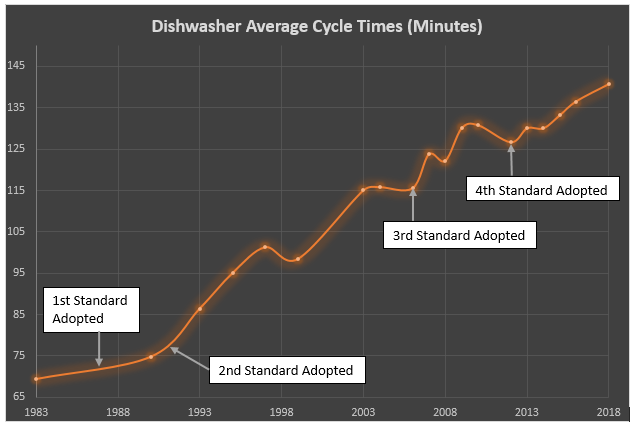
"Why do today’s dishwashers typically take more than 2 hours to run through a normal cycle when less than a hour was common in the past? The reason is absurd energy and water “conservation” rules. These rules, imposed on dish and clothes washers, have made these products perform worse than in the past, cleaning less well or much more slowly. One of the best things that the Trump administration did (other than Operation Warp Speed, of course) was creating a product class–superwashers!–that cleaned in under an hour and were not subject to energy and water conservation standards. The Biden administration reversed these rules but the 5th circuit just ruled that the reversal was “arbitrary and capricious.”

The ruling notes

…the record contains historical evidence that dishwasher cycle time has increased from around one hour at the advent of DOE’s conservation program to around two and a half hours in 2020. See CEI Petition, 83 Fed. Reg. at 17773–74. DOE does not appear to contest this data; in fact, DOE in 2020 appeared to agree that the frustratingly slow pace of modern dishwashers caused consumer substitution away from dishwashers and toward handwashing. See 2020 Dishwasher Rule, 85 Fed. Reg. at 68729; see also Record App’x 3 (noting consumers supported efficacious dishwashers by a margin of 2,200 to 16). And nothing wastes water and energy like handwashing: DOE itself estimated in 2011 that handwashing consumes 350% more water and 140% more energy than machine washing. See Record App’x 5 (citing U.S. Dep’t of Energy, Technical Support Document Docket EE-2006-STD-0127: National Impact Analysis 16 (2011), https://perma.cc/849K-NCX8).

…What did DOE say in response? Basically nothing: It acknowledged the concern and moved on. But bare acknowledgment is no substitute for reasoned consideration.

…the Repeal Rule is arbitrary and capricious for two principal reasons. (1) It failed to adequately consider appliance performance, substitution effects, and the ample record evidence that DOE’s conservation standards are causing Americans to use more energy and water rather than less. (2) It rested instead on DOE’s view that the 2020 Rules were legally “invalid”—but even if true, that does not excuse DOE from considering other remedies short of repealing the 2020 Rules in toto.

More generally AnechoicMedia on twitter wrote:

Water usage restrictions on home dishwashers are a complete non-issue from an environmental standpoint and our inability to overthrow this petty regime is why this country sucks. You cannot provide abundance and prosperity while retaining this wartime rationing mindset.

A position with which I wholeheartedly agree."

Friday, December 22, 2023

This Christmas, Americans Can Afford More Toys Than Ever

The rising prices throughout much of the economy make it a little easier to appreciate the things that seem to be inflation-proof, like video games.

By Eric Boehm of Reason.

"Inflation has been a nasty grinch for the past few years—seemingly stealing away our hard-earned dollars while we sleep.

But the rising prices throughout much of the economy make it a little easier to appreciate the things that seem to be inflation-proof.

Like video games. When The Legend of Zelda: Ocarina of Time was released in 1998, it cost $69.99 to order through the Sears catalog. Another Zelda game, Tears of the Kingdom, was released this year—25 years later—and it retailed for $70. That actually made it one of the most expensive games of the year, since most new Nintendo games these days sell for about $60.

Do the math. If Zelda games had kept pace with inflation, the new one should have cost about $130 today.

Sure, games today achieve some cost-savings because they're digital downloads. That means production companies like Nintendo don't have to pay for a physical game cartridge or CD-ROM, packaging, or shipping. But games today are also far, far more advanced than anything you could have bought for any amount of money a quarter-century ago.

It's not just video games that have defied inflation's steady creep. Toys in general are less expensive today, even before adjusting for inflation, than they were a few decades ago. That's despite the fact that wages have grown significantly over the same period of time. The average worker in the United States made about $13 an hour in December 1998, compared to about $29 dollar per hour now.

This is true over longer periods of time too. As I wrote earlier this year, the amount of work necessary to buy a single new Barbie has fallen quite a bit since the doll was introduced. According to what University of Central Arkansas economist Jeremy Horpedahl has termed the "Barbie Price Index," the average American woman has to work about 30 minutes to afford a Barbie—down from about two hours in 1959, when the doll first appeared on store shelves.

In fact, toys are so much cheaper today that some columnists say it's a problem. "A toy that cost $20 in 1993 would cost only $4.68 today," writes Katie Notopoulos, a senior correspondent at Business Insider. She claims that the availability of so many easily affordable toys and games—made possible by global trade, as she notes—is one of the reasons parents today are "so stressed out."

Seems like a good problem to have, doesn't it?

We're wealthier than ever, and we have better stuff. Nevertheless, it seems like capitalism can't catch a break these days. There's a steady drumbeat of economic nostalgia on both the political right and left that cherry-picks statistics to make the argument that Americans were better off 20, 40, or even 70 years ago. And when presented with evidence that many of the things Americans like to buy are getting cheaper, that's somehow a problem too.

There will always be those who want to declare "Bah, humbug!" during the holiday season. But prosperity is the gift that keeps on giving."

Saturday, December 2, 2023

Wall Street Journal reports consumer frustrations with over-regulated appliances

By Ben Lieberman of CEI.

"2023 is turning into the year of bad appliance regulations. Since January, CEI has submitted comments critical of proposed Department of Energy (DOE) efficiency standards for dishwashers, washing machines, stoves, and water heaters. Meanwhile, earlier rules for air conditioners, furnaces, and light bulbs took effect this year.

All threaten higher prices and reduced product performance, but perhaps worst of all are the proposals to tighten the already-strict energy and water use limits for dishwashers and washing machines. A November 24 Wall Street Journal article by Austen Hufford, “Why Does My ‘Efficient’ Dishwasher Take a Zillion Minutes for a Load?”, documents the struggles many consumers face from these standards as well as the lengths some must now go to get their dishes and clothes clean.

The most noticeable defect is the big increase in the time it takes to do a load of dishes. The article cites data compiled by CEI showing cycle times rising from 70 minutes in 1983 – before the multiple rounds of successively tighter dishwasher standards took effect – to 160 minutes this year. Even DOE admits that its regulations are the culprit, noting that “[t]o help compensate for the negative impact on cleaning performance associated with decreasing water use and water temperature, manufacturers will typically increase the cycle time.”  

Adding to the inconvenience, consumers also report having to rinse the dishes before and/or after running them in the dishwasher to get them sufficiently clean, or running them twice.  Apparently, efficiency with regard to homeowners’ time is not a consideration when setting efficiency regulations.

For washing machines, the current regulations mandate so little water be used that homeowners have had to take matters into their own hands to get their clothes clean. The article describes how some consumers have learned to dump extra water into their machines mid-cycle, while others risk voiding the warranty by tinkering with their washers to increase the flow.

Rather than consider a fix to these problems, DOE is doubling down by proposing even tighter requirements for dishwashers and washing machines that are likely to make things worse. As with so much irrational policy coming from Washington, these proposed rules are justified in part by the claimed climate benefits from a further ratcheting down of energy and water limits.   

The only good news is that Congress is fighting back. A new dishwasher or washing machine regulation would likely be subject to a resolution of disapproval under the Congressional Review Act. However, any such action by Congress would need to be signed into law by a president who is very unlikely to reject a rule his own bureaucrats came up with – and who has shown little flexibility on any measure the administration claims will help save the planet from climate change. Nonetheless Congressional action could at least set the stage for a future rejection of these bad dishwasher and washing machine rules – and along with them the whole DOE regulatory program that targets all home appliances."

Saturday, November 25, 2023

Cold truth about government pushing electric: Natural gas is much cheaper

By Paige Lambermont of CEI.

"The Department of Energy (DOE) has repeatedly documented that using natural gas in homes is far cheaper than using electricity.

This hasn’t stopped the Biden administration from trying to limit the use of natural gas in homes or some state and local governments from proposing and passing bans on natural gas hook-ups for new residential construction.

With winter, and the home heating challenges that come with it, fast approaching, these cold truths should be of serious concern for homeowners and policymakers.

Now there’s yet another federal government report highlighting these differences in costs. The Energy Information Administration (EIA) recently released its Winter Fuels Outlook. This document addresses possible scenarios for the cost of various sources of heating this winter.

EIA’s analysis sheds light on what we should be watching for winters ahead. Energy expert Robert Bryce, points out that for the coming winter, electric heating for households is projected to cost 77 percent more on average than natural gas. The discrepancy is even steeper for the Northeast in particular, where electric heat is projected to be 92 percent more expensive than gas.

Home heating is a major budget item for a lot of people in cold parts of the country. Policies at all levels of government that limit Americans to more expensive heating options are harmful. This includes policies like the one in New York state that would ban new natural gas furnaces in most new buildings by 2029. It also includes DOE’s final rule that would make it more difficult for people to purchase new gas furnaces.

Cost concerns are not the only problem with government policies that that are trying to stop people from using natural gas. Natural gas heating and cooking, and the electric grid currently exist in parallel. For homes with natural gas heating, if the power goes out, there’s still heat and usually a water heater and maybe even a stove capable of operating on natural gas. In an all-electric house, if a winter storm takes the power out for a few days, there’s nothing much to fall back on.

If grid capacity doesn’t expand at the same time as more homes and businesses move to electric heating, the mismatch in demand and supply may only become apparent during a time of grid stress—namely very cold days. Government meddling in this only serves to make blackouts more likely.

When it comes to personal energy decisions, people know best what will work for their homes and families. Policymakers should respect the individual personal energy choices of Americans and block this dangerous and costly electrification agenda."

Thursday, February 23, 2023

An hour of labor currently translates into far more in the way of goods than has been the case at any point in human history

See Larry Summers's Insight and Misunderstanding by David Henderson.

"Value and cost are not the same.

I remark often to students that, all things considered, I would probably rather have the life and the opportunities of a lower-income student in today’s United States in material terms than the life of John D. Rockefeller.

This is from Lawrence Summers, “Liberty, Optimism, and Superabundance,” Cato’s Letter, Winter 2023, Number 1.

The article is Larry’s comment on Marian L. Tupy and Gale L. Pooley, Superabundance. The book is on my shelf but I haven’t read it yet. My impression, like Larry’s, is that the book is quite good and quite important.

After the quote above, Larry explains in some detail why he would rather be a lower-income American student today than John D. Rockefeller a century ago.

An excerpt:

The chance of suffering a fatal illness at a young age would be much lower. The range of goods that would be obtainable would be much larger. The extent of the entertainment op- tions available would be much greater. The comfort of being

able to live in a room whose temperature was adjusted to suit would be vastly better for that student. The ability to get to a place 3 or 5 or 6 or 10,000 miles away quickly would be immensely larger. The number of things about which that person could learn would be far greater. The freshness, the range of foods that would be available to eat would be substantially more, and the comfort of the available clothing would be substantially greater.

Then Larry says something strange:

There is something slightly odd about using the notion of time cost in a Cato Institute publication, since, after all, it was Karl Marx who put forward a labor theory of value and sought to explain the value of all things based on the extent of labor input that went into them.

The idea of using time cost is not odd at all; it says nothing about value. Value and cost are distinct. The time cost of an item is the number of hours you would have to work at a given wage to earn enough to buy the item. It says nothing about how much you value the item. So recognizing time cost is not at all like accepting a labor theory of value.

Fortunately, Larry gets the gist anyway, writing:

But I think it is a very powerful way of capturing the progress that we have all observed. The truth is that an hour of labor cur- rently translates into far more in the way of goods that provide necessities for satisfaction or services that provide utility than has been the case at any point in human history."

Monday, February 6, 2023

The Campaign to Ban Gas Stoves

Biden and the media deny it exists, but the effort is calculated and well-funded.

By Kimberley A. Strassel. Excerpts:

"One is the Climate Imperative Foundation, which became an overnight green powerhouse and reported more receipts in 2021 than the League of Conservation Voters or the Sierra Club. A board member and funder is Kleiner Perkins billionaire John Doerr, whose climate action plan calls for getting rid of gas cooking. CIF’s executive director, Bruce Nilles, has made the end of gas stoves an imperative, writing in 2019: “Your gas stove has to go.” CIF has granted money to the Rocky Mountain Institute, which has long advocated “retrofitting” existing homes to be “all electric.”

Then there’s Rewiring America, “the leading electrification nonprofit, focused on electrifying our homes, businesses and communities.” And New York University’s Institute for Policy Integrity, which last year called on the CPSC to enact a gas-stove ban."

"several years ago this cabal hit on the idea of contradicting decades of science and ginning up hokey studies claiming gas stoves present a “health risk.”"

"One frequently cited study from the Rocky Mountain Institute—claiming to find a link between gas stoves and childhood asthma—was co-authored by two RMI staffers, neither of whom has a science degree. Another favorite study by New York University’s Institute for Policy Integrity claims gas stoves cause “dangerous levels of indoor air pollution.” It was written by two lawyers, and it cites . . . the RMI study."

"The November edition of the “independent” magazine Consumer Reports was devoted to the “Hidden Health Hazards in Your Home” and explained that its research found an “alarming concern” with levels of nitrogen dioxide from gas stoves. (It also featured a four-page tribute to induction cooktops, the left’s expensive alternative to gas.) Tucked at the end of the article online was an editor’s note: “This project was funded in part with a grant from the Climate Imperative Foundation.” CIF’s 2021 tax filings show a $375,000 donation to Consumer Reports specifically for research on gas stoves."

"The White House last month held an “electrification summit,” which featured a panel on getting gas out of homes. Nearly every guest (including a representative from Rewiring America) stated the “health” harm of gas stoves as accepted fact, and Trisha Miller of the White House’s Climate Policy Office described the need to “eliminate emissions” by getting rid of all “combustion appliances” in houses (including your washer, dryer and furnace). The electrification agenda is being carried out through the Department of Energy’s Better Climate Challenge, which lists Rewiring America and RMI as “allies.”"

"Around the time of the Consumer Reports story—and in the runup to the Electrification Summit—Mr. Trumka circulated a memo titled “NPR Proposing Ban on Gas Stoves (Indoor Air Quality).” (NPR is an acronym for notice of proposed rulemaking.) The Cruz letter says the memo cites the Consumer Reports and NYU studies among reasons Mr. Trumka concludes there is “sufficient information” now to forbid Americans from purchasing new gas stoves."

Monday, January 30, 2023

Are Gas Stoves Dangerous to Your Health? Here’s What Science Says

Debate over idea of banning gas stoves reignites questions about health risks

By Sumathi Reddy of The WSJ. Excerpts:

"Exposure to nitrogen dioxide won’t cause asthma in everyone, but in certain people who are more vulnerable to developing it, chronic inflammation and stress in the airway might be one trigger, says Dr. Nordgaard.

The level of risk in a home depends on a number of factors, says Dr. Jack, including the ventilation in the kitchen, how old and well-maintained the stove is and how you’re using it.

“For somebody cooking on a late model, well-maintained stove with a good hood and good ventilation, concentrations [of natural gas] are going to be pretty low and the risk is pretty low,” says Dr. Jack.

Researchers say other appliances that use natural gas, such as furnaces and boilers, are less of a concern when it comes to nitrogen dioxide because they are required to vent directly outdoors.

What About When the Stove Is Off?

Stoves can emit gas even when you’re not using them, but the gas emitted is largely methane, says Rob Jackson, an environmental scientist and professor at Stanford University. Methane is a greenhouse gas linked to global warming, but the levels emitted from a stove aren’t considered harmful to human health, he says.

“The methane emissions are not a health issue indoors at the concentrations we find,” says Dr. Jackson. He was senior author on a 2022 study in the journal Environmental Science & Technology, which found that three-quarters of the methane emitted from gas stoves takes place when they are turned off."


Sunday, January 29, 2023

The Campaign to Ban Gas Stoves

Biden and the media deny it exists, but the effort is calculated and well-funded

By Kimberley A. Strassel of Thge WSJ. Excerpts: 

"One is the Climate Imperative Foundation, which became an overnight green powerhouse and reported more receipts in 2021 than the League of Conservation Voters or the Sierra Club. A board member and funder is Kleiner Perkins billionaire John Doerr, whose climate action plan calls for getting rid of gas cooking. CIF’s executive director, Bruce Nilles, has made the end of gas stoves an imperative, writing in 2019: “Your gas stove has to go.” CIF has granted money to the Rocky Mountain Institute, which has long advocated “retrofitting” existing homes to be “all electric.”"

"Then there’s Rewiring America, “the leading electrification nonprofit, focused on electrifying our homes, businesses and communities.” And New York University’s Institute for Policy Integrity, which last year called on the CPSC to enact a gas-stove ban."

"several years ago this cabal hit on the idea of contradicting decades of science and ginning up hokey studies claiming gas stoves present a “health risk.”"

"One frequently cited study from the Rocky Mountain Institute—claiming to find a link between gas stoves and childhood asthma—was co-authored by two RMI staffers, neither of whom has a science degree. Another favorite study by New York University’s Institute for Policy Integrity claims gas stoves cause “dangerous levels of indoor air pollution.” It was written by two lawyers, and it cites . . . the RMI study."

"The November edition of the “independent” magazine Consumer Reports was devoted to the “Hidden Health Hazards in Your Home” and explained that its research found an “alarming concern” with levels of nitrogen dioxide from gas stoves. (It also featured a four-page tribute to induction cooktops, the left’s expensive alternative to gas.) Tucked at the end of the article online was an editor’s note: “This project was funded in part with a grant from the Climate Imperative Foundation.” CIF’s 2021 tax filings show a $375,000 donation to Consumer Reports specifically for research on gas stoves."

"The White House last month held an “electrification summit,” which featured a panel on getting gas out of homes. Nearly every guest (including a representative from Rewiring America) stated the “health” harm of gas stoves as accepted fact, and Trisha Miller of the White House’s Climate Policy Office described the need to “eliminate emissions” by getting rid of all “combustion appliances” in houses (including your washer, dryer and furnace). The electrification agenda is being carried out through the Department of Energy’s Better Climate Challenge, which lists Rewiring America and RMI as “allies.”"

"Around the time of the Consumer Reports story—and in the runup to the Electrification Summit—Mr. Trumka circulated a memo titled “NPR Proposing Ban on Gas Stoves (Indoor Air Quality).” (NPR is an acronym for notice of proposed rulemaking.) The Cruz letter says the memo cites the Consumer Reports and NYU studies among reasons Mr. Trumka concludes there is “sufficient information” now to forbid Americans from purchasing new gas stoves."

Tuesday, October 12, 2021

Why LED Bulbs Don’t Always Live Up to the Hype About Their Life Spans

The lights, touted as lasting far longer than their incandescent counterparts, can burn out more quickly in some circumstances 

By Jo Craven McGinty. Excerpts:

"According to the U.S. Department of Energy, LEDs use at least 75% less power than incandescent bulbs and last up to 25 times longer.

But it’s not clear how long the modern lights last outside of ideal laboratory conditions, and in certain circumstances, they might not outlive the traditional bulbs they bumped off the shelf.

“A lot of expectations have been created that if you buy an LED lightbulb, you don’t have to change it ever,” said Nadarajah Narendran, director of research at Rensselaer Polytechnic Institute’s Lighting Research Center. “It’s time for us to reset those expectations.”

When an incandescent bulb burns out, it extinguishes with a pop as its glowing filament snaps.

Light-emitting diodes—the components that provide illumination in LED bulbs—are different. Instead of experiencing sudden death, they grow dimmer over time, and according to industry standards, their useful life is over when their brightness is diminished by 30%.

There’s no convenient way to measure this at home. If a bulb no longer seems sufficiently bright, it might be time to replace it."

"According to Dr. Narendran, in keeping with standards established by the Illuminating Engineering Society, the ambient temperature in the lab is 75 degrees Fahrenheit, and the LED packages operate continuously, without being switched on and off, for 6,000 hours."

"But in ordinary use, as many as a dozen LEDs might be connected in a series inside a lightbulb; one or more bulbs might be enclosed in a light fixture that inhibits air circulation; and the lights might be turned on and off multiple times a day—all conditions that can cause LEDs to grow dimmer more quickly than promised."

"If testing procedures were revised to account for all of these conditions, it would alter the longevity estimates.

“You would find LED lifetime is not 20 years,” Dr. Narendran said. “It would be much shorter. It could be worse than an incandescent lamp in some cases. You could get only 500 hours if you have three bulbs trapped in a surface-mounted fixture” where airflow is restricted.

In comparison, incandescent bulbs are expected to last 1,000 hours."

"LEDs have the potential for the longest useful life of all lighting technologies.

But, they said, instead of rating LED bulbs on the length of time it takes a single component—the light-emitting diodes—to degrade, the industry needs to define “LED system life” and develop a corresponding test to accurately estimate its length."

Saturday, November 2, 2019

Cell phone radio frequency (RF) exposure doesn’t cause cancer

See What’s the Frequency, Berkeley? by Ilya Shapiro and Michael Collins of Cato.

"Did you know that cell phone radio frequency (RF) exposure causes cancer? It doesn’t. The Federal Communications Commission has concluded there’s “no scientific evidence” linking “wireless device uses and cancer or other illnesses.” Despite the FCC’s scientific findings, however, the city of Berkeley, California, requires every cell phone realtor provide a notice informing customers that, if they carry cell phones in a “pants or shirt pocket or tucked into a bra” when the phone is on and connected, they “may exceed the federal guidelines for exposure to RF radiation.”

That statement is technically true; “may” just means something is possible, not necessarily likely. Phones may exceed federal guidelines; likewise, phones may spontaneously combust. What Berkeley says is technically correct, just misleading (the unexplained acronym also sounds scary). CTIA, the wireless industry’s trade group, sued Berkeley for compelling speech in violation of the First Amendment.

The right to speak necessarily entails the right to remain silent. This principle ensures the freedom of conscience and prevents citizens from being conscripted to serve as unwilling bullhorns for government communications. Likewise, it is a foundational principle of the First Amendment that content-based restrictions of speech must survive the strictest scrutiny—meaning the government needs a really good reason and can’t achieve its goal any other way.

But the Supreme Court has ruled that regulations of “commercial speech” need not meet the same rigorous standards of review as other types of speech. The Court created this narrow exception in Zauderer v. Office of Disciplinary Counsel of Supreme Court of Ohio (1985). The Zauderer test applies lesser standards for mandatory disclosures, when the speech is “purely factual and uncontroversial information” and when the disclosure is not “unduly burdensome” and “reasonably related to the State’s interest in preventing deception of consumers.”

The Supreme Court previously remanded CTIA v. Berkeley in light of NIFLA v. Becerra (2018), where the Court clarified that the ambit of speech covered by Zauderer’s exception is narrow, and that governments did not have free reign provide scripts for commercial businesses. On remand, however, the U.S. Court of Appeals for the Ninth Circuit eroded Zauderer. The Ninth Circuit found that compelling speech content posed no constitutional issues because mandated disclosures need only be reasonably related to “non-trivial” government interests. This decision is another in a line of confused applications of Zauderer by the lower courts.

CTIA, represented by former Solicitor General Ted Olson, is again petitioning the Supreme Court to review that flawed decision. As we have at previous stages of litigation, Cato has filed an amicus brief supporting that petition. We argue that this important area of law desperately needs clarification, particularly at a time when compelled-disclosure regimes have proliferated and some courts have distorted the already insufficient Zauderer standard beyond recognition. To that end, the Court should apply strict scrutiny to review laws that force market participants to disparage their own products and participate in policy debates they wish to avoid.

The Supreme Court will decide whether to take up CTIA v. Berkeley later this fall."

Saturday, July 27, 2019

Bogus E-cigarette Panic Literally Killing People

By Michelle Minton of CEI. Excerpt:
"Justified by the need to scare teenagers away from e-cigarettes, government health agencies and preeminent health bodies have relentlessly engaged in a campaign of misinformation, exaggeration, and outright lying about e-cigarettes. Their hope was to make vaping seem far more dangerous than the evidence indicates. And they’ve succeeded.

“Scientists have been working hard to debunk the belief that e-cigarettes are less harmful than traditional cigarettes,” the American Lung Association (ALA) noted in a recent post. Yet, despite this hard work by ostensibly objective scientists, they haven’t yet been able to refute the large and growing body of evidence that vaping is less harmful than smoking. Failing to verify their alternative facts, they have instead turned to baseless fear-mongering.

Perhaps the most egregious example of anti-vaping advocates’ willingness to set facts aside is their repeated claim that vaping causes “popcorn lung” (bronchiolitis obliterans), a rare and debilitating lung disorder. The claim is based on the fact that some e-cigarettes contain the flavoring agent diacetyl. Diacetyl has been linked to popcorn lung, but primarily in factory workers at microwave popcorn plants (hence the name) exposed to massive amounts of the chemical. It might seem acceptable, based on that, to say there’s a chance the diacetyl in e-cigarette vapor could possibly cause popcorn lung in people who vape. But what the stalwart defenders of public health never point out is that cigarettes contain hundreds of times more diacetyl than e-cigarettes, and research finds no link between smoking and popcorn lung. Thus it is ludicrous—one might even say irresponsible—to suggest that popcorn lung is a risk faced by those who vape. But that hasn’t stopped groups like the ALA from doing exactly that."

Friday, March 23, 2018

Liberate Dishwashers from Federal Efficiency Mandates

By Devin Watkins of CEI.

"Thirty-five years ago, dishwashers cleaned dishes in about an hour. Sadly today, due to federal government regulations, there are no dishwashers that do so. This isn’t progress—it’s the failure of government to allow consumer choice. The Competitive Enterprise Institute this week petitioned the Department of Energy (DOE) to fix the problem.

Federal regulators have been so focused on forcing people to decrease energy usage that they have lost sight of the other features that consumers value. Even the DOE now recognizes that, because of their regulations, manufacturers “typically increase the cycle time.” The DOE is required by law to make sure that such features continue to be options for consumers, but has failed to do so.


Due to the increase in cycle times many consumers have complained. Here are just a few examples:
  • “The cycles run FOREVER - Plan on letting it run all afternoon before your dishes are ready so you can use them for dinner!!”
  • “It doesn't clean well, but has a very long cycle, well over two hours.”
  • One consumer described a cycle time of one and a half hours as “extremely long,” but sadly this is the shortest cycle time on the market.
  • “The cycle time is way too long, running for 4 hours and still not cleaning the dishes. I am currently in the process of hand washing a number of dishes that did not clean in last night’s 4-hour cycle.”
  • “It spontaneously starts beeping, non-stop, the cycle takes FOREVER. I hate it, I hate it, I hate it.”
  • When one consumer called a technician to complain of a 4.5 hour cycle time, she was told that the new machines just take longer than the old ones.
Dishwashers are just one of many consumer appliances harmed by federal regulations. Traditional incandescent light bulbs are banned by federal regulations in favor of compact fluorescent bulbs that contain mercury, have worse color rendering, and cost three to ten times as much. Traditional top-loading clothes washers with a central agitator are banned in favor of front-loading washers that cost twice as much and some of which, according to Consumer Reports, leave clothes “nearly as dirty as they were before washing.”

It is time to stop these irresponsible actions and restore the quality of dishwashers that have been harmed by federal regulations. That is why the Competitive Enterprise Institute has asked the DOE to establish a new category of fast dishwashers. This new category would take no more than an hour to complete cleaning and drying dishes.

The statute allows the DOE to set a new energy standard for a product which has a “performance-related feature” which justifies a lower standard based on the “utility to the consumer of such a feature.” As the consumer complaints above, and an 11,000 person survey demonstrate, a dishwasher’s cycle time is a very important feature with high utility to the consumer.

Our petition would restore choice to the American consumer to allow them to buy the product they choose. Those that like their dishwasher as it is will continue to be able to purchase them. But those that do not like to waste time and still get their dishes clean will have another choice.
It is time to start reversing the damage that federal regulations have done."

Monday, July 24, 2017

Can't Afford a Vacation? Blame the State!

By Veronique de Rugy at Reason.
"Your sweet summer getaway is just around the corner—if you can afford one.

But however you get to and from your favorite vacation spot, the government is there to take a cut. If you're a road tripper, you'll pay a tax on gasoline that accounts for almost 19 percent of the price of refilling your tank. Even more annoyingly, a quarter of that money is diverted from relevant tasks like highway maintenance to other projects, including turtle bridges and bike lanes. Repaving the roads is low on the priority list, but at least you can experience first-hand what driving in the Soviet Union must have been like.

If you fly, Washington will get you too. A ticket from New York to Paris in September on the French airline XL costs a total of $541. Some $401, or 74 percent, goes to taxes and fees. These can include a passenger facility charge (up to $18 per passage), a federal excise tax (7.5 percent of your airfare), $5.60 per one-way trip for the "September 11 security fee," up to $200 in U.S. and international departure and arrival fees, and more.

If you're flying domestically you'll pay fewer fees (yay), but your ticket will be more expensive than it could be (boo) because of protectionist laws banning foreign airlines from accommodating travel within the United States. According to the Mercatus Center's travel guru, Gary Leff, "The largest domestic airlines are lobbying aggressively to stop foreign airlines like Emirates, Etihad, and Qatar from expanding their U.S. flights, and from being allowed to charge low prices."

The rationale for government intervention here is that it "protects American jobs." Of course, that ignores the new jobs that could be created if these foreign companies were allowed to set up shop in the United States—not to mention the benefits that flow to American consumers when they get to choose from more carriers and price points.

Getting where you're going can take longer than it should, thanks to long security lines and an antiquated government-managed air traffic control system that stacks delays on top of delays. Other countries have privatized their systems and seen spectacular results, but not us.

The Federal Aviation Administration (FAA) has also made it harder for most of us to adjust our plans in the face of such delays. For decades, the only way to catch a lift on a private jet with open seats was to check for postings to a physical billboard. Not surprisingly, this limited the number of people with access to that option considerably. But when the company Flytenow put this data on an online platform, the FAA showed its gratitude for the money it could save passengers and pilots alike by shutting Flytenow down.

The fun continues even after you've arrived, since many state and local governments are also running interference. Don't expect to be able to grab an Uber or a Lyft in places such as Atlanta and Boston, which ban ride-sharing companies from picking up passengers. While some of these laws are only loosely enforced, many airports now spend a great deal of effort punishing rogue ride givers. According to The Wall Street Journal, "Miami airport police issued 4,000 citations to ride-sharing drivers over the past several years, each with a $1,010 fine."

Home-sharing services, too, are being targeted. Last year, Democratic New York Gov. Andrew Cuomo signed a law to impose fines in the state of up to $7,500 "per advertisement of an 'illegal unit' on home sharing sites like Airbnb, which is likely to mean a fine for anyone who advertises short-term accommodations," Leff wrote at View from the Wing. The result, of course, is higher costs for visitors. Unfortunately, cities such as San Diego and San Francisco are considering doing the same.

The governmental meddling doesn't end when you reach your destination. Some places won't let you drink or dance anywhere near a beach. Others ban food trucks, gambling, the consumption of soda from oversized cups, and/or smoking in public spaces. The bottom line is that you could vacation more and better, with lots of additional cash at your disposal, if government just got out of the way."

Monday, May 1, 2017

Innovation stagnates under socialist systems, but capitalism has created more life-transforming innovations than any other economic system (with focus on the washing machine)

By Chelsea Follett of Human Progress.
"Has anything changed the world more than the internet? South Korean economist Ha-Joon Chang thinks so. He would argue that one invention – an engine of liberation – has had a far more powerful effect on daily lives. He means the washing machine, of course, which the late Hans Rosling called the greatest invention of the industrial revolution. It freed women from the chore of laundry – or at least from spending one full day a week every week doing it.

As a result, Americans now lose less than two hours a week to the task, and today a greater proportion of poor US households own washing machines than average American households did back in the 1970s. While washing machines are far from being the only reason that women’s options have multiplied in the West, they have certainly helped. “Without the washing machine,” claims Chang, “the scale of change in the role of women in society and in family dynamics would not have been nearly as dramatic.”
  Source: Econweb and BLS

The change is ongoing. Thanks to economic growth and rapidly declining global poverty, more women own or have access to washing machines than ever before. Even so, one 2013 study estimated that, in 2010, 46.9 per cent of households worldwide owned one. That means the market for washing machines has significant room to grow – and that there is a vast amount of latent human potential still out there, yet to be unleashed.

Take China, home to the greatest escape from poverty of all time, when economic liberalization freed hundreds of millions from penury. The economy (measured in 2014 US  dollars and adjusted for differences in purchasing power) grew 31-fold between 1978, when the country abandoned communist economic policies, and 2016.

In 1981, less than 10 per cent of urban Chinese households had a washing machine (as approximated by the number of sets per hundred households). But by 2011, 97.05 per cent did. In 1985, less than 5 per cent of rural Chinese households had a washing machine, partly because of the expense, but also because they lacked access to electricity. By 2011, 62.57 per cent owned a machine. Thus possession of a washing machine is a useful indicator, not only of China’s tremendous progress, but of the narrowing gap between rural and urban areas. Source: Laili Wang, Xuemei Ding, Rui Huang and Xiongying Wu, “Choices and using of washing machines in Chinese households,” International Journal of Consumer Studies (38) 2014, pp. 104-109.

It’s a slightly different story in India, where liberalizing economic reforms didn’t begin until 1992, rather later than in China. From 1992 to 2016, India’s economy grew four-fold. Only 11 per cent of Indian households owned a washing machine in 2016.

As with China, urban households are better off, with machine ownership now topping 20 per cent in the most populous cities. That means many women still do the laundry by hand, pounding and scrubbing for hours, in some cases with no running water. Nonetheless, movement is in the right direction. As India’s economy grows and poverty declines, more women will be able to ditch the dirty washing.

We have come a long way since Bendix Home Appliances patented the first automatic washing machine for domestic use in 1937. As a Bendix ad in Life magazine put it in 1950, “washday slavery became obsolete in just 13 years” for American women. In 2007, Panasonic launched laundry machines with a sterilization mechanism designed specifically to address Chinese consumers’ priorities and successfully increased its market share in the country.

It is important to note what is at the root of this progress. Not only has competition and the profit motive incentivized the washing machine’s invention, it is the capitalist drive that is ensuring ongoing marketing to new customers in developing countries. Innovation stagnates under socialist systems, but capitalism has created more life-transforming innovations than any other economic system and sown the greatest rise in living standards in history.

Africa remains the continent with the worst record on economic freedom, as well as being the poorest continent with the least access to time-saving technologies. But even in Africa, the vicious cycle is breaking and capitalism is slowly helping to alleviate poverty. Washing machine ownership might be low, but most Africans are optimistic about their economic future and possibilities.

Thus today, washing machines are still doing the work they were doing 80 years ago – which isn’t just cleaning clothes. These juddering boxes are life-transforming technologies that allow women to put their time and labor to more constructive use. And as ownership sweeps across the world, we can also track the progress of economic freedom."