Showing posts with label Plastic bags. Show all posts

Tuesday, September 3, 2024

15 of the 16 applications a plastic product incurs fewer greenhouse gas emissions than their alternatives

 See Notable & Quotable: Plastics from The WSJ.

"Ronald Bailey writing in the August/September issue of Reason:

“Plastics are the new coal,” declares Beyond Plastics. . . . The Natural Resources Defense Council says “reducing plastic production is critical to combatting climate change.”

Producing plastics from fossil fuels emits a lot of carbon dioxide into the atmosphere, which contributes to warming the planet. An April study by researchers at the U.S. Department of Energy’s Lawrence Berkeley National Laboratory estimates that in 2019 “global production of primary plastics generated about 2.24 gigatonnes of carbon dioxide equivalent,” which represents 5.3 percent of total global greenhouse gas emissions. So switching to plastic alternatives would help slow man-made global warming, right?

Not so fast, says a new study in Environmental Science & Technology, which finds that “replacing plastics with alternatives is worse for greenhouse gas emissions in most cases.” The European researchers report that in “15 of the 16 applications a plastic product incurs fewer greenhouse gas emissions than their alternatives.”"

Wednesday, February 7, 2024

The Plastic Bag Racket

Banning single-use plastic bags doesn’t help the environment – and may even make things worse

By Adam Summers. He is a Research Fellow with the Center on Entrepreneurial Innovation at the Independent Institute. 

"Single-use plastic bag bans have been all the rage for the past 20 years or so, but, as is often the case with environmental laws, proponents have vastly overstated the benefits of doing so and understated the costs. It is another example where doing something is considered better than doing nothing—even if the results end up being more harmful in the end.

On a recent segment of “Jesse Watters Primetime” on Fox News Channel, host Jesse Watters decried the ways “reusable” bags are worse for the environment than “single-use” plastic bags and described such bans as a “cash grab” by grocery stores that profit from the sale of reusable bags. (The “single-use” designation was always a bit of a misnomer, as people tend to reuse these bags to line smaller trash cans, deposit pet poop, and hold or carry numerous other items.) 

The segment referenced a March 2023 CNN.com article detailing various estimates of how many times reusable bags must be used to provide a greater net environmental benefit than single-use bags. These range from five to 52 times for polyethylene and polypropylene bags to many thousands of times for cotton bags, depending on how comprehensive the bag life-cycle analysis is (see this 2018 Danish government study, for example—scroll down for the English summary).

“There will always be cases where we forget our (reusable) bags at home,” Thomas Ekvall, adjunct professor at the Chalmers University of Technology in Sweden and one of the authors of a report comparing the environmental benefits of various bag types for the United Nations Environmental Programme, told CNN. “We should try not to do that but when we do, we need to buy a bag. And if we then have already too many durable bags at home, it would be better from a climate perspective, at least, to buy a single-use paper or plastic bag.”

I wrote about this issue back in 2013, just a year before California would become the first to impose a statewide ban on single-use plastic bags with the passage of Senate Bill 270 in 2014. (Plastic bag manufacturers succeeded in delaying the measure through a referendum, but in November 2016, Californians narrowly passed Proposition 67, thereby implementing SB 270, with 53 percent of the vote.)

In a column for the San Diego Union-Tribune, I discussed the often-ignored costs of alternatives to single-use plastic bags:

The claims that plastic bags are worse for the environment than paper bags or cotton reusable bags are dubious at best. In fact, compared to paper bags, plastic grocery bags produce fewer greenhouse gas emissions, require 70 percent less energy to make, generate 80 percent less waste, and utilize less than 4 percent of the amount of water needed to manufacture them. This makes sense because plastic bags are lighter and take up less space than paper bags.

Reusable bags come with their own set of problems. They, too, have a larger carbon footprint than plastic bags. Even more disconcerting are the findings of several studies that plastic bag bans lead to increased health problems due to food contamination from bacteria that remain in the reusable bags. A November 2012 statistical analysis by University of Pennsylvania law professor Jonathan Klick and George Mason University law professor and economist Joshua D. Wright found that San Francisco’s plastic bag ban in 2007 resulted in a subsequent spike in hospital emergency room visits due to E. coli, salmonella, and campylobacter-related intestinal infectious diseases. The authors conclude that the ban even accounts for several additional deaths in the city each year from such infections.

[Fun fact: This column was used by the College Board’s official SAT study guide to help test-takers analyze passages for the essay portion of the exam. See here (pp. 10-11), here, and here.]

In addition, I pointed out that banning or taxing single-use plastic bags only leads to increased demand for other types of bags: “This is just what happened in Ireland in 2002 when a 15 Euro cent (about $0.20 at the time, approximately $0.16 at current exchange rates) tax imposed on plastic shopping bags led to a 77 percent increase in the sale of plastic trash can liner bags.”

This is hardly a unique example. A recent Bloomberg article noted similar increases in other forms of plastic bags following California’s bag ban in 2016, New Jersey’s ban in 2022, and a 2011 ban in the Australian Capital Territory (where the capital of Canberra is located).

Similarly, an August 2023 Los Angeles Times article examined the failure of California’s plastic bag ban. Among its findings was that, according to data from the California Department of Resources Recycling and Recovery (CalRecycle), the amount of plastic bag waste per capita has actually increased, from about eight pounds of plastic bags per person in 2004 to 11 pounds per person in 2021. In addition, it noted how plastic bags frequently gum up recycling machines. Even when placed in special plastic bag collection bins at grocery and retail stores, they usually end up in landfills anyway due to a lack of a market for the plastic and the dearth of recycling facilities equipped to recycle such materials.

The L.A. Times piece concluded:

Californians are generating more plastic bag waste per capita now than we were before the ban existed. Some shoppers are bringing reusable bags from home to stores, though not many, and far fewer are reusing HDPE bags they buy at the store. It’s unlikely that what goes into the store drop-off bins is being recycled. The “reusable” plastic bags we get from stores have become de facto single-use ones.

So what should be done about these “reusable” bags that are so difficult to recycle?

“Realistically,” the article offers, “the most efficient way to dispose of them is to use them as garbage can liners, pet poop bags, wet swimsuit holders, travel laundry hampers, and other household uses until they can’t be used anymore. Then put them in your trash.”

This is precisely what people did with the more environmentally friendly single-use bags before the ban!

Moreover, while reasonable attempts should, of course, be made to minimize litter, such as plastic waste making its way to waterways and oceans, the extent of plastic bag ocean litter coming from the United States has been wildly exaggerated by environmental groups, oftentimes with emotional pleas to save sea turtles and other marine life. As the Bloomberg piece explains:

Hardly any of that detritus is attributable to the US, let alone New Jersey. Marine plastic mostly comes from short, fast-flowing rivers passing through large, middle-income cities that can’t afford to manage their waste properly. About 81% of ocean polymers come from Asia, with more than a third emitted by the Philippines alone, according to a 2021 analysis. The US, at 0.25% of the total, is generating less marine litter than Panama or the Dominican Republic.

Even data collected by supporters of New Jersey’s bag ban struggles to make it look worthwhile. A 2023 survey by the non-profit group Clean Ocean Action found that bags comprised less than 2% of the items picked up during beach clean-up days, with candy wrappers, bottle lids, cigarette filters, straws and stirrers and even cigar mouthpieces vastly outnumbering them.

It also offered this chart for comparison:
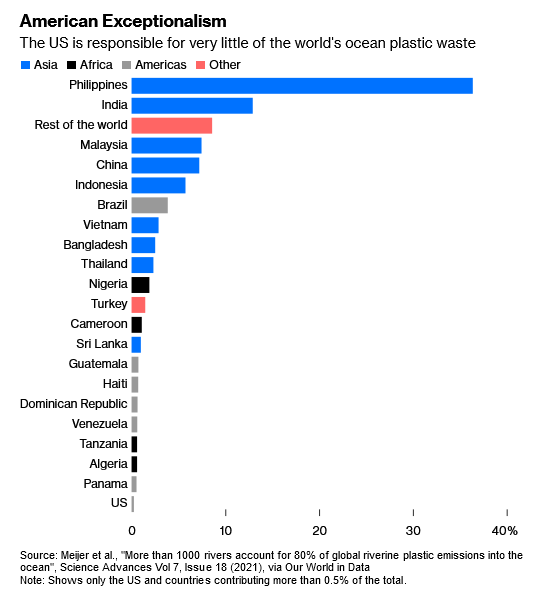
Chart: Ocean Plastic Waste By Country

(And if all of that was not enough, it turns out that studies have now shown that the paper and bamboo straws to which people have been encouraged to switch actually contain toxic “forever chemicals” that make them worse for both the environment and those who use them. Thanks again, environmentalists!)

In any case, even if the plastic bag bans had been “effective,” that does not mean that it would necessarily make good or just policy. As I argued in the San Diego Union-Tribune piece,

environmentalists have every right to try to convince people to adopt certain beliefs or lifestyles, but they do not have the right to use government force to compel people to live the way they think best. In a free society, we are able to live our lives as we please, so long as we do not infringe upon the rights of others. That includes the right to make such fundamental decisions as ‘Paper or plastic?’

I would only add that it will become increasingly difficult for the most zealous disciples of the climate change religion—who tend to be less concerned about “the science” and actual results than perpetuating a dogmatic worldview that seeks to endlessly punish people for the purported sin of utilizing natural resources—to win more converts to their cause when their supposed solutions continually fail and needlessly impose costs on others."

Wednesday, September 20, 2023

Ottawa’s plastic ban plan—stunningly poor and deceptive policy

By Kenneth P. Green of The Fraser Institute

"Can we talk about drinking straws for a minute? As you may know by now, as part of its “zero plastic waste” crusade, the Trudeau government has banned several kinds of plastic eating and drinking utensils and plastic grocery bags. The rationale behind these bans is that single-use plastics harm the environment; directly, by escaping into the physical environment and causing harms to wildlife, and indirectly by the greenhouse gas emissions attendant upon their manufacture.

But these rationales were known (yes, even by government) to be spurious. The government’s own analysis acknowledged that the amount of plastics from these sources physically entering the environment was miniscule. And that the potential greenhouse gas reductions from banning such plastics was equally miniscule in a global context and incapable of exerting any measurable influence on global climate. It was also known that the alternatives to plastic straws, forks, spoons, etc. would likely cause as much or more environmental harm—more waste to manage, more potential hygienic reductions, and more environmental impacts related to wood-and-paper-goods production, the favourite candidate for substitution products. Finally, it was also known that the ban plan would have costs that far outweighed the benefits of its stated goals.

In fact, all of these things were so well established it’s nearly impossible to view the government’s plastic ban as anything other than political performance art. There’s certainly no basis on which it can be anything resembling rational public policy. Now, barely a year into government’s ban plan, some of the predictable perversities of the bans are coming home to roost.

According to a new study published in the journal Food Additives and Contaminants, alternatives to plastic drinking straws (that is, straws made of paper, wood and glass) all carry a burden of chemicals called per-and polyfluoroalkyl substances (PFAS), somewhat histrionically called “forever chemicals” by the mainstream media. These chemicals are widely used in industrial processes due to their range of characteristics including water resistance and discoloration resistance.

Now, to be fair, the whole PFAS thing is somewhat overwrought and people should not panic. While there’s some highly theoretical, epidemiological and non-human experimental evidence that PFAS might influence some aspects of human biology, there’s virtually no direct evidence of such interactions in humans, and nothing like a standard toxicity measure has been established, nor a dose-response relationship for the vast class of PFAS that exist. Even the much-touted threat to children’s developmental health from the PFAS has failed to show itself in recent research.

Nonetheless, the rapid emergence of a “surprise” that taints the entire supposition of plastic-straw substitutability ought to demonstrate that Ottawa’s ban on single-use plastics was conceived in haste, promulgated in bad faith (where the Trudeau government knew the policy would deliver scant benefits, if any), and was deceptive in suggesting alternatives that were particularly more benign than single-use plastics.

Clearly, the Trudeau government should retract the bans on single-use plastics, and for that matter, the entire “zero plastic waste” framework, which has been demonstrated to be stunningly poor public policy. Unfortunately for Canadians, the government has shown a preference for doubling and tripling down on its mistakes and failures, so such an outcome is likely to await some future government more grounded in reality."

Thursday, April 2, 2020

It's come to this: Liberal San Francisco Bay Area bans reusable grocery bags

By DEBRA KAHN of Politico
"In the latest sign of how dramatically the coronavirus pandemic is altering the social landscape, even the liberal San Francisco Bay Area this week banned reusable grocery bags as a sanitary measure, dismaying recycling advocates who say durable sacks should still be allowed at stores.

The provision was among a host of lifestyle changes imposed Tuesday by six Bay Area counties in a rewrite of their first-in-the-nation March 16 order that required millions of residents to shelter at home. The counties have been credited with taking early actions that may have helped slow the spread in California."

"The rule appears to be the most stringent coronavirus-related restriction placed on reusable bags in California, which has banned single-use plastic bags since 2016. California allows the 70 or so jurisdictions whose local bans preceded the state ban, including most of the Bay Area, Los Angeles County and Sacramento County, to preempt state law.

California has aggressively moved toward reusable containers in an effort to reduce plastic consumption. Gov. Gavin Newsom last year signed the nation's first state law banning hotels from using small single-use plastic containers for shampoo and other toiletries. State lawmakers have also worked on bills that would phase out single-use plastic by 2030 in California.

But the coronavirus has altered the state's environmental march. Bottled water has flown off store shelves, while some fear the coronavirus will hinder efforts to build high-density housing near transit. Starbucks and Peet's Coffee, which have coffee shops across Northern California, stopped refilling customers' mugs earlier this month in favor of paper cups."

Wednesday, April 1, 2020

The Plastic Bag Ban Backfires: Reusable bags are notoriously dirty and may spread the virus

WSJ Editorial.
"New York’s environmentalists have terrible timing. The statewide ban on single-use plastic bags took effect on March 1, the same day New York confirmed its first case of coronavirus. To protect the public, officials in the Empire State and elsewhere should immediately suspend their plastic bag bans.
Much remains unknown about Covid-19, but the Centers for Disease Control and Prevention says it “may remain viable for hours to days on surfaces made from a variety of materials.” Reusable shopping bags may harbor the virus and could facilitate its spread in grocery stores and pharmacies that remain open even as workplaces, schools and restaurants shutter. Yet in California, New York, Seattle and elsewhere, plastic bags are banned and shoppers are urged to rely on reusable bags.

Experience shows the risks. In 2013 millions of American piglets died amid an outbreak of novel swine enteric coronavirus disease, and after an investigation the U.S. Department of Agricultureconcluded that reusable feed totes were the most likely root cause. The feed bags are often made of the same kind of material as reusable shopping bags. 

In 2010 several Oregon teens and adults fell ill after attending a soccer tournament, prompting an investigation by Kimberly Repp of the Oregon Health and Science University and William Keene of the Oregon Public Health Division. They traced the sickness to a reusable grocery bag, “which had been stored in a bathroom used before the outbreak by a person with a norovirus-like illness,” they wrote in a 2012 study for the Journal of Infectious Diseases. Soccer players and chaperones contracted the virus after touching the contaminated bag or eating cookies, chips or grapes carried in it.

Researchers at the University of Arizona and Loma Linda University surveyed grocery shoppers and randomly tested their reusable bags. “Large numbers of bacteria were found in almost all bags and coliform bacteria in half,” they wrote in their 2011 study, funded in part by the American Chemistry Council and published in Food Protection Trends. No wonder, since the majority of shoppers said they rarely or never washed them.

Americans are embracing extraordinary precautions to slow the spread of coronavirus. Until this pandemic passes, state and local officials should discourage shoppers from bringing their potentially virus-laden reusable bags out in public. Restore single-use bags, including the plastic kind."

Tuesday, March 17, 2020

Plastics Had Been Falling Out of Favor. Then Came the Virus With health concerns at the top of consumers’ minds, companies are abandoning eco-conscious policies and re-embracing single-use items

By Leslie Kaufman of Bloomberg. Excerpt:
"Plastics lobbying groups such as Plastics Industry Association and the American Chemistry Council (ACC) have long defended their products by noting that plastic has played a revolutionary role in medical care. Single-use surgical gloves, syringes, insulin pens, IV tubes, and catheters, for example, have both reduced the risk of patient infection and helped streamline operations by lifting the burden of sterilization.

As consumer taste started to shift against the $40 billion plastics industry, manufacturers added an additional argument to their arsenal: that their products are actually a boon to overall sustainability, despite being petroleum-based, non-biodegradable, and difficult to recycle. Plastic packaging plays a role in reducing food waste by extending the shelf life of fresh produce from days to over a week. Plastic parts in cars also reduce weight and improve fuel efficiency.

Most of these claims are based on a handful of studies, the most significant of which was done for ACC by Franklin Associates in 2018. It looked at the life cycle of products such as water bottles, shrink wrap, and retail shopping bags and concluded that if they were made of alternative materials—say glass or aluminum or textiles—they would require five times the amount energy to manufacture and use more water in the process. When Jack Williams, a senior vice president at Exxon Corp, told a group of investors on March 5 that, “from a sustainability viewpoint, plastic packaging beats alternatives,” he was referring to that study.

Anti-plastic crusaders like Steve Feit, a staff attorney on the climate and energy team at the Center for International Law, say the life cycle analysis is full of flaws. “It assumes that we are just going to make exactly the same products in the alternative materials” instead of redesigning to suit the new medium—“which is crazy,” Feit says. “And it doesn’t take into account the plastic’s effect after the product has been disposed into landfills.” While the Great Pacific Garbage Patch has gotten most of the attention, a 2018 study found that micro plastics are also leaching from landfills and sewers and polluting soil and water sources.

But while the sustainability rationalization has been met with skepticism, the health justification is harder to fight. Plastic on its own isn’t a magic bullet: a study published in the Journal of Hospital Infection concluded that the virus behind Covid-19 can survive for nine days on plastic surfaces at room temperature. Yet for many, products that can be thrown away after one use seem to be the safest options.

After Starbucks suspended accepting refillable mugs, Dunkin’ and Tim Horton’s announced similar policies. Despite a warning from the U.S. Surgeon General that they’re not particularly effective, face masks—including a sleek air-filtering model worn by celebrity lifestyle icon Gwyneth Paltrow—have been selling out worldwide. Many pharmacies are also reporting shortages of latex gloves. Adding to the anti-plastic movement’s concerns, the onset of an oil price war between Saudi Arabia and Russia triggered an historic sell-off in markets. Rock-bottom petroleum prices mean lots of plastic could be made even more cheaply in the long-term."

Friday, March 13, 2020

Greening Our Way to Infection: The ban on single-use plastic grocery bags is unsanitary—and it comes at the worst imaginable time

By John Tierney.

"The COVID-19 outbreak is giving new meaning to those “sustainable” shopping bags that politicians and environmentalists have been so eager to impose on the public. These reusable tote bags can sustain the COVID-19 and flu viruses—and spread the viruses throughout the store.

Researchers have been warning for years about the risks of these bags spreading deadly viral and bacterial diseases, but public officials have ignored their concerns, determined to eliminate single-use bags and other plastic products despite their obvious advantages in reducing the spread of pathogens. In New York State, a new law took effect this month banning single-use plastic bags in most retail businesses, and this week Democratic state legislators advanced a bill that would force coffee shops to accept consumers’ reusable cups—a practice that Starbucks and other chains have wisely suspended to avoid spreading the COVID-19 virus.

John Flanagan, the Republican leader of the New York State Senate, has criticized the new legislation and called for a suspension of the law banning plastic bags. “Senate Democrats’ desperate need to be green is unclean during the coronavirus outbreak,” he said Tuesday, but so far he’s been a lonely voice among public officials.

The COVID-19 virus is just one of many pathogens that shoppers can spread unless they wash the bags regularly, which few people bother to do. Viruses and bacteria can survive in the tote bags up to nine days, according to one study of coronaviruses.

The risk of spreading viruses was clearly demonstrated in a 2018 study published in the Journal of Environmental Health. The researchers, led by Ryan Sinclair of the Loma Linda University School of Public Health, sent shoppers into three California grocery stores carrying polypropylene plastic tote bags that had been sprayed with a harmless surrogate of a virus.

After the shoppers bought groceries and checked out, the researchers found sufficiently high traces of the surrogate to risk transmission on the hands of the shoppers and checkout clerks, as well as on many surfaces touched by the shoppers, including packaged food, unpackaged produce, shopping carts, checkout counters, and the touch screens used to pay for groceries. The researchers said that the results warranted the adaptation of “in-store hand hygiene” and “surface disinfection” by merchants, and they also recommended educating shoppers to wash their bags.

An earlier study of supermarkets in Arizona and California found large numbers of bacteria in almost all the reusable bags—and no contamination in any of the new single-use plastic bags. When a bag with meat juice on the interior was stored in the trunk of a car, within two hours the number of bacteria multiplied tenfold.

The researchers also found that the vast majority of shoppers never followed the advice to wash their bags. One of the researchers, Charles Gerba of the University of Arizona, said that the findings “suggest a serious threat to public health,” particularly from fecal coliform bacteria, which was found in half the bags. These bacteria and other pathogens can be transferred from raw meat in the bag and also from other sources. An outbreak of viral gastroenteritis among a girls’ soccer team in Oregon was traced to a resuable grocery bag that had sat on the floor of a hotel bathroom.

In a 2012 study, researchers analyzed the effects of San Francisco’s ban on single-use plastic grocery bags by comparing emergency-room admissions in the city against those of nearby counties without the bag ban. The researchers, Jonathan Klick of the University of Pennsylvania and Joshua Wright of George Mason University, reported a 25 percent increase in bacteria-related illnesses and deaths in San Francisco relative to the other counties. The city’s Department of Public Health disputed the findings and methodology but acknowledged that “the idea that widespread use of reusable bags may cause gastrointenstinal infections if they are not regularly cleaned is plausible.”

New York’s state officials were told of this risk before they passed the law banning plastic bags. In fact, as the Kings County Politics website reported, a Brooklyn activist, Allen Moses, warned that shoppers in New York City could be particularly vulnerable because they often rest their bags on the floors of subway cars containing  potentially deadly bacteria from rats—and then set the bag on the supermarket checkout counter. Yet public officials remain committed to reusable bags.

A headline on the website of the New York Department of Health calls reusable grocery bags a “Smart Choice”—bizarre advice, considering all the elaborate cautions underneath that headline. The department advises grocery shoppers to segregate different foods in different bags; to package meat and fish and poultry in small disposable plastic bags inside their tote bags; to wash and dry their tote bags carefully; to store the tote bags in a cool, dry place; and never to reuse the grocery tote bags for anything but food.

How could that possibly be a “smart choice” for public health? Anyone who has studied consumer behavior knows that it’s hopelessly unrealistic to expect people to follow all those steps. If the Department of Health actually prioritized public health, it would acknowledge what food manufacturers and grocers have known for decades: disposable plastic is the cheapest, simplest, and safest way to prevent foodborne illnesses.

Instead, leaders in New York and other states are ordering shoppers to make a more expensive, inconvenient, and risky choice—all to serve a green agenda that’s actually harmful to the environment. The ban on plastic bags will mean more trash in landfills (because paper bags take up so much more space than the thin disposable bags) and more greenhouse emissions (because of the larger carbon footprints of the replacement bags). And now, probably, it will also mean more people coming down with COVID-19 and other illnesses."

Thursday, February 20, 2020

John Tierney on the ‘plastic panic’ that provides no benefits except to let green activists impose their preferences on others

From Mark Perry.
"In today’s Wall Street Journal, John Tierney explains how “Plastic Bags Help the Environment” and why banning them provides no benefit other than to let green, virtue-signaling activists lord their preferences over others. Here’s a slice:
Single-use plastic bags aren’t the worst environmental choice at the supermarket — they’re the best. High-density polyethylene bags are a marvel of economic, engineering and environmental efficiency. They’re cheap, convenient, waterproof, strong enough to hold groceries but thin and light enough to make and transport using scant energy, water or other resources. Though they’re called single-use, most people reuse them, typically as trash-can liners. When governments ban them, consumers buy thicker substitutes with a bigger carbon footprint.
Once discarded, they take up little room in landfills. That they aren’t biodegradable is a plus, because they don’t release greenhouse gases like decomposing paper and cotton bags. The plastic bags’ tiny quantity of carbon, extracted from natural gas, goes back underground, where it can be safely sequestered from the atmosphere and ocean in a modern landfill with a sturdy lining. If the goal is to reduce carbon emissions and plastic pollution, we can take some obvious steps: Repeal misguided plastic-bag bans.
Green activists have the power to impose their preferences now that environmentalism is essentially the state religion in progressive strongholds. They can lord it over the modern merchant class and corporations desperately trying to curry social favor. The plastic panic gives politicians and greens the leverage to shake down companies afraid that they’ll be regulated out of business.
Most important, the plastic panic gives today’s elites a renewed sense of moral superiority. No matter how much fuel politicians and environmentalists burn on their flights to international climate conferences, they can still feel virtuous as they issue their edicts to grocery shoppers.
Related: I’ve featured John Tierney before on CD including these posts: 1) “John Tierney on the war on science from the supposed ‘party of science’“, 2) “Recommended reading for Earth Day 2017: ‘Recycling is garbage’ from the NYT in 1996 – it broke hate mail record,” and 3) “John Tierney in NY Times: Recycling was ‘garbage’ in 1996, it’s still that way today, and the future looks even worse.”"

Tuesday, July 16, 2019

Why banning plastic bags doesn’t work as intended

Benefits of bag regulations are mitigated by changes in consumer behavior

By Rebecca Stropoli of Chicago Booth
"As well-intentioned bans on plastic shopping bags roll out across the United States, there’s an unintended consequence that policy makers should take into account. It turns out that when shoppers stop receiving free bags from supermarkets and other retailers, they make up for it by buying more plastic trash bags, significantly reducing the environmental effectiveness of bag bans by substituting one form of plastic film for another, according to University of Sydney’s Rebecca L. C. Taylor
Economists call this phenomenon “leakage”—when partial regulation of a product results in increased consumption of unregulated goods, Taylor writes. But her research focusing on the rollout of bag bans across 139 California cities and counties from 2007 to 2015 puts a figure on the leakage and develops an estimate for how much consumers already reuse those flimsy plastic shopping bags.

This is a live issue. After all those localities banned disposable bags, California outlawed them statewide, in 2016. In April 2019, New York became the second US state to impose a broad ban on single-use plastic bags. Since 2007, more than 240 local governments in the US have enacted similar policies.

The issue is a global one, as the environmental impact of plastic bags, straws, and utensils has been well-documented. The United Nations Environment Programme estimates that use of these products leads to an annual $13 billion of damage to global marine ecosystems alone.

To study the effect of disposable-plastic-bag bans on unregulated bag consumption, Taylor crafted a model that tracked the purchase of plastic bags following local bans on disposable bags. She measured sales across 546 retailers―including supermarkets, big-box stores, and pharmacies―using retail scanner data from the Nielsen Datasets at the Kilts Center for Marketing.

She finds that the bag bans reduced the use of disposable shopping bags by 40 million pounds a year. But purchases of trash bags increased by almost 12 million pounds annually, offsetting about 29 percent of the benefit, her model demonstrates. Sales of small trash bags jumped 120 percent, of medium bags, 64 percent, and of tall kitchen garbage bags, 6 percent. Moreover, use of paper bags rose by more than 80 million pounds, or 652 million sacks, she finds.

In addition, Taylor’s research suggests that, before the bag bans, consumers were reusing 12–22 percent of them as bin liners. Thus, the bans on disposable bags actually—and unintentionally—discouraged some environmentally responsible behavior. The labeling of such bags as strictly “single use” is also questionable, Taylor writes.

What are the broader implications for the environment? Thin, disposable plastic bags are nonbiodegradable and can easily exit waste streams and enter waterways and the environment, causing enormous damage to marine ecosystems and wildlife, Taylor writes. On the other hand, heavier plastic and paper bags take more energy and water to produce and transport, emitting more greenhouse gases and taking up more landfill space. 

The question is whether the benefits of reduced litter and marine-life destruction from disposable-bag bans outweigh the costs of greater greenhouse-gas emissions and use of landfills related to the unregulated plastics, Taylor writes. The trade-off underscores the need for regulators to consider the effects of product substitution when crafting policies.

Regulators may implement different policies on the basis of whether certain populations are more or less likely to reuse disposable plastic bags, she suggests. They might also consider promoting the production of thin, low-cost carryout bags designed specifically to be reused as trash bags, Taylor writes."

Monday, May 27, 2019

In Plastic-Bag Wars, the Industry Fights Back

Trade groups defend their straws, too, and say alternative materials do more harm to environment

By Saabira Chaudhuri of The WSJ. Excerpts:
"The APBA [American Progressive Bag Alliance] highlights a U.K. government analysis that found paper bags must be used three times for their carbon footprint to drop below that of single-use plastic bags made from high-density polyethylene—or HDPE—and cotton bags 131 times. The study measured the impact of making paper bags by counting the use of energy and palm oil, and the disposal of ash from production. It said growing cotton and producing yarn depletes natural resources, emits damaging chemicals and depletes oxygen in water bodies."

"thicker, reusable plastic bags wound up in Austin’s waste stream after the Texas city banned single-use plastic bags in 2013."

"About 5.5% of HDPE bags, sacks and wraps are recycled in the U.S., according to the Environmental Protection Agency."

"The American Chemistry Council said Maine’s recent ban on polystyrene containers is misguided because foam uses less energy and water than paper- or corn-based alternatives, mainly because it weighs less."

"Garçon Wines—a London-based firm that makes flat plastic wine bottles that fit through a mail slot—said its recycled bottles are 87% lighter than glass and shaped to allow more wine to be shipped in the same space, reducing emissions.

“There are undoubtedly some businesses who have not engaged with us because of the antiplastic sentiment,” Chief Executive Santiago Navarro said. “However, that does not change what we do.”"

Saturday, March 16, 2019

Plastic bag bans can backfire if consumers just use other plastics instead

By Rebecca Taylor, Lecturer in Economics, University of Sydney. Excerpt:
"For example, so-called “single-use” plastic carryout bags can have a multitude of unseen second lives – as trash bin liners, dog poop bags and storage receptacles.

A U.K. government study calculated that a shopper would need to reuse a cotton carryout bag 131 [times] to reduce its global warming potential – its expected total contribution to climate change – below that of plastic carryout bags used once to carry newly purchased goods. To have less impact on the climate than plastic carryout bags also reused as trash bags, consumers would need to use the cotton bag 327 times. 

My research has evaluated carryout bag regulations from many angles. In a recent study, I examined how plastic carryout bag bans in California have changed the types of bags people use at checkout, as well as these bans’ unintended impacts on consumer purchasing habits. My results showed that bag bans may not reduce total plastic usage if people begin purchasing trash bags to replace the carryout bags they were previously reusing for their garbage. As this finding shows, well-intended product bans can have unintended consequences.

Plastic bag use in California

California provides a unique laboratory for studying plastic bag regulations. From 2007 through 2015, 139 California cities and counties implemented plastic carryout bag bans. This local momentum led to the first statewide plastic bag ban in the United States, voted into law on Nov. 8, 2016. Because these restrictions were adopted at different times across the state, I was able to compare bag usage at stores with bans to those without, while also accounting for potentially confounding factors, such as seasonal shopping patterns.

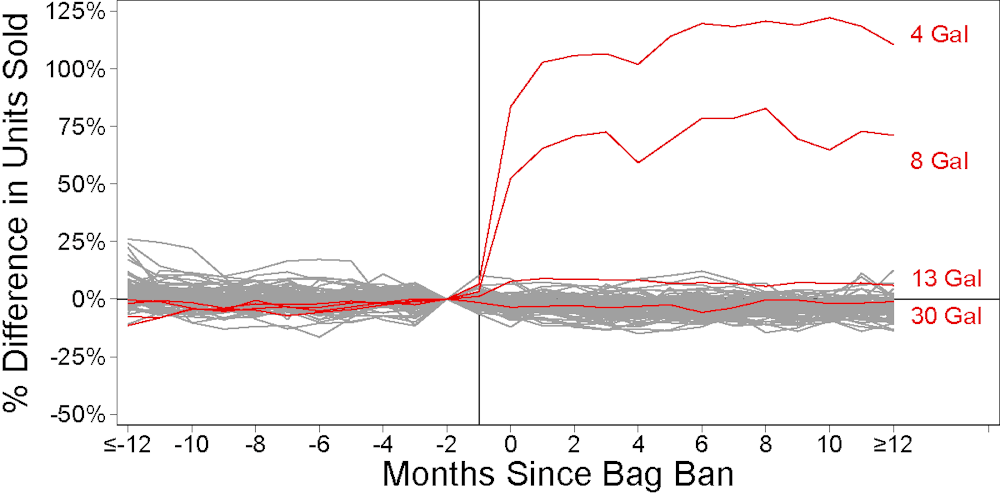
Using sales data from retail outlets, I found that bag bans in California reduced plastic carryout bag usage by 40 million pounds per year, but that this reduction was offset by a 12 million pound annual increase in trash bag sales. This meant that 30 percent of the plastic eliminated by the ban was coming back in the form of trash bags, which are thicker than typical plastic carryout bags. 

In particular, my results showed that bag bans caused sales of small (4 gallon), medium (8 gallon) and large (13 gallon) trash bags to increase by 120 percent, 64 percent and 6 percent respectively.


Percentage change in sales of garbage bags (red) and 114 other grocery product groups (gray) in the months before and after plastic carryout bag bans. Taylor, 2019, https://doi.org/10.1016/j.jeem.2019.01.001, CC BY-ND

Disposable does not automatically mean single-use

Although plastic carryout bags are widely referred to as “single-use,” consumers don’t necessarily treat them that way. By comparing the reduction in plastic carryout bags used at checkout to the increase in trash bags sold, my results revealed that 12 to 22 percent of plastic carryout bags were reused in California as trash bags pre-ban. Each reuse avoided the manufacture and purchase of another plastic bag. 

Moreover, my study underestimated reuse because it did not examine other ways in which people use plastic carryout bags, such as wrapping fragile items for shipping or storage instead of using plastic bubble wrap. Nor did it address increased use of reusable bags made of thicker plastic in place of disposable plastic bags. 

The U.K. study did examine the impact of shifting to thicker reusable plastic bags. It found that if these thicker bags were not reused between 9 and 26 times, they would have a higher global warming potential than disposable plastic carryout bags reused as trash bags.

Who bears the burden?

Who were the people who reused plastic carryout bags pre-ban, and presumably bore the burden of buying trash bags post-ban? I found that bag reuse was higher for people who purchased pet items and baby items – in other words, who needed to collect and dispose of excrement. In 2017, nearly 6 percent of U.S. households had a child under 5 years old, 44 percent owned a dog, and 35 percent owned a cat.

I also found that plastic bag reuse was higher among people who shopped for bargains. Although reusing shopping bags as trash bags could be motivated by environmental concern, it also could be motivated by frugality. Interestingly, I did not find a correlation between plastic bag reuse and income or political leaning, but I did find a positive correlation with higher levels of education."

Thursday, September 3, 2015

Plastic Bags Are Good for You

By Katherine Mangu-Ward of Reason. Excerpts:

"In 2006, the California Coastal Commission claimed that plastic bags make up 3.8 percent of beach litter, and a few years later the California Ocean Protection Council upped the ante to 8 percent of all coastal trash. Last year the Dallas City Council pinned 5 percent of the area's refuse on bags.

But the definitive American litter study—yep, such a thing exists—reports much lower figures. The 2009 Keep America Beautiful Survey, run by Steven Stein of Environmental Resources Planning, shows that all plastic bags, of which plastic retail bags are only a subset, are just 0.6 percent of visible litter nationwide. And those California data? They come from the International Coastal Commission (ICC), which the California Coastal Commission notes relies on information "collected by volunteers on one day each year, and is not a scientific assessment." (This insight, and many others in this story, is derived from a study produced last year by Julian Morris and Brian Seasholes for Reason Foundation, the nonprofit that publishes reason.) In D.C., a 2008 analysis prepared for the city's Department of the Environment by the Anacostia Watershed Society found that plastic bags were only the third-largest contributor to litter in the river, after food wrappers and bottles and cans.

Stein's study did find plastic bags in storm drains, but again, they made up only about 1 percent of the total litter.

Some plastic bags do find their way into the sea, of course. And one of the other concerns cited for the banning and regulation of plastic grocery bags is the safety of marine wildlife. The Blue Ocean Society for Marine Conservation is just one organization among many that claim that more than 1 million birds and 100,000 marine mammals and sea turtles die each year from eating or getting entangled in plastic.

Morris and Seasholes reconstructed an elaborate game of statistical telephone to source this figure back to a study funded by the Canadian government that tracked loss of marine animals in Newfoundland as a result of incidental catch and entanglement in fishing gear from 1981 to 1984. Importantly, this three-decade-old study had nothing to do with plastic bags at all.

Porpoises and sea turtles are undeniably charismatic megafauna—the pandas of the deep—and it's understandable that environmental groups would want to parade them around in a bid to drum up sympathy, almost certainly driven by the sincere belief that plastics put the beloved animals at grave risk. But in the end, there's little evidence that that's true. As David Santillo, a senior biologist with Greenpeace, told The Times of London, "It's very unlikely that many animals are killed by plastic bags. The evidence shows just the opposite. We are not going to solve the problem of waste by focusing on plastic bags. With larger mammals it's fishing gear that's the big problem. On a global basis plastic bags aren't an issue."

"But what about larger-scale impacts, such as climate change? Where do grocery bags stack up there? A 2011 study from the U.K.'s Environmental Agency attempted to quantify the emissions footprint both of plastic bags and of their substitutes. Holding the typical HDPE grocery bag up as the standard, researchers found that the common reusable non-woven polypropylene bag—the ubiquitous crinkly plastic tote, typically made with oil—had to be used at least 11 times to hold its own against an HDPE grocery bag. Cotton bags had to be used an amazing 131 times to do the same.

In 2007, for a brief moment, the "It bag" wasn't a $30,000 Hermes Birkin, it was a cotton tote designed by Anya Hindmarch that read: "I'm NOT A Plastic bag." Celebrities from Ivanka Trump to Keira Knightly were snapped toting the sold-out satchels for glossies like Life&Style and Grazia. While we can never know for sure, it seems wildly unlikely that Ivanka Trump has carried 131 loads of groceries in her life, much less in that particular bag.

What's more, those U.K. Environmental Agency figures assume the HDPE bag is not being reused. Nor do they account for the energy and materials needed to regularly wash the reusable bags in hot soapy water. Other alternatives did perform somewhat better in the global-warming matchup, including paper bags (which would have to be reused three times to match the single-use HDPE bag's footprint) and another type of reusable bag made of low-density polyethylene (four times)."
""It takes 12 million barrels of oil to produce the 100 billion plastic bags that are thrown away in the U.S. every year." Versions of this claim show up everywhere from New York Times editorials to Save the Bay pamphlets. But the origins of the figures are murky and the dramatic tone is misleading. Even if the number is accurate, it is almost a literal drop in the bucket: Americans consume a total of about 19 million barrels of oil a day. But as Morris and Seasholes point out, all that fretting about oil use "is surprising, not least because nearly all HDPE bags are produced from natural gas, not oil. Indeed, between 1981 and 2012, on average only 3.2% of polyethylene bags were made from oil. The reason is simple: it is far less expensive to produce ethylene, the feedstock for polyethylene, from natural gas (methane) than from oil." While the price of oil has recently declined, the assumption that plastic bags are made primarily from oil remains false.

In 2010, according to the U.S. Environmental Protection Agency, Americans threw away 690,000 tons of HDPE bags. Of those, approximately 30,000 tons were recycled. That means a total of 660,000 tons were discarded, mostly into landfills (approximately 82 percent of non-recovered municipal solid waste goes to landfill; 18 percent is incinerated). That same year, Americans also chucked almost exactly the same amount of "reusable" polypropylene bags (680,000 tons), of which zero were recovered. In other words, those polypropylene reusable bags actually constituted a slightly higher proportion of all bags going to landfills.

In April, NPR's Planet Money reported on the economics of plastic recycling, and noted that while recycled plastic from bags and sacks was once a profitable industry, times have changed. The prices of oil and gas have fallen, which means it is cheaper to just make new bags rather than undertake the laborious process of recycling the old ones. As Tom Outerbridge, who runs a Brooklyn recycling center called Sims, explained, "We can't afford to put a lot of time and money into trying to recycle it" if no one's buying the final product.""

"A 2011 survey published in the journal Food Protection Trends found coliform bacteria in fully half of the reusable shopping bags tested in a random survey of shoppers in Arizona and California. The same 2014 Edelman Berland study that found consumers frequently forgot their bags also unearthed the fact that only 18 percent of shoppers reported cleaning their bags "once a week or more." An article in the Journal of Infectious Diseases traced a 2010 outbreak of norovirus to nine members of an Oregon soccer team who had touched or eaten food stored in a contaminated reusable bag."