Showing posts with label Redistribution. Show all posts

Wednesday, September 2, 2026

Reflections on Americans’ Net Worth

By Bryan Caplan. Excerpt:

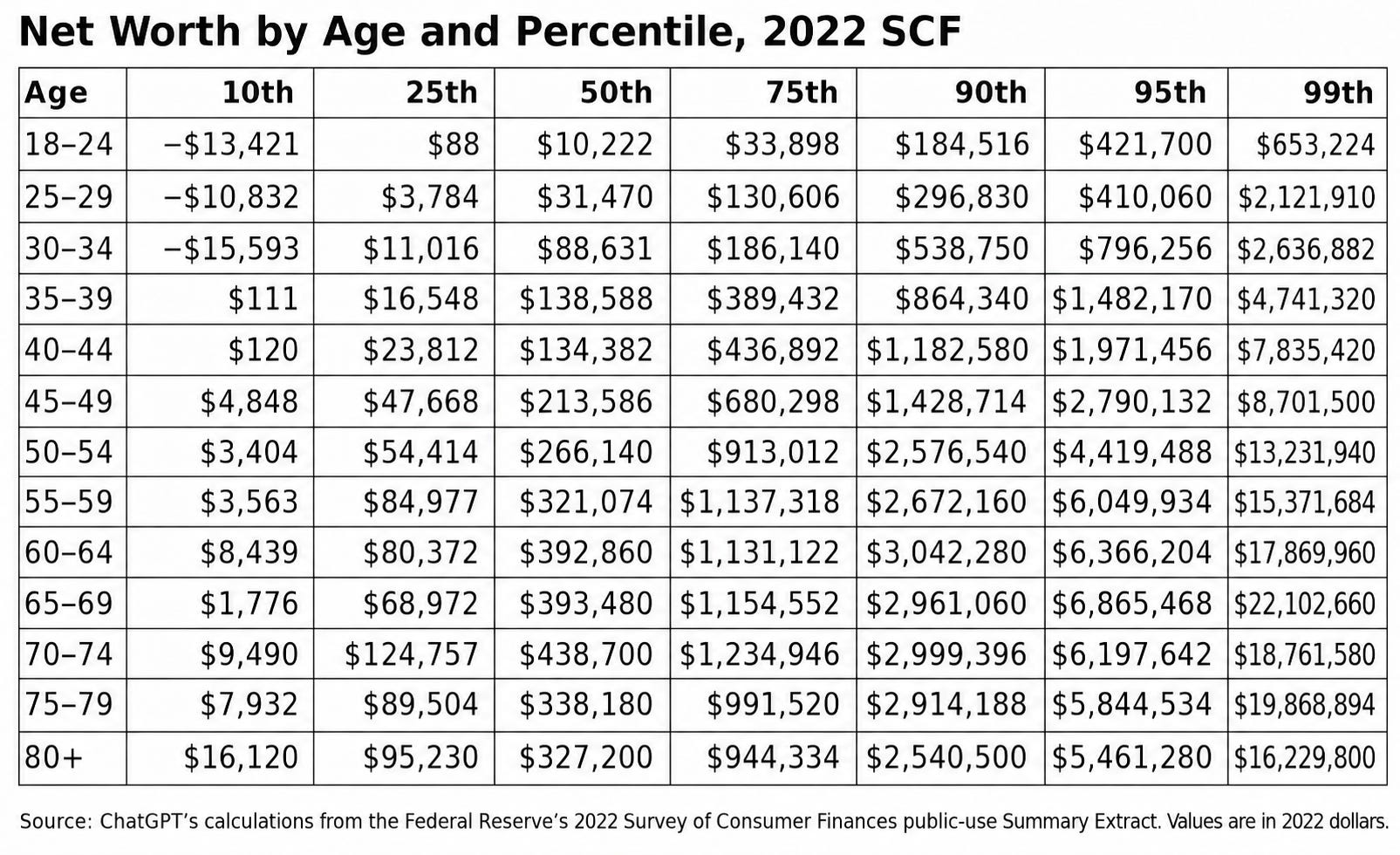
"I’ve been an economics professor for almost 30 years, but I don’t think I’ve ever before seen anything like the table below. I knew that claims that “58% of Americans can’t afford a $1,000 car repair” were laughable clickbait. I knew that — measured by income — the middle class is disappearing… by becoming upper-middle class. But only recently did I start to fully appreciate the chasm between populist pessimism and actual data on Americans’ net worth. From the 2022 Survey of Consumer Finances: 


"Main reflections:

  1. Economists have long known that inequality is relatively low for consumption, medium for income, and high for wealth. What they rarely emphasize, however, is how much wealth depends on age. The richest Americans aged 65-69 are worth about 30x as much as the richest Americans aged 18-24.

  2. Net worth is very high in absolute terms. The median is over six figures by the mid-30s. Americans at the 75th percentile are millionaires by their mid-50s. Americans at the 90th percentile are millionaires by around 40. Claims about middle-class, middle-aged Americans who “can’t afford” eggs or gas or beef are nonsense.

  3. The most sensible argument for worrying about trade deficits is that we’re “living beyond our means.” Trade deficits represent borrowing, and we can’t keep borrowing forever. But given Americans’ extraordinary net worth, the most sensible argument for worrying is still senseless. After 50 years of unbroken trade deficits, we’re wealthier than ever."


Sunday, August 23, 2026

Wealth Tax 2.0

By John H. Cochrane. Excerpts:

"If you invest an extra dollar today, how much extra do you get in a year? A 5% wealth tax drags down the rate of return by 5 percentage points. If you earn 10% on your investments, but then pay a 5% wealth tax, you only get a 5% after-tax rate of return. Starting from a 10% return, a 5% wealth tax is the same as a 50% tax on interest, dividends, and capital gains."

"The wealth tax applies on top of corporate taxes, property taxes, and taxes on dividends, interest, and capital gains. Inflation acts as another wealth tax, running 3% a year now. My guesstimate is that the government takes all the return and more."

"Should they (billionaires)  bet the farm on a new venture, investing time and effort as well as their money? Should young Elon Musk take his $175 million PayPal payout and retire on it, or plow it all into electric cars and rockets? We often think of saving vs. consumption here, but I think we underestimate the disincentive to take risk and invest effort that comes from progressive taxation. If the government taxes away the upside to investing, people take less risk." 

"Billionaires do not have a pot of gold that can be costlessly handed out. Billionaires’ wealth stays re-invested in companies. Redirecting their wealth to social spending lowers national investment and raises national consumption, dollar for dollar. That’s not even hidden; it’s the point. But less investment mechanically means less capital for the future, fewer businesses, less productivity, lower wages."

"less investment also drives up interest rates as people with profitable ventures look for investors. Companies could finance investment with foreign money, but that raises the trade deficit"

"Structuring businesses to avoid taxes rather than generate profit might be the most insidious effect of high taxation."

"We have a wealth tax, the estate tax. It tries to charge 40% of wealth once in a generation, or about 1% a year. (You pay double if you pass it to grandkids, so really about once every 30 years.) The estate tax attracts a beehive of perfectly legal avoidance. (Avoidance, not evasion. “Tough enforcement” and audits do nothing here.) Though the estate tax applies above a lowly $11 million, the CBO reports that it yields only $18 billion, or 0.1 percent of GDP. A recent study—by wealth tax backers—reports that the estate tax collects only three to four hundredths of a percent (0.03%–0.04%) annually of the Forbes 400 wealth, not 1% or so."

[the bill] includes “a $3,000 direct payment to every man, woman and child living in a household making $150,000 or less.” $1.1 trillion for Medicaid and Obamacare subsidies. Free dental, vision and hearing. $856 billion of government-provided homes to “abolish homelessness.” A childcare entitlement. A minimum salary for teachers. And so on. This is proudly a bill to turn investment into consumption."

"Free market wealth did not install Putin, nor did it create US crony capitalism under the regulatory state."

"What’s the right question? There is only one question — long run growth. Redistributing Rockefeller’s wealth would not have made your family better off. We’re all immensely better off because of long-run growth. Even if your concern is entirely at the lower end of the economic spectrum, long-run growth is the question. Ask of any policy, what does this do to long-run growth? For the wealth tax, not much!"  

Saturday, August 22, 2026

Did UBI make people happier? (only in the short run)

From Tyler Cowen.

"Eh, only in the short run:

We study the causal impacts of income on a rich array of employment outcomes, leveraging an experiment in which 1,000 low-income individuals were randomized into receiving $1,000 per month unconditionally for three years, with a control group of 2,000 participants receiving $50/month. We gather detailed survey data, administrative records, and data from a mobile phone app. The transfer caused total individual income excluding the transfers to fall by about $1,900/year relative to the control group and a 4.2 percentage point decrease in labor market participation. Participants reduced their work hours as a result of the transfers by 1-2 hours/week and participants’ partners reduced their work hours by a comparable amount. Among other categories of time use, the greatest increase generated by the transfer was in time spent on leisure. Despite asking detailed questions about amenities, we find no impact on quality of employment, and our confidence intervals can rule out even small improvements. Treated participants broadly increase expenditures, led by spending on non-durable goods and services, with smaller increases in spending on durable goods and human capital. We observe no significant effects on degree attainment, though the magnitudes of the estimated effects generally appear larger among younger participants. Measures of subjective well-being are higher among treated participants in the first year of the transfers but then revert to control group levels. Overall, our results suggest a moderate labor supply effect that does not appear offset by other productive activities.

That is from the QJE by , and  Via Matt Yglesias."

Friday, June 5, 2026

Why Has Poverty Declined in the U.S.?

By Jeffrey Miron.

"Was President Lyndon Johnson’s “war on poverty” the main driver of declining poverty rates after 1964?

Not according to a new study. The researchers examined a measure of poverty

that accounts for all taxes and government benefits … [and] anchored [the] poverty measure to the official poverty rate in 1963. ... [They also] adjusted income thresholds for inflation and the size of each person’s household.

Using this measure, they found that

poverty fell substantially prior to the War on Poverty, primarily due to increases in market income, without a substantial rise in the dependency of working-age adults and their children on government transfers for most of their income. … These trends were particularly stark for black people, who experienced a steep decline in poverty before the War on Poverty."

Monday, June 1, 2026

Britain’s Lost Generation of Workers

Nearly a million youth aren’t working, in school or job training

WSJ editorial. Excerpts:

"one in eight of its working-age youth currently aren’t employed, in school or in job training."

"Nearly 60% of these youth aren’t even looking for work, and more than half have never held a job."

"Nearly half of Britain’s idle youth now claim to have a work-limiting disability. And more than 42% cite mental health problems as their primary condition"

"The U.K. spent £52 billion in the 2024-2025 fiscal year on overall working-age, health-related benefits, up from £36 billion five years earlier" 

"the cumulative annual cost of a million idle youth at £125 billion, or nearly $168 billion—more than Britain spends on education each year."

"opportunity costs from lost revenue and economic potential."

"Steadily rising payroll taxes for employers—and a minimum wage that has increased by as much as 84% since 2019 for some younger age cohorts—are pricing young, inexperienced workers out of the job market." 

Sunday, March 29, 2026

AI Titans Work Hard to Discourage Working

New studies demonstrate what should be obvious: Universal basic income programs kill initiative.

By Jason L. Riley. Excerpts:

"Weavers and bank tellers feared for their livelihoods at the time, but the Industrial Revolution led to significantly more hiring in the textile sector, and banks increased employment after ATMs were introduced."

"In recent years more than 150 basic-income pilot programs in 35 states have been initiated. One of the pilots, backed by Mr. Altman, began in 2020 and provided low-income participants in Texas and Illinois with $1,000 a month, while a control group received $50 a month. After three years of payments, researchers found that both groups worked slightly more—which may have resulted from the pilot’s starting during the pandemic and ending as the economy bounced back. But they also found that people who received $1,000 put in fewer hours on the job than people who received $50, suggesting that the higher payments provided a disincentive to work.

Last month, economist Kevin Corinth and Hannah Mayhew of the American Enterprise Institute released a survey of 122 basic-income pilots that took place between 2017 and 2025 in 33 states and the District of Columbia. They reported mixed results. Employment increased in some programs and decreased in others, and the role of the pandemic was difficult to assess.

The pilot programs varied “in their designs, data collection and study quality,” and only 30 of them provided employment outcomes. Hence, the authors counsel against sweeping policy conclusions based on the results. Most experiments were small, and the evaluations “rely exclusively on survey data and are thus subject to reporting bias and non-response bias.” Yet Mr. Corinth and Ms. Mayhew did find that the larger and more credible studies—such as the one Mr. Altman backed—showed that unearned income has a negative impact on a person’s willingness to work."

"President Lyndon Johnson’s War on Poverty in 1964 launched the modern social safety net"

"The welfare system attempted to replace family breadwinners, but it turned out that those breadwinners were providing more than money. The result of these government interventions was more broken homes, antisocial behavior and blighted neighborhoods." 

Sunday, August 31, 2025

A Politician Speaks the Unspeakable

Germany’s Friedrich Merz says the current welfare state isn’t affordable

WSJ editorial. Excerpts:

"Friedrich Merz, the German Chancellor, said at a Christian Democratic Union conference on Saturday that “the welfare state that we have today can no longer be financed with what we produce in the economy.”"

"Nations have built welfare and entitlement states that are so large they have outstripped the ability of slow-growing economies to pay for them. Yet because the entitlement cushion is so broad and reaches deep into the middle class, it has become nearly impossible to reform." 

Saturday, August 30, 2025

About Those “Devastating” Welfare Caseload Reductions

By Matt Weidinger of AEI.

"Newly-elected President Barack Obama famously lectured opposition leaders that “elections have consequences.” That’s never been more apparent than in recent Republican-crafted changes projected to shrink welfare caseloads in the coming years. Democrats vilify the changes as “devastating,” never mentioning they will mostly shrink still-bloated welfare caseloads closer to pre-pandemic levels. And by focusing some of the biggest reductions on illegal aliens and able-bodied adults who may be unwilling to work, the reforms stand a strong chance of earning popular support.

Welfare expanded rapidly during the pandemic, and significant caseload expansions have continued even after it ended. Medicaid and the Children’s Health Insurance Program exploded from a pre-pandemic 71 million recipients to 94 million in March 2023, when pandemic-driven policy expansions started to unwind. While down, current caseloads remain over 78 million, still 10 percent above pre-pandemic levels. Food stamp caseloads similarly spiked, rising sharply from 37 million to over 43 million in the first months of the pandemic. Today’s caseload remains just off that peak and still 14 percent above the pre-pandemic level. 

New reforms are projected to notably reduce both Medicaid and food stamp caseloads, returning them closer to pre-pandemic levels. The biggest reductions are projected to result from expanded work requirements included in Republicans’ One Big Beautiful Bill (OBBB). Work requirements are widely supported by the public and contributed to remarkable results in the past. For example, Republican welfare reforms signed into law by Bill Clinton featured work requirements for welfare checks that contributed to more parents workingpoverty falling, and cash welfare caseloads plummeting 85 percent.

The OBBB dusts off that playbook by applying similar “community engagement requirements” to able-bodied adults on Medicaid, expecting them to perform 80 hours of work, education, or community service in at least two months per year. Nondisabled childless adults on Medicaid spend an average of 125 hours per month watching TV or playing video games, so most should have ample time. The Congressional Budget Office estimates this part-time, part-year requirement will save taxpayers $325 billion over the next decade while removing 4.8 million able-bodied adults from the Medicaid rolls. The new law similarly strengthens work requirements for food stamps, saving another $70 billion while reducing that caseload by three million able-bodied adults.

Other recent changes focus on specific groups, such as the Trump administration’s July 10 regulations ending illegal alien access to Head Start and postsecondary education subsidies. Additional changes in the OBBB will end child tax credit payments to households headed solely by illegal aliens.

Medicaid and food stamps were not the only programs that expanded significantly in the pandemic. Several other massive temporary programs and benefit expansions have come and gone, even as Democrats call for reviving them in the future. One fraud-riddled program paid unemployment checks for the first time to 15 million out-of-work independent contractors and self-employed individuals. Another provided unprecedented $600-per-week unemployment supplements to tens of millions, leaving two-thirds better off not working. And child tax credits were temporarily expanded for 39 million households, including those headed by nonworking adults for the first time. One liberal supporter branded that change simply “Goodbye, Clinton welfare reform. Hello, child tax credit.”

Combined, those temporary programs reflect Democrats’ vision for the future of much bigger caseloads and benefit checks, payable even to those who never worked to earn them. That vision of “guaranteed income” suffered a body blow last month, when the New York Times reviewed a rigorous study of guaranteed income checks paid in several states on a trial basis to parents of young children. Liberals have long touted such no-strings-attached welfare as a cure-all, while rarely admitting the trillion-dollar cost of a new nationwide program. Meanwhile, the study “found that years of monthly payments did nothing to boost children’s well-being, a result that defied researchers’ predictions and could weaken the case for income guarantees.” As study author Greg Duncan of the University of California, Irvine, bluntly summarized, “The money did not make a difference.”

It’s no surprise when Democrats who support massive welfare expansions attack Republicans over policies designed to reduce benefit dependence, even just back to former levels. But hardworking taxpayers in both parties often take a very different view. To them, reducing benefit receipt by requiring work by able-bodied adults or ending benefits for illegal aliens makes perfect sense, especially in an era of outsized dependence and fast-growing debt. That suggests Republicans’ caseload-shrinking policies stand a good chance of being embraced by the public, just as past welfare reforms have been."

Tuesday, August 26, 2025

Elon Musk Wants to Give You Money for Nothing

Artificial intelligence is the latest justification for supporting the bad idea of ‘universal basic income.’

By Jason L. Riley. Excerpts:

"It’s often forgotten that in the early days of the country’s “war on poverty,” the general understanding was that you alleviate privation by reducing dependency on the government and creating incentives to become more productive. The goal was “to help our less fortunate citizens to help themselves,” President John F. Kennedy said. “We must find ways of returning far more of our dependent people to independence.”"

"In the 1960s and ’70s, as welfare-state programs proliferated, the number of people receiving public assistance more than doubled."

"Nor do we have any reason to believe that issuing no-strings-attached cash stipends to poor families works as intended. “Significant but indirect evidence has suggested that unconditional cash aid would help children flourish,” the New York Times reported last month. “But now a rigorous experiment, in a more direct test, found that years of monthly payments did nothing to boost children’s well-being, a result that defied researchers’ predictions.”"

"The study, titled “Baby’s First Years,” concluded that after four years of monthly payments of $333, children whose parents received money “fared no better than similar children without that help.”"

"other research involving larger stipends has concluded they can negatively affect work habits. Last year, the National Bureau of Economic Research published a working paper on the employment effects of guaranteed income, which was described as the most comprehensive study of its kind to date. Researchers found that families who received $1,000 monthly payments for three years worked fewer hours."

"“Nearly 7 million men in the prime of life—over a tenth of the 25-to-54 age group—are neither working nor looking for work these days,”" 

Sunday, September 15, 2024

Welfare Is What’s Eating the Budget

Means-tested programs, not Medicare and Social Security, are behind today’s massive debt

By Phil Gramm and Jodey Arrington. Excerpts:

"Since its inception, Social Security has produced cash surpluses 60% of the time. In 2023 Social Security payroll taxes funded 88.9% of benefits. The cost of Social Security’s Old-Age, Survivors and Disability Insurance program, net of payroll tax collections, was only $88.1 billion. Medicare payroll taxes and premiums funded 49.7% of Medicare expenditures, producing a net cost of $509 billion. 

Means-tested social-welfare spending totaled $1.6 trillion in 2023. Welfare spending now absorbs an astonishing 72.6% of unobligated general revenue (total revenue net of Social Security and Medicare payroll taxes and premiums and mandatory interest on the public debt) and is larger than the claims against unobligated general revenue by Social Security (4.1%), Medicare (23.5%) and defense (37.2%) combined.

Since funding for the War on Poverty ramped up in 1967, welfare payments received by the average work-age household in the bottom quintile of income recipients has risen from $7,352 in inflation-adjusted 2022 dollars to $64,700 in 2022, the last year with available household income data. This 780% increase was 9.2 times the rise in income earned by the average American household.

Since 1967 defense spending has fallen from 68% of unobligated general revenue to 37.2% in 2023"

"the U.S. today redistributes a larger share of its gross domestic product, 29.4%, through transfers and taxes than any developed country in the world except France with 30.1%."

"After counting all transfer payments as income to the recipients and taxes as income lost by taxpayers, and adjusting for household size, the average households in the bottom, second and middle quintiles all have roughly the same incomes—despite dramatic differences in work effort. With the explosion of means-tested transfer payments, the portion of prime work-age persons in the bottom quintile who actually work has fallen to 36% from 68%. In the second quintile, households with a work-age adult who actually works have declined to 85% from 90%. While work effort fell in the bottom two quintiles, the percentage of middle-income households with a prime work-age person who works has risen to 92% from 86%"

"For about the same income, 2.4 times as many work-age persons in the second quintile actually work and on average work 85% more hours than those in the bottom quintile. And 2.5 times as many work-age middle-income persons actually work and work on average 108% more hours."

"The bipartisan effort to reform Aid to Families with Dependent Children during the Clinton administration was a success."

"the 1996 Clinton welfare reforms reduced the rate of dependency of families on what is now called Temporary Assistance for Needy Families by 80%. Six years after the adoption of the reforms, the number of program beneficiaries had fallen dramatically, the labor-force participation rate of never-married mothers had increased, and child poverty had declined. State-imposed work requirements for food-stamp eligibility in Arkansas, Mississippi, Missouri and Florida have thus far also been successful."

"In reporting household income, the Census Bureau doesn’t count 88% of transfer payments made to households that are defined as being poor. The census doesn’t count refundable tax credits (for which the beneficiary receives a check from the Treasury), food-stamp debit cards, free medical care through Medicaid, or benefits from about 100 other federal transfer payments as income to welfare recipients. When those benefits are counted as income, 80% of those who are today counted as being poor are no longer poor, and almost half have incomes equivalent to American middle-income earners."
Wednesday, July 24, 2024

The Long-Term Effects of Income for At-Risk Infants: Evidence from Supplemental Security Income

By Amelia Hawkins, Christopher Hollrah, Sarah Miller, Laura R. Wherry, Gloria Aldana & Mitchell Wong.

Abstract

"The Supplemental Security Income (SSI) program uses a birthweight cutoff at 1200 grams to determine eligibility. Using birth certificates linked to administrative records, we find low-income families of infants born just below the cutoff receive higher monthly cash benefits (equal to 27% of family income) at ages 0-2 and small but significant effects on transfers through age 10. Yet, we detect no improvements in health care use and mortality in infancy, nor health and human capital outcomes as observed through young adulthood for these infants. We also find no improvements for their older siblings."

Monday, July 22, 2024

The Employment Effects of a Guaranteed Income: Experimental Evidence from Two U.S. States

By Eva Vivalt, Elizabeth Rhodes, Alexander W. Bartik, David E. Broockman & Sarah Miller.

"We study the causal impacts of income on a rich array of employment outcomes, leveraging an experiment in which 1,000 low-income individuals were randomized into receiving $1,000 per month unconditionally for three years, with a control group of 2,000 participants receiving $50/month. We gather detailed survey data, administrative records, and data from a custom mobile phone app. The transfer caused total individual income to fall by about $1,500/year relative to the control group, excluding the transfers. The program resulted in a 2.0 percentage point decrease in labor market participation for participants and a 1.3-1.4 hour per week reduction in labor hours, with participants’ partners reducing their hours worked by a comparable amount. The transfer generated the largest increases in time spent on leisure, as well as smaller increases in time spent in other activities such as transportation and finances. Despite asking detailed questions about amenities, we find no impact on quality of employment, and our confidence intervals can rule out even small improvements. We observe no significant effects on investments in human capital, though younger participants may pursue more formal education. Overall, our results suggest a moderate labor supply effect that does not appear offset by other productive activities."

Sunday, July 21, 2024

Connecticut Democrats Try to Tax the Wealthy Away

Hartford won’t be satisfied until every last millionaire in the state moves to New Hampshire or Florida

By Carol Platt Liebau and Frank Ricci. Ms. Liebau is president of the Yankee Institute. Mr. Ricci is a Yankee Institute fellow and author of “Command Presence.” Excerpts:

"Connecticut is a high income-per-capita state and has one of America’s most burdensome tax systems. It collects $30.9 billion annually in taxes. Yet it has still managed to accumulate one of the highest ratios of debts-per resident of any state in the nation. State officials should look for ways to exercise greater fiscal discipline instead of seeking new ways to tax residents.

As long as income is earned honestly, one state resident making more money than another isn’t a justification for taxing it away. Most millionaires are self-made. Eighty percent of them grew up in families at or below middle-income levels. Only 2% inherited their wealth from their families."

"Connecticut’s politicians should read a recent Boston University study on Massachusetts’s tax policies as a cautionary tale. High income taxes, expensive housing and steep healthcare costs have caused net out-migration to increase by 1,100% since 2013. The state has lost billions in adjusted gross income and hundreds of millions in income tax revenue annually. As remote work and increased mobility provide people with more choices, the out-migration is likely to continue, potentially leading to even greater economic repercussions by 2030.

The Boston University study paints a bleak picture of how Massachusetts is struggling to retain its workforce, especially high-income earners and younger professionals moving to states with lower tax burdens and more affordable living. If this trend continues, Massachusetts could lose up to $1 billion in income taxes every year."

Monday, June 17, 2024

Wealth Must Be Made Before It Can Be Distributed

‘There’s nothing that does so much harm as good intentions.’

Letter to The WSJ

"While I have a great deal of respect for Prof. Blinder, the flaw in his distributionist logic is staring him in the face. He complains that government social spending targeting the nation’s low-income households, elderly, disabled, sick, unemployed and youth is a lower proportion of GDP in the U.S. than it is in France and Germany.

But U.S. GDP per capita far exceeds those of France and Germany, so that the amount of U.S. social spending per person surpasses that of both these traditionally redistribution-focused nations—over $19,000 in the U.S. versus than $15,000 in Germany and France. (If the GDPs are compared under purchasing power parity, social spending per capita is closer in the three countries but the U.S. still comes out ahead.

Distributionists (whether re- or pre-) focus so intently on making sure that everyone’s slice of pie is identical that they neglect the most important factor in the human condition: How much pie is everyone actually getting? History shows that policies that focus too heavily on equity result in there being far less to go around over time, and the most vulnerable suffer from this greater scarcity. As Milton Friedman liked to say, “There’s nothing that does so much harm as good intentions.”

Prof. Jason Taylor

Central Michigan University

Mount Pleasant, Mich."


Friday, April 12, 2024

The lowest quintile of Americans receives a net of 127 percent of their market income through the tax and transfers while the top quintile gives up 31 percent of their market income due to taxes and transfers

From Erica York. She is senior economist and research director at Tax Foundation.

"Income transfer programs amplify the U.S. federal tax system’s progressivity, move the state and local system from moderate regressivity to moderate progressivity, and result in a highly progressive fiscal system overall.

The lowest quintile of Americans receives a net of 127 percent of their market income through the tax and transfer system, accounting for both the taxes they pay and the transfers they receive, meaning that for each dollar they earned, they received an additional $1.27 from the government, netting transfers (gains) and taxes (losses). At the other end of the spectrum, the top quintile gives up 31 percent of their market income due to taxes and transfers."