Showing posts with label Lobbyists. Show all posts

Thursday, June 18, 2026

Should we worry about the influence that wealthy individuals have on politics?

See Matt Zwolinski Makes Emmanuel Saez’s Error by David Henderson.

Mr. Henderson pointed out that many of Zwolinksi's examples were of corporate influence, not individual influence. And there is plenty of influence from unions like the NEA.

Excerpt:

"There were so many things to pursue here. I’ll take two. First, I live in a highly NIMBY area and I don’t notice that particularly wealthy people dominate the discussion in favor of hampering housing construction. If anything, the wealthiest people in the debate tend to be developers who want to build.

Second, Matt is quite comfortable taking away wealthy people’s money with the estate tax, which really is a death tax. What would he feel comfortable taking away from teachers and their unions so that they would be less effective in pushing in an anti-liberty direction? Their freedom of speech? I doubt it, but I don’t know his answer.

But making those points takes us away from my main point, which is that most of the lobbying is done by corporations, not wealthy individuals. There is little doubt that Disney, to take his example, would have lobbied heavily for the extreme extension of copyright even if no Disney shareholder had been particularly wealthy.

While researching my next article for Hoover, I came across something I wrote in which I had linked to a discussion in which Larry Summers asked the same question of Emmanuel Saez. Saez had failed to make the simple distinction between high-market-value corporations and wealthy people. Go to this link and follow Larry’s reasoning from the 1:06:00 point on. It’s masterful. Larry calls on Saez to give one example of a wealthy person having much less political power because the government has reduced his wealth from a very high number to a lower, but still very high, number. When Saez answers, he gives an example of a corporation, just as Zwolinski responded to me.

There is one way in which Zwolinski probably has more understanding of the relevant economics than Saez does. At the 1:10:10 point, Saez mentions robber barons as if it’s a slam dunk, showing that he doesn’t understand that the major characters listed as robbers and barons were neither. (Other than that, it’s a great expression.) My guess is that Zwolinski understands the true facts about robber barons better than Saez does."

Monday, August 11, 2025

MAGA Antitrust Agenda Under Siege by Lobbyists Close to Trump

Administration’s populist promise to be tough on companies is clashing with influence campaigns

By Dave Michaels and Annie Linskey of The WSJ. Excerpts:

"Through these power brokers, companies have also been able to appeal to some of the president’s broader economic priorities to limit enforcement. Working through Mike Davis—a longtime Trump ally—and other consultants, Hewlett Packard Enterprise made commitments, not disclosed in court papers, that called for the company to create new jobs at a facility in the U.S., according to people familiar with the matter. The unusual offer was designed to ease the government’s opposition to the company’s merger with a major rival, Juniper Networks, which would reduce competition in the wireless networking market."

"Other companies facing antitrust investigations are now looking to hire lawyers or lobbyists close to Trump after witnessing the favorable settlement that HPE reached" 

Saturday, April 27, 2024

California Loses Nearly 10,000 Fast-Food Jobs After $20 Minimum Wage Signed Last Fall

By Lee E. Ohanian.

"Last September, Gov. Gavin Newsom signed California Assembly Bill 1287 into law, which includes a $20 per hour minimum wage for fast-food workers and a fast-food regulatory council which has the authority to raise the industry’s minimum wage annually. But between last fall and January, California fast-food restaurants cut about 9,500 jobs, representing a 1.3 percent change from September 2023. Total private employment in California declined just 0.2 percent during the same period, which makes it tempting to conclude that many of those lost fast-food jobs resulted from the higher labor costs employers would need to pay.

More fast-food job losses are coming as the new minimum wage took effect earlier this month. This includes losses at Pizza Hut and Round Table Pizza which are in the process of firing nearly 1,300 delivery drivers. El Pollo Loco and Jack in the Box announced that they will speed up the use of robotics, including robots that make salsa and cook fried foods.

Fast food prices are up since the law took effect on April 1. In less than one month, Wendy’s increased prices by 8 percent, Chipotle’s prices have increased by 7.5 percent, and Starbucks prices are up by 7 percent. McDonald's has announced it will be raising prices, and many other fast-food franchises have announced hiring freezes.

California now has the highest-priced fast food in the country, but there is an obvious limit to how much further prices can climb. “I can’t charge $20 for Happy Meals,” noted Scott Rodrick, a Northern California McDonald’s franchisee.

It is nothing short of bizarre that California would choose to specify a substantially higher minimum wage for its fast-food industry, which tends to hire workers who are much younger than other industries, which have a minimum wage of about $16 per hour. About 30 percent of fast-food workers are teens, and another 30 percent are between twenty and twenty-four years old. With 60 percent of its workforce twenty-four or younger, the fast-food industry stands in sharp contrast to the other industries, in which only about 13 percent of workers are that young.

Young workers have less experience than older workers and are still in the process of building skills, both of which tend to limit the amount of value that young workers can create for an employer. Young workers are also expensive from a human resources standpoint, because they require significant training and because they tend to move in and out of employment frequently, reflecting school schedules. Annual worker turnover in the fast-food industry exceeds 100 percent, which raises employer recruiting and training costs significantly.

Fast-food employers have few alternatives to a $20 minimum wage other than cutting their workforces or raising prices, as fast-food profit margins are slim, averaging 5‒8 percent. Labor advocates typically argue for the need of a “living wage” when it comes to the pay of less-skilled workers. But this ignores the fact that many of those workers are part time, and it also ignores the fact that fast-food owners and their investors must receive adequate compensation for their time and capital. Living wages can mean no wages, which is what has happened for over 9,500 California fast-food workers since last September.

The genesis of the new law is one of the uglier pieces of legislation to have come out of Sacramento. Minimum wage and “living wage” laws almost always are tied to unions, because they typically provide exemptions for workers covered by a collective bargaining agreement. This one is no exception. For over a decade the Service Employees International Union (SEIU) tried to unionize fast-food workers, but failed, despite spending $100 million in the process.

The union then turned to its legislative friends in Sacramento to create a new law in which a regulatory council, which would of course be dominated by union representatives, would regulate wages and working conditions in the fast-food industry, unless of course the restaurant agreed to collective bargaining. The Legislature passed this law, Assembly Bill 1228, in 2022, and Newsom signed it, but it was so onerous that the industry gathered enough signatures to put the law in front of voters in a 2024 ballot referendum. Legislators panicked, knowing that voters would likely overturn the law. A new bill, AB 1287, was crafted that substantially weakened the regulatory authority of the fast-food council, and the industry agreed to remove the ballot referendum.

But the ugliness of the new law doesn’t stop there. The 2023 law includes a strange exemption from the $20 wage for fast-food restaurants that bake their own bread and sell it as a stand-alone item. Why? According to several sources familiar with the bill’s negotiations, the exemption was included to satisfy Newsom, because one of his political donors, Greg Flynn, owns several California Panera Bread franchises, which bake their own bread and sell it as a stand-alone item.

After this exemption came to light in the national media in February, Newsom responded to allegations that the bakery exemption reflected a political payoff for his donor as outrageous, but he provided no other explanation for why such a one-off exemption was provided, and he still hasn’t. Newsom received more criticism in the media when it was reported that a restaurant he partially owns near Lake Tahoe posted a job listing for a table busser at $16 an hour. With a $37 pasta dish and a $67 steak dinner on the menu, the restaurant doesn’t qualify as fast food, so it is not required to pay the $20 minimum wage. And while Newsom is not involved in managing his businesses since becoming governor, many still find it tone-deaf that the spirit of the legislation that he is so proud of is not being followed by his family business.

The $16-per-hour job posting in Newsom’s restaurant is informative regarding the market price of restaurant service workers. The restaurant is not paying more because it doesn't need to. It can find qualified applicants at $4 less per hour than the fast-food minimum wage, even in Lake Tahoe, which is a high cost-of-living area.

The job will be filled in Newsom’s restaurant, and perhaps it has already been filled. But there are over 9,500 California jobs that no longer exist because they can’t pay what Newsom’s restaurant is paying. And that is the saddest bit of this ugly new law."

Thursday, May 18, 2023

Big Business vs. Free Enterprise

By Dan Mitchell

"I explained during a recent speech in Poland that I get very upset when big companies support policies that disproportionately harm small businesses.

By the way, I have no objection to big companies simply because they are big. Or merely because they sometimes earn a lot of profit.

But, as captured by my Eleventh Theorem of Government, I don’t like big business when it gets in bed with big government.

That’s a recipe for all sorts of bad policies, and also a major source of political corruption.

For purposes of today’s column, though, let’s consider how it is a recipe for reducing competition.

We can now quantify the damage, thanks to some new research by Professor Shikhar Singla, published by Goethe University in Frankfurt.

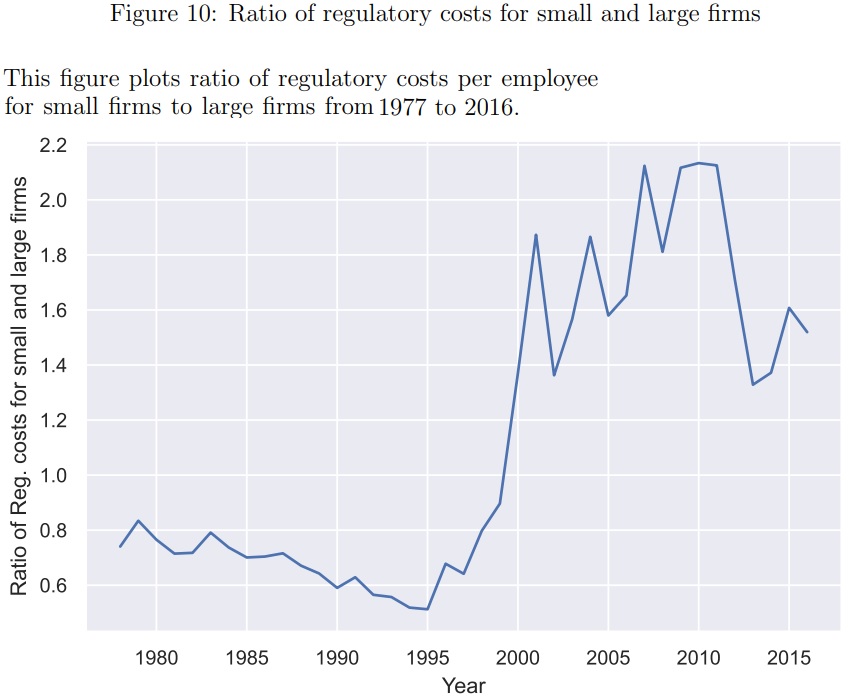
…the total economy-wide cost of regulations since 1970 has increased by almost 1 trillion dollars, which is roughly 5% of US GDP in 2018. …there has been a massive increase in regulation since the late 1990s. …an average small firm faces an average of $9,093 per employee in our sample period compared to $5,246 for a large firm. …We find that a 100% increase in regulatory costs leads to a 1.2%, 1.4% and 1.9% increase in the number of establishments, employees and wages, respectively, for large firms, whereas it leads to 1.4%, 1.5% and 1.6% decrease in the number of establishments, employees and wages, respectively for small firms… Results on employees and wages provide evidence that an increase in regulatory costs creates a competitive advantage for large firms. Large firms get larger and small firms get smaller. …The smaller the firm, the more competitively disadvantaged it gets… Fixed costs create a competitive disadvantage for small firms. …We find that large firms oppose regulations in general. But, they push for regulations which have an adverse impact on small firms. Hence, they are willing to incur a cost that creates a competitive advantage for them.

How much of a competitive advantage?

It’s become very significant this century, as shown by Figure 10 from the study.

Policy obviously veered in the wrong direction at the end of the Clinton Administration and then (unsurprisingly) stayed bad during the Bush, Obama, and Trump years.

And policy is staying bad during the Biden years.

The Wall Street Journal editorialized on this topic in 2021. Here are some excerpts.

…what’s really going on: Old-fashioned self-interest. …Take Amazon CEO Jeff Bezos’s endorsement of a higher corporate tax rate. …Mr. Bezos knows a higher rate would hurt Amazon much less than it would other companies. …Mr. Bezos can buy some political goodwill by providing cover to Democrats on taxes, while his company will benefit on the tax subsidy side of the ledger. Big businesses also know they can afford the higher costs of new regulation that smaller competitors cannot. That helps explain Big Oil’s embrace of methane emission rules in the Obama years that hurt independent frackers, as well as putting a price on carbon now. …Or consider the rush by Big Finance to endorse environmental, social and governance investing, or ESG. …BlackRock CEO Larry Fink is an enthusiast, and guess who will benefit if Biden Administration regulators set new requirements for ESG disclosure or investing? ESG lets BlackRock charge higher investment fees than it can charge for index funds that buy the entire market. …corporations look out first and foremost for their own interests, and that often means collaborating with government for narrow purposes that aren’t always in the public interest.

This is disgusting. And it’s not the first time Bezos and Amazon have tried to hurt small businesses.

In my fantasy world, we would have separation of business and state.

In the real world, I’ll be happy if we can simply block the left’s ESG agenda so that big companies will be forced to earn money in the market rather than steal money via politics."

Saturday, April 22, 2023

The link between economic concentration and political power?

From Tyler Cowen.

"Our findings do not support the political antitrust movement’s central hypothesis that there is an association between economic concentration and the concentration of lobbying power. We do not find a strong relationship between economic concentration and the concentration of lobbying expenditure at the industry level. Nor do we find a significant difference between top firms’ and other firms’ allocation of additional revenues to lobbying. And we find no evidence that increasing economic concentration has appreciably restricted the ability of smaller players to seek political influence through lobbying. Ultimately, our findings show that the political antitrust movement’s claims do not rest on a solid empirical foundation in the lobbying context. Our findings do not allay all concerns about transformation of economic power into political power, but they show that such transformation is not straightforward, and they counsel caution about reshaping antitrust law in the name of protecting democracy.

Here is the recent paper by Sepehr Shahshahani and Nolan McCarthy.  Via the excellent Kevin Lewis.  And yes, yes I know there is much more here than just lobbying expenditures, but that it doesn’t show up in that area…isn’t supportive."

Lobbying Turns Green

By David Boaz.

"I don’t mean to keep writing the same article about lobbying and special interests over and over. But the federal government keeps creating more and more opportunities for special interests to hire lobbyists. This week The Economist writes,

with up to $800bn in clean‐​energy handouts now up for grabs over the coming decade, …

The energy industry as a whole spent nearly $300m last year on lobbying, the most since 2013 (see chart 1). Big oil and electric utilities, which had been reducing their spending on influence‐​seeking before 2020, have ramped it up again; spending is growing in line with that of the biggest lobbyists, big pharma. Renewables firms went from spending an annual average of around $24m between 2013 and 2020, to $38m in 2021 and $47m in 2022. “We’ve now got an interesting new ecosystem of swamp creatures here,” says the government‐​relations man at a giant renewable‐​energy company.

And what caused this new ecosystem?

The reason is the passage last year of the Inflation Reduction Act (IRA). The law funnels at least $369bn in direct subsidies and tax credits to decarbonisation‐​related sectors (see chart 2). It came on the heels of the Bipartisan Infrastructure Law, which also shovels billions in subsidies towards clean infrastructure. Some of the provisions offer generous tax credits, with no caps on the amount of spending eligible for the incentives. A mad investment rush, should it materialise, could lead to public expenditure of $800bn over the next decade. An official at a big utility says her firm has projects in the works across America that, if successful, will secure a staggering $2bn in funding from the two laws. “We stopped counting…we just have a big smile on our faces all the time these days,” confesses the renewables firm’s government‐​relations man. “There is a lot there for a lot of people,” sums up a business‐​chamber grandee. And, he adds, “A lot of lobbyists are interested in the spending.”

And as my colleague Scott Lincicome told Politico about another multi‐​billion‐​dollar pot of gold, the CHIPS and Science Act, “It would almost be corporate malpractice to not go after that cash.”

This is of course the standard story whenever Congress appropriates, or considers appropriating, a new pot of taxpayers’ money. The civics books explain that the people bring a problem to Congress, committees hold hearings and hear from expert witnesses, the issue is debated, Congress then maybe appropriates the money, and selfless experts in the bureaucracy spend it in the national interest. The reality is more like a feeding frenzy to get a piece of every new funding opportunity. It’s no surprise that that lobbying expenditures are reaching new highs in the spendthrift Biden administration.

Lobbying is protected by the First Amendment: “Congress shall make no law … prohibiting … the right of the people peaceably to assemble, and to petition the Government for a redress of grievances.” But those who worry that corporate interests and the wealthy have too much influence in Washington should recognize the “supply‐​side economics” of the problem: When government supplies billions — tens of billions — hundreds of billions of dollars to be handed out by appointed officials and the bureaucracy, you can bet that interested parties will leave no stone unturned in their effort to get a piece of that cash.

As Craig Holman of the Ralph Nader‐​founded Public Citizen told Marketplace Radio during the 2009 financial crisis, “the amount spent on lobbying … is related entirely to how much the federal government intervenes in the private economy.”

Marketplace’s Ronni Radbill elaborated: “In other words, the more active the government, the more the private sector will spend to have its say…. With the White House injecting billions of dollars into the economy [in early 2009], lobbyists say interest groups are paying a lot more attention to Washington than they have in a very long time.”

Big government means big lobbying. When you lay out a picnic, you get ants. And today’s federal budget is the biggest picnic in history.

The Nobel laureate F. A. Hayek explained the process 80 years ago in his prophetic book The Road to Serfdom: “As the coercive power of the state will alone decide who is to have what, the only power worth having will be a share in the exercise of this directing power.”

That’s the worst aspect of the growth of lobbying: it indicates that decisions in the marketplace are being crowded out by decisions made by lobbyists and politicians, which means a more powerful government, less freedom, and less economic growth."