"Today about a quarter of the US workforce are required to have a license to work in their chosen profession, up from just 5 percent in 1950. Almost always the trend has been to add occupational licensing over time, but in 1983 Colorado did something unusual: it delicensed funeral service workers such as funeral directors. Brandon Pizzola and I analyzed what happened in our 2017 paper, Occupational licensing causes a wage premium: Evidence from a natural experiment in Colorado’s funeral services industry.
What we found was that delicensing reduced wages, reduced prices, and caused a shift towards cremation rather than the more expensive mortuary services preferred by funeral directors. Here’s a key figure.
![]()
But that is not the end of the story. In 2023 a series of gruesome abuses came to light involving the sale of body parts, rotting bodies, and worse. Newspapers repeatedly noted that Colorado was the only state not to license funeral service workers. As a result, Colorado is relicensing funeral service workers as of 2027.
The problem is that there is no evidence that abuses were worse in Colorado. It’s easy to find similar abuses—including sexual abuse of corpses—in states with heavy licensing. Pizzola and I didn’t examine the rate of necrophilia among funeral workers in our paper (silly us), but we did cite the following:
A recent US government review of occupational licensing concluded that “the empirical research does not find large improvements in quality or health and safety from more stringent licensing” (CEA, 2015). Similarly, Colorado revisited their decision in a 1990 sunrise review that considered reinstating occupational licensing. The Colorado Department of Regulatory Agencies found that since the 1983 occupational delicensing: (1) “there had been incidents of malpractice within the profession but no widespread pattern of abuse,” (2) “[a]llegations of significant threats to the public health, safety and welfare perpetrated by the death care industry in Colorado regarding the improper disposal of human or infectious wastes had not been supported by verifiable evidence,” and (3) “claims that the public in Colorado had suffered or might suffer significant detriment due to a lack of trained mortuary science practitioners caused by the abolition of the Board were unsupported” (Colorado Department of Regulatory Agencies, 2007).
Moreover, the licensing requirements—mandating various hours of training and so forth—have very little to do with the types of abuses that generated public support for relicensing. How many hours of “don’t have sex with corpses” training is required? And the funeral director in the worst Colorado case was in fact sentenced to 40 years in jail. Isn’t that incentive enough?
People want what cannot be guaranteed: good behavior in all circumstances. And they will reach for a licensing regime if it promises that, even when such promises are empty."
Friday, June 19, 2026
Colorado’s Funeral (licensing) Mistake
Saturday, March 14, 2026
Entrepreneurs Take on the Funeral Monopoly: When Selling a Box Becomes a Crime
Oklahoma’s protectionist casket laws block competition and inflate costs. But some entrepreneurs are fighting back, taking their case to court to defend economic freedom
"In 2017, Candi Mentink and her husband, Todd Collard, of Calvin, Oklahoma, launched Caskets of Honor, an innovative business selling caskets wrapped in vinyl graphics to honor the deceased. Todd, a graphic designer, created designs ranging from religious and patriotic themes to sports and hobbies.
The business grew quickly, but after four years, they discovered something surprising: in Oklahoma — one of only three states alongside Virginia and South Carolina — it is illegal to sell caskets without a funeral director’s license.
Candi and Todd learned this lesson the hard way. When they advertised their caskets at the Tulsa State Fair in October 2021, an Oklahoma Funeral Board investigator posed as an interested customer. After Todd told him he would be happy to sell him a casket, the investigator informed them that they were breaking the law. The investigator proceeded to file a complaint with the Board, which pursued an administrative action against the couple, resulting in a $4,000 fine, among other requirements.
To continue operating their business, Candi and Todd had to do some creative maneuvering. Obtaining a funeral director license was out of the question. That would require two years in a mortuary science program, a one-year apprenticeship, and thousands of dollars in fees. On top of that, to fully comply with the law, they would also have to transform their workshop into an official funeral home, which would be prohibitively expensive — not to mention wasteful, since they don’t plan on becoming funeral directors or running a funeral home.
Their workaround was moving the company’s legal home to Texas and requiring online orders. This allowed them to operate under interstate commerce rules, though Oklahoma law still bars them from selling or advertising to Oklahomans from their shop, cutting into sales.
Lawmakers have repeatedly tried to repeal the restriction, but pushback from the Funeral Board and a private trade association has stalled reform.
As a result, Candi and Todd have decided to sue. Working with the Institute for Justice (IJ), they filed a lawsuit on February 4 challenging the law as unconstitutional under Oklahoma’s protections of economic freedom.
Commenting on the lawsuit, IJ Attorney Matt Liles highlighted the absurdity of the current law. “At the end of the day, a casket is just a box. It serves no health or safety purpose,” he said. “You shouldn’t need to spend years studying unrelated topics just to sell a box.”
The lawsuit drew particular attention to the protectionist nature of the current legal regime. “Oklahoma’s licensure requirements for casket sales have the intent and effect of establishing and maintaining a cartel for the sale of caskets within Oklahoma,” IJ writes. “…This anti-competitive cartel limits the lawful sale of caskets in Oklahoma to those who provide all other funeral services, while preventing individuals who do not wish to provide funeral services from offering caskets directly to the public. This scheme creates arbitrary and unreasonable barriers to conducting a lawful business and serves no legitimate interest related to public health, safety, or welfare.”
Vested Interests and the Power of Public Opinion
In his 1949 treatise Human Action, the Austrian economist Ludwig von Mises warned about the ever-present threat of special interest groups that wish to stifle competition through legislation.
“There were and there will always be people whose selfish ambitions demand protection for vested interests and who hope to derive advantage from measures restricting competition,” he wrote. “Entrepreneurs grown old and tired and the decadent heirs of people who succeeded in the past dislike the agile parvenus who challenge their wealth and their eminent social position.”
It’s easy to see why Oklahoma’s funeral industry wants to block up-and-coming competitors like Caskets of Honor. Less competition allows them to charge higher prices and ignore evolving consumer preferences — such as customized casket designs. The Institute for Justice notes that “the average funeral in Oklahoma costs $5,671 — 18 percent higher than the cost in neighboring states.”
How do vested interests get away with policies so clearly harmful to competitors and consumers? Mises explains: “Whether or not their desire to make economic conditions rigid and to hinder improvements can be realized, depends on the climate of public opinion.” In other words, they succeed because public opinion is on their side — a fact reflected in the repeated failure of three bills to end Oklahoma’s protectionist law.
Such protectionism, Mises observed, would have been largely futile in the nineteenth century, when classical liberalism prevailed. “But today,” he wrote, “it is deemed a legitimate task of government to prevent an efficient man from competing with the less efficient. Public opinion sympathizes with the demands of powerful pressure groups to stop progress.”
Changing that public opinion is challenging, but one promising approach is to tell the stories of entrepreneurs like Candi and Todd. When people see the real-world impact of protectionist policies, the injustice becomes impossible to ignore."
Thursday, August 14, 2025
Free the Patient: A Competitive-Federalism Fix for Telemedicine
"During the pandemic, many restrictions on telemedicine were lifted, making it far easier for physicians to treat patients across state lines. That window has largely closed. Today, unless a doctor is separately licensed in a patient’s state—or the states have a formal agreement—remote care is often illegal. So if you live in Virginia and want a second opinion from a Mayo Clinic physician in Florida, you may have to fly to Florida, unless that Florida physician happens to hold a Virginia license.
The standard framing says this is a problem of physician licensing. That leads directly to calls for interstate compacts or federalizing medical licensure. Mutual recognition is good. Driver’s licenses are issued by states but are valid in every state. No one complains that Florida’s regime endangers Virginians. But mutual recognition or federal licensing is not the only solution nor the only way to think about this issue.
The real issue isn’t who licenses doctors. It’s that patients are forbidden from choosing a licensed doctor in another state. We can keep state-level licensing, but free the patient. Let any American consult any physician licensed in any state. That’s competitive federalism—no compacts, no federal agency, just patient choice.
A close parallel comes from credit markets. After Marquette Nat. Bank v. First of Omaha (1978), host states could no longer block their residents from using credit cards issued by national banks chartered elsewhere. A Virginian can legally borrow on a South Dakota credit card at South Dakota’s rates. Nothing changed about South Dakota’s licensing; what changed was the prohibition on choice.
Consider Justice Brennan’s argument in this case:
“Minnesota residents were always free to visit Nebraska and receive loans in that state.” It hadn’t been suggested that Minnesota’s laws would apply in that instance, he added. Therefore, they shouldn’t be applied just because “the convenience of modern mail” allowed Minnesotans to get credit without having to visit Nebraska.
Exactly analogously, everyone agrees that Virginia residents are free to visit Florida and be treated by Florida physicians. No one suggests that Virginia’s laws should follow VA residents to Florida. Therefore, VA’s laws shouldn’t be applied just because the convenience of modern online tools allow Virginians to get medical advice and consultation without having to visit Florida.
In short, patients should be allowed to choose physicians as easily as borrowers choose banks."
Friday, May 16, 2025
Government Versus Your Health
"A new book by Dr. Jeffrey Singer proposes a simple idea: “Every human being of adult years and sound mind has the right to determine what shall be done with his own body.” You might think that principle is hard to argue with. Yet in Your Body, Your Health Care, Singer shows that government potentially interferes with just about every decision we make in health care.
Government regulations limit whom we can seek care from, what facilities we can seek care in, what drugs we can take and who can prescribe them. In fact, there is hardly any area of medicine where we are able to make unrestricted choices.
In Dallas, Texas, where I live, for example, I am not allowed to seek care from a nurse-practitioner in independent practice, even if the services she offers are services she has been trained to provide by government-sanctioned training programs. The only exception is for a nurse who pays a doctor an average of $50,000 a year to “supervise” her practice. Yet this supervision is perfunctory and has almost no real content. It is little more than an expensive bribe that nurses are required to pay doctors for the right to do what they have been trained to do. Both patients and nurses are paying the cost of that bribe.
You might think that restrictions like this one exist because of government’s concern that patients might make bad decisions that would be harmful to themselves. Yet in states where nurses are able to practice without paying doctors $50,000 (27 in all), there is no evidence of patient harm.
At times, Singer (who is himself a general surgeon) suggests that much government regulation of medical care is overzealous paternalism. But if that is what mainly motivates lawmakers, why are we allowed to make so many risky choices unimpeded by the state? For example:
- There is no law that prevents me from putting on a scuba tank and exploring an underwater cave. Yet in as many as 1 in every 3,000 cave dives, someone dies.
- No law prevents me from hang-gliding. Yet among those who engage in the sport, as many as 1 in 1,000 die every year.
- No law prevents me from mountain climbing—an even riskier sport. Yet one in every 80 people who attempt to climb Mt. Everest dies. Of those who reach the summit, one in 20 never makes it back down.
The most important reason for most medical interventions, as Singer acknowledges, is the financial self-interest of those who benefit from the regulations.
Beginning in the middle of the 19th century, the Amercian Medical Association set out to make licensing of physicians a reality in every state. By the second decade of the 20th century organized medicine had gained virtually complete control over the practice of medicine.
Like the medieval guilds of old, organized medicine has successfully sought to restrict supply in order to increase doctor incomes. Singer gives us a short review of that history, which I have explored in a full-length monograph for the Cato Institute (also the publisher of Singer’s book). He also brings us up to date on the many studies of the competency of nurses. If anything, nurses may be slightly better than doctors for those tasks they have been trained to do.
Right now, America is suffering from a doctor shortage. One way to solve that problem is to expand the number of providers and the scope of services they are allowed to provide. In addition to nurse practitioners, there are physician assistants, foreign-trained medical doctors and assistant physicians. None of these are being utilized to the full extent of what they have to offer.
And here is a fact some readers might find surprising. Most people know that after students complete medical school, they go through a complicated process of finding a residency program to complete before they can become full-fledged practicing doctors. But 7 percent of doctor-of-medicine graduates and 10 percent of doctor-of-osteopathy graduates never find a residency. These students fall into a sort of legal limbo—unable to use their skills to meet patient needs.
We could greatly expand the supply of medical care in this country if politicians would just step aside and let the market for professional services work.
Without regulation, what would keep patients from seeing providers who are untrained in the care they offer to deliver? Singer says the private sector already has tools that protect us against that eventuality. If Singer claims he has surgical skills that he never trained for (brain surgery, for example), no hospital would allow him to practice there; no health insurance company would pay for his services; and no malpractice insurer would cover him.
Space does not permit a full discussion of the many valuable contributions to health policy you will find in this book. But no reader should skip Singer’s excellent treatment of the “War on Drugs.”
Singer introduces us to the “iron law of prohibition,” which holds that as law enforcement of prohibited drugs becomes more intense, the potency of the prohibited drug increases. That’s partly because smaller packages of the drug make smuggling easier. The iron law explains why bootleggers smuggled whiskey instead of beer or wine during alcohol prohibition. The iron law explains why cannabis has become more potent, why crack cocaine replaced powdered cocaine, why cracking down on black market prescription pain pills brought on heroin, and why cracking down on heroin brought on fentanyl.
For students of health policy, Singer’s new book is a must-read contribution."
Saturday, April 12, 2025
California’s Regulatory State Has Come To Resemble Medieval Guilds
The same oppressive regulations that caused people to escape Europe for America are now creating an exodus from blue states
By Scott Beyer of The Independent Institute.
"The more rules a government puts on the people who live under it, the more of them flee. One big example of this was the guild system that existed in medieval Europe. These trade associations that were enforced by authorities restricted economic freedom, prosperity, and even the basic ability for people to live their lives. So people fled to foreign lands where this was less the case. But we in America are repeating the same mistakes, primarily at state level, with Democratic-controlled ones like California losing people to less-regulated ones like Texas and Florida.
In Medieval Europe, there were associations known as guilds that dominated manufacturing and trade. They were enforced through a combo of government law (coming from kings, lords, etc.), and private mafia cartels. The guilds were established to ensure high-quality production and stabilize economic activity. In many ways they created the concepts of trademarking and branding that we’re now familiar with.
But like all cartels, they destroyed the competition and dynamism that grows economies in an effort to protect their own interests. Anyone who wanted to become a tradesman, such as a blacksmith, not only had to undergo extensive training, but pay regular guild fees. They also imposed wage and price controls, preventing market feedback mechanisms that would encourage more activity during situations such as famines.
As Cambridge University historian Shelaigh Ogilvie notes, guilds enforced monopolies with the backing of authorities. Consumers and non-guild merchants were punished by fine, business closure, or even arrest. Guilds also discriminated on religious, racial, and gender lines – Jews, women, and members of some Protestant sects were among the groups restricted from membership.
The guild system gradually ended, particularly as rural merchants began to undercut them and some jurisdictions moved to outlaw them.
European history, though, is indeed dominated by groups that migrated due to being locked out by these protectionist institutions. The examples most familiar to Americans are those which spurred the exodus to this country—Germans who fled their homeland for Pennsylvania; protestant Scotch-Irish who roamed Appalachia; and British puritans who settled the Northeast. But it was intracontinental as well, with different oppressed minorities, such as the Jews and French Huguenots, escaping to more tolerant parts of Europe.
We see guild-like behavior today, most acutely in the developing world. I’ve already covered for this site the work of Hernando de Soto, who has written about the complex licensing systems in Latin America and Africa. It makes these societies poorer, as people must run their businesses illegally in the shadows, paying bribes to prevent officials from cracking down on them.
Strong economic freedom has been key to America’s appeal since its founding. But the growth of the regulatory state from the Progressive Era on shifted something in our character, and state and municipal regulations in particular have come to resemble a softer form of this despotic guild mentality.
Our occupational licensing regimes are quite literally guilds – even if that word is seldom used. Depending on the state, licensing is needed for construction, cosmetology, landscape architecture, cab driving, and other relatively low-skill trades. The result is market concentration, as firms or unions which can best navigate the maze crowd out competitors.
Milton Friedman identified this drift towards guild-like regulation in the early 1960s, saying “there has been a retrogression, an increasing tendency for particular occupations to be restricted to individuals licensed to practice them by the state … [impacting] egg graders and guide dog trainers, pest controllers and yacht salesmen, tree surgeons and well diggers, tile layers and potato growers.”
In California today, 75 out of 102 “lower-income occupations” require a license, according to the Institute for Justice, and on average professional training takes 487 days longer than the national average.
But the problem in California extends beyond occupational licensing and into a larger regulatory scope that exceeds what was likely found in medieval Europe or today’s Third World. Take three recent stories from the news. In the first, comedian Bill Maher publicly complained to Governor Gavin Newsom’s face on TV about needing to pay for two inspections just to upgrade his roof. Maher echoed many homeowners who have found it difficult to rebuild or improve their homes following the wildfires. In the second story, a former producer for The Simpsons had to tear down the treehouse in his yard—a structure that was beloved in the community and attracted visitors—because the city deemed it non-compliant and threatened him for years with criminal charges. The third story, which is not recent and concerns a much bigger issue, is California’s high speed rail. State environmental review has put the project years behind schedule and tripled its cost estimate.
The sense from all these stories is that the state, on matters large and small, is putting its boot down on any ability to progress economically.
And indeed, people are fleeing. From 2020 to 2022, over 500,000 Golden State residents moved out, and net population growth has been flat. New York, with a similar governing philosophy, also lost hundreds of thousands of residents and projections see further out-migration. The fastest-growing states by population continue to be economically freer ones in the West and South.
States like California that tolerate this regulatory overreach repeat the same mistakes made centuries ago by medieval authorities who empowered guilds. Even if they haven’t voted—historically, anyway—for deregulatory policies, residents there are voting with their feet to places that lack these powers."
Wednesday, March 12, 2025
Private monopoly and restricted entry
By Frank Verboven & Biliana Yontcheva.
"Our recent research examines the impact of these regulations by looking at the Latin notary system, under which high-skilled lawyers receive exclusive rights to prepare authentic deeds that certify various important transactions, including, notably, those related to real estate, but also business registrations, marriage contracts and inheritance matters.
We start with a cross-country analysis of several Western European countries. We find that the regulated notary fees are high, and there is a strong bias towards monopoly markets. This provides a first indication that the entry restrictions put a high weight on producer interests.
Next, we provide an in-depth analysis with additional data for one country, Belgium. We show that notary offices tend to have high profit margins, especially for real estate transactions. Furthermore, we show that the current entry restrictions primarily benefit the industry, and hardly take consumer benefits into account.
We use the Belgian data to estimate a demand model for the choice of notary office and individual notary, based on distance and other characteristics, and use this model to evaluate a policy reform that liberalizes the system. Reducing fees for real estate and other transactions would imply strong gains to consumers, without jeopardizing geographic coverage. Liberalizing entry without reducing prices generates substantial gains for consumers and total welfare. Finally, a combination of reducing fees by almost 20% and free entry would maximize total welfare and imply even larger gains for consumers at the expense of the notary firms.
Our research has implications beyond the notary system. It calls for a re-evaluation of occupational licensing regulations in professional service industries, in order to ensure that these policies do not excessively restrict entry into the industry for individuals who have fulfilled the necessary educational requirements. These constraints to entry may often not serve the public interest by correcting market failures but rather protect private industry interests."
Sunday, February 16, 2025
‘The Licensing Racket’ Review: There’s a Board for That
The restrictions and costs of professional licensing don’t apply only to doctors and lawyers. Hairdressers, decorators and others must deal with them too
By Alex Tabarrok. He reviews the book The Licensing Racket: How We Decide Who Is Allowed to Work, and Why It Goes Wrong by Rebecca Haw Allensworth. Excerpts:
"hair braiding has been practiced for at least 30,000 years. For most of that history, no government license was required. Yet today, in many American states, hair braiders must obtain a license—and that often means hundreds of hours of cosmetology training that costs tens of thousands of dollars."
"Nearly a quarter of American workers now require a government license to work, compared with about 5% in the 1950s. Much of this increase is due to a “ratchet effect,” as professional groups organize and lobby legislatures to exclude competitors."
"Governments enact occupational-licensing laws but rarely handle regulation directly—there’s no Bureau of Hair Braiding. Instead, interpretation and enforcement are delegated to licensing boards, typically dominated by members of the profession. Occupational licensing is self-regulation. The outcome is predictable: Driven by self-interest, professional identity and culture, these boards consistently favor their own members over consumers."
"At the Tennessee board of alarm-system contractors, most of the complaints come from consumers who report the sort of issues that licensing is meant to prevent: poor installation, code violations, high-pressure sales tactics and exploitation of the elderly. But the board dismisses most of these complaints against its own members, and is far more aggressive in disciplining unlicensed handymen who occasionally install alarm systems."
"“the board was ten times more likely to take action in a case alleging unlicensed practice than one complaining about service quality or safety.”"
"She finds similar patterns among boards that regulate auctioneers, cosmetologists and barbers. Enforcement efforts tend to protect turf more than consumers."
"it was these competitor-initiated cases, “not consumer complaints alleging fraud, predatory sales tactics, and graft,” where boards gave the stiffest penalties."
"You might hope that boards that oversee nurses and doctors would prioritize patient safety, but Ms. Allensworth’s findings show otherwise. She documents a disturbing pattern of boards that have ignored or forgiven egregious misconduct, including nurses and physicians extorting sex for prescriptions, running pill mills, assaulting patients under anesthesia and operating while intoxicated."
"the board system is not designed to protect patients or consumers. She has a lot of circumstantial evidence that signals the same conclusion. The National Practitioner Data Bank (NPDB), for example, collects data on physician misconduct and potential misconduct as evidenced by medical-malpractice lawsuits. But “when Congress tried to open the database to the public, the [American Medical Association] ‘crushed it like a bug.’”"
"the AMA and the boards limit the number of physicians with occupational licensing, artificially scarce residency slots and barriers preventing foreign physicians from practicing in the U.S. Yet when a physician is brought before a board for egregious misconduct, the AMA cites physician shortage as a reason for leniency."
"but when it comes to allowing foreign-trained doctors to practice in the U.S., the claim suddenly becomes something like “patient safety requires American training.”"
"We deregulated airlines, trucking and natural gas, reducing prices and increasing efficiency. It’s time to deregulate the professions. Alarm installers, interior decorators and hair braiders should not require a license. In cases where health and safety are at issue, Ms. Allensworth suggests replacing occupational licensing with narrowly tailored regulation. Chefs don’t require an occupational license to cook, but we do require commercial kitchens to be inspected for sanitation."
"Many European countries offer combined undergraduate and medical degree programs that take only six years, compared to the eight or more years required in the U.S."
Sunday, December 22, 2024
The High Price of Doctors: A Disease of Regulation
"What’s driving the high price of doctors: market inequality or government entry restrictions? My co-bloggers’ debate reminds me of a random encounter with some striking evidence: The Digest of Education Statistics‘ Table 294.
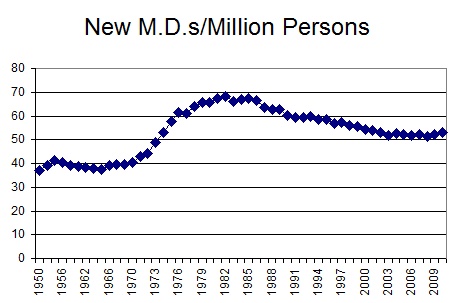
If you peruse this table, you’ll discover that total number of new M.D.s per year has been virtually flat for 30 years. During this period, population increased over 30%. As a result, the new M.D./population ratio has declined for decades.
![]()
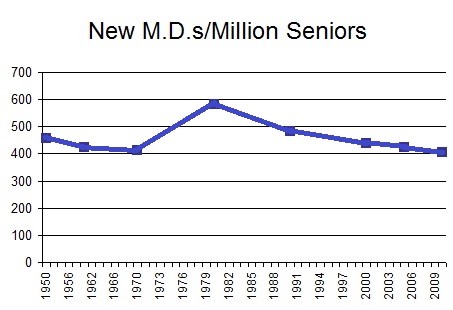
If you’re not horrified, consider that the senior population – doctors’ best customers – increased by over 50%. As a result, new M.D.s per senior fell by about a third over the last three decades:
![]()
This is exactly what you’d expect when government imposes rigid numerical quotas in the face of sharply rising demand: a constant quantity regardless of market conditions.
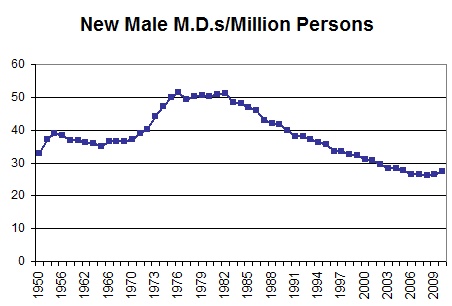
If you’re still not convinced, know this: Over the last thirty years, new female M.D.s have sharply increased. How is this possible given the stagnant total? Because the number of new male M.D.s dropped like a rock! New male M.D.s per person are down by over 45%.
![]()
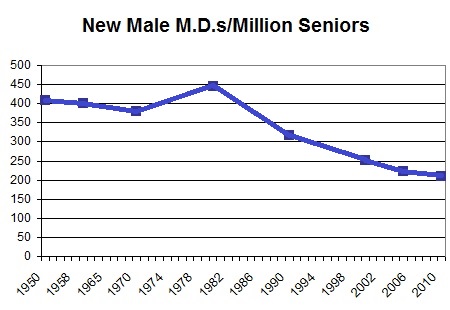
New male M.D.s per senior are down over 50%:
![]()
In any normal labor market, massive female entry would have led to a large increase in total workers. But the market for new doctors is anything but normal. The rise in new female doctors has been almost perfectly offset by a matching fall in new male
doctors.My point, of course, is not that women have “stolen” men’s places in medical school. My point, rather, is that that draconian government entry barriers are the only credible explanation of the facts. Why else would the number of male doctors have fallen so far relative to demand? Infinitely inelastic demand for medical services? A massive decline in the talent of male applicants to medical school?!
As our population ages, we have naturally seen a large increase in the demand for doctors. If the market for M.D.s worked normally, however, we would have fortuitously experienced a large offsetting supply shock: the rise of the female doctor. Regulation has deprived us of this godsend – and deprived vast numbers of qualified men and women of the right to work in their preferred occupation. Thanks to government entry barriers, demand has gone up and supply is frozen in place. Consumers and taxpayers are paying a fortune for medical care. And the problem is only going to get worse."
Also see Licensing Doctors: Do Economists Agree? by SHIRLEY SVORNY.
"Abstract
IN THE UNITED STATES , STATE LEVEL BOARDS DICTATE RULES for physician licensure and discipline.1 Would-be physicians must complete an approved medical training program and pass a standardized test. Scope- of-practice laws prohibit other health professionals from offering similar services. Given the resources involved in licensing doctors, taxpayers might be surprised to learn that the link between licensing and service quality is tenuous at best. In fact, economists who have examined the market for physician services generally view medical licensing as a constraint on the efficient combination of inputs and a drag on innovations in health care and medical education."
Friday, October 25, 2024
1500 Hours: Haircuts, Pilots, and Regulatory Capture
"I don’t like to brag, but I got a decent haircut last week from a competent barber. Not bad eh? That very same week I was also landed safely in a $375 million jetliner by a competent pilot. From a basic common-sense standpoint, the two services could hardly be more different, but from a regulatory and licensing standpoint they are oddly, ridiculously similar.
The minimum number of pilot-in-command (PIC) hours required to gain a commercial pilot rating as an Airline Transport Pilot is 1,500 hours — this includes things like cross-country flight hours, night flying, instrument ratings, multi-engine time and so forth. This all seems sensible enough — most of us would hardly object if the people entrusted with our lives had some minimum qualifications.
Curiously enough, however, the other profession that requires 1,500 hours of rigorous training time is hairdresser. And no, I am not making this up.
The Institute for Justice has been highlighting the nation’s comically onerous license environment for years, pointing out that cosmetologists, for example, have to undergo approximately ten times the training time that Emergency Medical Technicians must undertake. They point out that, “given that there is no reason to believe EMTs are underregulated, this suggests these other occupations are overregulated.” Indeed.
But why? Who exactly stands to gain from such a patently hyper-regulated system? Is it government bureaucracy, bent on protecting fat licensing fees and the staffed departments that come with them? Possibly that’s some of it, but it seems to be more invidious than that. In this instance, it is the industry itself which provides the basic impetus for this kind of absurdity. According to an industry mouthpiece in Missouri (a perfectly middle-of-the-pack state in terms of licensing requirements), it is practitioners themselves who are the most motivated to maintain these extreme licensing requirements. Last year they crowed of their success at the state capitol:
“Legislators proposed House Bill 590, which would eliminate the license requirement for cosmetologists in Missouri. Professionals fought back, stating that cosmetology is a science and its practitioners need specialized training in the use of chemicals and sanitation. The public hearing on the bill was held in 2013 and no more hearings are scheduled at this time.”
Needless to say, the legislation did not pass, and Missouri’s licensing requirements remain rigidly enforced. Artificially erected barriers to entry, especially within relatively low-wage professions, are common. Their primary purpose is to keep out competitors from industries which are relatively broad and which require relatively low technical skill. Excessive licensing requirements are an attempt to put a veneer of difficulty on an otherwise easily-done profession in a rather naked effort to minimize competition. Preschool teachers, for example, are even more heavily licensed than hairdressers: a prospective candidate must undergo 2, 927 days (more than eight years) before they can purchase their license and be unleashed upon the state’s youngsters. If you care to be a gaming inspector (presumably checking slot machines), you don’t need many training hours but need to cough up the cool grand needed for a license. And so on. Excessive licensing requirements are everywhere and tend to cluster around the lowest-paid professions. It’s not a coincidence.
Schools and licensing programs, it turns out, are often the primary beneficiaries of this kind of market manipulation. “Z” Hair Academy, for instance, charges their students over $18,000 in tuition to earn certification through their training programs. Never fear, they assure prospective students, there are “scholarships” and Federal Financial Aid packages available. According to the Institute for Justice, the average student takes out $7,793 in federal student loans, and since most Missouri cosmetologists make less than $24,000 a year, it would require another three years of semi-indentured servitude just to pay back the tuition loans.
As if it weren’t bad enough, some of these academies open their services to the public, allowing their unlicensed students to practice their trade at discount rates. I got my perfectly good haircut from a trainee for $12 — about a third of the going rate. These academies therefore manage a double trick: two revenue streams under the convenient protection of government licensing requirements. All told, according to the Institute for Justice, Missouri’s licensing requirements cost the state’s economy $3.55 billion and lead to 38,500 fewer jobs each year by artificially stifling the supply of ready applicants to the field. It’s a racket.
While it’s tempting to place the blame on the coiffure-industrial complex, it’s important to remember that they can only operate this way by the effective manipulation of state control. It is a perfect case study for the phenomenon of regulatory capture: regulatory agencies created to protect the interests of consumers work instead to safeguard the commercial interests of the industries they are expected to be regulating.
Hairdressers are clearly not alone in this, and many a trade has circled its wagons against efforts to deregulate highly entrenched, disproportionally advantageous licensing schemes. In the end, however, these kinds of artificial barriers to the free market-directed flow of supplies and demands only tend to waste resources and diminish the public’s benefits. One thousand five hundred hours squandered in the repeated performance of a basic task like hair care doesn’t only waste the learner’s time, but also promotes a dependency mindset — a perception that the state is best positioned to authorize entrepreneurial activities.
The next time you step off a commercial airliner, take a look at the pilot’s hair — chances are, the hairdresser underwent more training. It’s a ridiculous waste and licensing requirements need to be thoroughly cleaned up."
Wednesday, July 10, 2024
License to Exclude: Black Barbers in Arkansas
By Tanner Corley, Wendy Lucas, and Marcus Witcher.
"Abstract
In the early twentieth century, predominantly white union barbers in Arkansas implemented voluntary regulations that dictated business practices to create a voluntary cartel. Black and other minority barbers who often had more success than white barbers prior to unionization tended to ignore these regulations, destabilizing the union’s cartel. Lacking a strong enforcement mechanism, white union members turned to the state to eliminate what they saw as unfair competition. By implementing a licensure law and creating the Board of Barber Examiners in 1937, established barbers were able to give themselves a stark advantage over future entrants into the profession. The law was detrimental to minority barbers. Black barbers failed to pass barber licensure exams at an equivalent rate as their white counterparts, and the number of Black barbers in Arkansas decreased significantly over the decade that the regulations were implemented. In making our assertions, we examine primary sources regarding the Journeymen Barber’s International Union of America, while also keeping in mind the data on pass rates, the composition of regulations, and exams that the Board of Barber Examiners implemented. Though scholars often assume that licensure laws harm minorities, we provide a detailed case study to support those claims."
Saturday, April 6, 2024
Stricter occupational licensing in dentristy raised prices but did not improve quality
See Regulation Does Not Help Consumers by Dan Mitchell.
"Sensible regulation requires cost-benefit analysis. In other words, do the positive effects of a government intervention outweigh the negative effects?
For instance, a nationwide, 5-miles-per-hour speed limit definitely would reduce traffic fatalities, but lawmakers fortunately don’t impose that kind of rule because it would be absurdly costly.
And since the scholarly research shows a clear link between health and wealth, it’s possible that some (supposedly) pro-safety regulations may wind up leading to a net loss of life.
Other regulations may not have that deadly effect, but they can still be bad news because they increase costs with no concomitant benefits.
For an example, let’s go back more than 20 years to look at an academic study on dentistry. The authors, Morris M. Kleiner and Robert T. Kudrle, found that red tape was not good news for consumers.
Here are some excerpts.
We have analyzed the impact of stricter occupational licensing requirements on economic outcomes, dental prices, and earnings using dental records of the consumers of these services. …we sketched a model linking regulation to the flow of new dentists as well as to quality and prices. …Alternative multivariate statistical models were used to test the impact of more restrictive licensing provisions, first on dental outcomes and then on the prices of dental service prices and practitioner earnings. …we are able to provide some evidence on how tougher dental regulation reduces the flow of dentists to the states over time.
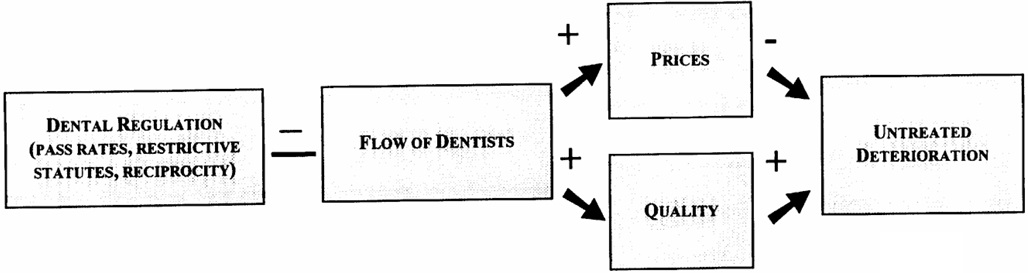
We also show that stricter regulation raises prices, but has no effect on untreated deterioration. …more stringent regulation does not appear to affect some indirect measures of service quality, such as lower malpractice premiums or fewer patient complaints. …Our multivariate estimates show that increased licensing restrictiveness did not improve dental health, but it did raise the prices of basic dental services. Further, using several tests for the robustness of our estimates, we found that the states with more restrictive standards provided no significantly greater benefits in terms of lower cost of untreated dental disease. Our estimates…show that more regulated states have somewhat higher dental prices. …Consequently, moving toward more restrictive policies that limit customer access to these services could reduce the welfare of consumers. …To the extent that states are considering a reduction in the pass rate on dental exams or making it more difficult for out of state practitioners to enter, our analysis suggests that there would be no gains to consumers in terms of overall dental health.
This flowchart from the study illustrates what the authors were trying to measure.
The bottom line is that we have yet another case study (for others, see here, here, here, here, here, here, here, here, here, and here) of red tape being bad news.
P.S. In recent decades, the U.S.A. has had two presidents (here and here) that pushed for less red tape."
Monday, March 4, 2024
Restrictive Planning Laws and Occupational Licensing in Britain: A Barrier to Social Mobility
"New research from the Institute of Economic Affairs highlights how Britain's planning system and occupational licensing regulations are impeding social mobility for the nation's poorest. Dr Justin Callais and Dr Vincent Geloso's study reveals a correlation between the rigidity of these systems and the stagnation of income mobility since the 1970s.
Britain's planning restrictions have been criticized for disproportionately benefiting wealthier homeowners at the expense of the wider population. Evidence suggests that without these regulatory barriers, housing prices could have been significantly lower, making it easier for individuals to relocate for better employment opportunities. This inability to move closer to more lucrative job markets is a critical factor holding back social mobility.
The study also addresses the issue of occupational licensing, which has seen a marked increase in the number of professions requiring certifications. By comparing UK regulations with those of Denmark, Callais and Geloso argue that reducing the scope of occupational licensing could considerably improve income mobility. They suggest that revisiting and potentially scaling back these regulations to 1990s levels could lead to a significant boost in social mobility, by up to 3.1%.
Contrary to the belief that government spending on welfare and education is the primary means to enhance social mobility, the authors advocate for a different approach. They propose that enhancing economic freedom through limited regulation, more flexible labour markets, and fewer barriers to business formation could be more effective. This perspective is supported by the argument that economic freedom not only facilitates individual prosperity but also has fewer negative repercussions compared to policies like high taxation and redistribution.
As Britain grapples with these challenges, the findings of Callais and Geloso offer a compelling argument for reevaluating the country's approach to planning and occupational licensing. By embracing the principles of economic freedom, there is a potential pathway to breaking down the barriers that prevent many from climbing the social ladder. The dialogue surrounding these issues is crucial, as it prompts a reexamination of policies that may inadvertently be hindering the very progress they seek to promote."
Wednesday, February 14, 2024
Research finds little evidence that occupational licensing laws improve the quality of services or public health and safety
See Summary of national research by Jarrett Skorup of The Mackinac Center for Public Policy.
"Research finds little evidence that occupational licensing laws improve the quality of services or public health and safety.[1] They raise wages for licensed workers, but this comes at the expense of higher prices for consumers and more unemployment in the economy.[2] The evidence suggests that licensing laws persist primarily because existing firms advocate for them to restrict their competition and boost their income and profit. Licensing requirements also present a barrier to people moving from state to state.[3]
The most comprehensive study on the economic effects of licensing at the national and state level finds that it costs the economy more than 1.7 million jobs and up to $184 billion annually in potential economic output. The estimated impact in Michigan is a loss of 80,000 jobs and an annual cost of nearly $8 billion in misallocated resources.[4]
Licensing laws do not appear to produce higher quality services. Even if they did, the value of the improved quality must outweigh the costs imposed by these laws. A study published by the National Bureau of Economic Research in 2020 found that there was no relationship between how stringent a state’s licensing laws are and the ratings consumers give service providers. The study did find, however, that more restrictive licensing laws are associated with less competition and higher consumer prices.[5]
A more recent study examined consumer reviews of different businesses on the borders of states with significantly different licensing laws. If these laws improved services, consumers should rate them noticeably higher in states with strict licensing requirements compared to consumers in neighboring states with lax or no licensing mandate. The researchers found no connection between licensing requirements and consumer reviews in most occupations they examined. The only statistically meaningful differences identified suggest that less burdensome licensing is associated with higher service quality.[6]
The negative impact of licensing laws is probably most firmly felt in industries that pay relatively low wages but are highly regulated. Research from the Institute for Justice, for example, finds that licensing rules for cosmetologists lead aspiring workers to fail to graduate on time, accumulate more college debt and default on loans. Michigan law requires cosmetologists to complete 1,500 hours of education and training. This costs on average more than $16,000 per year.[7]
Another measure of the value of licensing laws is how well they stand up when scrutinized by the government. Several states conduct “sunrise reviews” of their licensing laws, which are formal reevaluations of the need for mandating a license. An analysis of nearly 500 of these reviews from different states found that licenses are not recommended 80% of the time.[8] Michigan does not have a statutorily required sunrise review process."
Wednesday, January 31, 2024
Occupational licensing can detour immigrant physicians’ career paths
Analysis of a small dataset shows only one in three immigrant physicians in the United States is on track to practice medicine
Tyler Boesch and Ryan Nunn of The Federal Reserve Bank of Minneapolis. Excerpts:
"The United States has for many years experienced substantial shortages of health care professionals that result in reduced patient access and higher health care costs. In this context, the health care system and the broader economy cannot afford to exclude qualified individuals from practice. Unfortunately, for many immigrant physicians (i.e., those who worked as physicians before immigrating) in the United States, this is exactly what has occurred. According to our analysis of data on approximately 300 physicians who immigrated to the United States between 2004 and 2022, only one in three who are employed report working as a medical resident or physician.
Occupational licensing is a key part of this story. Despite years of experience in their professions, immigrant physicians often struggle to meet the requirements of U.S. licensure, including the need to obtain residency training in the United States. Indeed, in prior research we found that licensing disproportionately reduces employment of foreign-born workers in the licensed sector."
"Physicians who immigrate to the United States tend to find employment of some kind. About 85 percent of the Upwardly Global physician clients in the dataset report being employed. However, only 34 percent of those who are employed report working as a medical resident or a physician.2
Many of those who were originally physicians find non-physician health care jobs"
"One common occupation is medical assistant, where individuals complete various administrative and clinical tasks in a health care setting. Upwardly Global staff note that while this occupation does not fully utilize their medical training, many clients feel that medical assistant roles offer important networking opportunities with medical professionals and exposure to the American health care system. But the median annual salary among Upwardly Global clients who are former physicians working as medical assistants is $41,600 in 2023 dollars. While this figure only pertains to the first year of employment and is likely low relative to subsequent earnings, it is just a fraction of typical starting salaries for physicians in the United States."
"Another common occupation is medical researcher, either in a health care or university setting. In this role, former physicians are able to use their medical expertise while avoiding the hurdles associated with relicensure. The median annual salary of Upwardly Global clients who are former physicians working as medical researchers is $59,000 in 2023 dollars—still far below that of practicing doctors, but again with the caveat noted above."
"In assessing why so many former physicians are not currently on track to practice medicine, one important consideration is the educational credentials immigrants possess. In the United States, a doctor of medicine (M.D.) or a doctor of osteopathic medicine (D.O.) are the most common degrees held by those practicing as licensed physicians. As shown in Figure 3, of the former physicians in our sample who are not on track for relicensure, 77 percent hold M.D.s: lack of an M.D. does not appear to be the barrier for most former physicians.3 Indeed, in our data sample 69 percent of M.D. holders are not currently practicing or on track to becoming physicians.
Physician licensure is complicated. In addition to medical degrees, it typically requires exams, field-specific medical residencies, financial resources, and continuing medical education. (See Scheffler [2019] for a helpful discussion of these requirements as they apply to foreign-trained physicians.) Moreover, licensure requirements—for physicians or for most professionals in other fields—are not uniform across countries. When combined with the language barriers some experience, this makes for a daunting situation for immigrants who were formerly physicians."
"23 percent of immigrant physicians who are not on track to practice medicine in the United States are currently working as medical assistants. While these individuals may eventually still become relicensed, it seems likely that more would have done so had it been straightforward for them to translate their prior training into U.S. licensure."
"Representatives from Upwardly Global told us that many of its clients are deterred by the unavailability of medical residency slots and the required time, cost, and complexity of the licensure process. Smoothing this process and making residencies easier to obtain would almost certainly increase the number of immigrants who contribute their talents as practicing physicians."
Sunday, December 31, 2023
Why Can’t Italy’s Economy Get Into Gear? Consider the Taxi Line
Painfully long waits for taxis offer a clue about the country’s 30 years of stagnation
By Eric Sylvers of The WSJ. Excerpts:
"Finding a taxi in Italy’s financial capital when it is raining involves long lines and patience. During trade fairs and fashion shows it is even harder: Demand surges but the number of taxis stays the same.
Even on sunny days, there are lines of suitcase-laden travelers searching forlornly for a taxi at airports and train stations around Italy. Many locals don’t even bother trying."
"A major reason for Italy’s stagnation is the power of vested-interest groups who successfully impede efforts to boost competition, innovation and productivity."
"Italy’s economy is 1.5% smaller than it was in 2007, before the global financial crisis, according to the World Bank. In that time Germany’s economy has grown 17%, France’s by 13% and the U.S.’s by 28%"
"Much of Italy’s stasis can be traced to a lack of meritocracy that permeates the public and private sectors, said Lorenzo Codogno, an economist and consultant"
"An ingrained system that prizes seniority over the skills of individuals is also contributing to Italy’s lack of economic progress. The result is that almost 21% of Italians aged 15 to 34 aren’t employed, studying or in training, the highest in the EU. That compares with 13% in France and 10% in Germany.
For decades, Italy has also struggled to improve a painfully slow civil-justice system that puts off investors, a large underground economy, high national debts, chronic tax evasion and large differences in wealth between the country’s north and south.
Compared with other Western countries, Italy has few internationally successful startups and attracts little venture capital. Italy barely features in the leading rankings of the world’s top 100 universities, and Italian high-school students underperform most other developed countries.
Italian beaches offer another glimpse of the lack of competition and resistance to change. Year after year, the same businesses pay public authorities a small fee for lucrative concessions to rent umbrellas and reclining chairs to beachgoers. The EU has complained about the lack of competitive public tenders and the insignificant revenue the Italian government collects for those privileges.
"The problems at Italy’s beaches and taxi stands show that the country’s woes are related to bad laws, rather than any inherent lack of talent or entrepreneurship in the country, said Carlo Maria Capè, the chief executive of BIP, which advises businesses in Europe and South America on using technology."
Taxi drivers have successfully pushed for laws that keep ride-hailing apps such as Uber heavily restricted. Uber drivers in Italy must be licensed and have a luxury car, which makes the service more expensive than a regular taxi and dulls its appeal for most would-be users. In many Italian cities taxi drivers have blocked the issuing of new taxi licenses for the past two decades, protecting the value of their own license but making it hard to find a ride. But they are losing the nation’s sympathy.
Taxi drivers’ associations argue they don’t make enough money to survive if their market were opened up. But a taxi driver from Bologna became a cult hero on social media when he challenged that narrative by posting his daily takings on X, formerly Twitter. His popularity only grew this month when his taxi cooperative suspended him for a week for hurting its image.
Issuing more licenses wouldn’t solve the taxi problem by itself, said Grea. “It’s a prerequisite, but you need a general strategy to improve mobility in Italian cities that incorporates public and private transportation. Solve that and people will see that change is possible.”"
Thursday, November 9, 2023
Now You Can Take It with You: Effects of Occupational Credential Recognition on Labor Market Outcomes
Requiring government permission to practice, occupational licensing creates barriers to entry and is likely to serve special interests rather than the public interest.
By Kihwan Bae and Edward J. Timmons of Cato.
"Occupational licensing is a prominent labor market institution in many countries. For example, the share of workers with occupational licenses is above 20 percent in the United States and the European Union. As a government‐issued credential, occupational licenses are expected to improve service quality and protect consumers from unscrupulous providers. However, by requiring government permission to practice, occupational licensing creates barriers to entry and is likely to serve special interests rather than the public interest. State licensure prevents individuals with out‐of‐state licenses from providing a service even though they are trained, credentialed, and experienced workers who are unlikely to raise concern about service quality. Our work shows that expanding recognition of out‐of‐state licenses increases employment of licensed occupations without sacrificing service quality.
This study focuses on a policy of universal recognition among US states that allows individuals with occupational licenses issued by other states to work without repeating a costly relicensing procedure. Under the existing system, occupational licenses are often not portable across states: an individual licensed in one state cannot practice in another state until that individual obtains a new license, which often requires additional training, exams, or practice experience. The limitation in license portability may reduce interstate exchange of licensed service and mobility of licensed individuals. Also, for those who need to move across states for involuntary reasons—such as work reassignment of a spouse—a costly relicensing procedure may prevent or delay their continuing work in licensed occupations. Thus, universal recognition may improve license portability and lower licensing barriers to entry and mobility against individuals who are credentialed by other states.
Our work examines the effect of universal recognition on labor market activity and geographic mobility. In theory, universal recognition is expected to increase labor supply through additional labor market participation of individuals with out‐of‐state licenses. Since the policy should have little effect on service quality and labor demand, we hypothesize an increase in employment and a decline in wages. Turning to geographic mobility, universal recognition may increase migration and commuting inflows from other states. Also, we expect the policy to increase the supply of services and reduce prices, although these effects are beyond the scope of our research. Overall, universal recognition may have a positive welfare (well‐being) implication by reducing licensing barriers against experienced workers and by adding competition into the market for licensed services.
To identify the effect of universal recognition, our research exploits staggered adoption of the policy by 18 states from 2013 to 2021. The study sample is individuals aged 18–64 in the American Community Survey from 2005 to 2021 who live in houses, apartments, or mobile homes. Our analysis examines how universal recognition affects the labor market outcomes of licensed individuals in states with a universal‐recognition policy relative to other states. Labor market outcomes our analysis focuses on include employment, unemployment, labor market participation, hourly wages, usual hours worked, the number of weeks worked, interstate migration, and interstate commute. In our study, the term “licensed individuals” refers to people who reported a current or previous occupation that is licensed in most states and identifiable in the survey. Among them, our research focuses on 21 licensed occupations that are typically eligible for universal recognition but not for interstate licensure compacts, an alternative license portability program.
Our research reveals that universal recognition has a strong effect on employment. After the policy was implemented, the employment ratio increased by 0.98 percentage points among licensed individuals in the sample relative to unlicensed individuals. The employment effect is driven by additional labor market participation and a reduction in unemployment after the policy implementation. There is also evidence of a decline in hourly wages among licensed individuals after the policy implementation. Moreover, the policy’s employment effects are largest for licenses with the lowest preexisting portability, which suggests that universal recognition accomplishes its goal of improving license portability and thus labor market outcomes. Regarding geographic mobility, our research shows that migration into states with universal recognition increased by 48.4 percent (0.77 percentage points) among individuals with low‐portability licenses.
Our work contributes to the ongoing policy debates on occupational licensing. This study demonstrates the efficacy of an occupational credential recognition program on labor market activity and geographic mobility. Furthermore, our study provides a clear, negative welfare implication of licensing barriers between states. Our research demonstrates positive labor market effects of license portability on experienced practitioners with out‐of‐state licenses, so there is little to no concern of a decline in service quality. Lastly, this study provides guidance for policymakers who may want to consider universal recognition as a cost‐effective policy tool for workforce development of migrants with out‐of‐state licenses and for labor market assimilation of immigrants with foreign occupational credentials.
Note
This research brief is based on Kihwan Bae and Edward Timmons, “Now You Can Take It with You: Effects of Occupational Credential Recognition on Labor Market Outcomes,” West Virginia University Economics Faculty Working Paper no. 70, March 2023. A slight modification of the paper was submitted for publication to the Journal of Labor Economics on September 19, 2023."
Wednesday, May 17, 2023
Occupational Licensing as a Barrier to Entry for Immigrants
By Tyler Boesch, Katherine Lim & Ryan Nunn. From the Federal Reserve Bank of Minneapolis.
"Abstract
Affecting about one-fifth of U.S. workers, occupational licensing is a core labor market institution. However, despite considerable policy focus on the uneven burden of licensure across groups, relatively little is known about the differential impacts of licensure policies by nativity and race/ethnicity. We explore demographic disparities in licensure rates, using variation in licensure within states and occupations to estimate its effects on employment. We find that licensure reduces foreign-born employment in a state-occupation pair by nearly 20 percent relative to native-born employment. Similar effects are evident for Asian, Black, and Latino workers overall, but the effects on Asian and Latino employment are driven largely by foreign-born workers. Wage premiums for immigrants are correspondingly larger than for native-born workers, consistent with the interpretation that licensure requirements constitute a disproportionate barrier to the labor supply of immigrants."
Saturday, February 4, 2023
WVU study shows marginalized communities benefit when states permit nurse practitioners to provide primary care
By Micaela Morrissette. She is a Research Writer for WVU Research Communications.
"Nurse practitioners from communities of color are generally underrepresented in the workforce. However, a recent study from West Virginia University occupational licensing experts revealed more appropriate racial representation in states permitting full practice authority, or FPA, which entitles NPs to perform all the responsibilities for which they are trained.
According to Alicia Plemmons, John Chambers College of Business and Economics assistant professor and coordinator for scope of practice research at the Knee Center for the Study of Occupational Regulation, “We also found evidence that Black and Asian nurse practitioners serve more Black Medicare beneficiaries after receiving FPA. Full practice authority is a costless way of helping communities of color address health care access disparities.”
Plemmons and Edward Timmons, service associate professor and director of the Knee Center, published their results in Policy, Politics and Nursing Practice. Their findings show that in FPA states, the NP workforce tends to be more diverse and more racially and ethnically aligned with the state’s overall population.
The study ties together three health care industry concerns: the worsening shortage of primary care providers in the United States, especially in marginalized communities, the importance of enabling patients from communities of color to choose primary care providers who share their racial and ethnic backgrounds and the debate over allowing nurse practitioners to exercise FPA.
NPs are among the most highly-trained members of the nursing professions. When a state permits them to exercise FPA, NPs can serve as primary care providers, performing the full range of duties for which they’re qualified without entering into prohibitively expensive collaboration contracts with supervising physicians — contracts costing from $75 to nearly $4,000 a month.
“In every state, NPs may all meet with patients, but that’s where the similarities stop,” Plemmons explained. “Some states require physician supervision for NPs, while others simply require collaboration agreements. Some limit NPs in diagnosing patients or developing treatment plans, others limit making specialist referrals or ordering imaging services. Probably the most contentious restriction is prescribing medication.”
To examine the effect of FPA on the racial and ethnic diversity of the NP workforce, Plemmons and Timmons compared the backgrounds of NPs, patients and overall state populations nationwide, focusing on Black, Asian and Hispanic communities. Overall, they found that FPA states had higher concentrations of NPs from communities of color.
Representation looked different among different communities, but the data for Black NPs and patients in FPA states stood out: Black NPs in FPA states served 2.8% more Black Medicare beneficiaries than Black NPs in non-FPA states.
Plemmons said that’s significant because multiple studies have shown that patients of color prefer primary care providers who share their backgrounds. These patients may be more likely to schedule annual check-ups, share relevant information and follow a treatment regimen when the provider brings cultural commonalities and competencies to the table. Cultural misalignment between patients and providers may be one reason behind racial disparities in health care outcomes.
“Black women die in childbirth at staggering rates compared to white women, frequently due to practitioners’ lack of cultural competence and respect,” Plemmons said. “When Black pregnant women receive prenatal care from a Black provider, mortality rates reduce sharply.”
But finding a doctor, especially a Black doctor, isn’t always easy. That problem is getting worse and is hitting hardest in marginalized communities — diverse, poor or rural — where many doctors won’t work, though NPs will.
“The U.S. struggles to provide adequate primary care to its residents. Provider shortages are a key contributor, as is our aging population, and shortages are particularly acute in communities of color,” Plemmons said. “The Association of American Medical Colleges estimates a shortage of 54,100 to 139,000 physicians by 2033, compounded by the fact that a majority of physicians will specialize in something more lucrative than primary care.
“However, nearly 82% of NPs will specialize in primary care. And while the number of physicians entering the workforce is declining, the per capita supply of NPs has grown significantly.”
Plemmons said she’s aware of “roughly 50 studies using combinations of Medicare and private insurance data to observe quality, access and cost outcomes when patients are served by nurse practitioners rather than physicians. The overwhelming majority find no effect, or find improvements, in terms of increased access and lower costs.”
Regardless, many states limit NPs’ FPA, often on the basis of concerns about quality of care.
During the COVID-19 pandemic in 2020, many states temporarily waived FPA. A few waivers remain in place. Overall, 26 states and the District of Columbia permit FPA, “while other states continue to place restrictions that require nurse practitioners to have supervisory or collaborative relationships with physicians to deliver care or prescribe medications.”
Policies requiring agreements with physicians mean that even though NPs are willing and available to serve the marginalized communities where physicians won’t move, they can only work where physicians are available.
“West Virginia is unique in that, after three years of collaboration with a physician, an NP may have nearly all the rights of FPA for job duties and prescribing medications, except Schedule II drugs,” Plemmons said. “NPs are recognized in state policy as primary care providers. Our state has one of the most expansive policies among South Census regions, even though it’s relatively restrictive as compared nationally.”"
Friday, November 4, 2022
New Evidence That Nurse Practitioners Provide Excellent Primary Care Services
By Jeffrey A. Singer of Cato and Spencer Pratt.
"Ever since the first nurse practitioner (NP) was created in 1965, a debate has raged between the medical profession and the advanced practice nursing profession (APRNs) over whether NPs can provide primary care services comparable in quality to physicians. Organizations representing APRNs argue that nurse practitioners receive training that fully qualifies them to provide primary care services. Organizations such as the American Medical Association maintain that “care from nonphysicians is dangerously being promoted as ‘just as good’ as that provided by doctors—despite the huge differences in education and training requirements.”
Both opponents and proponents of expanding nurse practitioners’ scope of practice can cite literature comparing care by NPs to care by physicians. Opponents point to the differences in education and training: physicians must complete 10,000 to 16,000 hours of clinical education and training, while NPs only have 500 to 720 hours. Proponents cite research that NPs provide safe, comparable care to their physician counterparts. Proponents and opponents make these arguments to state lawmakers considering legislation to expand NP scope of practice in their states.
Some physicians claim that NPs make up for their lack of knowledge and experience by ordering too many tests or consulting too many medical specialists, which adds to health care costs. If so, that also makes the argument that, rather than getting in over their heads and risking medical errors, NPs know their limitations and get help when they need it.
It is challenging to study and compare patient outcomes with NPs versus physicians as primary care providers. For example, there’s the matter of self‐selection bias, where certain patients may prefer physicians. It is difficult to adjust the data based on the complexity of patients’ conditions. For example, patients who have comorbidities often see specialists. Studies should also consider cost—NPs cost less compared to managed care systems—and access to primary care (in many states, NPs and physician assistants tend to practice in rural and underserved areas).
A recent study by researchers at the University of Washington, the VA Puget Sound Health Care System, and the University of Michigan was designed to minimize confounding factors and offer the best comparison of NP to physician‐provided care.
The study used a quasi‐experimental approach to examine differences in clinical outcomes, service utilization, and health care costs between NP‐assigned and physician‐assigned patients. It used administrative data from the Veterans Health Administration (VHA), one of the largest integrated care systems in the U.S..
The VHA reassigned patients whose primary care physician had left the VHA to either another physician or an NP, independent of the patients’ health, introducing a pseudo‐random feature to the study. The final sample included 806,434 patients in 530 VHA facilities across the U.S.. After comparing patient conditions pre‐ and post‐reassignment and between primary care providers, the study found NP‐assigned patients had similar total costs and clinical outcomes to physician‐assigned patients and were less likely to require hospitalization.
The pseudo‐random element of the study addresses the confounding variable of sampling bias. The integrated model of the VHA removed the exogenous variables of patient preference and complexity of health status at the time of reassignment. In addition, the study’s large sample size accomplishes a degree of generalizability that other studies have not. This minimizes the effect of independent variables seen in other studies, enabling researchers to better estimate the association between NP‐assigned and physician‐assigned patient outcomes.
In some states, NPs have full practice authority and independently evaluate, diagnose, and treat patients. Other states restrict their scope of practice, requiring them to work for physicians or have physicians oversee their practice. This new research strengthens the case for expanding NP’s scope of practice to allow them to provide primary care services fully and independently.
Spencer Pratt is a Research Associate in the Department of Health Policy Studies"
Wednesday, September 21, 2022
Licensing, and progressively stricter forms of it, is not associated with greater service quality
"About a quarter of the American workforce must get a permission slip from the government—known as an occupational license—to legally work in their chosen occupations. Getting a license can be costly and time-consuming, requiring fees, exams and many hours—sometimes amounting to several years—of education and experience. Steep licensing requirements serve as a barrier to occupational entry, imposing costs on workers, consumers and the wider economy. But proponents claim they improve service quality by screening out workers likely to provide inferior service.
This study tests proponents’ claims by comparing consumer Yelp ratings for service providers in neighboring states with different regulatory regimes. For four types of service providers—interior designers, locksmiths, manicurists and tree trimmers—we compare quality in licensed states with that in unlicensed states. For two other types of service providers—barbers and cosmetologists, which are both universally licensed—we compare quality in states with more and less burdensome licenses. In all, across the six occupations, we look at nine sets of state pairings.
We limit our analyses to providers located within a certain narrow distance from either side of state borders, which helps ensure that the primary difference between providers is the regulatory regime under which they operate. This creates an apples-to-apples comparison.
Our results run counter to the theory that licensing improves service quality. Licensing, and progressively stricter forms of it, is not associated with greater service quality across any of our nine comparisons. In fact, in eight of the nine comparisons, we find no statistically significant difference in quality at all. In the ninth—our comparison of tree trimmers in licensed Maryland and unlicensed Virginia—quality is higher in unlicensed Virginia and statistically significantly so.
These results add to mounting research suggesting the benefits of licensing are overstated and licensing may even be counterproductive. In light of this research and an even larger body of evidence showing licensing’s negative effects, policymakers should be highly skeptical of occupational licensing. To ensure licenses are not needlessly shutting workers out of occupations, policymakers should carefully consider whether proposed and existing licenses are necessary to protect the public and reject or repeal those that are not. They should also ensure requirements for any licenses deemed essential are only as burdensome as necessary to protect the public. To do otherwise is only to raise barriers, not quality."