Showing posts with label High Speed Rail. Show all posts

Tuesday, July 29, 2025

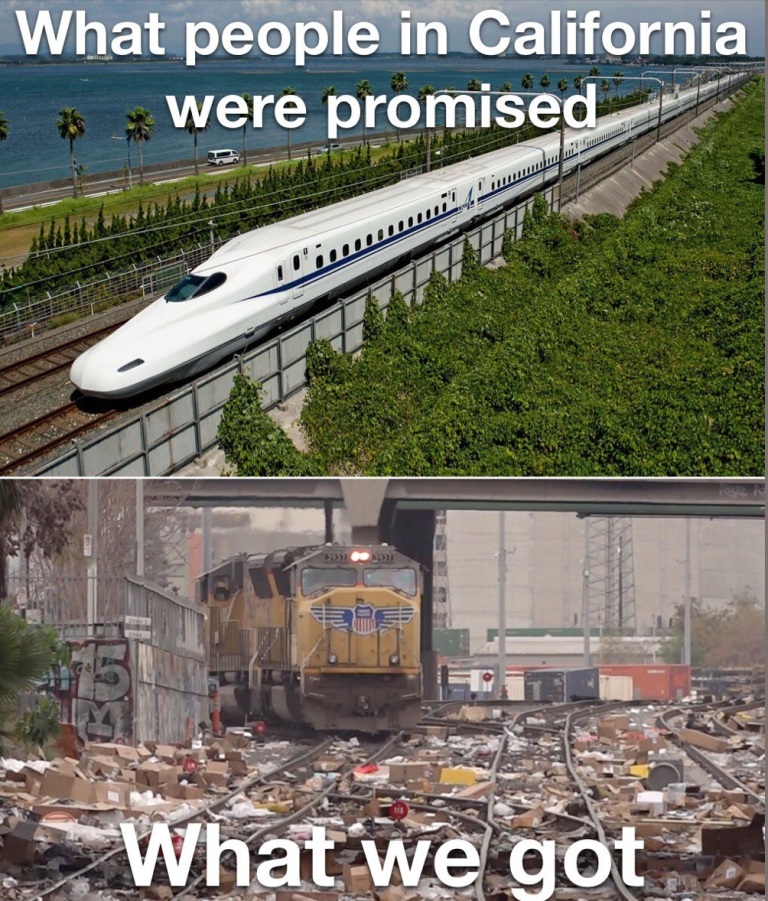
California’s Bullet Train Is a Model of Progressive Governance

Trump gave Newsom a perfect opportunity to cut his losses and shift blame. Why didn’t he take it?

By Allysia Finley. Excerpts:

"At the current construction rate, the 500-mile choo choo between San Francisco and Orange County won’t be completed in the governor’s lifetime. The state as of last month hadn’t begun to lay tracks on the first 119-mile segment between Madera (pop: 68,079) and Shafter (pop: 21,915).

This first leg should have been relatively easy since the state’s rural Central Valley is lightly developed and populated. No need to raze strip malls and housing developments. A private company built a 235-mile high-speed train from Orlando to Miami in 11 years for about $6 billion. Yet it has taken California more than a decade merely to bulldoze permitting barriers and clear lawsuits."

"China has borrowed some $1 trillion to build nearly 30,000 miles of high-speed rail lines, many of which connect lightly populated towns and carry few passengers."

"Democrats claimed the train would cost a mere $33 billion and be complete by 2020. The 500-mile train trip from San Francisco to Anaheim would supposedly take only 2½ hours and cost less than flying."

"The state high-speed rail authority at the time projected 65.5 million annual riders by 2030, about five times as many passengers who take Amtrak’s trains in the more densely and heavily populated Northeast Corridor."

"But the rail authority is at least $7 billion short of what it needs to complete the first segment and needs more than $90 billion to build all 500 miles."

"healthcare for undocumented immigrants (estimated to cost $12 billion this year)."

"Democrats spent $24 billion to combat homelessness, yet the result was more homelessness. State K-12 spending has risen by 50% since 2018, but student test scores have fallen. Electric rates have surged yet power has become less reliable." 

Wednesday, December 11, 2024

How Madrid built its metro cheaply

Madrid tripled the length of its metro system in just 12 years — faster and cheaper than almost any other city in the world. What can its expansion teach other cities?

By Ben Hopkinson. He is head of research at Britain Remade, where he works on policy development and analysis. Excerpts:

"In 1995, the Madrid Metro was 71 miles (114 kilometers) long. That would make it the 51st longest metro in the world today, reasonable considering Madrid is the 57th largest city in the world by population. Yet 1995 was the beginning of a revolutionary building spree. Over the course of the next 12 years, the metro grew by 126 miles (203 kilometers), nearly tripling in length. This expansion made it one of the world’s fastest-growing metros, on par with Beijing and Shanghai. Today, Madrid has the sixth longest metro outside of China, and the third longest in Europe after London and Moscow.

The new lines went all over the Community of Madrid, the region the City of Madrid is in. They included links to Madrid’s airport, a new circular line around the city center, extensions into the suburbs packaged with new homes, and new cross-city lines. There was even a circular line connecting five different towns to the southwest of the city of Madrid called MetroSur (South Metro)."

"Madrid was able to build so much because of one thing: low costs. The 35-mile (56 kilometer) program of expansion between 1995 and 1999 cost around $2.8 billion (in 2024 prices). New York’s 1.5-mile extension of the 7 subway to Hudson Yard cost about the same (adjusted for inflation). London’s Jubilee Line Extension, built at the same time as Madrid’s expansion, cost nearly ten times more per mile than Madrid’s program. The World Bank described Madrid’s costs as ‘substantially below the levels that were internationally considered possible’. Since the 1990s, Madrid, and Spain as a whole, has continued to build infrastructure at some of the lowest costs in Europe."

"Madrid’s success provides four key lessons for policymakers and engineers in places that struggle to cheaply build new transit.

  • City-level powers rewarded fast, inexpensive delivery. The structure of the Community of Madrid concentrated the planning, funding, and construction powers at the right level to deliver the project. This enabled political entrepreneurs to make electoral promises about delivering new infrastructure and have their political fortunes dependent on success.
  • Time is money. The regional government streamlined environmental and planning processes and the company that oversaw construction expedited the building by tunneling 24/7.
  • Trade-offs matter and need to be explicitly considered. The metro planners recognized the trade-offs that exist between station design and cost, signaling complexity and how much testing is required, and tried-and-tested technology versus innovation.
  • A pipeline of projects enables investment in state capacity. Madrid built the necessary state capacity to deliver the project, with experienced engineers and managers working in-house to deliver the technical design and oversee construction. The public company tasked with construction could pay extra to hire experts and procured based on cost and quality instead of just the lowest-cost bid."

"Former Madrid Metro boss Manuel Melis Maynar’s advice that ‘design should be focused on the needs of the users, rather than on architectural beauty or exotic materials’, wasn’t followed by London’s Jubilee Line Extension, built at the same time as the Madrid Metro extensions. Each of its stations had a different architect, creating large, complex designs with vast chasms between the surface and the tracks. While these were popular with architecture critics – several stations were shortlisted for Britain’s most prestigious architecture award, the RIBA Stirling Prize – they were also expensive to construct. London Bridge’s Jubilee line station cost £217 million in 2024 terms.

Madrid took a different approach. As far as possible, stations were standardized, using copy-and-paste designs. This simplified the engineering and design work required, while construction crews would gain experience and efficiency in building stations. The new stations are simple and replicable and are also easy to navigate. Busier stations have sculptures and murals to add character, a far cheaper way to spruce up a station than building an architectural behemoth. While per-station costs aren’t available, even if the entire budget of the 1995–1999 program was only spent on stations, they would still be just £60 million each in 2024 terms, less than a third as much as London Bridge’s Jubilee line station."

Tuesday, November 26, 2024

China Is Building 30,000 Miles of High-Speed Rail—That It Might Not Need

The train system is one of the biggest public works in history, and it’s becoming a giant money pit

By Brian Spegele of The WSJ. Excerpts:

"one of the biggest public works in history, soon to exceed 30,000 miles of high-speed rail"

"It’s becoming a giant money pit. China has spent more than $500 billion on new tracks, trains and stations in the past five years, while the country’s national railway operator, China State Railway Group, is nearing $1 trillion of debt and other liabilities. Just keeping up with its debt requires $25 billion annually."

"China’s population is projected to shrink by around 200 million people in the next three decades. Some of the newest lines are in effect duplicating older ones."

"On a recent afternoon, Fushun Station itself was practically deserted, with around 20 travelers milling about in a cavernous waiting room with seats for 1,000. Another even newer station a few miles up the road was similarly empty."

"China State Railway envisions adding nearly 15,000 miles more by 2035, costing hundreds of billions of dollars."

"high-speed trains are far more costly than alternatives, such as traditional trains or buses, which many economists believe are sufficient for much of the country."

"China State Railway’s liabilities grew to a record of about $860 billion as of September. The total debt tied to China’s rail expansion is even higher, since cash-strapped local governments are being required to bear many of the costs for new projects."

"The rail investments also divert resources away from initiatives such as building a stronger social safety net that economists say China needs to help its aging population and increase domestic consumption over time."

"one of China’s priciest rail projects is taking shape, linking Tibet’s capital of Lhasa with the central city of Chengdu in Sichuan, at a cost of more than $50 billion."

"While not technically high-speed rail, the trains would run at around 100 miles an hour over the 13-hour journey. That’s still far longer than the 2½ hours it takes to fly from Chengdu to Lhasa, with plentiful daily options. Flights can go for as little as $50 one way, making it tough for the trains to compete."

"Efforts to boost profitability are constrained by a desire to keep ticket prices low, which builds goodwill for Xi and the government. A study by Chinese academics last year found that prices for high-speed rail tickets in China were less than a quarter of the average cost of such tickets globally."

"China is now practically duplicating some routes. High-speed trains have operated for years between the inland cities of Chongqing and Kunming, a journey that takes about five hours. China State Railway says a new $20 billion line being built between the cities, following a different path, will cut travel time to about two hours, while supporting the regional economy and promoting national unity." 

Friday, November 8, 2024

In Minneapolis, Planners Mix Basic Income and Rent Control with a Light Rail Project

By Marc Joffe of Cato. 

"The Metropolitan Council, a regional planning and policymaking body for the Minneapolis-St. Paul area, is pushing ahead with a second suburban light rail transit extension while struggling to complete another one which is nine years behind schedule. The Council’s actions, like those of other agencies pursuing light rail, show a disregard for taxpayers and other stakeholders.

As Minnesota’s Legislative Auditor has reported, the Council originally obtained federal support for its Southwest Green Line Light Rail extension in 2011 based on an estimated cost of $1.25 billion and a revenue service date of 2018. The most recent available estimates (from two years ago) call for service to begin in 2027 and an overall project cost of $2.74 billion.

The pre-pandemic daily ridership estimate for the extension was a modest 28,900 trips. It remains to be seen whether those anticipated riders show up. Ridership on the current Green Line service which connects downtown Minneapolis and downtown St. Paul is around 25,000, well below 2019 levels.

Yet despite its struggles with the Green Line extension, the Met Council is going full steam ahead with plans to extend the Blue Line through the northwestern Minneapolis suburbs of Robbinsville, Crystal, and Brooklyn Center. The project is listed as one of those in line for a Federal Transit Administration Capital Investment Grant as shown on the agency’s monthly dashboard.

The Blue Line extension has been in the grant pipeline for several years but suffered a setback in 2018 when BNSF broke off discussions with the Met Council about allowing light rail trains to share its existing freight rail tracks. A few years later, planners returned with a more expensive plan to create a new right of way for the line, mostly along County Route 81.

David Robins who led opposition to the Blue Line extension in 2023 before moving away from Robbinsville told me:

The Met Council members are not elected, but rather, appointed by the governor to handle a huge range of disparate tasks in the metro Twin Cities area, such as wastewater treatment, parks planning, aviation oversight, public housing and public transit. They have no set budget. Their decisions often override the decisions of local municipalities. It’s unbridled power. SLR81 has always favored responsible, scalable, low impact and safe public transit, but there’s ample evidence Light Rail isn’t even needed, and alternative options have been flatly dismissed. There are legitimate concerns about massive cost overruns and project delays on other lines, crime along existing lines, and disruptions to core business and residential areas. It makes little sense to trust the largest public works project in Minnesota history to the Met Council.

The 695 signers of Robins’s anti-Blue Line extension petition at change​.org cited a variety of reasons for their opposition, including potential business displacement, pedestrian safety, and crime. Suburban residents often oppose transit projects because they make it easier for perpetrators to reach their neighborhoods from urban areas, a fear that has some support in academic literature.

Another concern with the Blue Line is the potential for gentrification. If proximity to new transit stations raises land values, owners might raise rents or evict tenants to build more costly housing. The Met Council asked the University of Minnesota Center for Urban and Regional Affairs to propose measures that would alleviate the impact of Blue Line gentrification. The Center recommended that residents living along the new line receive a basic income, while also benefiting from rent controls, government-funded legal representation upon receipt of an eviction notice, and other protections. It is not clear how this package would be funded, or whether it is even necessary given the uncertainty around ultimate ridership. But the Met Council accepted the proposals anyway.

Rather than worry about the spread of crime and the risks of gentrification, the Met Council should consider abandoning the Blue Line extension. If that is a step too far for the planners, perhaps they can at least defer further work until the Green Line extension is finished and actual ridership data become available."

Friday, November 1, 2024

Does Austin Need an $8 Billion Light Rail Project?

By Marc Joffe of Cato.

"The Federal Transit Administration’s (FTA’s) Capital Grants Dashboard shows that Austin, Texas, is on track to get over $4 billion of federal funds. The grant would cover 49 percent of the estimated $8.234 billion cost (including $1.1 billion of debt service expenditures) to build a 9.8‑mile light rail system through the city center. The nation’s 11th-largest city has experienced dramatic growth without light rail, but transit advocates prevailed upon voters to begin funding a system in the November 2020 election through a property tax increase. Some of those voters may now be experiencing buyers’ remorse, as they will have to cover the remaining 51 percent of the cost for a system with questionable benefits.

Given Austin’s rapid growth and serious traffic congestion, light rail might seem like an obvious solution. But continued rapid population growth is by no means a sure thing. Last year, Austin fell out of the top 10 US cities by population after being surpassed by Jacksonville, Florida. And Travis County, which includes Austin and surrounding areas, saw its first year of net out-migration since 2002. Both the city and county are still growing, but the rise in population could further slow or reverse given Austin’s high housing costs.

But even if Austin’s population flattens, there is still the question of how its 980,000 residents (plus visitors) can move about the city without causing traffic jams. Light rail is not a cost-effective solution to congestion, and there are other things the city could do to obtain some relief more quickly.

The light rail project is on track to get its Full Federal Grant Agreement (FFGA) in 2027. The city could then commence construction with an eye toward finishing the project in 2033. But these dates could well slip.

FTA typically requires a secure source of local funding before signing an FFGA. But the city is now defending a lawsuit filed by seven Austin property owners hoping to strike down the tax voters approved in 2020. Plaintiffs contend that the ballot measure called for a “citywide traffic-easing rapid transit system,” but Austin now plans to lay only a portion of the originally proposed track, violating its promise of a citywide system in the 2020 ballot language. As long as this lawsuit has a chance of succeeding, the federal grant agreement may not be forthcoming.

Once construction starts, there is no guarantee that it will be completed in six years. Indeed, other projects provide cautionary tales. Honolulu took 12 years to build its 10.75-mile Skyline. Maryland started construction of the 16-mile Purple Line in the Washington, DC, suburbs seven years ago and is not expected to start carrying passengers for another three years.

When Austin’s light rail begins operations, its impact on traffic congestion may not be that great. Project sponsors expect 28,500 daily riders by 2040, but past projections by other agencies have sometimes proved to be wildly overoptimistic. In Honolulu, for example, city officials expected 10,000 daily riders on phase one of its Skyline service, but thus far, actual ridership is only about a third of this projection. Rail projects in San Francisco and Southern California have also seen large shortfalls in actual versus expected ridership.

Further many future light rail riders may switch from existing bus service. Cap Metro’s 801 Rapid bus covers much of the route to be served by the light rail project, and many passengers from this bus line could be expected to become light rail passengers. As a result, even if light rail attracted 28,500 passenger trips in 2040, only a portion of those would replace car trips.

On the other hand, light rail will reduce the street network’s capacity through lane and road closures. For example, the city has proposed to close a portion of Guadalupe Street known as “The Drag” to vehicular traffic, diverting cars to Nueces Street. So, after spending $8 billion to slightly reduce car trips on a more constrained road network, the city may see little to no congestion relief.

But there are other things Austin could do to reduce traffic, and these options could be implemented well before 2033 at a far lower cost. First, it could make enhancements to the 801 Rapid and other core bus routes to reduce travel times, such as adding more transit priority lanes, traffic signal coordination, and level boarding (which saves time by removing the need for passengers to walk up and down steps at bus stops). These incremental measures might boost the 801 Rapid’s on-time performance above its current 75 percent level and thereby attract more riders. The city could also continue efforts to improve its CapMetro Bikeshare network by adding more locations and including scooters in the mix. Although shared micromobility is already popular in Austin, it has room to grow, as illustrated by Washington, DC. In the nation’s capital, shared micromobility utilization approaches 18 trips per day per thousand population, almost double Austin’s rate.

Big cities usually have some form of rail transit, and it is understandable that some in Austin would want to add this amenity as the city’s population approaches the million mark. But rail transit made more sense in the early 20th century when more personalized forms of transportation were less developed. As Austin hits its stride in the 21st century, its leaders should think carefully before investing heavily in a legacy form of transportation."

Tuesday, May 21, 2024

The Great California Train Robbery

A subway to Silicon Valley will cost $12.75 billion for six miles

WSJ editorial. 

"Who says the Biden Administration isn’t productive? Every day it seems to issue a new and costly regulation, and every day it announces another giant grant for its political allies. The latest example is a redundant six-mile subway in Silicon Valley that will cost more than NASA’s new Mars mission.

The Federal Transit Administration last week announced a $500 million down payment for the project and is expected to finalize a $6 billion award later this year. This new underground line will extend the Bay Area Rapid Transit (BART) through San Jose and Santa Clara, which are already served by the region’s Caltrain and public buses.

A decade ago, the duplicative subway was estimated to cost $4.4 billion and open in 2026. Local transportation planners wanted BART to “ring” the San Francisco Bay. Estimated costs have since ballooned to $12.75 billion—$2.1 billion a mile—owing to inflation and engineering changes. Now service isn’t expected to start until 2037.

A local project manager blamed soaring costs and delays on “a shortage of skilled labor in the Bay Area and the country.” Perhaps more construction workers would be available if the Administration weren’t splashing around hundreds of billions of dollars on green energy and public works like the Silicon Valley subway.

A January audit skewered the local transit agency in charge of the project for a lack of transparency about its costs. Note also that BART ridership is running 50% below pre-pandemic levels owing to a population exodus and more remote work. Crime and vagrancy on trains have also scared away riders.

All of this is why even some local Democrats are criticizing the subway. But Biden officials and the project’s supporters in Congress, including Reps. Ro Khanna and Anna Eshoo, don’t mind grabbing taxpayer dollars. The Administration pushed the 2021 bipartisan infrastructure bill so it could reward political allies and buy votes.

Biden officials also recently handed California another $3.1 billion for its bullet train to nowhere. Recall that the Obama Administration conditioned several billions of dollars in stimulus funding on the first segment being built in the Central Valley district of Rep. Jim Costa, a longtime bullet-train supporter who provided a critical vote for ObamaCare.

The train’s first 170-mile leg between Merced and Bakersfield isn’t expected to be done for another nine years at a cost of $35 billion. NASA’s Mars rover will return to earth before the 500-mile train—with an estimated $128 billion price—is finished, if it ever is.

Undaunted, the Administration recently awarded $3 billion to a bullet train from Las Vegas to Rancho Cucamonga (population: 176,336), an hour east of Los Angeles. The project’s developer says round-trip prices may run around $400—more than twice as much as a plane fare. Biden officials hope the train will be a re-election ticket for Nevada Sen. Jacky Rosen, who has repeatedly boasted about her role in promoting the Vegas train.

None of this politically driven infrastructure spending will improve economic productivity. The projects squander scarce federal resources that could go for more vital causes like national defense. The California trains make Amtrak look like a good investment."

Saturday, March 16, 2024

Another “Least Surprising Headline” for High Speed Rail

By Dan Mitchell.

"California voters made a terrible mistake back in 2008 when they narrowly approved a referendum for a $33 billion high-speed train between San Francisco and Los Angeles.

Opponents said the project was a boondoggle and they made several predictions.

  1. It will wind up costing far more than advertised.
  2. It will take much longer to build than initially promised.
  3. It will benefit special interest groups.

Lo and behold, skeptics were right.

Since I’m a fiscal economist, I was especially interested in the first concern. Based on real-world experience, we know that almost everything government does winds up being very expensive.

Indeed, this pattern is so clear that I wrote a column back in 2017 about the California project’s cost overruns and said it was the “least surprising headline ever.”

New we have another “least surprising headline.”

It’s from KCRA in Sacramento, California’s capital. Here’s what was reported yesterday.

If you want some of the grim details, I’ve excerpted a few sections of the story.

California’s mega high-speed rail project between San Francisco to Los Angeles also faces major funding hurdles, the project’s CEO Brian Kelly told state lawmakers… Kelly told lawmakers the project…was still a few billion dollars short to complete the Central Valley segment between Merced and Bakersfield. …Project leaders estimate it will still need an additional $100 billion to finish what voters were originally pitched in 2008: a bullet train that runs between San Francisco and Los Angeles. A timeline on its completion has not been set.

Here’s some additional analysis on this absurd boondoggle.

Charles Lane of the Washington Post opined on the California project in 2022. Here’s some of what he wrote.

Originally touted as a sub-three-hour link between San Francisco and Los Angeles, this mega-project has not carried a single passenger in the 14 years since the state committed to building it. It has made a lot of public money disappear, though: more than $10 billion…the public was told to expect completion by 2020. …Early on, France’s national railroad company ended its bid to help develop the California line and went somewhere with less red tape: Morocco. …At this point, the best thing for California might be to cut the project’s losses and abandon it. Yes, this would leave in place several massive concrete structures that have been completed. Passersby could look on them as monuments to magical thinking about infrastructure.

That same year, the Wall Street Journal editorialized about throwing good money after bad.

California Democrats once hoped that their 500-mile bullet train from Los Angeles to San Francisco would be a high-speed rail model for the nation. It’s a model, all right—in how politics can drive public works off the rails. …The California High-Speed Rail Authority this week increased its cost estimate for the bullet train to $105 billion from $100 billion two years ago. In 2008 when voters approved $10 billion in bonds for the choo-choo, the estimated price tag was a mere $40 billion. That’s enough to have built 10 large water reservoirs in the parched state. This latest $5 billion doesn’t even account for rapidly rising material and labor costs.

Last but not least, the folks at Reason (who have a long track record of being right on this issue) published a we-told-you-so column.

Here are excerpts from Matt Welch’s article.

The infamous, $113-billion-and-counting California high-speed rail line between San Francisco and Los Angeles, which was supposed to be completed by 2020 for a cost of $33 billion yet has only begun tinkering on a 171-mile stretch in the Central Valley…there never has been, at any stage of this living monument to political unseriousness and hubris, even a “little chance” that the S.F.-L.A. line would zip passengers between the cities in just 160 minutes, let alone deliver on the whole ragbag of laugh-out-loud promises that the state and federal political establishment delivered with a straight face. …There is a point to rehashing these old arguments beyond saying we told you so. The fact is, these reality-based objections were widely known at the time. It’s just that the people who otherwise fashion themselves as serious thinkers about public policy made the conscious choice to jettison rationality in favor of pie-in-the-sky dreaming.

Sadly, this is not just a problem for California taxpayers.

People from every other state are coughing up a lot of money to finance this boondoggle.

One very obvious lesson, therefore, is to get the federal government out of the high-speed rail business, out of the long-distance rail business, out of the mass-transit business, and out of the transportation business."

Saturday, October 7, 2023

California Implications of Britain’s Plan to Truncate Its High‐​Speed Rail System

By Marc Joffe of Cato.

"Two recent developments reinforce the case against new, large government‐​run rail projects. These initiatives are usually a bad deal for taxpayers given their high and unpredictable costs, long construction cycles, and disappointing ridership.

First, Prime Minister Rishi Sunak radically downsized Britain’s ambitious HS2 high‐​speed rail project intended to connect Central London with Manchester in the north of England. Estimated costs had ballooned to £106 billion (or $129 billion at the recent exchange rate).

HS2’s northern terminus will now be at Birmingham, limiting the project which was originally expected to include 335 miles of track, to just 140 miles. And the first six miles between London Euston and Old Oak Common in the London suburbs will only be built if private funding can be found.

Sunak announced his decision at the Conservative Party conference on October 4, telling attendees:

HS2 is the ultimate example of the old consensus. The result is a project whose costs have more than doubled, which has been repeatedly delayed and it is not scheduled to reach here in Manchester for almost two decades… and for which the economic case has massively weakened with the changes to business travel post‐​Covid. I say, to those who backed the project in the first place, the facts have changed. And the right thing to do when the facts change, is to have the courage to change direction. So I am ending this long‐​running saga. I am cancelling the rest of the HS2 project.

Much the same can be said of California’s high‐​speed rail project. As I discussed here previously, estimated project costs have roughly tripled since it was originally sold to voters in 2008 and the completion date will be at least a decade later than the original expectation of 2020. And, with California population not growing in accordance with projections, the high‐​speed rail authority has reduced its ridership forecasts.

Perhaps California Governor Gavin Newsom can take a page from Prime Minister Sunak by truncating his own high‐​speed rail project. Newsom indicated such an intention in his 2019 State of the State speech, but rapidly backtracked after facing criticism from project advocates.

Meanwhile, in Northern California residents have been absorbing the latest bad news about one of its own rail‐​based white elephants. The six‐​mile extension of the Bay Area Rapid Transit (BART) system through downtown San Jose received a new price tag and delivery date.

The construction cost estimate was raised from $9.3 billion to $12.2 billion (or roughly $2 billion per mile), and revenue service is now not expected until 2036.

The new completion date is one year after Californians will be prohibited from buying cars with internal combustion engines. As I wrote previously, the extension will replace very few car trips and a large proportion of those theoretically would have been in electric vehicles. As a result, the BART project is an extremely inefficient way of battling climate change.

Local leaders have generally supported the BART extension despite its poor cost/​benefit profile, but perhaps now someone in power will call for a reappraisal. As with high‐​speed rail, the project has strong support from advocates and special interests. It remains to be seen whether any California official will stand up to the train lobby and take the side of the state’s beleaguered taxpayers."

Sunday, October 2, 2022

Why Trains Will Struggle to Replace Short Flights

Poor rail links to hub airports are a headache for those who see trains as a broad alternative to single-aisle planes

By Jon Sindreu of The WSJ. Excerpts:

"a new paper by Vreni Reiter, Augusto Voltes-Dorta and Pere Suau-Sánchez casts doubt over the extent to which trains can take over.

The authors use Germany as an example of a dense, distributed population with extensive access to high-speed rail. They identified 87 nonstop flight routes—about 32% of Germany’s annual seat capacity—that would be theoretical targets of a ban, with the longest train journey taking five hours and 37 minutes. 

Crucially, they account for something that most studies of this kind don’t: About a quarter of passengers aren’t traveling point to point, but rather going to a hub airport and then hopping on a long-haul plane.

As is the case with Air France, officials would presumably be more tolerant of such flights. But that would also limit the environmental benefits: In a scenario in which airlines would only be required to use 10% of seats for connections to preserve a route, air-travel carbon emissions would only fall 2.7%.

Increasing the threshold to 80% would yield a larger 22% cut, but 71% of passengers would be diverted to rail or direct long-haul flights which, on average, would make journeys two hours longer. In some extreme cases of popular routes involving non-hub airports, such as Berlin-Stuttgart, even a 10% threshold would leave more than a million people each year with no alternative but to more than double their travel time.

The lessons are applicable everywhere. High-speed rail will keep increasing its market share in short routes with a lot of point-to-point demand, such as Munich-Berlin, Barcelona-Madrid or Seoul-Busan. But to act as hub feeders, rail networks would need a massive upgrade.

Capacity must be sized to the few departure hours in which airlines fill their big planes, leaving wasted space for much of the day. Trains must also take people directly to airports, not city centers. Such “intermodal” networks are often nonexistent. Spain, for example, is only surpassed by China in kilometers of high-speed rail, but so far hasn’t connected its main airports to it. The investments needed to deliver all of this high-speed capacity to smaller cities aren’t just hugely costly, but also polluting.

“A cost-benefit analysis leaves blanket-ban policies in a bad place,” said Dr. Suau-Sánchez. “A surgical approach is best.”"

Sunday, February 13, 2022

California’s Laughing Rail Stock

The bullet train’s price tag goes up again, this time to $105 billion

WSJ editorial.

"California Democrats once hoped that their 500-mile bullet train from Los Angeles to San Francisco would be a high-speed rail model for the nation. It’s a model, all right—in how politics can drive public works off the rails.

The California High-Speed Rail Authority this week increased its cost estimate for the bullet train to $105 billion from $100 billion two years ago. In 2008 when voters approved $10 billion in bonds for the choo-choo, the estimated price tag was a mere $40 billion. That’s enough to have built 10 large water reservoirs in the parched state.

This latest $5 billion doesn’t even account for rapidly rising material and labor costs. Most of the plus-up, according to the rail authority’s business plan, is for environmental “mitigation,” including changes to address the “visual effects” around the César E. Chávez National Monument, to “enhance noise barriers” in the city of Tehachapi (population: 14,414), and to restore a stream along a hiking trail.

Recall how the Obama Administration dangled $3.5 billion in federal funds to force construction to start in the sparsely populated Central Valley. The White House said there would be fewer environmental obstacles, though one apparent motive was to reward Rep. Jim Costa (D., San Joaquin Valley), a longtime project proponent, for his ObamaCare vote.

Yet communities along the train’s first 119-mile operating route, from Wasco (population: 27,047) to Madera (population: 66,224), have demanded design changes anyway. Meantime, Democratic state legislators are pushing to delay electrifying that 119-mile segment and to redirect bond funds to commuter rail in metropolitan areas.

The first trains that run might be slow, diesel and mostly empty. “I’m worried that we’re dead in the water,” Assembly Speaker Anthony Rendon said last fall. “I’m also worried that we have what would be a laughingstock for California.” Too late."

Friday, August 12, 2011

California High-Speed Rail Project to Cost More Than Expected

Great post by Megan McArdle.
"When the California High Speed Rail project was put before voters, its backers estimated that it would cost $33 billion. Fairly quickly thereafter, planners revised that estimate to $43 billion, a 25% increase.

But that seems to have been giddily overoptimistic. According to the Mercury News, the state now expects the first leg of California's high speed rail is to come in over budget. Waaaaaaaay over budget (H/T Reihan Salam):
The California High-Speed Rail Authority's new cost estimates released Tuesday show the initial stretch of construction between Merced and Bakersfield will cost $10 billion to $13.9 billion depending on how it's built. Project planners had previously pegged the sectionat $6.8 billion.

And this is the part that they're building first because it's so cheap--not a lot of expensive real estate (or angry, politically powerful neighbors in the way). The Mercury News says that if the whole project's costs blow up the way the first leg has, the whole project will cost somewhere between $63 and $87 billion. But why expect the increase will be proportional? Of course, it might well be lower--but the later legs are going to be the ones where there's a lot of expensive infrastructure, and time-consuming community resistance--standing between the builders, and completion.

This is not exactly an uncommon problem with government projects. To some extent, it's a problem with all sorts of projects. But I am not under the impression that commercial real estate developments usually miss their targets by hundreds of percentage points.

Why should this be so? It's a curious version of the winner's curse, in which the winner of an auction is usually the person who is most overoptimistic about the asset's value. In politics, the "winning" projects--the ones that get funding--are usually the ones where the people pushing the projects are the most delusionally convinced that they can do it all on the cheap.

Of course, it's not like corporate America doesn't have their wild-eyed schemers who promise to deliver massive benefits for a tenth of the cost of alternatives. And more than a few of these people manage to get the company to come along for a ride on the Fantasy Express. Anyone who has worked in corporate America has a few of those stories (always about someone else): "It's a floor wax, but it's also a doberman pinscher!" "Sure, no one wants to live in the middle of a swamp right now, but wait until you see the new water polo course we're going to put in!" "We're losing money on every unit, but will make it up in volume!"

But in corporate America, there are usually a fair number of people who care a whole lot if your project costs too much, or doesn't work, because if it all blows up, their jobs and salaries will be put at serious risk. Those people will nitpick your cost estimates until you're sitting around a conference table an hour past quitting time arguing about whether you really can buy bulk paperclips for $5 a gross with a Staples discount card.

Who's going to lose their job over this project? It was passed by initiative, so politicians aren't really on the hook. The people in charge of the cost estimates are all civil servants. In theory, the taxpayers should care. But what the hell do they know about how much it costs to build a high speed rail system?

As Reihan says, this is a national embarassment. Not just because it's hard to believe that voters would have passed this particular $80 billion rail initiative (this is about half of California's annual budget--as if the United States had voted to adopt a $2 trillion highway bill). But because this is no way to run a policy process."

Tuesday, March 22, 2011

More Problems With High Speed Rail

See The High Speed Rail Battle of Britain by Wendell Cox. (Hat tip: Competitive Enterprise Institute). Excerpts:

"The international record of high-speed rail projections is nothing short of horrific. Not only have costs proven far higher, but ridership and revenue have been less than projected. All of this means that taxpayers end up paying more.

Again, Britain is a prime example. The Eurostar London to Brussels and Paris continues to attract at least 50 percent less ridership originally projected. High speed rail systems in Taiwan and Korea have had similar ridership shortfalls.

As in Britain, costs have been higher as well. In Korea, the high speed rail line costs rose three times projections. Costs in California have increased 50 percent in two years and doubled over a decade even before the first shovel has been turned (inflation adjusted). The cost escalation has already equaled the high end of the range predicted by Joe Vranich and me in our Reason Foundation Due Diligence Report on the California system in 2008.

If the proposed high speed rail project were simply to miss its cost and revenue targets by the international average (which is far better than the British experience), the benefits to users would fall below £1.00 for each £1.00 of cost. Both the strategic case and the business case for high speed rail would be blown apart. The spectre of cost overruns was a major factor in Governor Scott’s cancellation of the Florida high speed rail project."