"Payment errors in the Supplemental Nutrition Assistance Program (SNAP, formerly food stamps) have received considerable attention in recent months. While much of the debate has revolved around the One Big Beautiful Bill Act’s (OBBBA) new requirements surrounding SNAP payment errors and the impact on states, many have overlooked the people most affected by improper payments—low-income households.
The national SNAP payment error has hovered around 10 percent in recent years, accounting for almost $10 billion in erroneous SNAP benefits yearly. Some of this is fraud, but much of it involves correctable mistakes by participants or government eligibility workers. Thanks to the OBBBA, states are now financially incentivized to lower their payment error rates because states are required to fund a portion of SNAP benefits if they climb above a payment error rate threshold.
Facing the prospect of substantial financial penalties if they do not lower their error rates, states have begun to tighten their eligibility process. As Congress works toward reauthorizing SNAP through a new farm bill, it must resist calls to weaken this cost-sharing requirement or otherwise alter SNAP’s payment error formula.
The OBBBA requires states to contribute a share of total SNAP benefits issued in their state starting in fiscal year (FY) 2028, unless their SNAP payment error rates fall below a 6 percent threshold or they are otherwise exempt. Only 10 of the 53 states or territories met this threshold in FY2025. If a similar trend holds for FY2026, states will be required to pay up to $11 billion collectively in annual SNAP benefit costs in future years. This stands in stark contrast to the period preceding the OBBBA, in which the federal government covered benefit costs entirely, leaving states to face little to no penalty for high payment error rates.
Given this blunt reality, some have called for delaying the payment error cost share or ending it entirely. Some have even suggested that states will discontinue SNAP if the payment error cost share is not delayed. Other arguments have pointed to a lack of symmetry in the payment error calculation itself, which penalizes underpayments. These arguments may fall on sympathetic ears, with Senate Republicans proposing to delay OBBBA’s payment error requirements in an attempt to pass a farm bill. However, these arguments overlook the negative effects that SNAP payment errors have on low-income families. The best approach is to leave the SNAP payment error formula as it is and fully implement the payment error cost-share requirement as OBBBA intended in FY2026.
Delaying or eliminating the cost-sharing requirement accepts the current high level of SNAP payment errors. While it is true that the vast majority of SNAP payment errors are overpayments rather than underpayments, SNAP households are still negatively affected by overpayments. For example, federal regulations require that state agencies establish a claim against households that receive an overpayment, in an attempt to collect on those claims. Once overpayments are discovered, recouping them can happen by reducing the amount of future SNAP benefits, which can put a strain on a household’s budget or potentially discourage them from participating altogether.
Although research suggests that less than 20 percent of overpayments are eventually recovered, this process can disrupt assistance, requiring recipients to submit additional paperwork or lose eligibility. Avoiding overpayments will ensure that families consistently receive the resources that they need to meet their food needs.
Furthermore, while changing the payment error formula could create symmetry in the treatment of overpayments and underpayments, the consequences of underpayments are immediate and directly harmful to low-income households. This is likely why overpayments will always be more common than underpayments. State workers may be particularly sensitive to underpayments due to the immediate consequences they can have for recipients—an important consideration for treating underpayments differently than overpayments. However, state workers also need strong incentives to avoid overpayments. Requiring a state financial contribution when payment errors exceed a certain threshold will save the federal government money, but it will more importantly avoid disrupting SNAP benefits for participating households.
The Agriculture Improvement Act of 2018 has been operating on a one-year extension since FY2023, making Congress overdue to pass a new farm bill. The farm bill not only sets agriculture policy for the country but also authorizes SNAP, including the treatment of payment errors. The House of Representatives passed a new farm bill in April 2026 that maintained OBBBA’s payment error approach, but the Senate failed to pass a companion bill even after agreeing to delay the payment error cost share. The Senate’s failure offers a good opportunity to leave OBBBA’s payment error approach as intended."
Friday, September 11, 2026
Why Congress Shouldn’t Change SNAP’s New Payment Error Approach

Friday, December 26, 2025
SNAP Has an Eligibility Loophole. Congress Needs to Close It.
By Romina Boccia and Tyler Turman of Cato.
"The Supplemental Nutrition Assistance Program (SNAP), formerly known as Food Stamps, served 41.7 million Americans and cost taxpayers $100 billion in fiscal year 2024.
Congress established firm income and asset limits to target households with the greatest financial need. Yet, states have found a way around these rules.
Through a policy called broad-based categorical eligibility (BBCE), states can bypass federal eligibility standards and draw down more federal dollars. The result: Millions of people are receiving SNAP benefits that Congress never intended.
Congress has so far failed to close this loophole, so United States Department of Agriculture (USDA) Secretary Brooke Rollins is considering taking action. But only legislation can fully restore SNAP’s eligibility standards. Representative Ben Cline’s (R‑VA) No Welfare for the Wealthy Act (H.R. 416) would require all households on SNAP to meet the program’s federal income and asset requirements.
How States Exploit Categorical Eligibility
Federal law provides two pathways to qualify for SNAP:
- Statutory eligibility: gross income at or below 130 percent of the federal poverty level (FPL)—$2,292 for the average two-person household—net income (gross income minus deductions for certain expenses) at or below 100 percent of FPL, and countable assets under $3,000 ($4,500 for elderly or disabled households).
- Categorical eligibility: automatic qualification for households receiving or authorized to receive benefits from other welfare programs, such as Temporary Assistance for Needy Families (TANF).
Congress made categorical eligibility a permanent feature of SNAP to reduce paperwork. But over time, the USDA stretched this authority to broaden SNAP far beyond Congress’s intent. The USDA currently recognizes three types of categorical eligibility:
- Traditional categorical eligibility: Households receiving specifically cash benefits from programs such as TANF are SNAP-eligible. Federal law requires states to implement this form of categorical eligibility. Eligibility requirements for TANF cash assistance are more restrictive than SNAP in many states.
- Narrow categorical eligibility: States can confer categorical eligibility through noncash TANF benefits, but these are primarily limited to services such as childcare or counseling.
- Broad-based categorical eligibility: States can make most, if not all, low-income households categorically eligible for SNAP if they receive or are authorized to receive minimal noncash TANF benefits or services. The USDA’s 2000 regulation allowed states to raise gross income limits up to 200 percent of FPL when determining eligibility for noncash TANF benefits aimed at reducing out-of-wedlock pregnancies or promoting two-parent families. In 2009, the USDA added that even pamphlets and hotline referrals could qualify as noncash TANF benefits. Another memo clarified that states could, in addition to raising gross income limits, also increase or eliminate asset limits for these noncash benefits through BBCE. By 2011, even notices of eligibility could count as a benefit. States that use BBCE are not required to impose net income tests, but households would still be subject to the gross income limit.
As of 2025, 43 states and the District of Columbia have seized the opportunity to grow their SNAP rolls at federal taxpayers’ expense by adopting BBCE. The Foundation for Government Accountability recently estimated that 5.9 million people are on SNAP through BBCE despite not meeting federal eligibility criteria. This costs taxpayers almost $11 billion in annual benefits.
Setting the Rules Straight
Congress nearly took a step toward eliminating BBCE during debate on the One Big Beautiful Bill Act (OBBBA), but Representative Michael Cloud’s (R‑TX) amendment to close the loophole was excluded from the final legislation.
The USDA now appears ready to act through regulation. A preliminary notice indicates that the department would limit categorical eligibility to “ongoing and substantial” benefits from TANF-funded programs “designed to assist households and move them towards self-sufficiency.” This would eliminate states’ ability to use BBCE to trigger SNAP eligibility for those beyond SNAP’s gross income and asset limits with “token TANF” benefits.
This would be an improvement, but it is not enough. Any changes that the USDA makes through regulation can be undone through regulation. Case in point: Trump’s USDA proposed reining in BBCE in 2019, but Biden’s USDA withdrew it in 2021. The No Welfare for the Wealthy Act would align SNAP eligibility with federal law without loopholes and, more importantly, establish durable boundaries that can be reversed only by another act of Congress, unlike agency regulations that can flip-flop with every administration.
Aligning Authority with Accountability
States’ abuse of BBCE has allowed people with six-figure assets, millionaires, and lottery winners to receive SNAP benefits. It should be abolished.
Defenders of BBCE argue that it gives states the necessary flexibility to adjust income and asset limits to reflect their local economic conditions. But SNAP is a program funded almost entirely by the federal government. Asking Uncle Sam for more “flexibility” in spending taxpayers’ money is akin to a teenager asking Dad for the “flexibility” to use his credit card.
The states are free to experiment with eligibility rules for welfare programs as they please—if they’re willing to pay for them. Congress can further empower states by devolving welfare programs and having them take more fiscal responsibility for how they are run. This would align authority with accountability and give states the flexibility to tailor their programs to local needs but with the fiscal incentive to manage them judiciously. Additionally, devolution would eliminate the perverse incentive states have to maximize enrollment through loopholes such as BBCE because the federal government would no longer be footing the bill.
However, some states may be ill-equipped to pay for their share of more than 40 million people’s SNAP benefits. Additionally, starting in FY 2028, many states may be on the hook to pay for part of their SNAP benefits if they have payment error rates above 6 percent due to OBBBA’s matching fund requirements. Since SNAP participants eligible through BBCE have been tied to disproportionately high payment error rates compared to other households, eliminating this policy could help states lower their improper payments and meet OBBBA’s requirements. More importantly, SNAP’s devolution to the states should begin with rightsizing the program by removing those who do not meet its statutory eligibility requirements. Congress should establish firm eligibility standards for SNAP, as Representative Cline’s No Welfare for the Wealthy Act would do."
Thursday, December 18, 2025
Fast Facts About SNAP
By Romina Boccia and Tyler Turman of Cato. Excerpt:
"The Supplemental Nutrition Assistance Program (SNAP) served 41.7 million Americans on average each month at a cost of roughly $100 billion in fiscal year 2024. The program suffers from rising costs, lax eligibility enforcement, and significant waste due to misaligned incentives as a result of its near-total reliance on federal funding. SNAP’s inclusion in the Farm Bill—combining rural agricultural interests seeking more subsidies and nutrition assistance advocates seeking expanded benefits—makes enacting meaningful reforms to reduce spending difficult. This fact sheet lays out key details that legislators and the public should know about SNAP’s problems and potential reforms to align authority with responsibility by devolving nutritional assistance to the states.
SNAP spending has grown far faster than population increases, economic conditions, and unemployment rates would predict.

Reasons include:
- Benefit increases
- The 2021 Thrifty Food Plan (TFP) reevaluation violated congressional spending authority and broke a 45-year precedent by allowing TFP to grow faster than inflation, increasing benefits by 21 percent. The Committee for a Responsible Federal Budget estimated that the reevaluation would add $180 billion to the deficit over FY 2022–2031.
- Loosened eligibility standards
- State SNAP policies, including loosened eligibility and simplified reporting requirements, accounted for nearly half of SNAP’s caseload increase from 2000 to 2016.
- Federal SNAP guidelines limit eligibility to households with gross monthly incomes at or below 130 percent of the federal poverty level (FPL)—$2,292 for a family of two, the average SNAP household size—and countable assets less than $3,000 ($4,500 for households with elderly or disabled).
- According to 2025 estimates from the Foundation for Government Accountability (FGA), over 5.9 million people enrolled in SNAP through broad-based categorical eligibility (BBCE) did not meet the program’s eligibility requirements. Thirty-eight states use BBCE to abolish asset limits, and 35 have raised gross income limits above federal rules, with 27 setting the limit at 200 percent of FPL. In 2023, the FGA estimated: Four million had assets above federal limits, and 1.4 million had incomes above federal limits.
- Poorly enforced verification protocols
- The 1996 welfare reforms required able-bodied adults without dependents (ABAWDs) to participate in a qualifying employment/training program for at least 80 hours/month.
- Per FGA, roughly four million ABAWDs were on SNAP in 2023. Policies, including geographic waivers, allowed most states to shirk work requirements. In 2022, 84 percent of ABAWD SNAP recipients didn’t meet work requirements through employment.
- The One Big Beautiful Bill Act (OBBBA) expanded work requirements for most ABAWDs from ages 18–54 to 18–64, restricted geographic waivers, removed or tightened most exemptions, and imposed stricter verification requirements.
SNAP’s top-down financing structure contributes to poor health outcomes, encourages widespread waste, and stifles innovation.
- States rely almost entirely on the federal government to fund SNAP. Although states are responsible for half of SNAP’s administrative costs, they pay nothing to provide benefits, which account for over 90 percent of the program’s total costs.
- SNAP’s financing model gives states little financial incentive to reduce improper payments.
- The US Department of Agriculture (USDA) reported in 2015 that 42 of 53 state agencies had weakened their quality control procedures, which artificially lowered reported improper payment rates. Consequently, the USDA suspended reporting of payment error rates for 2015 and 2016.
- Average improper payments have almost tripled from 3.66 percent in FY 2014 to 10.93 percent in FY 2024.
- A 2016 USDA study found that one in five SNAP purchases were for sweetened drinks, desserts, salty snacks, candy, and sugar. SNAP participants have poorer nutrition and higher rates of obesity compared to nonparticipants.
- As of December 2025, the USDA has granted 18 states waivers to restrict the purchase of items such as soda and candy. These changes will be implemented throughout 2026. Federal rules restrict states from setting their own nutritional standards without a waiver.
- By bundling SNAP with agricultural subsidies in the Farm Bill, Congress has created a durable political coalition of nutrition assistance advocates and farm interests, making cost-control reforms difficult. This is a textbook case of logrolling that shields both programs from accountability, transparent debate, and reform.
- OBBBA reduced the federal share of administrative costs from 50 percent to 25 percent (effective FY 2027) and required states with payment error rates above 6 percent to pay a portion of SNAP benefit costs (ranging from 0 percent to 15 percent, effective FY 2028)."
Further reading:
- “The SNAP Loophole that Lets Millionaires Receive Food Stamps” by Romina Boccia and Tyler Turman
- “How Biden’s Thrifty Food Plan Change Broke SNAP’s Cost Controls” by Romina Boccia and Tyler Turman
- “Food Stamp Shutdown Reveals the Fragility of Federal Welfare” by Romina Boccia and Tyler Turman
- “SNAP: High Costs, Low Nutrition” by Chris Edwards
Download a printable PDF version of this fact sheet here.
Thursday, May 4, 2023
SNAP and Obesity
"Congress is scheduled to reauthorize the Farm Bill this year, the largest part of which is the $127 billion Supplemental Nutrition Assistance Program (SNAP). The SNAP, or food stamp, program is run by the U.S. Department of Agriculture (USDA). It was created in 1964 to improve nutrition for low‐income families, but the economic situation and food consumption of such families has greatly changed since then.
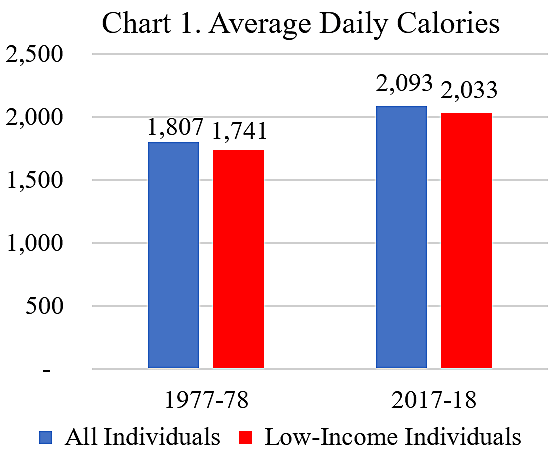
Cato’s John Early and colleagues have described how real levels of poverty in America have plunged over the decades. One change has been food consumption. Chart 1 shows that calories have risen substantially for Americans since the 1970s, including low‐income Americans. The USDA data is the average daily intake for age two and above, and low income means individuals with incomes of less than 186 percent of the poverty level.
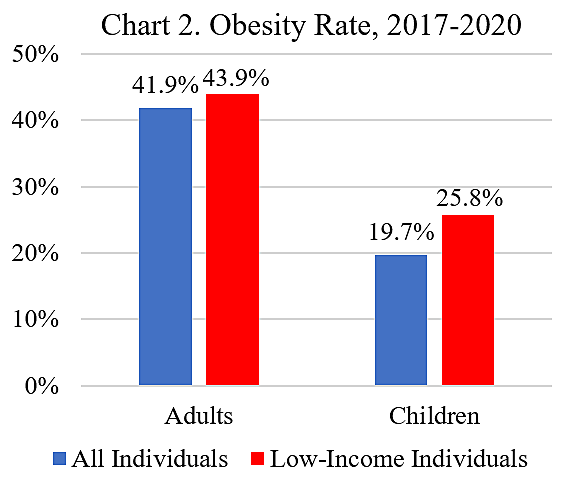
Today, many Americans at all income levels are eating too much food, including too much unhealthy food, and they are gaining excess weight. The main food‐related health problem for low‐income Americans today is obesity, not hunger.
Chart 2 shows that low‐income adults and children have higher obesity rates than other Americans. SNAP was originally aimed at alleviating food shortfalls, but many low‐income individuals today are eating too much of the wrong foods. In the CDC data for the chart, adults are age twenty and over and children are age two to 19. Low income means individuals with incomes of less than 130 percent of the poverty level.
There are many unresolved issues in low‐income nutrition. Why do SNAP recipients have less healthy diets than others? Which foods cause obesity? Are “food deserts” an important problem? How can people be encouraged to eat better?
Complex nutrition problems likely won’t be solved by one‐size‐fits‐all solutions from Washington. Indeed, federal interventions are often flawed, and because they are imposed nationally can generate widespread harm. The imposition of arguably faulty federal dietary guidelines is an example.
Another example is SNAP, which has also had broad—and perhaps partly negative—effects on diets. The USDA says that the program is supposed to provide “nutrition benefits,” “healthy food,” and “healthy eating patterns.” But about 23 percent of SNAP benefits are for junk food including sugary drinks, desserts, salty snacks, candy, and sugar.
The N in SNAP is for nutrition, but studies have found the opposite. One USDA study found that “lower nutritional quality of household food acquisitions was associated with SNAP participation status.” A recent review by Jerold Mande and Grace Flaherty found, “Children participating in SNAP were more likely to have elevated disease risk and consume more sugar‐sweetened beverages (SSBs), more high‐fat dairy, and more processed meats than income‐eligible nonparticipants.” The USDA has found that SNAP recipients are more obese than similar‐income nonrecipients.
Because SNAP is a rigid top‐down program, it has likely displaced alternative, and perhaps better, solutions for low‐income nutrition. The federal government, for example, has repeatedly denied city and state requests to withdraw SNAP subsidies from soft drinks and candy, as discussed by Nicole Negowetti. The nutrition case against sugary soft drinks is clear‐cut as Negowetti notes, but they are the single largest purchase item in SNAP. The USDA advises against sugary drinks, but its own SNAP program subsidizes them.
People can buy foods they want with their own money. But when taxpayers are paying $127 billion a year for a program that does not produce the outcomes promised, it is time to reevaluate. Congress should perform a thorough review of SNAP’s nutrition failures as it reconsiders the Farm Bill this year.
I recommend that Congress devolve SNAP funding and administration to the states, allowing for a diversity of policy approaches. Low‐income nutrition involves many uncertainties, so imposing a single national policy does not make sense. With devolution, states could try different rules for allowable purchases, work requirements, benefit levels, and other program features. That approach would generate information about what works best for recipients, taxpayers, nutrition, and the economy.
More on SNAP, nutrition, and obesity here, here, here, here, and here.
Data Note: Obesity for adults means a BMI of 30 or more. Thus, an average‐height man of 5’ 9” is obese if he weighs more than 203 pounds. Obesity is a higher weight category than overweight, which is BMI 25 to 30."
Saturday, April 29, 2023
Work Requirements in SNAP
"Federal policymakers will soon run into a hard deadline to increase the government’s legal debt limit. President Biden wants a simple debt‐limit increase with no strings attached, but House Republicans have proposed spending reforms called Limit, Save, Grow to include in a debt‐limit deal.
One GOP reform would strengthen work requirements for the Supplemental Nutrition Assistance Program (SNAP), also called food stamps. The proposal would affect a small fraction of people on the program and reduce costs only slightly. But restricting hand‐outs to encourage work makes sense because the economy has millions of job openings, as shown in the chart below.
In 2023, about 42 million people will receive food stamps at a cost of $127 billion. Many recipients are exempt from SNAP work requirements, including children, the elderly, and the disabled. About four‐fifths of SNAP households include a child, a senior, or a disabled person. The other one‐fifth consist of adults who generally need to be working, looking for work, or in training to receive ongoing benefits.
There are two sets of work requirements for SNAP recipients. General rules require individuals able to work, age 16–59, and not caring for a child under age 6, to register for work, to accept suitable work, or be in a training program. These rules have numerous exceptions. There are additional rules for able‐bodied adults without dependents (ABAWDs) age 18–49 to receive benefits for more than three months within any three‐year period.
The Republican proposal would tighten work requirements by raising the top age for the ABAWD group from 49 to 56. Looking at Table 3.2.a here, 3.5 million SNAP households do not include either children, the elderly, or the disabled, and about 2.5 million are in the ABAWD group. That appears to leave about 1 million households or fewer that may be affected by the GOP proposal. The data is for the October 2019 to February 2020 period.
SNAP’s ABAWD rules had been suspended during the pandemic but come into force again this year. And even then, the American Enterprise Institute’s Kevin Corinth notes that numerous states have federal waivers that void some of the program’s work requirements.
Tightening the SNAP work requirements would generate just a small part of the savings from the Republican plan. But it is important to begin reining in bloated entitlements, and adjusting eligibility to encourage work is a good place to start.
Tuesday, October 4, 2022
The ‘Food Insecurity’ Racket
The feds spend $114 billion a year on food stamps. Biden wants more
"The White House wants to change the subject from the troubled economy ahead of the November elections, and so arrives President Biden’s modest promise this week to “end hunger in America” by 2030. He’s holding a conference at the White House Wednesday on the subject, which will no doubt be full of high-minded intentions. But the food problem in American life isn’t a matter of deprivation, and the government already spends tens of billions of dollars on food.
The White House on Tuesday rolled out its National Strategy on Hunger, Nutrition and Health. “Transformative programs, policies, and system changes are needed” says the strategy document, including improving “food access and affordability.” Toward that end, the White House promises to “work with Congress to expand access” to the Supplemental Nutrition Assistance Program (SNAP), better known as food stamps, and one idea is letting college students sign up.
But insufficient public benefits aren’t a problem. More than 41 million Americans participated in food stamps each month on average in 2021, up from 35 million in 2019. In 2021 the Agriculture Department increased the benefit by more than 20%, rejiggering the formula ostensibly so recipients could afford more and better food like eggs and produce.
That fillip was separate from a temporary 15% bump in benefits as part of pandemic relief. States have also been allowed to waive whatever modest work and verification requirements once existed. The net effect has been an enormous taxpayer blowout: The feds spent $114 billion on SNAP in 2021, up from $60 billion in 2019. Any residual hunger in America isn’t the result of stingy government.
The Congressional Budget Office has estimated the new benefit formula alone will cost $250 billion to $300 billion over a decade. As the American Enterprise Institute’s Angela Rachidi pointed out this month, a gusher of spending hasn't been accompanied by a significant drop in “food insecurity,” which has replaced “hunger” as the justification for more government programs.
Food insecurity is a gauzy measure that overstates how many Americans don’t consume enough calories. One irony is that ferocious grocery-store inflation may be driving Americans to eat more fast food, which is more affordable but often less healthy. How about making food more affordable by reducing the 11.4% annual pace of food inflation?
The White House nutrition document is a long list of half-baked ideas, from recycled calls to expand the child tax credit to promises of increasing “procurement of local foods in federal prisons.” Why not a farmer’s market in the prison yard? Nearly all of these ideas involve government spending more money or using government to change human behavior it has never been able to change.
Like welfare in general, food stamps were once intended as temporary help for people down on their luck. But over time the program has expanded to become a large and growing entitlement that breeds dependence on government but nonetheless hasn’t managed to solve “food insecurity.” Maybe dependency is the real problem."
Wednesday, January 20, 2016
Are SNAP benefits really too low?
"Benefits are too low. At least, that’s the narrative circulating in Washington when it comes to the Supplemental Nutrition Assistance Program (SNAP)—formerly known as Food Stamps. A new report from the President’s Council of Economic Advisers at the White House incorrectly argues as much, and suggests that benefits should be increased. But before acting on this recommendation, Congress might want to take a closer look at the data that show that SNAP eliminates hunger for the overwhelming majority of American children, and leaves most recipient households with adequate food. Congress should reform SNAP, but a costly benefit increase is not the right answer.
According to a US Department of Agriculture survey on food security, only 1.1 percent of American households with children had a child who experienced hunger in 2014. Yet, the CEA report mistakenly claims that “the current level of [SNAP] benefits often cannot sustain families through the end of the month—causing children to go hungry and endangering their health, educational performance, and life chances.” Little evidence suggests that low SNAP benefits contribute to child hunger. In fact, SNAP is a major reason child hunger is not a larger problem.
The CEA’s claim that SNAP cannot sustain families through the end of the month also overstates the evidence. It is true that food purchases for SNAP households have been found to decline over the course of the month. But researchers Justine Hastings and Ebonya Washington suggest in their 2010 American Economic Journal article that this is due to “short-term impatience.” In other words, households respond to a large influx of cash-equivalent at the beginning of the month by spending it up-front. The authors recommend solving this problem by giving out SNAP benefits more frequently. A study by Jessica Todd published in 2014 in Applied Economic Perspectives and Policy found that a temporary increase in SNAP benefits resulting from the 2009 stimulus package increased SNAP spending later in the month. It’s been suggested that this means that SNAP benefit levels were too low prior to the increase. It’s possible. But it is also possible that households responded to an increase in benefits by spending more, which still doesn’t tell us much about the adequacy of SNAP benefits.
The CEA report’s statement that “a majority of SNAP households still reported experiencing low or very low food security in 2014” also misrepresents SNAP. Low food security (meaning an adequate, nutritious diet is not provided) could have easily occurred before the household started receiving SNAP benefits. Examining food security data while households were participating in the program, reveals that 66.5 percent were in fact food secure.
Another way to assess SNAP adequacy is to compare benefit levels to the cost of food in the thrifty food plan (USDA’s assessment of an adequate diet that is used to set SNAP benefit levels). A recent study found “that for roughly 30 percent of households, the average cost of the [thrifty food plan] exceeds the maximum SNAP benefit.” This means that 70 percent of SNAP households receive sufficient benefits to provide a diet determined adequate by USDA, which provides further evidence that SNAP is sufficient for most households.
All of this is to suggest that costly across-the-board increases in SNAP benefit levels are not needed. According to the Congressional Budget Office (CBO), the SNAP increase in the 2009 stimulus cost approximately $8.4 billion per year (accounting for about one-fifth of the growth in SNAP expenditures from 2009 to 2011). A 3 percent benefit increase, per the CBO, would cost an additional $2.3 billion per year.
A less costly option may be to provide different benefit levels based on local food costs, as has been suggested in a 2013 Institute of Medicine report. Allowing for larger housing cost deductions when calculating SNAP amounts should also be considered. This would increase SNAP amounts for those living in high housing costs areas, such as New York City, Boston, and Washington, D.C. Both would better target those most at risk of being ‘food insecure,’ without raising benefit levels for many of those who do not need it.
Pilot programs to test these theories are also worth considering, as was recommended in a new report from the National Commission on Hunger. And more research is definitely needed on the relationship between SNAP and hunger, especially among children. Adding a question to the USDA’s food security survey to better assess whether households were receiving SNAP at the time of the reported incidence of hunger would be a good first step.
SNAP has been described as “one of the most effective antipoverty programs in the safety net.” If this is to remain true, we need an open and transparent dialogue about what the data really show. Large-scale policy changes based on false impressions are not the answer."