"Over 30 people die per day in drunk driving crashes, according to national estimates.
One mechanism for reducing these deaths might be restrictions on the kind of business that can sell alcohol. Researchers studied such laws in Texas, where
cities can use local option elections to decide whether to permit particular types of alcohol sales [e.g, at on-premise locations like restaurants versus off-premise locations like liquor stores].
The findings suggest that
[l]egalizing alcohol sales increased retail access but did not measurably change traffic crashes in Texas cities, suggesting that the consequences of alcohol liberalization depend on where alcohol is purchased and consumed.
This expanded access was location-dependent:
The findings are consistent with a possible shift toward off-premises purchases but do not establish that increased retail purchases replaced purchases at bars and restaurants. … Because the Texas elections mainly expanded off-premises retail access, they may have increased convenience without increasing the form of alcohol consumption most closely associated with impaired driving.
All in all, the
findings challenge the assumption that making alcohol easier to purchase necessarily increases drunk driving."
Sunday, October 18, 2026
Does Easier Alcohol Access Affect Road Safety?

Thursday, October 15, 2026
AI Leaders Are Asking to Be Regulated. This Is Nothing New.
By Christopher J. Calton of The Independent Institute.
"After Dario Amodei, CEO of the AI company Anthropic, penned an open letter calling for AI regulation, Rahm Emanuel took to X. “I’ve served in two White Houses and in Congressional leadership,” the former Chicago mayor wrote, “and I can tell you when the last time a CEO or an industry at large asked to be regulated: never.”
Emanuel’s statement reflects the commonly held progressive myth that conniving Robber Barons do everything they can to impede the state’s noble effort to regulate them, but nothing could be further from the truth.
Business leaders have long lobbied to have their own industries regulated. In fact, an entire body of historical scholarship is devoted to that phenomenon. Historians such as Gabriel Kolko, Robert Wiebe, and James Weinstein spent their careers detailing how Big Business allied with progressive reformers and politicians to construct the federal regulatory apparatus.
What does Big Business have to gain from regulation? More than anything else, to suppress economic competition and avoid cutting prices.
“Competition was unacceptable to many key business and financial interests,” Kolko wrote in his landmark history of the Progressive Era. “As new competition sprang up, and as economic power was diffused throughout an expanding nation, it became apparent to many important businessmen that only the national government could rationalize the economy.”
Railroads were the first major industry to face widespread regulation, and the champions of the movement were railroad tycoons who had grown weary of the competitive pressure to cut prices. One railroad president endorsed the proposed Interstate Commerce Commission as the solution to “the prevailing contagion of depression and loss, from the effects of ruinous rates, which were uncontrollable from a lack of adequate protection of railroad interests.” Attempts to cartelize the railroads under the leadership of J. P. Morgan predictably failed owing to the strong incentives to offer discounts to shippers in the hope of generating enough traffic to cover the high fixed costs of building track networks.
Business leaders in other sectors adopted the same strategy for suppressing competition. The public-school narrative of American history teaches that Upton Sinclair’s The Jungle, an entirely fabricated account of Chicago’s meat-packing industry, triggered the onset of economic regulation. In reality, twenty years beforeThe Jungle was published, the so-called Beef Trust was already lobbying for inspection laws to protect them from European competition.
The corporatist state reached its apex during the New Deal, when President Franklin Roosevelt invited executives from the nation’s largest companies to Washington to draft their own protectionist regulations under the ultimately unconstitutional National Industrial Recovery Act. Mammoth corporations were in a better position to absorb regulatory costs than their competitors, and price controls made it impossible for smaller operations to undercut them. In one instance, the National Recovery Administration even jailed a businessman for charging customers five cents less than his industrial code allowed.
Today, large companies are reluctant to explicitly acknowledge their desire to suppress competition when they lobby for regulations, but the playbook is essentially unchanged. When Apple publicly endorsed California State Senator Scott Wiener’s bill to require California businesses to disclose their greenhouse gas emissions, the company insisted that “fighting climate change” was one of its top priorities. Apple boasted that it had already been measuring and reporting its climate emissions, implicitly acknowledging that its business model would be unaffected by the burdens the new rule imposes on its smaller competitors.
The nascent AI industry is already enormously competitive, and rivalry has contributed to rapid advancements in the quality and availability of the technology. Dario Amodei’s plea for regulation sounds the alarm about “cyberattacks,” “bioterrorism” and “serious economic disruption,” but underlying all of those concerns is a fear of market competition. “A race to the bottom, spurred by commercial incentives,” he writes, “can make these risks more acute.”
More likely, he fears that Anthropic cannot win a marketplace contest that rewards quality and affordability. Like so many business leaders before him, Amodei views the regulatory state not as the protector of consumers, but as the guardian of his own self-serving corporate interests."
Thursday, October 8, 2026
In São Paulo entrenched interests lost out due to less restrictive housing regulations; prices went down & new households benefited
See Who benefits from upzoning? A 2016 zoning reform in São Paulo increased the ability of developers to supply housing units by lifting limitations on permitted densification on a block-by-block basis by Tyler Smith of the AEA.
It looks like the eighborhoods receiving the largest reductions in regulations saw the biggest increase in supply and the biggest decrease in prices. See the text in red near the end.
"The share of the world's population living in cities rose from 33 percent in 1960 to 56 percent in 2019 and is projected to reach 68 percent by 2050, with much of that growth concentrated in developing countries. Whether cities can provide sufficient housing for those future residents depends on local land use rules, which determine where and how developers can build.
But measuring the effects of these rules has proven difficult. Data limitations, complexity, and endogeneity have stymied efforts to estimate the value of zoning reforms.
In a paper in the American Economic Journal: Economic Policy, authors Santosh Anagol, Fernando Ferreira, and Jonah Rexer examine a 2016 zoning reform in São Paulo and related detailed administrative data to assess the impact of zoning policies.
"The really hard thing about studying zoning is getting fine-grained information on the actual rules that are enforced on the ground," Anagol told the AEA in an interview.
The central regulatory parameter for land use in São Paulo is the built area ratio (BAR)—floor space divided by lot area. The 2016 zoning reform stripped the city's 32 neighborhood governments of the power to set the maximum BAR, assigning new values block by block with the aim of densifying corridors served by metro, rail, and bus lines.
Across roughly 45,000 blocks, the average maximum BAR rose from 1.55 to 2.09, permitting an average of 36 percent more construction on a given parcel. However, the distribution of reforms was uneven. Forty-five percent of blocks received an increase of 1 BAR or more while nearly half saw no change or a reduction.
The authors exploited this block-level variation using a boundary discontinuity design. Blocks whose maximum BAR increased were used as treatment groups, and the nearest blocks where the maximum BAR held constant or fell were used as controls.
The authors supplemented the building permit records with property tax records, real estate listings from 2019 to 2022, formal sector wage data, and a 2017 commuting survey of 24,800 households. They then estimated an equilibrium model in which developers choose how much to build, and households choose among 329 commuting zones, based on price, commuting time, access to high-paying jobs, building age, density, and neighborhood characteristics.
According to the authors’ estimates, developers responded quickly to zoning reforms. A 1.4-point increase in maximum BAR raised multifamily permit filings by roughly 66 percent relative to nearby control blocks, with differences emerging about a year after passage of the reform and growing thereafter. Notably, single-family permits were unaffected, consistent with BAR easing constraints primarily on larger structures.
Between 2019 and 2022, listings for sale grew about 10 percent faster in treated blocks. At the commuting-zone level, a 1-point BAR increase was associated with 10.9 percent higher listings growth and a 5.7 percentage-point reduction in prices.
By simulating the model for ten years following the reform, the authors estimated that the reform added roughly 39,000 units—a 1.6 percent increase in the housing stock—and reduced average prices by 0.4 percent. The authors suggest that this modest average can be explained by BAR rising only 0.54 overall. But neighborhoods receiving the largest increases saw up to 17.5 percent more units and 3 percent lower prices.
"While in the long run it may bring all prices down, the welfare gains, at least initially, may be concentrated amongst higher-income, higher-educated groups," Anagol said.
The reform produced a nominal wealth transfer of 11.33 billion reais, or 1.62 percent of city GDP, from current homeowners and landlords to future real estate owners. The size of the transfer suggests that it may generate political repercussions.
"The entrenched interests lose out from these housing reforms when prices go down, whereas new households benefit," Anagol said.
The work shows that targeted upzoning produces real supply responses and localized affordability gains. But the concentration of losses among existing owners may help explain why reforms of this kind remain difficult to pass.
♦
“Estimating the Economic Value of Zoning Reform” appears in the August 2026 issue of the American Economic Journal: Economic Policy."
Saturday, October 3, 2026
The Limited Efficacy of Social Media Bans for Teens
"The Jonathan Haidt-pilled among us shouldn’t celebrate Australia’s social media ban for teens just yet.
New evidence suggests that the ban has neither gotten teens off social media nor changed the culture around its use.
The ban
imposed few practical costs on teenagers who wanted to continue using social media: 75 percent described circumventing the restrictions as easy or very easy. … Among teenagers still using banned platforms, 52 percent gave a social reason, most often that their friends were still on the platforms or that they feared missing out.
The collective action problem remains and
the existing adherence rate may not last. On average, affected teenagers said that roughly two-thirds of their peers would have to adhere before they would adhere themselves. Yet they believed that only about 30 percent of their peers were adhering, close to our estimated rate of 27 percent. … Unless enforcement or social norms changed, we therefore expected adherence to decrease rather than increase.
Alternative
approaches include coordinated time limits, … campaigns that make nonuse visible and socially rewarded, incentives for reduced social media use, and organized activities that replace time and interaction lost online.
Of course, teens will likely find reasons and ways to circumvent these policies as well."
Monday, September 14, 2026
By the Time Governments Are Regulating AI, They’re Regulating the Past
"AI is changing fast. And spreading fast. Both are problems for people seeking to regulate it.
Regulation works best when regulators understand what they are regulating. That is not the case for AI. Costs are collapsing, having dropped 1000-fold for large language models since 2023. At the same time, capabilities are expanding, business models are changing, and market leaders are turning over rapidly.
These dynamics create both opportunities and problems. Now almost anyone can use AI to manage their household or launch a business. But, as Bill Gates recently noted, they can also create deep fakes, launch phishing attacks, or break into internet sites, as happened to Hugging Face.
This also makes regulation hard: Rules written for the AI that regulators see today will no longer exist by the time the rules take effect.
Nevertheless, many people want regulations that would control AI. The EU has embraced what it calls comprehensive AI regulation, in which regulators judge the relative riskiness of AI applications and systems and then apply controls ranging from outright prohibitions to light-touch oversight. Some people are calling for mandated surveillance of AI users, restrictions on model capabilities, product standards, and computer code review. Gates recommends an international organization layered on top of national all-of-government regulators to oversee all AI risks people imagine. All of these approaches assume overseers who would control innovation.
While it is true that whenever a technology’s costs fall and its abilities grow, people use it more. Sometimes for evil. When Henry Ford put cars within reach of every family, some families created new businesses, but others became bank robbers. When internet service providers spread access across the country, e-commerce exploded, but so did criminal activity on the dark web. In these instances, successful regulatory responses were not to limit cars or the internet, but to use the technologies for regulatory purposes.
The examples of automobiles and the internet illustrate a path forward for AI policy: Let the technology evolve for the good it can do. At the same time, officials and entrepreneurs can protect citizens by developing their own innovations based on a deep understanding of the technologies and their markets.
Recent research published in the Journal of Economic Perspectives provides insights into AI and its markets. The researchers examined the AI most people use, LLMs. LLMs are growing in complexity, now operating in three layers: The Model Layer, where creators such as OpenAI and Meta design and train LLMs; the Inference Layer, where AI providers like OpenAI and Together AI host and run models to respond to user requests; and the Application Layer, where a large ecosystem of startups and established firms embed LLM capabilities into user-facing applications for accounting, legal, retail, and other services.
Activity in each layer has exploded in multiple directions. The Model Layer grew from 1 model in early 2023 to 668 by the end of 2025. There are curious dynamics in this layer. Open-weight models—which allow users to customize systems for specific tasks—charge users 90% less than do closed weight models. Open-weight providers effectively give away their models after spending billions in development and training. Despite what looks like bad economics, there are over twice as many open-weight models as closed-weight models, 449 versus 219.
Customers in the Model Layer also make choices that appear counter intuitive. Even though open-weight providers charge 90% less than do their closed weight counterparts, customers use closed-weight models more than twice as often.
The complexity doesn’t stop there. At the Inference layer, the number of providers grew from 30 to 90 in 2025. These providers largely host open-weight models and their non-price capabilities vary. Closed-weight model creators are more likely to have vertical relationships at this layer.
The growth and interplay of these two layers illustrate why controls can be counterproductive. They limit innovators’ abilities to experiment, meaning that there would be fewer models in both levels. Fewer models at this stage of development means fewer opportunities for customers to express their preferences. And it is unclear whether the two layers will remain separate.
Model diversity is growing in several ways. Measured by the Artificial Analysis Intelligence Index, 80% of the models fell between 0.1 and 0.29 on the scale at the beginning of 2025. By the end of the year, they fell between 0.22 and 0.61, an increase in spread of over 100%.
Market leadership changes often. In the Application Layer, the market leader for science-oriented models changed eight times in 2025, while the market leader for legal services changed five times.
What does this mean for regulators? The innovators, investors, and customers driving AI are creating tremendous value, estimated to be approaching $1 trillion. Regulatory controls handicap legitimate AI providers and create market opportunities for those less inclined to follow the rules.
The lesson isn’t that government has no role in AI’s evolution. It is that seeking to control AI is counterproductive. AI policy should let the government be a leading AI user without limiting legitimate users of AI. This is more like what good governance has always done: punish harmful conduct and protect citizens by adapting its own capabilities as the world changes."
Saturday, September 12, 2026
Hit the Brakes Hard on Trusting Government
"Here’s a letter to the Wall Street Journal.
Editor:
Peggy Noonan is so frightened of AI that she not only calls on investors to stop funding it, but on government to “hit the brakes hard” on this technology (“Pause AI for Humanity’s Sake,” September 11).
Ms. Noonan imagines AI unleashing a terrible dystopia. Yet what we imagine should be informed by the past. Ms. Noonan’s imagination isn’t. Were she to consult the past, she’d encounter a few realities beyond the obvious one that countless technologies that we today celebrate were, when introduced, reproached as imperiling humanity.
One such reality is that when insiders stir up alarm about their own industries, they’re often angling for regulation that shelters them from competition. As classic case involves AT&T: it warned that telephony would collapse into chaos unless regulated as a natural monopoly. Established bankers played the same game during the Depression, warning that, without government-imposed interest-rate ceilings, ruinous competition for deposits would breed financial crises. In each case the peril lay less in the absence of regulation than in the ‘cures’ – a fact that points to a second and more fundamental reality: a far greater danger than new technology to humanity is government authority to regulate technology.
History gives us every reason to distrust government with the awesome power to determine just how new technologies will develop, and how and when we should be permitted to uses these technologies. In short, history teaches that the wealthiest and safest societies are ones in which innovation is, as Adam Thierer calls it, “permissionless.” If we’re to hit the brakes hard, it should be on the ages-old, fear-fueled impulse to put control of economic forces and technological advances into the hands of politicians and bureaucrats."
Sunday, September 6, 2026
Domestic Energy Shipments Are Breaking Records Under the Jones Act Waiver
"The Jones Act is a de facto tax on Americans trading with one another. By requiring domestic waterborne commerce to use vessels that cost far more to build and operate than their international counterparts, the law raises shipping costs. That’s a real burden given the significance of transportation in a country as vast as the United States and helps explain why relatively little freight moves by water.
Conversely, economic logic holds that lowering these costs will expand commerce, which is exactly what has happened since the Trump administration issued a Jones Act waiver for energy and fertilizer shipments in March. Freed from the law’s constraints, domestic fuel shipments have surged to unprecedented levels.
PADD 5 Receipts Nearly Set a Record in Five and a Half MonthsOne of the most dramatic examples of this increase has been to the West Coast, Alaska, and Hawaii, collectively known as PADD 5. According to a recent Energy Information Administration analysis, waterborne shipments of crude oil and petroleum products from the Gulf Coast to PADD 5 in April and May 2026 were more than four times their level in the same months of 2025. April’s volume was more than double the previous monthly record, and shipments remained elevated in May.
That increase has been sustained. US Maritime Administration (MARAD) data show that in less than six months, waiver shipments have already exceeded the Jones Act fleet’s annual total in every year from 2000 through 2025, with one exception. Only 2024 remains narrowly ahead (by 2.2 percent), and it appears on the verge of being surpassed."
Jet fuel: More jet fuel has been moved to PADD 5 under the waiver than in the preceding 35 years combined (1990–2025). Gasoline blend stock and alkylate: More gasoline blending components and alkylate have been moved into PADD 5 than the Jones Act fleet moved from 2010 through 2025 combined. Finished gasoline: The waiver has seen more finished gasoline moved to the West Coast than the Jones Act fleet has moved in the last eight years combined." "East Coast-bound shipments topped 1.2 million barrels a day in April, which was the highest monthly figure on record and about 11 percent above anything seen pre-waiver."
"In 2017, the CEO of Overseas Shipholding Group, a major Jones Act tanker operator, admitted to the Financial Times that the law was suppressing domestic oil flows: “If there was not a Jones Act, then there probably would be more movements of crude oil from Texas to Philadelphia.”"
Friday, August 14, 2026
Regulated Markets Are Slow to Handle Change
"Gowrisankaran, Langer and Reguant have an excellent paper, Energy Transitions in Regulated Markets (WP), in the latest AER.
The basic idea is that regulation designed to prevent utilities from building useless power plants can induce them to keep obsolete power plants. Some background. We regulated electric utilities under the theory that they were natural monopolies and therefore we would do better by pushing their prices down. What’s a reasonable price? Hard to say, so regulated utilities were allowed to recoup their operating costs plus a fair return on their “rate base”—their capital stock. Makes sense, but once profits depended on the size of the capital stock, utilities had an incentive to build too much—the classic Averch–Johnson effect. Regulators responded with “prudence” requirements and the rule that capital must be “used and useful.” In a stable world, that rule is a check, albeit an imperfect check, on so-called gold-plating.
But now consider what happens in a time of technological change, such as a rapid decrease in the cost of generating electricity with natural gas (driven by fracking and improvements in combined-cycle natural-gas (CCNG) technology). In a free market, large decreases in costs would cause firms to abandon coal and move to natural gas—some would do this to make profits, others to avoid losses. In short, the market forces sunk investments to be abandoned when not profitable.
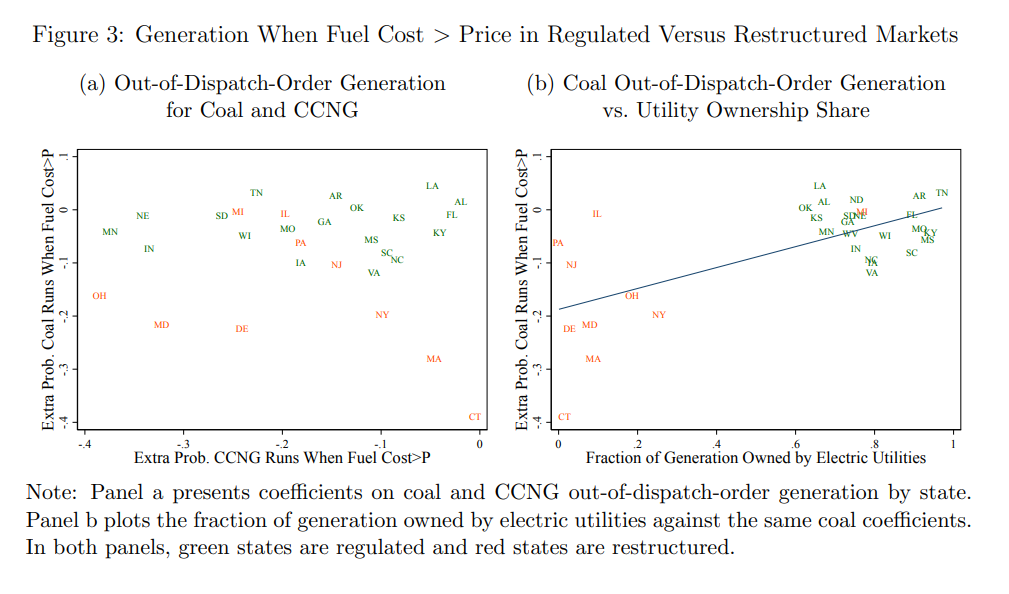
But there is another possibility under regulation. Tell the regulator that your plants are still viable. Well, telling is cheap talk so you keep burning coal to prove that the plant remains useful. If you can keep your base operating that’s better than abandoning it and to signal how valuable your coal plant still is, it may even be worth while to burn coal when the cost exceeds the price of electricity! The authors have some nice data on exactly this point.
Figure 3 takes a little work to understand, but the pattern is clear. Each point represents a state. In panel A, the vertical axis shows how much less likely a coal plant is to run when the cost of coal exceeds the price of electricity. Obviously, a strongly negative coefficient is the economically sensible response: when burning coal is more expensive than buying electricity, the plant should burn less.
The red points represent restructured states and the green points regulated states. In restructured states coal burning falls when prices fall, just as expected. Coal burning in regulated states responds much less. (I.e., the red points generally lie below the green points.) Indeed, the six states with the largest reductions in coal operation are all restructured states.
One objection to this analysis might be that utilities in general are just slow to respond to prices, so on the horizontal axis the authors plot how well utilities respond to a higher price of gas. Note that these coefficients are all negative and there is no obvious difference between regulated and restructured states. In both types of states, utilities respond well to the price of gas, but only in restructured states do utilities respond strongly to the price of coal. (Why coal and not gas? Because the used-and-useful standard binds on capital whose usefulness is in doubt—which, once gas got cheap, meant coal. In other words, the utilities have to defend coal to the regulators, not gas.)
Panel B on the right shows a slightly different way of presenting the same data. The vertical axis is again how much less likely a coal plant is to run when its cost exceeds the electricity price. The horizontal axis is the fraction of generation owned by electric utilities. Regulated states tend to be vertically integrated, while restructured states opened electricity generation to competition, so utility ownership and regulatory status are closely correlated. Regulated states generally have utility ownership above 60%, while all the restructured states but one are below 30%. The best-fit line slopes upward: in other words, the more generation a state’s utilities own, the less coal dispatch responds to price. A different perspective on the same story.
That is the direct empirical evidence. The authors then construct a more ambitious structural model. In theory, regulation could produce either too much or too little investment in the new technology; their estimates imply too much. Much, too much. Not only do regulated utilities retain too much coal, they also build too much gas capacity. In short, they accumulate both too much old capital and too much new capital. Averch–Johnson on steroids.
The bottom line is that regulation under dynamic conditions is much more difficult than under static conditions. My view is that it may not even be worth the candle"
Abstract
Natural gas has replaced coal as the dominant fuel for US electricity generation. However, utilities in regulated US states have retired coal more slowly than others. We build a structural model of rate-of-return regulation during an energy transition where utilities face trade-offs between lowering costs and maintaining and using legacy capacity. A regulated utility facing carbon taxes lowers short-run coal generation 48 percent as much as a cost minimizer would. Thirty years after a sudden energy transition, a cost minimizer has retired 71 percent more coal capacity than the regulated utility. Alternative regulations may jeopardize affordability and reliability goals during energy transitions.
Wednesday, August 5, 2026
How to Escape the Productivity Slump
Removing policy barriers can unleash a new era of productivity and abundance.
"Summary: For the past half-century, much of the developed world has experienced a puzzling slowdown in productivity growth—the rate at which workers and businesses become more efficient over time. While digital technologies have advanced at a remarkable pace, innovation in the physical world has slowed considerably. The problem is not a lack of scientific breakthroughs or a shortage of good ideas. Rather, it is a failure to translate discoveries into products, infrastructure, and services that improve everyday life. This slowdown is largely the result of policy choices. By reforming outdated permitting systems, using innovation incentives such as R&D prizes and Advance Market Commitments, and reducing barriers created by protected local monopolies, we can accelerate the spread of new technologies and usher in a new era of prosperity.
In a previous exploration of the housing affordability crisis, I observed a sobering reality: artificial scarcity is often a policy choice. We have placed arbitrary limits—mostly through local governments—on our ability to build homes, driving up costs and restricting opportunity. But this pattern of self-imposed constraint does not stop at the edges of our neighborhoods. It extends into the institutions and policies that shape economic growth. It is one of the primary reasons why, despite living in an age of extraordinary digital innovation, we remain stuck in a decades-long productivity slump.
Economists often measure technological progress using a concept called Total Factor Productivity (TFP). In simple terms, TFP measures how efficiently an economy turns labor, land, and capital into goods and services. When TFP rises, society discovers better ways to produce more with the same resources.
From the 1920s through the early 1970s, TFP in the United States and much of the developed world grew at more than 2 percent per year. This was the era that gave us commercial aviation, widespread electrification, antibiotics, and the Apollo program. The physical world was transformed in a single generation.
Since the early 1970s, however, productivity growth has slowed dramatically to less than 1 percent in most years. As investor Peter Thiel famously quipped, “We wanted flying cars; instead, we got 140 characters.” Digital technologies have advanced rapidly, while progress in energy, transportation, infrastructure, and advanced manufacturing has been far slower. We can send vast amounts of information across the globe in milliseconds, yet we often struggle to build major infrastructure projects on time or on budget.
A 2020 paper by Nicholas Bloom and co-authors argues that good ideas are getting harder to find – that is, more investment in research and development has become necessary for each new patentable idea. However, more recent research by Teresa Fort and co-authors (currently in working paper form) suggests that this is not the case. The Bloom et al. result may, in fact, be an artifact of focusing on manufacturing firms, which were dominant from about 1970 to 1990. Fort and her co-authors show that patenting and innovation have shifted in recent decades, becoming dominated by firms in information, management, and professional services.
Because manufacturing is a physical process, it is much more likely to be subject to, for example, environmental regulations, whereas an IT firm operates in a much less regulated sector. So, our relative stagnation may not be the result of a scientific drought after all. Universities and research laboratories continue to produce remarkable discoveries. We are not failing at invention; we are failing at diffusion, the process of turning new discoveries into widely used products and services.
The Diffusion Deficit and the Permitting Veto
Innovation does not benefit society until it escapes the laboratory and enters the marketplace. The journey from a peer-reviewed paper to a consumer-ready product is long, expensive, and uncertain. Over time, policymakers have added layer upon layer of regulatory complexity to that journey.
Physical innovation requires physical construction. New technologies need testing facilities, advanced laboratories, semiconductor fabrication plants, energy infrastructure, and transportation networks. Yet building almost anything of significance in the modern West often requires navigating years of environmental reviews, public-comment periods, and multi-agency approvals.
Laws such as the National Environmental Policy Act (NEPA) and state-level counterparts such as the California Environmental Quality Act (CEQA) were originally intended to prevent environmental harm. Over time, however, they have increasingly become tools for the delay of progress. Because these laws frequently allow opponents to challenge projects on procedural grounds, they have contributed to what political scientist Francis Fukuyama calls a “vetocracy”—a system in which many actors can block decisions but few can make them. Average NEPA environmental impact statements now take almost four years to complete, with many extending far beyond a decade. Thankfully, the median is a bit shorter, but still about 2.5 years.
Consider the recent push to reshore semiconductor manufacturing. While the government has allocated billions of dollars in subsidies to build these vital factories, the physical construction is bottlenecked by years of permitting and environmental reviews. A state-of-the-art fabrication plant (commonly called a “fab”) that takes 18 months to build in Taiwan or South Korea can take three to five years just to obtain a permit in the United States.
The result is predictable: projects take longer, cost more, and become less attractive to investors. Even when governments provide subsidies for strategic industries such as semiconductor manufacturing, years of permitting can slow implementation. Time is money, and prolonged regulatory uncertainty discourages investment in capital-intensive industries.
The solution is straightforward, even if politically difficult. Critical infrastructure, advanced manufacturing facilities, and research laboratories should face streamlined approval processes. If projects satisfy clearly defined environmental and safety standards, they should be approved in months rather than years.
Pull Mechanisms: R&D Prizes and Commercialization
Reducing regulatory barriers is only part of the solution. We must also rethink how innovation is encouraged and financed.
In addition to corporate financing, most governments try to support innovation through “push” funding. Researchers receive grants to conduct experiments, purchase equipment, and explore new ideas. This model, some economists argue, can be effective for basic science, especially when commercial applications may be years away.
Commercialization presents a different challenge. Many promising technologies fall into what innovators call the “Valley of Death” – the difficult period between a successful laboratory demonstration and a commercially viable product. At this stage, development costs rise sharply while uncertainty remains high.
That is where “pull” mechanisms become valuable. Instead of paying for research inputs, policymakers reward successful outputs. An Advance Market Commitment (AMC), for example, guarantees that a buyer will purchase a product if it is successfully developed. Rather than funding every possible approach, the sponsor commits to paying for results.
Economist Michael Kremer helped pioneer this approach through vaccine development programs. More recently, Operation Warp Speed demonstrated its effectiveness. The government did more than fund vaccine research; it guaranteed large future purchases for successful vaccines. By reducing market risk, policymakers encouraged firms to accelerate development and manufacturing simultaneously. The result was one of the fastest vaccine-development efforts in history.
Consider other approaches. Throughout history, prizes have also stimulated innovation. The Longitude Prize helped solve a critical navigation problem for maritime trade, while the Ansari X Prize helped launch the private spaceflight industry. Pull mechanisms align private incentives with public goals by rewarding success rather than political connections or grant-writing skill.
Breaking Local Monopolies and Regulatory Capture
When people hear the word “monopoly,” they often think of large technology companies. Yet some of the most significant barriers to innovation exist at the local level.
The electric utility sector provides a clear example of how regulatory design shapes technological adoption. Because most utilities operate as regulated monopolies with government-guaranteed rates of return on capital investments, their business model relies on continuous, large-scale infrastructure growth.
Put simply, utilities make more money the bigger power plants and power lines they build, so they usually prefer huge projects over things like rooftop solar panels that let people generate their own power without the utility having to build as much infrastructure.
Decentralized energy technologies—such as local battery storage, micro-grids, and advanced management software—directly threaten this model by optimizing the existing grid and reducing the need for new capital projects. As a result, studies from the MIT Energy Initiative and industry financial analysts indicate that utilities frequently leverage legacy regulatory processes to delay or block these decentralized innovations from integrating into the wider network.
Similar dynamics exist elsewhere. State dealership franchise laws frequently restrict direct-to-consumer automobile sales, making it more difficult for new manufacturers to enter the market. Occupational licensing requirements now affect roughly one-fifth of American workers and can create barriers to entry that limit competition and labor mobility.Innovation depends on what economist Joseph Schumpeter called “creative destruction” – the replacement of older, less efficient business models with better ones. When established interests use regulation to shield themselves from competition, they slow technological adoption and reduce future productivity growth. Encouraging competition and reducing regulatory barriers at the state and local level would help accelerate the diffusion of new ideas throughout the economy.
Choosing Abundance
The productivity slowdown is not an immutable law of nature. It is, at least in part, the consequence of policy choices. Human ingenuity remains as powerful as ever. We have more scientists, more capital, and better tools than any previous generation. The challenge is not generating ideas; it is allowing those ideas to spread.
By streamlining permitting processes, expanding the use of R&D prizes and Advance Market Commitments, and reducing barriers created by protected local monopolies, we can accelerate innovation in the physical world.
An additional one or two percentage points of annual productivity growth may sound insignificant. Yet when compounded over decades, the effects are transformative. Higher productivity means higher incomes, better health outcomes, more abundant energy, and greater opportunities for future generations. The ideas already exist. The question is whether we will allow them to flourish."
Thursday, July 30, 2026
The Endangered Species Act Reduces Housing
"Max Tabarrok’s paper on the Endangered Species Act and housing (WP) has just been published in the Journal of Public Economics! It’s a clever paper: Max observed that the moment an animal is put on the endangered species list, developers face enhanced compliance costs and liability risk. But what’s important for an empirical economist is that this increased regulation isn’t national–it binds just where the species lives. Thus, the ESA creates many natural experiments, places where it binds and nearby places where it doesn’t and the list changes over time–there were 82 listings in 1970 and nearly 1500 today–and there are even some de-listings which reduce regulation.
Here, for example, is a picture of the habitat (red) and control areas (blue) for when the Northern Long Eared Bat was put on the endangered species list.

The bottom left panel measures annual housing permits per 1000 1980 pop in treatment (red) versus control (blue) areas. The bottom right is the event study coefficients. After the bat was put on the endangered species list, the number of new housing permits declined in areas where bats might live relative to control areas.
Here is what happened when the Peregrine falcon was delisted. Before the delisting, housing permits were lower in regions (red) where the falcon had habitat compared to controls areas but after the delisting the treatment areas caught up to the control areas.

Overall:
…this paper provides evidence that an additional endangered species listing reduces annual housing permit flows by 0.5 permits per thousand 1980 residents, about 10% of the average place’s permit flow. Accounting for spillovers and diminishing costs, my estimates suggest the aggregate effect of the ESA has been to reduce the national housing stock by…roughly 6.3 million missing units over 1980–2024, about 4% of the 2025 housing stock.
Now, you might say, ok this shows the ESA has costs. What about the benefits of the ESA? It’s hard to measure the benefits, of course, or even know if the ESA is effective. But Max shows using satellite data that there are quite a few places where the ESA binds on infill development.
…at the intensive margin of housing production, new developments are often replacing existing buildings or are filling in space in a highly developed area that could not host endangered species even if no new construction took place. On the intensive margin, the tradeoff with species protection does not bind, and may even be positive sum as it substitutes for less dense greenfield development. Therefore, whether and how much the ESA constrains development on the extensive vs intensive margin is relevant to the tradeoffs we face between housing production and species protection, and thus is relevant to the aggregate welfare effects of the law.
In this section I extend the main empirical specification of the paper to satellite data on land use from the National Land Cover Database (NLCD) (Multi-Resolution Land Characteristics Consortium, 2025) and to heterogeneity within the Building Permits Survey to assess where the effects of the Endangered Species Act are accruing.
The NLCD is a set of satellite images of the United States compiled and pre-classified by the U.S. Geological Survey. They classify 30-square-meter pixels into one of fifteen land use groups, including four levels of development, three types of forest, and two types of wetland. The NLCD has annual files going back to 1985. I overlap these pixels with the map of permit-issuing places in the BPS using constant 2024 borders, and track the changes to pixels within each place over time. The hazard rate of extensive margin or greenfield development is measured by the flow of non-developed pixels (e.g., forests or wetlands) into any of the four levels of developed land use, divided by the total area of greenfield land use.
He concludes:
The most urbanized 15% of places are responsible for 90% of total permit flows, while the highest-value endangered species habitat is well outside these developed areas. The Endangered Species Act seems to restrict infill development in these dense areas as much as it restricts greenfield development in exurban sprawl (Table 9, Table 10, Table 11). Relaxing the legal mechanism of the Endangered Species Act in already developed areas may increase permit flows in dense, energy- and land-efficient cities in California and on the East Coast at the expense of sprawling suburbs in the Sun Belt, increasing both housing supply and endangered species habitat.
The Trump administration is trying to limit the ESA, multiple lawsuits have already been filed. Max’s paper is thus timely and it points to a fix that might satisfy housing proponents and environmentalists: relax the ESA’s bite on infill and redevelopment in already-built-up areas, where the housing-versus-habitat tradeoff barely binds, rather than across the board.
Addendum: Obviously, I am pleased as punch to see this paper in print. Max began writing the paper before graduate school–he has only just finished his first year. He was fortunate to have had lots of great advice along the way, most notably from a superb pre-doc he did at Dartmouth under the auspices of Heidi Williams."
Tuesday, July 21, 2026
New York’s Data Center Self-Sabotage Gov. Kathy Hochul finds another way to hurt economic development in the state.
The article discusses how it is regulation and not data centers that are driving up costs.
Monday, July 20, 2026
Evicting Wall Street From the Housing Market Will Be Messy
Law restricting activities of big investors in residential real estate could mean less cash to build new supply
By Carol Ryan of The WSJ. Excerpts:
"Under the 21st Century ROAD to Housing Act . . . investors who already own more than 350 family homes can’t buy any more from the existing housing stock."
"Any landlords that don’t already have scale will find it hard to expand their portfolios through the exemptions."
"Big landlords are being nudged to pour cash into the build-to-rent sector instead. This means taking on development risk and constructing entire rental neighborhoods from scratch. The benefit of constructing whole rental communities in one area is that they are much cheaper to maintain than homes that are scattered across dispersed neighborhoods."
"Build-to-rent is exempt from restrictions under the new law. Like multifamily apartment buildings, it is an area of the housing market in which large investors can continue to operate freely."
"Anyone considering putting money into the housing market . . . must now weigh the risk that future administrations could tighten the rules further."
"Returns on build-to-rent investments don’t look high enough to compensate for the risk."
"Build-to-rent communities are hard—or impossible under some zoning rules—to sell off individually to consumers"
"Eight large institutional investors were net sellers of more than 3,000 homes in the second quarter of this year, a fivefold increase in net-selling activity from the same period of last year"
"some smaller investors plan to cash out permanently by selling homes to individual home buyers over time"
Thursday, July 16, 2026
Keeping Cool: The Air Conditioner That Changed America
By Gale L. Pooley. He teaches US economic history at Utah Tech University. Excerpt:
"One of the great triumphs of entrepreneurial capitalism is how quickly air conditioning traveled the familiar path from luxury to necessity. What began as an expensive convenience for a tiny elite became, within a generation, affordable to ordinary families. The market did not merely invent comfort — it democratized it.
In their report Time Well Spent: The Declining Real Cost of Living in America, Michael Cox and Richard Alm found that a 5,500-BTU air-conditioning unit cost about $350 in 1952. At the time, entry-level workers earned roughly 83 cents an hour, putting the time price at 422 hours.
Today, Walmart sells a far more efficient 6,000 BTU air-conditioning unit (with a remote control) for only $115. The current hourly wage for limited-service restaurant workers is around $19 an hour, putting the time price at six hours.
The time price has decreased by 98.6 percent. For the time it took US workers to earn the money to buy one unit in 1952, they get 70 today.
If air conditioning saves lives, why don’t more Europeans have it?
Europe’s electricity prices are typically much higher than the US, driven by higher taxes, network costs, renewable energy mandates, and energy import dependence. Customers in the US pay 17 to 19 cents per kilowatt-hour (kWh) compared to 25 to 32 cents in Europe. This means Europeans pay roughly 47 to 68 percent more per kWh than US customers.
Americans are also much richer than Europeans. According to World Bank data, American gross domestic product (GDP) per capita was $84,809 in 2024, while the European Union’s was 25 percent lower at $63,585. That $21,224 difference could buy a lot of comfortable cooling.
The European Union also prioritizes environmental targets over human comfort by imposing strict regulations for heating and cooling, making these amenities much more costly. The commission encourages citizens to use fans instead of air conditioning. Imagine the government doing that in Phoenix and Atlanta in July. Italy, Greece, and Spain even announced temperature limits in public spaces during the 2022 heatwave in an effort to meet these environmental objectives. Spain limited air conditioners to be set no lower than 80°F. No wonder European productivity is 38 percent lower than the US.
Historic preservation laws and strict landlord rules frequently ban exterior window units to maintain aesthetic uniformity.
While air conditioning ownership increases households’ electricity consumption, it may be a small price to pay for comfort and avoiding death.
The problem is not the climate but the policy mindset. Too many European regulators approach energy and technology through the ideological lens of scarcity rather than creative innovation and human flourishing. One reason such policies persist is that the officials who design them are largely insulated from the consequences of their decisions and rarely experience their costs directly. Instead, those costs are borne by millions of ordinary citizens.
Air conditioning is not ultimately a story about cooling. It is a story about knowledge. It transformed oppressive heat into comfort, inhospitable regions into thriving communities, and summer misery into year-round productivity. Coal, copper, and electricity become valuable only after humans discover how to harness them. The history of air conditioning is the history of knowledge triumphing over nature’s constraints.
The ultimate resource is neither energy nor matter. It is the infinite capacity of human beings to learn, create, and discover."
Wednesday, July 15, 2026
NYC’s socialist movement forcing millionaires to flee the state — leaving Mamdani, DSA in a bind
By Judge Glock. Excerpts:
"A new Citizens Budget Committee report found that New York’s share of millionaires, those earning more than a million dollars a year, declined more than any other state since 2010.
The state went from having 12.7% of all millionaires in the nation to 8.7%.
Worse yet, in the more recent years, the state’s highest earners have been leaving much faster than its lowest earners."
"New York City’s tax rates on the wealthy are already the highest in the nation."
"Economists Joshua Rauh and Ryan Shyu found that a California income-tax hike drove almost 1% of top taxable incomes out of the state in a single year.
The loss of taxpayers and other changes among the well-off meant the state lost most of the cash it would otherwise have raised from the tax.
Another study, by Enrico Moretti and Daniel Wilson, looked at how state taxes affected the movement of top scientists, a group that’s not thought to be particularly mercenary or focused on cash.
They found a 1% increase in after-tax income in a state brought nearly 2% more star scientists into the state — while a tax increase drove them away."
"New York’s high rates explain why the state lost more than $7 billion of annual taxpayer income just to Fairfield County in Connecticut over a five-year span, 2019 to 2023 — and more than $7 billion just to Palm Beach County in Florida."
Saturday, July 11, 2026
It’s Time To Legalize Kei Trucks
Restrictions on kei trucks are another way government drives up the cost of living
By Scott Beyer of The Independent Institute.
"If you’ve spent time traveling the Third World—or Japan—you’ve seen them: tiny pickup trucks, built for cargo, hauling lumber, produce, construction materials, or even groups of workers. They’re ubiquitous in developing countries because they’re inexpensive, fuel-efficient, and well-suited for certain types of work. Yet for decades they’ve been largely absent from U.S. roads. That’s a shame, because the humble Japanese kei truck represents the kind of practical vehicle that would benefit Americans.
Kei trucks originated in Japan after World War II as part of the country’s “kei” (or light vehicle) classification. Manufacturers such as Suzuki and Mitsubishi designed them to meet strict size and engine limits while remaining surprisingly capable work vehicles. Although they typically produce around 50 horsepower, and sometimes only have top speeds of 60mph, they can haul loads approaching 1,000 pounds while achieving fuel economy that exceeds 35mpg.
The reason Americans rarely see kei trucks has to do with regulation, not lack of demand. Federal law prevents newer kei models because imported vehicles must comply with the same crashworthiness, lighting, and emissions standards that apply to vehicles originally sold in the U.S. Meeting those standards is not worth it for Japanese manufacturers who never intended to sell kei trucks in the American market.
There is one notable exception: once a vehicle reaches 25 years of age, it is exempt from many of those federal safety requirements. That means Americans who want a kei truck are largely limited to importing vehicles that are at least a quarter-century old. Even then, ownership is not straightforward. Several states—including Rhode Island and Georgia—have refused to title or register many kei trucks for normal highway use, while Maine has enacted restrictions that effectively bar them from public roads. Other states permit registration only under limited classifications, such as off-road, farm, or low-speed vehicle designations.
The Trump administration has broadly emphasized cutting regulations and boosting domestic industry, and has directed that energy towards kei trucks. During the rollout of the “Freedom Means Affordable Cars” initiative, President Trump called the trucks “cute” and “beautiful” while criticizing barriers that prevent them from reaching U.S. soil. He tasked Transportation Secretary Sean Duffy with clearing obstacles to domestic production, so that kei-style trucks could bypass import tariffs like the 25% Chicken Tax (which specifically targets light trucks). However, this directive remains in early stages and faces hurdles within the federal code.
At state level, a wave of reforms has at least expanded access to the 25+ year-old kei trucks. Last year, Texas Senate Bill 1816 formally legalized titling, registration, and on-road use after earlier DMV inconsistencies. Such reforms typically enable operation, but mandate lower speed limits, require standard insurance/safety inspections, and can vary by jurisdiction. Meanwhile in other states, such as Oregon, reform efforts failed and kei trucks remain illegal to use on public roads.
There are compelling economic reasons to welcome these vehicles. A brand-new full-size pickup truck now sells for $66,000 on average in America. It’s hard to find even quality used trucks nowadays for under $20,000. Brand new kei trucks are often sold in Japan for under $10,000. Many plumbers, electricians, landscapers, carpenters, farmers, and other small business owners would benefit from this cheaper option and don’t need massive four-door pickups that tow 15,000 pounds.
Kei trucks are also at times more practical. Some models feature fold-down bed sides that allow forklifts to load pallets directly from either side of the truck. Their small footprint allows them to maneuver through tight alleys, narrow driveways, and crowded work sites that would frustrate drivers of a large pickup.
The most common argument against kei trucks concerns safety. Critics point out that they lack many of the crash protections found in newer American vehicles. That observation is true, but it also raises an obvious question: are kei trucks really so dangerous that Americans cannot be trusted to choose them, while motorcycles—which offer no crash protection whatsoever—remain legal? Society routinely allows adults to accept varying risk levels.
Environmental objections are similarly unpersuasive. Some critics argue that kei trucks fail to meet modern emissions standards. Yet this argument actually highlights the inconsistency of current policy, which allows 25-year-old vehicles but not cleaner, newer versions. Kei trucks also achieve far better fuel economy than most full-size pickups.
Ultimately, kei trucks serve as a reminder that government regulations make everyday life more expensive. Here is a vehicle that has proven itself on farms, construction sites, and city streets worldwide, and is used by millions. Yet Americans cannot purchase a new one, even though their retail value starts at about 1/10th the average price of a new pickup truck. Nor can they purchase a 25-year-old one without paying thousands in extra taxes and duties. That is because regulators have more say in what consumers can drive than consumers themselves. The Trump administration should move forward with its kei truck deregulation efforts."
Wednesday, July 8, 2026

Monday, July 6, 2026
Air Conditioning, Scourge of the French Left
Heat waves kill thousands in Europe, but politicians resist the relief Americans can take for granted
By Alexander Kustov. He is an associate professor of global affairs at the University of Notre Dame. Excerpts:
"The French left argues that air conditioning is a selfish indulgence and an ecological menace. Jean-Luc Mélenchon, the country’s most prominent left-wing leader, warned that cooling would mean “increasing the damage,” and says he wouldn’t expose his grandchildren to air conditioning because it “destroys your sinuses.”"
"The economist Alan Barreca and his colleagues found that the spread of home cooling explains most of the decline in “hot-day-related fatalities” in the U.S. since 1960."
"Air conditioning accounts for about 3% of global emissions today, and in France, where two-thirds of the power is nuclear and much of the rest is low-carbon, running a unit is close to carbon-free."
"a group of left-wing economists, among them Joseph Stiglitz, Thomas Piketty and Kate Raworth, declared economic growth “a doomed strategy” and signed on in support of a road map, developed by United Nations Special Rapporteur Olivier De Schutter, for a new “degrowth economy.” Its policies aim to reduce material consumption, shorten the workweek, and impose caps on personal income. Underlying this road map is the idea that wanting to be comfortable is shameful."
"In France, a condominium owner generally needs the consent of the other owners to install air conditioning. In the country’s heritage zones, a state architect can veto any unit visible from the street. In England and Wales, an air conditioner that has no heating function requires permission. The canton of Geneva issues a permit for comfort cooling only to people who prove they need it. Spain forbids public and commercial buildings from cooling below 80 degrees."
"The left’s most respectable voices are telling grandmothers to draw down the shutters and wait it out."
Sunday, July 5, 2026
As Europe Sweats, Some Politicians Talk of Air-Conditioning, Not Climate Action
Heat-related deaths and disruptions to daily life are forcing politicians to reckon, in different ways, with a rapidly warming planet
By Michael D. Shear and Jeanna Smialek of The NY Times. Excerpts:
"In the context of northern Europe’s traditionally mild, temperate climate, some left-wing and green parties opposed air-conditioning and have instead favored renovating buildings with architectural fixes to keep them cool when it gets hot. But the dangers to health posed by this week’s heat wave are piling pressure on that view — and changing minds.
In the Belgian city of Ghent, which is run mostly by left-of-center politicians, the municipal website this week discouraged citizens from using air-conditioners, saying that “the best air-conditioner is a tree” and advising they use fans and request a free tree to plant outside their houses.
Maurits Vande Reyde, a right-wing member of the Flemish Parliament, responded to Ghent’s recommendations on social media.
“It is absurd that all governments in our country, under pressure from left-green mumbo-jumbo, advise against the use of air-conditioning,” he wrote on Tuesday. “The most efficient and best solution. How many deaths would the government already have on its conscience with this kind of absurd advice?”
After The New York Times sent a request for comment, Ghent removed wording that read “avoid air-conditioners,” replacing it with the phrase “cool smartly.”
Thomas Dierckens, a spokesman for the mayor of Ghent, said in a written comment that the city was not against air-conditioning — noting that it had installed 30 portable air-conditioners into day care centers this week.
Marine Tondelier, the head of the Green Party in France, acknowledged that she was “breaking a taboo” when she said on Tuesday that “there are places where we can no longer do without air-conditioning.”
In London, Sadiq Khan, the center-left Labour Party mayor, said on Thursday that air-conditioning would need to be installed in the capital’s schools, offices and hospitals, as he warned that London needed to “act now” to strengthen its resilience ahead of worse heat waves to come. And at the European level, Terry Reintke, co-president of the European Parliament’s Green group, said in an interview that some air-conditioning was necessary, alongside longer-term solutions like planting more green spaces."
Record-breaking heat waves are challenging the Europe’s longstanding resistance to cooling technology, spawning new political battles
See Europe Is Hot as Hell. Why Doesn’t It Want Air Conditioning? by Matthew Dalton of The WSJ. Excerpts:
"European infrastructure was designed for a climate that was much cooler than today. Temperatures in the northern half of the continent rarely rose above 90 degrees Fahrenheit and temperatures over 100 were almost unheard of.
Rail lines and electrical grids weren’t built to withstand extreme heat. Many of the continent’s buildings lack design features that would keep them cooler in the summer, such as shutters to block out the sun.
Most of the continent’s homes and institutions lack air conditioning. In Italy, around 56% of homes are equipped with the technology, a figure that falls to 25% in France and 5% in the U.K. Europe’s summer heat waves often claim tens of thousands of lives, far more than in the U.S., a difference that scientists say is partly due to the lack of air conditioning."
"Europe is the fastest warming continent, with temperatures that are already around 2.5 degrees Celsius warmer than in the preindustrial era, compared with around 1.4 degrees for the earth as a whole.
Last week, Paris topped 40 degrees Celsius (104 degrees Fahrenheit) on Wednesday and Thursday. That has only happened on three other days since official records began in the 19th century: in 1947, 2019 and 2022."
"Authorities across Europe have tried to avoid air conditioning on a large scale. The side effects from a big increase in air conditioning are considered to be large: The devices are costly; they are energy hungry; and they eject hot air into the street, warming cities even more. Moreover, they are a nuisance in dense urban neighborhoods, afflicting residents with the omnipresent hum of compressors."
In London, city regulations require developers to adopt cooler design measures—natural ventilation, shutters on windows and better insulation—before installing air conditioning in new buildings. Paris and Berlin have plans to incorporate more plants into the city landscape, reducing the heat-magnifying effect of stone during a heat wave. Paris opened the Canal Saint-Martin for swimming during the latest heat wave.
The problem is such measures are considerably less effective than air conditioning at reducing the threat of extreme heat, according to the Intergovernmental Panel on Climate Change, the U.N.’s official climate science body. In its latest report on adaptation in Europe, the IPCC rates air conditioning as a highly-effective response to heat waves, while mechanical ventilation was rated medium-effectiveness and urban greenery was given a low rating.
Measures such as mechanical ventilation or shading don’t work when the heat is relentless, experts say. During the latest heat wave, 85-degree Fahrenheit temperatures at night didn’t allow buildings to cool down before the sun rose to bake them again.
Radhika Khosla, a climate scientist at Oxford University, said countries should mix better building design with air conditioning to limit the devices’ energy consumption. “You want to use it for what it’s really needed as opposed to making it your go-to solution,” she said."
"In some European cities, installation of an air conditioner in an apartment requires approval from the entire building. Local officials also get a say, to make sure the system respects architectural norms, noise laws and the city’s energy goals.
In Geneva, the installation of an air conditioner is subject to strict energy-usage rules. London officials have forced homeowners to remove air conditioning because they haven’t resorted to other cooling methods, such as ceiling fans."
"First, residents [in Paris] must gain approval from the neighbors. Then, if the system is visible from the street, local officials can refuse if it mars the iconic, limestone facades of the city’s Haussmannian buildings."
"Under French law, a building association can block the installation of a system if it produces more than five decibels during the day or three at night, roughly the noise of a light breeze."
Tuesday, June 30, 2026
Chevron Deference Is Gone. Where Is Kagan’s ‘Massive Shock’?
Loper Bright isn’t without costs, but it has benefits too—and it hasn’t proved particularly disruptive.
By John Chisholm. He is a trustee of the Santa Fe Institute and of the Foundation for Economic Education. Excerpts:
"When the Supreme Court ended Chevron deference, one of the most consequential doctrines in American law, Justice Elena Kagan warned in dissent that it would “cause a massive shock to the legal system.” Two years later, that hasn’t happened.
In Loper Bright Enterprises v. Raimondo (2024), a 6-3 majority discarded a 40-year-old rule for interpreting “ambiguous” statutes. Under Chevron v. Natural Resources Defense Council (1984), judges were obligated to defer any time a federal agency made a “reasonable” interpretation of the law. Loper Bright was the last in a series of cases in recent years narrowing Chevron. Now courts, not agencies, must determine the best reading of the law."
"Two economic lenses bring those benefits into focus, revealing why Loper Bright is the sounder doctrine in the long run."
"The first lens is regulatory stability."
"The second lens is cognitive diversity. Social scientist Scott Page has shown that for hard problems, a diverse group of decision-makers tends to outperform a homogeneous group of higher-ability experts."
"public debate and cost-benefit analyses systematically overweight Loper Bright’s costs—the same bias that drove Chevron’s centralization in the first place."
"Two years on, no “massive shock” has materialized. Agencies still prevail in most challenges. Empirical studies put their win rate at roughly 75% when courts applied Chevron and near 60% on established rules since Loper Bright."