Showing posts with label Inequality. Show all posts

Friday, October 23, 2026

Income-based Ginis exceed consumption-based ones by 4.7 points on average globally, and by as much as 10 points in some regions

Lidia Ceriani and Paolo Verme. 

Abstract: The Gini index remains the most important measure of economic inequality worldwide, and accurate estimates of this index are essential for effective public policies. Yet, Gini estimates for the same country and year vary considerably across data sources, a problem that remains largely unresolved. The paper reviews the largest global and regional databases providing Gini estimates, surveys the related literature, and constructs a unified dataset of 122,351 Gini observations spanning 222 countries and territories and 158 years, from 1867 to 2024. The analysis of this new dataset shows that income-based Ginis exceed consumption-based ones by 4.7 points on average globally, and by as much as 10 points in some regions, with these gaps widening over time. The gross--net income distinction and the use of alternative equivalence scales together with several other measurement choices add further systematic differences. Based on these findings, the paper provides correction factors that can be used to harmonise Ginis built on different welfare concepts. We further show that overall divergence across databases has grown only modestly since 1960, and mainly through the proliferation of databases rather than through genuine divergence among long-standing sources. Thus, improving on the existing discrepancies across Ginis globally is possible, but ultimately depends on database administrators disclosing full details of Gini construction and on users selecting Ginis built on comparable measures.

Saturday, September 26, 2026

Proposed wealth tax risks destroying California’s innovation engine

By David R Henderson and Francois Melese. Excerpts:

"Many wealth tax advocates assume that a founder’s fortune represents wealth unfairly extracted from society. But economic research says the opposite. Nobel laureate William Nordhaus estimated that innovators capture only about 2.2% of the economic value they create. The other 97.8% flows to consumers. In short, a billionaire tech founder’s wealth is only a small slice of the value he or she created for society.

Google illustrates the point. Sergey Brin and Larry Page became extraordinarily wealthy by building one of California’s most valuable companies. Their combined fortunes are over $500 billion.   Yet, if Nordhaus’s estimates are even roughly right, the value that Google’s innovations create for consumers is measured not in billions but in trillions of dollars.

Much like AI companies today, Google’s technology was highly disruptive and displaced several categories of work—from print advertising to travel services. Total U.S. newspaper advertising revenue collapsed from nearly $50 billion at its peak in the mid-2000s to under $10 billion by the early 2020s. Meanwhile, as consumers increasingly booked flights and hotels online, jobs for U.S. travel agents tumbled nearly 50%, from around 124,000 in 2000 to roughly 66,000 today.

Happily, as has occurred throughout history with disruptive technologies, these highly visible losses were dwarfed by massive, but less visible gains. Google helped launch and accelerate new industries—from digital advertising and app development to search optimization and cloud services. Google’s platform helped birth a broad ecosystem where businesses can instantly reach suppliers and customers across the globe. Both consumers and businesses benefited as the cost of search and price comparisons fell, shifting bargaining power to buyers and intensifying competition among sellers to produce better products at lower prices.

According to the U.S. Bureau of Labor Statistics, since Google’s founding in 1998 employment in software publishing, internet services, digital marketing, and related information industries has grown by well over a million jobs. Google itself estimates that its Search, Ads, Play, Android, and Cloud ecosystems support more than 2 million U.S. businesses, publishers, developers, and nonprofits.

Brin and Page became billionaires by revolutionizing how billions of people find information, products and services. The fortunes they accumulated are not the result of wealth redistribution; they reflect a series of innovations that increased productivity, expanded consumer choice, reduced transaction costs, contributed to greater competition and more efficient markets, and helped create new markets and employment opportunities across the globe.

This matters for how we think about wealth taxes. Most startups fail. A handful like Google earn outsized returns that compensate investors and founders for those many failures. Meddling with the potential rewards reduces the incentive to take those risks—not just for existing billionaires, but for the next generation of entrepreneurs deciding whether and where to launch a company or pursue risky new technologies."

"But under current law the wealthy already pay a substantial share of the state’s [California] income taxes. The top 1% of taxpayers—around 180,000 filers—pay 40% to 50% of all personal income taxes. The state’s roughly 200+ billionaires alone pay 2-3% of all personal income taxes. They and the tech companies they founded also pay high corporate, capital gains, and payroll taxes." 

Thursday, September 24, 2026

Krugman, Stiglitz, et al Flunk Econ 101

By David R Henderson.

"Six winners of the Nobel Prize in economics recently signed a statement in favor of California’s Proposition 40, the measure that would impose a one-time 5 percent tax on California billionaires. They are Daron Acemoglu, Abhijit Banerjee, Peter Diamond, Esther Duflo, Paul Krugman, and Joseph Stiglitz. Their statement showed little understanding of basic economics.

In one section, they write:

Over the 2019-2025 period, the total amount of California income tax paid by billionaires amounted to only 1.6% of their $1.4 trillion wealth gain, much less than what ordinary Californians pay on their paychecks.

There are two problems here. First, they don’t know that billionaires today, the ones who would be paying the tax, got a $1.4 trillion wealth gain. There’s huge mobility in and out of the group of billionaires, especially over a period as long as 6 years. Also, someone might have had a billion in 2019 and have a billion today. That person would be taxed this special 5 percent. What’s his wealth gain? Zero.

Second, it’s a phony comparison because the rest of us “ordinary Californians” don’t see our wealth gain on our paychecks. Our paychecks are for services rendered. Capital gains, whether realized or not, don’t appear. So someone might make $80,000 on his paycheck and have had, over six years, an unrealized capital gain on his house of $200,000. But these economists don’t take account of that. Are they aware that a few million Californians are sitting in houses on which they have had huge capital gains? Or are they just incredibly sloppy or even dishonest?

They also state:

This extreme wealth has translated into extraordinary power, in California just like in the United States more broadly. During the 2000 federal election cycle, billionaires accounted for about 1% of total donations; in 2024 this number had risen to 19%. The Washington Post, the Wall Street Journal, the Los Angeles Times, Instagram, Facebook, TikTok, X are all owned or controlled by prominent billionaires. Sergey Brin alone has already spent more than $100 million to defeat the California billionaire tax.

But there were many fewer billionaires in 2000, for two reasons. First, even inflation-adjusted, there are way more billionaires just as there are way more millionaires. Second, inflation alone has led to more billionaires. One billion in 2024 would be, in 2000 dollars, $549 million.

Moreover, are these economists aware of why Sergey Brin spent more than $100 million to defeat Proposition 40? It’s because it’s on the ballot. If they wanted him not to make political contributions, there was a way to do it: persuade their allies not to put Proposition 40 on the ballot. These economists don’t just flunk Econ 101; they also flunk Irony 101.

The Nobelists also state:

California’s 250 billionaires are collectively worth $2.3 trillion. Their wealth now amounts to the entire annual income of all California taxpayers — some 20 million of them.

But billionaires’ net worth is their wealth, the value of all their assets, and it’s a stock. The annual income of all California taxpayers is a flow. Economists are not worth their pay, a flow, and might even not be worth their wealth, a stock, if they fail to distinguish between stocks and flows.

In his speech at the Nobel banquet of 1974, Friedrich Hayek stated:

There is no reason why a man who has made a distinctive contribution to economic science should be omnicompetent on all problems of society – as the press tends to treat him till in the end he may himself be persuaded to believe.

I’m sure he would extend his generalization to women too, so Esther Duflo isn’t let off the hook.

Actually, though, the six economists’ statement is even worse than what Hayek feared. He worried that Nobelists would pontificate “on all problems of society.” But these Nobelists get even some basics of economics wrong."

Saturday, September 19, 2026

A 5 Percent Wealth Tax Would Destroy a Lot More Than It Raises

 By Jack Salmon. Excerpts:

"the billions of dollars in wealth held by the almost 1,000 billionaires in the U.S. isn’t cash that is being hoarded under a mattress waiting to be taxed. For instance, Elon Musk’s roughly $900 billion fortune is mostly stock held in SpaceX and Tesla."

"Musk’s personal fortune represents only about one-third of the combined value of the companies he has founded."

"The remaining two-thirds is represented by factories, equipment, intellectual property, business assets, and claims held by other shareholders, including pension funds, mutual funds, and ordinary Americans who own shares directly or indirectly. The companies also employ tens of thousands of workers whose wages support household incomes and consumption.

For other billionaires, the share of wealth kept for themselves versus the share granted as value created for wider society is even larger than that of Musk. Mark Zuckerberg’s personal fortune represents about 13 percent of the market value of Meta. The other 87 percent is owned by shareholders, ordinary investors, or represented as data centers, servers, other productive assets, and nearly 79,000 employees.


In other words, the wealth of billionaires is a small share of the trillions of dollars in private wealth that they have created for millions of ordinary American’s. The free enterprise system rewards this kind of entrepreneurial activity and innovative behavior that in turn promotes productivity and growth. Removing these rewards by confiscating their personal assets and handing them over to the state would instead punish such activity.

A 5 percent wealth tax is a 99 percent income tax

The second thing to recognize is that the proposed 5 percent tax on wealth is a much larger tax on the returns of investments.

But we also have to account for the invisible tax that we all pay—inflation. Once inflation is factored in, market returns drop to 5.48 percent. At that level, the wealth tax is a 91 percent tax on investment returns. If we also assume that capital gains taxes are applied to dividends, then the after-tax return drops to just 5.05 percent. In this case, the wealth tax is effectively a 99 percent tax on investment income.

A 99 percent tax on investment income will have a significant impact on the incentives of investors. One of the incentives that will undoubtedly change is that people will take less risks. Low risk investments have lower rewards, and this will be felt by everyone, not just the billionaires that the policy targets.

Slower capital formation, weaker productivity, lower wages and fewer opportunities for workers and businesses affect all workers and consumers, not just wealthy ones.

We already have a wealth tax of sorts

As Stanford economist John Cochrane recently pointed out on his Substack, the U.S. already taxes wealth in certain circumstances. For example, the estate tax applies to the assets of the deceased when it is passed onto an heir.

Importantly, I should point out that a tax on the transfer of property is very different to a tax recurring tax on property ownership. The Supreme Court has also made a strong distinction between these types of taxes too, as it considers the estate tax an indirect excise tax on the transfer of property.

As Cochrane points out, the estate tax attracts a significant amount of perfectly legal avoidance. Although the tax applies at a much lower threshold than the proposed wealth tax, at $13.99 million, the Treasury estimates, that combined with gift tax receipts, the estate tax raised $29 billion in revenue in FY2025, or less than 0.1 percent of GDP.

Even a study published by supporters of a wealth tax found that the estate tax collects just 300-to-400ths of a percent annually of the Forbes 400 wealth.

The revenue gain is about $200 billion a year

So how much revenue do proponents of a wealth tax suggest it would raise if implemented in the U.S.?

French economists Emmanuel Saez and Gabriel Zucman estimate that a 5 percent wealth tax will raise $4.4 trillion over 10 years. To get this figure, they assume a tax evasion rate of 10 percent. This implies an elasticity of taxable wealth around -2. This assumption is significantly out-of-whack with the bulk of economic literature.

Evidence of savings effects based on Norwegian micro data estimate elasticities of taxable wealth around -7 under a comprehensive tax base. Similarly, evidence from Switzerland using cantonal variation finds that a one-percentage-point reduction in the wealth-tax rate increased reported taxable wealth by at least 43 percent after six years.

One 2021 journal article used rich administrative data from Colombia and a government-designed program for voluntary disclosures of hidden wealth to estimate the behavioral effects of wealth tax. The authors found that two-fifths (40%) of the wealthiest 0.01 percent evade taxes, with these evaders concealing one-third of their wealth offshore.

Using Danish administrative data, Jakobsen et al. find that reductions in the wealth tax increased taxable wealth by 31 percent among the very wealthy over eight years. Their estimates incorporate saving, portfolio and asset-composition responses, legal avoidance, and possible evasion of self-reported assets. The net-of-tax rate elasticity is therefore estimated at around -11.

With these estimates in mind, budget scoring organizations often use more realistic elasticity estimates that are more aligned with the economic literature. For example, the Tax Foundation models wealth tax proposals using a semi-elasticity assumption of -8, while Penn Wharton applies semi-elasticities of evasion and avoidance around -9.

If we replace the elasticity assumptions of Saez and Zucman with a more realistic semi-elasticity of around -8, then the revenue raised by the tax drops from $4.4 trillion to $3.3 trillion over 10 years. This isn’t an outlier assumption. In fact, Sanders and Warren used a 33% avoidance assumption in their 2020 wealth tax campaigns.

Factoring in baseline avoidance in the existing tax system and stronger behavioral responses, tax scholar Kyle Pomerleau applies an elasticity of -13. This results in a 10-year revenue yield of $2.3 trillion, or roughly half the Saez-Zucman figure. This amounts to a little over $200 billion a year in additional revenues, or about 10 percent of current deficits.

A high price for the U.S. economy

A 5 percent wealth tax isn’t just a tax on billionaires, it is a tax on investment, a tax on risk-taking, a tax on capital accumulation that drives productivity, higher wages, and job growth. The people who ultimately bear those costs would include workers, consumers, retirees, and the millions of ordinary Americans whose savings are invested in the companies billionaires helped build.

Wealth is not cash sitting idle in a bank account. It is the factories, companies, technologies, and investments that generate future income for millions of people. Taxing wealth at punitive rates may satisfy a desire to punish the rich, but it risks shrinking the very economic base from which future prosperity will come.

Let’s not tax away our productivity, innovation, and growth for the sake of political symbolism."

Monday, September 7, 2026

Labor's share of income

From Labor’s Share of GDP: Wrong Answers to a Wrong Question By Alan Reynolds. 

"Jason Furman and Peter Orszag found “the decline in the labor share of income is not due to an increase in the share of income going to productive capital—which has largely been stable—but instead is due to the increased share of income going to housing capital.” Depreciation and government, they noted, also gained an increased share (i.e., grew faster than labor income.)" 

Workers do not receive shares of GDP – they receive shares of personal or household income.  

Contrary to popular confusion, dividing employee compensation (wages and benefits) by GDP does not measure how a capitalist private economy (e.g., “superstar firms”) divides income between labor and capital. Most obviously, the government makes up a huge share of GDP, including nonmarket goods like defense and public schools. Nonprofits also account for a lot of GDP, with no obvious payout to labor or capital. Less obviously, depreciation makes up another huge share of GDP, including wear and tear on public highways and bridges as well as private equipment, homes, and buildings. The “imputed rent on owner-occupied homes” is another large piece of GDP. Asking if labor is getting a fair share of defense, depreciation and imputed rent is a truly foolish question. Net private factor income would be a better gauge than GDP, for the purpose at hand, but still flawed. The ratio of compensation to GDP uses the wrong numerator as well as an untenable denominator. Labor income must add the labor of self-employed proprietors.  

When people say “labor’s share is falling,” they surely mean income people receive from work has not kept up with income people (often the same people) receive from property: dividends, interest, and rent. But, that crude Piketty-Marx labor/capital dichotomy ignores another increasingly important source of personal income: namely, government transfer payments from taxpayers to those entitled to cash and in-kind benefits."

"labor’s share of household income is highest in deep recessions (77.5% in 1982, 76.2% in 2009) and lowest at cyclical peaks (70.6% in 2000, 68.3% in 2007). The higher labor share in recessions does not mean recessions are good for workers, of course, but that they are even worse for business and investors. Those who equate a higher labor share of income (e.g., during recessions) with higher real income for workers are making a basic and very large mistake." 

"labor’s somewhat smaller share of income is not because of any sustained rise of capital income or capital gains. It is because of a sustained rise in the share of income from transfer payments and a sustained fall in the labor force participation rate."

"Labor’s share of personal income fell mainly because the share devoted to government transfer payments rose. Labor’s share of GDP fell for other reasons (rising shares going to housing, government, and depreciation), but it is a fundamentally misconstrued statistic used to rationalize irresponsible remedies to an illusory problem of “monopolies.”"" 

From The Labor Share Fell. So What? by Alex Tabarrok.

"I have also plotted total compensation to labor (in real terms) in the graph above and far from shrinking it is higher than ever and growing. Moreover the right axis is logged so you can also see that outside of recessions the growth rate of labor compensation looks quite steady (similar slope over time). (Labor compensation per member of the labor force is noisier but looks similar)."

"In short, the data are consistent—not proof of, but consistent with—a story in which capital has become more productive, raising output. More productive capital also raises the demand for labor, so while more of the new output goes to capital in the first instance, the pie is growing and labor’s absolute compensation has grown with it."

Comment from Scott Sumner

"People often assume that if labor's share is falling then capital's share is rising. That is not always true, as GDI also includes depreciation and indirect business taxes, both of which have been rising as a share of GDI. So capital's share has risen by considerably less than labor's share has fallen.

Matt Rognlie showed that much of the rise in capital income has been the implicit rent on owner-occupied housing, which is not what most people think of when they hear "capital income". Another part of the rise is labor income being reclassified as capital income for tax purposes."

BLS Overstates Drop in Labor Share by David Henderson. 

"The underlying assumptions about "proprietor income" are biasing the labor share calculations. The calculation of labor share involve adding compensation received by employees to "proprietor income," which is the labor income received by those who run their own business. However, proprietor income is conceptually tough to measure, because someone who owns their own business can receive both "labor income," as if the person was an employee of their own business, and "capital income," as the owner of the business. In the real world, these two types of payments are jumbled together. To address this issue, the Bureau of Labor Statistics has assumed that the hourly labor compensation of proprietors is the same as that of employees. However, if the labor income of proprietors is actually rising over time, then this assumption means that the labor share is understated. One study finds that about one-third of the observed decline in labor share is due to this assumption that the hourly labor compensation of proprietors is the same as that of employees, rather than using an alternative method that tries to estimate the capital income of proprietors directly. (bold and italics in original)"

Labor’s share of income in the very long run is pretty stable by Scott Sumner.

"It seems silly to focus on gross domestic income, which includes depreciation and indirect taxes.  If we subtract them out we get the more conventional measure of national income, the way most people envision the concept.  And using that measure the labor’s share has been amazingly stable, rising from 68.0% in 1965 to 68.1% in 2015. Capital’s share fell from 32.0% to 31.9%.  No change in 50 years! Is that too good to be true?  Yes, for instance in 1990 labor’s share was 72.4%, so it’s just a coincidence. But it does suggest that labor’s share in the very long run is pretty stable."

Screen Shot 2015-09-10 at 5.38.54 PM

Wednesday, September 2, 2026

Reflections on Americans’ Net Worth

By Bryan Caplan. Excerpt:

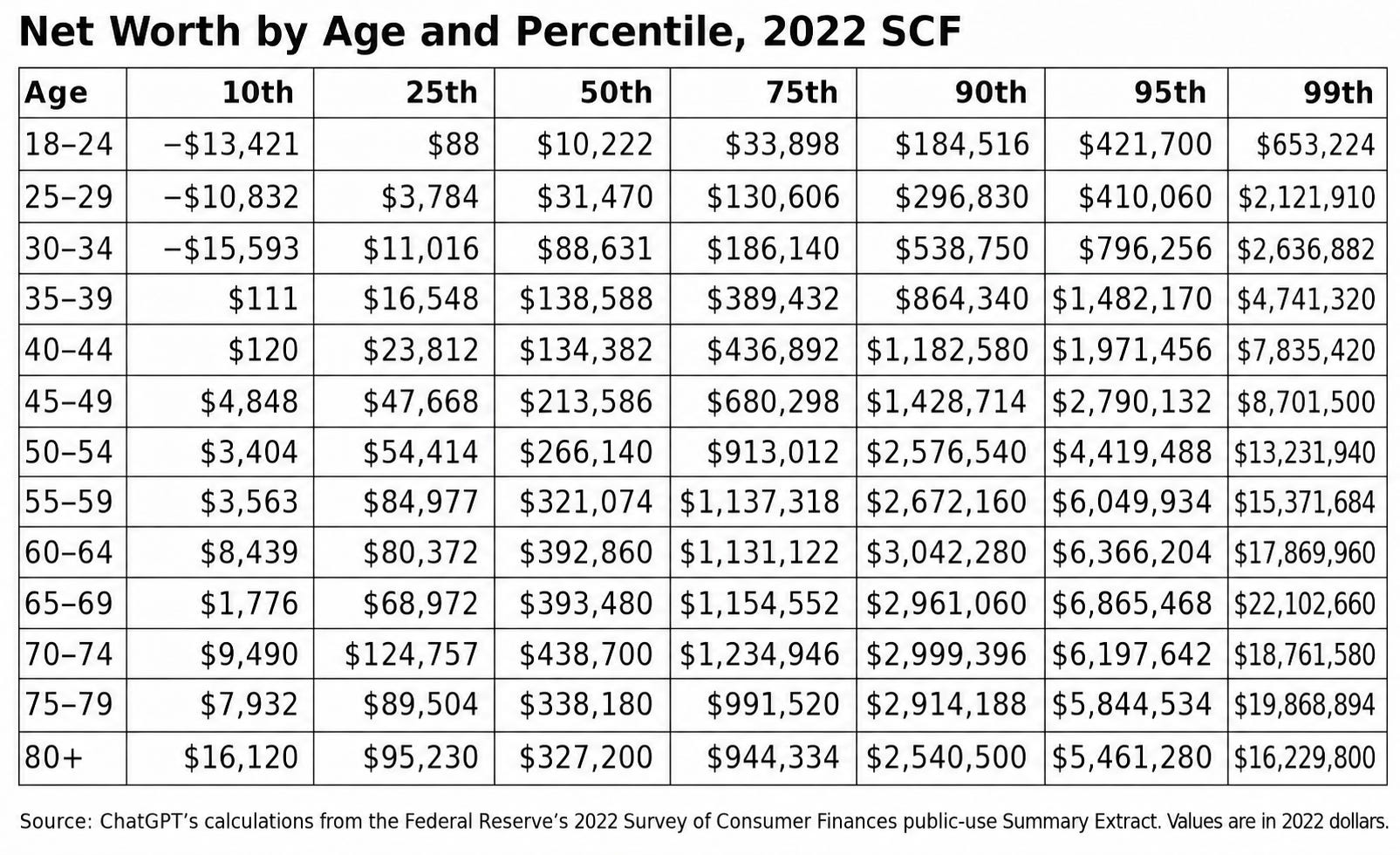
"I’ve been an economics professor for almost 30 years, but I don’t think I’ve ever before seen anything like the table below. I knew that claims that “58% of Americans can’t afford a $1,000 car repair” were laughable clickbait. I knew that — measured by income — the middle class is disappearing… by becoming upper-middle class. But only recently did I start to fully appreciate the chasm between populist pessimism and actual data on Americans’ net worth. From the 2022 Survey of Consumer Finances: 


"Main reflections:

  1. Economists have long known that inequality is relatively low for consumption, medium for income, and high for wealth. What they rarely emphasize, however, is how much wealth depends on age. The richest Americans aged 65-69 are worth about 30x as much as the richest Americans aged 18-24.

  2. Net worth is very high in absolute terms. The median is over six figures by the mid-30s. Americans at the 75th percentile are millionaires by their mid-50s. Americans at the 90th percentile are millionaires by around 40. Claims about middle-class, middle-aged Americans who “can’t afford” eggs or gas or beef are nonsense.

  3. The most sensible argument for worrying about trade deficits is that we’re “living beyond our means.” Trade deficits represent borrowing, and we can’t keep borrowing forever. But given Americans’ extraordinary net worth, the most sensible argument for worrying is still senseless. After 50 years of unbroken trade deficits, we’re wealthier than ever."


Monday, August 31, 2026

Most European Countries that Had Wealth Taxes Have Repealed Them

By David R Henderson. Excerpts:

"According to the OECD, 12 OECD countries had individual net wealth taxes in 1990, and all 12 were European countries. By 2017, only four OECD countries still had them" 

"the likely reason is that they were losing some of their wealthiest residents to other countries that didn’t impose taxes on wealth." 

Sunday, August 23, 2026

Wealth Tax 2.0

By John H. Cochrane. Excerpts:

"If you invest an extra dollar today, how much extra do you get in a year? A 5% wealth tax drags down the rate of return by 5 percentage points. If you earn 10% on your investments, but then pay a 5% wealth tax, you only get a 5% after-tax rate of return. Starting from a 10% return, a 5% wealth tax is the same as a 50% tax on interest, dividends, and capital gains."

"The wealth tax applies on top of corporate taxes, property taxes, and taxes on dividends, interest, and capital gains. Inflation acts as another wealth tax, running 3% a year now. My guesstimate is that the government takes all the return and more."

"Should they (billionaires)  bet the farm on a new venture, investing time and effort as well as their money? Should young Elon Musk take his $175 million PayPal payout and retire on it, or plow it all into electric cars and rockets? We often think of saving vs. consumption here, but I think we underestimate the disincentive to take risk and invest effort that comes from progressive taxation. If the government taxes away the upside to investing, people take less risk." 

"Billionaires do not have a pot of gold that can be costlessly handed out. Billionaires’ wealth stays re-invested in companies. Redirecting their wealth to social spending lowers national investment and raises national consumption, dollar for dollar. That’s not even hidden; it’s the point. But less investment mechanically means less capital for the future, fewer businesses, less productivity, lower wages."

"less investment also drives up interest rates as people with profitable ventures look for investors. Companies could finance investment with foreign money, but that raises the trade deficit"

"Structuring businesses to avoid taxes rather than generate profit might be the most insidious effect of high taxation."

"We have a wealth tax, the estate tax. It tries to charge 40% of wealth once in a generation, or about 1% a year. (You pay double if you pass it to grandkids, so really about once every 30 years.) The estate tax attracts a beehive of perfectly legal avoidance. (Avoidance, not evasion. “Tough enforcement” and audits do nothing here.) Though the estate tax applies above a lowly $11 million, the CBO reports that it yields only $18 billion, or 0.1 percent of GDP. A recent study—by wealth tax backers—reports that the estate tax collects only three to four hundredths of a percent (0.03%–0.04%) annually of the Forbes 400 wealth, not 1% or so."

[the bill] includes “a $3,000 direct payment to every man, woman and child living in a household making $150,000 or less.” $1.1 trillion for Medicaid and Obamacare subsidies. Free dental, vision and hearing. $856 billion of government-provided homes to “abolish homelessness.” A childcare entitlement. A minimum salary for teachers. And so on. This is proudly a bill to turn investment into consumption."

"Free market wealth did not install Putin, nor did it create US crony capitalism under the regulatory state."

"What’s the right question? There is only one question — long run growth. Redistributing Rockefeller’s wealth would not have made your family better off. We’re all immensely better off because of long-run growth. Even if your concern is entirely at the lower end of the economic spectrum, long-run growth is the question. Ask of any policy, what does this do to long-run growth? For the wealth tax, not much!"  

Thursday, August 20, 2026

A Reality Check on the Inequality Panic

Calls for wealth redistribution rest on a faulty premise about inequality

By Chelsea Follett of Cato. 

"Summary: Widespread claims of rapidly worsening global inequality are unsupported by the evidence. Long-term data show significant declines in inequality across income, health, education, and other important metrics, largely driven by rising prosperity in poorer countries. Popular policy proposals to address inequality, such as wealth taxes and expanded foreign aid, are misguided and dangerous. Policies that sustain economic growth and market stability are better guarantors of progress.


Anthropic CEO Dario Amodei called for far higher taxation in a recent blog entry, arguing that current wealth concentration is higher than that of the Gilded Age and is about to get worse globally. The chart-topping singer Billie Eilish implored billionaires to give away their money, while New York City mayor Zohran Mamdani has gone further, opining, “I don’t think we should have billionaires” because we live in “a moment of such inequality.” If anything is having a moment, it is the conviction that inequality has grown urgent enough to justify a muscular policy response.

But the facts don’t support this. Not only has global income inequality fallen over the long run — contrary to the popular narrative — but inequality has also declined in education, health, and a host of other areas. The world is now more equal across a range of factors, from lifespan and childhood survival to internet access and schooling. The more broadly one examines inequality, the more encouraging the data appear. It turns out that even the shock of COVID-19 failed to erase decades of progress toward a wealthier and more equal world.

Indeed, the data show a pronounced decline in global inequality over the past few decades, driven largely by rising prosperity in poorer countries. During the pandemic years of 2020 and 2021, progress slowed sharply. Some indicators stalled and a few modestly worsened. But the gains accumulated before the crisis were not undone.

In short, the damage to human well-being was more limited than many feared. 

Another recent analysis published in The Economist finds that global inequality in consumption spending is falling. In 2000, the richest 10% of humanity spent 40 times more than the poorest 50%. In 2025, they spent around 18 times more. Using data from World Data Lab, they find that the poorest 50% now out-consume the richest 1%, breaking from past trends.

Yet many think that only large-scale redistribution can stop runaway worldwide inequality. Figures as diverse as Amodei, Eilish, and Mamdani are far from alone in embracing this view. Over the past few years, calls for a worldwide wealth tax, a vast increase in foreign aid spending, and other unprecedented measures are gaining steam across academia, non-profits, the press, and international organizations like the United Nations. 

That conclusion is premature. Getting the facts straight is essential, because misunderstanding global inequality can push policymakers toward harmful solutions.

The record on foreign aid is far less encouraging than its advocates suggest: decades of evidence show that aid frequently fails to deliver sustained development and bears no reliable relationship to long-term economic growth. Worse, the fixation on ever larger aid flows often crowds out the harder work of domestic reform. In some cases, foreign aid has been shown to weaken political institutions, entrench bad governance, and slow the process of democratization.

Wealth taxes have their own problems, from high administrative costs and enforcement challenges to low revenue production and invasion of financial privacy. These problems help explain why so many of the countries that have implemented wealth taxes in the past — such as France, Germany, and Sweden— later abolished the tax. Perhaps the worst of all, by discouraging risk-taking, wealth taxes suppress investment and growth, effects that would be felt in both rich and poor countries and would likely prove especially damaging to development in the world’s poorest economies.

Recent work on multidimensional inequality suggests that the world has not been drifting toward ever greater gaps, but that the rich and the poor have been converging in material comfort. Calls for global wealth taxes or massive new aid programs often rest on the assumption that international trade and economic freedom have failed to deliver broadly shared gains. Yet the long-term evidence suggests the opposite.

The pandemic offers two lessons here: First, it highlights just how sensitive progress is to disruptions in markets. It depends on conditions that allow growth to occur and persist, including functioning markets and stable institutions. Many of the proposed policy solutions risk undermining that progress.

The second lesson is that while the pandemic represented a hurdle in the path of progress, the long-term trend toward lower global inequality is holding strong.

Alarmist narratives shape public opinion and encourage policymakers to pursue sweeping interventions that may do more harm than good. A clearer view of the data counsels caution rather than panic."

Sunday, August 16, 2026

There was a huge collapse in wealth inequality in the UK between 1900 and 1980

Tweet from Sylvain Catherine. He is a professor at Wharton, the business school of the University of Pennsylvania. Excerpts:

"If . . .we look at the top 1% . . . there was a huge collapse in wealth inequality in the UK between 1900 and 1980, and basically no change since then. And that is before taking state pensions into account. The same thing is true when you look at the top 10%."

The graph shows the share or percent of total wealth going to the top 1% and the top 10% over time. Those shares fell dramatically.  

Image 


Saturday, August 8, 2026

The McNamara Fallacy Returns: How Inequality Metrics Distract From the Real Causes of Poverty

By David Youngberg. He is an associate professor of economics at Montgomery College. Excerpt:

"Complaints about inequality that rely on political influence are really complaints about cronyism. Cronyism defies easy measurement, but it is what matters, and as long as the focus is on what’s easy to measure, we avoid tackling the underlying issue and the “solutions” just create bigger distortions.

But what about redistribution? Critics of inequality typically pair their concerns with some kind of tax-and-transfer system, and those funds would certainly help struggling families. If you take $1,000 from the rich and give it to the poor, the gap shrinks while the poor’s plight improves. Transfers, funded by taxing the super-wealthy, have a certain logic to them.

Even if the math worked, it’s not so simple. High taxes discourage work and encourage tax avoidance and evasion. The rich spend money on accountants (to find legal workarounds) or lawyers (to defend them if the government catches their illegal workarounds) rather than building new companies and ideas. They eschew high-risk investments when the high rewards that usually go with them are cut to a fraction. Getting rich is sometimes a matter of nepotism or corruption, and sometimes it’s a matter of hard work, thoughtful risk-taking, intelligence, out-of-the-box thinking, and all the things we associate with creating a more prosperous world. Punish that with higher taxes, and society suffers.

Economists call this the equity-efficiency trade-off. The economic pie can shrink as it’s cut more equally, so redistribution can leave the poorest people worse off, not better.

There are super-rich people who got their wealth completely from cronyism, and there are super-rich people who made their fortunes completely by creating and investing in things that make society wealthier. Most are in the vast gray area between: they have created companies that genuinely improved people’s lives but have also used governments to secure protections against competition. How much of each billionaire’s wealth grew the economic pie and how much was due to cronyism? The answer is as hard to measure as Viet Cong morale.

When the emphasis is on the gap between the rich and poor, hurting “the rich” becomes a goal in itself and leads to misidentified threats and misplaced efforts. For example, it’s not just the rich that benefit from cronyism. Occupational licensing restricts competition in jobs nowhere near the top of the income ladder: cosmetologists, taxi drivers, athletic trainers, travel guides, and countless others all drive up prices for everyone, low-income households included.

Unfortunately, tackling this particular problem won’t shrink the income gap because licensed salaries don’t reach the stratosphere. As long as anger is directed at the big numerical gaps, this very real problem doesn’t resonate. But taxing the super-rich, the very-rich, or even the somewhat-rich will “improve” inequality even as investment predictably falls. Inequality metrics decrease as the stated goals are quietly ignored. 

Progressives often tout Europe’s low income inequality as evidence of the success of its generous social programs and broad, heavy taxes that pay for them. Those taxes, paired with a mangled mess of regulation, also stifle entrepreneurship and stunt firms that would otherwise grow. The end result is sobering. After factoring in both taxes and benefits, including health benefits, the median incomes of the largest European economies are 14 to 45 percent lower than America’s. Income might be more equal, but the typical person is worse off.


The focus on shrinking the measurable gap makes it harder to achieve much-needed regulatory reform. Robin Hood policies of redistribution might not help the poor, but they will definitely reduce inequality, and as long as that’s what’s prioritized, the real problems linger." 

Friday, August 7, 2026

The Deadly Focus on Income and Wealth Inequality

Wealth Inequality, Sylvia Nasar, Jeff Bezos, Elon Musk, Bernard Madoff, LBJ

By David R Henderson. 

"Readers under age fifty-five might not realize this, but economic inequality was not a large issue in American political discussions until 1992. After that year, discussions of the issue ebbed and flowed. So much of what has been said by opponents of inequality is simple assertion. What has been missing in the statements of those who want government to reduce inequality is much information about why it exists and any sense of why some kinds of inequality are good.

Unfortunately, a single-minded focus on reducing inequality will lead to bad outcomes, even death. That conclusion follows from standard economic reasoning about the causes of economic growth. Reducing inequality by lopping off wealth from the wealthiest would lead to less economic growth; lower economic growth makes death rates higher than otherwise.

You might think that the focus on wealth inequality has come about because of the huge growth in wealth of the 100 or so wealthiest people in the world, many of whom live in the United States. While that surely has made the issue more prominent, the upset about inequality began well before that. I date it at 1992. In 1992, Jeff Bezos, whose wealth is close to $300 billion, had not yet even started Amazon, the source of his wealth. He and his then-wife MacKenzie Scott started Amazon two years later, in a rented garage. In 1992, Elon Musk, now the world’s wealthiest man, was a twenty-one-year-old undergraduate at Queen’s University in Kingston, Ontario, who was about to transfer to the University of Pennsylvania.

So, if not the wealth of Bezos and Musk, what did lead to the focus on economic inequality? Two key factors were an article in the New York Times and a politician running for the Democratic nomination for president who picked up on that article.

The New York Times article was reporter Sylvia Nasar’s “The 1980’s: A Very Good Time for the Very Rich,” March 5, 1992. In that article, Nasar reported data from the Congressional Budget Office on income gains at various percentiles of the income distribution. She quoted Paul Krugman’s exaggerated statement that “it [the additional income from a growing economy] all went to the very top.” As a good reporter, she also gave balance. She quoted Lawrence Lindsey, who, in his book The Growth Experiment, had noted that the early 1980s drop in the top federal income tax rate from 70 percent to 50 percent encouraged high-income people to use fewer tax loopholes and thus show more taxable income on their tax forms. One important example, which Nasar didn’t mention, was municipal bonds. Interest on those bonds was exempt from the federal income tax and so that interest income was not reported on tax forms. But when the top rate fell to 50 percent, high-income people shifted much of their investment away from tax-exempt municipals to other investments whose income was subject to the federal tax. The income from those investments showed up on their tax forms, making it look as if their income had risen substantially; in many cases, it hadn’t.

These are the opening paragraphs of my latest Hoover article, “The Deadly Focus on Income and Wealth Inequality,” Defining Ideas, August 6, 2026.

And:

The other main myth is that the rich don’t deserve their wealth. It’s true that a small percent of them didn’t or don’t deserve their wealth. If they obtained their wealth through fraud or by using the political system to get special treatment, then they are undeserving. Exhibit A for someone who got his wealth through fraud is Bernard Madoff, who ran a Ponzi scheme to take wealth from strangers and even from friends.

Exhibit A of someone who got his wealth as an insider in the political system is Lyndon B. Johnson. In the 1940s, after he had defended the budget of the Federal Communications Commission, an official at the FCC suggested that the Texas congressman’s wife buy a license to operate a radio station in the Austin market. She did so and only a few weeks later, applied for a better part of the spectrum and for longer hours of operation. Both requests were granted within weeks. The FCC also was slow to grant licenses for other radio stations to compete in the lucrative Austin market. By the time LBJ ran for president in 1964, the market value of his and his wife’s net worth was between $9 million and $15 million, over half of which was the value of their media holdings. To put that in perspective, $14 million in 1964, when adjusted for inflation, would be $151 million today."


Saturday, July 25, 2026

The Myth of the Free-Riding Billionaire: Ray Madoff’s ‘The Second Estate’

In her new book, Ray Madoff argues that America’s wealthiest exploit the tax code at the public’s expense. But her critique understates both what the rich pay and what they produce.

By Paul Mueller of AIER. 

"Wealthy professionals can be strident egalitarians or naive optimists about the benefits of government spending — or so it would seem after reading law professor Ray Madoff’s book The Second Estate: How the Tax Code Made an American Aristocracy. 

Madoff clearly has an axe to grind against America’s wealthiest citizens, and she is deeply critical of the legal mechanisms they use to protect and transfer their assets. Her argument often seems to boil down to this: Why should wealthy Americans keep so much of their wealth for personal use rather than allow the public — or, more specifically, Congress — to decide how those resources should be spent?

Yet The Second Estate is no low-brow polemic. Professor Madoff knows federal tax policy well, and her explanations of the tax code and the ways wealthy individuals use it are often insightful. My disagreement is not with her description of the mechanics of taxation, but with her underlying assumption — at times explicit, at times implied — that concentrated wealth is inherently harmful because it deprives the federal government of resources.

The wealthiest Americans pay hundreds, thousands, or even millions of times more in taxes than the average taxpayer. More importantly, the companies they create and build make the country more prosperous and generate enormous tax revenues in the process.

This should be obvious upon reflection. The businesses created, owned, or led by members of the Forbes 400 employ millions of people and generate tens of billions of dollars in federal tax revenue each year.

Yet The Second Estate presents a very different picture: a special class of Americans who exist above the reach of the tax code and avoid contributing their fair share to government revenue. We can set aside the questionable assumption that more federal revenue is automatically beneficial for most Americans. The deeper flaws in Madoff’s argument stem less from what she says than from what she leaves out about the super-wealthy.

Myths About the Rich and Taxes

Professor Madoff is correct to distinguish between different types of federal taxes. Income from dividends, interest, and the sale of assets (capital gains) is generally taxed differently — and often at a lower rate — than income earned through wages.

Long-term capital gains and qualified dividends are typically taxed at rates of 0, 15, or 20 percent, depending on income level, while wages are subject to both income taxes and payroll taxes. Employees pay 7.65 percent in Social Security and Medicare taxes through FICA, and employers pay another 7.65 percent. Capital gains, by contrast, are not subject to payroll taxes.

As a result, a billionaire’s effective federal income tax rate can be lower than that of an employee earning a middle-class salary. Madoff correctly explains how these differences affect taxpayers who receive income through wages versus those who receive income through investments.

Suppose Adam is self-employed while Betty receives all of her income from dividends and long-term capital gains. The following table illustrates how their federal tax burdens would differ at income levels of $80,000, $160,000, and $320,000.


Madoff explains how wealthy individuals often borrow against their assets rather than sell them. They don’t pay taxes on those loans (though they do pay interest). This is true. Sometimes individuals with a net worth of tens or hundreds of billions of dollars will report little or no income in a year because their “salaries” or wages are very small and they didn’t realize any capital gains.

But the fact that the ultra-wealthy can avoid paying federal income taxes some years does not mean they avoid them altogether. They have to pay down their loans and lines of credit periodically. And if they want to make exceptionally large purchases or investments, loans from banks are not enough. Then they must sell shares, realize gains, and pay taxes. The super-wealthy undoubtedly pay far more dollars in taxes than any middle-class or upper-middle-class individual.

Elon Musk, for example, famously paid about $11 billion in income taxes in 2021. This particular tax bill was anomalous both for its size and because the IRS taxed much of it as ordinary income at a high tax rate. Musk had a huge block of his stock options that he had to exercise or lose. Yet even if those were the only income taxes he ever paid over the course of 50 years, that would still come out to ~$200 million in taxes annually — far more than any but the very wealthiest Americans earn over their lifetimes, let alone what they pay in income taxes. 

Most of the super-wealthy find ways to pay lower rates on their income. Still, many wealthy individuals pay vast sums, in the tens or hundreds of millions of dollars, annually on dividend income (Steve Ballmer pays approximately $250 million every year). There are also large one-time tax payments from capital gains. Ken Griffin paid roughly $4 billion in 2021, Jeff Bezos paid about $2 billion in 2020 and 2021, Jensen Huang paid more than $100 million in 2024 and 2025, and Tim Cook paid roughly $300 million in 2021. 

Even accounting for the payroll taxes paid by ordinary wage earners, these tax payments represent the equivalent of thousands upon thousands of “Adams” paying federal income taxes. And this is where the shortcomings of Professor Madoff’s argument become clear.

Her account gives the impression that the ultra-wealthy largely avoid taxes because their effective tax rates are often lower relative to their income or wealth. While wealthy individuals certainly have ways to reduce their tax liabilities and structure their assets efficiently, it is inaccurate to suggest that they simply avoid paying federal taxes. 

It is also misleading to ignore the many other taxes the super-wealthy pay. 

They pay property taxes on their land and houses every year. In places like Los Angeles and New York City, those tax bills can reach hundreds of thousands or even millions of dollars. They pay taxes when they shop, dine, or travel. They pay transfer taxes, building fees, development fees, and a host of other taxes and charges. 

That is hardly “free-riding” on the tax system — especially when they pay many times (10, 100, or even 1,000 times more) than the average taxpayer while consuming nowhere near that proportion of government services. 

The Wealth Creation the Tax Debate Ignores

Even this oversight, however, misses the most important contribution of the super-wealthy to society: wealth. Focusing on how much Elon Musk or Jeff Bezos or the Mars family pays in personal income or other federal taxes in a specific year is a red herring. It is a rounding error compared to how much wealth their companies have generated for shareholders and how much tax revenue they have generated. Focusing on the corporate income taxes paid (or not) by individual companies makes similar mistakes. 

Consider Tesla. Over the past five years, the company has reported relatively little federal income tax liability (about $48 million in 2023) despite nearly $20 billion in net income. This is largely because Tesla has carried forward previous losses, invested heavily in new capital, and benefited from certain green energy and research-and-development tax credits. Yet Tesla employs roughly 134,000 people. If the average wage for those employees is $100,000, the company would pay more than $1 billion annually in employer-side FICA taxes alone. Employees would pay another $1 billion-plus through their share of payroll taxes — not including the income taxes they pay.

Those figures are small compared to what Amazon (1,100,000 employees), Apple (90,000 employees), Meta (45,000 employees), and Alphabet (115,000 employees) pay in FICA taxes — over $10 billion annually for the employer share alone.

Madoff’s quixotic crusade against dynastic or family wealth is just that — tilting at windmills. Only a quarter or so of people on the Forbes 400 list inherited the majority of their wealth. And that number gets smaller as you move to the top 100 and then the top 50. Inherited wealth can only last if it remains invested in companies rather than cashed out or spent. For every example of inherited wealth growing, there are more examples of inherited wealth becoming depleted.

Who Owns Wealth?

All of this raises a basic question: Why should we care that families such as the Mars, Walton, or Koch families possess wealth they can pass on to future generations?

Madoff argues that the wealthy “free-ride” on the tax system. But this assumes their money somehow already belongs to the government or the public.

It does not. 

Madoff also suggests that the super-wealthy exercise undue political influence from the shadows. In this, she leaves the solid ground of analyzing existing tax rules and mechanisms to the ideological concerns and disapproval she has for large concentrations of wealth in general.

Could the tax code be fairer and better than it is? Certainly. Will her specific recommendations make it so? I’m not sure. But will politicians implement her “ideal” policies? Assuredly not. 

Besides raising revenue, the tax code should distort and discourage economic activity as little as possible. While everyone benefits from clear rules of the game that promote competition and responsibility, it’s far from clear that they would all benefit from more “tweaks” to the tax code to close loopholes. Revenue with minimal distortion, not leveling the fortunes of the super-wealthy or making sure they pay their “fair share,” should guide tax policy.

Lobbyists, insiders, and wealthy individuals have certainly influenced the tax code for their own benefit. But so have middle-class homeowners through mortgage deductions, residents of high-tax states through state and local tax (SALT) deductions, and lower-income Americans through welfare programs and tax credits. This is how the political game is played. 

Rather than criticizing the super-wealthy for minimizing their tax liabilities as best they can, policymakers should focus on reducing government spending so that everyone else’s taxes can be reduced too. Reducing political power, limiting the coercive reach of the state, and allowing individuals to keep more of what they earn would do far more to improve Americans’ lives than taking more money from the wealthy and giving it to politicians.

Such broad-based reforms would also be more just."

Tuesday, July 14, 2026

How Government Spending Enriches the Wealthy

Covid relief programs and easy Fed policy inflated the value of assets such as stocks and real estate

By Vivek Ramaswamy. Excerpts:

"When Washington floods the economy with borrowed and freshly printed dollars, the money flows first into assets owned by the wealthiest Americans—stocks, bonds, real estate. Six relief laws pushed roughly $4.6 trillion out the door in the bipartisan response to the pandemic. The Federal Reserve cut interest rates to zero and more than doubled its balance sheet, from about $4 trillion to nearly $9 trillion.

Only some of that money reached working-class Americans. Economists at MIT found that about a quarter of the $800 billion from the Paycheck Protection Program went to workers who would have lost their jobs. Three-fourths landed in the top fifth of households by income, at a cost of $170,000 to $257,000 per job-year saved—a regressive windfall. The student-loan payment pause tells the same story: It has cost well over $200 billion and—because higher earners carry the biggest balances—most of that relief went to white-collar professionals.

As big government pumped money into the economy, assets boomed: The stock market has roughly tripled from its March 2020 low. The wealthiest 10% of households own 89% of all stocks, according to 2021 Federal Reserve data. The top 1% gained more than $6.5 trillion in equity wealth during the pandemic, while the bottom 90% added just $1.2 trillion. The wealth share of the top 1% hit a record high in mid-2021, and American billionaires’ fortunes swelled by roughly 70%."

"Consumer prices peaked at 9.1% in June 2022, with inflation growing at its fastest pace since 1981. Groceries rose 12.2% in a single year and gasoline nearly 60%. As paychecks lagged, real wages fell—down 3.6% over the year ending in June 2022"

"a post-pandemic property tax that hit states like Ohio hard. The only meaningful asset most middle-class Ohioans own is their house, and home prices in Ohio rose over 25% between 2020 and 2022. That paper gain was a financial curse for families intending to stay put: While real income remained flat, tax bills went up. Ohio homeowners absorbed, in 2023, the largest reappraisal shock on record. One analysis found the increase was more than seven times the size of the previous cycle’s, averaging nearly 35%." 

Tuesday, July 7, 2026

Did median wealth in the U.S. fall nearly 20% from 2020-2025?

See The U.S. Added 1,200 New Millionaires a Day Last Year by Miriam Gottfried of The WSJ. Excerpt:

"While average wealth per U.S. adult climbed by almost 10% between 2020 and 2025 net of inflation, median wealth fell by nearly 20%."

This was based on a report from UBS, A Swiss multinational investment bank and financial services firm (according to Wikipedia). 

But I am skeptical. I looked at some data from the Federal Reserve on the wealth of the bottom 50% over these years and even if we adjust for population growth and inflation, it is clear that per person wealth of the bottom 50% has gone up over these years (and it is possible that the numbers at the Fed site are adjusted for inflation but it just does not say).

The Fed site is Distribution of Household Wealth in the U.S. since 1989. (Hat Tip to Timothy Taylor for this link-his blog is The Conversable Economist).

This graph shows that wealth for the bottom 50% in the U.S. about doubled from $2 trillion in 2020 to $4 trillion in 2026


It might be hard to see but it does say "Bottom 50%." You can got to the link and select bottom 50% to see for yourself. They also have an option to see a table with these numbers. This link will take you directly to the table.

In the 2nd quarter of 2020, the bottom 50% had $2.21 trillion in wealth. In the 2nd quarter of 2025 it was $4.13 trillion. So it was up 87%. The U.S. was up just 3.3%. See US Population by Year.

So if the total is up 87% and the number of persons is up just 3.3%, the wealth per person must be way up. And this is for the bottom 50%. Median means that half are below a certain number and half are above. The article says the median wealth went down. But that seems unlikely if the per person wealth of the bottom 50% is up.

If we adjust for inflation (and the numbers might have already been adjusted, I just can't tell), let's use the CPI increase of 24% from 2020-25. See Consumer Price Index Data from 1913 to 2026. I got the % increase by using the yearly average for each year.

So let's reduce the $4.13 trillion wealth owned by the bottom 50% in the 2nd quarter of 2025 by 24%. That gets us about $3.14 trillion. That is 42% higher than the $2.21 trillion in the 2nd quarter of 2020. Which is still much higher than the 3.3% increase in the U.S. population. That means per capita wealth increased for the bottom 50%. That makes me skeptical that the median wealth went down.

Friday, June 26, 2026

Is Entrepreneurialism Bad?

By David R. Henderson. Excerpts:

"Imagine a product that costs $1.80 to make and sells for $2. Imagine also that the average household in America buys one of these items per week. There are approximately 134 million households in America. That means that in a given year, US households will buy 6.968 billion units and will spend $13.936 billion on this product.

Then along comes an innovator who has figured out how to produce the item at a cost of only $1.50 per unit. The innovator would ideally like to have a patent and might well get a patent. But even if he doesn’t, it will take time for competitors to notice his innovation, figure out how it works, and implement it. Let’s say it takes a year. For products with a complicated production method, that could well be an underestimate.

What will the innovator do during that year? Cut price? Maybe a little but not much. For one year, all his competitors are using a method that costs $1.80 per unit and are charging $2.00. What the innovator could do is cut the price to, say, $1.90 per unit and take a large share of the market. Let’s say he takes half the market. Then 67 million households will buy 3.484 billion of his units and will spend $6.62 billion on his product.

On each unit, the innovator makes 40 cents, the difference between the price of $1.90 and the cost of $1.50 per unit. For that year, therefore, he will make $1.394 billion. Voila! He’s a billionaire."

"Starting a successful startup is the most common way to become a billionaire"

a 2004 study he (Nobel prize winner William D. Nordhaus) wrote for the National Bureau of Economic Research, Nordhaus wrote:

Only a minuscule fraction of the social returns from technological advances over the 1948–2001 period was captured by producers, indicating that most of the benefits of technological change are passed on to consumers rather than captured by producers.

How minuscule? 2.2 percent. The remaining 97.8 percent of the gains from innovation go to consumers."

"Once other competitors imitate the innovator, the price falls and the unusual gains to the innovator go away. Consumers then get the benefits from the innovation year after year." 

Sunday, June 21, 2026

Who Wants to Be a Trillionaire? The SpaceX IPO is a credit to Elon Musk and American capitalism

WSJ editorial. Excerpts:

"The company raised $75 billion in its public debut, nearly three times more than the previous largest IPO (Saudi Aramco in 2019). It will need that money and multiples more to achieve Mr. Musk’s ambition of colonizing Mars and mining asteroids."

"Mr. Musk’s wealth largely consists of shares in SpaceX and Tesla."

"Mr. Musk’s wealth is a tribute to U.S. entrepreneurship and innovation, which are byproducts of its free-market system."

"Mr. Musk, an immigrant from South Africa, launched the rocket company in 2002 with money he made from his PayPal startup."

"NASA awarded SpaceX a contract to supply the International Space Station. SpaceX later developed reusable rockets that greatly reduce launch costs"

"Its success, which came through trial and failure, has ended U.S. reliance on Russia to transport astronauts to the space station and launch American satellites."

"In 2015 SpaceX launched Starlink, an internet satellite company that has helped Ukraine resist Russia’s invasion and dissidents living under authoritarian regimes like Iran to communicate."

"SpaceX has created thousands of jobs in working-class communities"

"Its workers . . . receive stock options, which has allowed them to share in the company’s success." 

"the IPO has made millionaires of 4,400 SpaceX current and former employees" 

The Deceptive Statistics Behind California’s Wealth Tax

Saez and Zucman have spent years using dubious assumptions to push the case for confiscation

By Phillip W. Magness. Excerpts:

"For years the pair (Emmanuel Saez of UC Berkeley and Gabriel Zucman of the Paris School of Economics) have relied on selective accounting methods and questionable assumptions to tilt the scales in favor of confiscatory wealth taxes."

"Under the U.S. system, taxes are generally assessed on income earned over the course of a year. Since 1920, federal tax law has followed the realization principle, meaning that income must actually be realized as earnings before it can be taxed. Messrs. Saez and Zucman instead propose taxing estimated changes in a person’s net worth—including unrealized capital gains that exist only on paper. If a billionaire’s stock portfolio rises in value, they want to tax the appreciation even if the assets are never sold."

"Unrealized gains are notoriously volatile and speculative. They can disappear overnight with a market downturn. Federal courts have long viewed taxes on unrealized gains as constitutionally dubious"

"The underlying wealth estimates are deeply unreliable. Because billionaire tax returns are private, Messrs. Saez and Zucman rely heavily on outside estimates of billionaire wealth. One of their favorite sources is the Forbes 400 list."

"wealthy Americans to exaggerate rather than minimize their fortunes"

"these estimates are systematically inflated."

"the pair has repeatedly asserted that the ultrarich pay a combined federal, state, and local tax rate of only 23%, supposedly lower than the 24% working-class Americans pay."

"Messrs. Saez and Zucman’s own earlier research told a very different story. In a 2018 paper published in the Quarterly Journal of Economics, their own data files showed that the top 0.001% pay an average combined tax rate of roughly 41%."

"they changed their approach and assigned the full burden of the corporate tax to shareholders alone."

"this maneuver dramatically lowers the apparent tax rate paid by billionaires." 

"they artificially inflate the tax burden borne by lower-income Americans . . . omit the EITC from their calculations."

"Jason Furman finds that the bottom 20% of Americans face an overall combined tax burden of approximately 11%"  

Thursday, June 18, 2026

Should we worry about the influence that wealthy individuals have on politics?

See Matt Zwolinski Makes Emmanuel Saez’s Error by David Henderson.

Mr. Henderson pointed out that many of Zwolinksi's examples were of corporate influence, not individual influence. And there is plenty of influence from unions like the NEA.

Excerpt:

"There were so many things to pursue here. I’ll take two. First, I live in a highly NIMBY area and I don’t notice that particularly wealthy people dominate the discussion in favor of hampering housing construction. If anything, the wealthiest people in the debate tend to be developers who want to build.

Second, Matt is quite comfortable taking away wealthy people’s money with the estate tax, which really is a death tax. What would he feel comfortable taking away from teachers and their unions so that they would be less effective in pushing in an anti-liberty direction? Their freedom of speech? I doubt it, but I don’t know his answer.

But making those points takes us away from my main point, which is that most of the lobbying is done by corporations, not wealthy individuals. There is little doubt that Disney, to take his example, would have lobbied heavily for the extreme extension of copyright even if no Disney shareholder had been particularly wealthy.

While researching my next article for Hoover, I came across something I wrote in which I had linked to a discussion in which Larry Summers asked the same question of Emmanuel Saez. Saez had failed to make the simple distinction between high-market-value corporations and wealthy people. Go to this link and follow Larry’s reasoning from the 1:06:00 point on. It’s masterful. Larry calls on Saez to give one example of a wealthy person having much less political power because the government has reduced his wealth from a very high number to a lower, but still very high, number. When Saez answers, he gives an example of a corporation, just as Zwolinski responded to me.

There is one way in which Zwolinski probably has more understanding of the relevant economics than Saez does. At the 1:10:10 point, Saez mentions robber barons as if it’s a slam dunk, showing that he doesn’t understand that the major characters listed as robbers and barons were neither. (Other than that, it’s a great expression.) My guess is that Zwolinski understands the true facts about robber barons better than Saez does."

Wealth tax equilibrium accounting

By John H. Cochrane.

"The recent Piketty-Saez-Stiglitz revival of wealth taxes, ostensibly to improve the lot of the poor, makes many mistakes. I’ll focus on one: the difference between wealth and consumption. The poor wish consumption. Turning capital into consumption must destroy the capital that produces consumption. Taxing wealth in the name of inequality will make the world, including the poor, much poorer.

Why should billionaires live high on the hog while so many still live such wretched lives? “Tax the rich, feed the poor / Til there are no rich, no more” sang the rock band 10 Years After in 1971. It’s a centuries-old answer looking for new questions. (They made a lot of money on that song! The song is more like Lennon’s “Revolution,” expressing some skepticism. I remembered the lyrics as “till there are no poor no more,” but the actual lyrics are more accurate descriptions, both of the intention and the likely effect.)

However, the vision of high lifestyle amid destitution imagines great inequality of consumption. The current outrage, and demand for confiscatory taxation, is over inequality of wealth. (And that, largely mark-to-market wealth driven by high prices.) There is a big difference.

The hard fact: Our billionaires, and now trillionaire, own wealth that is almost exclusively stock in companies they created. That wealth is almost entirely left reinvested in those companies. And the companies produce great products, innovate, and employ thousands. Just what is the problem, you might ask, but that’s not our point today.

For example, suppose Elon Musk consumes $10 million a year. It’s hard for any human to consume that much. Still, that’s 1/1000 of 1% of a trillion. At 10% per year, Musk earns that much in less than an hour.

The wealthy do not swim in Scrooge McDuck pools of money that can be handed out. And even if they did, that money, redistributed, would swiftly drive up prices rather than feed everyone. Musk’s trillion is not the ready inventory of a huge grocery store that can be handed out to feed people. And if it were, once the store was empty, the poor would be hungrier again, and there would be no store to buy from.

What would the government do if it took over Musk’s SpaceX stock? At best, the government would use SpaceX earnings to buy and hand out, say, food, rather than invest in the company. Others must then produce food and not rocket ship parts. That means reorienting the productive capacity of the economy away from investment and to consumption. It means less capital going forward. Certainly no rocket ships or AI, and all the benefits those stand to bring.

But most of SpaceX value is not a stream of profits like a railroad’s. Most of its market value is investor’s hope that in the future SpaceX will dream up new and profitable ventures. That value would go poof the minute the government took it and stopped investing. It may go poof anyway.

Perhaps you think the government, by taxing Musk and demanding cash, can force Musk to sell his stock to others who won’t implode SpaceX’s value. But where do others get money to buy SpaceX stock? In the end, it must come from other company’s earnings that won’t be invested in other companies. Again, the economy reorients from investment to consumption. Tax the rich feed the poor, till there are no businesses no more.

Perhaps you think the government can manage SpaceX “for people, not for profits.” It used to. And NASA, though one of the best government agencies, was never able to do what SpaceX can do. Socialism never did turn much of a profit for consumers.

The world’s rich consume very little of their wealth. The worlds’ poor consume a lot of whatever they have. Being poor is not fun. If we split up Musk’s $1 trillion and gave about $100 in Tesla stock to each of the world’s nearly 10 billion people, it’s a good bet they would not be content to consume only 1/10 of a cent extra per year.

There are plenty of other reasons that wealth taxation will not help. Even the billionaires’ wealth, even if it could be transferred and consumed without destroying the seed corn of our economy, is trivial. 


This is simply false, and innumerate. 15% of a Trillion is $150 billion. The US alone spends $1.8 Trillion on anti-poverty programs each year, to little effect. (Wolfgang Richter is probably a parody account but alot of people have been saying things like this-CM)

The biggest reason it will not work is the simple one: incentives. If you tax wealth, you tax the activities that create wealth.

Taxing billionaires is not enough. Piketty, Saez, and Stiglitz now want the rest of us to “degrowth” in order to transfer resources to the poor. That doesn’t add up either. Degrowth means producing less too. What are the poor to eat? Penury and depopulation used to be embarrassments of the socialist left. I guess they now features.

I too would love to raise the prosperity of the world’s poor. The goal is not the issue. The issue is whether the wealth tax will help or hurt.

What helps? This graph from Max Roser at Ourworldindata makes the point beautifully: 


The x axis is GDP per capita, not time. The y axis is the share living in extreme poverty. In fact, our lifetime has seen the greatest decline in global inequality and global poverty ever seen. What helps the poor? Growth. Capitalism and growth. Degrowth and wealth taxation will push us right back up that slope."