Showing posts with label Systems. Show all posts

Tuesday, June 9, 2026

Free market policies lowered poverty in Peru

See The Left Aims for an Andean Comeback by Mary Anastasia O’Grady. Excerpt:

"Peru’s shift over the past 20 years toward policies that support open markets, private initiative and macroeconomic stability has dramatically improved living standards. The share of Peruvians living below the poverty line fell to 25.7% in 2025 from 58.7% in 2004." 

Saturday, May 23, 2026

The Case Against Socialism, Part V

By Dan Mitchell. Excerpts: 

"here is the most compelling comparison of a pure socialist economy and a mostly capitalist economy."


The chart is based on the Maddison database, and there are data gaps during World War II as well as several decades of missing North Korean data.

But the lesson is blindingly obvious. South Korea has become a rich nation while North Korea is mired in grinding poverty. Heck, you can see the difference from outer space.

It makes the East Germany-West Germany comparison seem trivial by comparison.

South Korea is definitely not perfect and its long-run outlook is worrisome because of demographics.

But pretty good is definitely better than totally awful.

Another win for capitalism over socialism.

You can peruse previous editions in this series by clicking here, here, here, and here."

Tuesday, February 10, 2026

Moving from socialism to capitalism greatly improved Poland's economy

See Poland’s Economy Set to Enter Global Top 20 Following Another Strong Year by Don Nico Forbes of The WSJ. Excerpt:

"Poland’s economy topped $1 trillion last year, punctuating a decades-long boom that is in stark contrast to the faltering economies of its much bigger European neighbors.

The milestone, confirmed by data released Friday by the country’s statistics agency, likely lifted Poland into the world’s top 20 economies for 2025. It is expected to supplant Switzerland, which hasn’t yet released its end-of-year tally. Poland now sits right behind No. 19 Saudi Arabia’s $1.3 trillion economy.

Three-and-a-half decades ago, under an isolated communist regime, the purchasing power of an average Pole—adjusted for local prices—was on par with Jamaica. Now, it’s higher than Japan."

Sunday, November 30, 2025

The Soviet men who controlled the country weren’t always so keen on encouraging or even maintaining radical egalitarianism

See The World’s Greatest Feminist Experiment Was Not Where You’d Think: In “Motherland,” the journalist Julia Ioffe charts the Russian campaign to emancipate women — and the country’s failure to live up to that promise by Jennifer Szalai. Excerpt:

"But as “Motherland” also shows, the Soviet men who controlled the country weren’t always so keen on encouraging or even maintaining radical egalitarianism. And when they were intent on so-called equality, it was often to punish women because of their connection to men who happened to run afoul of the Kremlin. In Kazakhstan, the Akmolinsk Camp for Wives of Traitors to the Motherland was just one node in the sprawling network of the Gulag. Children born in captivity were sent to an orphanage where they were sometimes so neglected that they didn’t learn how to speak. One mother compared the sounds such children made to “the muted moans of pigeons.”

Having children, it turned out, would be a consistent obsession of the Soviet regime. Abortion was legalized, then outlawed, then legalized again. Stalin introduced a tax on childlessness. After the demographic disaster of World War II, the new superpower needed an expanding population. Ioffe notes that Stalin’s strategy for development relied mostly on “vast human sacrifice.” Men would make the big political decisions, while women would make more babies: “They would give up their sons for the country, pretend their children were heroes rather than cannon fodder, and when those sons fell in battle, they would have more.”

Alongside this official history, Ioffe traces a private one. One of her great-grandmothers survived a pogrom. Another, the pediatrician, was forced by the secret police to work at a military hospital during World War II. The women in her family would eventually learn that their stellar professional achievements did not mean a break from domestic work.

As the Soviet economy sputtered in the 1970s and ’80s, a dearth of consumer goods also made household tasks infinitely harder. It was impossible to procure disposable diapers or washing machines. (Politburo wives, by stark contrast, had access to special stores filled with otherwise scarce goods at discounted prices.) Women with Ph.D.s and full-time jobs spent their evenings pickling mushrooms and mending clothes. Even basic menstrual products were scarce."

Tuesday, July 15, 2025

The Lure of Comrade Mamdani

He says he respects differences. His radical utterances indicate otherwise.

By Mary Anastasia O’Grady. Excerpt:

"Before Castro’s communist revolution, Cuba had the fifth-highest per capita income in the Western Hemisphere, where it ranked third in life expectancy. Its literacy rate of 76% was the fourth highest in Latin America.

In the 1950s, according to a 2005 PBS documentary, “Cuba ranked 11th in the world in the number of doctors per capita. Many private clinics and hospitals provided services for the poor. Cuba’s income distribution compared favorably with that of other Latin American societies.”

Today the island has dire shortages of food, medicine, housing and doctors, crumbling hospitals, recurring blackouts and a shrinking population.

In the 1920s Argentina was one of the world’s top 10 economies. The Great Depression of the 1930s destabilized Argentina’s democracy, and the country began to turn away from market economics. PerĂ³n was a fascist demagogue who undermined republican ideals in the name of the people. He died in 1974, but repeated bouts of peronismo, during military and civilian governments, have long haunted the country. By 2023 the breadbasket of South America was a basket case. People were eating out of trash bins on the streets of Buenos Aires, a once-glorious city."

Tuesday, July 8, 2025

Zohran Mamdani Wants New York City to Try Real Socialism

If AOC’s candidate defeats Andrew Cuomo in Tuesday’s mayoral primary, we’ll know who owns today’s Democratic Party

By Thomas McKenna of The WSJ. Excerpts:

"The city already prevents landlords from raising the rent more than a token amount on these units each year."

"The city’s rent-stabilization program already makes it impossible for some landlords to cover their costs. Others find it cheaper to leave apartments empty if needed repairs aren’t worth the investment. Tens of thousands of rent-stabilized units sat vacant in 2023, according to U.S. Census data. More will be empty if landlords can’t pay their mortgages, and tighter supply pushes prices up."

"no-cost public transit tends to attract more crime, homelessness and soliciting. Officials in Portland, Ore., cited upticks in each when they ended fare-free rides downtown in 2010." 

Saturday, October 12, 2024

Ordinary People Lose with European-Sized Government

By Dan Mitchell.

"There are three important things to understand about Western Europe.

Today, let’s further look at what we can learn from Europe.

Adam Michel of the Cato Institute authored a new study that compares Europe and the United States.

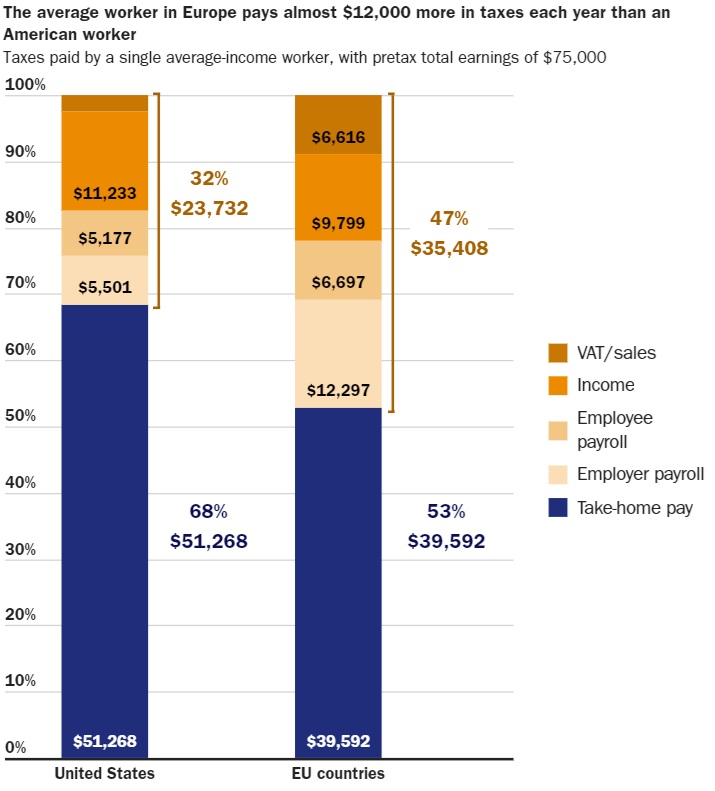
As part of his report, he calculated that the a middle-class European pays nearly $12,000 more in taxes than an American at the same income level.

The huge gap is due mostly to Europe’s value-added taxes and employer payroll taxes (which companies pay on behalf of workers).

Needless to say, this is not good news for European households.

But that’s just part of the bad news. You also have to consider that Europeans are much less likely to earn as much money as their American counterparts.

There’s an enormous gap between the U.S. and E.U. when looking at per-capita GDP. But GDP doesn’t directly translate into living standards, so let’s look at another chart from Adam’s paper.

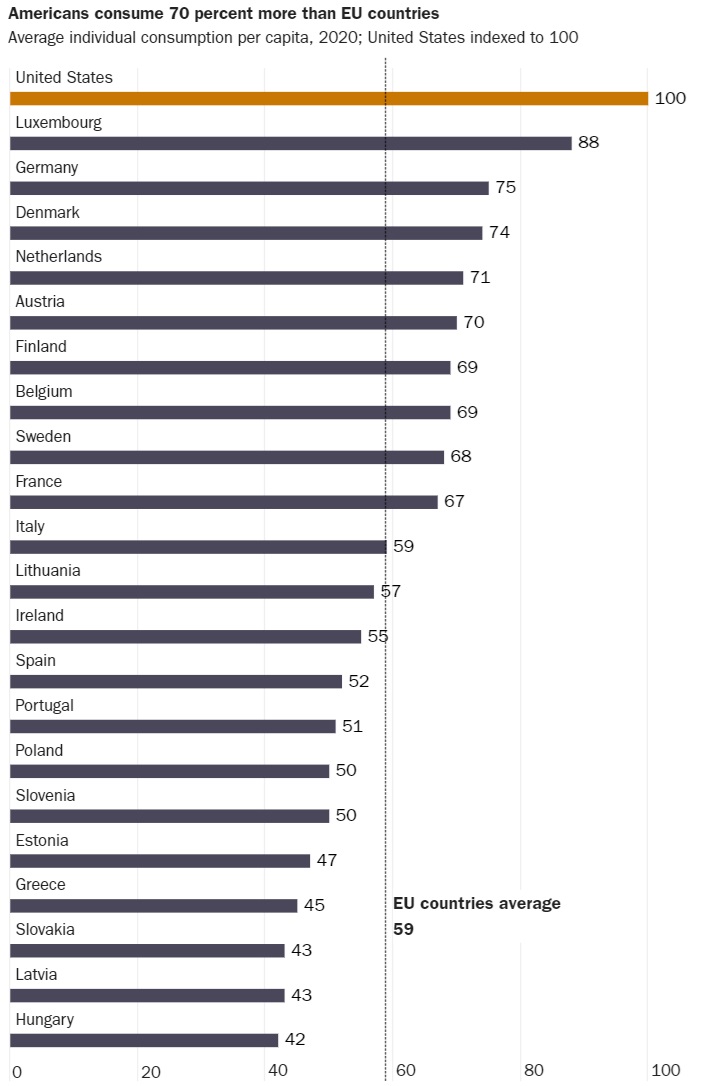
Here’s a comparison of per-capita consumption (using the same AIC data I’ve shared in 2012, 2014, 2017, 2019, and 2022). Only the tiny tax haven of Luxembourg is close to the United States.

By the way, I don’t blame Eastern European nations for being way behind the United States. They still have to catch up after suffering from communist enslavement (though some of them are doing a much better job than others).

But I’m digressing. The main lesson to be learned from today’s column is that America should not become more like Europe. That’s a recipe for earning less income and paying higher taxes. I hope Trump and Harris are paying attention."


Thursday, October 10, 2024

The African National Congress no longer regards privatisation as a “swear word” and has accepted that “bringing private sector money on board is not selling your soul”

See South Africa update from Tyler Cowen.

"The African National Congress no longer regards privatisation as a “swear word” and has accepted that “bringing private sector money on board is not selling your soul”, said South Africa’s deputy president Paul Mashatile.

In an interview with the Financial Times at the end of a week-long investor roadshow to Britain and Ireland, Mashatile said South Africa’s new government, in which the ANC is sharing power with the market-leaning Democratic Alliance, had understood the need for more private investment in sectors such as energy, water and infrastructure. “We don’t have the money to do it, so we need the private sector,” said Mashatile, considered a potential successor to President Cyril Ramaphosa.

Investor sentiment towards South Africa has improved dramatically since the formation of the GNU [Government of National Unity], after 15 years in which the economy has barely grown against the backdrop of corruption scandals and government mismanagement of basic services.

The South African rand has risen more than 12 per cent against the US dollar this year, behind only the Argentine peso and Turkish lira. The Johannesburg bourse’s benchmark index is up 21 per cent in US dollar terms including dividends.

Here is more from the FT."

Tuesday, November 7, 2023

Greece’s Great Economic Comeback

Europe’s former basket case is becoming a model fiscal citizen with free-market reforms.

WSJ editorial. 

"Talk about an economic comeback story. Less than a decade ago, Greece looked like it might never recover from its economic and political traumas. On Friday it won back an investment-grade credit rating from Standard & Poor’s.

The upgrade on Greek debt achieves a goal set by Prime Minister Kyriakos Mitsotakis, although it also sells short the scale of the transformation Mr. Mitsotakis has brought about in Athens. S&P Global cited “significant budgetary consolidation” and the summer’s electoral “mandate for policy continuity” to explain its decision—which, as so often with credit ratings, arrives behind the curve and for the wrong reasons.

Athens needed to get spending under control after the fiscal excesses of the early 2000s culminated in a debt crisis starting in 2009. But if a balanced budget were all the country required to be deemed investable, a credit upgrade would have happened by now. Greece agreed to three separate bailouts from its European peers between 2010 and 2015, all of which included punishing fiscal conditions.

Those conditions were never met because neither the bailout deals nor Greek politicians implemented a growth agenda. Voters grew exasperated with the first two bailouts-to-nowhere and in 2015 swung to the far left, electing Alexis Tsipras of the Syriza Party as Prime Minister.

Mr. Tsipras nearly blew up the eurozone, refusing to honor bailout conditions and going so far as to stage a botched referendum on euro membership before stepping back from the brink. Then he signed a bailout deal with its own fiscal strictures.

Mr. Mitsotakis’s innovation, since ousting Mr. Tsipras and bringing the center-right New Democracy party back to power in 2019, has been to focus on economic growth. He cut the corporate tax rate to 22% from 29%, has worked to rationalize government operations, and now is pushing ahead with privatizations.

The renewed optimism explains why the economy is expected to grow this year by about 2.5%, S&P expects government debt will fall to 146% of GDP from 189% in 2020, and investment is pouring in. All of this happened despite the pandemic, a migration crisis and several natural disasters. It also explains why Mr. Mitsotakis won re-election handily this summer.

Challenges remain for an economy that still is too dependent on a handful of industries such as tourism, and important regulatory reforms are needed to increase dynamism. But Mr. Mitsotakis has figured out that an economic growth agenda is the essential ingredient for building support for those reforms—and for balancing the books. That’s a lesson the rest of Europe—and America—could learn from the Continent’s former problem child."

Sunday, November 5, 2023

John Stuart Mill On The Role Of Government

From Library of Economics and Liberty. This excerpt is from his book Principles of Political Economy with some of their Applications to Social Philosophy. In particular, Book V, Chapter XI: Of the Grounds and Limits of the Laisser-faire or Non-Interference Principle. 
"V.11.8

§4. A third general objection to government agency, rests on the principle of the division of labour. Every additional function undertaken by the government, is a fresh occupation imposed upon a body already overcharged with duties. A natural consequence is that most things are ill done; much not done at all, because the government is not able to do it without delays which are fatal to its purpose; that the more troublesome and less showy, of the functions undertaken, are postponed or neglected, and an excuse is always ready for the neglect; while the heads of the administration have their minds so fully taken up with official details, in however perfunctory a manner superintended, that they have no time or thought to spare for the great interests of the state, and the preparation of enlarged measures of social improvement.

V.11.9

But these inconveniences, though real and serious, result much more from the bad organization of governments, than from the extent and variety of the duties undertaken by them. Government is not a name for some one functionary, or definite number of functionaries: there may be almost any amount of division of labour within the administrative body itself. The evil in question is felt in great magnitude under some of the governments of the Continent, where six or eight men, living at the capital and known by the name of ministers, demand that the whole public business of the country shall pass, or be supposed to pass, under their individual eye. But the inconvenience would be reduced to a very manageable compass, in a country in which there was a proper distribution of functions between the central and local officers of government, and in which the central body was divided into a sufficient number of departments. When Parliament thought it expedient to confer on the government an inspecting and partially controlling authority over railways, it did not add railways to the department of the Home Minister, but created a Railway Board. When it determined to have a central superintending authority for pauper administration, it established the Poor Law Commission. There are few countries in which a greater number of functions are discharged by public officers, than in some states of the American Union, particularly the New England States; but the division of labour in public business is extreme; most of these officers being not even amenable to any common superior, but performing their duties freely, under the double check of election by their townsmen, and civil as well as criminal responsibility to the tribunals.

V.11.10

It is, no doubt, indispensable to good government that the chiefs of the administration, whether permanent or temporary, should extend a commanding, though general, view over the ensemble of all the interests confided, in any degree, to the responsibility of the central power. But with a skilful internal organization of the administrative machine, leaving to subordinates, and as far as possible, to local subordinates, not only the execution, but to a greater degree the control, of details; holding them accountable for the results of their acts rather than for the acts themselves, except where these come within the cognizance of the tribunals; taking the most effectual securities for honest and capable appointments; opening a broad path to promotion from the inferior degrees of the administrative scale to the superior; leaving, at each step, to the functionary, a wider range in the origination of measures, so that, in the highest grade of all, deliberation might be concentrated on the great collective interests of the country in each department; if all this were done, the government would not probably be overburthened by any business, in other respects fit to be undertaken by it; though the overburthening would remain as a serious addition to the inconveniences incurred by its undertaking any which was unfit.

V.11.11

§5. But though a better organization of governments would greatly diminish the force of the objection to the mere multiplication of their duties, it would still remain true that in all the more advanced communities, the great majority of things are worse done by the intervention of government, than the individuals most interested in the matter would do them, or cause them to be done, if left to themselves. The grounds of this truth are expressed with tolerable exactness in the popular dictum, that people understand their own business and their own interests better, and care for them more, than the government does, or can be expected to do. This maxim holds true throughout the greatest part of the business of life, and wherever it is true we ought to condemn every kind of government intervention that conflicts with it. The inferiority of government agency, for example, in any of the common operations of industry or commerce, is proved by the fact, that it is hardly ever able to maintain.. itself in equal competition with individual agency, where the individuals possess the requisite degree of industrial enterprise, and can command the necessary assemblage of means. All the facilities which a government enjoys of access to information; all the means which it possesses of remunerating, and therefore of commanding, the best available talent in the market—are not an equivalent for the one great disadvantage of an inferior interest in the result.

V.11.12

It must be remembered, besides, that even if a government were superior in intelligence and knowledge to any single individual in the nation, it must be inferior to all the individuals of the nation taken together. It can neither possess in itself, nor enlist in its service, more than a portion of the acquirements and capacities which the country contains, applicable to any given purpose. There must be many persons equally qualified for the work with those whom the government employs, even if it selects its instruments with no reference to any consideration but their fitness. Now these are the very persons into whose hands, in the cases of most common occurrence, a system of individual agency naturally tends to throw the work, because they are capable of doing it better or*109 on cheaper terms than any other persons. So far as this is the case, it is evident that government, by excluding or even by superseding individual agency, either substitutes a less qualified instrumentality for one better qualified, or at any rate substitutes its own mode of accomplishing the work, for all the variety of modes which would be tried by a number of equally qualified persons aiming at the same end; a competition by many degrees more propitious to the progress of improvement than any uniformity of system.
§6. I have reserved for the last place one of the strongest of the reasons against the extension of government agency, Even if the government could comprehend within itself, in each department, all the most eminent intellectual capacity and active talent of the nation, it would not be the less desirable that the conduct of a large portion of the affairs of the society should be left in the hands of the persons immediately interested in them. The business of life is an essential part of the practical education of a people; without which, book and school instruction, though most necessary and salutary, does not suffice to qualify them for conduct, and for the adaptation of means to ends. Instruction is only one of the desiderata of mental improvement; another, almost as indispensable, is a vigorous exercise of the active energies; labour, contrivance, judgment, self-control: and the natural stimulus to these is the difficulties of life. This doctrine is not to be confounded with the complacent optimism, which represents the evils of life as desirable things, because they call forth qualities adapted to combat with evils. It is only because the difficulties exist, that the qualities which combat with them are of any value. As practical beings it is our business to free human life from as many as possible of its difficulties, and not to keep up a stock of them as hunters preserve game, for the exercise of pursuing it. But since the need of active talent and practical judgment in the affairs of life can only be diminished, and not, even on the most favourable supposition, done away with, it is important that those endowments should be cultivated not merely in a select few, but in all, and that the cultivation should be more varied and complete than most persons are able to find in the narrow sphere of their merely individual interests. A people among whom there is no habit of spontaneous action for a collective interest—who look habitually to their government to command or prompt them in all matters of joint concern—who expect to have everything done for them, except what can be made an affair of mere habit and routine—have their faculties only half developed; their education is defective in one of its most important branches."

Thursday, November 2, 2023

Capitalism, the keystone of modern prosperity

By Chelsea Follett of Cato.

"Despite the rise of anti-capitalism across the political spectrum, Johan Norberg sheds important light on the benefits and major advances brought about by capitalism.

Good news for fans of bipartisanship: even in today’s hypercharged political environment, an increasing number of people on both sides of the aisle agree on something! Unfortunately, it’s a notion that, if incorrect, could undermine the policies and institutions that form the very foundation of the modern world. The newfound area of agreement is the idea that capitalism, globalization, and free markets have failed.

Indeed many of the ideas expressed by Karl Marx and Friedrich Engels in their magnum opus, The Communist Manifesto, are gaining ground. Obsession with class warfare now transcends political tribes, dominating both the halls of deep blue academia and the lyrics of the chart-topping anthem of the “new right,” Rich Men North of Richmond. A swelling bipartisan chorus of voices dismiss laissez-faire economics as out-of-date. The complexities of the modern world, they claim, require robust government action to support domestic industries, repatriate risk-ridden globalized supply chains, and protect domestic markets from the vicissitudes of international competition.

Recent polling shows that only around 21 percent of Americans hold a very positive view of capitalism, dropping to just 11 percent among those under age 30. Mounting skepticism toward capitalism is not restricted to the United States; from Latin America to Europe, anticapitalism is all the rage. For example, a majority of French adults, 62 percent, express a negative view of capitalism.

In this age of growing derision toward the system of free enterprise, there is a man who stands athwart the anticapitalist zeitgeist declaring, “The global free market will save the world.” Who is this individual who dares to express such an unfashionable view? “No one is particularly keen on globalization now,” observed journalist Po Tidholm on Swedish Public Radio in 2020, “except possibly Johan Norberg.”

Norberg, a Swedish author and historian of ideas and a colleague of mine at the Cato Institute, wears the accusation with pride, quoting it at the start of his latest book, The Capitalist Manifesto. Given the current intellectual climate, the timing of the U.S. release of the book could not be better.

He was not the first to come up with the title; prior Capitalist Manifesto authors include Robert Kiyosaki, Andrew Bernstein, Louis Kelso and Mortimer Adler. As Norberg notes, there is only one Communist Manifesto, but there are many capitalist manifestos—appropriately, as capitalism allows for a diversity of thought.

Norberg’s prior books include In Defense of Global Capitalism, which, as its title suggests, mounted a defense of free enterprise—against the system’s vocal leftist critics. But in the two decades since that book’s publication, expressing hatred of capitalism has become a bipartisan pastime in vogue among populists on both the left and right alike. In light of this trend, The Capitalist Manifesto presents an updated, sorely needed, and eloquent restatement of the principles of free market.

The book addresses the most frequent criticisms leveled against markets today and generally seeks to rehabilitate capitalism’s image in the mind of the skeptical modern reader. As business magnate Elon Musk put it in a recent post, “This book is an excellent explanation of why capitalism is not just successful, but morally right.”

How can Norberg, Musk, or indeed anyone remain enthusiastic about a system that so many people spanning the political spectrum now agree has been a failure? Examining the last couple of decades, the book acknowledges they have been filled with shocks, wars, and failures. Examining the problems of the last 20 years, including financial crises, violence in the Middle East, an industrial-scale war in Europe, various other disasters, and of course a global pandemic, Norberg never shies away from recognizing the bad. But, the last 20 years, he argues, despite so many devastating catastrophes, have nonetheless been the best years in all of human history.

How is that possible? Step back and examine the trendlines. A third of all wealth ever created was created over these last two decades alone. Over the last 20 years, during every minute of complaining about how global capitalism has wrecked the world, over 90 people climbed out of destitution. Child mortality has fallen so dramatically that the number of annual child deaths is down by millions compared to a decade ago even as the total population has grown.

The greatest progress occurred in the countries that most integrated into the global economy. Why is that? The miraculous problem-solving capacity of human beings that allows us to improve our conditions—if given the freedom to do so. Hence countries in the economically freest quartile enjoy more than twice the average per capita income of less free countries.

Capitalism’s haters fail to recognize modern prosperity’s origins. Norberg characterizes well-off anticapitalist thinkers such as Thomas Piketty this way: “taking pride in ignoring what’s going on down there, in garages, in shops and factories, and how that might relate to the fact he lives in history’s richest civilization.”

But, the anticapitalist might protest, modern abundance rests atop a proverbial house of cards. Surely the pandemic revealed the unacceptable fragility of globalized markets?

Yet pandemic shortages proved short-lived as entrepreneurs found ways to adjust the manufacturing process to changing conditions. In many cases, companies with more complex supply chains actually adjusted faster than those with less complex supply chains, because they had more options and found alternative suppliers or manufacturers who weren’t under lockdown. Concentrations of supply chains, Norberg warns, in fact pose a greater risk of disruption than diversified ones, due to their total reliance on a smaller number of suppliers–having all their eggs in one basket. Domestically produced goods were often more likely to see shortages than imported ones; recall that it was international trade that alleviated the United States’ baby formula shortage when policymakers lifted import restrictions in response to the crisis.

The book defends capitalism from charges that it simply represents theft and exploitation, pointing out that it in fact embodies the opposite of those things: enrichment and freedom of choice. Replacing markets with a system of more centralized government control concentrates decision-making power in the hands of a small elite.

Substituting the collective wisdom produced by billions of people with the preferences of a few bureaucrats whose own money isn’t on the line tends to spell disaster. Norberg cites numerous examples including Quaero, the stillborn dream of a government-backed search engine from 2005. Quaero was intended to outcompete Google. Despite the best efforts of numerous European politicians and bureaucrats, and despite the French and German governments wasting millions of taxpayer dollars on the project, Quaero collapsed within a year. Its implosion demonstrates what happens, again and again, when decision makers are divorced from the reality of market signals and financial consequences.

With abundant data and memorable examples, Norberg shows the historical ignorance of the new vogue for anticapitalism. He unmasks it as nothing new at all, but something wizened and old that has reared its ugly head again. Tariffs, industrial policy, repatriation, and price-setting have repeatedly failed. Will policymakers on the left and right alike heed Norberg’s warning, or will humanity relearn the lesson the hard way?

The Communist Manifesto ends with the words, « The Communists … openly declare that their ends can be attained only by the forcible overthrow of all existing social conditions. The proletarians have nothing to lose but their chains. They have a world to win. Working men of all countries, unite!” Instead of a call for violent revolution, The Capitalist Manifesto ends with a plea for the peaceful preservation of the system of global capitalism endangered by unwise policies: “We pro-capitalists of the world have nothing to lose but our chains, tariff barriers, building regulations and confiscatory taxes. We have a world to win.”"

Thursday, October 26, 2023

Capitalism and the Jews, by Jerry Z. Muller

Steven Menashi reviews Jerry Z. Muller's book Capitalism and the Jews. 

"the persecution or exclusion of Jews is a strong sign that the moral case for capitalism is under attack" (excerpt from the review which is below). But first some data:

Heritage Foundation's Index of Economic Freedom ranking for selected countries.

Israel 34
Bahrain 68
Jordan 93
Oman 95
Saudi Arabia 98
Egypt 151
Pakistan 152
Lebanon 164
Iran 169
Afghanistan Not ranked
Iraq Not ranked
Libya Not ranked
Syria Not ranked
Yemen Not ranked

"Early in the Christian era, the church fathers found themselves compelled to explain the persistence of the Jews. Continued Jewish fidelity to the Mosaic law challenged the Christian teaching that the law had been fulfilled and abolished through the Christian faith. The famous solution devised by Augustine was that the Jews had survived, in exile and abjection, as witnesses to the historical authenticity of Old Testament prophecy and the error of failing to see its fulfillment in Jesus Christ. It must therefore have embarrassed those who held this view when, in modern times, Jews came to rank among the most prosperous people in the liberal capitalist West.

It makes sense that partisans of the Augustinian teaching found it necessary to question the methods of Jewish merchants and financiers and the influence of commerce generally. At the same time, the apostles of what would come to be known as liberal capitalism had good reason to see the Jews as fulfilling a providential, one might even say a chosen, mission. Through the ingenuity of the Jews, wrote Montesquieu in 1748 in The Spirit of the Laws, “commerce was able to avoid violence and maintain itself everywhere.” Capitalism, even in its nascent form, “broke through the barbarism of Europe.”

According to Jerry Z. Muller, professor of history at Catholic University, capitalism has been the most important force in shaping the fate of the Jews in the modern world. In 2002 he published The Mind and the Market, a study of the idea of capitalism in Western thought. “Jews,” he wrote, “served as a kind of metaphorical embodiment of capitalism.” In his new book, Capitalism and the Jews, Muller focuses squarely on the relation between them in four interlocking essays that explore, respectively, Western thinking about Jews and capitalism, the Jews’ own responses to capitalism, Jewish involvement in Communist movements1, and the rise of ethnic nationalism that came about as a response to capitalism’s relentless march in the 19th century and onward.

To be sure, capitalism has affected the course of the entire modern world, not only that of the Jews, but “Jews have had a special relationship with capitalism,” Muller explains, “for they have been particularly good at it.” Among Jews, economic success has been a source of both pride and embarrassment. Among their neighbors, it has prompted both affection and abhorrence.

_____________

Muller gives the impression of a long and deep dispute, but while anti-Semitic anticapitalists and philo-Semitic capitalists each placed a different gloss on the social values of modern capitalism, all seemed to acknowledge that the Jews carried those values wherever they went. Anti-Semites denounced Jews as rootless cosmopolitans whose commercial activities undermined traditional ways of life, while capitalists praised Jews for fostering the creative destruction and social dynamism characteristic of free markets. Anti-Semites condemned Jewish merchants for promoting self-interested egoism at the expense of Christian fellowship.

For their part, capitalists welcomed Jews for promoting liberal individualism and rights of private property against clerical establishments and state regimentation of moral norms. To the anti-Semites, Jewish commercial influence undercut the passion and vitality of human life in favor of soulless economic calculation. To the capitalists, the Jews illustrated how commerce could counteract socially destructive prejudices and passions by promoting gentle manners and civil intercourse.

German anti-Semites called Jews Luftmenschen, “people of the air,” who lacked a firm grounding in agriculture and industry and produced nothing of material value. Capitalist thinkers correspondingly credited Jews with creating financial innovations—-letters of exchange, the stock market, and the strategic use of public debt—that promoted rationalism and efficiency in economic life.

Muller insists that historical circumstance, rather than any quality inherent in Judaism, explains the capitalist inclinations of Western Jewry. Yet he later calls his own judgment into question. In his first chapter, Muller discounts the argument of Werner Sombart, the anti-Semitic German sociologist (1863-1941), that the Jewish faith inclined its adherents to capitalism because it was given to abstraction and promoted a legal-contractual conception of their relationship with God.

In his next chapter, however, Muller explains the Jews’ facility for commerce by making reference to their “religious intellectualism.” Judaism “was a religion oriented to continuous contact with texts,” writes Muller, which “cultivated the habit of finding commonalities and distinctions in arguments, and of thinking in abstractions.” He observes that Talmudic law is “replete with debates about economic matters, including contracts, torts, and prices,” and even cites a passage from the Babylonian Talmud to demonstrate that “the rabbis had an acute appreciation of the benefits of the division of labor.”

Again in his first chapter, Muller condemns an anti-Semitic lecture delivered in 1930 by John Maynard Keynes in which the economist blamed the Jews for polluting capitalism by promoting deferred gratification, the focus on means over ends, which led people to discount the quality and enjoyment of life in favor of future profit. Yet in the following chapter, Muller explains that the Jews’ high valuation of educational study “reflected a long time horizon, in which the economic payoff would be deferred for years.”

Perhaps, notwithstanding the hostility with which anti-Semites formulated the Jewish connection to capitalism, their arguments cannot be so easily dismissed. For at the very least, Judaism did provide fertile ground for the cultivation of modern commercial life. As a religion of laws governing worldly conduct, Judaism does not have the innate suspicion of commercial activity that is among the originating concepts of the Christian tradition, with its Gospel account of Jesus’ rage at the money changers working on the grounds of the Temple. Theologically, Christianity has always emphasized spiritual preparation for the afterlife rather than earthly endeavors.

_____________

Yet Christianity is also a product of Judaism and echoes Judaism’s teachings even when it seeks to supplant them. In denouncing deferred gratification as the attempt “to secure a spurious and delusive immortality,” Keynes averred that “it is not an accident that the race which did the most to bring the promise of immortality into the heart and essence of our religions has also done the most for the principle of compound interest and particularly loves this most purposive of human institutions.” Keynes’s caricature notwithstanding, he was on to something. For Judaism did originate the promise of immortality—“I will make you a great nation and I will bless you,” God tells Abram in Genesis 12, guaranteeing him descendants as numerous as the stars—and that promise remains at the heart of Judaism’s daughter religions, including Christianity.

Sombart portrayed the triumph of capitalism as the replacement of a concrete, particularist Christian community with an abstract, universalistic society. But Judaism has always stood above all for the maintenance of a concrete, particularist community—the Jewish people. Christianity had to spread Jewish values as a universal faith before they could find expression in modern liberal capitalism.

Christianity did not purport to apply such values to the government of society. “My kingdom is not of this world,” Jesus tells his followers. So Christians had to borrow from Jewish law. The early church incorporated the Hebrew Scriptures into the Christian Gospels, though it was not at all obvious that the Old Testament should have been permitted to survive the New. In the early modern period, the Hebrew Bible again informed Christian views of society, as in the English jurist John Selden’s The Law of Nature and of Nations According to the Hebrews (1640). Christians also depended on Jews themselves, serving as a kind of shabbos goy in reverse, to engage in those commercial activities that were socially beneficial but religiously forbidden to them. In the 12th century, the church resolved to prevent the evil of Christian usury by allowing Jews to engage in moneylending and other financial activities—which made the Jews of Europe contemptible, but also indispensable, to Christian society.

Gradually, their skills in commerce were acquired by the surrounding Christian communities. So it may be said that capitalism, to some extent, Judaized Christian life. Karl Marx made the point most vividly in his essay “On the Question of the Jews,” which denounced the “Jewish spirit” of capitalism but also argued that capitalist society turned everyone into Jews. Under capitalism, he wrote, “money has become a world power and the practical Jewish spirit has become the practical spirit of the Christian peoples. The Jews have emancipated themselves insofar as the Christians have become Jews.”

Of course, Muller is right to argue that the Jews embraced commerce in part as a result of their treatment by the Christian West. Always under the threat of expropriation or expulsion, it made little sense for Jews to acquire land or other immovable goods; one could more easily relocate wealth gained from trade or finance. Politically dispossessed, Jews employed financial influence. As sojourners, Paul Johnson has written, “they had no share in or emotional commitment to society as a whole and so could watch its old traditions, methods and institutions being demolished without a pang.” That made them natural innovators and capitalist entrepreneurs.

_____________

By and large, Jews embraced these roles. With impressive historical detail, Muller refutes the notion, common to leftists eager to enlist the faith in the cause of collectivism, that Jews have been generally hostile to capitalism. While Jews have been prominent ideological spokesmen for socialist and Communist movements, those movements have enjoyed little support among the Jewish rank and file. The chief rabbi of Moscow in the early 20th century, Jacob Mazeh, is said to have told Leon Trotsky, nĂ© Lev Bronstein, “The Trotskys make the revolutions, and the Bronsteins pay for it.”

Indeed, the fate of the Jews has long been tied to the fate of capitalism. Jews of the early-modern period pleaded for political toleration on the grounds of the economic benefit it would bring—and thus the case for accepting the Jews was often mixed with the case for embracing commerce. In 1655 the Dutch rabbi Menasseh Ben Israel appealed to Oliver Cromwell, Lord Protector of the newly formed English Commonwealth, to readmit the Jews to England. England stood to profit, he argued. “It is a thing confirmed, that merchandizing is, as it were, the proper profession of the Nation of the Jews,” wrote Ben Israel. “They do abundantly enrich the lands and countries of strangers, where they live, not only with what is requisite and necessary for the life of man; but also what may serve for ornament to his civil condition.” A century later, the Jewish philosopher Moses Mendelssohn argued that Jews should enjoy civil equality in Germany because the merchant “is a real benefactor to the state” and helps “to render the comforts of life more known, and more generally serviceable.” Another century on, Theodor Herzl predicted that Arabs would welcome Jewish settlement in Palestine because when the Jews brought “their intelligence, their financial acumen, and their means of enterprise to the country, no one can doubt that the well-being of the entire country would be the happy result.”

_____________

But the result has not always been so happy. Not every society wants commerce. Capitalism represents certain moral choices about the good life—-choices that more aristocratic, theocratic, nationalistic, or agrarian societies resolve differently. At the birth of modern capitalism, the Jews came to symbolize a moral system that actually did threaten the traditional social order.

In his last chapter, Muller tries to explain why the triumph of capitalism did not end anti-Jewish hatred but in fact intensified it. Whereas Jews once performed economic functions Gentiles would not, in the modern era they became competitors with Gentiles. Given their already formidable economic training, Jews were bound to outperform other groups and to provoke new resentments. Moreover, Muller suggests, the capitalist state weakened traditional ties and fostered new forms of identification with the political community of the nation, which excluded other ethnics such as Jews.

Again, this explanation seems at odds with an earlier part of the book, in which Muller observes that the Jews were most accepted where capitalism was most firmly established. “Both in Europe and America, a fundamentally positive view of commerce within the larger society tended to lead to a favorable or at least neutral disposition toward the Jews,” he writes. “Here we find the greatest difference between continental European societies, on the one hand, and British and American society on the other.”

Muller points to the influence of Lockean liberalism in the U.S. Anglo-American society inherited a natural-rights tradition according to which capitalism produces not only a rich but also a good society. In this view, capitalism complements religious teaching; it shows due respect to the rights of liberty and property with which individuals “are endowed by their Creator”; and it calls forth distinctive virtues such as honesty, diligence, sobriety, and thrift. Capitalism thus understood forms a political community in which all are welcome who play by the rules. Continental Europe, by contrast, developed a more nationalist tradition in which the law expresses the spirit of a people. Capitalism, it follows, may be a useful means of organizing economic affairs, but it must express, and be constrained by, the national ethos. It is no surprise that ethnic and religious minorities present greater difficulties for such a society.

In this way, then, the fate of Western Jewry has been bound up with the moral case for capitalism and the bourgeois society. The case is a strong one: modern capitalism has produced greater individual liberty, peaceful coexistence, social mobility, and material prosperity than history had previously known. But because capitalism has so thoroughly eclipsed its alternatives, the moral argument on which it rests is often invisible. Muller quotes the Nobel laureate Simon Kuznets as saying, “Given the kind of human capital that the Jews represent, the majority in any country, if it wished to maximize long-term economic returns, should have not only permitted the Jewish minority the utmost freedom, but in fact should have subsidized any improvement in the economic and social performance of promising individual Jews.” Yet not every society is interested in maximizing long-term economic returns. Indeed, the persecution or exclusion of Jews is a strong sign that the moral case for capitalism is under attack.

Capitalism and the Jews have enjoyed a mutually beneficial relationship, albeit a rocky one. “In the long run,” writes Muller, “capitalism was good for the Jews. And the Jews were good for capitalism.” It was a relationship largely thrust upon them; as agents of modernity, the Jews were a chosen—not a choosing—people. As in society at large, there was a cost to embracing capitalism because it treats religion as a private matter, divorced from nationality and political rule.

In a sense, then, capitalism also Christianized Judaism. It did so by severing religious belief and worship from the national identity of the Jews and from the laws that are intended to govern their social conduct. Peaceful trading for profit falls somewhat short of the prophetic vision of a restored Jerusalem under divine sovereignty. “In that day,” the book of Zechariah tells us, “there shall be no more traders in the House of the Lord.” Of course, the House of the Lord has yet to be rebuilt, and until it is, Jews must still reside among the nations."

Friday, October 13, 2023

Illiberalism Continues to Plague Chinese Economy

 By Clark Packard of Cato.

"Since the late 1970s, when Chinese president Deng Xiaoping initiated some market‐​oriented liberalization, the country has been on an upward economic trajectory. As documented by my colleague Jim Dorn in a recent essay for Cato’s Defending Globalization project, these reforms yielded substantial dividends. It is estimated that nearly 800 million Chinese were lifted out of extreme poverty since 1980, coinciding with the onset of these reforms.

In recent years, particularly under the leadership of Xi Jinping, China has pivoted away from the market‐​oriented policies that catapulted it to prosperity and global influence.

Today, the prevailing consensus within Washington policy circles is that China is an economic juggernaut poised to surpass the United States as the world’s leading economy in the near future. Proponents contend that Beijing’s reembrace of heavy industrial policy, coupled with the abandonment of market liberalization, has energized the Chinese economy.

However, the actual reality departs from the proponents’ simplistic narrative, as I argue in my new essay for Cato’s Defending Globalization project.

Indeed, China confronts an array of short‐ and long‐​term economic challenges.

Short‐​Term Headwinds

Today China grapples with several immediate challenges that are almost certain to exert downward pressure on its economy in the coming years. Xi Jinping has rapidly moved the country in an illiberal direction. The once‐​dynamic and thriving tech sector has been stymied by Xi Jinping’s embrace of Maoist socialism. China has cracked down on educational platforms, and its general aversion to private sector enterprises continues to exacerbate youth unemployment, which is estimated to have exceeded 20 percent.

China’s real estate sector is overinflated, and property developers are failing to deliver promised residential units, leading to a widespread middle‐​class boycott of mortgage payments in 2022. Major Chinese property developer Evergrande defaulted on its debt in late 2021 and then filed for bankruptcy in August.

Earlier this week, the largest Chinese property developer, Country Garden, warned that “it doesn’t expect to be able to repay all of its U.S. dollar bonds and other offshore debts,” according to the Wall Street Journal. This is a worrying sign about Beijing’s ability to stabilize the country’s beleaguered housing market. Meanwhile, local governments, reliant on land sales to fund public services, are increasingly grappling with constrained budgets.

China’s handling of the COVID-19 pandemic has been fraught with difficulties, and the nation’s increasing dependence on forced labor and repression in the Xinjiang region has drawn international condemnation. Additionally, Beijing has reneged on its “One Country, Two Systems” commitment to Hong Kong, effectively annexing it in 2020 with the passage of the national security law. Today Beijing’s galloping illiberalism has rendered the country less attractive for foreign investment.

Long‐​Term Headwinds

While the short‐​term challenges may be surmountable with different policies, the long‐​term headwinds pose more formidable and enduring obstacles.

First, China is facing a rapidly aging population and a diminishing workforce, which will dampen economic output, stifle innovation, and strain government services. The United Nations recently projected that India will overtake China as the world’s most populous country in 2023. Notably, China’s aging population is an accelerating phenomenon, as highlighted by a Foreign Affairs article that observed, “In 1978, the average median age of a Chinese citizen was 21.5 years. By 2021, it had risen to 38.4, surpassing the United States.” China’s fertility rate has plummeted to 1.15 births per woman, well below the replacement rate of 2.1 births per woman.

Furthermore, China is witnessing an exodus of talent as young, highly educated individuals seek opportunities abroad. Take artificial intelligence (AI), where a significant proportion of top‐​tier AI researchers globally obtained their undergraduate degrees in China. However, the majority do not remain in China, with 56 percent choosing the United States as their preferred destination.

Reasons for this exodus, as explained by a report from the Paulson Institute at the University of Chicago, include the “relatively relaxed and innovative scientific research environment” in the United States compared to China, China’s “authoritarian political system and restricted freedom,” and various impediments such as “language barriers, pervasive internet censorship, and environmental quality.”

Additionally, China’s workforce productivity is not expanding at the same robust pace as it has in the past. The period following Deng’s reforms witnessed a rapid surge in productivity growth, largely attributable to catch‐​up growth due to China’s low starting point. Today, mounting evidence suggests that productivity growth is slowing, or perhaps even reversing, representing a more pronounced decline compared to global productivity trends.

Demographic shifts and brain drain certainly play a role in this phenomenon, but China’s growing reliance on top‐​down central planning and industrial policy also contribute. According to a 2022 paper from the International Monetary Fund, state‐​owned enterprises (SOEs) are estimated to be 20 percent less productive than their private sector counterparts in the same industry. This contrasts with the period of reform between 1998 and 2005, which fostered significant private sector entrepreneurship, as detailed in a recent blog post.

Collectively, the economic reforms that China undertook from the late 1970s to 2012 propelled the nation to increasing wealth and improved living standards for the average citizen. In recent years, however, the country has veered toward illiberalism, characterized by heavy‐​handed state intervention and repressive human rights practices. These policies are beginning to manifest in economic data; for instance, foreign direct investment (FDI) in China has dwindled from around 4 percent of China’s GDP in 2011 to approximately 1 percent today. As economist Noah Smith has noted, FDI from G7 countries declined from $35.4 billion in 2014 to $16.3 billion in 2020.

For policymakers in Beijing seeking to rejuvenate the economy, a return to the market‐​oriented reforms of the past is the key to future growth."

Tuesday, September 12, 2023

China Pays for Economic Mismanagement

The bill is coming due for Beijing’s rejection of free enterprise in favor of communist ideals

By Mickey D. Levy. Mr. Levy is senior economist at Berenberg Capital Markets and visiting scholar at the Hoover Institution. Excerpts:

"Mr. Xi began clamping down on free enterprise in 2012, mistakenly believing China’s socialist ideals were consistent with sustained economic health. Beijing set unrealistically high targets for gross domestic product even as China’s potential growth slowed naturally as its labor force and capital approached capacity, production costs rose, and productivity slowed. Constraints on big tech and social-media firms were particularly damaging.

China set GDP targets way above potential and hit them—despite slower consumer spending, private investment and exports—with aggressive government investment focused on real estate. The unhealthy high gross capital formation that has been maintained above 40% of GDP and diminishing productivity have signaled resource misallocation and future problems.

China’s fiscal policy is administered largely by local governments, as dictated by leaders in Beijing. Local governments met their growth targets by relying heavily on land sales to real-estate developers, construction and massive bond issuance supporting stimulus. Those bonds have been purchased by local government financing vehicles and shadow banks that rely on fragile, unstable funding sources to bear the risk.

The government-driven excesses in real estate and debt began unraveling in late 2021, as land sales and construction fell. Since then,

and more than 50 Chinese developers have defaulted on their debt. Chinese households know the value of their real estate has fallen much more and the economy is in far worse shape than rosy government statistics suggest. Cash-strapped local governments have limited resources for stimulus. Some are having trouble servicing their debt and need financial support from Beijing. Global demand for Chinese goods is falling, reflecting weak economies and efforts to reduce exposure to China supply chains. Reduced production for export means fewer high-paying manufacturing jobs."

"China’s potential growth and productivity are significantly diminished. Estimates of a nation’s potential growth are framed by expansion of its labor force, capital and productivity. China’s population and labor force are falling owing to its one-child policy. Its capital stock may continue to rise rapidly, but under the current regime it will be driven by low-productivity government investment, including allocating resources to state-owned enterprises. Leaders in Beijing and the nation’s sprawling regulatory apparatus suppress the innovative and productive private sector."

"Current attempts to achieve GDP growth above 2% to 3% would lead to more undesirable excess. Chinese leaders must deal with the social fallout, and global economies must adjust to the realities of China’s diminished potential."

Saturday, August 19, 2023

A Warning from Poland’s Lech Walesa

By Dan Mitchell.

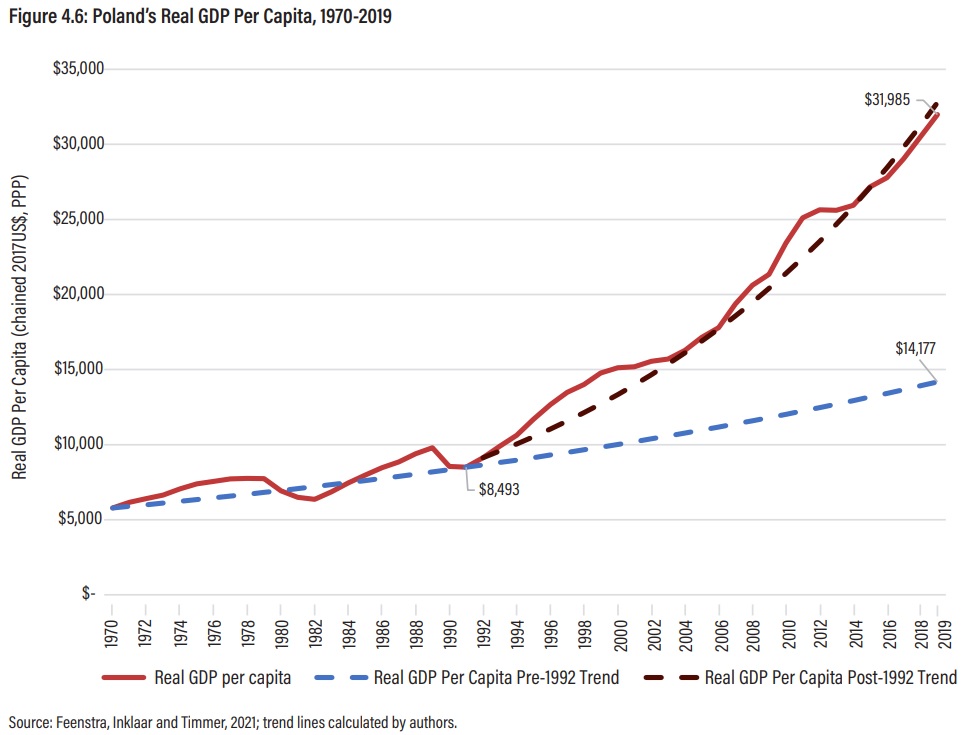
"Just last month, I cited some academic research showing how Poland’s economy dramatically approved after the fall of the Soviet Empire and the country escaped socialism.

The change has been dramatic. Indeed, Poland has easily out-performed China in recent decades, showing that decent economic policy is much better than bad-but-not-totally-awful economic policy.

Unfortunately, not everyone understands that socialism is bad news.

I can understand why politicians like the idea. They have a “public choice” incentive to grab more control over the economy.

But I don’t understand why some young people are sympathetic to this totalitarian economic system.

I’ve done everything I can to explain why socialism is a failure, but perhaps I’m not the right messenger.

So let’s look at what the leader of Poland’s first independent union said to them.

Lech Walesa. Of the giants who brought down the Iron Curtain — among them Ronald Reagan, Margaret Thatcher, John Paul II, Vaclav Havel — only Walesa is still with us. At 79, he still looks as vigorous as the young electrician who led a workers’ uprising against the “dictatorship of the proletariat”; forced Poland’s Marxist regime to recognize the first independent trade union in the communist world; was imprisoned under martial law only to later force his former jailers at the negotiating table to allow free elections… What is his message for young people who have no living memory of communism? “Many young people are actually fooled to accept communism as an idea,” he said, speaking through an interpreter. “There are beautiful sentences talking about equality, about justice. … But as soon as you start putting that system into practice, all sorts of serious disasters come about. But young people quite often don’t know it. We have experience [with socialism], so we really know something about it. So, I strongly recommend rejecting it.”

That’s very good advice.

Unless, of course, you have a very perverse desire to create more deprivation and misery in the world."

Former Polish president Walesa tells youths to reject socialism

By Marc A. Thiessen in The Washington Post.

"Sitting in his office at the European Solidarity Center, the museum built on the grounds of the old Lenin Shipyard where Solidarity was born, I asked about polls showing that half of young Americans have a positive view of socialism. What is his message for young people who have no living memory of communism? “Many young people are actually fooled to accept communism as an idea,” he said, speaking through an interpreter. “There are beautiful sentences talking about equality, about justice. … But as soon as you start putting that system into practice, all sorts of serious disasters come about. But young people quite often don’t know it. We have experience [with socialism], so we really know something about it. So, I strongly recommend rejecting it.”"

"“populist demagogues are leading the world, because it’s easier. But those who potentially have better solutions than demagogues and populists have to wake up.”"


Friday, August 18, 2023

Debunking the Myth of Swedish Socialism—Again

 By Johan Norberg.

"Whenever I lecture around the world, whatever I talk about, there is almost always someone in the audience who wants to ask me about Sweden. Is it the successful example of socialism that many assume?

I try to explain that we have been socialists and we’ve been successful—but never at the same time.

I’ve written about this in a Cato Policy Report and I’ve done a documentary about it for U.S. public television, but people keep asking me. So I decided that I had to write a book about it for the Fraser Institute to tell the whole story, The Mirage of Swedish Socialism: The Economic History of a Welfare State.

And it’s actually one of the best examples we have of the benefits of free markets and the perils of socialism. Between 1870 and 1970, Sweden had a smaller government and a more open economy than most comparable countries, and that was the era when Sweden grew faster than any other developed country but Japan.

Then, when Sweden had already become one of the richest countries in the world, Sweden began to experiment with socialist ideas. From 1970 through 1990, government was massively expanded, taxes were raised, and the economy was regulated. This was not the golden era of socialist nostalgia, but more like an Atlas Shrugged moment: Swedish companies like IKEA and Tetra Pak and lots of successful entrepreneurs left Sweden and not a single net job was created in the private sector. It was the one moment in Sweden’s modern history that we lagged behind other countries.

After a devastating financial crisis in the early 1990s, politicians from both the left and right agreed to end this experiment. Instead, they reduced public spending, taxes, and regulation to get back to the growth model that made Sweden successful. Sweden started to outperform its neighbors again.

If Bernie Sanders and AOC wants to imitate actually existing Sweden today, they would have to liberalize markets in many ways, reform Social Security, introduce school vouchers, get rid of the minimum wage and most occupational licensing, and abolish taxes on inheritance and property.

Sweden still has a bigger welfare state than the United States, but the receivers pay for it themselves. The tax burden falls heavily on low‐ and middle‐​income households in Sweden, making the tax system much less progressive than in the United States and almost all other rich countries.

The lesson Swedes took from the 1970s was that you can have a big government or you can make the rich pay for it all, but you can’t have both.

I explain this history and detail how Sweden’s welfare state works in the book, but if you want the shortest possible takeaway from Sweden’s modern political history, listen to Kjell‐​Olof Feldt, Social Democratic Minister of Finance (1983–1990): “What we believed in as young socialists simply turned out to be impossible in practice.”"

Tuesday, July 18, 2023

Sweden's treatment of Indigenous people

See Her Culture Was Suppressed for Centuries. Now It Powers Her Best Seller.. By Lisa Abend of The NY Times. Excerpts:

"Ann-HelĂ©n Laestadius grew up among the SĂ¡mi, an Indigenous people living near the Arctic Circle, in Europe. Her novel, “Stolen,” a success in her native Sweden, reflects that culture to a broad audience."

"An Indigenous people, the SĂ¡mi, who number around 80,000, inhabit a vast territory that stretches across the Arctic areas of Norway, Sweden, Finland and Russia’s Kola Peninsula. For centuries, their language and culture have been forcibly suppressed by national governments that also stripped their land rights and developed industries that threatened the habitats on which their livelihoods and culture depend.

To this day, the SĂ¡mi are engaged in legal and political struggles to protect their lands from mineral and timber extraction, and their herding routes from energy projects. And although the Nordic countries are widely perceived, both abroad and at home, as progressive and egalitarian, many of the SĂ¡mi who live within their borders say they remain targets of discrimination, racism and — through their reindeer — violence.

A case in point: After the Swedish Supreme Court in 2020 granted the SĂ¡mi the exclusive right to manage hunting and fishing rights in the area of Girjas Samby, near the Norwegian border, reindeer killings (which had long plagued the community), increased markedly. It was an expression, many SĂ¡mi believe, of anger among local Swedes who resented losing their hunting rights to a people they had long denigrated. “They kill our reindeer,” Laestadius said, “because they can’t kill us.”"

Wednesday, April 26, 2023

The humanizing effect of market interaction

By Colin Harris (Department of Economics, St. Olaf College), Andrew Myers (Department of Political Science, Stanford University) and Adam Kaiser (Department of Economics, George Mason University). From The Journal of Economic Behavior & Organization.

"Abstract

The quality and quantity of intergroup contact affects how outgroups are perceived. Positive interaction tends to have a humanizing effect of moral inclusion. Negative interaction instead tends towards dehumanization and moral exclusion. One avenue of intergroup contact that has been empirically underexplored is interaction in a market. Do markets generate moral sympathy, or do they allow us to ignore or deny the moral status of others? We create a measure of moral sentiment that captures the frequency, valence, and type of moral language used about an outgroup. We match our novel sentiment data to dyadic measures of market interaction to test if markets act as a (de)humanizing force. We find a positive relationship between market interaction and the use of (1) moral, (2) virtuous (but not vice), (3) bridging, and (4) bonding language to talk about a contacted outgroup. Our results suggest market interaction has a humanizing effect."

Thursday, March 16, 2023

The Big Myth Is Full of Recycled Anti-Capitalist Cheap Shots

The Big Myth Is Full of Recycled Anti-Capitalist Cheap Shots

By Phillip W. Magness.

"Historian Richard Hofstadter once wrote that "the paranoid is a double sufferer, since he is afflicted not only by the real world, with the rest of us, but by his fantasies as well." A compelling case could be made that this affliction has taken hold among the highest ranks of Hofstadter's own profession. New academic "histories" now appear on a near-monthly basis, each blaming a variety of social ills on the conspiratorial machinations around a single idea: the free market.

Almost everything in this genre follows the same formula. When the American electorate fails to embrace the political priorities of an Ivy League humanities department, these disheartened authors cast about for a blameworthy culprit. They settle on "market fundamentalism" or "neoliberalism." The explanation then takes a paranoid turn, declaring the targeted theories a "manufactured myth" arising from the "inventions" of 20th century business interests, which allegedly hoodwinked voters into accepting the "magic" of the free market as a matter of received wisdom. Certain that they have found the source of their political obstacles, these historians then claim to uncover a "secret" history that has been hiding in plain sight. All eventually settle on a mundane conspiracy of business interests and libertarian economists, who allegedly derailed America from its progressive path by convincing people that markets work better than government at solving problems.

At some 550 pages, The Big Myth: How American Business Taught Us To Loathe Government and Love the Free Market is among the most loquacious entrants into this crowded literature. Harvard University's Naomi Oreskes and California Institute of Technology historian Erik Conway lay out their conspiracy theory with formulaic precision, but their book is atypical in one significant way. While most of the other works in the anti-neoliberalism genre manage at least to excavate some interesting archival findings about libertarian economists (before badly misinterpreting them), this book is remarkably light on original content.

The Big Myth's argument most closely resembles that of Cornell University historian Lawrence Glickman's 2019 book Free Enterprise: An American History, which advanced a nearly identical thesis wherein the concept of "free enterprise" allegedly arose as a myth in the service of anti–New Deal business interests. But The Big Myth also weaves in recent tracts by Philip Mirowski and Dieter Plehwe, Kim Phillips-Fein, Kevin Kruse, Quinn Slobodian, and Jane Mayer. Oreskes and Conway round out their spartan use of economic sources (their recounting of "market failure" theory makes heavier use of Pope Francis' encyclicals than any actual economics texts) with a dash of Thomas Piketty's dubious inequality empirics and a touch of Ha-Joon Chang's attempts to resurrect trade protectionism.

A reader with even casual awareness of these other authors will be left wondering why this same story needed yet another repackaged recitation. The result is a meandering journey through secondary sources and Wikipedia entries, presented as if they were tacked to a basement wall amid a disorderly web of yarn and dental floss in a progression that only its authors truly comprehend.

The Big Myth is structured in sequential vignettes about various themes and figures such as Ludwig von Mises, Leonard Read, Friedrich Hayek, Rose Wilder Lane, and Milton Friedman, all of whom are portrayed as either willing propagandists for big business or hapless dupes of the same. The authors expend almost no effort on understanding the arguments of the thinkers they set out to debunk.

A revealing example appears in the book's treatment of Leonard Read's 1958 essay "I, Pencil." Read's story is a fairly straightforward allegory for Adam Smith's famous concept of the "invisible hand," showing how complex social coordination arises from routine economic exchanges and signals in the absence of a centralized design. To Oreskes and Conway, however, the metaphor is literally the hand of God working from above to ensure the market system provides. As they put it, "God made the marketplace and the marketplace made the pencil; ergo God made the pencil."

This peculiar reading originates in a remark by Read's titular pencil: "Since only God can make a tree, I insist that only God could make me." While Read was a practicing Christian who used religious imagery in his writing, this quip was not an invocation of divine intervention to account for the assembly of pencils. It is an allusion to a famous line from Joyce Kilmer's poem "Trees," a point that Read made obvious in a later printing that credited the saying to "a poet." Oreskes and Conway nonetheless carry their mistake to absurd lengths, sneering all the while that deviation from the progressive economic planner's impulse is a sign of superstitious philosophical Occasionalism about markets.

Interpretive peculiarities continue in their treatment of Ludwig von Mises' Socialism. After initially acknowledging that the book was written in German in 1922, Oreskes and Conway soon drift into anachronism by insinuating that it was intended as a critique of President Franklin Roosevelt. ("Mises's use of the term socialism was misleading," they contend, "because no credible American political leader in 1944 was advocating central planning.") They augment this ascription of prophecy with a sleight of hand, replacing the revolutionary Marxists of Mises' original commentaries with the comparatively benign Norman Thomas as their own preferred avatar of socialism. Like other texts in the anti-neoliberalism genre, The Big Myth removes 20th century free market authors from their historical context by hand-waving the Soviet Union out of existence and proceeding as if socialism means nothing more than a narrow swath of modern Scandinavian social democracies.

Such errors are frequently paired with another recurring theme: the authors' fundamental inability to approach their opponents with anything remotely resembling intellectual charity. The book is filled with gratuitous swipes, many of them comically ahistorical.

This usually means either a false accusation of racism or a disparaging attack on a target's qualifications. Mises receives both types of abuse. After dubbing him an "absolutist who sympathized with fascism," Oreskes and Conway launch into an extended attack on the Austrian economist's migration to the United States in 1940. In their telling, Mises was a relic of a bygone laissez faire ideology who struggled to find a respectable academic job until "dark money" funders created a succession of positions for him at New York University. It is doubtful they would pass similar judgment on the many academic refugees from Nazi Germany who hailed from the political left. Meanwhile, Mises' academic work in the United States gained higher honors than either Oreskes or Conway has ever achieved. By the decade's end, he had published three monographs with Yale University Press, including the decidedly anti-fascist book Omnipotent Government. Upon his retirement from teaching at age 88, Mises was named a distinguished fellow of the American Economic Association.

Only a paragraph after branding Mises a fascist sympathizer, Oreskes and Conway shift into gushing praise for John Maynard Keynes' "The End of Laissez Faire." Keynes' lifelong support for eugenics extended to this famous essay, which called on governments to "pay attention to the innate quality as well as to the mere numbers" of their citizenry. Interestingly, Keynes first delivered this message as a 1926 lecture at the University of Berlin. Mises, who attended as an academic observer, lambasted Keynes' irresponsible remarks out of concern that they could be interpreted as support for Nazi race theory. Keynes continued to flirt with fascist elements through at least 1936, when he penned a notoriously tone-deaf preface to the German edition of his book General Theory, announcing that he "expect[ed] less resistance from German, than from English, readers."

Oreskes and Conway's penchant for disparagement apparently extends only in the free market direction. They casually brand Milton Friedman a "racist extremist" and defender of segregation, but not for any actual defense of segregation. The authors simply disagree with his argument that markets were more effective tools for bringing about integration than government edicts.

Hofstadter wrote that the paranoic's accounts of his enemies "are on many counts the projection of the self." It is hard to resist a similar conclusion here. Oreskes and Conway label their opponents racists and eugenicists while lionizing progressive racists and eugenicists. They accuse Friedrich Hayek of eschewing "the essence of scholarship," which "is to look past the immediacies of time and place," while themselves constantly processing history through their modern partisan commitments. They accuse free market economists of venturing outside their scientific expertise while offering their own decidedly nonexpert opinions on everything from economic inequality to COVID-19.

The authors' discussion of the latter subject, which closes the book, is unintentionally comedic. Oreskes and Conway use the pandemic to contrast U.S. "market failure" with the alleged success of "countries that mounted a strong, coordinated response," China foremost among them. As their book went to press, China's centralized "zero-COVID" regime was collapsing into the same unfettered disease spread that Oreskes and Conway ascribe to free markets. But readers should not expect any self-interrogation from this pair."