Showing posts with label Patents. Show all posts

Wednesday, October 15, 2025

Lutnick Wants a Tax That Would Kill Innovation

All of us benefit when universities earn royalties on inventions resulting from subsidized research

By Joseph P. Allen.  He is executive director of the Bayh-Dole Coalition. He was a staffer to Sen. Birch Bayh, 1977-81. Excerpts:

"until recent decades, if that research resulted in an invention, Washington seized all patent rights."

"As a result, few of those lab discoveries ever turned into commercial products. Universities and private companies lacked the incentives to find partnerships and invest the huge sums needed to turn these initial discoveries into useful products."

"The Bayh-Dole Act of 1980 allows academic institutions and small companies to own the patents on discoveries made with federal support so they can be turned into useful products. The Economist Technology Quarterly in 2002 called the law “possibly the most inspired piece of legislation to be enacted in America over the past half-century” and credited with helping “reverse America’s precipitous slide into industrial irrelevance.”"

"Academic institutions can keep any royalties from licensing their patents"

"Mr. Lutnick’s idea would cost the government more revenue than it would generate."

"Academic patent licensing income totaled about $2.7 billion in 2024. Assuming Mr. Lutnick snags 50%, as he calls for, the government gets $1.35 billion. While no one has calculated precisely what the government receives through taxes created from products and companies stemming from the Bayh-Dole Act, the figure clearly is more than $1.35 billion. Academic patent licensing contributed $1 trillion to the U.S. gross domestic product between 1996 and 2020—$40 billion a year. Additionally, the law supported 6.5 million jobs."

"a new study by the Association of University Research Parks estimated that university research parks and other innovators created $33 billion in annual federal tax revenue." 

Friday, May 5, 2023

More Failure for China’s Industrial Policy

By Dan Mitchell.

"And now we have even more evidence thanks to a new National Bureau of Economic Research study by Shang-Jin Wei, Jianhuan Xu, Ge Yin and Xiaobo Zhang. Here’s a description of their methodology.

"In this paper, we study the consequence of a relatively mild form of government failure – bureaucrats simply being average and not omniscient – on the success or failure of an industrial policy. For example, when a firm applying for a subsidy presents a set of recent patents as proof of its innovation ability to a government committee that reviews the application, the bureaucrats in the committee can count the patents but may not be able to differentiate their quality. …We study these questions in the context of China’s largest pro-innovation industrial policy. The program is known as InnoCom and offers a large subsidy – a 10 percentage points reduction in the corporate income tax rate to successful applicant firms. A major policy change in 2008 expanded the scale of the program greatly… the 2008 policy shock has induced the initially less innovative firms – those with fewer than six patents – in the targeted industries to rush to achieve the desired level of patents for subsidy applications. In addition, a rising share of the new patents owned by them appears to be of low quality. …we study how the patent trade has changed following the 2008 policy shock. In particular, the share of patents sold to initially less innovative firms in the targeted industries exhibits the fastest growth after 2008. This is especially true for patents sold by either the firms outside the targeted industries, which are not eligible for a subsidy anyway, or by the firms in the targeted industries that already had more than six patents before the policy shock and hence do not need more to compete for a subsidy."

What did they find?

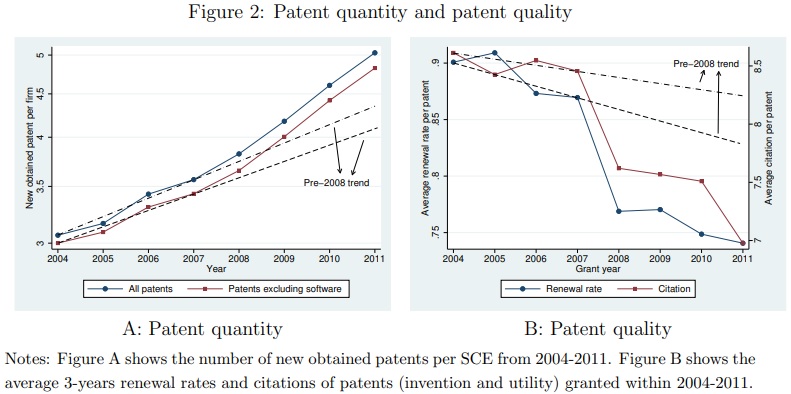
As shown in Figure 2, firms responded by having more patents, but those patents had much less value.

Indeed, 98 percent of the patents were low quality.

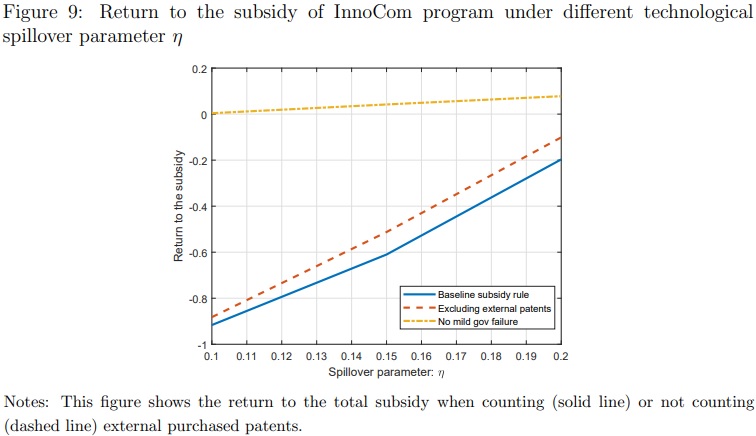
Even more important, the overall program has destroyed wealth, as measured by a negative net social return.

"After calibrating the model to the data, we find that although the subsidy leads to an increase in the patent count by 33%, 98% of the increase is of low quality. This implies a notable decline in the average quality of the new patents. …By comparing the welfare levels in the model with and without the subsidy program, we estimate the net social return to the subsidy to be -19.7%. That is, the society would be better off without this subsidy program. …the thought experiment serves to confirm that the presence of even a mild government failure could convert an…industrial policy from success to failure."

Here’s another visual, this one showing negative rates of return regardless of assumptions of technological spillovers.

One final point that’s worth sharing.

The authors note that industrial policy also causes damage because taxes produce deadweight loss.

…because public funding is financed through distortionary taxation, it costs the society more than 1 RMB to fund 1 RMB worth of subsidy.

Some fans of industrial policy claim that China is an example of successful industrial policy, but that’s nonsense. Total nonsense. Utter nonsense. Unless there are sweeping pro-market reforms, China will continue to lag way behind the United States."

Sunday, May 23, 2021

Biden’s Vaccine IP Debacle

His patent heist is a blow to the Covid fight and U.S. biotech

WSJ editorial. Excerpts:

"But suspending IP isn’t necessary to expand supply and will impede safe vaccine production. The global vaccine supply is already increasing rapidly thanks to licensing agreements the vaccine makers have made with manufacturers around the world.

Pfizer and BioNTech this week said they aimed to deliver three billion doses this year, up from last summer’s 1.2 billion estimate. Moderna increased its supply forecast for this year to between 800 million and a billion from 600 million. AstraZeneca says it has built a supply network with 25 manufacturing organizations in 15 countries to produce three billion doses this year.

AstraZeneca and Novavax have leaned heavily on manufacturers in India to produce billions of doses reserved for lower-income countries. But India has restricted vaccine exports to supply its own population. IP simply isn’t restraining vaccine production.

Busting patents also won’t speed up production, since it would take months for these countries to set up new facilities. Competition will increase for scarce ingredients, and less efficient manufacturers with little expertise would make it harder for licensed partners to produce vaccines."

"Mr. Biden ought to listen to Angela Merkel. Pfizer’s partner BioNTech is a German firm, and the German Chancellor said Thursday that she opposes the WTO heist: “The protection of intellectual property is a source of innovation and it must remain so in the future.”"

Saturday, May 15, 2021

The Economist on Patent Waivers

From Alex Tabarrok.

 "A good statement from The Economist:

We believe that Mr Biden is wrong. A waiver may signal that his administration cares about the world, but it is at best an empty gesture and at worst a cynical one.

A waiver will do nothing to fill the urgent shortfall of doses in 2021. The head of the World Trade Organisation, the forum where it will be thrashed out, warns there may be no vote until December. Technology transfer would take six months or so to complete even if it started today. With the new mRNA vaccines made by Pfizer and Moderna, it may take longer. Supposing the tech transfer was faster than that, experienced vaccine-makers would be unavailable for hire and makers could not obtain inputs from suppliers whose order books are already bursting. Pfizer’s vaccine requires 280 inputs from suppliers in 19 countries. No firm can recreate that in a hurry.

In any case, vaccine-makers do not appear to be hoarding their technology—otherwise output would not be increasing so fast. They have struck 214 technology-transfer agreements, an unprecedented number. They are not price-gouging: money is not the constraint on vaccination. Poor countries are not being priced out of the market: their vaccines are coming through COVAX, a global distribution scheme funded by donors.

In the longer term, the effect of a waiver is unpredictable. Perhaps it will indeed lead to technology being transferred to poor countries; more likely, though, it will cause harm by disrupting supply chains, wasting resources and, ultimately, deterring innovation. Whatever the case, if vaccines are nearing a surplus in 2022, the cavalry will arrive too late.

Elsewhere in this issue they draw on my work with Kremer et al.

The increase in capacity seen over the past year was brought about in large part because of government interventions, most notably Operation Warp Speed in America and the activities of the Vaccine Taskforce in Britain, which guaranteed payments and drove the expansion of supply chains.

These efforts splashed around a lot of money which, if none of the vaccines had worked, would have been lost. But with the benefit of hindsight it is now hard not to wish they had been more generous still. In March Science, a journal, published estimates from a group of economists of the total global economic loss that would have been avoided if enough money to produce vaccines for the entire world had been provided up front, rather than enough for most of the rich world. They calculated that if the world had put in place a vaccine-production infrastructure capable of pumping out some 1.2bn doses per month by January 2021, it would have saved the global economy almost $5trn (see chart).

Eric Budish of the Chicago Booth School of Business, one of the model’s authors, explains the situation using a plumbing metaphor: it is faster to lay down a wider-bore pipe at the start of a project than to expand a narrow one later. The rich world succeeded in producing effective vaccines remarkably quickly in quantities broadly sufficient to its needs: an extraordinary achievement. But the capacity of the system it built in order to do so created constraints that the rest of the world must now live with. That was a choice, not destiny."