Showing posts with label Family. Show all posts

Friday, September 4, 2026

Median Family Income for Married Couples With Children Is Probably Higher Than You Think

By Jeremy Horpedahl.

"In 2024, median income for married couples with children at home was $143,400 in the US. That’s an almost 80 percent real (inflation-adjusted) increase since 1974, the first year Census reports comparable data. Is there some selection bias in who chooses to get married and have kids? Yes. Has there been an increase in dual-income families? Yes, but probably much less than you think (the median family of this type already had two earners by the late 1970s).

With those caveats, this is still pretty impressive:"


Monday, May 12, 2025

Want to Raise Birthrates? Immigration Is the Key

In the U.S., Hispanics tend to have more children. But ‘baby bonuses’ have proved ineffective everywhere

By Jason L. Riley. Excerpts:

"Asian and European experiences are worth examining because the political leaders of these nations, like Mr. Trump, thought that monetary benefits would induce women to have more children. Taiwan has spent more than $3 billion on natalist initiatives. France expanded a policy in 1994 that offered money to couples with multiple children to subsidize child-rearing costs. In 2006, when Russian per-capita income was $10,700, Vladimir Putin doubled the government’s monthly child-support payments and offered a $9,200 baby bonus to mothers who had a second child. Russia’s population was 143 million in 2006, where it roughly remains today."

"even Nordic societies that are known for generous maternity leave and child-care policies have also seen a dearth in newborns."

"Trying to bribe women into having more children than they want has been largely unsuccessful, even when the government offers to pay for child-care while mom returns to the office."

"What has helped prevent U.S. birthrates from going off the deep end is the presence of Hispanics, who tend to have more children."


Sunday, October 27, 2024

China’s One-Child Economic Disaster

Facing demographic decline of its own design, the Communist Party now may subsidize bigger families

WSJ editorial

"Chinese Finance Minister Lan Foan disappointed investors in a press conference last Saturday that offered few details about a fiscal stimulus for the sputtering economy. We’ll discuss the merits of such a plan when details emerge, but meanwhile a startling line caught our eye concerning the consequences of the country’s former one-child policy.

Mr. Foan said in particular the package “will respond to the changing situation of China’s population development” (according to a translation prepared by state media journalist Fred Gao). This is consistent with a Reuters report that Beijing is considering a monthly subsidy of around 800 yuan per child for a family’s second and third children.

What a stunning reversal. For decades Beijing enforced a one-child policy that was ghastly in the way only an authoritarian regime can achieve. The human cost was incalculable, particularly on Chinese parents subject to forced abortions or sterilizations. The social consequences have been catastrophic as sex-selective abortions skewed the population in favor of males and successive generations of Chinese have grown up without siblings, aunts or uncles.

Communist Party leaders will never admit to any of that, but even they recognize the policy has been an economic disaster. Intended to prevent the population from expanding beyond what a developing economy could support, the effect has been nearer the opposite. China’s aging and soon-to-be shrinking population is now an impediment to economic growth.

President Xi Jinping abandoned the one-child policy in 2016, and in 2021 the Party allowed parents to have up to three children. Apparently this isn’t having the desired effect, so now Beijing may attempt natalist subsidies. The problem for Beijing is that these subsidies haven’t worked anywhere they’ve been tried.

Prosperity has reduced child-bearing across the developed world, but democracies let nature and individual choice take their course. China’s Communist Party chose brutal coercion, with damaging consequences that are likely to persist for the foreseeable future. Chalk up another defeat for central planning—and for Western intellectuals who wished we could be more like China."

Friday, October 18, 2024

The 2021 Child Tax Credit (CTC) expansion reduced employment among unmarried mothers with relatively low levels of education and young children

See Employment and Labor Supply Responses to the Child Tax Credit Expansion: Theory and Evidence by Michael R. Strain & Diane Whitmore Schanzenbach of AEI.

"Abstract

The 2021 Child Tax Credit (CTC) expansion increased government benefits to families, and especially to families with the lowest incomes. Economic theory predicts that this policy intervention would have led to a reduction in labor supply among adults in those families. Our review of available research suggests that employment within broadly defined demographic groups was not reduced by the 2021 CTC changes. However, we see some evidence that employment was reduced among unmarried mothers with relatively low levels of education and young children—the demographic group that was most affected by the CTC expansion"

Friday, August 23, 2024

Do Family Leave Policies Work?

By Jeffrey Miron of Cato.

"Policies that subsidize or mandate family leave aim to reduce the gender pay gap, shrink the “child penalty,” and otherwise promote success for women in the labor market.

A recent study, however, finds

no evidence that [California’s 2004 Paid Family Leave Act (CPFL)] … increased employment, boosted earnings, or encouraged childbearing, suggesting that CPFL had little effect on the gender pay gap or child penalty. For first-time mothers, … CPFL reduced employment and earnings roughly a decade after they gave birth.

The study authors conclude,

Given the growing research on the health and well-being benefits of paid family leave policies, US policymakers favoring these benefits may want to consider alternative implementation strategies to mitigate the potentially adverse effects on women’s employment and careers.

One alternative is to leave decisions about career and child-rearing to women and their families, with no government thumb on the scale!"

Wednesday, July 24, 2024

The Long-Term Effects of Income for At-Risk Infants: Evidence from Supplemental Security Income

By Amelia Hawkins, Christopher Hollrah, Sarah Miller, Laura R. Wherry, Gloria Aldana & Mitchell Wong.

Abstract

"The Supplemental Security Income (SSI) program uses a birthweight cutoff at 1200 grams to determine eligibility. Using birth certificates linked to administrative records, we find low-income families of infants born just below the cutoff receive higher monthly cash benefits (equal to 27% of family income) at ages 0-2 and small but significant effects on transfers through age 10. Yet, we detect no improvements in health care use and mortality in infancy, nor health and human capital outcomes as observed through young adulthood for these infants. We also find no improvements for their older siblings."

Saturday, February 24, 2024

Expanding the Child Tax Credit Would Perpetuate Systemic Poverty

The policy is a true budget buster and is ineffective in the long term

By Veronique de Rugy.

"In the well-intentioned rush to support American families by expanding the child tax credit (CTC), critical questions are often ignored: Aren't we already doing enough, and is this the best way to help? It's imperative to step back and examine the assumptions at the heart of this ongoing debate.

The child tax credit was first introduced in the 1997 Taxpayer Relief Act as a way to lower the tax burden for working families, with a $500 per child credit. It was increased a few times, including during the Bush years and in 2017 during the latest Republican tax reform. The justification has morphed into whatever its advocates happen to think it should be: It's an anti-poverty program—hence its refundability. It's a pro-family program—hence its growing size. It's a fertility booster program—hence both its size and refundability.

While it's not that great at meeting any of these goals, it is a true budget buster. At current levels, it costs about $1 trillion over 10 years, a price tag that will grow if it is expanded. For the 2024 tax year, the CTC will be worth $2,000 per qualifying child with $1,700 potentially refundable through the additional child credit. The House of Representatives just passed an expansion that, if passed untouched by the Senate, would extend more benefits to lower-income families. The maximum refundable amount per child would increase from $1,600 to $1,800 for 2023 taxes filed this year. It would also grow depending on inflation. And it would only require work every other year, which is a first step into turning the credit into a universal basic income for families.

Ignoring that the CTC sits on top of roughly 80 or so other welfare programs—many of which are already targeted at families—advocates of the CTC expansion argue that to make it a better anti-poverty measure we should eliminate the work requirements. Assuming no behavior changes, the expansion would certainly provide more government cash for eligible families—but it complicates things further by creating disincentives to work and rise from poverty, especially as it builds on other existing transfers.

Research by Kevin Corinth and Scott Winship at the American Enterprise Institute highlights the fact that after the proposed Wyden-Smith expansion, a single parent with three children earning $15,000 annually would get $11,244 from the Supplemental Nutrition Assistance Program (SNAP), $6,750 from the Earned Income Tax Credit (EITC), and $5,400 in CTC money. That adds up to a little more than $37,000 (ignoring many other benefits). Tragically—because of both the way higher earners are phased out and the generosity of the cumulative benefits—if that same single mom's work earnings nearly tripled to $40,000, she'd take home only some $5,000 more. Indeed, making more than $39,000 means losing all of SNAP and some EITC.

It isn't hard to see how this system, despite creating some work incentives at first, discourages people from pursuing better long-term paths for their families. This is a big deal. Increased employment among low-income parents as a result of work requirements has driven much of the long-term decline in child poverty, as we learned during the welfare reform of the 1990s. We need stronger incentives to move up the income ladder rather than incentives that perpetuate systemic poverty. And this expansion of the credit isn't going to cut it.

Unfortunately, many on the right are willing to ignore the disincentive to work because they worry about declining fertility rates. That would be a valid argument if, and only if, we had evidence that more government spending or more tax credits were effective at lifting fertility rates after they drop below replacement rates. And that isn't the case.

As noted by Adam Michel and Vanessa Brown Calder, the CTC, other financial transfers, and cash benefits are unlikely to be a cure for what ails us. A review of relevant studies "finds that financial transfers result in a short-term increase in births while leaving the long-term total unaffected."

A better way to go would be to boost economic growth so that families have more income in the first place. One way to do this is to cut and flatten tax rates, which would change incentives to save, invest, or be entrepreneurial. Also advisable is doing away with the excessive regulations driving up the cost of things families need, like housing, food, formula, and child care."

Sunday, December 17, 2023

The Biggest Root Cause of Crime Is Fatherlessness

Children are likelier to finish high school and stay out of trouble if they’re brought up by two parents

By Jason L. Riley. Excerpts:

"“If you finish high school, get a job, and get married before having children, you have a 98% chance of not being in poverty.”"

"That advice, more popularly known as the “success sequence,” is often credited to research done by Brookings Institution scholars Isabel Sawhill and Ron Haskins, though others have made similar observations."

"High-school graduates and children raised by both parents are much less likely to end up in jail. “Virtually every major social pathology,” political scientist Stephen Baskerville writes, “has been linked to fatherless children: violent crime, drug and alcohol abuse, truancy, unwed pregnancy, suicide, and psychological disorders—all correlating more strongly with fatherlessness than with any other single factor, surpassing even race and poverty.”"

"the sharpest increase in violent crime began in the 1960s, a decade that saw low unemployment, strong economic growth and a doubling of black household incomes. As notable, labor-force participation rates of young black men fell during the 1980s and ’90s, one of the longest periods of sustained economic growth in U.S. history."

"Nationwide, the total crime rate is about 48% higher in cities “that have above the median share of single-parent families, compared to cities that have fewer single-parent families.”"

"their involvement [fathers] in childrearing is linked to positive outcomes in the academic development of their children, “especially in mathematics and verbal skills.” That finding “has been established for both sons and daughters but, unsurprisingly, it is especially pronounced among boys. The presence of married fathers is also protective against school suspensions and expulsions, as well as the risk of dropping out of high school.”"

Tuesday, October 3, 2023

On Marriage, an Economist Bravely States the Obvious

Melissa Kearney worried about being pigeonholed as she wrote ‘The Two-Parent Privilege.’

By Jason L. Riley. Excerpts:

"the institution’s decline has led to a host of economic woes—problems that have fractured American society and rendered vulnerable populations even more vulnerable"

"“the absence of a father from a child’s home appears to have direct effects on children’s outcomes—and not only because of the loss of parental income,”"

"there are strong links between family structure, the well-being of children and outcomes later in life. Daniel Patrick Moynihan said as much in his 1965 report on the black family, and Moynihan relied on research conducted much earlier by black sociologists such as E. Franklin Frazier.

George Gilder wrote about the importance of the nuclear family in “Sexual Suicide” (1973) and “Men and Marriage” (1986). Charles Murray, who had touched on it in his landmark study, “Losing Ground” (1984), made similar arguments in “Coming Apart” (2012). In 1994 David Blankenhorn published “Fatherless America,” and 1996 brought David Popenoe’s “Life Without Father: Compelling New Evidence That Fatherhood and Marriage Are Indispensable for the Good of Children and Society.”"

"Conservatives likely are familiar with at least a few of the aforementioned titles, yet those books in many cases have been denounced or simply ignored by the same left-wing intellectuals Ms. Kearney is trying to win over."

"Ms. Kearney said that writing the book felt like taking “a big risk” professionally because her peers tend to avoid addressing the role of family structure in discussions of social inequality and look down on those who do. “My saying it’s not discussed is probably more reflective of the circles I run in, which is, you know, higher ed, academia, which of course skews liberal,” she said. “And progressive, left-leaning conversations about kids’ well-being and concerns about social mobility—in those circles, in those conversations, I often find that this topic is met with discomfort.”"

"The author reports that in 1960 only 5% of babies were born to unwed mothers in the U.S. In 2019 it was almost 50%."

Friday, April 21, 2023

The Two-Parent Privilege

From Tyler Cowen.

"A new and great book, authored by Melissa S. Kearney of the University of Maryland.  The subtitle is How Americans Stopped Getting Married and Started Falling Behind, and here is one excerpt of the summary points:

Two-parent families are beneficial for children.

The class divide in marriage and family structure has exacerbated inequality and class gaps.

Places that have more two-parent families have higher rates of upward mobility.

Not talking about these facts is counterproductive.

The marshaled evidence is convincing, and I will be blogging more about this book.  While some stiff competition is coming, this could be the most important economics and policy book of this year.  And yes it is remarkable that such a book is so needed, but yes it is.  And here is Melissa on Twitter."

Wednesday, December 14, 2022

Can you raise a family on one income?

By Scott Sumner.

"Yes.

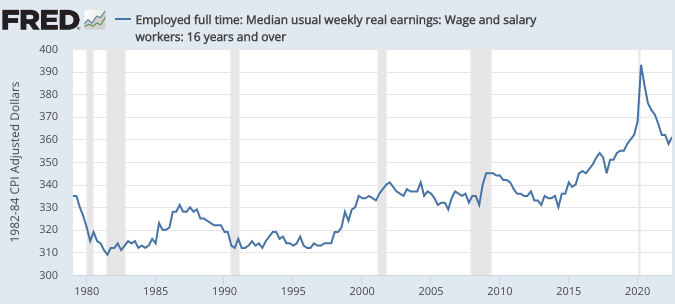
Let’s start with some data:

A few comments: 

1.This deflates median wages by the CPI.  Most economists believe the PCE is more accurate, and it would show much more rapid real wage gains.  

2. This excludes fringe benefits, which have improved much faster than money wages.

3. On average, families are smaller, hence there are fewer children to raise.

4.  If I had used average wages, the increase would have been even greater, as top end incomes have risen faster than median wages.

To summarize, this is a conservative estimate of the gains in real wages. So why the perception that it now takes two incomes for the lifestyle that one income once supported?  I see many factors:

1. In a few places such as Silicon Valley that claim is clearly true, at least for workers with median incomes.  Influential pundits often live in places where house prices have risen much faster than average.

2.  We now have higher expectations.  Suppose you are a median worker that wished to reproduce a 1960s lifestyle.  How do you do this?  You’d move into a 1200 square foot ranch house with one bath in a working class immigrant neighborhood.  To get a car as unreliable as a 1960s car, you must buy a cheap 15-year old car.  To get a TV as bad as a 1960s TV, you find one that someone left out at the curb.  You give up your cell phone.  No vacations by jet, it’s a drive down to Disneyland.  You get the idea.

3.  After the 1950s, a steadily increasing number of women began working.  As two incomes became the norm, the lifestyle that two incomes could support because the norm.  Now families wanted a 2500 square foot house with a big kitchen and three baths.  They expected a reliable car, a big flat panel TV and an iPhone.  They flew to Disney World instead of driving to Disneyland.  Humans are social animals, so the perception of “necessities” depends mostly on what sort of lifestyle you see among your friends and family.  Keeping up with the Jones.

Pundits seem surprised that people now believe it takes two incomes to support a family, whereas one income would have been adequate in the 1960s.  In retrospect, however, this was inevitable once America’s married women decided to enter the labor force in large numbers.  It would have occurred even if real wages had increased 10 times faster.

If you don’t believe me, you might want to study more extreme cases, such as China and South Korea, where real wages did increase at least 10 times faster.  If you speak with people from those countries, you’ll often hear claims that the birth rate has fallen to very low levels because it is too costly to raise children today. In one sense, that’s obviously nonsense.  Back in the early 1960s, South Korea was as poor as sub-Saharan Africa and (like Niger today) Korean women had roughly 6 children on average.  Today, South Koreans are vastly richer, even adjusting for the rising cost of living, and they have 0.8 children.

In places such as China and South Korea there has been a radical change in expectations, in all sorts of dimensions.  Not just the number of goods that are viewed as necessities, but also the expectations for childrearing.  Far more effort is now devoted toward getting kids into the best universities.  

Thus although Chinese and Korean parents are obviously not too poor to have larger families, there may be a sense in which economic factors are influencing family size.  But it has more to do with a change in acceptable lifestyles, rather than in any lack of growth in real wages."

https://fred.stlouisfed.org/series/COMPRNFB


Monday, December 5, 2022

The Parable of the Child Tax Credit

Democrats hope to expand this bad policy in the lame-duck session.

WSJ editorial.

"Congress is returning to Washington for a lame-duck session, and Democrats think they’ve found the perfect holiday gift for hard-to-shop-for American voters: Subsidies for children. The left and some Republicans will argue that only childless ghouls could oppose cash for kids, but the tax credit is a parable about good intentions, unintended consequences, and the insatiable entitlement state.

A core Democratic priority in Congress is resurrecting a $3,000 child tax credit for dependents ages six and up, with a $600 bonus for younger children. Congress passed such a larger credit for 2021, dressed up as pandemic relief, with half of the benefit payed in monthly checks. By some miracle the payments expired, but Democrats are eager to bring it back, if not this month then in the new Congress.

Scott Hodge nearby lays out the regrettable history of the child tax credit, which he helped propose in the 1990s. The credit was born as a $500 per-child benefit for middle-income families, but has since degenerated into one more cash transfer payment. The Internal Revenue Service is now another turnstile of the welfare state.

That’s because over time Congress made more of the credit “refundable,” which means available to those who don’t owe federal income taxes. By 2004 the credit was worth $1,000; those with $10,000 of earned income could claim a portion of it. Republicans in 2017 doubled the benefit to $2,000, and this year filers need a mere $2,500 of income to qualify. The increase to up to $3,600 eliminated any income requirement, handing out the full benefit as a universal basic income for people with children.

As Mr. Hodge explains, the child tax credit “has become one of the largest federal income-transfer programs” and “one of the leading reasons that more than 40% of all filers pay no income tax.” Meanwhile, the top 1% of taxpayers paid more than 38% of individual income taxes in 2019, according to the Tax Foundation. That is fiscally and politically unsustainable.

The child tax credit has also been an engine for higher tax rates. Democrats can raise the top rate on income north of 40% while protecting suburban middle-income voters from the pain thanks to the kid discount. The full Democratic allowance would cost $1.6 trillion over 10 years, and these credits are an expanding black hole for revenue that could be used to lower taxes for everyone. Think of it as a progressive insurance policy against pro-growth tax policy.

Progressives respond to these critiques by touting the 2021 allowance as a grand achievement that reduced child poverty, citing data out of Columbia University. God bless Bruce Meyer, the University of Chicago economist who has been explaining into the media void that such data is “based on simulations that do not rely on income data from the period in question” and doesn’t account for behavior changes such as cutting back on hours at work.

A paper from Mr. Meyer and associates tries to capture a better picture of households and finds “only a small decline in poverty” during monthly child credit checks and “no rise after the elimination of the payments.”

The “best evidence, though still imperfect,” the paper notes, “suggests poverty was relatively stable in 2021 and the first half of 2022. Part of the explanation for the lack of change appears to be a compensating decline in employment among low-skilled workers with children.” In other words, the disincentive to work swamps the benefits. The disincentive would get worse if the larger allowance became a permanent feature of the entitlement state and not a one-time cash infusion.

***

Democrats have underestimated American voters, who still think benefits should be paired with work and a path out of dependency. That is one reason the larger credit expired without a political peep. In a December 2021 poll, 51% said the credits probably or definitely shouldn’t be permanent.

Low-income voters are always assumed to support cash benefits, but 46% of those earning less than $50,000 opposed the payments. That may be because Americans understand that poverty in the U.S. is now less about material deprivation and more about idleness, addiction, mental illness and other destructive realities that can’t be cured with a bigger check.

Democrats are hoping to lure Republicans into a lame-duck deal to revive the $3,600 credit in return for some GOP tax priority, but that’s a bad political and policy trade. For all the country’s problems, American voters still want opportunity and upward mobility more than income redistribution."

Wednesday, April 27, 2022

Policies that make it more difficult for working parents to work flexibly should be reviewed and updated

See The Future of Working Parents by Vanessa Brown Calder of Cato. Excerpt:

"For instance, local labor regulations that make workplaces more rigid to “protect” workers make work less flexible and therefore make work and family life less compatible. Meanwhile, federal labor regulations, like the Fair Labor Standards Act, that require workers be compensated for overtime with payment rather than through future time off also make balancing work and family life more difficult. These rules should be reformed to accommodate families with needs for flexible work.

Additionally, regulations that limit gig economy work make flexible work more difficult to come by for parents, especially since parents are more likely than non‐​parents to take gig economy jobs. The Biden administration has said that it is “committed to ending the abusive practice of misclassifying employees as independent contractors, which deprives these workers of critical protections and benefits,” but this is the wrong approach. The administration should consider that a majority of gig workers in a variety of surveys prefer the independent contractor designation that makes flexible work possible and are happy with their employment arrangement.

Moreover, home based businesses must be legalized. Currently, zoning bans and restricts many types of home based businesses, and additional permitting and licensing requirements create barriers to entrepreneurship. As one example, the cottage food industry took off during the pandemic, but in some states like Rhode Island, moms can be shut down for selling something as benign as home‐​baked cookies. This is unfortunate because selling food onlineand working from home more generallyare opportunities for working parents balancing childcare needs, families balancing elderly care needs, and for recent refugees and immigrants.

Occupational licensing laws also need reform to accommodate flexible work. For example, certain states require lawyers to have practiced full‐​time for a series of consecutive years to be licensed, and this penalizes working parents that want to work part time or take time off in order to balance family and career. These rules should be reformed to accommodate working parents and workers of all stripes.

This is only a sample of the many reforms that should be made to increase flexible and remote work opportunities, and as workers and companies are rethinking expectations around work, policymakers should rethink the many policies that prohibit the flexible and remote arrangements that working parents crave.

If what parents say is any indication, flexible work is the future. Policymakers would be wise to clear the way for it."

Tuesday, November 9, 2021

The Spending Bill Is an Attack on Work and Marriage

A single mom could end up paying thousands more for daycare if she marries. Children will suffer

By Casey B. Mulligan. Excerpts:

"For each year that a couple has children under 5, being unmarried could easily save them over $10,000 annually in child-care costs compared with being married.

That’s because of how the subsidies are structured. A single mother earning 75% of the median household income in her state would pay nothing for child care, regardless of how much the child’s father earned. But the father’s income counts if he is legally part of the family. A husband and wife who each earned about 75% of the median income would have to pay thousands for the same daycare. In 2022-24, the married couple would pay full price, which would likely exceed $15,000 a child a year—$30,000 for two children under 5."

"Democrats will claim that their new bill at least encourages work by making child care free, but that refers only to a narrow slice of the population. Most families, especially those that don’t qualify for a full subsidy or that have older children, will pay more for child care. One reason: Under the heading of “quality regulation,” the bill requires that child-care workers be paid a “living wage” and that their earnings be “equivalent to wages for elementary educators with similar credentials and experience.”

The precise meaning of that would be left to regulators, but according to the Bureau of Labor Statistics, elementary-school teachers earned an average of $63,930 annually in 2019, compared with $25,510 for child-care workers. By that benchmark, child-care facilities would need to pay workers 151% more."

"As one’s income from working increases, the amount offered by these benefit programs decreases. The marginal tax rate on working an extra hour, day or week, or improving your skills, can be extremely high."

"the several implicit employment and income taxes in the revised bill would increase marginal tax rates on work by about five percentage points. I expect that such a change, over five years, would reduce full-time equivalent employment by about 4%, or about five million jobs."

"Quebec imposed “quality” regulation on its child-care market, which, a landmark study found, led to “increases in early childhood anxiety and aggression” with “little measured impact on cognitive skills.” Kids exposed to the program suffered “worse health, lower life satisfaction, and higher crime rates later in life.”"

Thursday, April 1, 2021

Do births to unmarried women affect the poverty rate?

See Charts of the day, all viral edition by Mark Perry. Excerpt: 

"In the last week or so I’ve had three charts that went “viral” on Twitter, here they are!

1. Chart of the Day I (above) shows the shares of births to unmarried women by race in 2019 based on recently released US birth data from the National Center for Health Statistics.

2. Chart of the Day II (above) shows the same data on the share of births to unwed mothers in Chart I for Asians, Whites, Hispanics, and Blacks above along with median household income for those groups in 2019. For the two variables in the chart above the correlation coefficient (a statistical measure of association between two variables that ranges from -1 (perfect negative correlation) to +1 (perfect positive correlation)) is -0.99, or almost perfect negative correlation between the shares of births to unwed mothers and median household income by race in 2019.

When I posted the first chart above on Twitter, I posed the following questions: Should we be concerned? Should these differences be discussed? When I posted the second chart above on Twitter, I asked “See any patterns?” There were a number of notable, high-profile responses to those questions:

From Glenn Loury: “Yes, be concerned. And. Yes, talk about this.”

From Prager University: “We’ve said it before and we will say it again: Black America has a culture crisis that can’t be fixed by government handouts or “social justice” movements. It starts at home.”

From Andrew Sullivan: “This is central to tackling racial inequality. Without moving these numbers, not much will ever change.”

From Jordan Peterson: “Given the well-documented and multiplicitous disadvantages faced by children who grow up in fatherless families the answer is incontrovertibly yes.”

Note: Tucker Carlson mentioned Jordan Peterson’s Quote Tweet of my chart last night on his “Tucker Carlson: Tonight” show!

From author Melissa Tate: “‘White Privilege’ debunked. This is culture privilege & family privilege. Asian culture emphasizes academic achievement/excellence & values marriage & family. The result is they out-earn all other races. Breakdown of family & marriage causes poverty.”

From Sharyl Attkisson: “Have kids when you can afford them and as a couple: Family is more likely to be prosperous. Out of wedlock and single: More likely to be poor. Of all they teach our kids in school, some basic economic fundamental facts about finances could help everyone more in the long run.”

From Ben Shapiro: “This chart is vital, and will be completely ignored.”

From Obianuju Ekeocha: “70% and 69% are very high. Surely this is the root of so many problems. It is not white supremacy to point this out and it is not racist to demand a change within our communities. IMHO.”

MP: The 70% share of black births to unwed mothers is a major issue that does deserve more attention in the national discussions on racial disparities, “Black Lives Matter,” allegations of white privilege and systemic racism, etc. As long as 70% of black children are born to unmarried mothers, the black-white disparities in income, wealth, homeownership, educational outcomes, school suspensions, crime rates, incarceration rates, etc. will all continue. And of course, the racial disparities between Asians and whites (for income, wealth, education, etc.) receive almost NO attention because it doesn’t fit the narratives of white privilege, black victimhood, systemic racism, etc. ….."