Showing posts with label Venezuela. Show all posts

Sunday, November 23, 2025

Maduro Caused the Disaster

He and Chávez created the crisis in Venezuela, not Trump

Letter to The WSJ

"Regarding Quico Toro’s essay “Another U.S. Attempt to Topple Maduro Would Be a Disaster” (Review, Nov. 8): Venezuela’s economic collapse and migratory crisis began in 2013, at least four years before the U.S. imposed broad U.S. sanctions. From 2013 onward, Venezuela experienced the highest inflation rate in the world and a precipitous decline in gross domestic product, driven directly by the devastating economic policies of Hugo Chávez and Nicolás Maduro, including widespread nationalizations, reckless monetary and fiscal policies and the implementation of universal price and currency controls.

Mr. Toro neglects the consequences of the Biden administration’s policy of accommodation. Far from improving conditions, diplomatic passivity has allowed the government to dig in its heels, intensifying repression and exacerbating the humanitarian crisis.

Leading Americans to believe that President Trump collapsed the Venezuelan economy is another way to whitewash the policies of Mr. Maduro’s regime.

Jorge Jraissati

Boca Raton, Fla.

Mr. Jraissati is president of the Economic Inclusion Group.

Friday, August 2, 2024

Venezuela’s Nicolas Maduro Proves Milton Friedman Right, 60 Years Later

By Benjamin Powell of Texas Tech University. The full article is below but I am putting the last paragraph first.

"More than 60 years ago, Nobel Prize-winning economist Milton Friedman wrote that he knew of no “society that has been marked by a large measure of political freedom, and that has not also used something comparable to a free market to organize the bulk of economic activity.” While Venezuela was briefly an exception, it eventually lost its political freedoms after socialist policies destroyed its economic freedoms."

"The Venezuelan government is claiming that Nicolas Maduro has won re-election to a third term as President. However, this claim does more to illustrate the incompatibility of a democratic political system and a socialist economic system than it does to establish Maduro’s legitimacy as Venezuela’s President.

The problem is that socialist systems centralize economic power in the hands of government. Once that happens, the government also has the power to subvert the democratic process by punishing any political opposition economically.

Venezuela’s socialism started out democratically with Hugo Chavez’s election in 1998. The state’s monopoly on the world’s largest oil reserves, combined with high prices in the 2000s, gave the government plenty of foreign reserves to import goods and appease voters, even though its policies were undermining its domestic production and causing the economy to underperform.

Oil production eventually declined due to state incompetence, corruption, and political graft. Once global oil prices also fell, the Venezuelan economy collapsed and has now been in crisis for a decade.

Under Maduro, socialist economic policies and corruption have caused one of the worst economic and humanitarian crises in the Western Hemisphere in centuries. Annual inflation peaked at 344,509% in 2019. (That’s not a typo!) Shortages of basic goods are widespread. More than 7 million refugees have fled the country.

Voters would surely throw any administration with this track record out of office in a free and fair election. At that point, when voters in any free country would demand a change of course, Venezuela’s democratic socialism evolved into normal authoritarian socialism.

This year, it appears Venezuela’s National Electoral Council (CNE) manipulated the vote count outright, leading to the Organization of American States (OAS) refusing to recognize the election results. However, this is not the first time the Maduro regime has manipulated the democratic process. In his last re-election bid, six years ago, state-owned firms ordered workers to vote for Maduro under threat of losing their jobs and polling places allegedly bribed voters with food aid to support the regime.

Following Sunday’s hotly contested election, the CNE, run by Maduro appointees, declared him the winner claiming that he had won 51.2% of the votes while opposition candidate Edmundo Gonzalez received only 44.2% of the votes. The opposition was denied access to CNE headquarters while votes were being tallied, but they claim that the 73% of tally sheets they’ve been able to access show Gonzalez winning by a more than two-to-one margin. Independent pre-election polling is much more in line with the opposition’s claims than the Venezuelan government’s. Three independent polls were conducted in the weeks leading up to the election. Each indicated that between 59% and 72% of voters intended to vote for Gonzalez, while Maduro polled at just over 12% in two polls and just under 25% in the third.

More than 60 years ago, Nobel Prize-winning economist Milton Friedman wrote that he knew of no “society that has been marked by a large measure of political freedom, and that has not also used something comparable to a free market to organize the bulk of economic activity.” While Venezuela was briefly an exception, it eventually lost its political freedoms after socialist policies destroyed its economic freedoms."

Wednesday, July 31, 2024

Twelve Graphs on Why Maduro Could Only “Win” by Stealing Venezuela’s Election

By Daniel Raisbeck of Cato.

"On July 26, I noted that the crucial question about Venezuela’s upcoming election was not whether Maduro would lose in a landslide, as he did according to serious exit polls and the National Electoral Council’s initial figures prior to an alleged blackout. Rather, the question was whether Maduro would accept the result. He did not.

At the time of writing, the regime, which controls the electoral council, has not produced evidence to back its claims that Maduro beat opposition candidate Edmundo González by a margin of 51 to 44 percent. Protests are erupting in Venezuela and several Latin American countries, including Chile, which is led by a left-wing president, refusing to recognize the election’s validity. It is now clear that Maduro’s plan is not to flee or negotiate, but rather to hold on to power by any means necessary.

Why are those means necessarily fraudulent, potentially also violent?

The following graphs will help explain why, according to fair calculations, around 65 percent of Venezuelan voters rejected Maduro’s government yesterday at the polls. 

Inflation

Inflation Rate, Annual Consumer Prices: Venezuela (%)

Source: International Monetary Fund

Chávez took control of Venezuela’s central bank in 2007. When he died in 2013, Maduro inherited 40 percent annual inflation levels after a hefty rise in the previous decade. By 2017, the Chavista regime’s monetary mismanagement had left inflation at 438 percent per annum.

Inflation Rat: Annual Consumer Prices: Venezuela (%)

Source: International Monetary Fund

Mere triple-digit annual inflation levels—such as those that Venezuela is experiencing now— would seem low in comparison to the hyperinflationary period of 2018 and 2019, when the Chavista regime oversaw 65,000 percent and 19,000 percent inflation respectively.

Devaluation

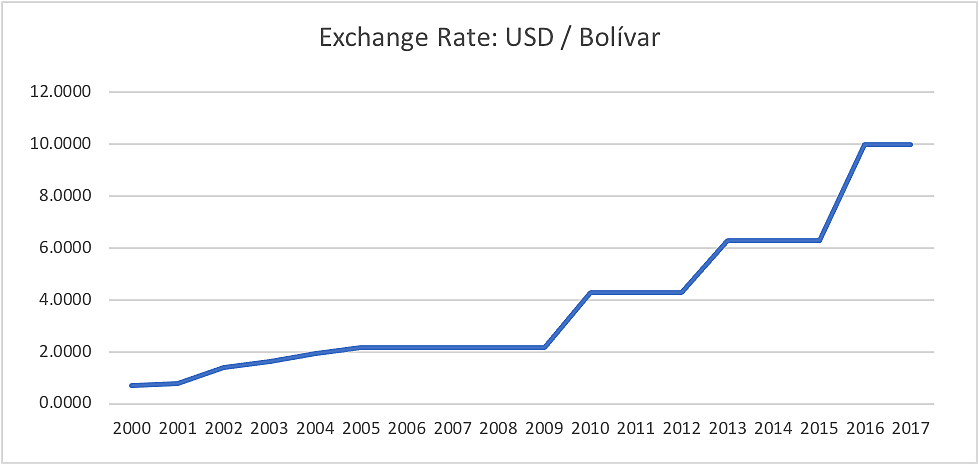
Exchange Rate: USD / Bolivar (2000-2017)

Source: Federal Reserve of St. Louis

Chávez constantly devalued Venezuela’s currency, as did Maduro when he took over. By 2017, the bolivar had lost 92 percent of its value against the dollar since 2000. As hyperinflation raged, Maduro further devalued by 95 percent and removed eleven zeroes from the currency in two years.

By 2018–2019, Chávez and Maduro had made Venezuela’s currency worthless; street vendors at one point sold goods woven from bolivar banknotes. Maduro was forced to remove currency exchange controls. By 2021, large parts of the Venezuelan economy were de facto dollarized.

Exchange Rate: USD / Bolivar (1/2018-11/2021)

Source: Federal Reserve of St. Louis

Debt to GDP

Venezuela: Debt to GDP

Source: International Monetary Fund

When Chávez won his first election in 1998, Venezuela had a relatively healthy debt-to-GDP ratio of 30.7 percent. By the time of Chávez’s death in 2013, the debt had risen to the equivalent of 85.4 percent of GDP. Since 2015, Venezuela’s debt-to-GDP ratio has remained well above 100 percent, having reached a record level of 327.7 percent in 2020.

Per Capita GDP

Venezuela: Per Capita GDP (1980-2023)

Source: International Monetary Fund

High oil prices and Chávez’s deficit spending boosted Venezuela’s per capita GDP nearly fourfold from 2003 until 2012. A full bust would follow the boom. The Chavista model’s collapse and the oil bear market of the mid-2010’s pushed the country’s per capita GDP in 2018 to roughly the same level as 1984—this despite a population exodus. The same remains true today despite the sharp rebound in oil prices since the lows of 2020. Chavismo thus set Venezuela back four decades in terms of economic growth.

Poverty & Extreme Poverty

Poverty & Extreme Poverty in Venezuela (2002-2021)

Source: United Nations Office for the Coordination of Humanitarian Affairs

Through his extreme fiscal profligacy, fueled by debt and petrodollar income at the height of the 2000’s oil boom, Chávez created the mirage of a nation that was defeating poverty. By the early 2010’s, the poverty rate had dropped below 30 percent of the population and extreme poverty below 10 percent. Then came fiscal, monetary, and economic collapse. By 2019, 96 percent of Venezuelans lived in poverty and 79 percent in extreme poverty. In 2021, the Financial Times reported, “for the first time, the average Venezuelan is poorer than the average Haitian.” The formerly rich Venezuela had become Latin America’s poorest country.

Oil Production

Crude Oil Production in Venezuela (2000-2023)

Source: U.S. Energy Information Administration

Venezuela sits atop the world’s largest oil reserves and, in the early 2000’s, was producing north of 3 million barrels of crude per day. Even after the oil-sector strike of 2002–2003, an attempt to prevent Chávez from seizing control of the state-owned oil company (PDVSA), and Chávez’s subsequent firing of 20,000 PDVSA employees (out of a total of 35,000), Venezuela produced over 2.5 million barrels per day. But decline set in as Chávez seized PDVSA, filled its ranks with his supporters, and used its resources for his “revolutionary” aims, for instance building social housing.

The poorly led company was unable to weather the oil bear market which began in 2014. Trump-era sanctions halted all oil exports to the United States, but Venezuela’s exports to the rest of the world also dropped precipitously, as did internal oil consumption. By 2019, Venezuela was producing well below one million barrels of crude per day, a figure that dropped to under 500,000 barrels per day during the COVID-19 crisis.

Chavista propaganda blames the collapse of Venezuela’s oil industry solely on US sanctions, but history has provided a curious point of comparison. Despite facing severe sanctions on its own oil exports since early 2022, Russia “has defied predictions of severe declines in its oil supply,” as Reuters reported at the end of 2023 (with Russian supply expected to remain steady in 2024). In Venezuela’s case, Bolivarian socialism, not sanctions, is the main culprit of PDVSA’s downfall.

Emigration

Venezuelan Migrants & Refugees per Country

Source: Plataforma de Coordinación Interagencial para Refugiados y Migrantes de Venezuela (R4V)

Venezuelans began to leave their country en masse in 2014. By 2022, 6.8 million Venezuelans were residing abroad, many of them as refugees. According to R4V, a platform of the United Nations High Commissioner for Refugees and the International Organization for Migration, there were 7.77 million Venezuelan refugees and migrants in the world in early 2024, with 6.59 million living in Latin America and the Caribbean.

Neighboring Colombia is the country that has received the most Venezuelans in the last ten years, at an astounding 2.8 million; Colombia’s total population in 2013 stood just above 46 million, according to the World Bank. Peru (1.54 million), Brazil (568,000), Chile (532,000), and Ecuador (444,000) follow. Outside Latin America, the United States and Spain have received the largest numbers of Venezuelan migrants. In 2019, a UN report estimated that Venezuela had already lost 10 percent of its population due to the exodus.

Political Prisoners

Political Prisoners in Venezuela (2014-2024)

Source: Foro Penal

As in Cuba, whose regime Chávez admired and emulated, political repression has been a hallmark of the Chavista era, with a sharp rise in political prisoners during Maduro’s time in power. High-profile opponents of Chavismo who have been incarcerated include Leopoldo López, a party leader and local mayor in Caracas, and former Caracas mayor Antonio Ledezma, both of whom managed to flee Venezuela.

The number of political prisoners increased drastically in 2017 when the regime violently put down massive protests that arose after Maduro’s “dissolution” of the opposition-led National Assembly and the arbitrary arrest of opposition leaders. Although the regime has used the release of certain political prisoners as a bargaining tool in its frequent negotiations with the opposition, it targeted opposition leader María Corina Machado’s staff members for arbitrary detention during the recent election campaign.

Homicide Rate

Homicides in Venezuela

Source: World Bank (based on official figures)

Chávez had little intention of upholding Venezuelans’ liberty and property. Nor did he safeguard their right to life. Venezuela’s homicide rate rose sharply under his rule and that of Maduro, reaching a high of 63 murders per 100,000 inhabitants in 2014, according to official figures, whose accuracy has been questioned. The Venezuelan Observatory of Violence, an independent research institute, has constantly published figures that exceed those of the regime. The institute calculated the 2013 murder rate, for instance, at 79 per 100,000 inhabitants versus the regime’s 39 per 100,000.

As journalist Jeremy McDermott wrote in 2014, “Unfortunately the government claims that homicides actually dropped 30 percent in 2013 are so unbelievable that they must be discounted.” At 79 homicides per 100,000 people, he added, Venezuela “is still far away the most dangerous nation in South America, and trails only Honduras (with a rate of 86) as the most dangerous nation on earth.”

But the homicide rate has dropped considerably since the mid-2010’s, as the observatory’s own figures attest. In 2023, the institute reported 27 homicides per 100,000 inhabitants, the lowest rate since 2001. According to one theory, mass emigration has lowered the murder rate because entire criminal groups have also left Venezuela.

Human Freedom

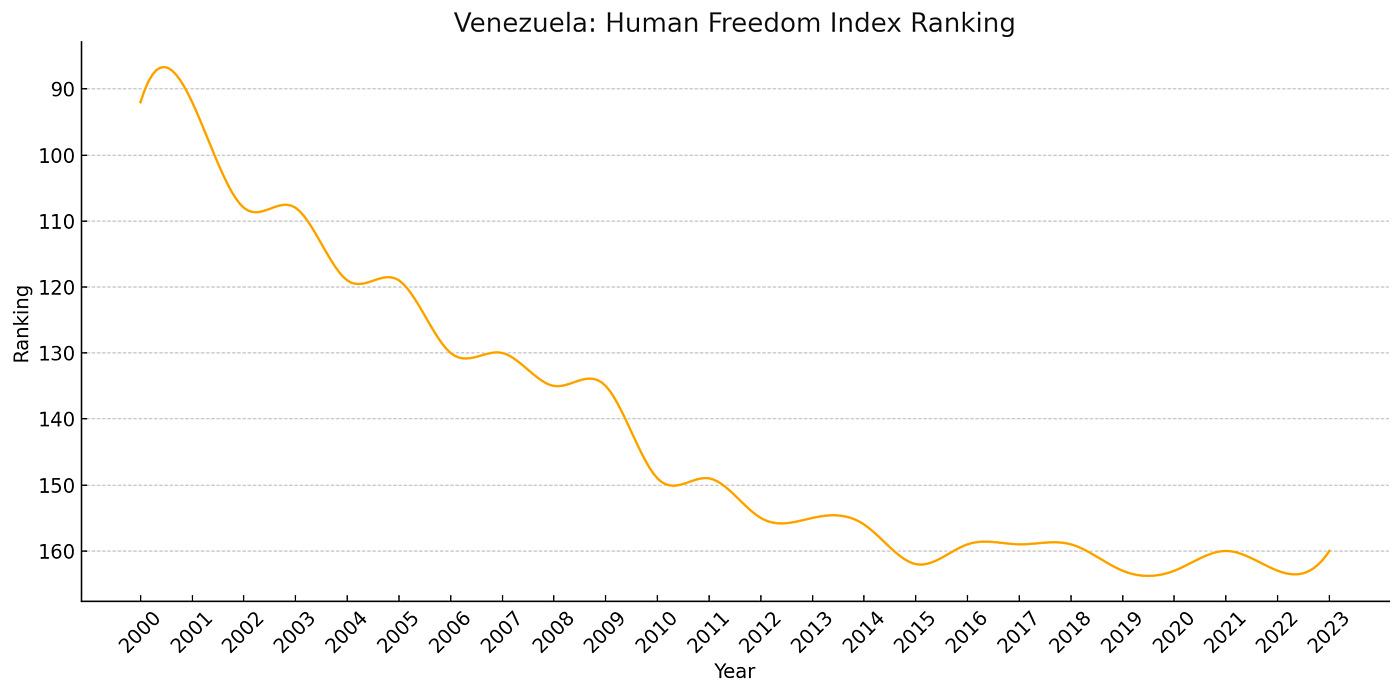
Human Freedom Index Ranking: Venezuela

Source: Human Freedom Index

The Human Freedom Index measures countries’ economic liberty together with the degree of civil and personal freedom that they allow their citizens. The index, which measures human freedom in 165 countries since the year 2000, has tracked Venezuela’s descent into authoritarianism since the early stages of Chávez’s rule. From its initial human freedom ranking below the middle of the pack in 2000, Venezuela steadily deteriorated. In 2019, it fell to second-to-last place. Venezuela currently ranks last in terms of economic freedom."

Sunday, March 27, 2022

The Disaster That Is Venezuela (or The NY Times says price controls cause problems)

By Tim Padgett. He reviews "THINGS ARE NEVER SO BAD THAT THEY CAN’T GET WORSE: Inside the Collapse of Venezuela" by William Neuman (a New York Times correspondent). Tim Padgett is the Americas editor at the Miami NPR affiliate WLRN and Time’s former Latin America bureau chief. Excerpts:

"For Venezuela, 2012 was the eve of the worst national collapse in modern South American history.

Hugo Chávez, the red-bereted firebrand who’d brought his socialist Bolivarian Revolution to power in 1999, would win another presidential term that October. But by March 2013, he’d be dead of cancer, and you could feel something malignant about to lay waste to his country’s social and economic body.

Spiraling inflation, widespread corruption and ludicrous financial thinking were erasing Venezuela’s historic oil boom. Through the decade, gross domestic product would free-fall almost 80 percent and malnutrition would stalk the population. In 2015 the capital, Caracas, would suffer the highest homicide rate of any city in the world."

"A fifth of Venezuela’s 30 million people would flee abroad."

"In the 21st century, Chávez’s authoritarian regime, known as Chavismo, turned that Venezuelan delusion into demolition. It did steer petro-riches to the poor for once; many barrios saw their first schools, clinics and potable water pipes. But when the price of oil skyrocketed from less than $8 a barrel at Chávez’s inauguration to more than $100 a barrel shortly before he died, insane economic malpractice and malfeasance ensued."

"“Chávez’s socialism was all means and no production,” he writes. “It was showcialismo,” an endless bacchanal of multibillion-dollar projects — like a national electricity monopoly, Corpoelec — that were essentially left to rot after the ribbon-cuttings. As Venezuela gorged on imports and prices ballooned, Chávez and his handpicked successor, the witless ideologue Nicolás Maduro, kept forcing price controls that further discouraged domestic industry, spawning huge shortages and extortionate black markets."

"Using fraudulent contracts and invoices, Chavista mandarins and their business cronies gamed the chasm between the official and black-market bolívar-to-dollar exchange rates. They reaped Mafia-grade profits; they also bled the state-run oil monopoly, PDVSA, of cash and robbed Venezuelans of urgent necessities like food, housing and energy infrastructure."

Thursday, December 30, 2021

Venezuela’s Fatal Embrace of Cuba

An oil-rich one-time ally of the U.S. has been quietly colonized by a much smaller, poorer neighbor. Now Venezuela is as wrecked and destitute as a country at war

By Moisés Naim. Mr. Naim, who served as Venezuela’s minister of trade and industry in the early 1990s, is Distinguished Fellow at the Carnegie Endowment for International Peace in Washington, D.C. Excerpts:

"In the first half of 2019, Venezuela began to suffer gasoline shortages. This, on its face, was preposterous. The nation had the world’s largest proven oil reserves—its refineries boasted the capacity to supply the country’s needs many times over. Yet drivers up and down the land found themselves waiting days on end in lines outside gas stations, bringing to mind the old joke about how if communists took over the Sahara it would run out of sand.

At the same time, tanker ships were departing from Venezuelan terminals full of oil. They did so in contravention of U.S. sanctions, turning off their satellite tracking devices to avoid detection and heading north-northwest…toward Cuba. This image tells the fundamental story of Venezuela’s multilevel disaster. Even amid crippling gas shortages that left Venezuela in economic free fall, Caracas’s priorities were clear: Cuba’s needs come first. Always."

"For much of the 20th century, Venezuela was the poster child for the successful South American republic: democratic when its neighbors were despotic, prosperous when its neighbors were poor, and stable all through the vagaries of the Cold War. Venezuela carved out a niche as the country that the U.S. State Department could highlight to make its case that democracy could work in Latin America."

"One out of five Venezuelans has fled the country, a dismal parade of more than six million penniless, frail and desperate people straggling into neighboring countries in search of charity and shelter."

"for many decades, Venezuela certainly appeared to be “developing.” Indeed, from the time that its oil industry got going in the 1920s, Venezuela was a development star, with incomes growing steadily and a strong middle class emerging in a country with no history of any such thing.

Yet starting with the debt crisis of the early 1980s, the process stalled. The country’s politics became bitterly divided. Then, in the last 10 years, the development process slammed into reverse. Today, with incomes in free fall and people literally hiking to the nearest border to find something to eat, to call Venezuela a developing country is an absurdity, if not an obscenity.

At the moment, according to researchers, 95% of Venezuelans are poor in terms of income. More than 3 in 4 Venezuelans live in extreme poverty and food insecurity. At around $3 a month, the legal minimum wage won’t feed a person for a day, let alone a family for a month. There is therefore little point in working: About half of the working age population has dropped out of the labor force, leaving remittances from relatives who have fled as the main survival strategy for about 40% of the population. GDP per capita has plummeted to levels not seen since the 1950s.

Hyperinflation set off this most recent and precipitous descent. Beginning in 2017, unbridled government spending, uncontrolled monetary expansion and a collapse in tax revenues led prices to rise out of control. Money became largely useless: Prices in local currency rose an estimated one million percent in 2018. At 45 months and counting, Venezuela’s hyperinflationary spiral is now the second longest in history, bested only by Nicaragua’s in the 1980s.

No part of life is spared the chaos. Water shortages are endemic in all major cities. Blackouts are common. Chronic gasoline shortages have ground public transport to a halt in many places: Bicycles have become the mode of transport of choice for those who can afford them. The healthcare system has collapsed, leading child mortality rates to spike to levels not seen in a generation. Diseases such as diphtheria and malaria, which were all but eradicated decades ago, are back. The sole bright spot? Murder rates have fallen because, some surmise, ammunition is in short supply and gang members have migrated to neighboring countries."

"The main culprit is clear enough: socialism, in a particularly virulent and criminalized incarnation. A wave of expropriations beginning in 2005 put much of the country’s private economy in state hands. Those firms that remained private faced a wall of state controls that left them with little say over their own operations. Wages, prices, hiring and firing, production levels, imports, exports and investment—each became subject to minutely detailed rules thought up by socialist bureaucrats with little notion of how to run a business."

"Private investment largely ceased. No sane entrepreneur would invest in an economy like Venezuela’s, unless in illegal businesses or in companies with close ties to corrupt military or government bigwigs. Of them, there were many: Bureaucrats across the growing state-owned enterprise sector looked for creative ways to extract value from the assets they controlled and ferret it away in offshore bank accounts. Soon, Caracas had turned into a major money laundering hub, with neophyte kleptocrats looking for savvier partners able to help them hide their loot.

Venezuela’s socialism was criminalized from the start, often serving as little more than a narrative that the powerful used to cover up their plunder of public assets. A ruthlessly extractive state elite ran through the nation’s economy like a plague of locusts, leaving virtually nothing behind.

How could such a destructive governance model take hold in a country with one of the most enduring democracies in Latin America? The question will keep academics busy for generations, but the first place to look for an answer is Cuba, which is where Venezuela found the model of state control that it would implement to such disastrous effect.

To call Venezuela under Hugo Chávez and Cuba under Fidel Castro “allies” is to understate the case. Beginning in the early 2000s, thousands of Cuban doctors, teachers, nurses, sports-trainers and community organizers poured into Venezuela as part of an oil-for-development-assistance deal that became an economic lifeline for the island while filling Venezuela to the brim with Cuban spies. Soon, Cubans were enmeshed in Venezuela’s state system at every level, and Chávez made little secret of the fact that he trusted them more than his own people."

"Venezuela experienced a kind of upside-down colonization, with the smaller, weaker country—Cuba—effectively taking over its larger, richer neighbor."

"Soon, Venezuelan kleptocrats were buying ranches in the Argentine pampas and castles in picturesque towns in Spain." 

"sanctioning Venezuela did little to isolate its regime. Why? Because the U.S.’s strategic competitors—including China, Russia, Iran, Belarus, Turkey, Qatar and, of course, Cuba—stepped into the breach, creating an alternative international support system that sustained the Venezuelan dictatorship."

"the Western left took up a well-funded propaganda campaign, called “Hands-Off Venezuela” and supported by the Venezuelan government, that called for “nonintervention” in Venezuela’s affairs, but in a strikingly lopsided fashion: Only the Western democracies were admonished to keep their hands off Venezuela, not the autocracies that propped up the regime."

Thursday, July 25, 2019

The economic consequences of Hugo Chavez: A synthetic control analysis

By Kevin Grier and Norman Maynard.
"Journal of Economic Behavior & Organization, 2016, vol. 125, issue C, 1-21

Abstract: We use the synthetic control method to perform a case study of the impact of Hugo Chavez on the Venezuelan economy. We compare outcomes under Chavez's leadership and polices against a counterfactual of “business as usual” in similar countries. We find that, relative to our control, per capita income fell dramatically. While poverty, health, and inequality outcomes all improved during the Chavez administration, these outcomes also improved in each of the corresponding control cases and thus we cannot attribute the improvements to Chavismo. We conclude that the overall economic consequences of the Chavez administration were bleak."

How central planning hurt Venezuela

See Under Venezuelan Socialism, There Is No Beer. (And No Democracy.) Attempts to centrally plan an economy ruin both civic life and life's pleasures. By Robert Lawson and Benjamin Powell in Reason. Excerpt:
"Three years ago, the two of us traveled to the Venezuelan border to better understand the causes of the country's economic strife. We traveled to the bridges near Cúcuta, Colombia, where—unlike in Venezuela, just across the river—there were no government-enforced wholesaler monopolies, no arbitrary price controls, no limits on profits. What a difference a river and a border made: On the Colombia side, freer markets were providing what the Venezuelan government could not.

The stores in Colombia were well stocked. Three or four pharmacies near the bridge sold a wide variety of medicines and supplies. Bulk food was everywhere, and pallets heaped with bags of rice were constantly offloaded from trucks and into storefronts. Phone cards, cooking oil, diapers, pre-packaged snacks, juice drinks, and many other basic goods were all widely available. Roadside stands sold food and ice cream. According to Julian, a reporter traveling with us, prices were cheap, even by local standards. A pound of rice went for less than a dollar.

The only thing we couldn't find was beer. It was available for takeaway from stores, but we were looking for a place to sit and people-watch. Eventually, we found a small, dusty joint with a few beat-up plastic chairs and a beer cooler. It wasn't on one of the main shopping alleys, but it was the only option around. We grabbed a couple of Bahias, which cost about 33 cents each.

Not only were the beers cheap, but we counted ourselves fortunate because, to Venezuelans, beer had become a rare luxury. In Venezuela, six months earlier, there was no beer at all. That's right—they ran out of beer. Empresas Polar, which produces 70 to 80 percent of Venezuela's beer, had closed all four of its breweries the previous April when they ran out of malted barley.

More accurately, the company ran out of the foreign exchange money necessary to buy imported barley. Barley isn't grown in Venezuela's tropical climate. In a market economy, Empresas Polar would have traded domestic currency in the foreign exchange market to buy whatever imported ingredients it needed. But Venezuela's planners control access to foreign exchange, and they didn't allocate enough to the company to import the needed barley.

The government prefers a different explanation: It says the problem is that Polar's CEO is a "thief and a traitor" who is trying to undermine the socialist regime.

As horrifying as a shortage of beer sounds, it's nowhere near the worst of Venezuela's problems. 

Venezuelans aren't just thirsty. They're hungry. Most of them don't have access to a market like the one we were at across the river. As a result, three-quarters of the country's adults lost an average of 19 pounds during 2016. Caritas, a Catholic humanitarian organization, found that among children under 5 years old, more than 11 percent suffered from moderate or severe malnutrition. The situation has only become worse since our visit. Venezuelans lost an average of 24 pounds in 2017. Venezuela's socialist policies are literally starving the country.

Two months after our visit, the Ministry of Health released statistics showing that infant mortality rates had shot up 30 percent in 2016. The minister who released the statistics was promptly fired. So much for Article 83 of Venezuela's constitution, which declares, "Health is a fundamental social right and the responsibility of the State, which shall guarantee it as part of the right to life." Apparently, writing down a "right" to something on a piece of paper doesn't magically make it materialize.

Many observers believed Maduro's predecessor, President Hugo Chávez, had created prosperity with socialist economic policies. What these observers missed was that high oil prices disguised how his policies were destroying the country's economy. Venezuelans were sitting on the world's largest known oil reserves, yet oil production was at a 23-year low. Nationalized oil companies hadn't maintained their pipelines and refineries, because they had no profit motive to do so.

Kevin Grier, an economist at Texas Tech, co-authored a study that compared the performance of Venezuela's economy during the oil boom against the economies of similar but non-socialist countries. He found that Venezuela's economy improved, but by less than that of the other countries; in fact, if Venezuela had not followed socialist policies, Venezuelan incomes would likely have been 20 to 30 percent higher. High oil prices hid the fact that Venezuela was falling behind its neighbors economically and merely keeping pace when it came to poverty and infant mortality. Once oil prices fell, the mask was off.

So with production cratering and oil revenues drying up, where is the Venezuelan government getting its money? That's easy: They're running a printing press, and you don't have to be an economist to know that results in inflation. Prices are rising faster and faster every year—the inflation rate was more than 30 percent in 2008, and more recently hit an estimated 18,000 percent in March and April 2018. It's almost impossible to measure inflation properly in a country with such massive shortages and controlled prices.

Hyperinflation is one of the most destructive things a government can do to an economy. It devastates the balance sheets of banks and other lenders, which causes borrowing and lending to grind to a halt. Virtually every house, factory, and business you've ever seen was created with borrowed funds, and failing banks mean no new houses, factories, or businesses. Inflation erodes savings, destroys people's ability to make long-term plans, and turns the entire economy into a race to spend money as fast as possible before it loses its value.

For much of 2017, Chávez's successor, President Nicolás Maduro, had an approval rating that hovered between 20 and 30 percent; anti-government protests abounded. But Maduro was reelected in 2018 amid, as The New York Times put it, "widespread disillusionment," with "more than half of voters not casting ballots" and critics alleging that the election was "heavily rigged."

This shouldn't surprise you. Political freedom cannot survive without a large degree of economic freedom. In his 1944 book The Road to Serfdom, Friedrich Hayek argued that a competitive capitalist economy is necessary to sustain democracy, and that once a country becomes "dominated by a collectivist creed, democracy will inevitably destroy itself."

Centrally planned economic systems necessarily concentrate economic power in the hands of government planners, who can punish dissent through their economic edicts. This is exactly what has happened in Venezuela, where state employees were fired for signing a petition demanding that Maduro be recalled. In 2017, Maduro ordered a special election for a Constituent Assembly that could rewrite the constitution and give him even greater power."

Wednesday, July 4, 2018

Venezuela’s Long Road to Ruin

Few countries have provided such a perfect example of socialist policies in practice

By Mary Anastasia O’Grady of The WSJ. Excerpts:

"By the time Chávez was elected, Venezuela already had 40 years of socialism under its belt and precious little, if any, experience with free markets."

"When Venezuela promulgated its 1961 constitution, Betancourt immediately suspended Article 96, which read: “All can freely engage in the profitable activity of their choice, without any limitations other than those provided for in this Constitution and those established by law for security, health or other reasons of social interest.”

This crucial protection remained on the shelf for 30 years, as a string of socialist governments employed price and exchange controls in counterproductive attempts to raise living standards.
Rent control in Venezuela dates to 1939 but was not enforced by Pérez Jiménez. In August 1960 Betancourt revived it, passing a new rent-control law and prohibitions on eviction. Since then, “not one apartment rental building has been built,” writes Vladimir Chelminski in his 2017 book, “Venezuelan Society Checkmated.” The legendary slums that climb Caracas’s hillsides are a testament to this socialist stupidity.

Carlos Andrés Pérez took the presidency for the first time in 1974. World oil prices had shot up as President Nixon’s domestic price controls crippled U.S. production. As a result, Venezuela felt rich. The national assembly granted CAP, as the president was popularly known, an “enabling law” so that he could rule by decree. He mandated salary increases for the entire nation and implemented, for the first time, a minimum wage. He froze prices and issued crazy edicts. All commercial buildings had to employ elevator operators, and all public restrooms had to have attendants.

CAP put limits on foreign investment in everything from telecom and banking to food and electricity distribution, forcing foreigners to sell what they owned in Venezuela. He nationalized oil in 1976. The state expanded its role in iron, steel and aluminum and took control of coffee, cocoa and the previously independent central bank."

Saturday, October 7, 2017

Ricardo Hausmann on the Venezuelan Tragedy

From David Henderson.

"The Financial Times has an excellent interview with economist Ricardo Hausmann on the Chavez and Maduro-created tragedy that is Venezuela. HT2 Timothy Taylor, aka, the Conversable Economist.

The whole thing is worth reading. With help from a good interviewer, Cardiff Garcia, Hausmann, an economics professor at Harvard's Kennedy School, gives a good narrative about the changes in economic policy that took Venezuela from being one of the economic jewels of South America to being arguably, if the numbers are adjusted for reality, one of the poorest countries in South America. Short summary of economic policy: price controls, profligate government spending, and expropriations with the attendant disrespect for property rights. Short summary of political strategy: Chavez overthrows Venezuela's constraints on presidential power and he and his successor jail political opponents and critics.

Now some highlights.

The trouble started way before Chavez

So it was a magnet. It was wealthy, prosperous. It used massively its resources to invest in infrastructure. When democracy came along it prioritised education, health, public housing. And it was a fairly prosperous place. University education was free. Not only primary and secondary but university education was free. There was very cheap access to electricity, water and so on. So it was a fairly prosperous place. When in 1973, 74 the price of oil went up, then the country had these grandiose plans. Very much State centric at the time. State owned enterprises in steel, aluminium, ship-building and all sorts of other things that ended up in very bad failures, and the 1980s was a very, very difficult period in Venezuela.

Chavez's consolidation of power
Well, in the first couple of years he was focused on changing the constitution in order to create a much more powerful Presidency, with a much longer period and with a possibility of re-election, with a single chamber in the legislative branch instead of two, so as to make it more pliant. And with the ability to scrap all the judicial system and start from scratch.
So he concentrated his first couple of years in consolidating political power. He did not change the economics much. He left the same Finance Minister that [previous President Rafael] Caldera had, Maritza Izaguirre, and there was no discernible change in policies.
Then in the year 2000, with the new constitution, he got re-elected and there he started to move a little bit more on the economic front, and in one day he asked the more-pliant-now National Assembly to grant him the power to pass laws through Presidential Decree.
And on one day he passed 48 laws through a Decree. No-one had read the laws. Nobody had discussed the laws. That led to a massive protest movement, and that massive protest movement ended up unseating him for something like 48 hours, and then his popularity had actually collapsed and things were not looking well for him.

Government spending on "social" programs and their intellectual origin
And there he [Chavez] started to use oil money to massively expand social programmes. These social programmes were mostly designed by Cuba, in Cuba, with significant Cuban advice. And he started to spend a lot of the increasing oil money in that.

Price controls, exchange controls, and import controls--and Chavez's motive
So they used exchange controls, price controls, import controls as a way of keeping control on the private sector -- as a way of making the private sector pliant and dependent on bureaucratic decisions of the State. And there I think Sebastian Edwards' model of saying: Okay, what we are going to do now is we are going to expand spending, this is not going to generate inflation because we're going to have price controls, and this is not going to generate a balance of payments crisis because we have import controls... But that, mixed with the fact that they could borrow internationally, and they borrowed internationally in massive amounts. In incredibly massive amounts.

The collapse of the oil industry that reads like a precis of a chapter in Atlas Shrugged
Let me just give you a sense of the magnitude of the mismanagement of the oil industry. In 1998, the year before Chávez got elected, or the year in which in December of that year Chávez got elected and he took power in February 1999. In 1998, Venezuela produced 3.7 million barrels of oil [per day]. Today it's producing about two. If Venezuela had maintained its market share in the world oil industry -- which it could have because it had infinite reserves, it had the largest reserves in the world -- it would be producing two million barrels more than it is currently producing. With the same market share. So the collapse is immense relative to history, and it's immense relative to this opportunity cost of where it should have gone had it just kept its market share the way it was.
That collapse of the oil industry happened in two steps. First, all the know-how of that industry, centuries of man-years of experience was lost in the firing of these people. They were not only fired but persecuted, so most of them left the country. Many of them left the country. And they caused, for example, an oil boom in Colombia [where many of them moved to]. Colombia went from producing 200,000 barrels of oil [per day] to a million barrels of oil thanks to the fact that Venezuelans knew how to extract much more oil from the fields that Colombia was already exploiting.
So there was a massive loss of human capital. They also wanted to create a politically conscious oil company, so they started to put an enormous amount of social programmes and other things on the books of PDVSA, the oil company. And as a consequence they starved the company from investment and they ran the company in an amazingly corrupt way, and this is really not just talk about corruption but evidence of corruption in massive ways. There were these foreign oil companies... These foreign oil companies have been complaining to the government that they want to wrest control of the procurement of oil projects because they know that this procurement is being done at multiples of what things should cost. There's people that have been found in the US owning hundreds of millions of Dollars of money that has been laundered out of PDVSA and so on.

Chavez's wave of nationalizations
Exchange controls and price controls were put in 2004. Chávez won re-election in 2006. And in early 2007 he announced that he was now going to move towards socialism, and he started with a spree of nationalisations. In those days the price of oil was very high, so he could afford to just buy everything that moved or that he fancied.
So for example he nationalised the telephone company that was owned by Verizon. He nationalised the three cement companies that were owned by the Mexicans, Cemex, Holcim and Lafarge. He nationalised one of the largest banks, which was owned at the time by Banco Santander. He nationalised the supermarket chain. He nationalised 3.7 million hectares of land.
So he went on an expropriation spree. At the beginning, when he had money, he would pay for things, and then if these were things owned by people he didn't like, he would just expropriate and not pay for them. So he changed the contracts of the oil companies in a way that essentially extracted part of the expected cash flows out of them, and many of them accepted but a few of them, Exxon, Conoco Phillips and so on sued. And these suits are now being adjudicated by the International Court for the Settlement of Investment Disputes, and these investment disputes in Washington now add up to $16 billion of claims. Of expropriations that he didn't pay for. And these are only the foreigners.
He expropriated the service companies that provided services to the oil company, because they started to protest that they were not being paid so instead of paying he just expropriated them.

Another chapter out of Atlas Shrugged
So he took over significant chunks of the Venezuelan economy, and the typical thing is that the moment they took over a company, they ran it to the ground. Production collapsed. They nationalised the steel company. The steel company at the time of nationalisation was producing 4.5 million tons of steel with 5,000 workers. It now has 22,000 workers but it's producing something like 200,000 tons of steel. So they ran those companies to the ground. Aluminium is almost not done any more, when Venezuela was producing about a million tons of aluminium back when...
So essentially they expropriated the economy and collapsed it on the public sector. And in the private sector they created all these constraints and this enormous uncertainty over property rights because everybody else was being expropriated and you never knew when it would be your turn. Owens-Illinois was a company making bottles. They were expropriated. Why bottles? Another company making detergents was expropriated. Why detergents?
So everybody else would not know when would his turn come up.

The effect of the Venezuelan government's interventions on living standards
So as a consequence, incomes per capita have collapsed to a degree that it is hard to transmit and understand, and that collapse in private incomes is accompanied by a collapse in public services like healthcare for example. They are just beyond belief. People have been writing pieces that I'm sure are going to win a Pulitzer Prize, because it's just astonishing how life expectancy rates, how the prevalence of diseases that had been eradicated... Venezuela was the first country to eradicate malaria back in 1961. Even before the US did. And malaria is back big time. Measles is back big time. There are no drugs for HIV. There are no drugs for hypertension. There are no machines to do dialysis. There are no cancer drugs.
So there's been an incredible collapse in health standards. And as you know, Caracas is the highest murder city of the world. It beats Central American countries which come second and third as the most violent city in the world. So that is what's happened to the collapse in living standards.

The awful role of lenders, including Goldman Sachs
So you think of capital markets as being angels for good in the world. But when capital markets have to deal with a government that is willing to compromise future cash flows for any cash up front, and it's not using the resources to create any good things for the future, then you're giving money to an authoritarian regime to mismanage in the short run and you are condemning the future of the country with obligations that they will not be able to afford to pay. So that's why I call them hunger bonds.
A very clear example that prompted this was Goldman Sachs lending the government $850 million at an interest rate of 50%. No-one has a project that pays 50%. So the government has $850 million now, then they have to pay an amount going forward that they will not have the resources to pay it with. Because they're not using the money in any investment programme that will be able to pay for that debt. That debt is just to prop up the current regime, and in my mind that makes that debt odious. It's a debt of the regime, it's not a debt that should bind the people of a country, because the regime does not represent the people and the regime cannot commit the future of the country. The people's future.

Trump's sanctions, surprise, surprise, haven't made things better
Cardiff Garcia: Any potential restructuring now is further complicated by the US sanctions enacted since that initial interview was taped. The sanctions which have made it very hard, maybe impossible, for US investors to enter into any new exchange of bonds that would happen as part of a restructuring.

The government's attacks on Hausmann and a close relative
Then obviously the government has attacked me for writing op-eds, or they accuse me of these fancy conspiracy theories of all kinds. But the truth is they haven't been able to grab me but they have been able to put my brother-in-law in jail for being a journalist. So that in itself was also a very traumatic experience for the whole family. So I would say this repression, this oppression, this destruction of dreams has been a very disrupting element of my life these last few years.
. . .
No, he's under house arrest. After spending seven months in very, very inhumane conditions.

My one little criticism is that it would have been nice for Cardiff to draw Hausmann out on something that virtually every economist knows, but some readers do not: there is no mystery in why shelves in supermarkets are empty: price controls cause shortages and extreme price controls cause extreme shortages."

Friday, May 20, 2016

Venezuela has become a failed state: the underlying cause is that the government hasn't been content to just control the oil business. It wants to control every business.

See There has never been a country that should have been so rich but ended up this poor by Matt O'Brien of The Washington Post. Excerpts:
"There's no mystery here. Venezuela's government is to blame. Sure, $50-a-barrel oil hasn't helped, but it hasn't hurt so much that a "Mad Max"-style dystopia was inevitable. After all, every other country whose economy begins and ends at its oil wells has at least managed to avoid that fate. Which is to say that Venezuela is a man-made disaster. It's a gangster state that doesn't know how to do anything other than sell drugs and steal money for itself."

"This corruption hasn't just enriched the few. It has also impoverished the many. That's because the government has tried to control the economy to the point of killing it — all, of course, in the name of "socialism." Now let's back up a minute. It really shouldn't have been hard for Venezuela's government to spend some petrodollars on the poor without destroying its economy. All it had to do was send people a check for their share of the country's oil money. Even Alaska does that. And, to be fair, Venezuela was able to do so as well, as long as oil prices were in the triple digits. That's how its government cut poverty almost 30 percent its first 12 years in power."

"You can't keep redistributing oil profits, though, if there aren't any more oil profits to redistribute. Or at least not that many of them — which there aren't now. The first reason for that is that former president Hugo Chávez replaced people who knew what they were doing with people he knew would be loyal to him at the state-owned oil company. The regime's cronies were happy to take money out of the company, but not so much about putting what they needed back in so that they'd continue to be able to turn their extra-heavy crude into refined oil. As a result, production fell 25 percent between 1999 and 2013. And the second reason has just been that oil prices have fallen in half the past two years. Add those two together — selling less oil for less than before — and you have an economic death sentence for a country that doesn't have an economy so much as an oil-exporting business that subsidizes everything else."

"How has it come to this? Well, the underlying cause is that the government hasn't been content to just control the oil business. It wants to control every business. It tells them how much to charge, who's allowed to charge it, and even who's allowed to line up for it. Because that's the one thing Venezuela is well-supplied with now: hours and hours of lines."

"Here's how it works — or doesn't, rather. Venezuela's government, you see, has tried to stop the runaway inflation that's resulted from all its money-printing by forcing companies to sell for lower prices than they want. The problem there, though, is that businesses won't sell things for less than they cost. They'll just leave their shelves unstocked instead. So to make up for that, the government has subsidized a select few by selling them dollars at well, well below market rates. Consider this: The Venezuelan bolivar is trading for 1,075 per dollar on the black market right now, but 10 per dollar at the government's most preferential rate.* (It has one other.)

That's like paying $1 to get $108. Now, the idea is that giving companies money like this will let them make money — giving them a reason to fill their stores — even when they sell at the prices they're supposed to. But that's not how it has always worked out. Think about it like this. You could either use the $107 the government has given you to buy, say, milk for $3 overseas that you're only allowed to sell for $2 at home, or you could just sell it for $107 in the black market right away. In the first case, you'd make about $71; in the second, well, $107. So it's not profitable for unsubsidized companies to stock their shelves, but it's not profitable enough for subsidized ones to do so when they can just sell their dollars for more than they can resell imports. That's why Venezuela has had shortages of basic goods — everything from food to beer to toilet paper and especially medical supplies — even before oil prices fell so far.

Why doesn't the government just get rid of this exchange-rate system then? Because as difficult as it is to get someone to understand something when their salary depends on them not understanding it, it's even more so when their embezzling depends on it. In other words, having the power to decide who gets dollars and who doesn't means that you have them yourself, and can skim a little — or $300 billion — off the top if you're so inclined. And the Chavistas have been."

Tuesday, May 17, 2016

Venezuelan apocalypse: Some updates on the epic failure of socialism in oil-rich Venezuela

From Mark Perry.
"Despite having more oil reserves than Saudi Arabia, and in fact more proven oil reserves than any country in the world (8 times more than the US), oil-rich Venezuela’s economy is imploding and collapsing under the burden of socialism, and economic conditions there have deteriorated so dramatically that they probably now qualify as the “economic apocalypse” that some left-leaning economists were predicting just a few years ago would never happen in Venezuela. Some links and updates about Venezuela’s economic apocalypse appear below (a few new items have been added to the original post):

1. Here’s an overview from Investor’s Business Daily back in February, when Venezuela was still “on the brink” of economic collapse:
Like a skyscraper crane about to topple in high winds, Venezuela is teetering on the brink of a horrific economic collapse. It was brought on by one thing: socialism, taken to the hilt. Yet incredibly, neither Bernie Sanders nor his voters make this connection.
Today Venezuela, with the world’s largest oil reserves is, believe it or not, importing oil. It’s a perfect illustration of Nobel-winning economist Milton Friedman’s well known saying that if the Sahara took up socialism, there would soon be a shortage of sand. Socialism has also led to massive shortages of food, toilet paper, diapers and medicine, among many other things, all the result of state planning and currency controls and rampant inflation (see photo above of Venezuelans lining up for food). After 18 years of socialist spending, inflation has hit 720%, the IMF says. And don’t forget that Venezuela also has the world’s highest crime rate, with Caracas rated the world’s most dangerous city by the Citizens’ Council for Public Security and Criminal Justice.
2. According to a news report from PanAm News: “Hungry Venezuelans Hunt Dogs, Cats, Pigeons as Food Runs Out: Economic Crisis and Food Shortages Lead to Looting and Hunting Stray Animals.”

3. BBC reports that Venezuelan President Nicolas Maduro has threatened to seize factories that have stopped production, and jail their owners. Atlas Shrugged playing out in real life. (HT: Hit Squad, who points out that this is “Atlas Shrugged playing out in real life.”)

4. From a Sunday New York Times article, “Dying Infants and No Medicine: Inside Venezuela’s Failing Hospitals“:
The economic crisis in Venezuela has exploded into a public health emergency, claiming the lives of untold numbers of Venezuelans. It is just part of a larger unraveling here that has become so severe it has prompted President Nicolás Maduro to impose a state of emergency and has raised fears of a government collapse.
Hospital wards have become crucibles where the forces tearing Venezuela apart have converged. Gloves and soap have vanished from some hospitals. Often, cancer medicines are found only on the black market. There is so little electricity that the government works only two days a week to save what energy is left.
5. Bret Stephens describes socialism in his WSJ column today (emphasis mine):
Socialism is a mental poison that leads to human misery of the sort you see in see in the wrenching pictures [that appeared in the Sunday New York Times article above] of filthy operating rooms, broken incubators and desperate patients lying in pools of blood, dying for lack of such basics as antibiotics.
Democratic socialism—whether Chavez’s or Sanders’s—is legalized theft in the name of the people against the vilified few. It is a battle against income inequality by means of collective immiseration. It is the subjugation of private enterprise and personal autonomy to government power.
6. Here’s another part of the health care apocalypse in Venezuela, from an April article in Reason:
Over the past decade, an estimated 13,000 physicians fled the country in search of greener pastures. Cuba dispatched some of its own physicians to fill the gap, only to see them defect in turn. That’s no shock, considering that the physician father of a Venezuelan friend of mine has been reduced to accepting payment in cooking oil and other groceries.
7. As Bloomberg reported recently, Venezuela doesn’t even have enough money now to pay for the paper to print more money to keep up with its hyperinflation (which will reach 720% this year according to the IMF).

8. Looting of grocery stores has become increasingly common in Venezuela, as a result of the food shortages, watch video here.

9. In the CNN video below “Food, medicine scarce as Venezuela crisis deepens,” we learn that even though Venezuela is sitting on the world’s largest oil reserves, it can’t stock the nation’s refrigerators and can’t provide the life-saving medicine that many Venezuelans need to survive.

10. Even the New York Times editorial board today blames socialism for Venezuela’s downward spiral and economic apocalypse:
This crisis has exposed the hollow promise of the socialist policies Mr. Maduro and his predecessor, Hugo Chávez, have peddled since the late 1990s. While many Venezuelans got a taste of prosperity in better housing, subsidized food and higher wages when oil prices were high — oil accounts for roughly 96 percent of Venezuela’s exports — the government failed to build anything resembling a sustainable economy. It also failed to save when money was flowing in, which would have softened the impact of the recession that began in 2014.
The New York Times also points out that Venezuela’s apocalyptic murder rate is now about 52.2 Venezuela’s per day, or one murder about every 28 minutes.

MP: Despite what maybe should have been an obvious outcome and end-game of the socialist policies of Chavez and Maduro, it’s interesting to look back at the cheer-leading being peddled by some on the left as recently as 2013 for Chavez and Venezuela’s socialism, here are two examples:

11. Writing in Salon in March 2013, David Sirota extolled “Hugo Chavez’s economic miracle.”

12. In November 2013, left-leaning economist Mark Weisbrot scolded “Venezuela haters” by claiming that “this economy is not the Greece of Latin America,” and warning the haters (aka sensible adults) that “predicting a Venezuelan apocalypse won’t make it happen.”"

Sunday, February 7, 2016

For regular people living in Venezuela, the situation is bleak (maybe caused by debt, inflation and socialism)

See Venezuela's Tiger by Emily Skarbek of EconLog.
"Often economists want to isolate questions of public debt and analyse these issues as if public choice considerations weren't at play. Perhaps less studied are the ways in which debt practices can systematically exert pressure on formal political institutions. But if you want to understand what is going on in Venezuela today, you can't do so without looking at this political-economy nexus.

For regular people living in Venezuela, the situation is bleak. As the Economist reports, food queues start at 3am, with the real possibility there won't be anything for those at the end of the line. And the queues are growing longer and violent. Real wages fell by 35% last year, 76% of Venezuelans are now poor, supplies of medicines have fallen to 1/5 of their normal level.
"The government has admitted that in the 12 months to September 2015 the economy contracted by 7.1% and inflation was 141.5%. Even Nicolás Maduro, Chávez's hapless heir and successor, called these numbers "catastrophic". The IMF thinks worse is in store: it reckons inflation will surge to 720% this year and that the economy will shrink by 8%, after contracting by 10% in 2015. The Central Bank is printing money to cover much of a fiscal deficit of around 20% of GDP."
In a case study of Venezuela from 1984 to 2013, Reinhart and Santos examine the relationship among domestic debt, financial repression, and external vulnerability. The paper begins with a narrative of the evolution of domestic and external debt in Venezuela over the period.
"Despite soaring oil prices from 2006 to 2013, net consolidated external debt of Venezuela rose from US $26.9 to US $104.3 billion. The central government, however, only accounted for roughly a fifth of that increment. The difference, US $60.9 billion (78%), owed to standard practices of the Bolivarian revolution, and was issued by state owned enterprises and the relatively new Fondo Comun China-Venezuela (FCCV). The FCCV is a special-purpose vehicle that allows Venezuela to withdraw from a rolling line of credit at the Chinese Development Bank in exchange for future shipments of oil. 
Domestic debt in local currency also climbed, rising from 36.298 million bolivares (VEF) in 2006 to 420.502 million in 2013. The nominal increase of 1,060% (an average annual rate of 42%) was partially offset by an accumulated price increase of 528% (or an average annual rate of 30%), reducing the cumulative increase in real domestic debt to about 85% (or 9% per annum). During much of this period, the combination of exchange controls and interest ceilings created a captive domestic audience for domestic government debt despite markedly negative real ex post interest rates. The significant losses imposed on domestic bondholders escalated over time, owing to accelerating inflation."
Unlike foreign currency-denominated debt, debt in domestic currency may be reduced through financial repression (i.e. taxes on bondholders and savers producing negative real interest rates). Reinhart and Santos find the financial repression "tax rate" is significantly higher in years of exchange controls and legislated interest rate ceilings. In Venezuela, the "haircut" on depositors and bondholders via negative ex post real interest has exceeded 30% per annum on several occasions.

Confiscating the wealth of those responsible for capital savings can partially ameliorate the existing stock of domestic debt in the short run, but at the expense of encouraging capital flight and undermining any semblance of trust in crucial economic institutions. The paper documents that capital flight has been a chronic feature in the Venezuelan economy, "representing on average of 4.7% of GDP at the official exchange rate and 7.1% of GDP at the parallel market exchange rate, while siphoning away 17.2% of total exports". By all measures, exchange controls proved ineffective at reducing capital flight. In fact, "when measured as percent of GDP at the average parallel market, rate capital flight turned out to be significantly higher in years of controls (8.0% vs 5.2%).

Hayek would not be surprised. Over his professional career he argued disastrous monetary policy commits the state to taking measures that weaken the proper functioning of the market. In order to combat inflation, states will attempt to impose further controls that "would not only make the price mechanism wholly ineffective, but also make inevitable an ever-increasing central direction of all economic activity" (pg. 127).

In Venezuela, Chávez turned the would-be checks and balances of the state--the Supreme Court and the electoral authority--into extensions of executive power. He packed the court and they then threw out those legislators necessary for the opposition to get the two-thirds majority needed to change the constitution. President Nicolás Maduro seems prepared to continue the repression and price controls, calling the owner of Venezuela's largest privately-held company a thief and publicly blaming him for the country's dire economic condition.

It is perhaps fitting that it was at a Mont Pèlerin Conference in Caracas where Hayek famously quipped:

"We now have a tiger by the tail: how long can this inflation continue? If the tiger (of inflation) is freed he will eat us up; yet if he runs faster and faster while we desperately hold on, we are still finished! I'm glad I won't be here to see the final outcome . . .""

Friday, April 15, 2011

Venezuelans Waste Time And Resources Exchanging Currencies Due To Chavez Controls

See Chavez Policy Sends Venezuelans on Cross-Border Exodus for Cash. Here is the intro:

"For Gustavo Posse, the easiest way to get dollars these days involves a 403-mile drive from Valencia, in central Venezuela, to Cucuta in Colombia.

Posse, the owner of a medical clinic, made the drive last month to get hard currency to pay for the surgical equipment he was importing from the U.S. The 58-year-old businessman said he asked the Venezuelan government to sell him dollars. The answer was no.

“I have to change money here because in Venezuela it’s not allowed,” Posse said in an interview at his hotel in Cucuta, northeastern Colombia, last month. At home, “I apply for official dollars for my business but they never approve it.”

Exchange houses in Colombian border towns like Cucuta have become the only “liquid market” in trading of bolivars for dollars after President Hugo Chavez banned currency trading last May and required banks to use a state-run market, said Ricardo Hausmann, director of the Center for International Development at Harvard University.

“It’s a desperate situation for businesses, especially in Venezuela where everything is imported,” said Juan Pablo Fuentes, Latin American economist at Moody’s Analytics in Philadelphia. “These currency controls are like a game. The government looks to fence you in and you are always looking to find the exit.”"