Evaluating the free market by comparing it to the alternatives (We don't need more regulations, We don't need more price controls, No Socialism in the courtroom, Hey, White House, leave us all alone)
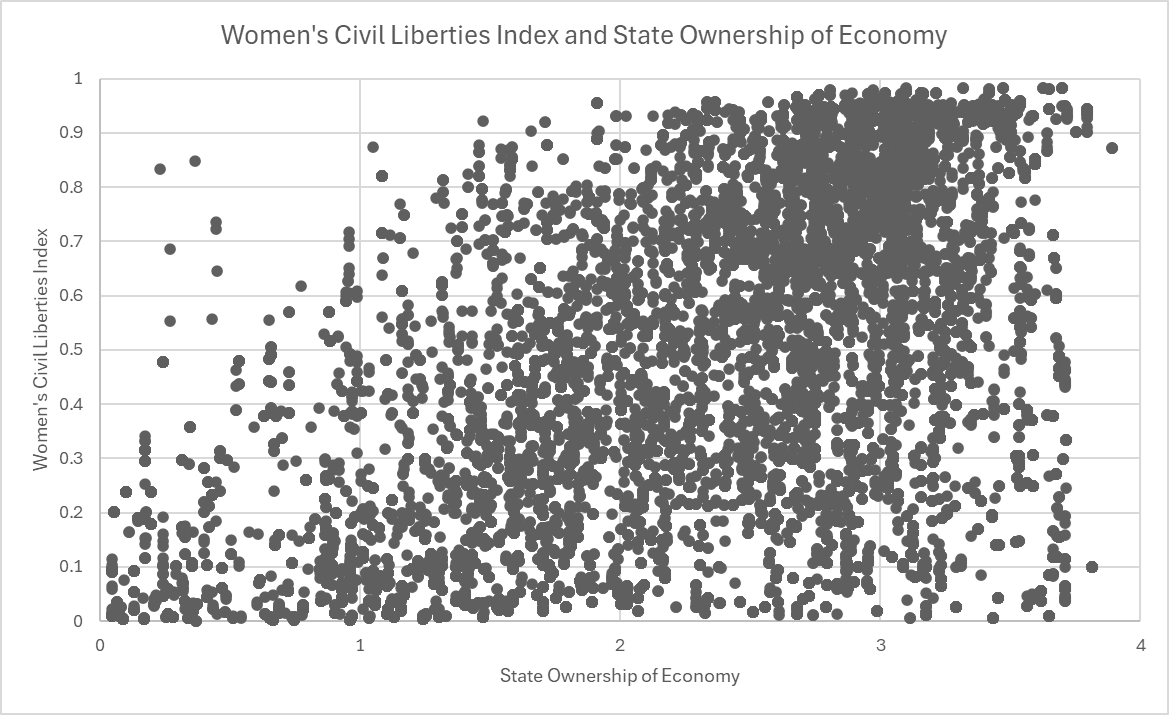
Using V-Dem data on State Ownership of the Economy and the Women’s
Civil Liberties Index, we can examine if socialism has historically been
associated with women having “the ability to make meaningful decisions
in key areas of their lives” or not. State Ownership of the economy
ranges from 0, with complete state ownership, to 4, with complete
private ownership. Women’s civil liberties range from low (0) to high
(1). The index includes measures of domestic freedom for women to move,
freedom from forced labor, property rights for women, and access to
justice. The data go as far back as 1789 for 202 countries, with
year-country 27,734 observations.
So, what does the data show?
The
data clearly show that socialism has historically been associated with
the suppression of women’s civil liberties. The only countries to
temporarily maintain women’s civil liberties above .7 were Ukraine, from
1990-1992, during their transition away from the Soviet Union, Algeria
from 2019-2020, and Belarus from 1990-1991, during their transition away
from the Soviet Union.
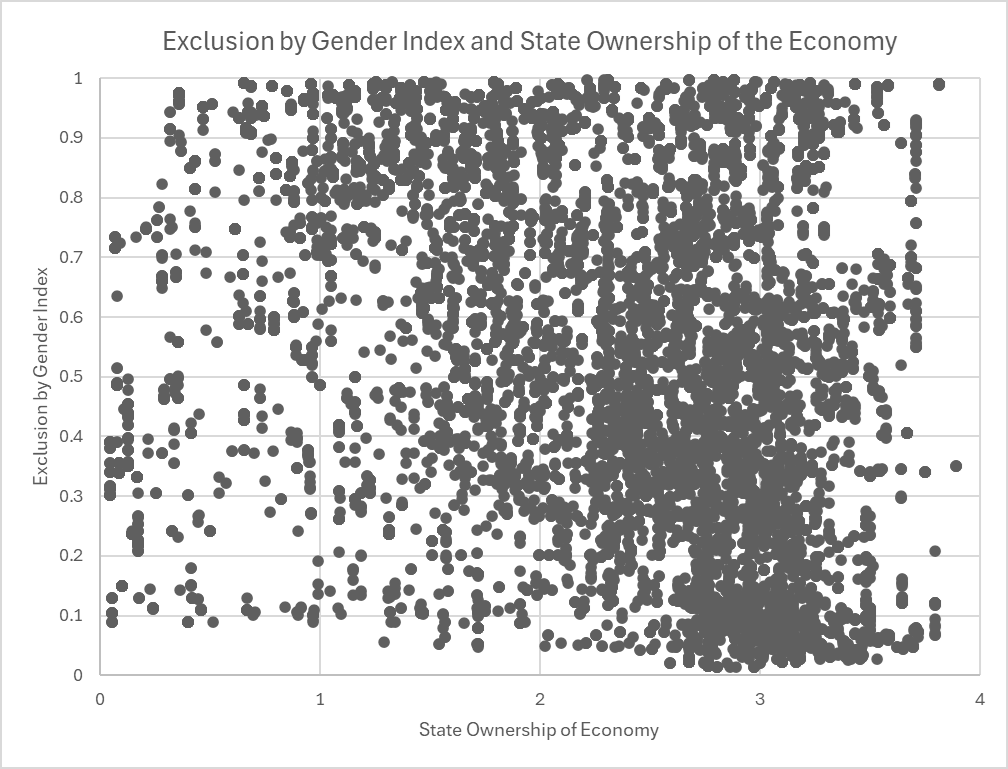
V-Dem also has an Exclusion by Gender
Index that we can examine as well. This index compares the civil
liberties of men to women, with 0 indicating women have much fewer civil
liberties than men and 4 indicating that women and men have the same
level of civil liberties.
Again, the historical data (26,335
year-country observations) suggests that historically socialism has
often failed to achieve gender inclusion.
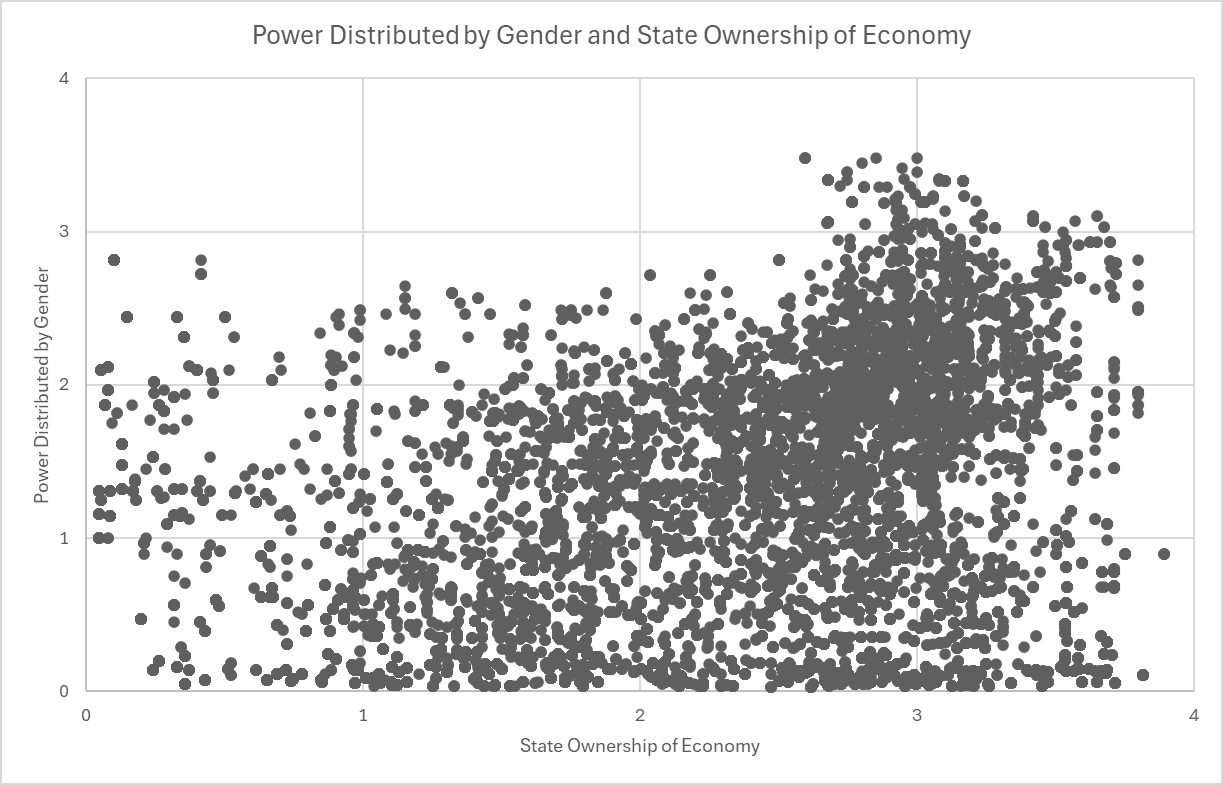
V-Dem
also has a Power Distributed by Gender dataset that shows whether men
have a “a near monopoly on political power” (0) or that “men and women
have roughly equal political power” (4) (27,734 observations). Again,
the historical record of socialism has not tended to be associated with
the equal distribution of political power.
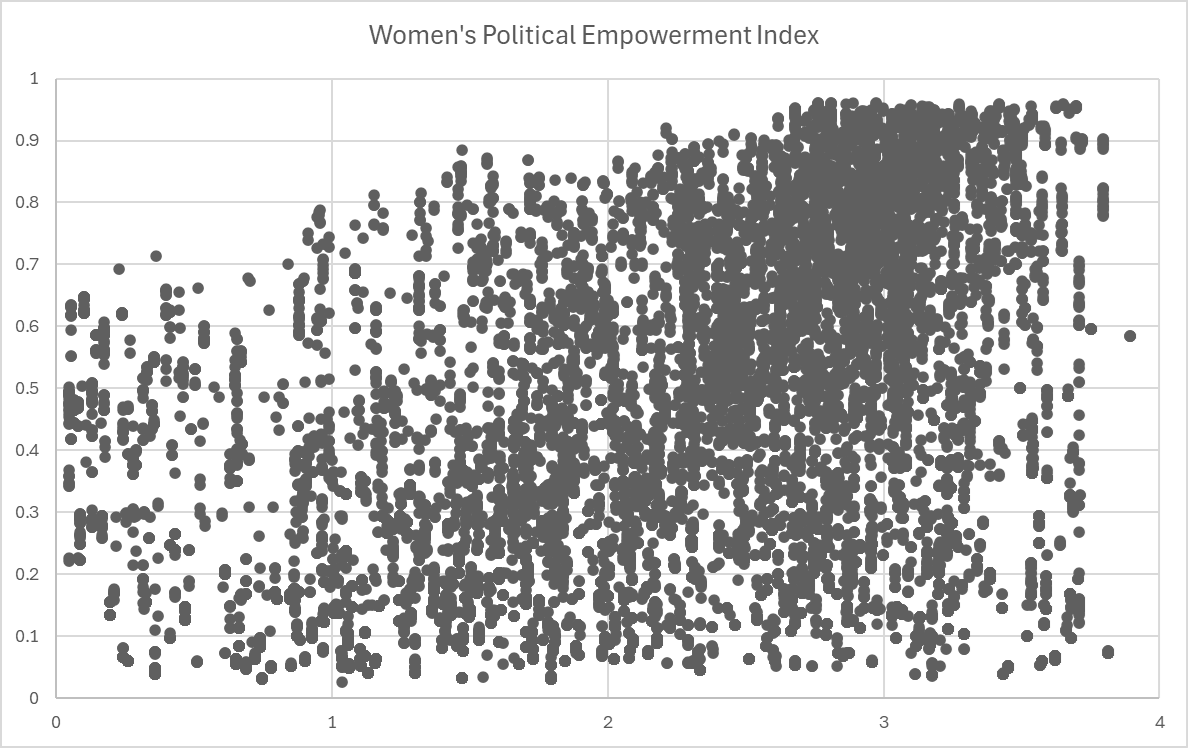
Finally,
there V-Dem also has a Women’s Political Empowerment Index. It ranges
from low (0) to high (1) and measures the capacity of women to engage in
societal decision-making (27,720 observations). Once again, socialism
has, historically, not been associated with high levels of women’s
political empowerment.
We
can endlessly debate whether women have better sex under socialism,
given the lack of empirical data. But we can say with certainty that
this broad data show that socialism historically has been associated
with the suppression of women’s rights."
"Mining companies are ramping up supplies
of critical minerals for rechargeable batteries such as lithium, cobalt
and nickel. Graphite, a key battery component, has largely been
overlooked.
That
is about to change. Some of the world’s biggest auto and battery makers
and the U.S. government are racing to secure graphite supplies amid
looming signs of shortages of the mineral suitable for batteries. So far
graphite prices haven’t reflected the tight supply.
“Graphite always seems to be the forgotten battery material, yet it’s in half the battery,” said Brent Nykoliation,
executive vice president of NextSource Materials Inc., which is
developing a graphite project in Madagascar. “It’s the largest raw
material in the battery.”
Graphite
is unusual among materials seen as crucial for the energy transition
because it can be man-made as well as mined. Most lithium-ion batteries
use synthetic graphite, which is produced from a petroleum byproduct, mostly in China.
But
using an energy-intensive, high-emissions process to produce graphite
defeats the purpose of the batteries that power EVs and store renewable
energy. The production of synthetic graphite can be four times more
carbon intensive than that of natural graphite, according to Benchmark
Mineral Intelligence, which tracks the battery supply chain.
As battery and auto makers look to reduce carbon emissions
in their supply chains, more are looking to natural graphite, analysts
say. The problem: The increase in demand is running headlong into a
supply shortage. By 2030, natural graphite is projected to have among
the largest supply shortfalls of battery materials, with demand
outstripping expected supplies by about 1.2 million metric tons,
according to Benchmark."
"Turning to supplies in unstable parts of the world has its own issues.
Some analysts have raised concerns that the mine in Mozambique is near a
conflict area where attacks by Islamic rebels have fueled a humanitarian crisis."
Robert E. Wright. He is a Political Economy at Augustana University.
"Wisconsin’s Supreme Court decided by a 4-3 vote on Wednesday May 13,
2020 to strike down the state’s “Safer at Home” order, its COVID-19
economic lockdown in other words. It did so completely, immediately, and
unequivocally. You can read the decision and all the concurrences and
dissents here.
Many moving pieces regarding constitutional issues like separation of
powers and delegation of legislative powers to officers of the
executive branch suffuse the decision. The concurring justices, however,
cut through all of that and kept their eyes on the key Constitutional
issues, many of which have been discussed by AIER here and here.
Below are key excerpts from the decision. “Palm” refers not to a part
of a hand but to the surname of the Wisconsin official whose actions
the court declared illegal. Although the decision directly frees only
Wisconsin, the principles are broadly applicable to the national
government and all US states. Yes, even California.
While many states have already loosened their lockdowns enough to
avoid a similar judicial smackdown, it is important to declare
unconstitutional all measures that crossed the line from legitimate
public health order (which again,
may include quarantine [the sick], cordon sanitaire [infected
districts], or protective sequestration [uninfected districts] depending
on circumstances) into tyrannical power grab so, like the
unconstitutional internment of Americans during World War II, it never happens again.
***
We do not conclude that Palm was without any power to act in the face of this pandemic. However, Palm must follow the law
that is applicable to state-wide emergencies. We further conclude that
Palm’s order confining all people to their homes, forbidding travel and
closing businesses exceeded the statutory authority of Wis. Stat. 252.02 upon which Palm claims to rely.
***
Palm points to statutes that she
asserts give her broad authority to impose regulation; but it does not
follow she can impose regulation without going through a process to give
people faith in the justness of the regulation. However, under Palm’s
theory, she can ‘implement all emergency measures necessary to control
communicable diseases,’ … even at the expense of fundamental liberties,
without rulemaking. That interpretation is constitutionally suspect.
***
Article I, Section 1 of the Wisconsin Constitution provides that ‘All people are born equally free and independent, and have certain inherent rights;
among these are life, liberty and the pursuit of happiness; to secure
these rights, governments are instituted, deriving their just powers
from the consent of the governed.” [If this sounds familiar, see the Declaration of Independence.]
***
At times, legislation is enacted
that infringes on a person’s rights despite these front-end procedures
[separation of powers; bicameralism], however, for that we have judicial review.
***
When a grant of legislative power is made, there must be procedural safeguards to prevent the “arbitrary, unreasonable or oppressive conduct of the agency.”
***
Palm cannot point to any procedural safeguards on the power she claims.
***
[Palm’s argument about being able to fine and imprison those who break her order] is without legal foundation and ignores more than 50 years of Wisconsin law.
***
Constitutional law has generally permitted the Governor to respond to emergencies without the need for legislative approval. … But the Governor’s emergency powers are premised on the inability to secure legislative approval given the nature of the emergency. … In the case of a pandemic, which lasts month after month, the Governor cannot rely on emergency powers indefinitely.
***
Crimes created by the Legislature in statutes must have specificity in order to be enforceable. … Because Palm fails to understand the specificity necessary
to a valid criminal statute, she also fails to understand that no less
specificity is required of a rule to which criminal penalties are
assigned.
***
Order 28 exceeds the [statutory] authority to quarantine those infected or suspected of being infected. … This directive is not based on persons infected or suspected of being infected.
***
She cites no authority for this vast seizure of power.
***
As the United States Department of Justice has recently written in a COVID-19-related case raising constitutional issues, “There is no pandemic exclusion … to the fundamental liberties the Constitution safeguards.”
***
The concurring opinion of Justice
Rebecca Bradley is also a brilliant exposition of what used to be
considered Civics 099 (i.e., high school level stuff) but apparently
today requires detailed explanation, even to state supreme court
justices, the dissent of one of whom Bradley eviscerates in footnote 3: “Spurning more than two centuries of fundamental constitutional law as well as the Wisconsin Constitution’s guarantee of liberty,
Justice Brian Hagedorn shockingly proclaims ‘the judiciary itself must
never cast aside our laws or the constitution itself in the name of
liberty. … Setting aside the self-contradictory nature of that
statement, Justice Hagedorn’s 53-page opinion contains no constitutional analysis whatsoever.” One assumes Hagedorn, like many of us, is suffering from Lockdown Brain.
Look for more court decisions in the weeks to come, hopefully ones where the Bradleys outnumber the Hagedorns."
The Communist Party is trying to fill the airwaves with positive stories about its battle against the virus. Chinese reporters, buoyed by widespread calls for free speech, are resisting.
"When Jacob Wang
saw reports circulating online recently suggesting that life was getting
better in Wuhan, the center of the coronavirus outbreak, he was irate.
Mr.
Wang, a journalist for a state-run newspaper in China, knew that Wuhan
was still in crisis — he had traveled there to chronicle the failures of
the government firsthand. He took to social media to set the record
straight, writing a damning post last month about sick patients
struggling to get medical care amid a dysfunctional bureaucracy.
“People
were left to die, and I am very angry about that,” Mr. Wang said in an
interview. “I’m a journalist, but I’m also an ordinary human being.”
The Chinese government, eager to claim victory in what China’s leader, Xi Jinping, has described as a “people’s war” against the virus, is leading a sweeping campaign to purge the public sphere of dissent, censoring news reports, harassing citizen journalists and shutting down news sites.
Chinese journalists, buoyed by an
outpouring of support from the public and widespread calls for free
speech, are fighting back in a rare challenge to the ruling Communist
Party.
They are publishing
hard-hitting exposés describing government cover-ups and failures in the
health care system. They are circulating passionate calls for press
freedom. They are using social media to draw attention to injustice and
abuse, circumventing an onslaught of propaganda orders."
"The journalists’ stories have stoked
widespread anger in China, painting a portrait of a government that was
slow to confront the virus and worked steadfastly to silence anyone who
tried to warn about its spread.
Profile, a general interest magazine in China, uncovered
a severe shortage of testing kits in Wuhan, provoking fury from
residents who demanded to know how the government could be so
ill-prepared.
Caijing, a business magazine, published
an explosive interview with an anonymous health expert who acknowledged
that officials in Wuhan delayed warning the public that the virus could
spread from person to person. “Why was no human-to-human transmission
found?” the headline asked.
Caixin, an influential newsmagazine, detailed
how health officials concealed early evidence that the virus showed
striking similarities to severe acute respiratory syndrome, or SARS,
which caused a deadly global outbreak in 2002 and 2003. “When was the
alarm sounded?” it asked."
"Within weeks, the authorities began tightening their grip,
instructing both the state-run news media and more commercially minded
outlets to limit negative stories, even on topics that once seemed
straightforward, such as the economic impact of the virus.
The crackdown worsened after the death on Feb. 7 of Li Wenliang,
a doctor who was silenced by the police after he tried to warn about
the mysterious virus. Millions of people took part in an online revolt
and demanded free speech, hailing Dr. Li, who had contracted the virus, as a hero for speaking out."
"Some have focused their stories on mistakes by local officials, instead
of national leaders, to avoid censorship. Others have shared news tips
and sources with colleagues at rival organizations, in case their own
stories are suppressed."
"Profile, the magazine, this week
published a damning interview with a doctor who was warned not to share
information about the coronavirus as it first spread in Wuhan. The
article almost immediately disappeared.
But
Chinese internet users quickly brought the story back to life, using
emojis, morse code and obscure languages to render the interview in ways
that would evade censors."
"it has tried to silence citizen journalists who live-streamed scenes of anger and despair from Wuhan; several have recently disappeared."
I got an email from AI about "corporate abuse" of human rights, asking if it is on the rise. So here is an email I sent to some AI officials.
Below is an email I sent to Ana Polanco in response to her email. I think many governments around the world make it very hard for people to start a business and that this contributes to poverty. Perhaps this is a human rights violation. I think that entrepreneurship is a human right. What do you think? Maybe you have a committee or some experts who study this issue that you can pass this along to.
Ms. Polanco:
I received an email about this topic and I admit that it could be a concern. Corporations don't necessarily put human rights first. But when it comes to economic issues and their relationship to human rights, I also believe that governments do many things which prevent people from starting and running businesses that help get them out of poverty. Governments often set things up so that you have to have a connection to or be a friend of some official to get you business started. Or there is an enormous amount of paper work and regulations that have to be complied with to start a business. This makes things hard for the poor and those with little formal education. I have provided some links to articles on this topic. I wish that AI would look into this issue to see if it is worth publicizing and acting on. I believe that entrepreneurship is a human right. Thank you for your time.
Cyril Morong
Here is an article in the New Yorker by James Surowiecki called The Tyrant Tax