Evaluating the free market by comparing it to the alternatives (We don't need more regulations, We don't need more price controls, No Socialism in the courtroom, Hey, White House, leave us all alone)
"A recent article in The Guardian profiles economist Isabella Weber. She doesn’t seem to like other economists very much, supposedly because we “obsess over ideological purity and are inflexible when searching for solutions.” Weber wants economists to come up with solutions that work even if… I guess, even if they don’t work well in theory? Maybe they will work well in practice?
Anyway, so far as I can tell, the article only gets into details on two concrete solutions to affordability. I’m sure she has more in her book, but let’s see what these are. The first for governments to create “publicly owned entities that can buy and sell grain into its market,” presumably to smooth out fluctuations in grain prices. The second is “the Mexican government’s canasta básica policy, through which retailers voluntarily cap the total price of a basket of two-dozen essential goods.”
Let’s look at the second one, since I think for developed countries like the US, fluctuating grain prices aren’t the primary source of affordability concerns. But perhaps American consumers would like a basket of grocery essentials to be cheaper.
Has this policy in Mexico worked? It was first implemented in 2022, and food inflation has certainly fallen in Mexico since then. But it has also fallen everywhere else in the world — 2022 was peak inflation not just in the US, but in most countries — so we can’t judge the success of the program based on that alone.
Instead, we can look at internationally comparable data on food spending, which comes from the USDA’s Economic Research Service. Our World in Data has a nice chart based on this data, and even though it is now two years out of date (I will provide 2025 data below), the 2023 data makes a case against the success of the “price controls” in Mexico (I put “price controls” in quotes because it is not a true price control, but an attempt to control prices via incentives):
Figure 1
It will probably not surprise you that the US spends much less on food as a percent of total spending than Mexico, given that we are a high-income country. But it is still worth pointing out just how low food spending is in the US. However, this chart still paints Mexico in a very poor light: for countries with about the same income level in the Americas (as measured by consumer expenditures), Mexicans spend much more on food than Argentina, Chile, or Panama.
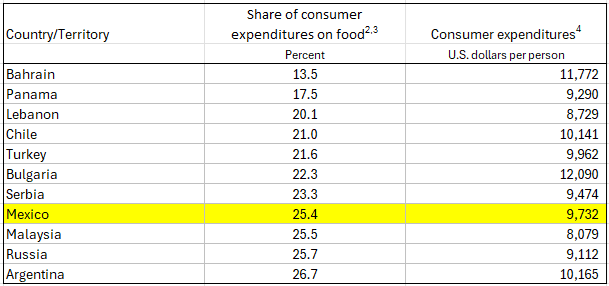
If we use the 2025 USDA data, and focus on the 10 countries with consumption expenditure closest to Mexico (between about $8,000 and $12,000 of consumption), we see that Mexico is very much on the high end: only Argentina was clearly higher:
Table 1
Finally, we can compare Mexico against itself in this data, looking at food spending going back to 2017:
Figure 2
Food spending actually peaked in 2020, though be cautious of any data from 2020 as the pandemic made data collection difficult. After declining in 2021 and then into 2022 (the policy seems to have been put in place in mid-2022), there haven’t been any further declines. And food spending is still well above pre-pandemic levels (unlike the US, where the 2025 figure of 6.4% is the same as 2017-18).
Ultimately, we would want a more sophisticated analysis than my simple tables and charts here. But it doesn’t appear that Mexico’s 2022 policy really made food much more affordable, either relative to peer countries with similar income levels, or relative to Mexico’s own recent history. And that’s even before we get into any unintended consequences of the “price controls.” Of course, the policy may have made that basic basket of two-dozen items more affordable than it otherwise might be — for that we would need to compare individual item prices to peer countries — but it hasn’t obviously made food overall more affordable in Mexico."
"Imagine that you and I buy the same product from the same website at the same time, yet you pay more than I do. The difference is that the seller knows something about each of us. Perhaps your browsing history, shopping behavior, location, or some other factor suggests that you are willing to pay more than I am. Is this fair? More importantly, is it illegal?
The Federal Trade Commission (FTC) is thinking about this. This issue is whether there is something about personalized pricing—pricing that treats customers as individuals rather than groups—that increases the chances of unfair or deceptive business practices, as the FTC defines them. It has proposed an enforcement policy that would scrutinize businesses that use personalized pricing.
The concern is understandable but misplaced. Digitization gives businesses far more information about customers than they previously possessed. And machine learning makes it increasingly possible to use that information to estimate what an individual might be willing to pay. But knowing that prices can be personalized tells us little about whether consumers are harmed.
The standard textbook example of personalized pricing considers a monopolist that knows precisely what each customer is willing to pay and charges accordingly. The monopolist makes higher profits and higher-end consumers lose the surplus they would have received if prices were uniform. This might sound ominous, but it leaves out much of what happens in actual markets.
Start with competition. A business that knows you are willing to pay $100 for something might like to charge you $100. But another firm notices and, if feasible, might offer it to you for $90, stealing your business. If firms have similar information about you, personalization can intensify competition for your business.
This isn’t simply conjecture. Prominent research has shown that personalized pricing can benefit consumers when market coverage is high. It also finds something especially relevant for policymakers: Consumers can sometimes be worse off when only some firms are able to personalize prices than when either all or no firms can do so. Other research reaches related conclusions, finding that consumer information can intensify competition as businesses make targeted offers to defend existing customers and attract customers from rivals.
There is no general rule that personalized pricing harms consumers or is problematic in any other way. It might benefit firms, but it can also increase competition, bring additional consumers into the market, and improve the matching of products with customers.
There is another issue that deserves more attention. Many of the analyses assume that the products in question already exist. But we know that when incumbents profit, rivals innovate. The same information that lets a business personalize prices can help it personalize products. This is already happening in e-commerce, entertainment, travel, and education. As the costs of customization decline, both prices and products become increasingly personalized. Regulations that make personalization less profitable will lower incentives to innovate.
The FTC’s proposal recognizes that personalized pricing is not unlawful in itself. But it states that when consumers reasonably expect prices not to vary with personal data, businesses using personalized pricing should disclose the personalization, its basis, and the types of data used. Failure to do so, the FTC says, is likely to constitute an unfair or deceptive practice. That puts a lot of weight on “reasonable expectations” and the presumed value of disclosing trade secrets.
People certainly care about fairness. But perceptions of fairness differ among people and change with experience. Americans do not even agree about whether our economic system itself is fair. Trying to turn such perceptions into a policy encourages arbitrary enforcement.
Besides, consumers already have ways of responding to situations they consider unfair. Richard Thaler’s work on transaction utility shows that people care about more than just prices. They care about the nature of the deal and respond accordingly. Businesses that violate customers’ senses of fairness lose business.
None of this means businesses should be free to deceive customers. The FTC should pursue violators based on current legal standards, applying them equally regardless of whether prices are uniform, personalized, or something in between. Research gives us little reason to believe that principles should change as knowledge increases."
"New York City Mayor Zohran Mamdani held up a bunch of plantains at a press conference on Monday and promised
that New York City shoppers would pay 30 percent less than "typical
retail prices" when the city opens five government-run grocery stores at
a cost to taxpayers of $70 million.
"How are you going to keep people from taking advantage of that deal?" one reporter asked the mayor. "Is there going to be a limit on the number of items that someone can take?"
"Our RFP [Request for Proposals]
makes very clear that this is a program for New Yorkers to be able to
put food on the table, not a program for people to be able to make a
quick buck through reselling," the mayor responded, before turning it
over to Jeanny Pak, the interim president of the New York City Economic
Development Corporation. She said the city was looking into a "library
card-esque" system that would allow the city to "manage who's buying,"
with a focus on "everyday New Yorkers."
The city's plan rests on the assumption that it can control who buys
subsidized goods. Yet Venezuela's experience with government-run grocery
stores suggests that assumption deserves scrutiny.
When Venezuela's socialist president,
Hugo Chávez, created a nationwide network of government-run grocery
stores called "Mercal" in 2003, he faced the same conundrum of how to
control excess demand when prices are set artificially low.
At first, Mercal seemed to work. It quickly became one of Chávez's
most popular social programs. In a 2007 episode of his talk show, Aló Presidente, Chávez compared
Mercal's prices with those at a nearby grocery store. A kilo of sugar
at Mercal cost 740 bolívares, compared with a price of 1,300 bolívares
elsewhere. Chicken sold for 1,900 bolívares instead of 4,550. The
discounts were roughly 43 percent to 62 percent below prices already
regulated by the government. Chávez called Mercal an instrument for
building "socialist commerce."
More than 70 percent of households reported
buying at least one item at Mercal during the program's peak in
popularity in 2005. But eventually artificially low prices led shoppers
to clear out the shelves, and the stores became famous for lines that
would wind around the block. The share of households shopping at Mercal plummeted below 40 percent by 2014.
The gap between Mercal's subsidized prices and prices at other grocery stores created an obvious resale opportunity. There were complaints of diverted goods, fictitious purchases, store clerks allowing their friends and relatives to jump the line, and corruption in procurement and distribution. Hauling food across the border to resell at market prices in Colombia became a booming industry. Black-market reselling even spawned a new profession: bachaqueo.
The government responded to the
shortages with tighter controls. It capped purchases, assigned shoppers a
weekday based on the final digit of their national ID number, and registered sales
by ID and fingerprint. Some stores required shoppers to bring a baby or
present a birth certificate before they could buy diapers.
Centralized procurement created another set of problems. In 2010,
Venezuela's Comptroller General audited the state food distributor and found
unjustified direct awards, food containers stored outdoors, damaged
products, and major discrepancies between inventory and port warehouse
records.
Mercal alone did not cause
Venezuela's food shortages. It operated inside a larger system of
national price and exchange controls, subsidized imports,
expropriations, precarious property rights, monetary financing of
government deficits, and declining oil production.
Thankfully, Mamdani's program is limited to New York City.
New York's experiment is local, far more limited, and therefore, lower-stakes. Private contractors will operate
the stores, while auditors, courts, reporters, and the public can
scrutinize the results. Chávez, by contrast, clamped down on the free
press and suppressed reporting on his failed policies.
New Yorkers will also have plenty of
alternatives. The city's five municipal stores will become part of a
food retail market that includes more than 1,100 grocery stores and 10,000 bodegas.
But the comparison is still useful
because, like Chávez, Mamdani will find that he can't escape the laws of
supply and demand. His evasive response to the reporter's question
suggests that he hasn't given much thought to how the city would manage
high demand for cheap groceries. One way or another, the program will
require quotas. The alternative is to tolerate price-sensitive shoppers
lining up outside stores to buy discount plantains.
The spectacle of food lines would be a public relations disaster for the media-savvy mayor, who has pointed to his policies as evidence that "socialists not only understand economics, just as well as the capitalists who came before." Mamdani's rhetoric evokes Chávez's, who called
Mercal "an instrument" for proving that socialism works and that Adam
Smith's theory of the invisible hand was a capitalist lie.
Like Chávez, Mamdani is a socialist,
an economic populist, and a gifted politician. He understands the
rhetorical power of holding up a bushel of plantains. A government can
dictate the price, but it cannot guarantee that the plantains will still
be there."
"Suppose that apples sell for more than oranges and Parliament in it’s
wisdom decides that, at last, apples and oranges must be compared. Not
by shoppers — shoppers are biased, they merely reveal what they are
willing to pay — but by a tribunal, which will determine whether apples
and oranges are of truly equal value and thus must sell at the same
price.
What would the tribunal need to know?
Start
with land. Orange groves sit on Florida real estate with one set of
alternative uses; apple orchards occupy Washington hillsides with
another. The opportunity cost of an orange includes the housing
development, the solar farm, the tourist attraction not built
on that grove. How is the tribunal to value what was never built?
Perhaps you answer: look at land prices. Brilliant suggestion, I reply.
Keep going.
Next,
capital. Orchards take years to mature, so today’s fruit embodies
investments made under yesterday’s expectations about today, financed at
interest rates the tribunal must somehow incorporate. Then storage:
apples keep, oranges rot, so an apple and an orange in April are
different goods than the “same” fruits in October. Add transportation,
refrigeration, frost, pests, crop insurance, the option to divert fruit
into juice, cider, marmalade, or pie, substitution with every other item
in the produce aisle, and the shifting preferences of millions of
consumers, each of whom knows things about his own breakfast that he
could not articulate to a tribunal. It all matters.
To determine the “just” price of apples and oranges, the tribunal would need the entire general-equilibrium system.
Market prices are necessary to compare alternative uses of resources, as Mises taught us in 1920. In 1945, Hayek
added the knowledge problem: the relevant knowledge is dispersed,
local, tacit, and fleeting. Free markets are the only institution that
aggregates that knowledge, articulates it in prices and gives people a
reason to listen and respond. A price is a signal wrapped up in an incentive.
Apples and oranges can be compared but only by the incomparably complex
operations of the price system. There is a reason we call it the
super-market.
Under the Equality Act’s “equal value” provisions, tribunals compare
jobs by scoring their intrinsic properties — effort, skill,
responsibility, working conditions — the labor theory of value applied
to labor. How is it going? The Tesco litigation
began in 2018; the tribunal’s fact-finding hearing ran 36 days, its
judgments run to more than 900 pages resting on some 19,000 pages of
training manuals, and the independent experts have yet to begin
the report that will actually say whether a shelf-stacker’s job equals a
warehouse worker’s. Eight years, and the calculation has not started.
Apples and oranges, adjudicated but not, as Orwell or Marx or Stafford Beer
might have imagined, by a industrial bureaucracy or by an all-knowing
artificial intelligence but by lawyers and commissions and tribunals.
The worst of all worlds.
And having discovered that the tribunal cannot price two jobs in a decade, the government now proposes
to add race and disability comparisons and an enforcement unit to
publish official guidance on which reasons for a wage difference are
permissible. A bureau of allowable scarcities.
Moreover, let us say that one day the tribunal reaches its conclusion
and finds the truly just apple to orange price. At last, nirvana. The
next day the public learns that vitamin C really does combat cancer–the
demand for orange juice skyrockets. To encourage more orange juice
production we need a higher price but wait…nothing about oranges or
apples or the labor required to produce them has changed. We need to
attract more labor to the orange juice industry but the effort, skill,
responsibility and working conditions of orange juice workers has not
changed. How can we justly pay them more than their apple juice
brethren? Blank out.
The market compares apples and oranges every day. It is the only
institution that can. But there is a deeper error here than computation.
Suppose the tribunal succeeded. Suppose that after another decade it
delivered the true and final score, shelf-stacker versus warehouseman.
What would it have found? Not justice. A wage is not a grade on your
character or a measure of your worth as a human being. A wage is a price
— a report on how scarce your skills are relative to the desires of
people you will never meet. Nurses are not morally less worthy than
plumbers should they earn less than plumbers or vice-versa, and no one thinks otherwise except the tribunals.
Hayek nailed it in The Mirage of Social Justice:
justice is about conduct — how one person treats another. An employer
who defrauds his workers, an employee who steals from the till, a
product sold under false pretenses — condemn them, take them to court.
But the pattern of prices that emerges from millions of voluntary trades
is nobody’s conduct. No one chose it, no one designed it, no one can be
guilty of it. The constellation of prices is, in Ferguson’s phrase, the
result of human action but not of human design. Demanding that prices
be just is a category error, like suing the weather. Prices don’t grade
our merit; they guide our actions. Ask them to do the first and they can
no longer do the second.
"The novelty of IDP (individualized dynamic pricing) lies in the ability to autonomously set prices by
using an individual’s data to infer how much they are willing to pay for
a product. Many industries, from car sales to higher education,
practice some sort of individualized pricing. The primary distinction
for IDP is that it can adjust prices cheaply, autonomously, and without
bias. This arrangement allows companies to increase profits while
offering lower prices to consumers."
"Dynamic pricing can best be understood as the adjustment of prices in response to changing market conditions."
"Algorithmic pricing’s recent turn in the spotlight is not a function of
its increased use. Rather, technological advancement, which has enabled
greater speed and individualization, has made the reality of those price
changes more apparent to the average consumer."
"individualized pricing. This practice has been around since the dawn of
commerce, when merchants and customers haggled over the price of a given
product."
"A common example of individualized pricing is buying a car."
"IDP can be less subjective than a human salesperson."
"the practice has been in use for years across an array of industries, from insurance to retail.
Each instance represents an effort to increase company profits, but it
also helps allocate goods and services more effectively to those who
need them."
"Most of the time, businesses use these tools as an extra nudge to lure in potential customers who are on the fence over a product.
An example of how businesses commonly use IDP, particularly in online retail, is to combat “cart abandonment,”
a term for when a user adds a product to their virtual shopping cart
but ultimately decides not to buy it. When the website realizes that the
customer is wavering in their resolve to buy a product or is browsing a
competitor’s website to compare prices, it might “sweeten” the deal by
offering a personalized discount hoping that the deal might convince the
customer to complete the purchase."
"the best protection for consumers is a competitive market. In competitive markets with no supply constraints, IDP has proven to largely benefit consumers.
Any time a firm uses IDP to raise prices for a given consumer, that
automatically allows a competing firm to undercut those prices and take
that consumer away. The nature of these structural protections is borne
out as new technologies are implemented, such as electronic shelf
labels. In spite of regulatory concern, there is virtually no evidence that electronic shelf labels are intended or used for surprise price increases."
"certain definitions of dynamic or personalized pricing would lump in popular pro-consumer discounts such as happy hours."
"Existing regulations often provide consumers with ample protection,
given that the conduct underlying IDP is not novel despite technological
advances. Aside from antitrust law covering concentrated markets, existing regulations on deceptive pricing directly address concerns about fictitious high baseline prices."
By Daniel J. Smith. He is a Professor of Economics at Middle Tennessee State University.
"As German forces launched what would become
their final major offensive on the Western Front in March 1918,
President Woodrow Wilson’s Food Administrator, Herbert Hoover,
identified what he called “one of the most vital problems confronting the nation”:
a shortage of sugar. Demand had surged. Soldiers needed sugar in their
rations, while producers and civilians relied on it to preserve and can
food for the war effort. At the same time, supply had collapsed due to
Europe’s engulfment in war, the disruption of Cuban cane fields during
the 1917 Chambelona War, and German U-boats threatening Atlantic
shipping.
What followed became one of the clearest
examples in American history of price controls spiraling into creeping
interventionism — and a textbook demonstration of why such schemes fail,
even when administered by capable and patriotic officials pursuing a
common wartime goal.
Hoover was commissioned as Food
Administrator of the United States on August 10, 1917. A successful
mining engineer and humanitarian, he seemed the ideal public servant for
such an important task. He wasted little time, setting out to “assure to the American consumer a fair and just price” of sugar. Blaming rising prices on speculators rather than on underlying economic conditions, he ordered the suspension of trading
in sugar futures on August 16 until “further notice.” And, by the end
of the month, he had pressured American beet sugar producers “to limit the price of their product” with an expected savings of $30 million within the next year.
But replacing the flow of information and
the structure of incentives supplied by the price system was far more
difficult than Hoover, a graduate of Stanford University, imagined.
Hoover’s attempts to adjust the system to unexpected changes in economic
conditions were frustrated by the sugar industry’s attempt to divert
the program to their own benefit. Hoover ultimately created a tripartite
bureaucratic apparatus: the Sugar Division of the Food Administration,
the International Sugar Committee, and the Sugar Distributing Committee.
He set prices by signing agreements with producers and refiners under
the threat of revocation of their license if they charged “excessive”
prices.
But artificially low prices did exactly
what economics textbooks predict: they encouraged consumption while
discouraging production. Pre-war per-capita consumption stood at roughly
85 pounds annually, much of it in candy, soft drinks, condensed milk,
canned goods, ice cream, and ketchup. Even at the beginning of the
program, administrators acknowledged the predictable difficulties of
holding prices low by urging consumers to limit consumption in the face of increased demand and decreased supply. By mid-October, a sugar famine was already causing sugar-using factories to shut down, and Hoover was forced to order cuts in candy production. The low price of sugar discouraged retailers from stocking it, especially given that it would not cover the increasing costs of transporting it from refineries.
Under Hoover’s informal price ceilings,
demand stayed high while beet growers watched competing crops become
more profitable. As economist Joshua Bernhardt (1919) noted,
mounting production costs and unregulated prices for other foods made
sugar beets progressively less attractive. In desperation, Hoover tried
to enlist schoolchildren and boys’ and girls’ clubs in sugar production,
offering families an allotment of sugar in exchange for planting an
acre of sugar beets. Pledge cards, circulars, and monetary incentives
were deployed with patriotic fervor.
Hoover also formed local commissions to
investigate spiraling production costs, producing thousands of pages of
testimony from planters, nearly all of whom recommended higher prices.
Testimonies from over 100 planters in California alone filled nine thick
volumes (Bernhardt 1919). Planters rejected a flat price because it
gave an advantage to low-cost producers, especially foreigners. Cuba
could deliver sugar for about 5.5 cents per pound, while domestic beet
sugar planters required nine cents and Louisiana cane sugar planters
needed ten. Hoover’s political solution to these competing special
interest groups was to buy cheap foreign sugar, along with domestic
output purchased at higher prices, and then resell it to American
refiners at an average price.
Price controls on sugar gradually expanded
the scope of intervention. Transportation priorities, refinery
allocations, export quotas, and distribution zones were imposed.
Louisiana sugar failed to reach New England refineries because regulated
prices made it more profitable for Louisiana mills to sell lower-grade
sugars directly to confectioners than to ship to Atlantic refiners.
Centrally prioritizing sugar allocation without market prices led to
accusations of misallocation. While households went without sugar for
canning and baking, Hoover argued in Senate testimony that the candy
industry employed 250,000 Americans and that further diversion of sugar
would put them “entirely out of work.” Yet, as Blakey (1918) notes,
the knowledge problem cuts the other way: candy might have deserved a
higher priority “in view of the national campaign for prohibition,”
given its potential as a substitute for alcohol.
The Food Administration proudly claimed it had saved consumers millions. Yet as Roy Blakey (1918) observed,
gratitude evaporated when sugar simply sporadically disappeared from
tables in regionalized shortages. Senator Henry Cabot Lodge’s mocking
refrain captured the public mood: “What comfort is there in a low price
when no sugar can be obtained?” Searches for “Sugar Famine” on Newspapers.com
yield over 20,000 matches during the years 1917-1920, the years
Hoover’s sugar programs were operative, yet only 284 in 1916 and 370 in
1920.
The dilemma Hoover faced was classic: he needed
“capable and informed representatives” who inevitably had skin in the
game, or “uninformed ones who were disinterested.” Neither produced
efficiency. Instead, the plan spawned a clerical army, including
state-level certificate systems classifying industrial sugar use into
five categories (A through E), population-based allocations, and
transportation zones, which required a system of prioritization as well,
designed to match supply to “equitable” demand. As Frank Rutter (1902)
earlier recognized about attempts to regulate the sugar industry, any
regulation would pit the concentrated interest of producers against the
dispersed costs faced by consumers, “Opposed to these demands [of the
sugar industry] there is only the diffused interest of the consuming
public, with no detailed knowledge concerning trade conditions or the
inner workings of the tariff, and without organization….”
The sugar episode was not an isolated wartime curiosity. It was a microcosm of the broader logic of Ludwig von Mises’ interventionism.
Regulate the price of one commodity and you must regulate its inputs,
its substitutes, its transport, and its distribution. “From the few
instances cited,” Blakey wrote, “as well as from one’s daily
observation, it is easy to see that the regulation of the price of one
thing involves the regulation of the prices of all constituent factors
and competing commodities, which in the last analysis means the
regulation of wages, as well as the regulation of the prices, the supply
and the distribution of everything else.”
Today’s policymakers would do well to
revisit this forgotten chapter before reaching for price controls,
“equitable allocation” schemes, or industrial policy boards. Price
ceilings create shortages, which in turn necessitate rationing.
Rationing requires bureaucracy, which opens the door to lobbying and
favoritism. The consumer — the very citizens Hoover was commissioned to
serve — ultimately pays in empty shelves and higher overall costs.
Herbert Hoover was a brilliant engineer
and a sincere public servant. He believed he could “stabilize” markets
through expert administration. The sugar famine suggested otherwise.
Markets are not problems to be solved by committees; they are discovery
processes that coordinate millions of decisions without central
direction. When governments try to override that process, even with the
best of intentions and the full powers of wartime emergency, the result
is not order but the very chaos they sought to prevent."
"Over ninety years ago, muckraking author Upton Sinclair
ran a failed campaign to become California’s governor in 1934. He later
recounted the experience in his very forgettable book, except for one
quote, “I, Candidate for Governor, and How I Got Licked.”
The one quote that stands out in Sinclair’s account of his campaign stumping is this one:
“It is difficult to get a man to understand something, when his salary depends upon his not understanding it!”
There is perhaps no better quote to understand California’s
politicians. Today, there is perhaps no better example of this insight
at work than California Governor Gavin Newsom’s ongoing efforts to find evidence of oil companies gouging California consumers. Writing in the Sacramento Bee in March 2025, Nicole Nixon recounts Newsom’s quixotic quest:
Two years after California’s Democratic leaders declared
victory over big oil with a law aiming to crack down on industry
profits, the state has been unable to prove companies engage in price
gouging when the cost of gasoline spikes in California.
Since late 2022, Gov. Gavin Newsom has accused the oil industry of ripping off California drivers, pointing to an extreme price spike in the state compared to the rest of the country – while companies reported record profits.
“Open your books and prove that you’re not price gouging. Otherwise,
you – big oil – will pay the price, not consumers,” then-Sen. Nancy
Skinner said after Newsom signed the bill she authored that created an
industry watchdog division and gave the California Energy Commission
authority to cap oil company profits and return funds to taxpayers.
But the state hasn’t leveled any penalties on oil refining companies
since the law passed and has even stopped posting the data it required.
California’s politicians and the bureaucrats at the state’s Energy
Commission are a perfect example of people whose salaries depend on
their not understanding things. They could never find evidence of “Big
Oil” gouging California consumers because there never was any to find.
It was all a scheme aimed at low-information California voters to keep
them from getting angry enough to vote out the state’s ruling
politicians.
This recent history is front and center today because the price of a gallon of gasoline in California has once again spiked above that in every other state.
Only now, a new generation of muckraking journalists dug into the
story of why California’s fuel prices are so much higher than in every
other state and found the real culprit. Here is a bullet point summary
of what CBS News California discovered after just six months of investigating:
Why California gas costs more: Higher taxes, labor and business
costs, combined with environmental programs, regulations, and the
state’s unique fuel blend, drive up baseline prices.
The political narrative is shifting: After failing to prove price
gouging — and grappling with the impact of two shuttered refineries —
state leaders are now publicly acknowledging the need to incentivize oil
companies to stay.
Why refineries are leaving: Rising costs, increasing regulations, long-term policy uncertainty, and shrinking returns
Why global conflict matters: California’s growing reliance on
overseas refining is increasing volatility — and validating
long-standing industry warnings that outsourcing refining increases the
risk of price spikes.
It turns out that 55% of the price of a gallon of gasoline in
California is due to factors specific to California, especially those
imposed by the state government. Amazingly, the state reports that it collects more in taxes per gallon than oil companies make in profit.
California’s politicians are the ones gouging California’s consumers.
But don’t expect them to do anything about it because their salaries
depend on their not understanding it."
"Republicans spent the better part of four years mocking the political
left’s greedflation narrative—and rightly so. But lately they’re using
similar arguments to deflect blame for high gas prices pushing up
measured inflation.
Overwhelmingly, that’s the result of markets pricing in the
likelihood of protracted war in Iran and supply chain disruption in the
Strait of Hormuz. Already, the war has caused $50 billion worth of oil lost—nearly a month of total US oil demand.
For economists, the price change is an unremarkable consequence. This
is what happens when the supply of a good falls, especially one for
which the short-term demand is relatively inelastic given oil’s
downstream importance. Indeed, with oil being a critical input to so
many other industries, sharply rising oil prices are one of the few
supply shocks with the power to make the overall price level
spike—producing a so-called transitory inflation.
During Joe Biden’s presidency, the war in Ukraine disrupted global
energy and food supply chains in a similar way. But this occurred at the
same time the Federal Reserve had just allowed a huge monetary
expansion, and Congress was borrowing like crazy. The result was soaring
economy-wide spending, as people shed money balances and bought assets,
goods, and services. This effect was ultimately hugely more
consequential in driving the uplift in the price level we saw over time.
Democratic politicians, as members of the incumbent party, faced
massive pressure to do something about the cost of living, and
predictably they reached for an explanation that didn’t implicate their
own support for “running the economy hot” through monetary and fiscal
stimulus. Some, including Biden, blamed Putin’s war in Ukraine. But
many, like Sen. Elizabeth Warren (D‑MA) and later the president again,
also advocated the greedflation or “profit-led” theory of inflation.
Senator Warren argued that price increases were primarily driven not
by excess consumer spending (from the inflated supply of money) or
supply disruptions, but by corporations tacitly squeezing excess profits
from consumers given the shrouding effect of the supply-shock cost
rises. The best evidence supporters of that theory could muster was
unconvincing: Nonsense reports conflated the producer price index with input costs, politicians made slipshod comparisons between corporate profits and the inflation rate, and researchers listened in on earnings calls for evidence that firms were using inflation as pretext.
Warren herself seems sincere in believing that this short-term
exploitation can arise from periods of cost shocks; she also condemned
companies she said were price gouging following Trump’s summer 2025 tariff chaos and last month pressed the Federal Trade Commission to investigate companies
raising prices after war in Iran broke out—especially in gasoline,
fertilizer, and airlines. But her misguided arguments are now finding
convenient use by Republicans too.
A day before that, Treasury Secretary Scott Bessent warned retail gas stations
to lower prices soon. As crude oil prices fall, Bessent said he’d be
looking “to keep the retail gas stations honest,” adding, “I’m sure the
president will call out anyone who’s a bad actor.” That comes at the
same time CNN reported Republicans were actively searching for a midterm strategy
post–Iran war: “The White House has also sought new ideas for taking on
rising prices, such as accusing gas station operators of seizing on the
war to gouge consumers at the pump.” Of course, we saw similar browbeating against companies after the Liberation Day tariffs.
But corporate greed or price gouging has never been a plausible
theory of price changes, let alone inflation. Corporations with
substantive market power don’t need pretext. They can always extract
high prices by artificially limiting supply. And firms without market
power that try to pocket a windfall invite undercutting by rivals;
that’s especially true of hypercompetitive retail gas stations. When
prices rise simultaneously across an entire industry—nay, across the
entire world—the far simpler explanation is either a demand shock or a
common cost shock—precisely the sort a war-driven supply shock produces.
Consumers have to be willing and able to pay the higher prices, after
all.
A lot of politicians around the world seem to get upset if prices for
retail gas spike on inventory that was acquired at lower cost. They
regard that as unfair “gouging.” Few of them, I suspect, insist on
selling their homes for the price they paid for them. But fundamentally,
this misunderstands the role of market prices, which reflect the
relevant scarcity of the products in each new context. The opportunity
cost for firms of selling oil below what the market will bear today is
the price that could be obtained elsewhere in the world. Firms also need
to replace inventory at the new market price. So, yes, they might make a
short-term accounting profit on some inventory, but this is quite
transitory.
More important, prices must rise to allocate scarce goods toward
those with the highest willingness to pay and to prevent shortages. The
profit received is an incentive to ramp up production and end a
shortage. Companies who don’t raise prices don’t miraculously have more
gasoline to give—we’re still $50 billion worth of oil short. And
because charging below market prices would be crystallized into a
shortage, consumers aren’t left better off in aggregate. The times when a
consumer benefits by finding gas at below-market prices are inevitably
offset by the times they find no gas at all—either because earlier
customers tapped the supply or because the time cost of waiting in line
for gas isn’t worth it.
The increasing frequency with which politicians reach for the
greedflation myth is troubling. It reveals that lawmakers aren’t
interested in reckoning with the consequences of their policies. When
voters swallow the greedflation myth, they give cover to the bad
policies that actually caused price hikes and absolve the lawmakers who
pushed for them. With Warren and the Democrats, it was strong support
for overly stimulatory monetary and fiscal policy. With the Trump
administration, it’s explaining away the impact of tariffs and a
conflict they started.
Voters and consumers shouldn’t let this happen. Supply shocks raise
prices, and wars are supply shocks. Loose monetary policy devalues the
dollar. At a minimum, governments that go to war or government
institutions that enable excess monetary creation bear responsibility
for the inflationary consequences, not the people and companies that
have to respond to those consequences."
"Affordability has become the defining issue of the 2026 election cycle,
and state governments have churned out bills and executive actions aimed
at easing the cost of living. Two philosophies have emerged across the
proposals. One asks the government to push out-of-pocket prices down;
the other asks the government to roll back its own cost-raising
policies. Only one can deliver durable results.
The year opened with a wave of State of the State addresses
emphasizing affordability concerns. Most proposals layered new
government interventions over existing ones. At least nine governors
pledged new or expanded childcare programs, from tax credits backed by Rhode Island’s Democratic governor and New Hampshire’s Republican one, to direct subsidies in Virginia and workforce funding in California and Pennsylvania. Energy rebates were also common: Arizona and Kentucky proposed funds to help residents cover utility bills, and Connecticut and Washington promised one-time household credits of $400 and $200, respectively. Illinois’s governor asked for $2 billion for the state’s medical debt forgiveness program.
Other governors went beyond subsidies into price controls. New Jersey’s Mikie Sherrill declared a state of emergency on utility costs and imposed a rate freeze. Pennsylvania extended a price collar on the state’s electricity market, Rhode Island capped health insurance costs, and Massachusetts’s governor demanded utility providers justify every fee on household bills. Indiana’s governor
supported a bill requiring utilities to demonstrate affordability
before raising profit margins. Lawmakers introduced more than 40 bills across 24 state legislatures in 2026 to ban algorithmic pricing, already outpacing all of 2025. New York’s attorney general would ban the practice across virtually all industries and prohibit electronic price tags in grocery stores. Illinois recently moved to ban junk fees.
These proposals repeat mistakes common at the federal level. Price
controls, subsidies, and mandates all aim to ameliorate the reality of
high market prices, rather than taking affirmative steps to bring them
down sustainably. Rebate checks and rate freezes for utilities don’t
make energy more widely available; they merely obscure the mismatch
between the quantities supplied and demanded. Worse, they inflict real
economic harm. Government-paid rebates diffuse their costs among
taxpayers while sending more dollars chasing the same constrained power
supply. A rate freeze disincentivizes the new generation, compounding
the supply problem.
Genuine supply-side reforms work because they change underlying
conditions rather than mask them. Zoning reform and relaxing urban
growth boundaries expand the effective supply of land available to
housing developers, lowering rents in the long run. Allowing private
power plants to sell excess power onto the state grid makes electricity
more available to consumers throughout the state. Trimming regulatory
burdens, more generally, lowers the cost of doing business and so
encourages more production.
In that sense, improving affordability through policy change, at
least in aggregate, is necessarily a supply-side project. It means
building more homes, producing more energy, and stripping away the
regulatory burdens that drive costs up. Some governors are embracing
this way of thinking, but their camp is much smaller.
Nebraska’s governor wants to allow large power users to build their own power generators and sell surplus onto the state grid, and Utah’s governor promised to “pull every lever” to expand housing supply.
During the 2026 legislative sessions, zoning reform to expand the
supply of housing showed strong momentum, with reform bills passing in
at least eight states. Indiana
made duplexes and accessory dwelling units legal by right throughout
the state, capped parking requirements, and limited impact fees. Washington enacted permitting reform, and Idaho
moved to allow manufactured homes in any residential zone. But there’s
clearly a lot more that can be done around permitting, urban growth
boundaries, and building codes.
In our new Handbook on Affordability, we
detail 37 state policies that could help lower living costs across
markets as diverse as health care and consumer financial services.
Eliminating clinician licensing and freeing clinicians to practice to
the full extent of their training would grow the supply of medical
professionals, driving down prices. Authorizing privately financed,
contract-based electricity systems would end incumbent utilities’
government-granted monopoly and open energy markets to greater price
competition. Ending childcare credential mandates and making home-based
childcare legal by right would grow the range of childcare options,
including more affordable alternatives.
The proposals there have one thing in common: They lower costs by
removing government-created barriers rather than layering new mandates
on top of them. That is the approach that can really move the needle on
prices."
"In 2024, Seattle tried to raise wages for app-based workers by requiring that they receive a per-task minimum pay.
By comparing earnings for Seattle workers before and after the law went into effect, a recent study finds that while the policy raised per-task wages,
the
increases in base pay per task were partially offset by a substantial
reduction in average tips, a major component of delivery pay.
Moreover,
drivers
experienced more unpaid idle time and longer distances driven between
tasks … [And,] the policy led to a reduction in the number of tasks
completed by highly attached incumbent drivers, … completely offsetting
increased pay per task and leading to zero effect on monthly earnings.
"Allysia Finley (“How America’s Oil and Gas Dominance Has Weakened Iran,”
Life Science, March 9) is right to celebrate U.S. energy development
but misses an important reason we no longer have 1970s-type energy
crises.
The
main reasons for the shortages in 1973 and 1979 were U.S. government
price and quantity controls on the oil market. Natural-gas prices were
also government controlled. While it is true that the Arab embargo of
1973-74 and the Iranian revolution in 1979 did reduce market supply,
neither caused the shortages nor the palpable sense of crisis. Had there
been no U.S. government controls, the prices of oil and oil products
would have risen more and more quickly, but there wouldn’t have been
shortages. When controls were lifted in the early 1980s, the age of gas
and oil shortages ended.
Ms.
Finley includes the first Gulf War alongside the Arab embargo and
Iranian revolution. But what happened then proves my point. While prices
spiked amid the conflict and Americans feared a return of gas lines,
the lines didn’t materialize because prices were no longer controlled.
We also didn’t experience supply crises in the 2000s or during the Arab
Spring.
Of
course, Americans are upset by higher prices, but we’ve lived with high
gas and oil prices before and we will again. More worrisome is the
report that President Trump wants to do something to lower gas prices.
The last time the government “did something” we had oil and gas crises
lasting a decade.
"That leaves us at the precipice of the worst-case
global energy scenario. The United States, by virtue of its robust
domestic oil and gas industry and its synergy with Canada’s oil
industry, is in the best possible place to weather a global energy
crisis. If this war had happened in 2012, we might soon have been
reliving 1973, complete with gasoline lines and rationing. But it is
2026, and domestic oil production is the highest ever. Our imports from Persian Gulf countries are the lowest since 1985 and account for a small percentage of the oil we import and consume.
This paragraph leaves out a crucial factor and also shows Wald’s misunderstanding of the world oil market.
The
crucial missing factor: whether or not we have price controls on oil
and gasoline. The reason for the gasoline lines and rationing in 1973,
as almost all informed economists know, is the presence of Nixon’s price
controls. These controls prevented the domestic price of oil from
rising to $11 per barrel, which became the world price in late 1973
after OPEC cut output. That caused a shortage at both the crude level
and the retail gasoline level. Countries, like Switzerland, that avoided
price controls also avoided gasoline lines. Contrary to Wald, if this
war had happened in 2012, we would have avoided shortages and gasoline
lines if our governments had avoided price controls.
Wald also
shows a misunderstanding in the quoted paragraph about how world oil
markets work. Whether or not we produce much or little of the oil we
consume, we will be subject to the world oil price. Price is determined
in a world market. I’m guessing you noticed that fact if you drove by a
gasoline pump today.
To be fair, it is true that the increase in
the price of oil hurts us less when we import little than when we import
a lot. The reason is that “us” includes oil producers. So most of the
loss to U.S. consumers goes to U.S. producers."
"Live Nation Entertainment
and the federal government have reached an agreement to end a yearslong
antitrust lawsuit. If you think that's going to make your Bad Bunny
tickets cheap, think again.
On Monday, Politico reported that Live Nation, the largest producer of live music concerts, settled with the Justice Department. This settlement ends the lawsuit filed against the company following public outrage at dizzying resale ticket prices for Taylor Swift's Eras Tour, alleging that Live Nation had monopolized the markets for primary ticketing services.
In addition to paying $200 million in
damages to 39 states and the District of Columbia, Live Nation accepted
a handful of structural remedies: the company must divest
itself from more than 10 amphitheaters, reduce the length of long-term
exclusivity contracts between Ticketmaster and event venues, allow
"venues to allocate a portion of their tickets to competing platforms,"
and "open parts of its platform to rival ticketing companies," reports Politico.
Following its 2010 acquisition of Ticketmaster, Live Nation became "the world's leading live entertainment ticketing sales…company," according to the Justice Department, achieving an 86-percent share
of the primary ticketing market for live events, excluding sports.
Given this massive market share, one might assume that Live Nation is
responsible for jacking up ticket prices to concerts.
But this isn't how the primary ticket market works. Performers themselves set the price, which ticketing companies sell for a fee of about 7 percent of the ticket's face value. Even including venue and ticket fees, which increase the all-in ticket price by as much as 30 percent, there are far more tickets demanded than available at this low price. Scalpers resolve this shortage by auctioning tickets to the highest bidder, which performers rationally refuse to do out of reputational concern.
In the case of the Eras Tour, tickets were sold for $130, but resold for thousands of dollars. One mother askedThe New York Times
if it was OK to sell her daughter's extras on a Facebook group for
$2,400, considering they were selling for $3,900 on secondary markets.
(While concert ticket resale generally accounts for about 2 percent of Ticketmaster's revenue, the company only facilitated the primary sale of Eras Tour tickets.)
Requiring Live Nation to unbundle its
venue and ticketing services, and forcing it to host rival ticket
sellers on Ticketmaster, may reduce primary ticket fees. "Shorter
exclusivity contracts give venues a more credible threat to switch
ticketers, competitive pressure on Ticketmaster reduces venue-facing
fees, and some portion of that reduction passes through to consumers as
lower service charges," explains Brian Albrecht, chief economist at the
International Center for Law and Economics. However, "requiring Ticketmaster to open its platform to SeatGeek and Eventbrite will not suppress resale prices," says Albrecht.
The Justice Department might
notch Live Nation's settlement as a win in the war on affordability,
but as long as performers price tickets markedly below what their fans
are willing to pay, scalpers will be strongly incentivized to purchase
these tickets at this below-market rate and get them in the hands of the
fans who value them the most. The answer is not more government
intervention, but allowing prices to work."
"Pharmaceuticals have high fixed costs of R&D and low marginal
costs. The first pill costs a billion dollars; the second costs 50
cents. That cost structure makes price discrimination—charging different
customers different prices based on willingness to pay—common.
Price discrimination is why poorer countries get lower prices. Not
because firms are charitable, but because a high price means poorer
countries buy nothing, while any price above marginal cost is still
profit. This type of price discrimination is good for poorer countries,
good for pharma, and (indirectly) good for the United States: more
profits mean more R&D and, over time, more drugs.
The political problem, however, is that Americans look abroad, see
lower prices for branded drugs, and conclude that they’re being ripped
off. Riding that grievance, Trump has demanded that U.S. prices be no
higher than the lowest level paid in other developed countries.
One immediate effect is to help pharma in negotiations abroad: they
can now credibly say, “We can’t sell to you at that discount, because
you’ll export your price back into the U.S.” But two big issues follow.
First, this won’t lower U.S. prices on current drugs. Firms are
already profit-maximizing in the U.S. If they manage to raise prices in
France, they don’t then announce, “Great news—now we’ll charge less in
America.” The potential upside of the Trump plan isn’t lower prices but
higher pharma profits, which strengthens incentives to invest in
R&D. If profits rise, we may get more drugs in the long run. But try
telling the American voter that higher pharma profits are good.
The second issue is that the plan can backfire.
In our textbook, Modern Principles,
Tyler and I discuss almost exactly this scenario: suppose policy
effectively forces a single price across countries. Which price do firms
choose—the low one abroad or the high one in the U.S.? Since a large
share of profits comes from the U.S., they’re likely to choose the high price:
Pfizer CEO Albert Bourla was even more direct, saying it
is time for countries such as France to pay more or go without new
drugs. If forced to choose between reducing U.S. prices to France’s
level or stopping supply to France, Pfizer would choose the latter,
Bourla told reporters at a pharma-industry conference.
So the real question is: will other countries pay?
If France tried to force Americans to pay more to subsidize French
price controls, U.S. voters would explode. Yet that’s essentially what
other countries are being told but in reverse: “You must pay more so
Americans can pay less.” Other countries are already stingier than the
U.S., and they already bear costs for it—new drugs arrive more slowly abroad than here.
Some governments may decide—foolishly, but understandably—that paying
U.S.-level prices is politically impossible. If so, they won’t
“harmonize upward.” They’ll follow the European way: ration, delay and
go without.
In that case, nobody wins. Pharma profits fall, R&D declines,
U.S. prices don’t magically drop, and patients abroad get fewer new
drugs and worse care. Lose-lose-lose.
We don’t know the equilibrium, but lose-lose-lose is entirely plausible. Switzerland, for example, does not seem willing to pay more:
Yet Switzerland has shown little political willingness to
pay more—threatening both the availability of medications in the
country and its role as a global leader in developing therapies. Drug
prices are the primary driver of the increasing cost of mandatory health
coverage, and the topic generates heated debate during the annual
reappraisal of insurance rates. “The Swiss cannot and must not pay for
price reductions in the USA with their health insurance premiums,” says
Elisabeth Baume-Schneider, Switzerland’s home affairs minister.
If many countries respond like Switzerland—and Trump’s unpopularity
abroad doesn’t help—the sector ends up less profitable and innovation
slows. Voters may feel less “ripped off,” but they’ll be buying that
feeling with fewer drugs and sicker bodies."
"On Tuesday, the Centers for Medicare & Medicaid Services (CMS) announced the
next 15 drugs that will be subject to government price negotiations.
This is the third round of selections, bringing the total number of
drugs subject to the new price-setting program to 40, with 10 drugs
selected in the first year and 15 in the second. Starting next year, the
number of new drugs selected annually will increase to 20.
According to CMS, Medicare expenditures for the 15 newly selected products total $27 billion from November 2024 through October 2025. This compares to $40.7 billion in sales for last year’s 15 selected drugs (from November 2023 through October 2024) and $60 billion for
the 10 drugs selected in the first year (also measured from November
2023 through October 2024). It seems as if the low-hanging fruit has
been picked and that each subsequent round of negotiations will likely
result in diminishing cost savings.
A supporter of the government’s price-setting power might have hoped
that this year would yield more potential savings than last year
because, for the first time, Medicare Part B drugs were eligible for
selection (only Part D drugs could be selected in the first two rounds).
However, despite the inclusion of six Part B drugs among the 15
selected products, aggregate sales for this year’s cohort are still
lower than in the previous round.
The drugs selected this year are the top 15 from CMS’s list of
50 potential drugs for selection. Should the 20 drugs announced next
year comprise drugs 16-35 on this list, sales will be considerably
lower—just $10.2 billion, based on the most recent data. (Of course, the
actual drugs selected in 2027 may differ from this, and their sales
next year may be higher or lower than last year.)
Admittedly, a retrospective review of a drug’s past sales is an imperfect metric for estimating the potential prospective savings
from the government’s price negotiations. A comprehensive analysis
would project the future spending of each drug as a baseline from which
to then estimate the savings from price setting. Such efforts should
also consider the extent to which the government’s intervention is
substituting for (and thus negating) the competitive, market-based
savings that can be derived from generics and biosimilars.
Just because the savings from this ill-conceived program may be
dwindling doesn’t mean the policy is less harmful over time. It still
impedes incentives for drug innovation by creating a new uncertainty for
drug developers. Moreover, the savings achieved through this policy
likely pale in comparison to those achieved by a well-functioning
generic and biosimilar market. Patent reforms that establish clearer
limits on drug monopolies could reduce uncertainty and deliver more
savings."
"Credit-card rates are set by markets. They are based largely on the
Federal Reserve’s benchmark interest rate and borrower risk. Restricting
rates will limit access to credit for lower-income Americans. That’s
what price controls do: They limit supply."
"The average annual percentage rate (APR) rose to 24.9% from 19.3%
between 2021 and 2024 as the Fed raised interest rates to control
inflation. The average APR has since ticked down to about 23.8% after
the Fed cut rates last year."
"Rates on credit cards are higher than on auto and home loans because they aren’t secured by property."
"Those with lower credit scores are charged higher rates to compensate
for their greater risk of default. Rising delinquencies have contributed
to higher rates. About 12.4% of credit-card balances were severely
delinquent in last year’s third quarter, about the same as in the
2008-09 recession."
"Capping rates at 10% would inevitably force issuers to slash rewards and
curtail credit. The latter is what happened after Democrats in 2009
restricted the kind of fees that credit cards could charge and when they
could raise rates. A paper by the Philadelphia Fed concluded the 2009
law “likely had an adverse effect on non-prime borrowers.”"
"Studies have also found that lenders restricted credit in states like Arkansas and Illinois after they capped interest rates."
[people then] "may turn to payday loans that charge even higher rates."
"Tomas Philipson ably details how “Biden’s IRA Is Harming Cancer Patients”
(op-ed, Dec. 1). Those who had a bit of economics training would have
seen that coming. It doesn’t matter whether it’s rent control, groceries
or healthcare—government-imposed price ceilings curtail investment in
maintaining and improving the quality of consumer products. In the
pharmaceutical industry, that means fewer new drugs to improve health
and longevity, and fewer discoveries of how to use existing medicines
better.
Small
businesses drive innovation because they are less bureaucratic and have
fewer worries about protecting existing products. They are the least
able to survive a policy that shortens effective patent lives and caps
prices as their discoveries approach the market. According to the 2023
Business Enterprise Research and Development survey, about 2,970 small
firms are engaged in U.S. biotechnology research and development. Their
business models depend on a handful of potential “home run” projects.
When price caps truncate the payoff window, many of their projects never
get financed or are abandoned.
The
Biden administration’s legacy not only harms cancer patients; it’s
choking off tomorrow’s small-business breakthroughs before they leave
the lab.
Casey B. Mulligan
Washington
Mr. Mulligan is chief counsel for advocacy at the Small Business Administration."