"Some time ago, roughly four years, I began this series on how drug prohibition only serves to create the public health crisis
that such policies are supposed to mitigate. Of course, I never
intended for such a large period to lapse between my last article and
this one, but I suppose it is a nice demonstration of the difference
between intentions and outcomes.
As a refresher, our last discussion
highlighted how Prohibition-Era laws such as the Harrison and Volstead
Acts begat later laws such as the Boggs Act of 1951 and the Narcotics
Control Act of 1956, which begat the modern War on Drugs™. Today, we
will explore further the parallels between the two regime paradigms,
highlighting why the continuing failure of the drug war is inevitable
and wholly predictable; a Pygmalion Effect which creates what it
forbids.
When the Eighteenth Amendment was
passed in 1920, it was widely hailed as a watershed moment that would
reduce crime and poverty, absolve the public of paying for prisons and
poorhouses, and save the family from the vagaries of drunkenness.
Similarly, when President Nixon declared drug addiction Public Enemy
Number One in 1971, it was with his 1969 declaration to Congress that
the full forces of government must be marshaled “to cope with this growing menace to the general welfare of the United States.”
Again, the nation was told, we would reduce crime and poverty, lower
the scope and costs of incarceration, and stamp out a danger to the
American family.
It is a vast understatement to say
that these assurances were wrong, and even this is underselling the
deleterious impact of these policies. Between 1916, four years before
Prohibition, and 1929, four years before its repeal, both
the number of cases terminated in Federal courts and the number of
prisoners remanded from those courts effectively quadrupled.
This, of course, led to a concomitant rise in prison spending due to
overcrowding, which was a clear indication that the promised decrease in
crime wasn’t coming. While proponents of Prohibition proudly proclaimed
that the tide of crime had lessened, minor crimes such as vagrancy and
public swearing had decreased by 50%, while more serious crimes rose
precipitously; property theft by 13.2%, homicide by 16.1% and robbery by 83.3%. The tradeoff here is one between a decrease in misdemeanors likely to result in a fine or a night spent in the local jail, and felonies which greatly increased the population of state and Federal prisons.
Similarly, claims that the War on
Drugs™ would reduce crime have proven unjustifiably optimistic at best.
In 2020, there were an aggregate 1.1 million arrests made for
drug-related offenses, of which the majority were for simple possession
(Cohen, Vakharia, Netherland, & Frederique, 2022). As of 2015, the
rate of prisoners as a function of the population has grown from 100 per
100,000 in the period before Nixonian drug policy to over 500 per
100,000 (Pfaff, 2015). As a result, the United States has become the
world’s largest jailer, both in absolute terms and in rate. According to
Miron and Waldock, expenditures related to drug prohibition – including
the increase both in prisoners and the number of prisons/jails needed
to accommodate them – now equals or exceeds some $41.3 million annually.
Despite the increase in crime, prison
sentences and the cost of enforcement, Prohibition had more of a
shifting effect on alcohol consumption; a thing that is also true of
drug consumption patterns under the current regime of criminalization.
This shift, the effects of which will be discussed in greater detail in
my next segment, is comprised of consumers moving away from a product of
lesser potency to one of greater. This phenomenon, known as the Iron
Law of Prohibition, is a result of fundamental economic principles; the
creation of barriers to both entry and supply creates pressure to
minimize volume while simultaneously maximizing profit (Beletsky &
Davis, 2017). In effect, bulkier products with a lower degree of
potency, such as beer or marijuana, are substituted by more potent, less
bulky products that are easier to produce and transport, such as hard
liquor and cocaine. While beer and marijuana may still be available on
the black market, the price of these items rises relative to their more
potent, less bulky alternatives, which tilts demand in favor of the
harder stuff.
Despite the rise in crime associated
with such illicit activities and the organized institutions that produce
the wares, much of the distribution of prohibited items is carried out
by small-scale entrepreneurs (Levine & Reinarman, 1991). While many
of the headlines tout the defeat of cartels and gangs, the reality is
that most of the arrests are those of small-to-mid-tier neighborhood
distributors. At any given time, somewhere between 1-2 million
individuals are involved in drug distribution within the U.S., while
roughly a half million individuals are incarcerated for drug-related
activities (Kleiman, Caulkins, & Hawken, 2011). What this means is
that the average dealer-distributor spends a year incarcerated for every
two to four years they engage in selling.
A Brief Look at Social Costs
All public policy should be judged by
comparing costs to benefits, including costs that are social rather
than monetary. While monetary costs are easier to examine – it is a
balance sheet problem, after all – social costs are no less important.
Between 1973 and 2013, over $1 trillion was spent on drug enforcement in the U.S. alone. Yet, in 2016, Americans spent $150 billion on heroin, methamphetamines, cocaine, and marijuana,
which doesn’t even factor in other classes of illicit drugs. Perhaps
the most troubling aspect of these sunk opportunity costs is that
despite a regime of increasing funding for supply-side enforcement, drug
prices have continued to decline over the last four decades. This
isn’t to say that they exist in cost parity with legal substances; their
prices are still higher. What it does say is that current policy does
little to abate demand.
Moreover, instead of reducing crime,
prohibition simply creates more criminals. Everyone involved in the drug
market, from supplier to distributor to consumer, is automatically a
criminal. Absent the property rights protections and dispute resolution
apparatus available via normal legal channels, interested parties must resolve their own conflicts, often leading to violent means.
Benson et al. (2001) find that drug enforcement is not associated with a
rise in violent crime, but is also correlated with a rise in property
crime; not necessarily because those involved in the drug market are
committing these property crimes, but because of the opportunity costs
associated with shifting resources away from one set of crimes and
towards another.
Just as it was with alcohol during
Prohibition, quality control is an issue with illegal drugs. As we
discussed earlier, prohibitory laws create incentives to minimize the
costs of production and transport while maximizing profit, which in turn
trends towards potency as the major concern. Because the product is
manufactured by local entrepreneurs, however organized, there are no
industry-wide safety standards. Hence, the current issue of heroin laced
with fentanyl, for example. This leads to an increase in drug-related
overdoses, and other related problems.
These are just a few of the more
obvious social costs related to the War on Drugs™.Next, we will take a
deeper dive into the issue of social costs."
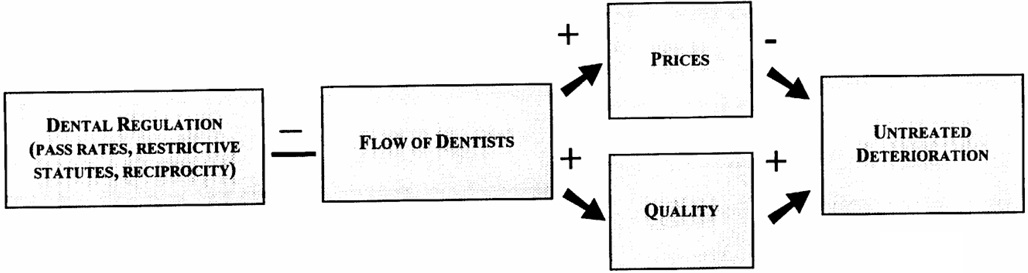
We also show that stricter regulation raises prices, but has no effect on untreated deterioration. …more stringent regulation does not appear to affect some indirect measures of service quality, such as lower malpractice premiums or fewer patient complaints. …Our multivariate estimates show that increased licensing restrictiveness did not improve dental health, but it did raise the prices of basic dental services. Further, using several tests for the robustness of our estimates, we found that the states with more restrictive standards provided no significantly greater benefits in terms of lower cost of untreated dental disease. Our estimates…show that more regulated states have somewhat higher dental prices. …Consequently, moving toward more restrictive policies that limit customer access to these services could reduce the welfare of consumers. …To the extent that states are considering a reduction in the pass rate on dental exams or making it more difficult for out of state practitioners to enter, our analysis suggests that there would be no gains to consumers in terms of overall dental health.