Evaluating the free market by comparing it to the alternatives (We don't need more regulations, We don't need more price controls, No Socialism in the courtroom, Hey, White House, leave us all alone)
Mr. Blinder proposes equipping regulators—specifically the
Financial Stability Oversight Committee (FSOC)—with more power to
control risks to the financial system. Experience makes me skeptical.
Before the last financial crisis, bank regulators and the Securities and
Exchange Commission had plenty of power to stop the increase in
leverage occurring among the largest banks, which seriously destabilized
the industry. They chose not to. Some now admit they had only a vague
notion of the risks, and thus lacked decisiveness.
Mr. Blinder suggests that, as a political
appointee, the secretary of the Treasury is reluctant to act. That
doesn’t explain the Fed or SEC’s reluctance with banks that were later
bailed out. He is also concerned with the FSOC’s confinement to an
oversight role. But each FSOC agency has a long track record of
authority not exercised in the face of political winds.
A better alternative is requiring systemically important bank
companies to hold more equity capital. Ten to 15 cents per dollar of
total assets, rather than the three cents they held before the last
crisis or the modest six cents they hold today, would be effective.
Institutions that hold more investor capital are more stable, less prone
to contagion, better able to support borrowers during recessions and,
should they fail, less costly to resolve.
The industry claims requiring more capital would push financial
activities outside the regulated sphere, such as into hedge funds.
Perhaps, but the market appears to know this and requires significantly
more capital of them than of regulated banks.
Supervisors have proven no better than bankers at judging risk.
Bank capital above current levels won’t end failure or recessions, but
it will help keep them from becoming Great Recessions.
Thomas Hoenig Kansas City, Mo. Mr. Hoenig is a former president of the Federal Reserve Bank of Kansas City and former vice chairman of the FDIC."
"Earlier this year the utility warned that Mr. Cuomo’s regulatory
blockade on new gas pipelines would require it to halt natural-gas
hook-ups and development in the suburbs north of New York City. Doesn’t
the utility know better than to expose the consequences of its
overseers’ destructive policies to the public? Now Mr. Cuomo is teeing
up Con Edison for the blame when his energy policies cause more
catastrophic failures.
A new state law the Governor signed last week requires 70% of state
electricity to come from renewables by 2030 and 100% from “carbon-free”
sources by 2040. Meantime, the Governor has blocked three natural gas
pipelines and mandated the premature shutdown of the Indian Point
nuclear plant that supplies a quarter of New York City’s power.
Last year the Independent System Operator New England, a
nonprofit that manages the transmission grid for New England, warned
that due to pipeline constraints the power system would be unable “to
meet electricity demand and maintain reliability without some degree of
emergency actions.” As a result, it could have to impose “rolling
blackouts or controlled outages that disconnect blocks of customers
sequentially.” New York is next.
Renewables made up about 25% of New York electricity last year,
though only 5% came from wind and solar while most of the rest was
generated by dams. The left proclaims that solar and wind prices have
fallen and are now competitive with fossil fuels, but only thanks to
federal subsidies that reduce costs by 15% to 30%.
Wholesale prices also don’t take into account that solar and wind are
intermittent and therefore require backup power. To ensure reliable
power upstate, Mr. Cuomo has put New Yorkers on the hook for $7.6
billion to rescue three nuclear plants upstate that were struggling
against subsidized renewables and cheaper natural gas.
The bigger power problem is in New York City and its suburbs.
Mr. Cuomo is pushing more offshore wind, which even with federal
subsidies is 2.5 times more expensive than natural gas. Last week the
Governor announced deals with two offshore wind developers for turbines
off Long Island, but who knows if they will ever be completed."
"Nuclear and natural gas can be ramped up during periods of high demand
such as storms and heat waves. Wind and solar can’t. They also put more
strain on the grid."
"Americans east of the Rockies are sweltering
as daytime temperatures soar toward 100 degrees or more. It is now
customary for journalists covering big weather events to speculate on
how man-made climate change may be affecting them, and the current heat
wave is no exception. Take this headline in The New York Times: "Heat Waves in the Age of Climate Change: Longer, More Frequent and More Dangerous."
As evidence, the Times cites the U.S. Global Change Research Program,
reporting that "since the 1960s the average number of heat
waves—defined as two or more consecutive days where daily lows exceeded
historical July and August temperatures—in 50 major American cities has
tripled." That is indeed what the numbers show. But it seems odd to
highlight the trend in daily low temperatures rather than daily high temperatures.
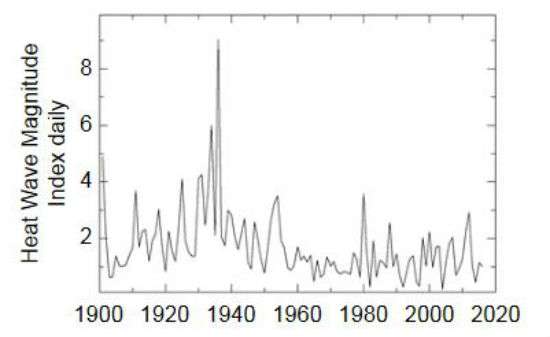
As it happens, chapter six of 2017's Fourth National Climate Assessmentreports that heat waves measured as high daily temperatures are becoming less common in the contiguous U.S., not more frequent.
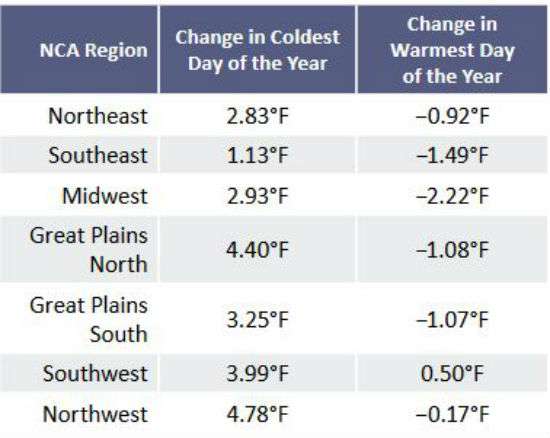
Here, from the report, are the "observed changes in the coldest and
warmest daily temperatures (°F) of the year for each National Climate
Assessment region in the contiguous United States." The "changes," it
explains, "are the difference between the average for present-day
(1986–2016) and the average for the first half of the last century
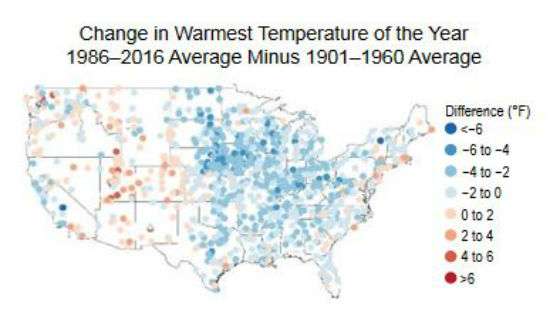
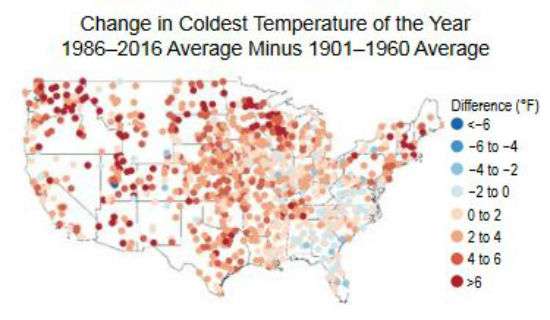
(1901–1960)." 4th NCAAnd here is the Heat Wave Magnitude Index, which shows the maximum magnitude of a year's heat waves. (The report defines a heat wave as a period of at least three consecutive days where the maximum temperature is above the appropriate threshold.) 4th NCAThe maps below, from the Fourth Assessment, illustrate the trends in
the warmest (generally daytime) and coldest (generally nighttime)
temperatures in the contiguous U.S.: 4th NCA 4th NCAAccording to the Intergovernmental Panel on Climate Change, climate models tend to significantly underestimate
the decrease in the diurnal temperature range—that is, the difference
between minimum and maximum daily temperatures—over the last 50 years.
The panel's latest report notes that there is "medium confidence" that "the length and frequency of warm spells, including heat waves, has increased since the middle of the 20th century" around the world. Medium confidence
means there is about a 50 percent chance of the finding being correct.
(The report does deem it "likely that heatwave frequency has increased
during this period in large parts of Europe, Asia and Australia.")
Heat wave trends aside, the Fourth National Climate Assessment
reports that "the annual average temperature over the contiguous United
States has increased by 1.2°F" if you compare the period of 1986–2016 to
that of 1901–1960. Outside the lower 48 states, Alaska's average winter and summer temperatures have increased since 1950 by 7°F and 2.6°F, respectively."
"Migrants who cross the border, legally or not, can claim asylum. They
are taught what to say to pass the low bar of “credible fear” in an
initial asylum interview, and then most are released into the U.S.
pending their final hearing. In the second quarter of 2019, more than
876,500 cases were pending in the immigration courts and they can take
years.
In fiscal 2019, Immigration and Customs Enforcement had funding
for an average daily detention population of 45,274. But as of June 29
more than 53,000 were in its custody. With its beds full, ICE now
releases some of those migrants who aren’t subject to mandatory
detention orders, but it has also slowed the numbers it takes from CBP.
The border patrol can’t by law stop apprehending illegal crossers,
though it can’t pass all of them out if its facilities. Thus, the
overcrowding.
Under a legal settlement known as Flores, CBP gives priority to
children and families before single adults. Minors can’t be detained
for more than 20 days, so parents are released with their children.
Migrants now know that if they bring children on the dangerous journey
north, they'll move through the system faster and be freed sooner.
Meanwhile, single adult migrants languish in increasingly deplorable
conditions, as the IG reports show."
"Not all administration efforts spring from the mind of Donald Trump.
It’s hard to see this one as anything but a logical response to the
media’s own disastrous bungling of last year’s U.S. National Climate
Assessment. Virtually every story punted on a key metric. None bothered
to relate the estimated climate damage risk—$500 billion a year by
2090—to the expected size of the U.S. economy, which would have tended
to dampen the panic talk.
Not a single news report mentioned that this outcome was associated with an extreme worst-case temperature increase
of more than 11 degrees Fahrenheit. Not one mentioned that the
assessment relied on an emissions scenario, known as RCP 8.5, so extreme
that it implies much bigger problems for future humanity than just a warmer climate.
Instead, just about every U.S. news story satisfied itself with
shrill adjectives suggesting the report promised a climate doom that it
didn’t.
It might interest you to know that, of the two-dozen-plus
climate models consulted by scientific bodies, only one model, that of
the Institute of Numerical Mathematics in Moscow, accurately simulates
past climate changes. It also forecasts the least warming, about 3.4 degrees Fahrenheit, under realistic emissions assumptions."
"The Administration rule tried to limit Medicare and Medicaid drug
rebates, which are bulk discounts negotiated by brokers known as
pharmacy-benefit managers. The rebates aren’t passed directly to
consumers at the pharmacy counter, but they tend to be plowed back into
plans to lower premiums for everyone.
Thus the worry in Congress and the Administration became that nixing
rebates would mean premium increases for seniors in an election year.
Ruh roh. This made the project politically unpalatable, even if it’s
hard to predict how much premiums would rise.
Health and Human Services estimated the rule would have
increased federal spending by about $200 billion over 10 years. The
Administration then explored a “demonstration” project that would have
handed taxpayer subsidies to insurers losing money from the rebate rule.
A government planner’s job is never done.
In any event pharmacy-benefit managers are moving, albeit
slowly, away from rebates and toward fees and other revenue sources, and
government shouldn’t interrupt this progress. Pharmacy-benefit manager
stocks rallied Thursday morning, which is a testament to how much
regulatory uncertainty the potential rule was causing."
"net prices for drugs after rebates and discounts grew a mere 1.5% in
2018, which is lower than general inflation. Few people in the press
report this, perhaps because it doesn’t fit today’s anti-business
political mood."