"As illustrated by my recent three-part series (here, here, and here), I care about helping the poor rather then hurting the rich.

More broadly, I want a bigger economic pie so that everyone can have a larger slice. And I don’t particularly care if some people get richer faster than other people get richer (assuming they are earning money honestly and not relying on government favoritism).
In other words, it doesn’t bother me if someone like Bill Gates is getting richer faster than I’m getting richer, so long as there’s an economic environment that gives both of us a chance to prosper based on how much value we are providing to others.
But some folks are fixated on how the pie is sliced.
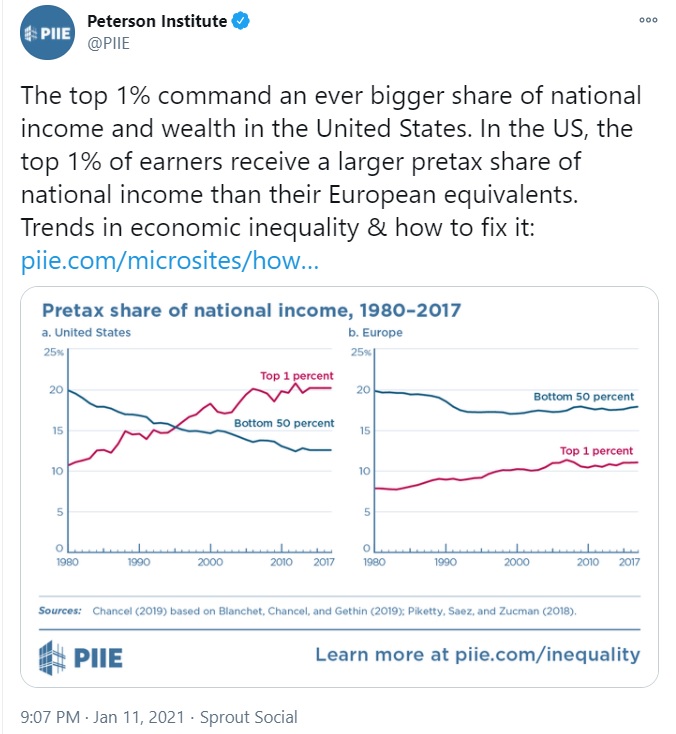
For instance, the Peterson Institute for International Economics recently tweeted that there is too much inequality in the United States (compared to Europe) and that something should be done to “fix” this supposed problem.
This type of data irks me because some people will assume that rising levels of income for the rich somehow imply falling levels of income for everyone else.
That may be true in nations with despotic socialist governments, such as Cuba, North Korea, and Venezuela, where the ruling class lines it pockets at the expense of the general population.
However, let’s focus on the United States and Europe, since the Peterson Institute wants readers to think that politicians in Washington should “fix” the distribution of income in America so that we resemble our friends on the other side of the Atlantic Ocean.
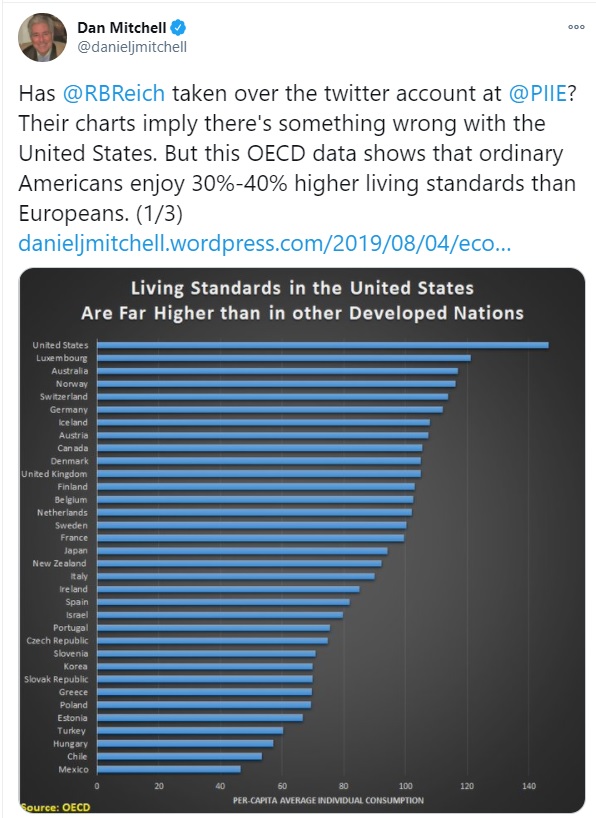
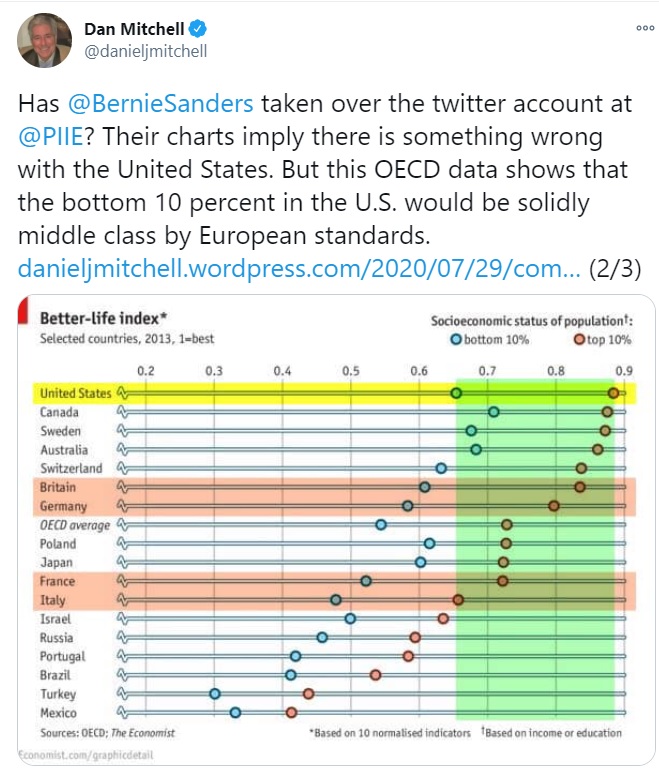
But first we must answer two very important questions: Are the non-rich in the United States suffering because rich people are doing well? And are the non-rich in Europe better off than the non-rich in America?
Earlier today, I answered those questions with three tweets.
I started with this tweet pointing out that average living standards are far higher in the United States than they are in Europe.
I then shared this tweet pointing out that the bottom 10 percent of people in America would be middle class compared to their counterparts in Europe.
I then concluded with this tweet showing that the bottom 20 percent of people in the United States have incomes higher than the average income in most European countries.
The moral of this story is that ordinary people are better off in America.
And that’s almost certainly because there’s generally more economic freedom in the United States – including lower tax burdens and less enervating redistribution.
P.S. While the Peterson Institute is very misguided on the tradeoff between inequality and growth, it is quite good on trade-related issues (see here, here, here, here, here, here, and here)."
Friday, March 4, 2022
Compared to the United States, Does Europe Have a “Better” Distribution of Income?


Thursday, March 3, 2022
U.S. Protectionism Gives Boost to Russian Energy Imports
"As outrage mounts over Russia’s invasion of Ukraine, Americans may be chagrined to learn that despite being the world’s largest oil producer and a net exporter of petroleum products, the United States turns to Russia to help meet its energy needs. Indeed, imports of Russian petroleum products have averaged over 370,000 barrels per day over the last decade, and in 2020 Russia was the third‐largest source of U.S. petroleum imports. But why? While a number of factors explain this phenomenon, part of the answer lies in protectionist U.S. policy. More specifically, the Jones Act.
Passed in 1920, the Jones Act restricts the domestic waterborne transport of goods to vessels that are U.S.-flagged, U.S.-built and mostly U.S.-crewed and owned. But such vessels are several times more expensive to build and operate than foreign ships, resulting in very high shipping rates. So high, in fact, that after factoring in the cost of Jones Act shipping it can often make more sense to buy products from distant countries rather than other parts of the United States—including petroleum.
An explainer about the importation of Russian oil and petroleum released last week by the American Fuel & Petrochemical Manufacturers (AFPM), for example, strongly hints at the role of expensive domestic waterborne transport.
U.S. West Coast refineries rely on imports of light sweet crude oil from other countries, including Russia, because access to U.S. produced light sweet crude oil is challenged by geography, transportation and logistics [emphasis added],” AFPM states. The blunt the impact of U.S. reliance on Russian imports, the group adds that policymakers can “provide relief from…policies that make it uneconomic to transport crude oil and petroleum products domestically.
A December 2021 statement from AFPM was more explicit about the Jones Act’s impact on sourcing decisions. Noting that half of California’s crude oil needs are secured internationally, AFPM’s Chief Industry Analyst Susan Grissom blamed the state’s inability to secure domestic supplies on “a lack of pipeline and rail transportation options and cost‐prohibitive Jones Act shipping requirements.”
Other sources also confirm the 1920 law’s distortionary role. A 2019 Reuters story, for example, highlighted a California refinery’s importation of crude oil from Nigeria instead of other parts of the United States at least partly due to the Jones Act while a 2017 report from the California Energy Commission noted that it cost 67 percent more to ship gasoline to California from the Gulf Coast than Singapore owing to the cost of Jones Act vessels and Panama Canal fees.
A 2017 Financial Times story, meanwhile, cited the Jones Act as a leading reason why East Coast refineries import foreign crude rather than turning to domestic suppliers.
When it’s cheaper for Americans to import oil and gasoline from abroad than other parts of the United States, no one should be surprised when that’s exactly what they do.
But sometimes the purchase of American energy isn’t just more expensive because of the Jones Act, but flat‐out impossible. Despite a domestic abundance, liquefied natural gas (LNG) cannot be transported within the United States by water owing to a complete lack of LNG tankers compliant with the law (perhaps no surprise given that building such a vessel in the United States is estimated to cost over $500 million more than one constructed abroad). Instead, regions of the United States reliant on LNG tankers to meet their energy needs—New England and Puerto Rico—must source their natural gas from abroad. While such purchases are mostly from Trinidad and Tobago, recent years have seen cargoes that originated in Russia.
And so it is that a law justified on national security grounds encourages the purchase of foreign, including Russian, energy supplies over those produced within the United States.
In recent days there has been an understandable desire to punish Russia through sanctions. But changes to the Jones Act or even temporary waivers allowed for reasons of national defense should also be firmly on the table. Revisiting the law offers a unique two‐fer that could both disincentivize the purchase of Russian energy products while offering a needed boost to the U.S. economy at a moment of increasing uncertainty."
Revisiting the Case for Free Trade
"Back in 2018, I wrote an Article for EconLib entitled “Does National Security Justify Tariffs?” In that piece, I argued against the national defense justification for protectionist tariffs. My main argument was tariffs on goods vital to national defense were unnecessary for the United States given our stable allies and that any supply disruptions would be short-lived as producers adjust.
But here it is in 2022. For nearly two years, the US and the world have been dealing with chronic shortages of goods and services. Many items needed for national defense and consumer demand, such as computer chips, are very difficult to procure. The idea of tariffs to protect domestic supply chains are becoming vogue again, with none other than a prominent former Federal Reserve chair floating the idea. My predictions seem to have failed. Now seems to be the perfect time to revisit the case for free trade.
First, let me discuss why my predictions failed. I did not foresee the events of the past two years. They are unprecedented. Never in human history has the entire world essentially closed up and gone home. Global trade fell 25% and domestic producers were shut down or severely curtailed. Even in my most pessimistic thoughts, I could not imagine such a collapse in trade. In my 2018 article, I assumed trade flows would remain fairly stable, if only over land. But that assumption did not apply to the policy responses to the COVID pandemic.
Additionally, I assumed a well-functioning price mechanism. Prices would rise for needed goods, encouraging more quantity supplied. During the COVID pandemic, prices were not allowed to function. Price controls were slapped on all sorts of goods in the early days. Firms faced rapidly increasing costs, coupled with decreased labor productivity, and the inability to raise prices. Naturally, this would combine to reduced quantity supplied. Add in forced closures and “work from home” orders, and firms could not increase productivity to meet rising demand.
The predictions I made in my 2018 article did not come true. But does that imply that there is a case for protectionist tariffs after all? Does the pandemic prove free trade is wrong? I do not think so for two reasons:
First: Protectionism would not have helped in 2020. It is true that other nations were shutting their borders and cutting off trade, but domestically the US was shutting down factories, too. No amount of protectionism is going to help if workers cannot work.
Second: People respond to incentives. Since costs 1) take place in the future and 2) depend on the realizable alternatives each person face, expectations play a large role. Prior to March 2020, no one had expectations of a major forced global shutdown of economic activity. But now, in 2022, expectations have changed. Producers now must expect some probability of such behavior going forward.
Consequently, they face new costs and new benefits of global supply chains and “just-in-time” production networks. How producers will respond to these new costs and benefits is anyone’s guess, but I suspect we will see more “near-shoring,” at least in the near term. Market interventions only make sense if there is some reason for why the market fails to provide “proper” incentives. But that is not the case for firms in 2022. They do not need incentives from the government; markets have provided that for them.
One of the advantages to free trade is it allows people the leeway they need to make decisions given the costs and benefits they face. As a rule, it is solid. If society is to be truly progressive and forward-looking, we need general rules that are also forward-looking. To impose protectionist tariffs based off the events of 2020 and 2021 would be reactionary, not proactive. It would be binding, not freeing."
Wednesday, March 2, 2022
How Reliable Is Modern Monetary Theory as a Guide to Policy?
By Scott Sumner & Patrick Horan.
"Modern Monetary Theory (or MMT) is a macroeconomic model that has become popular among some heterodox economists and progressive policymakers, and is often cited by those who favor expanding the size of government. To understand the MMT model, it helps to start with some basic accounting relationships for government finance. For instance, government spending is paid for with either taxes, debt, or money creation. MMT proponents argue that a government that issues its own currency will not default on its bonds because it has the power to issue as much money as needed to pay off the public debt. In their view, this gives governments the ability to fund expensive public projects such as universal healthcare and a universal jobs guarantee without concern for the cost of these programs.
According to MMT proponents, there is a risk that deficit spending could lead to higher inflation once the economy is pushing beyond full capacity. If inflation were to rise, MMT proponents advocate raising taxes to hold down inflation. Most MMT proponents, however, do not regard inflation as a current risk for the US economy.
Unfortunately, the MMT prescription of monetizing debt would likely lead to high deficits, high inflation, or both. It could even lead to hyperinflation and all its associated problems. Therefore, the Federal Reserve (Fed) is more likely to continue adhering to its mandate and refuse to monetize the debt. In that case, however, the burden of deficit spending would fall on future taxpayers, leading to slower economic growth. In addition, higher interest rates might discourage private investment.
How Conventional Fiscal Policy Works
Government spending can be paid for in one of three ways. The fiscal authorities can (1) raise revenue via taxes, (2) borrow money (by issuing government bonds) and engage in deficit spending, or (3) print money. The third option is often advocated by MMT proponents, whereas the first two are the more standard methods for governments (especially in developed countries) to finance their spending. Ultimately, all public spending must be financed with tax revenue, as the public debt must be serviced by future taxpayers, and even money creation imposes an “inflation tax” on the public.
Government spending involves an opportunity cost: the diversion of resources that could have been used by the private sector for either investment or consumption. When a government borrows, it diverts funds away from private sector borrowers, a process called “crowding out.” Furthermore, it must pay back its debt, including the principal and accrued interest. This imposes a burden on future taxpayers, especially if the interest rate rises over time. Some economists argue that the debt burden is currently not a problem, as the economy’s growth rate exceeds the interest rate on debt. However, this may no longer be true in the future, as increasing budget deficits put upward pressure on interest rates.
If the interest rate on government bonds exceeds the country’s growth rate, then even if taxes are sufficient to cover noninterest spending, the ratio of debt to GDP will continue to grow. If a government incurs sufficiently high debts, then creditworthiness may decline, pushing the interest rate on government debt still higher. Eventually, the debt ratio may become too high for the government to even service the debt, triggering a crisis. This is called a “sovereign debt trap,” which refers to a situation where the government can no longer pay back its debt and the only options are (1) to default on its debt obligations, (2) to print money, or (3) to acquire external gifts. Default is undesirable because the debtor government’s credit worthiness deteriorates further and financial markets could potentially destabilize. Printing money leads to higher and more unstable inflation, which is also undesirable as it creates uncertainty, distorts labor markets, and discourages saving and investment. Acquiring external gifts, even when possible, usually comes with stringent conditions.
Because all of these options are unattractive, prudent governments exercise some degree of fiscal restraint, not allowing the debt ratio to reach dangerous levels. While some deficit spending is manageable for a government with a good credit rating, excessive debt can be a drag on the economy, requiring sharp tax increases, inflationary money creation, or both.
The MMT Alternative
MMT proponents often suggest that governments do not need to pay for increased spending with higher taxes. Governments that use their own fiat currency can always issue more of that currency to pay back their debt. Thus, the government has no effective budget constraint, which means that budget deficits and accumulated debts are no longer problems in terms of imposing a burden on taxpayers. Extra government spending does not need to be “paid for.”
This does not mean that MMT rejects all principles of macroeconomics. As in traditional macro models, MMT acknowledges a limit to how much growth an economy can sustain, given available resources. When an economy is operating under this limit (called its “full potential”), then MMT proponents argue there is room for government to increase its deficits without raising inflation. Since an economy is viewed as being below its full potential if there are a substantial number of people who are involuntarily unemployed, MMT advocates frequently argue in favor of a government-provided jobs guarantee. Increased government spending only becomes problematic when the economy is above its sustainable full potential, which leads to increased inflation. If and when excessive inflation occurs, MMT calls for increasing taxes, reducing spending, or both.
Some MMT proponents advocate a policy of holding the interest rate on government bonds at zero indefinitely, which would eliminate the cost of servicing the public debt. At this point, government bonds would be an almost-perfect substitute for money. There is a tradeoff involved, however, as this policy also risks promoting high inflation, unless steep tax increases hold the budget deficit to very low levels.
Weaknesses of MMT
There are at least five major problems with MMT:
It has a flawed model of inflation, which overestimates the importance of economic slack.
It overestimates the revenue that can be earned from money creation.
It overestimates the potency of fiscal policy, while underestimating the effectiveness of monetary policy.
It overestimates the ability of fiscal authorities to control inflation.
It contains too few safeguards against the risks of excessive public debt.
MMT is partly based in a Phillips Curve model that was largely discredited by theoretical advances in the late 1960s. Prior to 1968, many economists saw a tradeoff between inflation and unemployment, which is represented by the famous “Phillips Curve.” This reflected the widespread view that inflation was caused by “overheating,” or economic output expanding beyond the economy’s potential. Inflation was only a problem (in this view) when unemployment fell to unsustainably low levels.
In 1967, Milton Friedman and Edmund Phelps showed that this theory was flawed and did not account for the role of expectations. Over the next few years, their “Natural Rate Hypothesis” was confirmed by events. Unemployment was relatively high during much of the period from 1972 to 1981, and yet the inflation rate averaged nearly 9 percent. In contrast, today the United States has only 4 percent unemployment, and yet inflation is slightly below 2 percent. Japan is at full employment, and has had virtually no inflation over the past quarter century.
In fact, the trend rate of inflation is determined by monetary policy, which can impact either the money supply (through open market operations) or money demand (through the payment of interest on bank reserves.) Short-term fluctuations in inflation are often correlated with changes in economic slack, but the underlying inflation process is caused by monetary policy, not economic overheating. Indeed, the unemployment rate will tend to return to its natural rate in the long run, regardless of any given trend rate of inflation. This is why, on average, countries with low inflation do not tend to have higher unemployment rates than countries with high inflation.
MMT proponents also overestimate the revenue that can be derived from money creation. They often talk about paying for new programs by printing money, but don’t seem to realize how little revenue can be earned in this way. Part of the confusion may result from recent innovations, such as “quantitative easing” (QE), which have given many pundits the impression that the government can create a lot of money without triggering inflation. But modern QE programs are nothing like the money-financed deficits that hard-pressed countries once relied upon to cover their bills.
Printing money is a source of revenue for the government if the new money does not earn interest. Thus, printing a $100 bill costs roughly 6 cents, yielding a profit of $99.94. This type of non- interest-bearing money is called “high-powered money,” which refers to the powerful effects resulting from the injection of more cash into the economy. When interest rates are positive, newly created non-interest-bearing currency is a sort of “hot potato,” which gets spent quickly, forcing up prices.
Until 2008, the entire monetary base (currency plus bank deposits at the Fed) was high-powered money. After 2008, however, the Fed began paying interest on bank deposits at the Fed, and thus most bank reserves are no longer high-powered money. QE programs that exchange interest-bearing reserves for interest-bearing government debt are very different from “printing money” in the classic sense, and do not provide a way of extinguishing public debt. The Fed’s purchase of Treasury bills reduces the government’s interest liabilities in one sense, but the new bank reserves are simply another form of government debt, which involve a roughly equal interest liability. It is true that the currency continues to pay no interest, and thus in theory the government could finance its activities by issuing new currency. But the amounts are far too small to make a meaningful difference. In the United States, the currency stock is just over 8 percent of GDP. If one assumes that nominal GDP rises at 4 percent a year on average and the currency ratio stays at roughly 8 percent of GDP, then revenue from money creation is only about 0.32 percent of GDP, a drop in the bucket compared to total federal spending, currently over 20 percent of GDP.
Of course, the government could eliminate interest on bank reserves and print almost unlimited amounts of base money, but this would result in high inflation. Even Keynesian economists such as Paul Krugman are skeptical of the MMT claim that printing money could finance a significant share of government spending without provoking hyperinflation:
When people expect inflation, they become reluctant to hold cash, which drive prices up and means that the government has to print more money to extract a given amount of real resources, which means higher inflation, etc. Do the math, and it becomes clear that any attempt to extract too much from seigniorage — more than a few percent of GDP, probably — leads to an infinite upward spiral in inflation. In effect, the currency is destroyed.
One academic study found that the maximum sustainable amount of inflation tax revenue is roughly 4 percent of GDP, which would generate an annual inflation rate of 266 percent!
The tendency for MMT proponents to overestimate the revenue potential of money creation is closely tied to a related error, underestimating the potency of monetary policy and overestimating the potency of fiscal policy. They err in arguing that fiscal policy is what ultimately determines inflation in places like the United States. Because inflation is currently low in the United States, MMT advocates have argued that there is room for government to increase its spending. However, inflation is low precisely because the Fed is not following MMT policy advice. It is monetary policy that determines inflation, not fiscal policy.
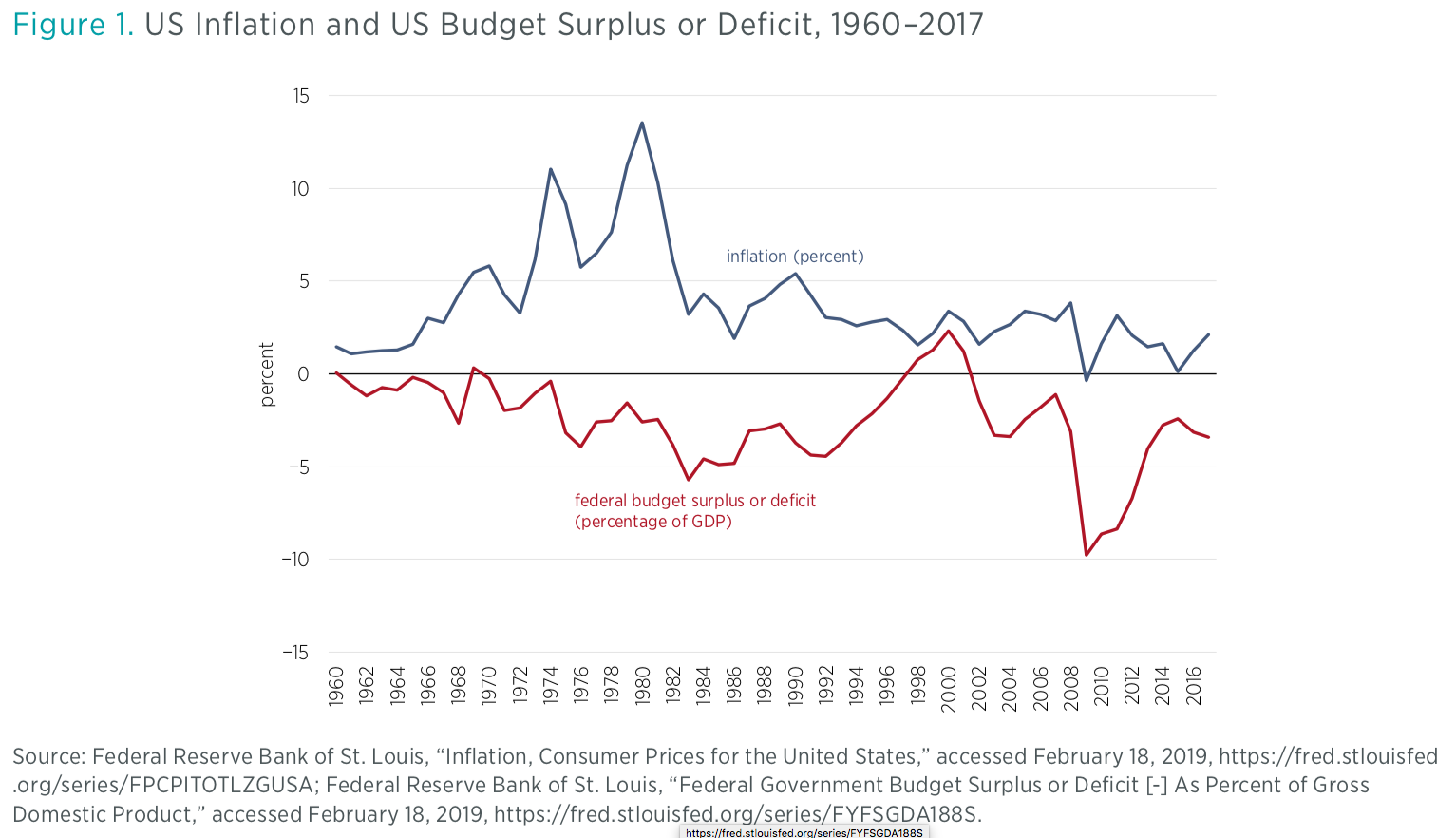
There is abundant empirical evidence in US history that points to the dominance of monetary policy. In 1968, President Lyndon Johnson raised taxes and balanced the budget to reduce high inflation. He was unsuccessful, and inflation continued to rise owing to expansionary monetary policy. Inflation only fell in the United States in the early 1980s, after the Fed under Paul Volcker reduced the growth of the money supply. Volcker’s actions occurred at the same time as rapidly rising US budget deficits under President Reagan. Since the 1990s, inflation in the United States has been consistently low despite widely varying fiscal policies, ranging from budget surpluses during 1999–2001 to high budget deficits today.
To illustrate this, figure 1 shows both the US budget deficit as a percentage of GDP and the inflation rate from 1960 to 2017. If MMT were correct, then one would expect to see increases in the deficit correlated with increases in inflation. However, despite dramatic increases in the budget deficit since 2001, inflation has not shown much variation.
Because MMT proponents overestimate the potency of fiscal policy, they mistakenly assume that fiscal policy can successfully control inflation. Today, central banks in most countries are independent and are charged with the task of stabilizing price levels. In most advanced countries, central banks are not required to support fiscal policy by lowering interest rates in order to allow governments to borrow more cheaply. Thus, monetary policy determines the path of inflation.
MMT’s explanation for inflation only works in places like Zimbabwe and Venezuela, where the central bank is subservient to fiscal policymakers, and thus central bank independence is eliminated. It is difficult to imagine why elected politicians, who adjust tax and spending policies in response to the interests of their constituents, would be more effective in controlling inflation than central bankers, who focus solely on that task.
If the MMT model is to be believed, then the roughly 2 percent inflation rate that has prevailed in the United States since 1991 owes to the deft actions of Congress in adjusting the budget deficit, not the decision of the Fed to try to keep inflation close to 2 percent. How likely does that seem? Congress has recently enacted tax and spending changes that have caused the budget deficit to soar, despite strong GDP growth and low unemployment. Does that seem like the action of an institution that can effectively target inflation at 2 percent?
Suppose that an MMT regime is implemented and inflation rises. The MMT prescription is to then raise taxes. Would Congress vote to increase taxes at a time when prices are already rising? Would the president also sign the legislation to increases taxes? It is difficult to imagine that the answer to these questions is yes, particularly with the current political gridlock in Washington, DC. Moreover, even if Congress possessed the political will to handle inflation responsibly, Congress would likely face serious informational challenges. Under the current regime, the Federal Open Market Committee (FOMC) meets roughly every six weeks to adjust its stance on monetary policy. If inflation were to become high, the FOMC would adjust monetary policy at its next scheduled meeting (or even call an emergency meeting if necessary). The Fed has decades of experience in learning how its policy tools affect the inflation rate. If inflation became a function of fiscal policy, Congress would have to learn how to adjust taxes in order to control inflation. This involves a learning curve that could prove very costly while inflation is doing serious damage to the economy. This is especially true if a zero-interest-rate policy were adopted, which would reduce the impact of tax changes on inflation.
Perhaps the most fundamental problem with proponents of MMT is their complacent attitude toward public debt and deficits. In fairness, this perspective is not without some justification and is shared by a number of mainstream economists. It’s true that the United States is less likely to default than Greece, owing to the fact that it controls its own currency. And it’s true that the interest rate on government debt has recently been lower than the growth rate of the economy. There are respectable models that suggest the government can safely increase the size of the debt when interest rates fall below economic growth rates. The basic idea is that economic growth will allow the government to service a growing debt over time.
Nonetheless, there are real risks in ignoring the government’s budget constraint. Debt that looks very manageable in one economic environment might suddenly look unsustainable in another, as Greece discovered during the Great Recession. The United States probably won’t default on its debt, but there are other unpleasant scenarios to consider. Suppose the public is opposed to extremely high inflation and Congress is thus unwilling to change the Fed’s low inflation mandate. In that case, a future budget crisis might lead to draconian tax increases, which stifle economic growth. Furthermore, even if the public were to tolerate high inflation, high inflation may only be able to fund a few years of government expenditures before a crisis occurs.
Even though economic growth currently exceeds the interest rate on public debt, this may not always be true. Consider how few economists during the 1980s would have anticipated near-zero interest rates in 2010. Also consider the projections that an aging population and growing healthcare costs will put increasing strains on the federal budget, pushing the debt-to-GDP ratio much higher during the 21st century. And then consider that Congressional Budget Office budget projections tend to assume continued economic growth, whereas the United States is likely to continue experiencing occasional recessions, which generally cause the deficit to get much larger. A responsible government does not incur debts that are only manageable if everything goes well. If history teaches us anything, it is to expect the unexpected.
Conclusion
MMT relies on dubious assertions about the causes of inflation and the respective roles of monetary and fiscal policy. It also rests on the unrealistic view that fiscal authorities would do an adequate job in managing inflation. An MMT agenda of having fiscal authorities manage monetary policy runs the risk of very high debts, inflation, or both—and both can be very harmful to the broader economy. Rather than rely on MMT, it would better for the Fed to ensure a stable, rules-based monetary policy, and for policymakers in Congress to exercise prudence in setting fiscal policy."
Confusion about "overheating"
"A recent article in the NYT criticizes Larry Summers, who correctly predicted that economic policy in 2021 was too expansionary. This caught my eye:
Mr. Summers has been focused on a different story, warning that government spending could increase inflation. With prices rising at the fastest rate in 40 years, he has been lauded for making the right call. “Does the WH owe Larry Summers an apology?” Politico asked last November.
The problem with this reading is that the economy hasn’t really overheated. Real gross domestic product and employment are still lower than prepandemic projections, according to government statistics. Yes, consumer spending patterns have shifted from services to goods, but that began two years ago; the fact that our supply chains still cannot adjust reflects a bigger problem with how they were designed.
It is frustrating to see respectable outlets like the NYT repeatedly make EC101 level mistakes. Economic overheating has nothing to do with real GDP; rather it represents excessive growth in nominal spending. And nominal GDP has risen to well above the pre-pandemic trend line. The economy is clearly overheating to some extent.
In 2008, real GDP in Zimbabwe was sharply depressed. Would anyone claim their economy was not overheating at a time when inflation reached a billion percent?
The NYT has a wealth of talented reporters. I am convinced that they try to be accurate, at least most of the time. That’s why I find this sort of story to be so maddening.
I also blame the economics profession. If the top economists in America (who mostly share the NYT’s ideology) were more critical of its reporting of economic issues, then it would face pressure to clean up its act. Conservatives might not believe this, but the NYT does care about elite opinion. Instead, we repeatedly see this sort of sloppy reporting. It doesn’t seem to be getting better.
PS. If the NYT hired a competent economist to proofread their economics stories, they could weed out dozens of mistakes each month, making it a better paper. Why don’t they do that—they have lots of money? (Yes, they have editors, but I’m talking about proofreaders with knowledge of economics.)"
Tuesday, March 1, 2022
The School Shutdowns and Lost Literacy
New evidence that children have fallen far behind in reading
"Governments made many mistakes in the pandemic, and shutting down schools was arguably the worst. We’re now discovering the damage as studies calculate the learning loss.
Amplify, the curriculum and assessment provider, examined its test data for some 400,000 elementary school students across 37 states. It found a spike in students not reading at grade level, with the literacy losses “disproportionately concentrated in the early elementary grades (K-2).”
Before the pandemic, 55% of kindergartners were on track in reading skills. That fell to 37% in 2020–2021 and 47% this school year. The year before the pandemic, only 29% of kindergartners were deemed “far behind” in early literacy skills. That rose to 47% and 37% the first and second year of the pandemic.
Amplify sees some progress this year in reading as the classrooms have reopened. But the troubles persist for this year's second graders, whose schooling has been dominated by shutdowns and disruptions. Among this Covid cohort, Amplify finds that “the number of students at greatest risk of not learning to read is slightly higher than it was a year ago.” Some 35% of second graders are in literacy crisis this year, up from 26% before the shutdowns.
Like other recent studies, Amplify reports that minority children suffered disproportionate learning loss. During the last normal school year, only 34% of black and 29% of Hispanic second graders needed intensive intervention to help catch up. This school year 47% of black and 39% of Hispanic second graders have fallen this far behind on literacy, compared to 26% of white peers.
A longitudinal study from the Annie E. Casey Foundation correlated early literacy skills and graduation for nearly 4,000 children. It found that kids “who don’t read proficiently by third grade are four times more likely to leave school without a diploma than proficient readers,” and “for the worst readers, those [who] couldn’t master even the basic skills by third grade, the rate is nearly six times greater.”
Blame the teachers unions, which blocked a return to normal learning. If Amplify’s findings don’t alarm elected officials, maybe recent numbers from Ballotpedia will. Last year there were 92 school board recall efforts nationwide, up from 20 in 2019. Parents know their kids are falling behind in fundamental skills, and they’re understandably furious."
Nationalizing 5G Would Be an Unforced Error
Stick with what made the U.S. the world leader in 4G
"In “China’s 5G Soars Over America’s” (op-ed, Feb. 17), Graham Allison and Eric Schmidt call for the Biden administration to build a “national highway system” for 5G wireless networks. This is consistent with Mr. Schmidt’s previous calls for a nationwide wireless wholesale network managed by the federal government and anointed government contractors. A similar idea was also proposed by some Trump administration officials before it was criticized on a bipartisan basis and buried. Does this op-ed foretell a new push toward a nationalized 5G regime?
Instead of relying on a government-run wireless operator, let’s stick with what made the U.S. the world leader in 4G: the entrepreneurial brilliance of the private sector investing risk capital. The authors omit that the U.S. wireless industry will have invested almost $300 billion in 5G infrastructure when all is said and done. But if they are looking for taxpayer dollars, last year’s infrastructure legislation will contribute $62 billion more on broadband, on top of the Federal Communications Commission’s $9 billion annual outlays in direct and indirect broadband support.
Messrs. Schmidt and Allison also omit that the same report they cite reveals that the U.S. has the highest 5G availability, at 49.2% and growing, while China has only 20.1%, and that our urban 5G download speeds are toe-to-toe with China’s.
The government could spur 5G deployment by scheduling more spectrum auctions and reloading the spectrum “pipeline.” But having the government own the means of wireless production would be a poor choice. A healthy dose of competitive paranoia is needed to excel in the global marketplace, but exaggerating to create a crisis to justify a nationalized wireless regime would undermine the authors’ ostensible goal of having the U.S. lead the world in 5G, and eventually 6G.
Robert M. McDowell
Hudson Institute
Vienna, Va.
Mr. McDowell was an FCC commissioner (2006-13)."