Thursday, May 25, 2023

Biden Is Counting on Unproven Technologies to Meet Climate Goals

By Jane Shaw Stroup of The Liberty and Ecology Blog.

"Thanks to Rachel Frazin of The Hill, we have a good idea of the flimsiness of the EPA’s recent proposed ruling on coal- and gas-fired power plants.

She observes that under the ruling, coal-fired power plants must cut their carbon dioxide emissions by 90 percent by 2030 if they expect to operate beyond 2039, while the largest natural gas plants (and new ones)  must reduce their emissions “90 percent by 2035 or run primarily on low-carbon hydrogen energy by 2038.”

The problem?

“[N]either hydrogen nor the other technology, known as carbon capture, is widely employed by the power sector—leading some experts to question whether their use can be scaled up in time to meet the rule’s requirements.” In fact, the only power plant in the U.S. to use carbon capture shut down three years ago due to falling oil prices and only now plans to start up again.

In a nutshell, carbon capture and “green” (low-carbon) hydrogen technologies are in their infancy. Frazin quotes Brandon Delis of  EPRI, a research institute for the power industry, “In the power generation industry, bringing new technologies to that scale, we typically want to see a number of full-scale demonstrations prior to calling it commercial-ready.”

Another industry expert says that getting federal approval for such technology is also a serious challenge! It takes six years to get approval for carbon capture right now.

Perhaps one government hand doesn’t know what the other is doing. Meanwhile, the alternative is shutting down plants, especially coal-fired ones. This is not a favorable option, as servicing the electricity grid is becoming more important—and more difficult."

How D.C. densified

From Tyler Cowen.

"DC’s relative success can be traced to a few decisions made decades ago. In the 1970s, policymakers in Arlington County made a decision to adopt what’s known as ‘transit-oriented development planning’ ahead of the opening of DC’s Metro Orange Line, which runs between Arlington and Prince George County, Maryland (via DC). Arlington policymakers identified that zoning for apartment construction in commercial areas could bring in property taxes and help balance the budget without the level of controversy of changing zoning in existing residential areas. Some nearby jurisdictions followed suit, learning from Arlington’s example, helping the DC region stay more affordable than the country’s other superstar cities.

Here is the full essay by Emily Hamilton of Mercatus, serving up a very good short economic history of Arlington.  And this on the District:

The District itself has permitted extensive redevelopment of formerly industrial neighborhoods when they received new Metro stations, including Navy Yard and NoMA. In the years since the 2010 financial crisis, DC has permitted thousands of apartments each year, a high rate compared to peer cities. As in Arlington, they’ve primarily been permitted on land that previously housed industrial or low-value commercial development where there are few or no existing residents to oppose new construction.

Interesting throughout.  I am pleased to live in the land of partial YIMBY.

That is all from the new and excellent issue of Works in Progress."

Scott Sumner on how banking regulations create more risk

See On the uncertainty of our judgement. Excerpt:

"Banking: We have a major banking crisis in 2008 because lots of commercial loans went bad. We are told that banks need to invest in safer assets, such as government bonds. Silicon Valley Bank does this and goes bankrupt when yields rise and bond prices fall.

This is why government regulation is not well suited to solve problems such as excessive risk-taking caused by moral hazard. If commercial loans are too risky, and government bonds are also too risky, what’s left? You could have a perfectly safe “narrow bank,” but the Fed refused to give a banking license to an entrepreneur who tried to create a bank that invests all its funds with the Fed.

We (meaning pundits and regulators and politicians) think we understand the banking problem, but we don’t. We have created a system that almost completely socializes the liability side of bank balance sheets. Without market discipline, banks have little incentive to behave responsibly. We then assume the solution is “regulation.”  

How likely is it that regulation can solve our banking woes? Consider the following analogy. Give me a book on “How to be a General” and have me go up against someone like Alexander, Hannibal, Napoleon, Patton, etc. How likely is it that I’ll succeed? Now give a young inexperienced government bureaucrat a book on how to regulate banking and have them go up against J.P. Morgan.

Good luck. 

P.S. Matt Levine has an excellent post discussing the difficulty of regulating banks. He points out that even the most basic questions are difficult to answer. No one even knows whether higher interest rates are good for banks or bad for banks."

Wednesday, May 24, 2023

Women’s Evolving Careers Helped Shrink the Gender Pay Gap

By Oksana Leukhina & Amy Smaldone. They are both with the St. Louis Fed. Excerpts:

"Greater Shares of Women Moved into Higher Wage Growth Occupations

How exactly workers allocate their on-the-job hours between simply doing the job and investing in their future productivity is not something that we can measure directly. However, we can look at the type of jobs held. Some jobs/occupations involve a lot of training early on and exhibit steep wage growth over the life cycle (e.g., physicians start as medical residents, spending most of their time training).

What we show next is that women indeed increasingly sorted into occupations that involve more training early on and more wage growth over time—such occupations also exhibit higher average wage levels.

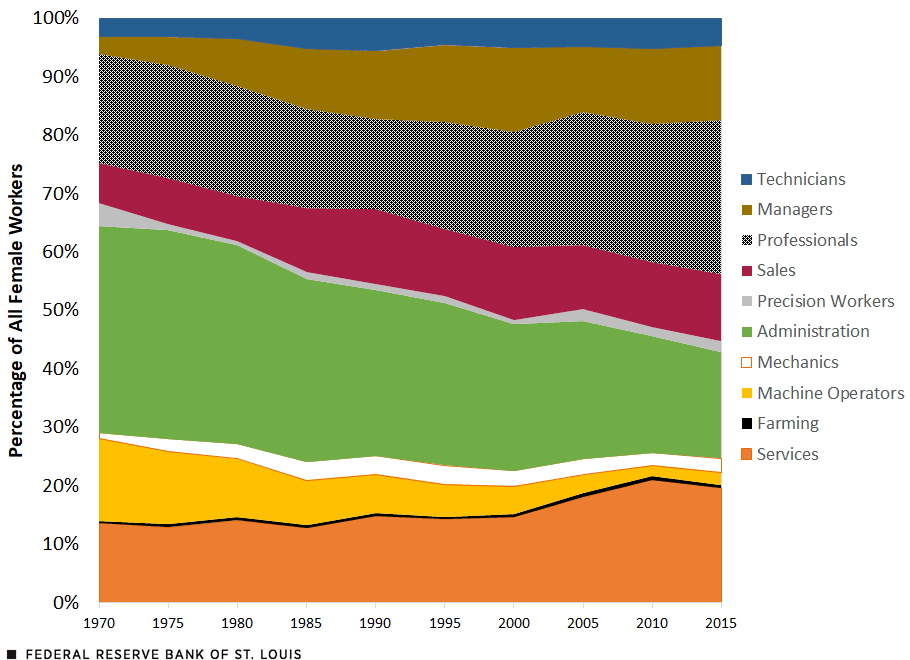
The fifth and final figure (below) shows how the distribution of working women across 10 broadly defined occupations evolved over time. We are looking at women in the beginning of their careers (in their late 20s). The occupations (top to bottom) are ranked according to the average male wages in 2015, with technicians, managers and professionals having the highest average wages that year, and machine operators and those in farming and services ranking near the bottom of the pay distribution.

Female Workers in Each Occupation

A stacked area chart shows the distribution of female workers in ten broad occupational groups. The share of women working in the four highest-paid groups expanded from 1970 to 2015.

SOURCES: U.S. Census, Current Population Survey and authors’ calculations.

NOTES: For each year, the figure represents the distribution of 26- to 30-year-old working women across 10 occupations. The occupations are ranked (top to bottom) by the average wage among 36- to 40-year-old men in 2015, with technicians, managers and professional workers having the highest-average wages that year.

In 1970, women entered into lower-paying occupations, working predominantly in administrative jobs. Over time, women clearly shifted toward better-paying occupations. For example, we see that the percentage of women working in the professional occupations went up from about 19% in 1970 to about 26% in 2015. The fraction of women working in the top four high-paying occupations increased from around 30% to 55%.

This evidence provides additional support for the main hypothesis that, as women increased their labor force attachment and as young women planned to work more over their life cycles, they increasingly entered career tracks that involved more training early on and higher wage growth over time, thereby narrowing the gender pay gap."

Enhancing economic freedom via school choice and competition: Have state laws been enabling enough to generate broad-based effects?

By John Garen. He is an economics professor at The University of Kentucky.

"Abstract

An aspect of economic freedom that varies across U.S. states is K-12 educational freedom. Some states allow a degree of choice for families in selecting schools outside public schools for their children. However, the enabling laws for such programs are often quite restrictive and limited to few children. Can this limited degree of competition and choice have a noticeable effect on an entire state's overall K-12 performance? I find strikingly large test score gains for states that have adopted voucher programs and/or Education Savings Accounts (ESAs), swamping the effect of per pupil K-12 spending on test scores. Moreover, vouchers and ESAs are associated with less per pupil spending. These effects are robust to a host of specification checks. A key factor is the amount of a program's funding that “follows the student,” even if a small number of students are eligible. Overall, it seems that even a small measure of educational freedom has a large effect."

Tuesday, May 23, 2023

The EPA Threatens to Turn Out the Lights

Its proposed power-plant emission rule would destabilize the energy grid and end reliable electricity

See By William S. Scherman. Mr. Scherman is a Washington-based energy lawyer at Vinson & Elkins, LLP. He served as general counsel for FERC, 1990-93. Excerpts: 

"The EPA’s aggressive standards require all coal-fired power plants to use a new and still-tricky technology called carbon capture and storage, or CCS, to reduce greenhouse-gas emissions 90% by 2035, or begin co-firing with natural gas. In addition, natural-gas-fired plants must capture 90% of emissions by 2035 using CCS or switch almost entirely to hydrogen by 2038. The only other option for both: shut down.

These nascent technologies simply won’t get the job done in the next few years. CCS is used at only one commercial power plant in North America. The only U.S. coal plant to implement CCS successfully closed in 2020 for economic reasons."

"The Biden administration recently acknowledged that building and using CCS faces many of the same permitting and regulatory problems plaguing other energy infrastructure"

"while hydrogen may be a future solution for electricity generation, the science isn’t there."

"Most hydrogen is produced by steam-methane reforming, which produces large amounts of CO2 as a byproduct and doesn’t provide a net reduction in greenhouse gases."

"Closing the dwindling number of coal-fired plants and most natural-gas-fired plants would drastically affect electric reliability."

"natural-gas-fired generation will need to play an even larger role in keeping the lights on."

"higher consumption will be met with substantially lower supply."

"If these plants close, that represents a loss of 2,517 million megawatt-hours, or 60% of U.S. electric generation."

"To replace the plants these new rules would close, the U.S. would need to quadruple its renewable-energy generation in 10 years. That is to maintain present levels."

"will require hundreds of thousands of miles of new long-distance transmission lines, which are difficult to build. A multiyear backlog for energy-project interconnections means we are still years away from launching transmission projects needed to keep the lights on."

"all four FERC commissioners, Democrats and Republicans alike, told the Senate Energy and Natural Resources Committee that it isn’t possible in the foreseeable future to maintain a reliable grid without the coal and gas plants targeted by the new rules."


Some hardships in the Soviet Union

See ‘The Soviet Century’ Review: Fragments of Communism: Banned publications, everyday hardships, a subjugated workforce: revisiting life in the U.S.S.R. by Joshua Rubenstein. He reviews the book "The Soviet Century: Archaeology of a Lost World" by Karl Schlögel. Excerpts:

"Mr. Schlögel doesn’t mention the avoyska—a “just in case” knitted bag—that Soviet citizens routinely carried with them on the chance they would happen upon tomatoes or melons for sale on a street corner (something I used to see for myself on my visits to the Soviet Union in the 1980s). He does note that when urban dwellers lined up for goods—not only at bazaars but at the entrances to subway stations, where people sold loaves of bread and articles of clothing—they often did so without knowing what everyone else was waiting for and just assumed it would be for something they needed."

"Among much else, we learn about life in a typical communal apartment, where several families had to share a space that was now divided into single rooms for each multigenerational family. As late as the 1970s, 40% of Moscow’s population “enjoyed” such accommodations, with all of its inevitable tensions, petty disputes and invasions of privacy. We learn about the system of door bells: “Ring once for Occupant A, twice for Occupant B and so forth.” And about the lavatory as a semipublic space. “A toilet for over thirty people . . . was not untypical,” Mr. Schlögel writes. A gallery of toilet seats would hang on the lavatory wall."

"when the special archive of banned books and periodicals was finally made available to researchers during the time of Mikhail Gorbachev’s reforms in 1987, it included “300,000 book titles, 560,000 journals, and a million newspapers”?"

"the “enormous concentration of human energy” required for the building of (for example) the Dnieper Hydroelectric Station, or the Magnitogorsk Iron and Steel Plant, was inconceivable without the violence that controlled and subjugated the workforce. “Elegance and barbarism,” he writes, “were intertwined."