Saturday, February 20, 2021

The Minimum Wage’s Racially Discriminatory Roots

If the filibuster is a ‘Jim Crow relic,’ so is a policy designed to curtail the abundance of black labor.

By Jason L. Riley.

"Speaker Nancy Pelosi said last week that the House version of the next coronavirus aid package will include a $15 federal minimum wage, adding that “27 million people will get a raise, 70% of them women.”

In truth, Mrs. Pelosi has no idea how many people would see a raise because she doesn’t know how many people would keep their jobs. Employers may decide that they can’t afford to pay someone a $15 hourly wage, so workers could be let go or offered fewer hours as a result. A new Congressional Budget Office report estimates that 1.4 million jobs would vanish, and no one knows how many people would never be hired in the first place because they’ve been priced out of the labor force. Politicians gloss over these trade-offs, but they are basic economic facts of life.

Mrs. Pelosi’s reference to female workers is also misleading. Democrats have long held up single working moms as the typical minimum-wage earner, but that’s a myth. A 2014 analysis by economists Joseph Sabia and Richard Burkhauser found that the vast majority of workers who would benefit from a minimum-wage increase live in nonpoor households. According to Mr. Sabia, “only 13 percent of workers who would be affected live in poor households, while nearly two-thirds live in households with incomes over twice the poverty line, and over 40 percent live in households with incomes over three times the poverty line.”

Such findings would seem to underscore the limits of using minimum-wage laws to address poverty. Most workers who earn minimum wages are not a family’s sole breadwinner. They tend to be teenagers living at home or senior citizens working part-time to stay busy in retirement. According to Mr. Sabia, single mothers made up less than 5% of those who potentially would benefit from a minimum-wage hike.

Low-income minorities stand to lose the most from lifting the wage floor because they are overrepresented among less-skilled and less-experienced workers. Labor economists William Even and David Macpherson’s study of the impact of state minimum-wage mandates in 2007-09 found that they cost younger blacks more jobs than the Great Recession did.

This is exactly what the early 20th century minimum-wage proponents were hoping these laws would do: keep black workers from competing for jobs. We hear a lot today from Democrats who want to ditch the Senate filibuster, which enables the minority party to block legislation that doesn’t have a 60-vote majority, ostensibly on the grounds that it has been wielded in the past to thwart black progress. Last summer, President Obama referred to the filibuster as a “Jim Crow relic” that was used to block civil-rights bills. We’ll know that Democrats are arguing in good faith when they hold minimum-wage laws and the labor unions that back them to the same standard.

The federal government got involved in setting wage levels in the 1930s and did so at the urging of unions that excluded blacks as members. During debates in Congress, lawmakers complained openly about the “superabundance” and “large aggregation of Negro labor” and cited complaints by whites of black Southerners moving north to take jobs.

As Congress increased the minimum wage periodically over the decades, these same arguments were put forward as a justification. When he was a U.S. senator from Massachusetts, John F. Kennedy backed minimum-wage hikes as a way of protecting New England industry. “Having on the market a rather large source of cheap labor depresses wages outside of that group, too—the wages of the white worker who has to compete,” he lectured an NAACP official at a hearing in 1957. “And when an employer can substitute a colored worker at a lower wage—and there are, as you pointed out, these hundreds of thousands looking for decent work—it affects the whole wage structure of an area, doesn’t it?”

It’s no accident that these wage mandates disproportionately harm black job prospects. That was the intent all along. Even if it’s no longer the intent, it’s still happening. What’s disconcerting is the support that these laws have among today’s black politicians and activists, who choose to ignore the facts and evidence. Alas, they have essentially been bought off by Big Labor, which makes them worse than useless."

Friday, February 19, 2021

Texas deliberately aided the profitability of intermittent wind and solar resources which reduced the the incentive for gas generation and extra capacity needed for emergencies

From Judith Curry's blog.

"The story from some media sources is that frozen wind turbines are responsible for the power shortfalls in Texas. Other media sources emphasize that fossil fuel resources should shoulder the blame because they have large cold induced outages as well and also some natural gas plants could not obtain fuel.

Extreme cold should be expected to cause significant outages of both renewable and fossil fuel based resources. Why would anyone expect that sufficient amounts of natural gas would be available and deliverable to supply much needed generation? Considering the extreme cold, nothing particularly surprising is happening within any resource class in Texas. The technologies and their performance were well within the expected bounds of what could have been foreseen for such weather conditions. While some degradation should be expected, what is happening in Texas is a departure from what they should be experiencing. Who or what then is responsible for the shocking consequences produced by Texas’s run in with this recent bout of extreme cold?

TRADITIONAL PLANNING

Traditionally, responsibility for ensuring adequate capacity during extreme conditions has fallen upon individual utility providers. A couple decades ago I was responsible for the load forecasting, transmission planning and generation planning efforts of an electric cooperative in the southeastern US. My group’s projections, studies and analysis supported our plans to meet customer demand under forecasted peak load conditions. We had seen considerable growth in residential and commercial heat pumps. At colder temperature these units stop producing heat efficiently and switch to resistance heating which causes a spike in demand. Our forecasts showed that we would need to plan for extra capacity to meet this potential demand under extreme conditions in upcoming winters.

I was raked over the coals and this forecast was strongly challenged. Providing extra generation capacity, ensuring committed (firm) deliveries of gas during the winter, upgrading transmission facilities are all expensive endeavors. Premiums are paid to ensure gas delivery and backup power and there is no refund if it’s not used. Such actions increased the annual budget and impact rates significantly for something that is not likely to occur most years, even if the extreme weather projections are appropriate. You certainly don’t want to over-estimate peak demand due to the increasing costs associated with meeting that demand. But back then we were obligated to provide for such “expected” loads. Our CEO, accountants and rate makers would ideally have liked a lower extreme demand projection as that would in most cases kept our cost down. It was challenging to hold firm and stand by the studies and force the extra costs on our Members.

Fortuitously for us, we were hit with extreme winter conditions just when the plan went in place. Demand soared and the planned capacity we had provided was needed. A neighboring entity was hit with the same conditions. Like us they had significant growth in heat pumps – but they had not forecasted their extreme weather peak to climb as we had. They had to go to the overburdened markets to find energy and make some curtailments. The cost of replacement power turned out to be significantly greater proportionately than we incurred by planning for the high demand. They suffered real consequences due to the shortcomings of their planning efforts.

However, if extreme winter had not occurred, our neighbor’s costs would have been lower than ours that year and that may have continued many years into the future as long as we didn’t see extreme winter conditions. Instead of the praise we eventually received, there would have at least been some annoyance directed at my groups for contributing to “un-needed expenditures”. That’s the way of the world. You can often do things a little cheaper, save some money and most of the time you can get away with it. But sometimes/eventually you cut it too close and the consequences can be extreme.

The Approach in Texas

Who is responsible for providing adequate capacity in Texas during extreme conditions? The short answer is no one. The Electric Reliability Council of Texas (ERCOT) looks at potential forecasted peak conditions and expected available generation and if there is sufficient margin they assume everything will be all right. But unlike utilities under traditional models, they don’t ensure that the resources can deliver power under adverse conditions, they don’t require that generators have secured firm fuel supplies, and they don’t make sure the resources will be ready and available to operate. They count on enough resources being there because they assume that is in their owner’s best interests. Unlike all other US energy markets, Texas does not even have a capacity market. By design they rely solely upon the energy market. This means that entities profit only from the actual energy they sell into the system. They do not see any profit from having stand by capacity ready to help out in emergencies. The energy only market works well under normal conditions to keep prices down. While generally markets are often great things, providing needed energy during extreme conditions evidently is not their forte. Unlike the traditional approach where specific entities have responsibilities to meet peak levels, in Texas the responsibility is diffuse and unassigned. There is no significant long term motivation for entities to ensure extra capacity just in case it may be needed during extreme conditions. Entities that might make that gamble theoretically can profit when markets skyrocket, but such approaches require tremendous patience and the ability to weather many years of potential negative returns.

This article from GreenTech media praises energy only markets as do many green interests. Capacity markets are characterized as wasteful. Andrew Barlow, Head of the PUC in Texas is quoted as follows, “Legislators have shown strong support for the energy-only market that has fueled the diversification of the state’s electricity generation fleet and yielded significant benefits for customers while making Texas the national leader in installed wind generation. ”

Why has Capacity been devalued?

Traditional fossil fuel generation has (as does most hydro and nuclear) inherent capacity value. That means such resources generally can be operated with a high degree of reliability and dependability. With incentives they can be operated so that they will likely be there when needed. Wind and solar are intermittent resources, working only under good conditions for wind and sun, and as such do not have capacity value unless they are paired with costly battery systems.

If you want to achieve a higher level of penetration from renewables, dollars will have to be funneled away from traditional resources towards renewables. For high levels of renewable penetration, you need a system where the consumers’ dollars applied to renewable generators are maximized. Rewarding resources for offering capacity advantages effectively penalizes renewables. As noted by the head of the PUC in Texas, an energy only market can fuel diversification towards intermittent resources. It does this because it rewards only energy that is fed into the grid, not backup power. (Side note-it’s typical to provide “renewable” resources preference for feeding into the grid as well. Sometimes wind is compensated for feeding into the grid even during periods of excess generation when fossil fuel resources are penalized. But that’s another article. )

Traditional planning studies might recognize that wind needs to be backed up by fossil fuel (more so under extreme conditions) such that if you have these backup generators its much cheaper to use and fuel them, than to add wind farms with the accompanying significant investment for concrete, rare earth metals, vast swaths of land …. . Traditional planning approaches often have to go to get around this “bias” of favoring capacity providing resources over intermittent resources.

When capacity value is rewarded, this makes the economics of renewables much less competitive. Texas has stacked the deck to make wind and solar more competitive than they could be in a system that better recognizes the value of dependable resources which can supply capacity benefits. An energy only market helps accomplish the goal of making wind and solar more competitive. Except capacity value is a real value. Ignoring that, as Texas did, comes with real perils.

In Texas now we are seeing the extreme shortages and market price spikes that can result from devaluing capacity. The impacts are increased by both having more intermittent resources which do not provide capacity and also because owners and potential owners of resources which could provide capacity are not incentivized to have those units ready for backup with firm energy supplies.

Personal Observations

Wind and solar have value and can be added to power systems effectively in many instances. But seeking to attain excessive levels of wind and solar quickly becomes counterproductive. It is difficult to impossible to justify the significant amounts of wind and solar penetration desired by many policy makers today using principals of good cost allocation. Various rate schemes and market proposals have been developed to help wind and solar become more competitive. But they come with costs, often hidden. As I’ve written before, it may be because transmission providers have to assume the costs and build a more expensive system to accommodate them. It may be that rates and markets unfairly punish other alternatives to give wind and solar an advantage. It may be that they expose the system to greater risks than before. It may be that they eat away at established reliability levels and weaken system performance during adverse conditions. In a fair system with good price signals today’s wind and solar cannot achieve high penetration levels in a fair competition.

Having a strong technical knowledge of the power system along with some expertise in finance, rates and costs can help one see the folly of a variety of policies adopted to support many of today’s wind and solar projects. Very few policy makers possess anything close to the skill sets needed for such an evaluation. Furthermore, while policy makers could listen to experts, their voices are drowned out by those with vested interests in wind and solar technology who garner considerable support from those ideologically inclined to support renewables regardless of impacts.

A simpler approach to understanding the ineffectiveness of unbridled advocacy for wind and solar is to look at those areas which have heavily invested in these intermittent resources and achieved higher penetration levels of such resources. Typically electric users see significant overall increases in the cost of energy delivered to consumers. Emissions of CO2 do not uniformly decrease along with employment of renewables, but may instead increase due to how back up resources are operated. Additionally reliability problems tend to emerge in these systems. Texas, a leader in wind, once again is added to the experience gained in California, Germany and the UK showing that reliability concerns and outages increase along with greater employment of intermittent resources.

Anyone can look at Texas and observe that fossil fuel resources could have performed better in the cold. If those who owned the plants had secured guaranteed fuel, Texas would have been better off. More emergency peaking units would be a great thing to have on hand. Why would generators be inclined to do such a thing? Consider, what would be happening if the owners of gas generation had built sufficient generation to get through this emergency with some excess power? Instead of collecting $9,000 per MWH from existing functioning units, they would be receiving less than $100 per MWH for the output of those plants and their new plants. Why would anyone make tremendous infrastructure that would sit idle in normal years and serve to slash your revenue by orders of magnitudes in extreme conditions?

The incentive for gas generation to do the right thing was taken away by Texas’s deliberate energy only market strategy. The purpose of which was to aid the profitability of intermittent wind and solar resources and increase their penetration levels. I don’t believe anyone has ever advanced the notion that fossil fuel plants might operate based on altruism. Incentives and responsibility need to be paired.  Doing a post-mortem on the Texas situation ignoring incentives and responsibility is inappropriate and incomplete."

Lockdowns and the Texas Power Disaster

By Jeffrey A. Tucker.  Excerpts:

"What seems to have escaped notice, however, is the role that Covid-related lockdowns may have played in reducing inspections and preparations for a possibly brutal winter. With so much of normal life shut down during the spring and summer, and so many people finding every excuse to Zoom meet rather than go to work, power plants were subject to neglect. 

The Electric Reliability Council of Texas (ERCOT) – a quasi-government entity – “manages the flow of electric power on the Texas Interconnection that supplies power to more than 25 million Texas customers – representing 90 percent of the state’s electric load.” It is also responsible for inspections, training, and maintenance such as preparing for extreme weather. 

An investigation by NBC found that ERCOT “did not conduct any on-site inspections of the state’s power plants to see if they were ready for this winter season. Due to COVID-19 they conducted virtual tabletop exercises instead – but only with 16% of the state’s power generating facilities.”

Thus in compliance with all the restrictions, and possibly also in order to avoid a germ, ERCOT shelved all its usual preparations in favor of pretend exercises. You can even see this from its board minutes dated October 8, 2020. Many of the regulations operations are suspended or made virtual. Some training was extended from 6 to 12 weeks with the option of being online. Board member Erik Johnson raised a warning flag: “This would significantly impact our ability to conduct continuing training for ERCOT operators.”"

"After posting this, I received a fascinating note from a specialist in Texas who wrote me as follows:

 “The news article from NBC in DFW was fairly misleading. The article assumes that ERCOT is responsible for physical inspections of generation assets, and it is not. ERCOT could have made an improved effort in winter readiness of g&t (generation and transmission) assets by holding g&t owners responsible for proving  natural gas fuel assurance before the storm hit and during the declared energy emergency.” 

Lockdowns have “made life more difficult for grid operators. PPE shortages and travel restrictions have made generation maintenance more difficult to schedule. There have been concerns early  on last spring about deferred generation maintenance. ERCOT among other grid operators should have been concerned and I am sure they probably  were. Here is an article from last spring about concerns over supply chain to the energy sector a possible lockdown impacts.”"

Biden Rescues Texas With . . . Oil

The feds dispatch diesel generators to ease the Lone Star deep freeze. 

WSJ Editorial.

"With Texans shivering as power outages continue for a fourth day, the Biden Administration announced it is deploying diesel generators to the state. Yes, good ol’ dirty diesel fuel is coming to the rescue again.

The left’s denialism that the failure of wind power played a starring role in Texas’s catastrophic power outage has been remarkable. Liberals blame gas plants for not covering wind’s you-know-what when turbines froze amid surging demand. This is ironic since they seem to be acknowledging that fossil fuels are necessary, though they still want to banish them.

California and New York also haven’t been able to break their hate-love relationship with fossil fuels. After a heat wave strained California’s grid last summer and renewables were MIA, Gov. Gavin Newsom suspended emissions rules and leaned on diesel emergency generators to keep people from baking.

California’s electric utilities are also widely deploying diesel generators to provide backup generation when they cut power during heavy winds that can spark wildfires. These blackouts are increasingly common and caused a run on diesel generators a couple of years ago after millions in northern California lost power for days."

Understanding the Texas Energy Predicament

By Institute for Energy Research.

"Texas is being hit with record temperatures and escalating energy prices as cold weather has caused over 4 million customers to be without power and the Electric Reliability Council of Texas, the state’s independent system operator which manages about 90 percent of the state’s electric load, has found itself unprepared for the onslaught, losing wind turbines to icy conditions and gas lines to freezing temperatures. Furthermore, natural gas for heating homes and businesses is given priority over electrical generation and industrial supply needs, which limits natural gas supplies available to generating units.

About 30 gigawatts of capacity in Texas is not operable due to the weather conditions, and downed distribution lines are adding to the problem of getting electricity to customers. Nuclear and coal plants could help save the people in Texas from the freezing weather, but there is insufficient capacity as competition from subsidized renewable technologies and low cost natural gas force existing coal and nuclear plants to retire. Competition from heavily subsidized wind power and inexpensive natural gas, combined with stricter emissions regulation, resulted in coal’s share of Texas’s electricity to drop by more than half in just a decade to 16 percent. Just a few years ago, then Secretary of Energy Rick Perry, a previous Governor of Texas, warned that coal and nuclear power were needed to keep the electric grid resilient, but environmentalists and politicians did not want to hear it, believing that a zero-carbon future is the way to go and that nuclear power is unsafe.

Texas Electricity Mix

Texas produces more electricity than any other state, generating almost twice as much as Florida, the second-highest electricity-producing state. Natural gas-fired power plants supplied more than half of the state’s electricity generation in the first 11 months of 2020. Since 2016, about 5,000 megawatts of Texas coal-fired generating capacity have retired. As a result, coal-fired power plants supplied just 16 percent of the state’s generation in the first 11 months of 2020, down from about one-third in 2014. The state’s two operating nuclear power plants typically supply almost one-tenth of the state’s electricity generation.

Wind-powered generation in Texas increased rapidly during the past two decades, providing almost one-fifth of Texas’s generation in the first 11 months of 2020. Texas leads the nation in wind-powered generation, producing 28 percent of all the U.S. wind-powered electricity in 2019. Solar power produced 2 percent of Texas’s generation in the first 11 months of 2020. The state has encouraged renewable energy use through its renewable energy mandate and by authorizing construction of transmission lines to bring electricity from remote wind farms to urban market centers. Texas was the first state to reach 10,000 megawatts of installed wind generating capacity. At the end of 2018, Texas had 24,185 megawatts of wind capacity installed, and, by the end of November 2020, installed wind capacity was 29,230 megawatts. Most of the generating capacity added in Texas since 2010 has been fueled by either natural gas or wind.

The Public Utility Commission of Texas first adopted rules for the state’s renewable energy mandate in 1999 and amended them in 2005 to require that 5,880 megawatts, or about 5 percent of the state’s electricity generating capacity, come from renewable sources by 2015 and 10,000 megawatts of renewable capacity by 2025, including 500 megawatts from resources other than wind. Texas surpassed the 2025 goal in 2009, primarily because of the generating capacity provided by the state’s wind farms, prompted by generous federal production tax credit subsidies.

Texas’s current energy problem is reminiscent of California’s problems last summer—another state with a renewable energy mandate. Last August, California had to institute rolling blackouts during a heat wave when it had insufficient power to deal with the increased demand from air conditioning and the lower output from its solar plants, which were hampered by smoke from the state’s wildfires. Normally, California would purchase power from neighboring states when it runs short but those states were also affected by the heat wave and needed their excess power to meet their own increasing demand. Also, due to California’s renewable energy standard, its electric utilities were focused on renewable investments and not maintaining their generating units and distribution system.

Texas’s Recent Change in Power Mix

Wind turbines at times this month generated over half of the Texas power generation. As wind generation dropped off and demand surged, fossil-fuel generation increased and covered the supply gap. Between the mornings of Feb. 7 and Feb. 11, wind as a share of the state’s electricity fell to 8 percent from 42 percent, according to the Energy Information Administration. Gas-fired plants produced 43,800 MW of power Sunday night and coal plants chipped in 10,800 MW—about two to three times what they usually generate at their peak on any given winter day.

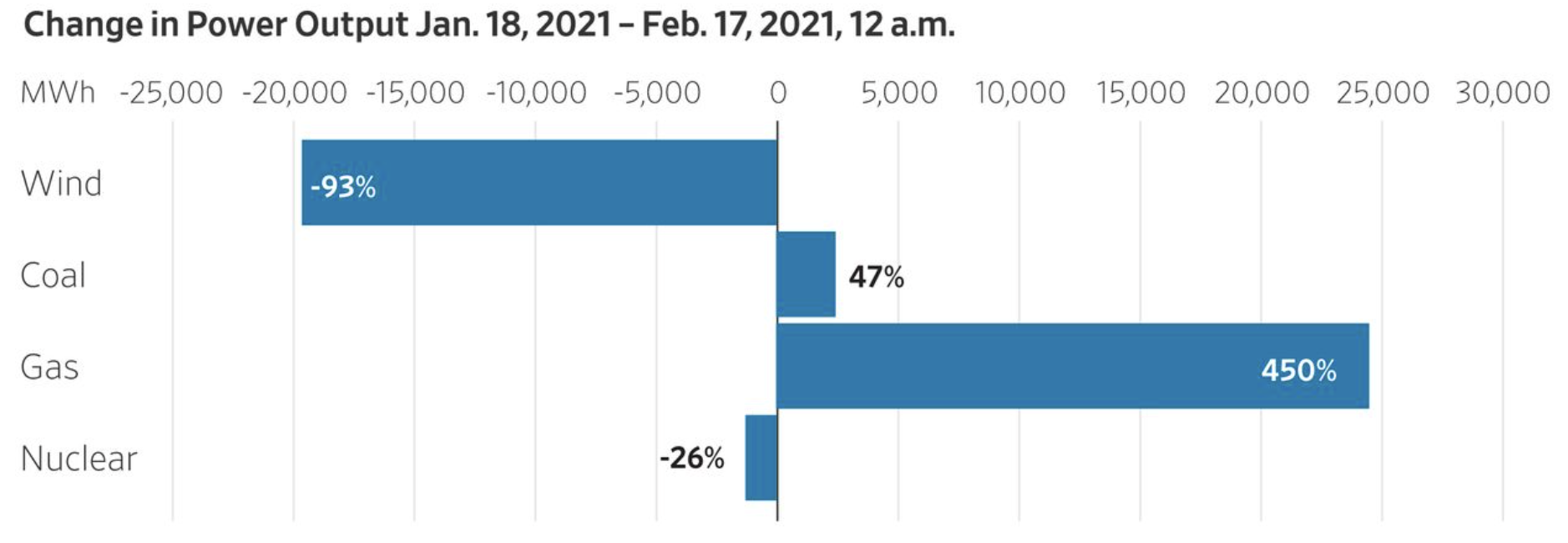
Between 12 a.m. on Feb. 8 and Feb. 16, wind power plunged 93 percent while coal increased 47 percent and gas 450 percent. Nuclear dropped 26 percent due to a reactor shutting off because the sensor could not relay that the system was stable—a safety feature. The past week in Texas shows that the state’s electricity grid that depends increasingly on subsidized, intermittent wind and solar energy needs baseload power to handle surges in demand. Natural gas helps but reliable coal and nuclear power are also needed.

Source: Wall Street Journal

Energy Security vs. Electrification

The Texas and California situations indicate that energy security and resilience are serious issues that need to be addressed to ensure that Americans have enough reliable and affordable energy. These recent experiences prove that during extreme weather, solar panels and wind turbines are of little value to the electric grid, especially when investment flows to them because of subsidies and mandates at the expense of grid reliability and resilience.

Energy security and resilience is the opposite of what Joe Biden and other politicians want for our future when they advocate for a “green new deal” or something similar by indicating that the United States should stop consuming hydrocarbons and use only carbon free sources. They want electricity to be almost entirely generated by renewable energy and for all sectors of the economy to be supplied solely by electricity. This means if cars and trucks and other vehicles become all electric, the increased electric demand will be supplied mainly by renewable energy, which will also need to replace the retiring hydrocarbon capacity—capacity that would last for decades if it was not forced to prematurely shutter, and which supplies 62 percent of our electricity. According to Elon Musk, an all-electric vehicle fleet worldwide will double the global demand for electricity. Given what has occurred in California and Texas, an all-electric energy future supplied mainly by renewables seems very unlikely to be successful.

Further, in line with a no carbon future, dozens of cities across the country are imposing bans on the use of natural gas for heating and cooking in new buildings. In addition to being bad for energy security, the bans are a form of regressive tax on the poor and the middle class because they compel consumers to use electricity, which costs four times more than natural gas on an energy equivalent basis. Despite what has occurred in California and Texas, the efforts to ban hydrocarbons and to electrify everything will continue because politicians say so, rather than responding to consumer needs.

Conclusion

The ongoing weather threats indicate that the United States should not rely on electricity alone to provide the country’s energy needs—particularly electricity produced mainly by intermittent renewable energy, which relies upon China for its manufacture and/or foundational minerals. American society needs to be more resilient to threats of all kinds and a diverse energy sector would provide that resiliency. Electrifying everything will result in the opposite effect. But that is what President Biden plans to do with his energy schemes."

Texas Spins Into the Wind

An electricity grid that relies on renewables also needs nuclear or coal power. 

WSJ Editorial.

"While millions of Texans remain without power for a third day, the wind industry and its advocates are spinning a fable that gas, coal and nuclear plants—not their frozen turbines—are to blame. PolitiFact proclaims “Natural gas, not wind turbines, main driver of Texas power shortage.” Climate-change conformity is hard for the media to resist, but we don’t mind. So here are the facts to cut through the spin.

Texas energy regulators were already warning of rolling blackouts late last week as temperatures in western Texas plunged into the 20s, causing wind turbines to freeze. Natural gas and coal-fired plants ramped up to cover the wind power shortfall as demand for electricity increased with falling temperatures.

Some readers have questioned our reporting Wednesday ("The Political Making of a Texas Power Outage") that wind’s share of electricity generation in Texas plunged to 8% from 42%. How can that be, they wonder, when the Electric Reliability Council of Texas (Ercot) has reported that it counts on wind to meet only 10% of its winter capacity.

Ercot’s disclosure is slippery. Start with the term “capacity,” which means potential maximum output. This is different than actual power generation. Texas has a total winter capacity of about 83,000 megawatts (MW) including all power sources. Total power demand and generation, however, at their peak are usually only around 57,000 MW. Regulators build slack into the system.

Texas has about 30,000 MW of wind capacity, but winds aren’t constant or predictable. Winds this past month have generated between about 600 and 22,500 MW. Regulators don’t count on wind to provide much more than 10% or so of the grid’s total capacity since they can’t command turbines to increase power like they can coal and gas plants.

Wind turbines at times this month have generated more than half of the Texas power generation, though this is only about a quarter of the system’s power capacity. Last week wind generation plunged as demand surged. Fossil-fuel generation increased and covered the supply gap. Thus between the mornings of Feb. 7 and Feb. 11, wind as a share of the state’s electricity fell to 8% from 42%, according to the Energy Information Administration (EIA).

Gas-fired plants produced 43,800 MW of power Sunday night and coal plants chipped in 10,800 MW—about two to three times what they usually generate at their peak on any given winter day—after wind power had largely vanished. In other words, gas and coal plants held up in the frosty conditions far better than wind turbines did.

It wasn’t until temperatures plunged into the single digits early Monday morning that some conventional power plants including nuclear started to have problems, which was the same time that demand surged for heating. Gas plants also ran low on fuel as pipelines froze and more was diverted for heating.

“It appears that a lot of the generation that has gone offline today has been primarily due to issues on the natural gas system,” Electric Reliability Council of Texas senior director Dan Woodfin said Tuesday. The wind industry and its friends are citing this statement as exoneration. But note he used the word “today.” Most wind power had already dropped offline last week.

Gas generation fell by about one-third between late Sunday night and Tuesday, but even then was running two to three times higher than usual before the Arctic blast. Gas power nearly made up for the shortfall in wind, though it wasn’t enough to cover surging demand.


Between 12 a.m. on Feb. 8 and Feb. 16, wind power plunged 93% while coal increased 47% and gas 450%, according to the EIA. Yet the renewable industry and its media mouthpieces are tarring gas, coal and nuclear because they didn’t operate at 100% of their expected potential during the Arctic blast even though wind turbines failed nearly 100%.

The policy point here is that an electricity grid that depends increasingly on subsidized but unreliable wind and solar needs baseload power to weather surges in demand. Natural gas is crucial but it also isn’t as reliable as nuclear and coal power.

Politicians and regulators don’t want to admit this because they have been taking nuclear and coal plants offline to please the lords of climate change. But the public pays the price when blackouts occur because climate obeisance has made the grid too fragile. We’ve warned about this for years, and here we are."