"At a press conference last week, Anders Tegnell said a massive decline in new COVID-19 cases shows Sweden’s “lighter touch” strategy is doing what it was designed to do.
“It really is yet another sign that the Swedish strategy is working,” Tegnell, Sweden’s top epidemiologist, said. “It is possible to slow contagion fast with the measures we are taking in Sweden.”
Unlike most nations in the world, Sweden avoided a hard lockdown. The nation of 10 million people instead opted for a strategy that sought to encourage social distancing through public information, cooperation, and individual responsibility. Restaurants, bars, public pools, libraries, and most schools remained open with certain capacity limits.
Sweden’s decision to forego lockdowns brought a barrage of scrutiny and criticism. Its approach was described as a “cautionary tale” by The New York Times.
But as I’ve pointed out, the criticism stemmed less from the results of Sweden’s experiment than the nature of the experiment. There are ample examples of nations (and US states) that have suffered far more from COVID-19 than Sweden even though these countries (and states) initiated hard lockdowns requiring citizens to shelter at home.
Perhaps the best way to measure the success of Sweden’s policies is to compare the outcome models predicted to the actual results.
On May 10, Dagens Nyheter—Sweden’s biggest daily newspaper—analyzed a pair of models inspired by the Imperial College of London study, which predicted as many as 40 million people could die if the coronavirus was left unchecked. The models predicted that Sweden's ICUs (intensive care units) would expire before May and nearly 100,000 people would die from COVID-19 by July.
“Our model predicts that, using median infection-fatality-rate estimates, at least 96,000 deaths would occur by 1 July without mitigation,” the authors wrote.
It’s a frightening prediction. And perhaps that was the point.
As Johan Norberg pointed out in The Spectator back in May, these models were used by critics of Sweden’s strategy to show its healthcare system would collapse if it did not “make a U-turn into lockdown” similar to the United Kingdom.
Well, we’re nearly through July. So how do the predictions stack up against the results?
Total COVID-19 deaths in Sweden stand at 5,700, nearly 90,000 less than modelers predicted. Hospitals were never overrun. Daily deaths in Sweden have slowed to a crawl. The health agency reports no new ICU admissions.
As the chart above shows, modelers weren’t just wrong. They weren’t even remotely close.
How did the experts get it so wrong? There are many reasons, of course, including the fact that COVID-19 isn’t as deadly as modelers originally feared. The simplest answer, however, is that modelers overlooked a basic reality: humans spontaneously alter their behavior during pandemics.
This should not be a surprise. Humans are intelligent, instinctive, and self-preserving creatures who will seek to avoid high-risk behavior. The natural law of spontaneous order shows that humans naturally adapt their behavior when circumstances warrant it. (In his 1988 book The Fatal Conceit, the economist F.A. Hayek described this process as “the least appreciated facet of human evolution.”)
Scientific evidence, as it relates to the current pandemic, bears out this economic idea. Research shows that in the US, workplaces and consumers changed their travel patterns before governments began issuing stay-at-home orders. In other words, without being ordered or even instructed, tens of millions of Americans were already adapting their behavior to the unknown threat of COVID-19.
A similar experience took place in Sweden, where foot traffic and train traffic were sharply reduced without draconian orders and penalties.
“We actually made a comparison to our Nordic neighbors, and the Swedish travel patterns have changed just as much as our Nordic neighbors, in spite of them having much more legal lockdowns than we have,” Tegnell said in a May interview.
The Swedish experience is important. As Phil Magness has noted at AIER, Sweden’s success suggests the presumed risks and benefits of lockdowns were largely a fiction.
“[T]he assumed benefits of a more severe lockdown policy appear to have been greatly exaggerated,” Magness wrote. “The assumed risks of the milder course adopted by the Swedish government appear to have been similarly inflated. And the overall death toll of the baseline ‘do nothing’ scenario appears to have little grounding in reality.”
One might argue that caution was warranted given the unknown threat of COVID-19. This argument is less persuasive when the costs of the lockdowns—a looming global recession, hundreds of millions of jobs lost, millions of businesses shuttered, historic social unrest, surging extreme poverty, and widespread health deterioration—are taken into account.
Fortunately, it’s not too late to learn from our mistakes. First, however, we must acknowledge them."
Thursday, July 30, 2020
Total COVID-19 deaths in Sweden stand at 5,700, nearly 90,000 less than modelers predicted
See Sweden’s Actual COVID-19 Results Compared to What Modelers Predicted in April: Sweden’s top epidemiologist Anders Tegnell says a massive decline in COVID-19 cases shows "the Swedish strategy is working.” Is he right? by on Miltimore of FEE.

We may already have herd immunity – an interview with Professor Sunetra Gupta
Are we already immune to coronavirus? Professor Sunetra Gupta, a theoretical epidemiologist at Oxford University, discusses her recent study on the herd immunity threshold, as well as her views on the social costs of lockdown, the inaccuracy of epidemiological models, and the curtailment of academic debate.
By The Reaction Team. Excerpt:
By The Reaction Team. Excerpt:
"A study produced by a team at Oxford University indicated that some parts of the United Kingdom may already have reached herd immunity from coronavirus. A significant fraction of the population, according to the study published last week, may have “innate resistance or cross-protection from exposure to seasonal coronaviruses”, making the proportion vulnerable to coronavirus infection much smaller than previously thought.
The Oxford team is led by Sunetra Gupta, a professor of theoretical epidemiology. In recent months, she has argued that the cost of lockdown will be too high for the poorest in society and questioned the language and quality of debate on the pandemic’s impact.
Reaction interviewed Professor Gupta about these matters and more, with questions from Maggie Pagano, Alastair Benn and Mutaz Ahmed.
Alastair: In the debate over T-cell immunity or cross-reactivity with coronaviruses, the common-sense view is that exposure to things that are similar does give you some protection, and it seems to be borne out in recent studies.
Yes, exactly. The principle of protection from exposure to related viruses, and indeed any kind of pathogen, is one that we’ve known for a very long time. The very first vaccine we had, which is smallpox, was based on the idea that cowpox protects against smallpox. This idea was already there well in advance of us knowing that smallpox was a virus – and indeed in advance of germ theory having been properly established. So we knew about this cross protection even before we knew that diseases were caused by germs. It’s a very old idea.
In my own studies, beginning with malaria and then later thinking about flu, the role of cross-immunity in protecting against disease seemed to be something that very much needed to be factored into our thinking. Most of the people who die from malaria are children, and they die upon their first exposure, because they have no immunity at that stage. That was one of the first things that struck me when I was working on malaria.
And then later when I was working on flu, it seemed to me a very good way of explaining why the 1918 flu had killed so many people, but why that didn’t seem to be repeating itself, was that it was likely that people hadn’t been exposed to flu. Many people would have not had the flu at all. So then that built up this population of naive immunity in people under the age of thirty who were very badly affected when the pandemic came through.
Having those ideas in mind, when the Covid-19 virus started to spread, I was pretty certain it wouldn’t have a huge, devastating impact in terms of mortality, because we had all these other coronaviruses circulating.
What I didn’t anticipate was that some of our responses to previous exposure to seasonal coronaviruses might actually protect us from infection. It’s one thing to get infected and not ill, but what the new studies are showing is that people are actually fighting off infection. So at an even more basic level, the pre-existing antibodies or T-cell responses against coronaviruses seem to protect against infection, not just the outcome of infection.
Mutaz: When the serological studies were conducted a couple of months ago, antibody rates were very low in the UK. Is that because people weren’t vulnerable to infection, or because once they were infected they had some level of innate immunity?
What we know is that the seropositivity rates in many parts of the world are much lower than we’d expect them to be if we assume that the epidemic has passed through and that people are resistant. If you take a very simple scenario where everyone is susceptible, you’d expect 60-70% of them to have some marker of exposure. And that is not what’s been observed.
I mean, there are areas where it is very high. There’s a paper published recently of a seroprevalence study done in the slums of Buenos Aires, which reports a 50% seroprevalence. And there have been studies from Lodi, Italy, where it is I think 60%.
So there are studies on the high side, but I think one can’t really trust studies on either side completely. One has to take all these measures with a certain degree of caution. What we have here are a range of measures. In cities, it’s typically much higher than in rural areas or areas that are non-urban.
One of the things that’s been done in reporting the seroprevalence, which is not correct, is that they’ve been homogenised. When people say only 5-6% of the UK population has been exposed, that’s not correct. I think very few people would agree that exposure rates in London are less than 20%.
The picture that we’re getting is heterogeneous. But even in hotspots, apart from a few reports, they’re still quite low. So why is that?
One reason might be that lockdown stopped the spread of infection, so it was halted at a stage when, say, 20% of people were immune and the rest of the people were still susceptible to infection. Well, under those circumstances, the easing of lockdown should result in fairly rapid growth of cases. And that’s not something we’re seeing.
So we’ve got those two bits of information. The third bit, the missing piece of the puzzle, is this idea that some people are fully resistant to infection, because they just have really good defences. That could just be part of our innate immunological makeup. It’s also becoming clear that some of the people that have beaten it off have had responses to other coronaviruses which could have played a role.
The other bit of the puzzle is that some people do get infected and they make antibody responses, but those responses die very quickly. So if you’re trying to measure exposure, you won’t get the full picture. Some of the measures of seroprevalence might be underestimates.
We’ve got four pieces of the puzzle, then. If we put them all together, which is what the paper that we published on Friday does, it gives you a theoretical framework that you can use to look at how these bits connect up together.
You can see two things. You can see why the seroprevalence level might be low, and you can also infer that the level of herd immunity needed to stop the thing from exploding again is actually much lower than the figures that are currently being thrown around quite incautiously might suggest."
Runaway Fraud Plagues the Massive Unemployment Program Congress Is About to Extend, Report Finds
Fraud, incompetence, and inefficiency are a feature, not a bug, of government agencies and state-run systems.
By Brad Polumbo of FEE.
By Brad Polumbo of FEE.
"The debate over expanded unemployment benefits has proven particularly fractious, given that the $2 trillion CARES Act Congress passed in March set up a broken economic system where nearly 70 percent of the unemployed can get paid more in benefits while staying home than they would make by going back to work. Yet as important as the ramifications of this distorted big government labor policy are, one largely overlooked consequence of the massive expansion of unemployment is skyrocketing fraud and abuse.
A new report from the fiscally conservative Foundation for Government Accountability exposes the stunning extent to which fraud has corrupted the hastily-crafted unemployment expansion. FGA Senior Research Fellow Josh Waters found that fraud will consume more taxpayer dollars under this expansion than the entire unemployment program paid out in 2019.
Remember that the unemployment system was already very wasteful before COVID-19, with roughly 10 percent of payments being made in error in 2019. Waters explains that even generously assuming this fraud rate remains constant—it will likely be worse this year due to system overload and COVID-19 chaos—his calculations show a whopping $26 billion will be lost to fraud as a result of this expansion.
“As states try to respond to the historic increase in claims due to shutdowns and layoffs, the $600 bonus payments are making it very lucrative for fraudsters who know many states probably lack the staffing and resources to combat fraud while the systems are overloaded with an unprecedented amount of claims,” Waters writes.
The FGA report documents how this fraud is playing out at the state level:
Consider the example of Brandi Hawkins, an allegedly corrupt government employee working at the Michigan Unemployment Insurance Agency who was charged on July 17 with dishing out more than $2,000,000 in fraudulent benefits. Investigators say some $200,000 in cash and many luxury items such as high-end purses were found in her home.
- Mississippi is estimated to have paid out at least $76 million in improper payments so far, and the governor warns the state has been “attacked with false claims”
- Washington State was hit by Nigerian scammers and is estimated to have paid out at least $650 million improperly
- Oklahoma already reports 65,000 fraudulent unemployment claims and has likely paid out tens of millions improperly
- Arizona estimates that its fraud rate has doubled since the expansion and that nearly 10 percent of benefits being paid out are fraudulent
It’s impossible to know how many like Hawkins there are out there, but you can bet for every scammer caught many others go free. There is a simple way to stop them all, however.
“The most important thing Congress can do is allow the [unemployment] bonus to expire as scheduled in July,” Waters concludes. “This will dramatically reduce the incentive for fraud and the cost of fraud. It will also allow for more robust economic recovery and further reduce overall unemployment claims as individuals return to work and are freed from unemployment dependency.”
These explosive figures reveal levels of government waste that should concern any taxpayer. Yet they’re only the beginning: If the unemployment expansion is reauthorized through January 2021, as House Democrats hope to do, the numbers will only climb higher and higher. (Meanwhile, if the expanded benefits are allowed to expire, unemployed people will still be eligible for the normal state-level unemployment benefits that predated the pandemic).
The levels of fraud on display here might understandably surprise average Americans, but they won’t come as a shock to free-market economists. Fraud, incompetency, and inefficiency are a feature, not a bug, of government agencies and state-run systems.
Why? Well, in private enterprise, there exists a profit motive. A business is run by an entrepreneur whose take-home pay—and his very livelihood—depend on earning as much as possible while restraining costs. It’s a system that incentivizes efficiency. Any company or entrepreneur who fails the efficiency test is unlikely to stay in business for long, regardless of how good their product is, since customers will take their business to more frugal competitors who can offer lower prices.
In bloated government agencies, no such pressure exists.
The involuntary support of taxpayers essentially serves as a blank check for welfare state bureaucrats who may have good intentions but operate under a different incentive structure. And since government agencies usually have a total monopoly on what they do, there is no competitive catalyst to promote efficiency in their operation. Over time, the structure inevitably results in stagnation and inefficiency, laying the groundwork for fraud and waste.
As famed free-market economist Milton Friedman explained, government agencies are doomed to be less efficient than consumers shopping for themselves with their own money, or even shopping for themselves with other people’s money. “If I spend somebody else’s money on somebody else,” Friedman wrote, “I’m not concerned about how much it is, and I’m not concerned about what I get.”
This is big government in a nutshell.
Policy proposals are too often debated in abstract terms of what the plan or proposal would do assuming competent government execution. Yet that is rarely, if ever, the actual result.
“Economists are quick to speak of ‘market failure’, and rightly so, but a greater threat comes from ‘government failure,’” economic journalist Matt Ridley wrote in his book The Rational Optimist: How Prosperity Evolves.
“Because it is a monopoly, government brings inefficiency and stagnation to most things it runs; government agencies pursue the inflation of their budgets rather than the service of their customers; pressure groups form an unholy alliance with agencies to extract more money from taxpayers for their members,” Ridley continues. “Yet despite all this, most clever people still call for government to run more things and assume that if it did so, it would somehow be more perfect, more selfless, next time.”
Establishment Republicans and Democrats alike are ignoring the evidence of fraud plaguing the expanded unemployment system they created. Instead, they’re pretending more government can somehow be the answer. It will work this time!
Taxpayers like you will pay the price for the establishment’s willful ignorance."
Wednesday, July 29, 2020
Are Surging State COVID-19 Cases Due to Early Reopening?
By Alan Reynolds.
""How Coronavirus Cases Have Risen Since States Reopened" in The New York Times July 9 claimed, "Florida and South Carolina were among the first to open up and are now among the states leading the current surge. In contrast, the states that bore the brunt of cases in March and April but were slower to reopen have seen significant decreases in reported cases since. Average daily cases in New York are down 52 percent since it reopened in late May and down 83 percent in Massachusetts" (which reopened May 18).
The purpose of this note is to question whether or not it is accurate to simply attribute the "current surge" in cases or deaths to the "states first to open up."
The New York Times article showed the percentage changes in cases since reopening – the date when states "lifted order to stay at home or allowed major sectors such as retail, restaurants and personal care services to reopen either statewide or in most areas." Eight states "first to open up" reopened before May 1, twenty more before May 15, and twenty-two states were "slower to reopen" from May 15 to May 29.
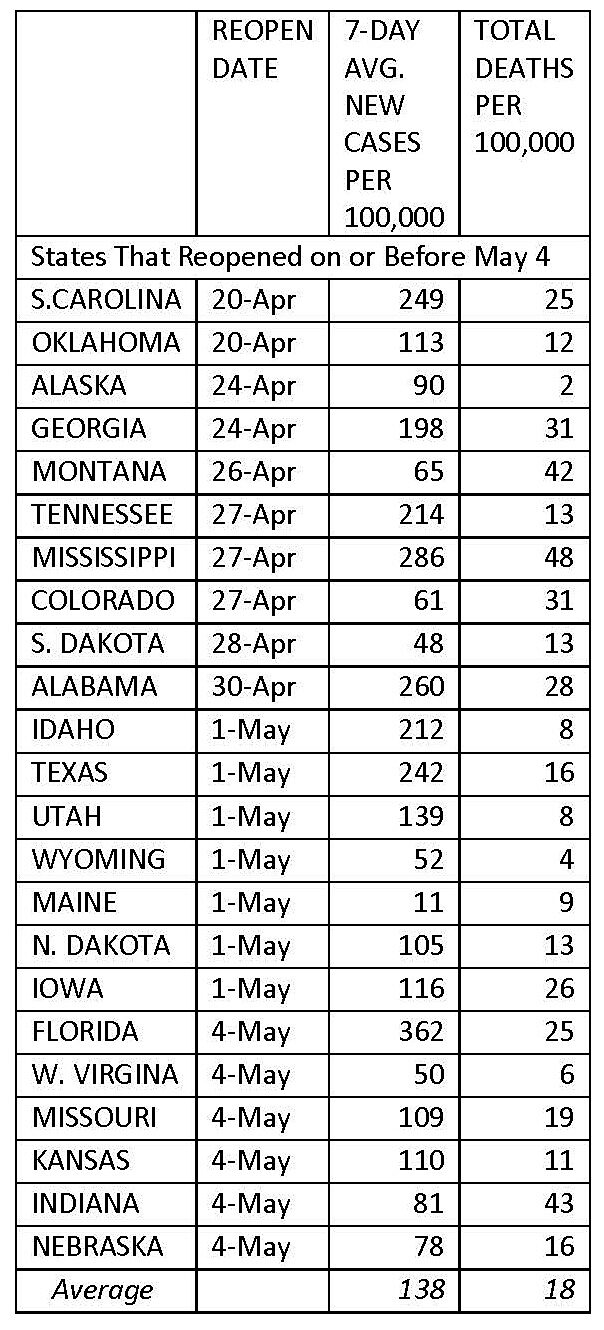
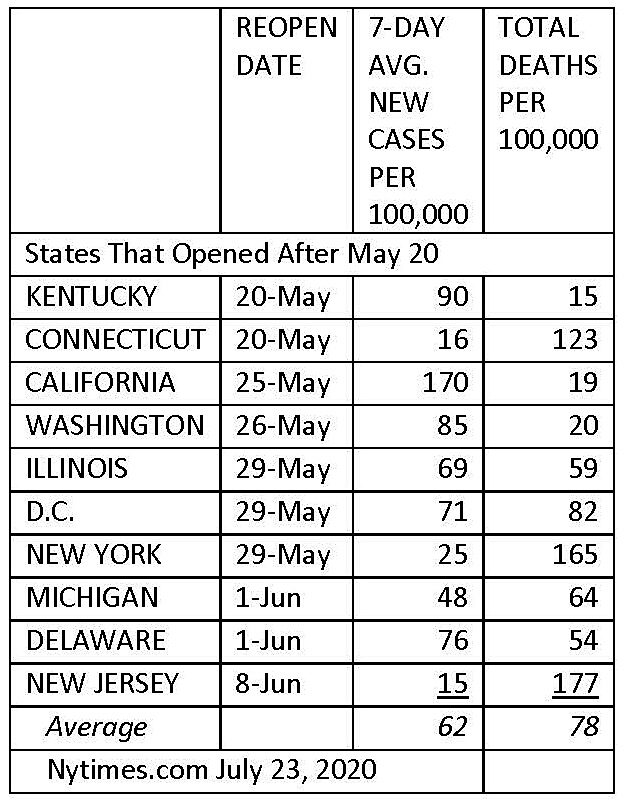
Unfortunately, the author's main example – saying Florida was "among the first to open up" on May 4–puts that state into his middle group (May 2 to May 14). To keep 70% of Florida in the narrative (Southeast Florida remained closed), my Table defines early reopening as May 4 or earlier. I redefine late reopening to mean ten states (including D.C.) that reopened after May 20, because the author's May 15 definition of late is not much later than May 4. Reopening dates are from the New York Times article. Statistics on new cases per day from a recent 7 day average and on total deaths per 100,000 residents from the beginning were in nytimes.com on July 23.
About a third of the 23 states that opened by May 4 (four with Democrat Governors) did see relatively high daily numbers of new cases over the 7 days ending July 22, famously including Texas and Florida but not Arizona (which reopened May 8). About 15 of the early-reopening states have not seen a significant "surge" of new cases. California had such a surge, but was one of the last states to reopen.
What all of the early reopening states have in common is not how many positive cases they've had tested in the past two weeks, but how few deaths they have had since the virus began. Unusually low death rates in all 23 states explain why so many reopened early. Conversely, very high death rates in states with densely-populated cities explains why they reopened late – such as the NY/NJ/CT corridor, Chicago, Detroit and Washington D.C.
On July 17 another New York Times article, "After the Surge in Coronavirus Cases, Deaths Are Now Rising Too," claimed daily deaths per million in 18 states over a 7-day span were higher than on June 1. Any detected rise in a state's daily deaths, however small, was again blamed on "the reopening and relaxing of social distancing restrictions in some states." But that is not what that article's statistics showed.
Increases in daily deaths were expressed as percentage changes, not numbers. Oklahoma deaths were up by less than one person per million, yet that was labeled a 19% increase. A map highlighting 20 "States where deaths have increased [in percentage terms] since June 1" includes Hawaii with only 24 deaths since the virus began, and Alaska with only 17. Aside from Alaska and Hawaii, only 18 other states had any rising deaths, which means most states had falling deaths. Contrary to the "early reopening" theme, eight states with falling deaths were among the earliest reopening states – Georgia, Mississippi, Missouri, Nebraska, Iowa, Maine, Indiana and Colorado. The last five early-opening states saw COVID-19 deaths fall by 60-70% since June 1, according to the same article.
Without careful cherry-picking among the 23 states that opened early, the date of reopening can't explain which states have recently experienced rising cases, much less rising deaths. California proves that reopening late does not by itself protect a state from a surge in new cases. Yet California is a rare state that reopened late despite few deaths (Washington may look like another, but Seattle had the first big nursing home crisis).
On the other hand, differences in death rates almost always explain which states opened early or late. Those with relatively few deaths (16 per 100,000 in Texas compared with 123 in Connecticut) have experienced almost flat epidemic curves – that is, cases and deaths did not rise sharply and then fall but instead remained low and little changed until recently.
By contrast, having suffered unusually high numbers of infections and deaths by April as late-openers did reduces today's odds of another big bout of community spread. Former super-hot spots like the NY-NJ-CT Metropolitan area have now acquired sizable pockets of COVID-19 resistance ("immunity") with previously-infected people now acting as a buffer to reduce contagion risk for their neighbors."
5 reasons why the coronavirus nightmare may soon be over
By Matt Ridley.
"Like the ancient mariner, the virus refuses to leave us alone. Resurging in Blackburn, Spain, and America, it is still going to be around here when the winter comes. As we head indoors, it will be back for a dreaded second wave, disguised among a host of colds and flus. Yet I am now optimistic that the nightmare will end this year or at least by the spring. Here are five reasons.
First, vaccine trials were promising. Having proved safe and capable of raising both a T-cell response and an antibody response, Oxford University’s vaccine, developed in collaboration with Astrazeneca, is now more likely to succeed than to fail, so long as its side effects are manageable in the elderly. And behind it comes a stream of other vaccines, some of which will surely work.
The second reason for hope is that, as Oxford University’s epidemiologist Sunetra Gupta has argued, herd immunity may be achieved more easily than we first thought. Indeed, from the way that infections have continued to dwindle despite lessening social distancing it seems probable that herd immunity has already been achieved in London at least. Half the population could be immune already because of recent exposure to coronavirus colds, while children seem to resist catching Covid-19, let alone passing it on. As the chief medical officer Chris Whitty has conceded, the epidemic was already in retreat before lockdown began. That is because the virus depends heavily on a few superspreaders, and pre-lockdown measures we were taking in March are remarkably effective: no handshakes, frequent hand washing, no large gatherings and so on.
So the third reason for optimism is that as long as we continue with these measures then this virus will struggle to keep spreading in the community. The one place where the virus did spread with horrible ease was in care homes and hospitals. Why was this? T-cell senescence is an issue, so old people’s immune systems are just not as good at coping with this kind of infection, and there were dreadful policy mistakes made, like stopping testing people, clearing patients out of hospitals to care homes without tests, and assuming no asymptomatic transmission. Healthcare and care home staff were not properly protected and were allowed to go from site to site. Many were infected and became carriers.
The fourth cause for cheer is therefore that now we know about asymptomatic transmission, we have more protective equipment and we have a better, if still imperfect, capacity to test, track and isolate cases, it is likely that the hospital-acquired epidemic of the spring will not be repeated.
My fifth excuse for being hopeful is that we now know better how to treat people who get seriously ill. Ventilation is not necessarily the answer, blood clotting is a real threat, making patients lie face down is helpful, dexamethasone can save lives and some antiviral drugs are showing promise.
These are reasons that even if a lot of people catch the virus this winter, fewer will die. Colds and flu viruses usually peak in mid winter when we are indoors. Viruses survive longer in colder and drier conditions, and centrally heated air dries out our protective mucus membranes. Covid-19 will certainly be hoping to peak then. But Australia offers a glimmer of reassurance. It’s winter there now, and this is proving to be the country’s weakest flu season on record. From January to the end of June, 21,000 Australians were diagnosed with flu. Last year more than 132,000 people were diagnosed in the same period. Social distancing is presumably the main reason. If that is repeated here, then not only will Covid have fewer flus and colds to hide behind, but it too will struggle to mount a seasonal peak. And fewer people will die from flu.
If we can beat this virus, then we can beat most respiratory ones. The ridiculous way in which we tolerate cold-spreaders, mocking them for taking a day off and praising them for trudging into work while feeling miserable, has to stop. It should be socially unacceptable to go to a party with a cold, let alone kiss the host on the cheek when you get there. Our children’s permanently runny noses need not be inevitable.
Ten years from now, I predict that we will not only have defeated Covid-19, but made colds rarer too.
Our bigger challenge this winter will be to tackle the backlog of treating cancer and other medical problems delayed by Covid. And to unleash economic growth to help those who lost their jobs."
Tuesday, July 28, 2020
Federal officers protecting federal property are now the targets of demonstrators, not the instigators of violence
See The WSJ editorial A Weekend of Urban Anarchy: These were not peaceful protests, despite what many in the media claim.
"Riots broke out again this weekend from coast to coast, with violence and vandalism damaging more of urban America. Democrats and their media allies insist these are largely peaceful protests, so it’s worth examining what really happened.
On Saturday in Seattle, protesters gathered outside the juvenile court and detention facility, set fire to portable trailers, and smashed the windows of nearby cars and businesses. An explosive device gashed an eight-inch hole in the side of the Seattle Police Department’s East Precinct, and rioters threw fireworks, stones and other projectiles at law enforcement.
“In all 59 officers were injured throughout the day with one of those being hospitalized,” the police department reported, and “injuries ranged from abrasions and bruising to burns and a torn meniscus.”
Similar scenes unfolded in Portland as rioters tried to tear down the fence surrounding the Hatfield Federal Courthouse. Demonstrators threw Molotov cocktails Friday night, and after midnight one federal officer took “a direct hit from a commercial grade firework,” another “was hit with a mortar firework,” and a third “was struck in the head with a mortar firework,” the Department of Homeland Security says. Peaceful?
DHS says some 5,000 or 6,000 returned to the scene on Sunday, threw smoke bombs and launched “a roughly 10-minute-long continuous firework attack against the courthouse.” DHS says at least 20 federal officers sustained injuries in Portland.
In Louisville, Ky., a black militia that calls itself the “Not F— Around Coalition” lived up to its name Saturday when a member discharged a gun and accidentally struck three compatriots, causing non-life-threatening injuries. In Oakland, Calif., rioters set fires downtown Saturday night, including at the Alameda County Superior Courthouse. In New York City, demonstrators defaced police vans with spray paint and tried to smash their windows, while others lit trash cans on fire. Demonstrators carried out more vandalism at a federal building in Atlanta and a Fraternal Order of Police lodge in Baltimore.
This list isn’t exhaustive, and it undermines the claim that the Trump Administration has deployed federal agents to suppress peaceful dissent. Federal officers protecting federal property are now the targets of demonstrators, not the instigators of violence. The real blame lies with progressive city leaders, who have all but promised violent protesters that they can act with impunity.
Portland recently imposed sweeping restrictions on when police can use tear gas to disperse protesters. Seattle passed a similar ordinance banning tear gas, blast balls and other less-than-lethal weapons—even after Police Chief Carmen Best warned that such restrictions leave officers with “no ability to safely intercede to preserve property in the midst of a large, violent crowd” and may “create even more dangerous circumstances for our officers to intervene using what they have left—riot shields and riot batons.”
Federal Judge James Robart issued an injunction against the Seattle ordinance last week after the federal government expressed similar concerns, but it’s only temporary. Other Democratic-run cities have passed or are pursuing similar bans.
The weekend’s events were a deliberate assault on public and private property, law enforcement, and public order. Lawlessness begets lawlessness, and in recent weeks we’ve seen reports of vigilantes and far-right activists joining the melee from Richmond to Philadelphia. Local officials are allowing this disorder to occur, and the more it is indulged the worse it is likely to get."
How to get a COVID-19 vaccine faster
By Raymond J. March. He is an assistant professor of economics at North Dakota State University. Excerpt:
"Developing a vaccine, although much less invasive than the other options, will require pioneering medical breakthroughs at record speed.
Hoping to beat the odds, President Trump launched Operation Warp Speed last May. The operation creates a partnership between private drug developers and several federal agencies to develop and distribute a vaccine by January.
Having considered 14 different drug developers, Operation Warp Speed recently selected five finalists for its partnership. Sparing no expense, it has distributed over $2 billion in R&D funds to these producers.
But why only five?
Even the most promising potential vaccines are just beginning the large-sample human-testing vaccine approval process, the most time-consuming and difficult component. With over 100 vaccines under development, there are a variety of options to diversify the risk for finalists that do not receive approval.
Evidence indicates that including more drug developers would provide us with the highest chance to get a vaccine. A model created by Accelerated Health Technologies predicts that a candidate pool of 15-20 vaccines would have an 80-to-90 percent chance for one to succeed.
Perhaps more important, providing a few producers with extensive financial support is no substitute for the collaboration among a diverse set of researchers that is often required to make a medicinal breakthrough. In his book "The Organization of Inquiry," economist Gordon Tullock stressed that the scientific field closely resembles the division of labor, where a large network of scientists collaborates directly or indirectly by working on narrow aspects of a larger puzzle.
Similar collaboration has brought us pathbreaking vaccine development before.
From 2014 to 2016 the Ebola virus rapidly spread through western Africa, where it caused over 11,000 deaths. Similar to COVID-19, Ebola was difficult to contain and exceptionally difficult to develop a vaccine for.
Despite the odds, scientists, public-health experts, and drug producers indirectly collaborated across the globe to create a "miracle" vaccine within a year. As one "STAT" article notes:
While the vaccine has come to be known as Merck’s Ebola vaccine, in reality, scores of researchers and Ebola outbreak response workers in Canada, the U.S., Europe, and Africa played a role in paving Ervebo’s path to licensure, whether that was in designing it, conducting pivotal pre-clinical studies in animals, or the clinical trials Merck used to support its application.
Our best hope to develop a COVID-19 vaccine quickly is to allow drug developers to employ a diverse set of approaches and let the scientific method dictate solutions. Unfortunately, I fear Operation Warp Speed undermines this approach with government-selected winners and losers, which decreases the chances of success. Here’s hoping I’m wrong."
Subscribe to:
Posts (Atom)