Tuesday, April 18, 2017

A Twisted Tale of Rent Control in the Maximum City

By Alex Tabarrok. Excerpt:
"Walking around Mumbai it’s common to see some lovely, older buildings (circa 1920s perhaps) that

 rentcontrol1

are in a great state of disrepair. A well maintained building can last for hundreds of years so why are these buildings falling apart? The answer is rent control. Bombay passed a rent control act in 1947 that froze rents at 1940 levels.

More than fifty years later, rents remained frozen at 1940 levels. It wasn’t until 1999 that the Act was modified slightly to lift controls on some new construction and to allow rent increases of 4% per year. After a fifty two year freeze, however, a 4% increase was a pittance. Thus, even today there are thousands of flats where tenants are paying rents of 400-500 rupees a month (that’s $6 to $8 a month!)–far, far below market rates.

The rent control law meant that there was virtually no construction of rental housing (WP) for decades and a slowly dilapidating housing stock. (Ironically, the only free market in rental housing is in the slums.

  rentcontrol4

The nominal landlords have neither the incentive nor the funds to maintain the buildings so every year during monsoon season some of the buildings collapse and people die. As the World Bank put it, the monsoons are Natural Hazards but the collapses are Unnatural Disasters:
Rent controls in Mumbai may have initially benefited tenants at the expense of landlords, but over time everyone suffers. Rent controls cause landlords to forgo maintenance and neglect their properties, and tenants not only live in dilapidated buildings but die when they collapse in heavy rains. Even if tenants are willing to either pay higher rents or to maintain the building, each tries to not pay his share of the expense (free riding), especially if appropriate retrofitting involves structural changes to the entire residential structure and not to individual apartments. Tenants also may lack the legal authority to make changes to their building’s structure.
Consider the photo at top, it’s an elegant building on a nice plot in a highly desirable part of town but take a closer look and you can see that it is falling apart (second photo). Several businesses and flats operate in the building. Now read the sign on the wall.

rentcontrol3

I don’t doubt that the sign is largely accurate but it also illustrates another aspect of rent control. Rent control transforms a mutually profitable exchange into a zero-sum war of misery."

In Wake of United Debacle, Give Airlines - and Travelers - More Flexibility

By Ryan Young of CEI.
"Yes, there is such a thing as bad PR. United Airlines proved it recently by forcibly removing David Dao, a 69-year old physician, from an overbooked flight. Blood was involved, and possibly a concussion. When the story became public, United lost more than $200 million of market capitalization in a day.

Markets at work, and rightfully so. Governments exist to shield bad actors; markets exist to punish bad actors. But there is more to the story. Two solutions to United’s easily-avoidable PR debacle come to mind.

The first is to use the price system. If a flight is overbooked and the airline has no choice but to ask some paying passengers to leave, compensating them for their trouble is a simple and peaceful way to do so. United does have such a policy, but its limited flexibility prevents it from being very effective.

Someone flying for an urgent family matter or an important business meeting will likely want to stay on the plane at almost any cost. But someone else on the same flight for a weekend getaway could easily be talked into vacating his non-urgent seat in exchange for, say, future discounts or a stay at a nearby hotel until the next flight is available. Different people have different preferences.

A flexible negotiating policy could have easily avoided United’s current PR nightmare. It would also make sure that the people with the most urgent needs would get seats. United should change its overbooking policies to better serve its customers.

The second and more fundamental solution is adding competition. As my colleague Marc Scribner puts it, quoted in a Los Angeles Times op-ed:

If American consumers wish to enjoy improved service quality in air travel, they should demand that Congress repeal 90 years of anti-competitive federal law. Less regulation of air travel, not more, is the solution.

One example. A foreign airline such as British Airways or Lufthansa cannot legally run a domestic U.S. flight from, say, San Francisco to Detroit. It may only run flights to or from international destinations, such as London-to-New York or Munich-to-Atlanta. This regulatory restriction gives U.S. airlines an unfair advantage, and they use it. Regulations let U.S. airlines behave as they do without recompense—short of a major PR disaster, which we are seeing now.

Opening the domestic market to international carriers would provide a powerful check on bad behavior, such as Dao experienced. If United treats its customers the way it treated him, travelers should have the option of going not just to Delta or American, but Air France, Air India, or anyone else for their next flight, domestically or internationally.

Incidents like last week’s bloody removal of Dao from his paid-for seat would likely never happen with a more flexible negotiating policy, coupled with a regulatory system that allows competition. The only thing standing in the way is regulation.

While there’s no excuse for how United handled Dr. Dao’s now-infamous “re-accommodation,” we know that the government regulations airlines are subject to often end up creating perverse outcomes for customers. It would be nice to see airline executives explain to the public how most of the time it’s actually government policies, from the TSA’s security theater to outdated government-run air traffic control, that end up ruining a traveler’s day.

Traveling through the air at 30,000 feet above ground at nearly the speed of sound should feel like the miracle it is. Airlines and their customers should stand together against regulators and make it feel that way once again."

Monday, April 17, 2017

Paid Leave Means Women Pay

By Vanessa Brown Calder of Cato.
"Who pays for women’s mandated paid leave and other women-centric labor policies? At a superficial level, it depends on who you ask. Proposals for federal mandated paid leave and child care laws run the gamut, and advocates identify government, taxpayers, or private companies as backers.

Unfortunately, those answers reveal a glaring oversight: directly or indirectly, women will pay.

Economists of a variety of ideological persuasions agree, including Larry Summers, former Director of the National Economic Council for President Obama. In 1989, Summers wrote “Some Simple Economics of Mandated Benefits” where he asserted that “The expected cost of mandated benefits is greater for women than it is for men.”

What does that mean? In his paper, Summers concludes that women will be paid less or not hired as a result of mandated benefits. In his words, “If wages could freely adjust, these differences in expected benefit costs would be offset by differences in wages.” And if not? “[T]here will be efficiency consequences as employers seek to hire workers with lower benefit costs.”

In the real world, Summers’ predictions seem to be borne out. Jonathan Gruber, an MIT economist historically unopposed to economic intervention, authored research that “consistently suggest[ed]” women’s wages are reduced to reflect the cost of benefit mandates in states that try them. Gruber estimated that the shift in cost is around “the order of 100 percent.”

And more recent research indicates women “pay” for mandated paid leave and job protections in other ways.[1] According to Jenna Stearns, wage and job entitlements led fewer women to hold management positions and promotion-track jobs in Great Britain. Her research provides “evidence that access to job-protected paid maternity leave can actually exacerbate gender inequality among highly educated workers” [emphasis added].

Although proponents rarely mention it, the U.S. policy status quo holds some counterintuitive advantages. A 2015 study comparing the U.S. against other countries suggests that women in the U.S. are more likely to have full time jobs and work as managers or professionals. That difference is attributed to a lack of maternal wage and job entitlement policies.

Importantly, if the U.S. did move toward paid leave or job entitlements for women, the loss of wages and/or opportunities during childbearing-aged years would not be one-time penalties. Being passed over for a job, involuntarily mommy-tracked, or having wages slashed to pay for prospective benefits can have impacts that last a professional lifetime.

These points aren’t mentioned in the current debate, but they should be. As Summers concludes, “There is no sense in which benefits become ‘free’ just because the government mandates employers offer them to workers.” Intellectual honesty requires we don’t ignore this inconvenient, but important fact: paid leave means women pay.
 
[1] Additional evidence here."

There is no evidence that trade with China has any impact on the overall number of jobs in the US

See Does trade with China cost jobs? by Scott Sumner.
"Trade with China undoubtedly costs jobs in specific industries. However there is no evidence that it has any impact on the overall number of jobs in the US. Last year I did a number posts criticizing a study by Autor, Dorn and Hanson, for drawing aggregate conclusions from cross-sectional data. Later Paul Krugman made the same criticism:
OK, what about the effect on overall employment? In general, you can't answer that with a similar computation, because it all depends on offsetting policies. If monetary and fiscal policy are used to achieve a target level of employment - as they generally were prior to the 2008 crisis - then a first cut at the impact on overall employment is zero. That is, trade deficits meant 2 million fewer manufacturing jobs and 2 million more in the service sector. . . . Up through 2007 we basically had a Fed which raised rates whenever it thought the economy was overheating; in the absence of the China shock it would have raised rates sooner and faster, so you just can't use the results of the cross-section regression - which doesn't reflect monetary policy, which was the same for everyone - to predict how things would have turned out.

Since then a number of papers have provided support for the Sumner/Krugman critique. First there was one by Jonathan Rothwell, and more recently by Ildikó Magyari. Notice how Magyari distinguishes between microeconomic and macroeconomic effects:
What is the impact of Chinese imports on employment of US manufacturing firms? Previous papers have found a negative effect of Chinese imports on employment in US manufacturing establishments, industries, and regions. However, I show theoretically and empirically that the impact of offshoring on firms, which can be thought of as collections of establishments - differs from the impact on individual establishments - because offshoring reduces costs at the firm level. These cost reductions can result in firms expanding their total manufacturing employment in industries in which the US has a comparative advantage relative to China, even as specific establishments within the firm shrink. Using novel data on firms from the US Census Bureau, I show that the data support this view: US firms expanded manufacturing employment as reorganization toward less exposed industries in response to increased Chinese imports in US output and input markets allowed them to reduce the cost of production. More exposed firms expanded employment by 2 percent more per year as they hired more (i) production workers in manufacturing, whom they paid higher wages, and (ii) in services complementary to high-skilled and high-tech manufacturing, such as R&D, design, engineering, and headquarters services. In other words, although Chinese imports may have reduced employment within some establishments, these losses were more than offset by gains in employment within the same firms. Contrary to conventional wisdom, firms exposed to greater Chinese imports created more manufacturing and nonmanufacturing jobs than non-exposed firms.
But the media loves a good story, and the "China stealing American jobs" meme just won't go away. Here's a recent article from The Economist:
Since relatively few industrial robots are in use in the American economy, the total job loss from robotisation has been modest: between 360,000 and 670,000. By comparison, analysis published in 2016 found that trade with China between 1999 and 2011 may have left America with 2m fewer jobs than it would otherwise have had. Yet, if the China trade shock has largely run its course, the robot era is dawning.
That's very misleading. It's possible that there are 2 million specific workers who lost jobs because of Chinese trade. But there is no evidence that the net number of US jobs was reduced at all.

Fortunately, the public doesn't seem to be buying all this gloom and doom, as support for trade is soaring dramatically higher. And Trump seems to have abandoned his proposal for 45% tariffs on Chinese goods."

Sunday, April 16, 2017

This Isn't A March For Science This Is About Economic And Political Policy

By Tim Worstall. Excerpt:
"One of those who organises the Union of Concerned Scientists has penned an explanation of the March for Science to take place next weekend. And it's entirely obvious that what he's actually irate about isn't science at all, it's the political and economic policies being put in place as a result of science that irks him. The two are not the same thing, not the same thing at all:
So, why are they grabbing placards now? Because an unprecedented attack on science, scientists and evidence-based policymaking is underway in the US federal government.
An attack upon science or the scientific method would be worthy of a march of course. But that really just isn't what is being complained about:
Nowhere is the attack more ferocious than on the issue of global warming, where the Trump administration has taken a wrecking ball to the modest but important policies put in place by President Obama.
Ah, no, that's not a complaint about science at all is it? That's a complaint about political and economic policy. I am, for example, boringly mainstream concerning climate science. That warming climate is happening, we're causing it and we should do something. And then I become equally boringly mainstream with what we should do about it--have a carbon tax. As Nick Stern, James Hanson, Greg Mankiw, William Nordaus, John Quiggin, Richard Tol, Marty Weizman, Sir Partha Dasgupta and just about every economist who has studied the matter agrees.

And the thing is, as the Stern Review itself, all 1,200 pages of meaty goodness of it, explains, because the carbon tax is the efficient method of dealing with this then the other methods, say, regulatory action like that from Obama, is not something we should do. For, if we deal with this problem the efficient way then we will either be able to solve more of it for the costs we're willing to bear or, alternatively, solve it entirely at least cost. Using regulation, that less efficient method, means that either we'll solve less of it because we'll be so aghast at the cost, or we'll be poorer once we have solved it.

That is, good economic policy tells us that the political action to deal with climate change should not be what Obama has been doing. Reversing those regulations is not thus an attack on science it's an attack on bad policy. And do please note that this is true whatever we think of climate science itself. The truth of emissions causing warming has no influence at all upon he best method of reducing emissions and thus warming."

In most of America it is illegal to construct the attached rowhouses and small-scale duplex and triplex apartments that historically provided the bulk of America’s cheap housing stock

The American economy isn’t actually becoming more concentrated: Opportunity is clustering, but people and growth aren’t by Matthew Yglesias.  Excerpts:
"Economic opportunity is becoming more concentrated, but Americans’ ability to move to take advantage of that opportunity is declining. Consequently, the rising average incomes in big coastal cities are being offset by those cities’ declining share of the population."

"America’s metropolitan areas are becoming more unequal, with per capita income rising faster in a small number of already affluent metro areas. This accords with the basic intuition that the growth sectors of the American economy — high tech, finance, biomedical devices — are largely concentrated in a few large coastal areas, while the plethora of manufacturing centers that dotted much of the country decades ago have declined."

"this has not led aggregate economic activity to be more concentrated in those affluent cities."

"How can New York get richer without growing its share of the overall national economy? The answer is that these same affluent metro areas contain a shrinking share of the country’s overall population."

"Today, instead of heading to the metro areas that offer the highest wages, Americans are generally moving to places like Atlanta, Dallas, and Nashville, where economic opportunities are mediocre at best.

The reason for this is not too mysterious. 

The price of a house — especially one in a neighborhood that’s considered to have good public schools — in the suburbs of Boston, Washington, or San Francisco is prohibitive. Young people of all kinds move to the central cities of the great coastal metropolises despite the rent squeezing, making do with roommates and cramped apartments. But middle-class grown-ups face vicious trade-offs between space, commuting time, and money. 

If you happen to earn a good living with specialized skills in a locally dominant industry, the math generally works out. New York bankers and Silicon Valley engineers pay exorbitant housing costs but make commensurate salaries. 

A mere dental hygienist, high school math teacher, chef, hairstylist, or physical therapist would also earn a higher average wage in the Seattle area than in the Sunbelt. But in most cases, the difference isn’t enough to compensate for the higher cost of living. The result is that Americans as a whole are “moving to stagnation,” voluntarily accepting lower pay in lower-productivity places in order to avoid the bite of housing costs. 

The problem in a literal sense is that high-wage coastal cities are adjacent to oceans and thus have fewer dimensions of freedom in which to sprawl without creating untenable commuting conditions. 

America does, however, possess the technological capacity to construct large numbers of dwellings on relatively small parcels of land. It happens to be the case that across most of the land in America’s suburbs — and even in America’s central cities — it is illegal to construct the attached rowhouses and small-scale duplex and triplex apartments that historically provided the bulk of America’s cheap housing stock. And where rowhouse neighborhoods exist and have become inordinately expensive, it is almost universally illegal to knock them down and replace them with large apartment buildings."

Saturday, April 15, 2017

Economic freedom has been key to advancement of women worldwide

By Fred McMahon of The Fraser Institute.
"Through March, we’ve seen two well-publicized celebrations of freedom, though the architecture of freedom has been little discussed.

CNN’s Freedom Week featured clips of people, many of them famous, describing what freedom means to them. More global was International Women’s Day, marking women’s gains in freedom and achievement across much of the planet. Achievement depends on freedom and, with freedom, women’s achievements become inevitable.

But these celebrations seldom mention one of the most fundamental freedoms; economic freedom—the ability of individuals to make their own economic decisions, without government or crony capitalist control or dependence.

Economic freedom has been key to women’s advance, opening many doors, including the ability to make their own career decisions and enter into once virtually forbidden professions such as engineering.

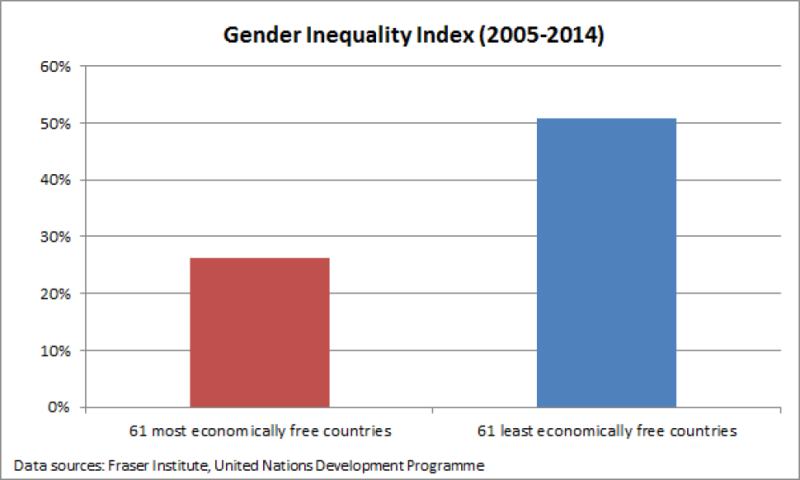
Antony Davies, Duquesne University, and James R. Harrigan, of Strata, a Utah-based think-tank, have found a strong relationship between economic freedom, as measured by the Fraser Institute economic freedom index, and gender equality, as measured by the United Nations Development Programme.


Economic freedom has been shown to be correlated with a number of outcomes for women, for example, literacy, which increases for both men and women in economically free nations, but most dramatically for women.

In the quarter freest countries, women’s literacy is 92 per cent and men’s 95 per cent. In the least free nations, women’s literacy is 60 per cent, a huge gap below men’s literacy at 75 per cent, using data from the World Development Indicators.

We at the Fraser Institute have just made a huge advance. Many countries do not extend the same economic liberties to women as to men. In the past, data were not available to measure the difference adequately.

Data availability now enables us to adjust the economic freedom index to take this into account. In the 2016 report, Rosemarie Fike explored the adjustment methodology, which will be fully incorporated into the 2017 report. And here too, the positive relation between economic freedom and gains in gender inequality still holds.

The adjustment technic penalizes the score of countries lacking economic freedom for women. The penalty is not based on subjective judgments but rather from data from the OECD and World Bank, The downward adjustment for the quarter least free nations is two-and-a-half times the adjustment for the freest nations.

Economic freedom is important for everyone. It provides the foundation on which the architecture for freedom is built. In an economically unfree society, government or crony capitalists have plenty of coercive tools, influencing an individual’s ability to find a job, get a promotion, gain education, feed and clothe their families, and see opportunity for their children.

One of the last century’s great totalitarian thinkers realized the power that comes from suppression of economic freedom. As Leon Trotsky put it: “In a country where the sole employer is the State, opposition means death by slow starvation. The old principle, who does not work shall not eat, has been replaced by a new one: who does not obey shall not eat.”

Of course, few states have been this extreme, but the more control government or crony elites have over an individual’s economic life, the greater the individual’s dependence. Economic freedom liberates individuals from this dependence and opens the door for other freedoms."