"If Joe Biden and Kamala Harris proposed to give taxpayer funds to pro-tax, pro-spending groups like the Center for American Progress or the Center on Budget and Policy Priorities, Republicans presumably would argue against handouts.
After all, why should taxpayers be forced to subsidize left-wing activism?
While this sounds like a strictly hypothetical question, the sad reality is that American taxpayers already are funding a group that pushes for higher taxes and bigger government.
The Organization for Economic Cooperation and Development is a Paris-based international bureaucracy that is dominated by Europe’s welfare states.
For decades, the OECD has pushed for policies for all sort of tax increases. The bureaucrats mostly push for class-warfare policies (higher income tax rates, higher capital gains taxes, higher death taxes, higher business taxes, etc), but the OECD also doesn’t hesitate to push for taxes that would pillage ordinary people (energy taxes, value-added taxes, etc).
Just a few days ago, the OECD stayed true to form with a new report urging more class warfare.
This report…explores how tax systems can mitigate…inequality with a focus on the distribution of income and wealth and identifies scope for potential reform. …Strengthening progressivity through domestic tax systems can take the form of setting more progressive tax schedules, broadening the bases of progressive taxes… Improving equity calls for increasing overall tax revenues… International tax collaboration can empower countries to more effectively implement their domestic tax policies. Progress in international tax transparency…has significantly strengthened the effectiveness of domestic taxation and gives governments new scope to tax capital.
In addition to a generic embrace of various class-warfare taxes, the OECD also could not resist marrying demagoguery with dishonesty (an OECD trait) when analyzing the taxation of income that is saved and invested.
In many countries, capital income receives more favourable tax treatment than labour income.
This is simply not true. The OECD bureaucrats are ignoring the fact that various forms of capital income (such as dividends and capital gains) are examples of double taxation.
If the corporate income tax is included, the overall tax burden on capital is higher than the tax burden on labor (as the OECD itself has acknowledged on multiple occasions).
Defenders of the OECD will claim I’m being unfair because the report explains that policy makers should be aware of “incentives to work, save and invest, and ultimate implications for economic growth.”
Yet that is just a throwaway line. To the extent that the report mentions growth, the OECD implies that more class warfare will, “mitigate inequality and support more inclusive growth.”
Ironically, the political types at the OECD routinely assert that higher taxes and bigger government will be good for prosperity even though the professional economists in Paris produce research showing the opposite is true.
The bottom line if that Republicans should have defunded the OECD a long time ago. But that apparently is asking too much of the “stupid party.”"
Saturday, August 3, 2024
The OECD Pushes (Again) for Class-Warfare Taxation

Forced National Service: Worse Than The Draft
Instead, Americans value voluntary service—and their freedom
"In my Defining Ideas article last month, “The Draft Is Still a Bad Idea,” I made the case against a traditional draft to obtain military manpower. A related proposal is for a universal draft of young people, male and female, that would give them a choice between military and civilian service.
That kind of draft is also a bad idea. Some of the arguments against such a draft are the same as the arguments against a military draft. The distinctive features of a universal draft also bring other issues into play. The bottom line, as I shall show, is that a universal draft is even more objectionable than a limited military draft. A universal draft, like a military draft, would violate young people’s freedom to choose their occupations and would take no account of the losses to these young people. In addition, a universal draft would, by definition, take away the freedom of many more young people than a military draft would. Also, as some officials in the military have recognized, a universal draft could make it more difficult for the military to get its desired amount of high-quality first-term manpower.
Dark impulses behind some proposals
Although some readers might think that universal national service is a new idea, it has been part of the conversation in the United States for over a century. Many of the advocates showed little regard for the people they wanted to draft.
Exhibit A is noted philosopher and psychologist William James. In 1910 he published an article titled “The Moral Equivalent of War,” in which he advocated a universal draft of young men. His article was based on a 1906 speech he gave at Stanford University. What was James’s case? He wrote:
To coal and iron mines, to freight trains, to fishing fleets in December, to dishwashing, clothes-washing, and windowwashing [sic], to road-building and tunnel-making, to foundries and stoke-holes, and to the frames of skyscrapers, would our gilded youths be drafted off, according to their choice, to get the childishness knocked out of them, and to come back into society with healthier sympathies and soberer ideas.
Note something in this quote that the late Hoover fellow Martin Anderson pointed out in a 1989 conference on national service held at the Hoover Institution. It wasn’t just that James wanted young men to be forced to work in fishing fleets. No. He wanted them to be forced to work in fishing fleets in December, one of the harshest months during which to be working on a boat. In his written remarks, Anderson stated:
There is a streak of cruelty here (fishing fleets in December?), of a barely concealed, seething lust to control the young, to hurt them, to crush the innocent enthusiasm for which the old so often envy the young.
Parenthetically, that quote reminds me of one of the main characteristics I appreciated in the late Martin Anderson. Even though he had no children, in his activity during the Nixon administration to end the draft and in his later writing against its renewal, Marty showed an intense compassion for young people.
The suggestion of harsh measures for young people wasn’t unique to William James. In the famous December 1966 conference on the military draft, a conference that attendee Milton Friedman saw as a turning point towards opposition to the draft, noted anthropologist Margaret Mead called for drafting women as well as men. She recognized that there was a special problem with women that didn’t exist for men: women can get pregnant. (It’s too bad that Mead wasn’t around to explain that fact to Supreme Court justice Ketanji Brown Jackson, who, in her confirmation hearing, said that because she was not a biologist, she could not give a definition of a woman. Anthropologist, not biologist, Margaret Mead had no such difficulty.)
How did Mead suggest dealing with young women who got pregnant while in national service? In a word, harshly. In her presentation at the 1966 conference, Mead stated, “[P]regnancy could be treated as a severe breach of contract, comparable to going AWOL in males.” Was she saying that such women should be imprisoned? It appears so. Was she saying also that they should be separated from their newborn babies? We don’t know. Mead stated further, “Part of the institution of universal national service would be the postponement of marriage until the service was completed, if universal national service takes the form of a nationwide call-up at eighteen.” She didn’t say what she would do to prevent girls from marrying before age eighteen.
In the late 1970s, when I became involved in opposing measures to reinstitute the draft, the idea for a national-service draft had become popular with some people, fortunately a minority, from across the political spectrum. In January 1979, an organization called the Potomac Institute published a short book titled Youth and the Needs of the Nation that presented the case for national service. The first part of the book presented the findings and recommendations of the Committee for the Study of National Service. Here’s a quote from that part of the book:
During the Committee’s study, two participants went to China (under other auspices). Like visitors to the People’s Republic before them, they came back impressed and challenged by the extraordinary mobilization of the talent of young people possible under authoritarian, post-revolutionary conditions.
It is true that an authoritarian government can achieve “extraordinary mobilization” of millions of people. The committee did not explain how the Chinese Communist government achieved this. Maybe its members understood that specifying the needed methods would turn people off. That would explain why the committee stated:
Some of us favor the adoption of mandatory National Service as soon as the public can be persuaded to support it, although no member of the Committee favors sending anyone to jail who refuses to serve.
That makes me wonder what the committee members meant by the word “mandatory.”
Actually, though, one member of the committee, Donald J. Eberly, did favor prison sentences for people who refused to serve. I know this because I debated him at Brown University in April 1979. The topic was the McCloskey bill, named after then-congressman Pete McCloskey. Eberly was the author of the national-service part of the bill. He was also a nice elderly man who looked like one’s ideal grandfather, making me doubt whether I would win the debate. But I did win by using one simple technique: quoting again and again the part of the bill that said that those who refused to comply would be charged with a crime and would, if convicted, be subject to a fine of up to $10,000 and/or a prison sentence of up to five years.
This tour of the landscape from 1906 to 1979 gives a feel for how long the compulsory national-service idea has been with us. Later proposals are similar although, for whatever reason, less spelled out.
The case against compulsion
The above documentation of the brutality of some of the proposals for national service implicitly makes the case against compulsion. Fishing fleets in December? Pregnancy being equated to going AWOL? Advocates being impressed by the Chinese government’s “extraordinary mobilization of the talent of young people”?
Nevertheless, the case against compulsion should be made explicit. One of the most important freedoms we have is the freedom to choose what to do with our lives, whether we are old or young. A national-service draft would destroy that freedom whether, depending on the particular version, for one year or two years. That’s wrong and is inconsistent with one of our proudest founding documents, which many of us celebrated last month. The Declaration of Independence stated that among our “unalienable rights” are “Life, Liberty, and the pursuit of Happiness.” A draft, whether for military or civilian service, violates the right to liberty.
And it’s not just the Declaration of Independence that speaks to liberty. The US Constitution, specifically the Thirteenth Amendment, guarantees freedom not to be drafted. Section I of that Amendment states, “Neither slavery nor involuntary servitude, except as a punishment for crime whereof the party shall have been duly convicted, shall exist within the United States, or any place subject to their jurisdiction.” Some people argue that Congress’s goal in passing that amendment was to end slavery and prevent its reimposition. But if that had been the only goal, Congress would not have added the words “nor involuntary servitude.” A draft is clearly involuntary servitude.
The negative effect on the military
During part of my time as an economics professor at the Naval Postgraduate School, the US Navy funded my research. In the late 1980s, when Senator John McCain and others were making noises in favor of universal national service, I proposed to my research sponsor that I study the issue. My sponsor quickly said yes. Why? One main reason was that two of the key people who signed off on the proposal were economists who understood the economics of the draft. They were against the draft on principle, but that wasn’t all. In previous conversations, they had pointed out an unintended negative consequence of universal national service: more difficulty in getting high-quality military manpower.
Here was their argument, which I found, and still find, persuasive. Think of the pool of young people whom the military has a chance of recruiting. The military must compete against colleges and employers. But introduce universal national service. Now the military must compete against civilian service as well. To be sure, there will be people whom the military would like to have who find civilian service unattractive. But there will also be people who want some kind of adventure and would satisfy part of their desire with a safe civilian job instead of a somewhat more dangerous military job.
The argument is not a slam dunk, but my two sponsors had thought about it enough, and looked at the demographics enough, to be convinced that a universal-service draft would make things more difficult for the military.
Building character and becoming adults
One desire that many advocates of universal national service share is that of molding young people into responsible adults. It’s a good goal.
But the main way people become responsible is by making choices and being accountable for the outcomes. Taking away their freedom to choose their work doesn’t seem like a clearcut way to make them more responsible. We do sometimes hear of former draftees asserting that being drafted was good for them because it made them responsible early. The most likely conclusion, then, is that drafting people would make some people become more responsible earlier than otherwise while postponing responsibility for others. Either way, it’s not a slam dunk.
Interestingly, though, in Youth and the Needs of the Nation, every example that the aforementioned committee gave of successful community service was of voluntary service. The committee stated:
Yet service to others, and voluntary action without waiting for government leadership or command, has been a special American theme from the first days of colonial settlement. In the early 19th century, de Tocqueville saw it as the secret of American success—just as the involuntary servitude of some Americans was the nation’s greatest sin. Frontier life required that neighbors help each other build barns, fight fires, harvest crops, and care for the sick. Popular movements for the abolition of slavery, for women’s suffrage, and for civil rights are later manifestations of the same spirit; the growth of the Boy Scouts and Girl Scouts, the Little Leagues and 4H Clubs, are other less political examples involving young people, as is all the free time given to the wide range of religious and civic organizations in our midst.
I emphasize that all of those activities, as the committee itself noted, were and are voluntary. I’ll close by noting an additional irony. In a document that advocated mandatory service, the authors stated that involuntary servitude “was the nation’s greatest sin.” I couldn’t have said it better."
Friday, August 2, 2024
Venezuela’s Nicolas Maduro Proves Milton Friedman Right, 60 Years Later
By Benjamin Powell of Texas Tech University. The full article is below but I am putting the last paragraph first.
"More than 60 years ago, Nobel Prize-winning economist Milton Friedman wrote that he knew of no “society that has been marked by a large measure of political freedom, and that has not also used something comparable to a free market to organize the bulk of economic activity.” While Venezuela was briefly an exception, it eventually lost its political freedoms after socialist policies destroyed its economic freedoms."
"The Venezuelan government is claiming that Nicolas Maduro has won re-election to a third term as President. However, this claim does more to illustrate the incompatibility of a democratic political system and a socialist economic system than it does to establish Maduro’s legitimacy as Venezuela’s President.
The problem is that socialist systems centralize economic power in the hands of government. Once that happens, the government also has the power to subvert the democratic process by punishing any political opposition economically.
Venezuela’s socialism started out democratically with Hugo Chavez’s election in 1998. The state’s monopoly on the world’s largest oil reserves, combined with high prices in the 2000s, gave the government plenty of foreign reserves to import goods and appease voters, even though its policies were undermining its domestic production and causing the economy to underperform.
Oil production eventually declined due to state incompetence, corruption, and political graft. Once global oil prices also fell, the Venezuelan economy collapsed and has now been in crisis for a decade.
Under Maduro, socialist economic policies and corruption have caused one of the worst economic and humanitarian crises in the Western Hemisphere in centuries. Annual inflation peaked at 344,509% in 2019. (That’s not a typo!) Shortages of basic goods are widespread. More than 7 million refugees have fled the country.
Voters would surely throw any administration with this track record out of office in a free and fair election. At that point, when voters in any free country would demand a change of course, Venezuela’s democratic socialism evolved into normal authoritarian socialism.
This year, it appears Venezuela’s National Electoral Council (CNE) manipulated the vote count outright, leading to the Organization of American States (OAS) refusing to recognize the election results. However, this is not the first time the Maduro regime has manipulated the democratic process. In his last re-election bid, six years ago, state-owned firms ordered workers to vote for Maduro under threat of losing their jobs and polling places allegedly bribed voters with food aid to support the regime.
Following Sunday’s hotly contested election, the CNE, run by Maduro appointees, declared him the winner claiming that he had won 51.2% of the votes while opposition candidate Edmundo Gonzalez received only 44.2% of the votes. The opposition was denied access to CNE headquarters while votes were being tallied, but they claim that the 73% of tally sheets they’ve been able to access show Gonzalez winning by a more than two-to-one margin. Independent pre-election polling is much more in line with the opposition’s claims than the Venezuelan government’s. Three independent polls were conducted in the weeks leading up to the election. Each indicated that between 59% and 72% of voters intended to vote for Gonzalez, while Maduro polled at just over 12% in two polls and just under 25% in the third.
More than 60 years ago, Nobel Prize-winning economist Milton Friedman wrote that he knew of no “society that has been marked by a large measure of political freedom, and that has not also used something comparable to a free market to organize the bulk of economic activity.” While Venezuela was briefly an exception, it eventually lost its political freedoms after socialist policies destroyed its economic freedoms."
Red States, Blue States: A Tale of Two Economies
"The latest employment data from the Bureau of Labor Statistics for June 2024 offers a compelling snapshot of the divergent economic fortunes of red and blue states. The national unemployment rate remained steady at 4.1 percent, a modest increase of 0.5 percentage points from June 2023. Yet, beneath these headline figures lie significant contrasts between states, particularly economically vibrant red and struggling blue states, with Texas and California as prime examples.
Texas: A Beacon of Prosperity
Texas continues to exemplify the benefits of more free-market policies, evidenced by its impressive employment growth and relatively low unemployment rate. Over the past year, Texas added 267,400 nonfarm jobs in a pro-growth environment and favorable regulatory climate.
According to the Texas Workforce Commission, the state’s civilian labor force now exceeds 15.3 million, highlighting the ongoing expansion of job opportunities. This growth is supported by a diverse economy encompassing technology, energy, and healthcare industries. The unemployment rate in Texas stood at 4.1 percent in June, mirroring the national average but significantly lower than California’s 5.2 percent rate.
Texas’ economic model emphasizes fiscal responsibility, including adopting more sustainable budgeting practices. This has helped the Lone Star State claim the 7th best fiscal freedom according to the Cato Institute’s Freedom in the 50 States. The state also ranks 20th in regulatory freedom and 17th overall when considering economic and personal freedoms. Texas ensures that its budget remains manageable by limiting government spending growth to less than the rate of population growth plus inflation over much of the last decade. This approach keeps taxes low and promotes long-term economic stability and growth. However, the current irresponsible budget, which increased by more than 20 percent, challenges past budget successes in Texas and should be addressed in the next session in 2025.
California: A Contrast in Economic Management
California, on the other hand, presents a stark contrast. Despite adding 223,600 jobs over the year, California’s unemployment rate rose to 5.2 percent, the second highest in the nation, just behind the District of Columbia at 5.4 percent. This increase underscores the state’s challenges, including high taxes, stringent regulations, and a high cost of living, which collectively stifle business growth and job creation.
According to the Freedom in the 50 States report, California ranks 48th in fiscal freedom, 49th in regulatory freedom, and 48th in overall freedom. The Golden State ranks poorly compared with Texas and all but two states, New York and Hawaii, regarding overall economic freedom. California’s economic struggles are not a recent phenomenon. Over the years, the state’s policies have created an environment less conducive to business investment and innovation. High-profile businesses and individuals have been leaving the state, seeking more favorable conditions in states like Texas, further exacerbating the economic divide. The Wall Street Journal recently reported the Internal Revenue Service’s latest migration data for net adjusted gross income by state in 2022 showed California had the largest net loss of $23.8 billion while Texas had the second largest net gain of $21 billion, next to Florida of $36 billion. This is yet another example of how people and businesses move from high-tax to lower-tax states.
Unemployment Trends Across the States
The broader employment trends in the June 2024 report revealed that eight states saw an increase in unemployment rates while only one state experienced a decrease. The majority of states, however, saw no significant change in their jobless rates. South Dakota boasted the lowest unemployment rate at 2.0 percent, followed closely by North Dakota and Vermont at 2.1 percent.
In contrast, states with more interventionist economic policies, like California and Nevada, struggled with higher unemployment rates of 5.2 percent. This trend highlights the broader pattern where states with more market-friendly policies enjoy better employment outcomes.
Job Growth and Economic Policies
The BLS data also shows that nonfarm payroll employment increased in eight states in June 2024, with North Carolina, Massachusetts, and Virginia leading in job gains. Over the year, 27 states saw employment increases, with Texas, California, and Florida posting the largest gains in absolute numbers. These large job gains often reflect the fact that these states have the largest populations, but what’s revealing is that the percent increases over that year were just 1.3 percent in California while a more robust 1.9 percent in Texas and 2.0 percent in Florida.
The nuances become clear when considering these states’ economic policies and environments. States like Texas and Florida, prioritizing low taxes and minimal regulation, have created environments where businesses can thrive. This is reflected in their strong job growth and relatively low unemployment rates. In contrast, states with higher taxes and more regulatory burdens, such as California, face more significant economic challenges despite adding jobs.
The Flat Tax Revolution
A significant aspect of the economic success seen in many red states, including Texas, is their embrace of the state flat tax revolution. This movement, which simplifies tax codes and lowers rates, has been crucial in attracting businesses and encouraging investment. By moving toward flat taxes, states can reduce the complexity and burden of taxation, making them more competitive and appealing to businesses and workers.
This revolution is part of a broader trend towards sustainable budgeting, where states aim to maintain fiscal discipline while ensuring they do not overburden their citizens with high taxes. The success of states like Texas in implementing these policies demonstrates the potential for other states to achieve similar economic prosperity by adopting these principles.
Policy Implications and Recommendations
The stark differences in economic outcomes between red and blue states underscore the importance of policy choices. Red states like Texas continue demonstrating that free-market principles lead to more robust economic growth and better employment outcomes. For policymakers, the lessons are clear:
- Reduce Regulatory Burdens: Streamlining and eliminating regulations can make it easier for businesses to operate and expand, fostering job creation.
- Pass Sustainable Budgets and Lower Taxes: Implementing sustainable budgeting practices and reducing the tax burden on businesses and individuals support more economic activity and attract investments.
- Promote Economic Freedom: Ensuring a business-friendly environment that supports entrepreneurship and innovation is key to sustainable growth.
As we look to the future, it is crucial that states learn from these examples. By adopting policies prioritizing economic freedom and reducing government intervention, states can create environments where businesses flourish, and jobs are plentiful for widespread prosperity. The contrasting fortunes of Texas and California serve as a powerful reminder that policy decisions have real-world consequences.
States can pave the way for a prosperous future by examining these trends and implementing effective policies."
Fed Dot-Plot Forecasting Fiascos: June 2008 and June 2021
"The Federal Reserve chairman and Federal Open Market Committee (FOMC) always imagine that they can prevent recession by anticipating trouble in time to stop it. If that were true, soft landings would be the norm rather than a freak rarity.
At his July 31 press conference, Fed Chair Jerome Powell remarked, “We know that reducing policy restraint … too late or too little could unduly weaken economic activity and employment.… If the labor market were to weaken unexpectedly, we are prepared to respond. Policy is well positioned to deal with the risks and uncertainties that we face.”
Prepared and well positioned? That would be a unique surprise. The Fed has an almost perfect record of raising the federal funds rate on bank reserves only after inflation surges are well underway. And it has an even better record of cutting interest rates only after recessions are likewise underway, always too late and usually too much.
Was the Fed prepared and well positioned to deal with unexpectedly high inflation from the second quarter of 2021 to the second quarter of 2022? From October 2008 to May 2022 the federal funds averaged 0.5 percent and was almost always near zero (rising above 2 percent only from October 2018 to September 2019). The Fed did not respond at all as the year-to-year personal consumption expenditures (PCE) inflation rate rose to 4.1 percent in the second quarter of 2021, 4.7 percent in the third, and 5.9 percent in the fourth. By the second quarter of 2022, inflation reached 6.8 percent. Yet the fed funds rate in 2022 was only 1.2 percent in June 2022, 1.7 percent in July, and 2.3 percent in August.
Conversely, when it comes to “reducing policy restraint” to prevent recessions, consider what happened in 2008. By June 2008, the economy had been in recession for six months, but no Fed governor or regional bank president expected even a future recession in their June dot-plot “projections” for 2008–2010. Even when the oil shock recession was aggravated by financial crisis in the next two months, the FOMC remained unprepared to act.
This is what happened in 2008 and how the Fed reacted, as documented by the New York Times:
- August 5: “The F.O.M.C. holds interest rates steady. It frets that inflationary pressures are building. Three of the regional reserve banks want to raise interest rates.”
- September 7: “The Federal Housing Finance Agency places Fannie Mae and Freddie Mac in government conservatorship.
- September 15: Lehman Brothers files for Chapter 11 bankruptcy protection; Bank of America buys Merrill Lynch.”
- Sept. 16: “The F.O.M.C. continues to hold steady on rates. Most Fed officials say they still believe the economy is growing, still predict it will grow in the final months of 2008 and grow more quickly in 2009. And they still fret that inflation is rising.”
Previously, at a Federal Reserve policy meeting on November 20, 2007, a month before the Great Recession began, the FOMC introduced a new quarterly Summary of Economic Projections (SEP). These highly publicized quarterly projections, from Federal Reserve governors and reserve bank presidents, became famous as a scatter diagram called the “dot-plot.” Barely seven months after the November 2007 launch, however, this new FOMC central planning ritual failed spectacularly.
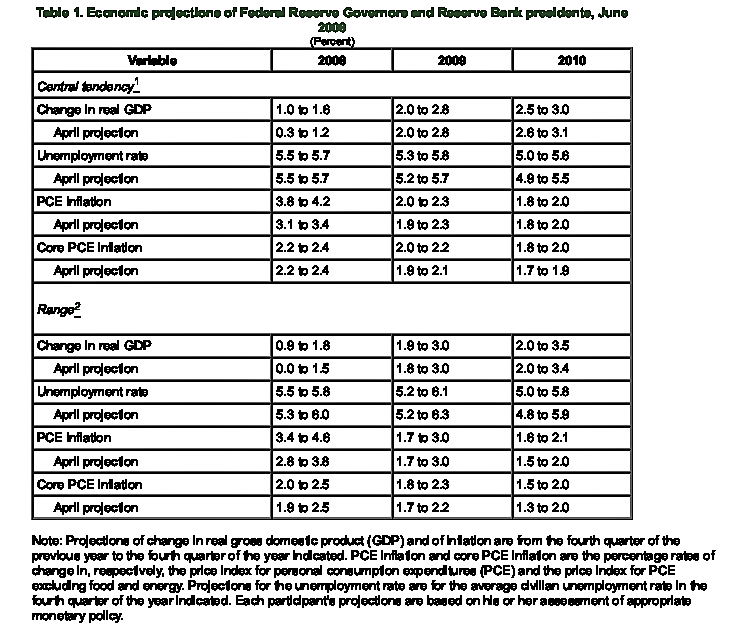
The SEP dot-plot projections from June 12, 2008, are shown in Table 1. By that time, the economy had already been in recession for half a year. Yet nobody at the FOMC in mid-2008 imagined recession was a serious threat. Indeed, “some participants pointed to the apparent resilience of the US economy … and suggested that the adverse effects of financial activity outside of the housing sectors could prove more modest than expected.”
SEP tables reveal participants’ projections of the percentage change in real GDP and PCE inflation between the fourth quarters of each year. They also post the unemployment rate expected in the last quarter.
The top panel in Table 1 instead highlighted the “central tendency” of these estimates in June 2008. Instead of using a median as an average (which became common later), this “trimmed mean” eliminated the highest and lowest three. To emphasize that not one of the projections was remotely close to being right, I prefer to focus on the bottom panel—which shows the entire range of estimates for all 12 participants.
Meeting in the middle of 2008, with half the year behind them, not one of the June 2008 FOMC projections imagined the 18-month recession that started that January would happen at any time in 2008, 2009, or 2010. Projections of real gross domestic product (GDP) growth by year-end ranged from 0.9 percent to 1.8 percent. Yet actual real GDP growth in 2008 was sharply negative—down 2.5 percent by the fourth quarter. For 2009, the Fed’s June 2008 projections expected real growth of 1.9 to 3.0 percent. But economic growth in 2009 was roughly zero, 0.1 percent.
The June 2008 FOMC SEP projected PCE inflation of 3.4 to 4.6 percent between the fourth quarters of 2007 and 2008. But actual inflation was only 1.2 percent in 2008 and 2009.
The unemployment rate in the June 2008 dot-plot was projected to be 5.5 to 5.8 percent in the fourth quarter of 2008, and 5.2 to 6.1 percent in the fourth quarter of 2009. But the unemployment rate reached 6.9 percent by the last quarter of 2008 and 9.9 percent by late 2009. Unemployment remained above 9 percent until the end of 2011 and did not return to pre-recession levels until 2014.
Table 1: FOMC summary of economic projections, June 2008
The Fed has only once managed to keep the federal funds rate above 5 percent for a long time without recession, from November 1994 to November 1998 (even as PCE inflation fell from 2.1 percent in 1994 to 0.8 percent in 1998). Before that, the longest such “higher-for-longer period” experiment with such a high central bank interest rate lasted only 14 months—when the New York Fed kept the discount rate at 5–6 percent from August 1928 to October 1929. That ended with the Great Depression.
The FOMC’s third major experiment with a higher-for-longer strategy lasted from June 2006 to September 2007, when the federal funds rate was kept above 5 percent for over a year. That ended with the Great Recession.
The latest higher-for-longer Fed marathon, which began August 2023, is now almost a year old and still being tested.
The 2008 Fed projections were dangerously slow to react to the unfolding recession, remaining strangely more concerned about an assumed inflationary impact of a global oil price spike. They forgot that oil price spikes are reliable omen of recession (and of Fed mistakes). High oil prices and a high fed funds rate preceded every postwar US recession since 1957 except one (1960). Oil prices and the fed funds rate spiked before the recessions of 1957, 1970, 1974, 1980, 2001, and 2008.
Figure 1: Weekly oil prices and the federal funds rate 2007–2014

As Figure 1 shows, shortly after the June 2008 FOMC meeting, on the week ending July 4, the spot price of West Texas Intermediate (WTI) crude oil peaked at $142.52 a barrel, and the fed funds rate was 2.2 percent. Oil then fell to $97.19 by the week ending September 19, and the Fed cut the funds rate below 1.3 percent.
By Christmas 2008, WTI crude reached a weekly low of $32.98, and the Fed fund rate had been slashed to essentially zero (0.14 percent) where it remained until May 2022, aside from October 2018 to September 2019.
The hubris of central banking relies on what F. A. Hayek called “the pretense of knowledge.” Like the quaint central planners of socialist fantasies, the pretense is that a dozen experts can somehow steer the entire US economy with a tiny rudder—the overnight “policy rate” paid to banks for holding reserves at Fed district banks. Even if that worked as planned, it requires forecasts because using past data to set future policy is doomed by the long and uncertain lags between Fed actions and business and household reactions.
Just as the FOMC was astonishingly slow to react to the inflation surge in 2021and early 2022, they were equally blindsided in 2008 by another oil price shock recession—despite the Fed having repeatedly made the identical blunder in other recessions of keeping interest rates high because oil prices were high.
Keeping Fed policy unchanged until the Fed’s committee could agree about obvious risks of inflation or recession caused costly procrastination errors in 2008 and again in 2021–2022.
Top Fed officials today apparently remain as confident as they were in mid-2008 that they will get it right this time—by reacting to “the data” in plenty of time to avoid a recession. But economic data looks backwards, not forward. Because monetary policy works with a long lag, Fed policy must be based on forecasts. Unfortunately, FOMC forecasts have a dismal record."
Thursday, August 1, 2024
Approval timelines really matter for housing
"We provide credible estimates of the effect of duration and uncertainty in local regulatory approval times on the rate of housing production. The analysis derives from a novel dataset of development timelines for all multifamily housing projects permitted in the City of Los Angeles between 2010 and 2022. As a lower bound, simply by pulling forward in time the completion of already started projects, we estimate that reductions of 25% in approval time duration and uncertainty would increase the rate of housing production by 11.9%. If we also account for the role of approval times in incentivizing new development, we estimate that the 25% reduction in approval time would increase the rate of housing production by a full 33.0%. Both the expected value and the uncertainty in approval times are salient to incentivizing new development. The results provide new evidence that local approval processes are a significant driver of housing supply and reinforce the notion that municipal regulatory reform is an important component of housing reform.
That is from a new research paper by Stuart Gabriel and Edward Kung, via the excellent Kevin Lewis. Speed also influences total supply! (rooftops)"
J.D. Vance Wants To Control You With Taxes
People making the same income should be paying the same level of taxes no matter how they choose to live their lives
"Republican vice presidential nominee J.D. Vance has been in the news for an old clip of him talking about how the tax code should punish adults without kids. While Vance's proposal probably aims to address demographic concerns, it represents a misguided approach that contradicts fundamental principles of economic freedom and fairness.
And you know what? That's precisely what our tax code already does, in this case and many others.
Using the tax code to "reward" parents and "punish" nonparents is at odds with the idea of a neutral, efficient tax system. In an ideal and fair world, the tax base would be broad but taxed at a low rate. People making the same income should be paying the same level of taxes no matter how they choose to live their lives.
Unfortunately, the tax code is neither fair nor neutral. It punishes and rewards all sorts of behaviors based on what government officials decide is good or bad.
For instance, the tax code does, in fact, treat people without kids more favorably than it treats those who do have kids. There's the child tax credit, of course. Then there's the earned income tax credit, which is more generous for families with children than those without. And there is no shortage of other provisions, such as a very significant deduction for heads of households and another for dependent care, which do the same thing.
It's hard to know what Vance's proposal really entails. Does he want another surtax on childless parents? Does he want to expand the child tax credit and make it a universal basic income like many conservatives and progressives want? It's also unclear whether he is simply failing to see that our tax code already delivers on his wishes and punishes childless adults. Either way, I assume he is well intentioned and that he is rightfully concerned about the decline in fertility we are witnessing not just in this country but across the world.
Unfortunately, punishing childless parents with additional taxes wouldn't boost fertility. For one thing, we've had a child tax credit since the 1990s, and the tax break has been regularly extended. That hasn't encouraged people to have more kids.
That's not unique to the child tax credit. Lots of evidence exists showing that government programs of all sorts meant to encourage, reward, or stimulate the supply of babies usually fail. One of the most dramatic examples is South Korea. The country has spent over $200 billion on such policies over the past 16 years, and fertility rates are still falling.
There isn't any doubt that more people, and hence more babies, are a boon for our lives and our economy. But that alone isn't a good reason for government subsidies. And while raising kids is expensive, that's no justification for a government tax break, either.
Besides, careful studies have shown the cost of raising a child in America has been decreasing for six decades. In the end, rather than rewarding families with lesser taxes at the expense of childless adults, I would encourage advocates to focus on removing existing government barriers—like overzealous policies that make child care more expensive without making kids measurably safer—that make life more complicated for families.
Ultimately, these are only secondary aspects of a much bigger debate. Our tax code is incredibly unfair. It's not just childless adults that face a surcharge compared to parents. Tax breaks for homeowners mean that renters pay more money for the same amount of housing. Households which include a college student pay less in taxes. People who can afford an electric vehicle can secure a tax break that others cannot.
These tax breaks for some are not just unfair to the taxpayers who don't get them—they also turn our tax code into a complicated mess that requires many millions of collective hours to comply with. Instead of adding more complexity and bias, we should be moving in the opposite direction—toward a simpler, flatter, and more neutral code that treats all taxpayers equally.
Using the tax code as a tool for social engineering is misguided. It leads to economic inefficiencies and infringes on individual liberty. Rather than doubling down on the problematic aspects of our current system, we should be working toward comprehensive reform. Only then can we hope to see taxes as something that truly serves the interests of all Americans, regardless of their personal choices."