Friday, March 5, 2021

Police brutality against black people happens way less than public thinks

By Rav Arora of The NY Post. Excerpts:

"A new survey commissioned by Skeptic Research Center reveals the extent to which the public is misinformed on the issue of police violence. Participants across the political spectrum in the nationally representative survey were asked how many unarmed black men were killed by police in 2019. The results were revealing. Overall, nearly half of surveyed liberals (44 percent) estimated roughly between 1,000 and 10,000 unarmed black men were killed whereas 20 percent of conservatives estimated the same. 

Most notably, the majority of respondents in each political category believed that police killed unarmed black men at an exponentially higher rate than in reality. Over 80 percent of liberals guessed at least 100 unarmed black men were killed compared to 66 percent of moderates and 54 percent of conservatives. But, according to a close database compiled by Mapping Police Violence, the actual number of black men killed by the police in 2019 is 27.

The second question the survey asked was: “In 2019, what percentage of people killed by police were Black?” While the survey states that the actual percentage is around 25 percent, the average survey respondent guessed 50 percent (58 percent for liberals and 41 percent for conservatives)."

"unarmed white people killed by cops in highly questionable circumstances while reaching for their license during a traffic stop (mistaken for a gun), failing to raise their hands upon police request, lying face down on the ground, or being suffocated to death by wildly excessive force, are ignored by the media."

"As political science doctoral candidate Zach Goldberg has shown in his research, unarmed black victims of fatal police shootings generate staggeringly nine times as many news search results compared to white victims."

Thursday, March 4, 2021

Covid-19 death rates 10 times higher in countries where most adults are overweight, report finds

By Lauren Mascarenhas of CNN.

"The risk of death from Covid-19 is about 10 times higher in countries where most of the population is overweight, according to a report released Wednesday by the World Obesity Forum.

Researchers found that by the end of 2020, global Covid-19 death rates were more than 10 times higher in countries where more than half the adults are overweight, compared to countries where fewer than half are overweight.
 
The team examined mortality data from Johns Hopkins University (JHU) and the World Health Organization (WHO) and found that of 2.5 million Covid-19 deaths reported by the end of February, 2.2 million were in countries where more than half the population is overweight.
 
In an analysis of data and studies from more than 160 countries, the researchers found that Covid-19 mortality rates increased along with countries' prevalence of obesity. They note that the link persisted even after adjusting for age and national wealth.
 
The report found that every country where less than 40% of the population was overweight had a low Covid-19 death rate of no more than 10 people per 100,000.
 
But in countries where more than 50% of the population was overweight, the Covid-19 death rate was much higher -- more than 100 per 100,000.
 
The researchers say that being overweight can also worsen other health issues and viral infections, like H1N1, flu and Middle East Respiratory Syndrome.
 
The World Obesity Forum suggests prioritizing those living with obesity for Covid-19 testing and vaccination.
 
"An overweight population is an unhealthy population, and a pandemic waiting to happen," the group writes.
 
In the US, close to three-quarters of the population is either overweight or obese, according to the US Centers for Disease Control and Prevention."

Getting Conned by COVID-19 CON Laws

How Iowa prevented a hospital from expanding... during a pandemic

By Conor Norris.

"Throughout the past year, COVID-19 put a strain on hospital capacity across the country. Although the number of new cases have been falling, hospitals and healthcare professionals are still feeling the pressure. Nevertheless, policymakers in Iowa have shown that they haven’t learned anything from COVID-19.

Recently, the state’s Health Facilities Council voted against a new campus proposed by University of Iowa Hospital (UIHC). The additional facility would have allowed the hospital to provide care for more patients. Even though UIHC takes 1400 transfer patients from other hospitals each month, space constraints force them to turn away an additional 200. The new facility would help end that.

Despite the problems of the past year, not everyone was on board. Namely, UIHC’s competitors. Leaders of other hospitals called the expansion unnecessary and a threat to their business. Rather than expanding to meet the demand that UIHC faces, the competitors said that UIHC should send the extra patients to them, which would help their bottom line. The Health Facilities Council is appointed by the governor to review applications to expand healthcare services in the state. Ultimately, they were convinced by the other hospitals’ arguments and denied the request.

In the U.S., we have long suffered from access to care issues. We are suffering from a physician shortage which is only expected to grow over the coming decades. We are on the verge of a national nursing shortage, despite the massive growth in the profession. Across the nation, we have healthcare shortage areas, where people lack access to the necessary primary care.

COVID-19 brought this issue to the forefront for many. Long waits and shortages of healthcare professionals became nightly news that drove fear. Remember the pictures of overwhelmed Lombardy hospitals a year ago?

In fact, in November a lack of health resources to deal with the fall/winter wave of COVID was a constant worry in Iowa. Luckily, they were not completely overwhelmed and unable to provide care to patients.

Unfortunately, even before COVID-19 fades into a distant memory like the 1958 flu pandemic, Iowa refuses to learn the lessons of COVID. We should not be placing arbitrary restrictions on expanding healthcare services. In three months’ time, Iowa’s healthcare system went from “going to collapse, no question,” to business-as-usual rent-seeking. Patients suffer from a healthcare system where competitors limit capacity.

Iowa is not alone; 35 other states have similar laws that restrict competition, called certificate of need (CON) laws. CON laws require anyone who wants to offer a new medical service, or expand an existing one, to apply to a state board and demonstrate its necessity. This covers things like opening a new center, expanding the number of beds, buying new machines, and offering new services. The state board determines whether these needs are already met. Because no one responds to consumer needs better than an unaccountable state board.

CON laws were introduced to lower healthcare costs by preventing duplicative services. The theory was that having many people offering the same service would drive up costs. By preventing this, CON laws would ensure access to care and reduce costs. Specifically, rural areas were supposed to benefit.

Congress required states to pass CON laws in 1974 in order to receive certain health-related funding. Realizing their mistake, Congress removed the requirement in 1987, but most states kept the law on the books.

In practice, CON laws give hospitals veto power over their competitors. Unsurprisingly, hospitals use this to restrain their competition from expanding. One of UICH’s most outspoken opponents in the CON hearing was Mercy Iowa City. Their director said, “This project, in my view, is completely unnecessary. It’s bad for our physician group, bad for the community hospitals that we serve, and bad for the patients in our local community.”

He is right. Having a competitor expand is bad for Mercy Iowa City, which has been forced to lay off employees due to the pandemic.

Imagine if Ford, GM, and Chrysler could testify to a regulatory board to prevent Tesla from making cars, forcing Elon Musk to go through a long and expensive process to show a need for electric cars before he could sell them. Odds are it would have been blocked, and we would likely see the long-established automakers making far fewer electric cars today.

Research consistently shows the detrimental effects of CON laws. They restrict access to care. CON laws are associated with 131 fewer hospital beds per 100,000 residents. They also reduce the number of MRI machines by 2 per 500,000 and CT scans by 37 percent. Rural areas bear the cost of all this. Not only are there fewer health facilities in rural areas, but residents in states with CON laws are also forced to drive farther to obtain care and are more likely to cross state lines to do so.

There is no evidence of improvement in care. In fact, we find the opposite. Patients have a higher mortality rate following heart attacks, heart failure, and pneumonia in states that limit care through CON laws. If that was not bad enough, healthcare costs more in CON law states. These states have a higher cost per procedure and a higher spending per person than states that allow competition.

Not only do CON laws fail to achieve their goals, they actively worsen each area they are meant to improve.

CON laws embody a failed policy that only causes harm to patients while protecting industry insiders. After suffering through a health crisis that threatened to overwhelm our healthcare system, state officials should be making it easier and removing unnecessary roadblocks to expand our healthcare capacity, not standing in the way.

Conor Norris is a research analyst at the Knee Center for the Study of Occupational Regulation at Saint Francis University. He graduated from George Mason University with an MA in economics."

Is it racist to expect black kids to do math for real?

Yes, serious people are arguing this. Make sure they don't infect your school district.

By John McWhorter.

"There is a document getting around called Dismantling Racism in Mathematics Instruction, a guide put together by a group of educators. It has a black boy on the cover.

The idea is to show us how our racial reckoning of late ought change how we expose black kids to math. I suppose the counsel is also intended for kids of other types of melanin, but this is in essence a document that could be called “Math For Black Kids.”

The latest is that state-level policy makers in Oregon are especially intrigued by this document. There is all reason to suppose that its influence will spread more widely.

And this is to be resisted, as this lovely pamphlet is teaching us that it is racist to expect black kids to master the precision of math. To wit – its message, penned by people who consider themselves some of the most morally advanced souls in the history of the human species, is one that Strom Thurmond would have happily taken a swig of whiskey to.

Of course the authors have it that “The framework for deconstructing racism in mathematics offers essential characteristics of antiracist math educators and critical approaches to dismantling white supremacy in math classrooms by visualizing the toxic characteristics of white supremacy culture.” But translated, this means that math as we have always known it is racism. That’s a rich claim, and if correct, it is of earth-shattering urgency. But is it correct? Let’s see how it holds up.

Now, part of “antiracist math teaching” here is to teach about black mathematicians (the authors have this as kids “reclaiming their mathematical ancestry” – the jargon is, we must admit, beautiful) or to air facts such as that the traditional Yoruba approach to numbers (and wow, numbers in Yoruba, I note as linguist me, are indeed fierce!) use base 20. No one would object to these things, nor to the idea that we “teach students of color about the career and financial opportunities in math and STEM fields.”

But 96% of people reading this kind of thing will be thinking “Yeah, but what about the math??”

And there is nothing white supremacist in that question. The substance of a serious proposal about teaching math will be, well, teaching how to do math itself, not its history and sociology.

For example, one idea in this fascicle is that black students learn how math has hurt people (i.e. black ones). But it’s no slam dunk that little kids need to be taught this. Wouldn’t this affect a child’s attitude towards mastering the skills? Or – the burden is upon the authors here to explain just why it would not. Sure, teachers imparting this lesson would show that they know racism exists; they will thus Reckon With Racism as we are told they must. But what might the impact of that lesson be on children who haven’t even reached puberty?

More to the point is that this entire document is focused on an idea that making black kids be precise is immoral.

Yes, the document pays lip service otherwise, claiming at one point to seek to         “teach rich, thoughtful, complex mathematics.” And rather often, the word praxis is used. But the thrust of this pamphlet is that:

1. a focus on getting the “right” answer is “perfectionism” or “either/or thinking;”

2. the idea that teachers are teachers and students are learners is wrong;

3. to think of it as a problem that the expectations you have of students are not met is racist;

4. to teach math in a linear fashion with skills taught in sequence is racist;

5. to value “procedural fluency” – i.e. knowing how to do the fractions, long division … -- over “conceptual knowledge” is racist. That is, black kids are brilliant to know what math is trying to do, to know “what it’s all about,” rather than to actually do the math, just as many of us read about what physics or astrophysics accomplishes without ever intending to master the math that led to the conclusions;

6. to require students to “show their work” is racist;

7. requiring students to raise their hand before speaking “can reinforce paternalism and powerhoarding, in addition to breaking the process of thinking, learning, and communicating.”

You may wonder if this is a cartoon but no, this is real! This is actually what this document tells us, again and again. This, folks, is the “Critical Race Theory” that so many of us are resisting, not a simple program for “social justice.” To distrust this document is not to be against social justice, but against racism.

The objections to my take here will be predictable. There is a kind of resistance that Zora Neale Hurston noted among black people wary of white curiosity which she termed “feather-bed resistance,” where one probes to enter but “never comes out.” While Zora would have had no truck with this vision of antiracist math whatsoever, we find the kind of resistance she referred to among The Elect these days when their claims are held up to the sunlight.

So for example: I am not cherry-picking especially ripe-seeming quotes from an otherwise perfectly normal document. I am referring to its principal tenets, often restated several times within it.

Another response will be that I am exaggerating the proposal’s impact – that almost nobody is using it for real and that really it’s “just a proposal.” To which the proper response is “Thank God,” – but we also recall that the people saying this would be dancing jigs if every state in the Union adopted the whole pamphlet wholesale.

Upon which the main thing is that those who see that this document is a racist screed must resist it if it pops up in your school district. Know that it may not be instantly aired that this specific document is being pored over by the people entrusted with the education of your children. However, sniff out the basic tenets I numbered above, and then ask if this thing has been shared by the school board members.

Many will dislike the general flavor of it but, amidst so much we all have to pay attention to, may question just what we must object to specifically about Dismantling Racism in Mathematics Instruction.

There are two things. Racism and religion. Just those.

As in, first it is racism propounded as antiracism. Black kids shouldn’t expected to master the precision of math and should be celebrated for talking around it, gamely approximating its answers and saying why it can be dangerous? This is bigotry right out of Reconstruction, Tulsa, Selma, and Charlottesville.

Second, it is not science but scripture. It claims to be about teaching math while founded on shielding students from the requirement to actually do it. This is unempirical. It does so with an implication that only a moral transgressor numb to some larger point would question the contradiction. This is, as such, a religious document, telling you to accept that Jesus walked on water.

Humans may grievously sacrifice the 9-year-old, the virgin, or the widow upon the pyre in worship of a God. Too, humans may sacrifice the black kid from the work of mastering the gift of math, in favor of showing that they are enlightened enough to understand that her life may be affected by racism and that therefore she should be shielded from anything that is a genuine challenge.

This is not pedagogy; it is preaching.

And in this country, religious propositions have no place in the public square."

Tuesday, March 2, 2021

Paul Krugman Thinks You'll Be Happier With Fewer Choices. Nonsense.

It's true that the freedom to make your own decisions comes with both benefits and consequences, but Krugman is squarely focused on just one side of that equation.

By Eric Boehm of Reason.

"Writing in The New York Times, Nobel Prize-winning columnist Paul Krugman offers a unified theory of everything wrong with America: We're just too free to choose.

Krugman says this is the lesson to be learned from last month's energy crisis in Texas that left some of the state's residents—people who had freely chosen to sign-up for variable rate offerings from their electric service providers—with sky-high bills when demand surged as the state's generating supply crashed. People can't be trusted to choose their electric service, he argues, because some will make ill-informed decisions that come with unexpected costs. From there, he expands this thesis to a general principle, one that he says is to blame for everything from rising health insurance premiums to the subprime mortgage meltdown of a decade ago.

"Many of us are actually offered too many choices, in ways that can do a lot of harm," Krugman argues. "Sometimes people offered too much choice will make bigger mistakes than they imagined possible." That's grounds for denying someone the right to take out a risky mortgage or refusing to deregulate electricity markets, Krugman argues, even though the outcomes he's proposing would leave people with fewer options for obtaining home-ownership and likely paying higher prices for energy.

Indeed, to understand the consequences of limiting choice, just take a look at the Obamacare health insurance marketplaces, which prohibit the purchase of cheap insurance plans that would otherwise be available. They are set up this way for exactly the reasons that Krugman is outlining: because some people might make the "wrong" choice and end up with massive medical bills. The result of that policy is higher premiums for everyone.

But the real kicker is Krugman's contention that "an excess of choice is taking a psychological toll on many Americans, even when they don't end up experiencing disaster."

Nonsense. Krugman is pushing an only slightly more sophisticated version of Sen. Bernie Sanders (I–Vt.) complaints about the wide variety of deodorants available at any American supermarket. Or, if you prefer a more academic take, he's peddling a warmed-over version of The Paradox of Choice, in which psychologist Barry Schwartz argued that a proliferation of choices "no longer liberates" but rather "debilitates" and "might even be said to tyrannize."

That claim has been challenged in subsequent social experiments, including one that reviewed 50 experiments into "choice overload" and found no evidence to support the idea. In fact, a 2009 study found that increasing the number of choices actually leads to people making more reasonable—not riskier or more indulgent—choices, because it is more difficult to justify the outlandish option when so many sensible ones exist.

Psychology aside, it should be obvious that restricting individuals' choices is not a pathway to greater satisfaction. Krugman is right that the freedom to make your own decisions about life's most important things—how to finance a house, how to save for retirement—comes with benefits and consequences, and plenty of stress to boot. But Krugman's argument would suggest that gay Americans were generally happier in the days when the choice to get married was denied to them. By the same token,  were women more content when laws and customs denied them many of the choices they are now free to make every day?

The same is true when it comes to consumption. There aren't 19 flavors of Pop-Tarts and a billion different types of breakfast cereal because Kellogg's is run by a mad scientist who enjoys nothing more than discovering new ways to mash together carbs and food coloring. They exist because the revealed preferences of consumers show that we like having lots of choices.

To be sure, there will always be people who make poor choices—and that includes major, life-altering choices. But Krugman is wrong to fret over the "ideology" of ever-greater choices that "has turned America into a land where many aspects of life that used to be just part of the background now require potentially fateful decisions. You don't get a company pension, you have to decide how to invest your 401(k)."

Before extolling the benefits of having someone else handle your retirement account, however, Krugman might want to take a look at how that's working out. State-run pension plans for government employees are a collective $1 trillion in the red, thanks to a combination of deliberate under-funding and poor investment decisions. Private sector pension systems didn't go nearly extinct because of Milton Friedman's "ideology;" they did so because companies often ran them poorly and left retirees with less than what had been promised.

This is the real blind spot in Krugman's argument, and the question he never bothers asking: namely, who should be making these decisions, if not the individuals subject to the risks?

When it comes to mortgages, electric bills, pensions, health care, and anything else, the person who is going to try their best to make the right choices is the person taking the risk. Putting someone else in charge is no way to reduce the stress of making major life decisions, as Krugman seems to believe it would—it just leaves you powerless.

Human beings are fallible, of course, and some of us like to take risks more than others, so there will always be both winners and losers. That's why the size, scope, and cost of the public safety net—that is, how much the rest of us should invest in helping those who make poor choices or fall on bad luck—is a matter of never-ending debate. And, of course, the government has a role to play in ensuring that outright fraud is not occurring in any marketplace.

But let's not confuse a debate over the government's limited role as a prosecutor of fraud and provider of emergency support to the truly needy for a normative debate over whether we should prefer a world with more or fewer choices.

On that question, there is no debate to be had. A world of proliferating choice is one that includes more possibilities for individual and societal flourishing. Not all choices are beneficial and some consequences of freedom can be painful, but it is beyond bizarre for Krugman to wish away the benefits of the modern world because of a few costly mistakes. It's worse for him to suggest that you shouldn't get to make your own decisions because someone else might have screwed up."

Texas Electricity Prices Are Lower Due to Deregulation

Thomas L. Hogan. Thomas L. Hogan, Ph.D., is a senior research fellow at AIER. He was formerly the chief economist for the U.S. Senate Committee on Banking, Housing and Urban Affairs.

"The deregulation of the Electric Reliability Council of Texas (ERCOT) region has been held up as a model for electrical utility reform. As economist Jay Zarnikau describes, ERCOT “is generally considered to be the most successful of the restructured retail electricity markets in North America.” Yet recent weather-induced blackouts and anticipated price increases are causing many to question whether deregulation has benefited Texas consumers.

In a recent Wall Street Journal article, Tom McGinty and Scott Patterson argue that deregulation of electricity markets in Texas has resulted in higher prices. Since average prices were higher in competitive regions, the authors conclude that residential customers in deregulated markets “paid more for electricity than state residents who are served by traditional utilities.”

Unfortunately, this conclusion is highly misleading since the authors do not consider changes in electricity prices over time, nonresidential prices, or differences in costs of production.

The Texas state congress passed legislation in 1995 and 1999 to allow greater competition in the ERCOT region. Electric providers were given the choice to either open their local markets to competition or remain as municipal utilities. Consumers in competitive regions were allowed to choose their own electricity providers beginning in 2002. A set of transitional guidelines was established and then phased out by 2005.

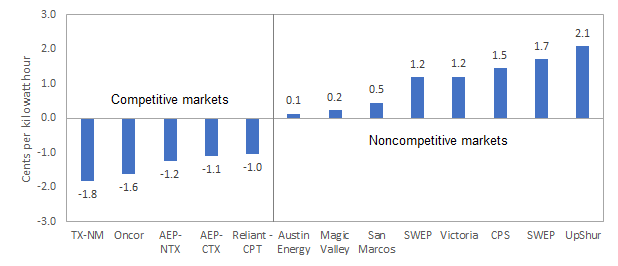
What has happened to retail market prices since that time? Economists Peter Hartley, Kenneth Medlock, and Olivera Jankovska address this question in a 2019 article in the journal Energy Economics. They study electricity prices in Texas from 2002 through 2016. The authors find that prices in competitive markets declined over the period and became more closely related to the costs of production, while prices in noncompetitive markets did not.

Figure 1 shows the changes in average electricity prices in the thirteen Texas regions from 2002 to 2016. Since deregulation began, average prices have fallen in every competitive market. They have increased in every noncompetitive market.

Figure 1: Changes in average electricity prices, 2002-2016

Source: Harley, Medlock, and Jankovska (2019, p.7, table 1)

This pattern can be seen in the data used by McGinty and Patterson. From 2004 through 2019, their charts show that average prices in competitive markets were higher than those of traditional utilities but that the difference has declined over time. The premium peaked in 2006 and fell through 2017, although the gap has widened since.

McGinty and Patterson cite this premium as evidence that competition has caused higher prices. However, it actually shows the opposite. It shows that the regions that later became competitive markets had high historical prices back in 2004, before competition was fully allowed.

What caused prices to be higher in those regions? For starters, they may have higher costs of production. One example is the regional difference in employee wages. Another is the wholesale price of electricity, the price at which a power company can buy electricity rather than producing itself. The increase in competitive retail prices from 2002 to the peak in 2006 appears to be strongly related to the increase in wholesale prices over the same period.

Using econometric analysis, Hartley, Medlock, and Jankovska control for cost-related factors such as regional wages and wholesale prices. They find that these factors are important determinants of electricity prices in competitive markets but not in noncompetitive markets. This evidence is consistent with the theory that high prices in 2004 were caused by production costs and were not related to deregulation.

Accounting for these factors, the authors find statistically significant decreases in electricity prices in all five competitive markets after 2007. In noncompetitive regions, prices decreased in only one of the eight, were not statistically affected in four regions, and increased in three regions. The evidence shows that deregulation has reduced prices in competitive markets, while prices in noncompetitive markets are mostly the same or higher.

Focusing on residential prices, McGinty and Patterson also claim that over the period from 2004 through 2019, average competitive prices in Texas were higher than the national average. Again, this statistic is misleading due to the long time period, which includes years before competition became effective, and ignores the decline in prices over time. Yes, competitive residential prices in Texas were above the national average in the early 2000s. But they have now been below the national average for more than a decade.

In addition, McGinty and Patterson ignore commercial prices, which, like residential prices, have declined due to deregulation. Commercial electricity prices in Texas have been lower in competitive than noncompetitive markets since 2010 and below the national average since 2009.

Contrary to McGinty and Patterson, a close look at the evidence reveals that deregulation and competition have, in fact, reduced electricity prices in Texas. Prices in competitive markets have fallen, while those of noncompetitive utilities have increased. Competition has brought both residential and commercial prices down below the national averages."

Monday, March 1, 2021

In wake of storm, high natural gas prices, CPS likely to slow shift to renewable power

By Diego Mendoza-Moyers of the San Antonio Express-News. Excerpts:

"CPS Energy’s top executive said Friday that the utility may have to slow its shift to clean energy — and maybe build another natural gas-fired power plant — because of the financial blow it took from last week’s deep freeze.

“Faster de-carbonization, utilizing technology — those sound great,” CEO Paula Gold-Williams said. However, referring to the cost of relying on more green power sources, she added: “They were already going to be hard before we had this weather event.”

Early last week, temperatures that dipped into the single digits knocked CPS’ coal and nuclear plants and renewable energy sources out of commission. The utility had to hunt for scarce, suddenly expensive natural gas on the spot market to keep generating electricity.

CPS officials said they’re still calculating the cost. But it’s likely to be exorbitant.

And ratepayers may have to pay the full bill. If they do, Gold-Williams said, CPS would have little choice but to slow the rollout of the FlexPower Bundle, its planned clean energy initiative. One of the utility’s goals is to shut down CPS’ coal-fired Spruce generation units ahead of schedule and replace them with renewables.

If CPS customers shoulder the hefty cost of last week’s gas purchases, telling them “to get ready for, potentially, rate increases to retire units early, I think, is going to be challenging,” Gold-Williams said.

In addition to the Spruce plant, CPS is looking to decommission several aging natural gas plants. To replace the electricity they generate, the FlexPower plan calls for building 900 megawatts of solar power, 50 megawatts of battery storage and 500 megawatts of “firming capacity,” or power available whenever demand is high.

The utility has been evaluating bidders’ project proposals since Feb. 1 but hasn’t released a cost estimate for the initiative.

CPS has said the 500 megawatts of power could come from new energy storage technologies.

But after last week’s power grid debacle, which left millions of Texans without electricity for long periods, Gold-Williams said CPS’ five-member board of trustees would be hesitant to make big investments in unproven technologies.

Trustees, she said, “are going to ask us are we sure, when we make these decisions, that we’re also protecting reliability and affordability.”

Instead of putting money into experimental energy storage methods or other cutting-edge technologies, the utility may invest in a new natural gas power plant, though a smaller one than its existing gas plants."

"Before the winter blast, CPS said closing several of its fossil fuel-fired plants early and adopting more renewable power could cost ratepayers as much as an extra $12 on their monthly bills on average over the next 15 years."