"Bryan Caplan recently gave Charles Karelis an opportunity to offer some thoughts on poverty. Karelis had this to say about a Universal Basic Income program:
UBI has negatives too. It would be way, way more expensive, pushing US tax rates into the middle of the EU pack. There would be no positive substitution effect, since it’s not work-contingent. The pros are that it would eliminate the class antagonism inherent in EITC, since everybody would get it. What’s more it would be easy to administer and receive. Above all, it would eliminate poverty, which is a miserable condition and an embarrassment to a rich country like ours. And as a cash program, it would get government out of the business of telling people what their spending priorities should be. People could spend their money on health care, or education, or leisure, or whatever they themselves thought was most valuable.I agree with much of that, but not the part about eliminating poverty. If I thought a UBI would eliminate poverty, then I’d support the program. Instead, I favor low wage subsidies.
There are at least three ways of thinking about poverty, and in each case a UBI program would fall short.
1. Perceptions of consumption: Poor people might be defined as those who seem to have very low levels of consumption. Even with a UBI, there would be plenty of people who make poor (or unusual) choices and thus end up with a consumption bundle that looks inadequate. Some would end up homeless, for instance.
2. Relative poverty: Some argue that the poverty line is a moving target, and as we become richer we redefine poverty to include real incomes that were formerly viewed as adequate. A UBI will not eliminate relative poverty because the concept will simply be redefined in the public’s mind to reflect UBI incomes. Think about how the term “minimum wage job” implies a lousy job, regardless of where the minimum wage is set.
3. Absolute poverty: A UBI will require European-style tax rates, as Karelis correctly points out. I’d expect these to eventually lead to European levels of GDP/person. (Not right away.) Thus America’s GDP/person will fall by roughly 25%. When that occurs, the UBI payments will have to be scaled back to levels that are lower than anticipated, and absolute poverty will reappear.
This doesn’t mean the UBI is a bad idea, but we should not expect it to eliminate poverty."
Wednesday, September 4, 2019
A UBI will not eliminate poverty
By Scott Sumner.

Tuesday, September 3, 2019
Forget The Amazon Hype, Fires Globally Have Declined 25% Since 2003 Thanks To Economic Growth
By Michael Shellenberger.
"The whole world is burning, The New York Times, CNN, and mainstream media outlets around the world have declared in recent days.The Amazon could soon "self-destruct" reports The Times. It would be "a nightmare scenario that could see much of the world’s largest rainforest erased from the earth," writes Max Fisher who notes, "some scientists who study the Amazon ecosystem call it imminent."
“If enough [Amazon] rain forest is lost and can’t be restored, the area will become savanna, which doesn’t store as much carbon, meaning a reduction in the planet’s ‘lung capacity,’” reports The New York Times.
It's not just the Amazon, though. Africa, Siberia, and Indonesia are also apparently going up in smoke. Claims The New York Times, "in central Africa, vast stretches of savanna are going up in flame. Arctic regions in Siberia are burning at a historic pace."
Any reader of the New York Times and other mainstream media outlet would be forgiven for believing that fires globally are on the rise, but they aren't.
In reality, there was a whopping 25 percent decrease in the area burned from 2003 to 2019, according to NASA.
Between 2003 and 2015, the area burned in Africa declined by an area the size of Texas (700,000 square kilometers or 270,000 square miles.
And against the picture painted by celebrities and the mainstream media that fires around the world are caused by economic growth, the truth is the opposite: the amount of land being burned is declining thanks to development, including urbanization.
That's because the amount of land being converted into ranches and farms has been going down, not up, and because more of it is being done with machines than with fire.
For the last 35 years, the world has been re-foresting, meaning new tree growth has exceeded deforestation. The area of the Earth covered with forest has increased by an area the size of Texas and Alaska combined.
Less land is being converted into agriculture globally in part because farmers are growing more food on less land.
Much of the re-forestation is occurring in deserts and tundra that had been barren, thanks to human-led reforestation initiatives, such as in China and Africa, and because of global warming. Warmer temperatures are what have allowed forests to grow in tundra.
Mainstream journalists botched this story. They should have known about the decline in burning since scientists published a major study in Science in 2015.
NASA promoted the Science article and wrote an update confirming a continuation of the decline in fires on August 20, 2019.
And yet mainstream journalists have continued to push the apocalyptic framing in their coverage of fires in Amazon and Africa and attempted to link them to climate change.
Consider how The New York Times misrepresented global fires earlier this week. "Their increase in severity and spread to places where fires were rarely previously seen is raising fears that climate change is exacerbating the danger," wrote Kendra Pierre-Louis.
But this is wrong. In truth, the climate-fire nexus brings good news: the decline in area burned has offset much of the risk of increased fire from global warming, according to Doug Morton, co-author of the 2015 Science study and a forest scientist at NASA's Goddard Institute.
“When land use intensifies on savannas, fire is used less and less as a tool,” said Niels Andela of NASA’s Goddard Space Flight Center. “As soon as people invest in houses, crops, and livestock, they don’t want these fires close by anymore. The way of doing agriculture changes, the practices change, and fire disappears from the grassland landscape.”
“Climate change has increased fire risk in many regions, but satellite burned area data show that human activity has effectively counterbalanced that climate risk, especially across the global tropics,” Morton said. “We’ve seen a substantial global decline over the satellite record, and the loss of fire has some really important implications for the Earth system.”
"Regions with less fire saw a decrease in carbon monoxide emissions and an improvement in air quality during fire season," notes NASA. "With less fire, savanna vegetation is increasing—taking up more carbon dioxide from the atmosphere."
But you wouldn't know it from the apocalyptic pronouncements of the New York Times, CNN, Leonardo DiCaprio, Rep., Alexandria Ocasio-Cortez, Madonna, Senator Bernie Sanders, French President Emmanuel Macron, Senator Kamala Harris who still spread and have not deleted their wrong photos and information they have spread about the Amazon.
The New York Times' Kendra Pierre-Louis even repeats the "lungs of the world" myth in her August 28 story.
Celebrities and the mainstream news media have advanced an apocalyptic narrative of fires in places like the Amazon as violent intrusions on nature. This picture is false.
“Fire had been instrumental for millennia in maintaining healthy savannas, keeping shrubs and trees at bay and eliminating dead vegetation,” says the senior author of a major Science paper about the decline of fires, Jim Randerson of the University of California, Irvine.
In truth, the decline in burning raises new challenges. “For fire-dependent ecosystems like savannas,” Morton said, “the challenge is to balance the need for frequent burning to maintain habitat for large mammals and to maintain biodiversity while protecting people’s property, air quality, and agriculture.”
As for the myth that the Amazon is the "lungs of the Earth" providing "20% of the world's oxygen," it appears to have been invented by a Malthusian Cornell University scientist in 1966, according to the George Mason University environmental philosopher, Mark Sagoff.
"In the 1960s, when 'lungs of the earth' was the big reason to save the rain forest," Sagoff told me yesterday, "I got interested in it as a scientific question. I found no evidence that any tropical rainforest contributes to the net oxygen budget of the world."
Sagoff sent me a 1966 an article by Cornell University scientist LaMont C. Cole in the journal BioScience. In it, Cole claimed that, as a result of burning fossil fuels, "the oxygen content of the atmosphere must start to decrease. I wish I could estimate how near we are to that frightening compensation point..."
In 1970, climatologist Wallace S. Broecker explained why there was nothing to be frightened in an article in Science in June 1970. By 2000, he explained, burning fossil fuels would deplete just 0.2% of the Earth's oxygen.
"In almost all grocery lists of man's environmental problems is found an item regarding oxygen supply," wrote Broeker. "Fortunately for mankind, the supply is not vanishing as some have predicted."
Broeker wrote his article because the mainstream media had been spreading Cole's myth. "Hopefully the popular press will bury the bogeyman it created,” Broecker said.
Sadly, it didn't. Little wonder that public trust in the news media has been declining for many years and most Americans today say they do not trust it.
The good news for the news media is that 69% of the public say that trust can be restored. A good start would be for CNN, The New York Times, and other media outlets to correct their inaccurate coverage, and start covering the Amazon and fires issue fairly and accurately."
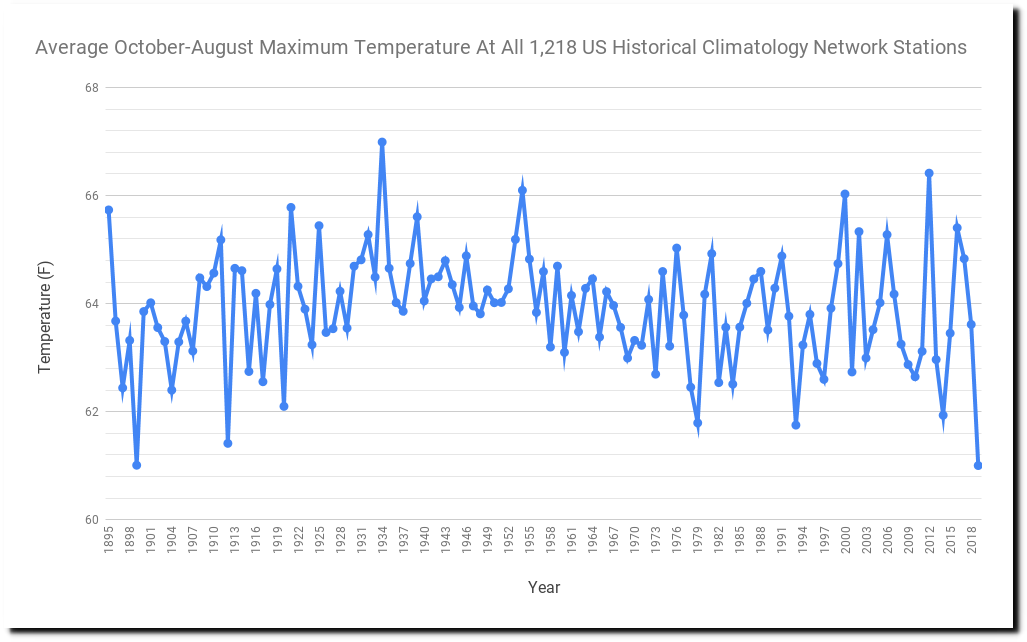
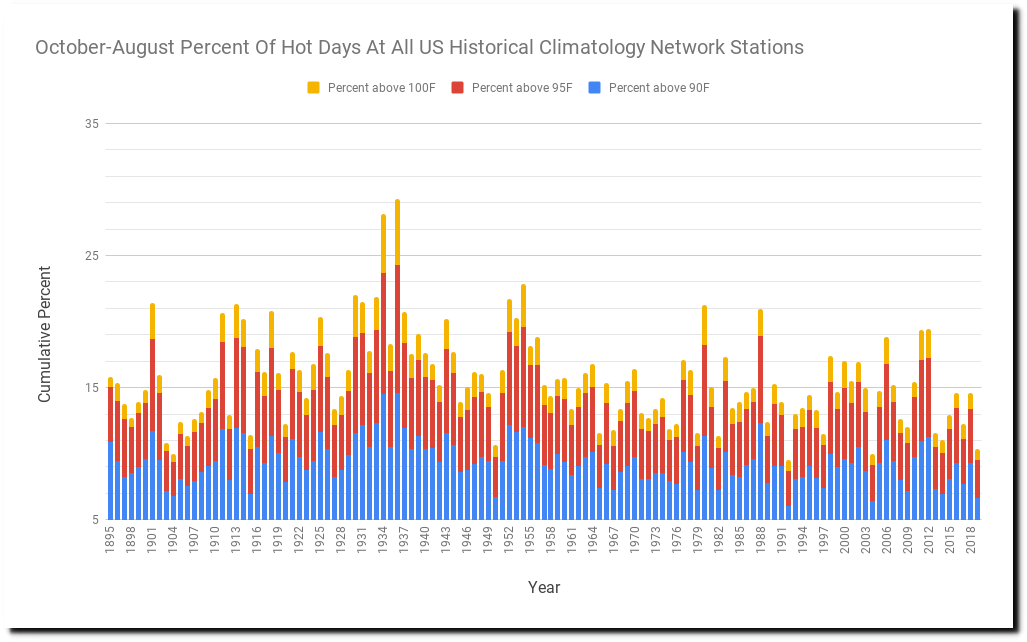
Coolest January-August On Record In The US
From
Real Climate Science.

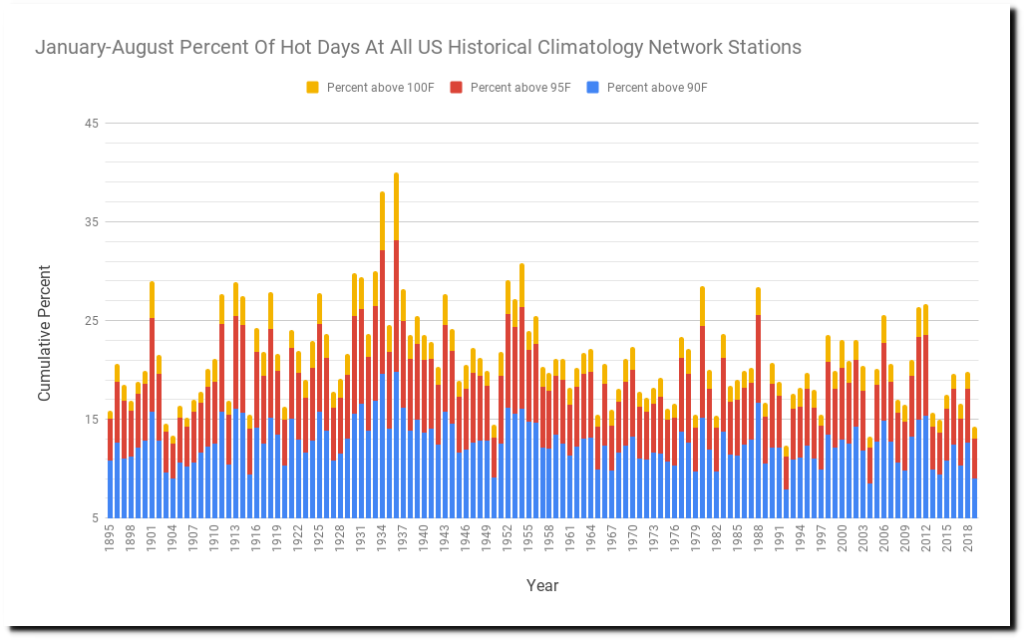
Sixty percent of the US has had below normal temperatures in 2019
 It also has been the coolest and wettest water year (October-August) on record in the US.
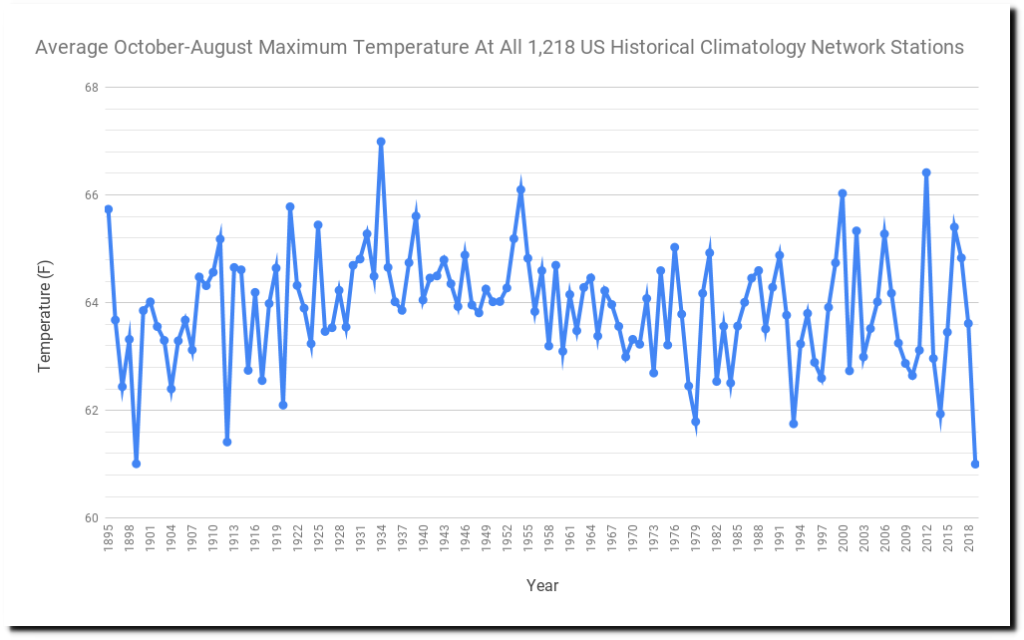
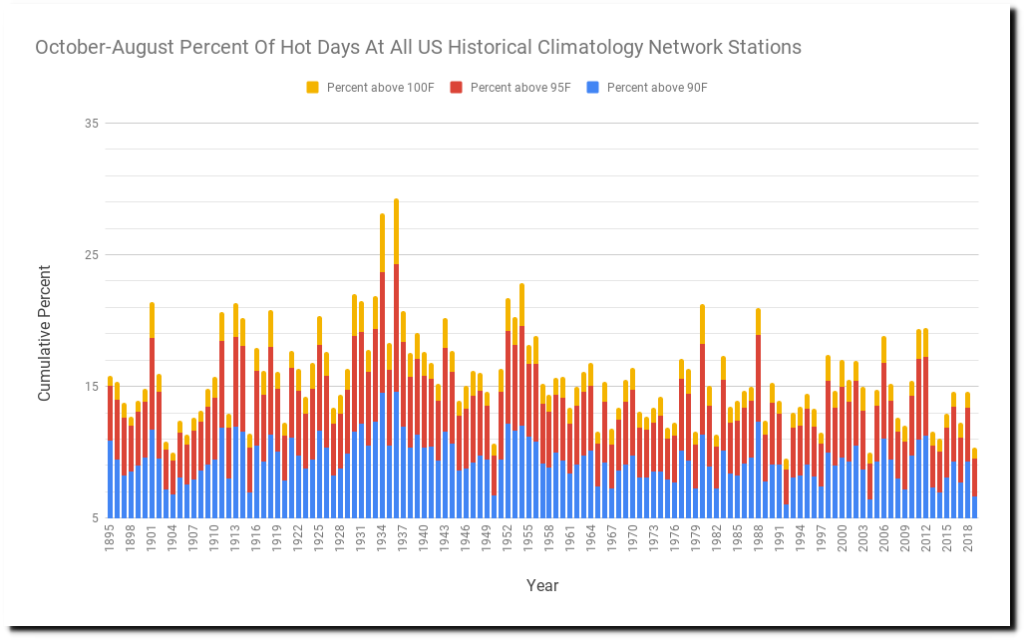
 The press is blaming Dorian on global warming, with the US coolest on record.
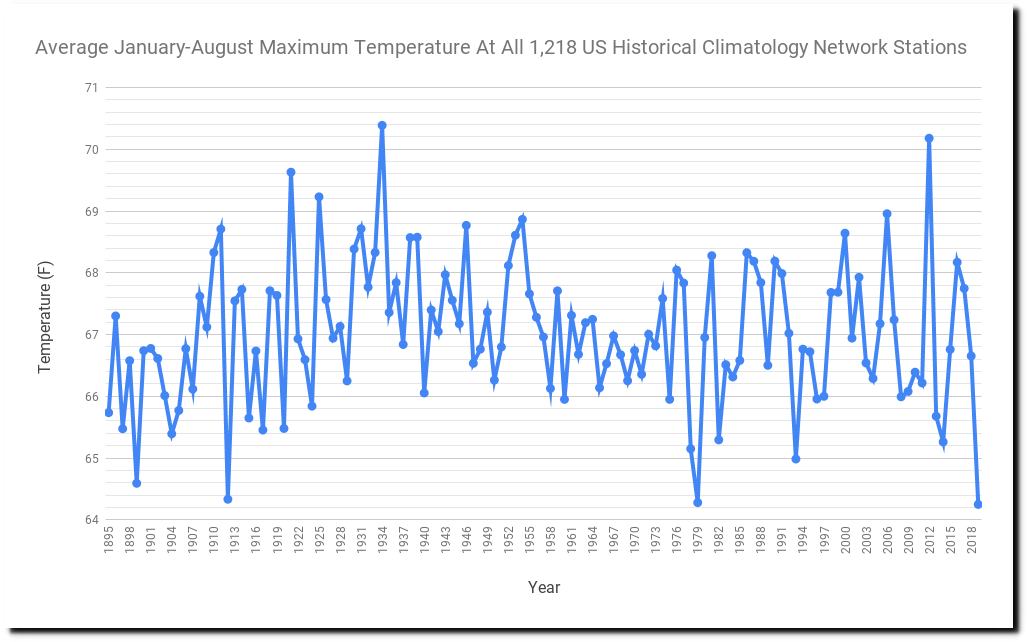

Sixty percent of the US has had below normal temperatures in 2019


Monday, September 2, 2019
Stakeholders, CEOs and the role of corporations
See The ‘Stakeholder’ CEOs: Executives who abandon shareholders won’t appease the socialists. WS editorial. Excerpt:
Milton Friedman on CEOs: The late, great economist anticipated the Business Roundtable. WSJ editorial:
See Milton Friedman on Corporate Responsibility: ‘Businessmen seem to me to reveal a suicidal impulse.’ From The WSJ.
See CEOs for President Warren: The Business Roundtable throws shareholders under the bus, even if just for show. Excerpt:
See C.E.O. Pledge of Social Responsibility. Letters to the NY Times:
"Politics aside, the moral and practical superiority of the stakeholder model is hardly clear. CEOs are themselves employees hired by directors who are supposed to be stewards of the capital that shareholders have invested. One virtue of the shareholder model is that it focuses the corporate mission on measurable financial results.
An ill-defined stakeholder model can quickly become a license for CEOs to waste capital on projects that might make them local or political heroes but ill-serve those same stakeholders if the business falters. Students of corporate governance have devoted years to analyzing the “agency problem” of holding CEOs accountable to the business owners. So-called activist investors who challenge underperforming managers are one market response.
Consider the long, slow decline of General Electric , which for decades helped mom-and-pop shareholders provide for their retirement. Former CEO Jeffrey Immelt was the model of the stakeholder executive, posing in Vanity Fair as a spokesman against climate change, issuing pronouncements after the 2008 panic about the failures of capitalism.
Yet Mr. Immelt failed in his core duty to find a post-panic business model that enhanced profits and shareholder value. That failure served neither customers, employees, suppliers, communities nor shareholders. From a moral point of view, GE did far more social and economic good when it was wildly profitable and its shareholder retirees could sleep better at night confident in its dividend."
Milton Friedman on CEOs: The late, great economist anticipated the Business Roundtable. WSJ editorial:
"The mucky-mucks of the Business Roundtable are tweeting in unison how “proud” they are to have abandoned the corporate purpose of serving shareholders for the more politically au courant “stakeholder” model. We wrote about it Tuesday, and the CEOs no doubt enjoyed their smooch from Fortune magazine more than they did our editorial.
The media cheerleaders seem especially pleased that the CEOs have thrown the late, great economist Milton Friedman over the side. So we thought we’d reprint nearby excerpts from Friedman’s 1970 essay, “The Social Responsibility of Business is to Increase its Profits,” from the New York Times magazine.
The entire essay is worth reading, but two points from the excerpts are worth stressing for the CEOs who almost surely never read it. The first is that Friedman never said a business should ignore the “basic rules of the society, both those embodied in law and those embodied in ethical custom.”
The attempt to smear Friedman’s counsel as amoral is false. His point was that profitable businesses serve the common good better than executives who spend money on “social responsibility” but preside over business failure.
The second point is Friedman’s warning that CEOs who put social responsibility above shareholders will find it redounds to their detriment. They feed the public belief that free markets and business are “wicked and immoral” and must be curbed by “external forces,” which typically means politicians.
Once those forces are unleashed, the arbiters will not be the “social consciences” of “pontificating executives.” The controlling power will be wielded by the iron fist of government. Nearly 50 years ago, Friedman anticipated the CEOs of the Business Roundtable."
See Milton Friedman on Corporate Responsibility: ‘Businessmen seem to me to reveal a suicidal impulse.’ From The WSJ.
"In a free-enterprise, private-property system, a corporate executive is an employee of the owners of the business. He has direct responsibility to his employers. That responsibility is to conduct the business in accordance with their desires, which generally will be to make as much money as possible while conforming to their basic rules of the society, both those embodied in law and those embodied in ethical custom. . . .
Whether blameworthy or not, the use of the cloak of social responsibility, and the nonsense spoken in its name by influential and prestigious businessmen, does clearly harm the foundations of a free society. I have been impressed time and again by the schizophrenic character of many businessmen.
They are capable of being extremely far-sighted and clear-headed in matters that are internal to their businesses. They are incredibly short-sighted and muddle-headed in matters that are outside their businesses but affect the possible survival of business in general. This short-sightedness is strikingly exemplified in the calls from many businessmen for wage and price guidelines or controls or income policies. There is nothing that could do more in a brief period to destroy a market system and replace it by a centrally controlled system than effective governmental control of prices and wages.
The short-sightedness is also exemplified in speeches by businessmen on social responsibility. This may gain them kudos in the short run. But it helps to strengthen the already too prevalent view that the pursuit of profits is wicked and immoral and must be curbed and controlled by external forces. Once this view is adopted, the external forces that curb the market will not be the social consciences, however highly developed, of the pontificating executives; it will be the iron fist of Government bureaucrats. Here, as with price and wage controls, businessmen seem to me to reveal a suicidal impulse."
See CEOs for President Warren: The Business Roundtable throws shareholders under the bus, even if just for show. Excerpt:
"introduction of the word “stakeholders” on the way to delivering these bromides is what set the media aflame this week. By whomping up the significance of this rhetorical innovation, we are invited to hurry past an obvious question: How can shareholder wealth ever be created except by satisfying stakeholders, who include customers, workers, suppliers and the communities that create the legal environment in which firms operate?
All of the above participate voluntarily. Apple , one of the signers, has never put a gun to your head and marched you down to the Apple store to buy its products. It doesn’t dragoon the best college graduates against their will to work for high pay and generous benefits in a building by Norman Foster.
Widely cited is the 1970 article by the late Milton Friedman, arguing that a public company’s purpose is to increase its profits legally and nothing else. Supposedly his wisdom is now obsolete. But his most important words, in the same article, may be a conditional statement questioning whether any corporate sloganeering to the contrary should ever be taken “seriously.”
After all, CEOs will still be hired by boards who are elected by shareholders; they will still be rewarded under contracts that pay them for producing sustainable increases in the stock price (that’s what those vesting requirements are for). Before this week’s statement, CEOs boasted freely about their employee-happiness ratings, their sustainability programs, their diversity efforts, as if these were perfectly consistent with shareholder wealth-maximization duties. What changed?
The press, in trying to make sense of nonsense, reliably takes refuge in the fallacy of conflating shareholder wealth maximization with short-run profit maximization.
These are completely different things. Any company can boost immediate profits by cutting customer service, advertising, product development, etc. But its share price would go down, not up.
Companies maximize shareholder wealth by optimizing (not minimizing, not maximizing) other values like customer happiness and worker satisfaction. If there’s a better way, let’s hear it. Maybe companies should be required to maximize shareholder wealth, minus 25%. How is this to be implemented? And why should America’s 3,600 public corporations bear special burdens in this regard? These companies account for less than one-third of the nation’s private-sector workforce and a tiny proportion of its 5.6 million employer firms."
See C.E.O. Pledge of Social Responsibility. Letters to the NY Times:
"The muddled and misguided concept of corporate social responsibility took one step forward and one step back with the Business Roundtable’s revised “Statement of a Purpose of a Corporation.”Proponents of corporate social responsibility like Mr. Sorkin celebrated the death of “shareholder primacy.” Meanwhile, across a growing ideological divide, defenders of capitalism warned of an impending slide toward socialism.The truth — and our country’s economic future — likely rests somewhere in the middle: Maximizing shareholder value over the long haul is socially responsible when corporations are forced to compete for customers and employees.The idea that shareholders’ caring about their returns means that they don’t care about customers or employees is nonsense. Shareholder returns depend on little else! The available evidence shows that customer satisfaction and shareholder returns go hand in hand. Similarly, unprofitable companies that close leave employees unpaid and unemployed. Profitable companies, on the other hand, make payroll.As the Nobel Prize-winning economist Milton Friedman warned way back in 1970, seemingly innocuous speeches by businessmen on social responsibility “may gain them kudos in the short run. But it helps to strengthen the already too prevalent view that the pursuit of profits is wicked and immoral and must be curbed and controlled by external forces.”When corporations have to compete for customers and employees in the market, the line between shareholder and stakeholder interests blurs, and wonderfully so.Reed Watson
Clemson, S.C.
The writer is an economics professor and director of Clemson University’s Hayek Center for the Business of Prosperity.""Your coverage of a recent C.E.O. focus on constituencies other than shareholders ignores one critical group: bondholders. As a member of this group, I am often frustrated by management teams (compensated by stock options) and shareholder activists who agitate for debt-financed share buybacks.Bondholder activism looks a lot like what other stakeholders — employees, customers, vendors — might request if they had a seat at the table: a healthy balance sheet, prudent capital spending (neither profligate nor stingy), disciplined mergers and acquisitions, and a measured approach to borrowing. Bondholders hate surprises (say, a customer boycott of a retailer who sells assault weapons) even more than shareholders do.For the long-term viability of the corporations they run and the benefit of all their stakeholders, I would encourage Jamie Dimon, the chief executive of JPMorgan Chase, and the others to ask themselves: “What would our bondholders want?” It’s called a “balance” sheet for a reason, even if shareholders have managed to tip the scales in their favor.Ellen Carr
Asheville, N.C.
The writer is a high yield bond portfolio manager."
More on David Koch
See Billionaire David Koch, Who Used His Wealth to Reshape U.S. Politics, Dies at 79 by Melanie Grayce West and John McCormick of The WSJ. Excerpts:
See Don’t Hate Koch Because He Was Generous by Chandra Bozelko. She is is vice president of the National Society of Newspaper Columnists and author of the blog Prison Diaries. Excerpts:
See David Koch’s Righteous Profits by William McGurn of The WSJ.
"he was a liberal on social issues such as abortion and same-sex marriage"
"The Kochs, though, have been critical of Mr. Trump’s policies on trade and immigration."
"He donated more than $1.3 billion of his fortune to charity, including gifts to the State Theater of New York at Lincoln Center—renamed the David H. Koch Theater—New York-Presbyterian Hospital and the Metropolitan Museum of Art, all in Manhattan."
See Don’t Hate Koch Because He Was Generous by Chandra Bozelko. She is is vice president of the National Society of Newspaper Columnists and author of the blog Prison Diaries. Excerpts:
"David Koch is dead. Long live cooperation across ideological lines.
When Koch Industries invited me to the 2015 Bipartisan Summit on Criminal Justice Reform in March 2015, I was a year out of prison and working for a liberal organization. Koch’s interest in criminal justice, like mine, developed from personal experience with the criminal legal machine. A grand jury indicted one of his companies, which owned a Texas refinery, on 97 felony environmental violations. It took six years and millions of dollars to defend. David Koch and his brother Charles wondered how people without their resources could handle the government coming at them with all its weight.
By giving money to reform organizations, the Kochs made it easier for conservative politicians to support the movement, enabling many of the legislative changes we see today at both the federal and state levels—including the federal First Step Act of 2018 and Florida’s Amendment 4, a ballot initiative to restore voting rights for felons. Cash bail reform received an infusion of funds from Koch Industries last year.
But David’s greatest contribution was to disprove the notion that people can’t work together without agreeing on everything.
This pernicious view was put forth by Washington Post critic Phillip Kennicott in a 2017 article. He called on arts groups to refuse contributions from the Kochs because their “campaign to discredit climate science” is a “threat to our planet.” Other activists and organizers convinced themselves that because the brothers opposed many government programs on philosophical grounds, their grants were clandestine ways to undermine public programs—forgetting that dissent is a two-way street and the Koch charities had to put aside any differences in opinion to make the gifts in the first place.
But insisting on homogeneity of thought is a surefire way to arrest progress. Think of what gains would be lost if health-care providers, charities and advocacy groups—including New York-Presbyterian Hospital, the Thurgood Marshall Scholarship Fund, Lincoln Center, the National Association of Defense Attorneys—boycotted the Koch brothers and their donations."
See David Koch’s Righteous Profits by William McGurn of The WSJ.
"In the denunciations that have appeared since his death, David Koch has been caricatured as an executive for a company that fought anything that might affect its profits. The truth is more complicated.
Begin with climate. David’s brother Charles, the company’s CEO and chairman, has acknowledged that the Earth has been warming for a century, that there has been a corresponding rise in CO2, and that man-made forces have contributed to this rise.
The Kochs’ offense has been to insist that those proposing “solutions” demonstrate they can deliver what they promise, whether it be “green jobs” or significant reductions in emissions. Solutions also mustn’t be self-defeating, such as U.S. tax incentives that would send, say, the manufacture of chemicals and fertilizer to China, where the use of coal in production would mean higher CO2 emissions. Above all, solutions should include an honest accounting that is upfront about the real costs, and weighs them against expected benefits."
"ven Joe Biden, the Democrat supposedly representing the moderate view, makes clear there will be no place for fossil fuels in a Biden administration. Which highlights a curious dichotomy: While fossil-fuel execs such as David Koch are assailed as moral monsters, no one raises any moral questions about a Green New Deal that cannot be implemented in any of its iterations without significantly reducing the standard of living for millions of Americans."
Sunday, September 1, 2019
Entrepreneurship allows women to avoid sexism in South Korea
See Blocked in Business, South Korean Women Start Their Own: Glass ceilings in a conservative country’s biggest companies have motivated a new generation of female entrepreneurs by Michael Schuman of The NY Times. Excerpts:
"At first glance, Energy Nomad appears to be a typical South Korean company: Just about everybody who works there is male.
Crusty engineers, mostly in their 40s and dressed in matching dark jackets and black pants, hover over its production lines in a factory outside Seoul, or work at nearby desks. The sole exception is one young women, who deferentially bows her head as a senior manager directs her into a meeting room.But at this start-up, looks can be deceiving. The lone woman, Park Hye-rin, is the boss. She founded Energy Nomad in 2014.“I may be able to encourage the next generation of women” said Ms. Park, 33. “More young women might join me in this community of the future.”Ms. Park is one of a new wave of Korean women who are starting their own companies. Frustrated in their climb up the corporate ladder in a male-dominated business culture, they choose to find another way up.“In education we are equal to men, but after we enter into the traditional companies, they underestimate and undervalue women,” said Park Hee-eun, principal at the venture-capital firm Altos Ventures in Seoul. “Women are disappointed with the working culture, so they want to make their own companies.”In 2018, more than 12 percent of working-age women in South Korea were involved in starting or managing new companies — those less than three and a half years old — a sharp increase from 5 percent just two years earlier, according to Global Entrepreneurship Monitor. In Japan, where women face similar biases, only 4 percent are starting companies.Similarly, a Mastercard report on 57 global economies last year said that South Korea showed the most progress in advancing female entrepreneurs, and that more women than men had become engaged in start-ups. Government statistics also show that a rising percentage of new companies, about a quarter, were started by women last year.The trend could reshape a corporate world where discrimination against women is deeply entrenched. South Korea has been a marvel of economic progress over the past 50 years, transforming from one of the world’s poorest countries into an industrial powerhouse famous for its microchips and smartphones. But notions of women’s role in society have changed slowly, often trapping them in poorly paid jobs with little chance of advancement.Only about 10 percent of managerial positions in South Korea are held by women, the lowest among the countries studied by the Organization for Economic Cooperation and Development, while the gap in pay between men and women is the widest.These biases infect the start-up sector, too. Building a new enterprise is a risky endeavor in any circumstances, but South Korean women often are not taken seriously by male bankers, executives or even employees.“You have to put extra effort into being a female entrepreneur,” said Kim Min-kyung, founder of a personalized lingerie company, Luxbelle.Ms. Kim, 35, was undeterred. By the usual standards of success in South Korea, she had already made it big, landing jobs at affiliates of the Samsung business group, among the most coveted positions in the country.But she felt unappreciated within Samsung’s bureaucracy. Though Ms. Kim never faced overt discrimination there, she said, she also knew she would eventually smack into a very low glass ceiling.“I thought I would not have a future as a woman at a more traditional company,” Ms. Kim said. “I thought I would not get a top position, so I had to go out and start my own business, sooner rather than later.”A start-up, she added, “is my company, and I can do whatever I want.”"
Opportunity zone initiative rewards the wealthy for projects they would have done anyway and not the poor it was supposed to help
See How a Trump Tax Break to Help Poor Communities Became a Windfall for the Rich by Jesse Drucker and Eric Lipton of The NY Times. Excerpts:
"President Trump has portrayed America’s cities as wastelands, ravaged by crime and homelessness, infested by rats.
But the Trump administration’s signature plan to lift them — a multibillion-dollar tax break that is supposed to help low-income areas — has fueled a wave of developments financed by and built for the wealthiest Americans.Among the early beneficiaries of the tax incentive are billionaire financiers like Leon Cooperman and business magnates like Sidney Kohl — and Mr. Trump’s family members and advisers.""The initiative allows people to sell stocks or other investments and delay capital gains taxes for years — as long as they plow the proceeds into projects in federally certified opportunity zones. Any profits from those projects can avoid federal taxes altogether.""Instead, billions of untaxed investment profits are beginning to pour into high-end apartment buildings and hotels, storage facilities that employ only a handful of workers, and student housing in bustling college towns, among other projects.""Many of the projects that will enjoy special tax status were underway long before the opportunity-zone provision was enacted.""Mr. Scaramucci’s development in New Orleans offers a portrait of how the tax break works. His investment company, SkyBridge Capital, is using the so-called opportunity zone initiative to help build a hotel, outfitted with an opulent restaurant and a rooftop pool, in the city’s trendy Warehouse District.The tax benefit also is helping finance the construction of a 46-story, glass-wrapped apartment tower — amenities include a yoga lawn and a pool surrounded by cabanas and daybeds — in a Houston neighborhood already brimming with new projects aimed at the wealthy.""But leaders of groups that work in cities and rural areas to combat poverty say they are disappointed with how it is playing out so far.“Capital is going to flow to the lowest-risk, highest-return environment,” said Aaron T. Seybert, the social investment officer at the Kresge Foundation, a community-development group in Troy, Mich., that supported the opportunity-zone effort.“Perhaps 95 percent of this is doing no good for people we care about.”""The opportunity zones, focused on low-income census tracts, were drawn by officials in each state, as well as in Washington, D.C., and Puerto Rico. Last year, the Treasury Department approved roughly 8,800 such zones. (The White House and Treasury declined to make senior officials available to discuss the program.)Nearly a third of the 31 million people who live in the zones are considered poor — almost double the national poverty rate. Yet there are plenty of affluent areas inside those poor census tracts. And, as investors would soon realize, some of the zones were not low income at all.""But even supporters of the initiative agree that the bulk of the opportunity-zone money is going to places that do not need the help, while many poorer communities are so far empty-handed.
Some opportunity zones that were classified as low income based on census data from several years ago have since gentrified. Others that remain poor over all have large numbers of wealthy households.And nearly 200 of the 8,800 federally designated opportunity zones are adjacent to poor areas but are not themselves considered low income.""Less than two miles away is the poorest opportunity zone in Louisiana — and one of the poorest nationwide. The zone includes the Hoffman Triangle neighborhood, where the average household earns less than $15,000 per year. Block after block, streets are lined with dilapidated, narrow homes, many of them boarded up. On a recent afternoon, one of them was serving as a work site for prostitutes.City officials, including the head of economic development for New Orleans, said they were not aware of any opportunity-zone projects in this neighborhood.""Similar scenes are playing out in opportunity zones across the United States: The federal government is subsidizing luxury developments — often within walking distance of economically distressed communities — that were in the works before Mr. Trump was even elected president."
Subscribe to:
Posts (Atom)