Evaluating the free market by comparing it to the alternatives (We don't need more regulations, We don't need more price controls, No Socialism in the courtroom, Hey, White House, leave us all alone)
"Ditch red meat, take a brisk walk to the grocery store, do the Sunday
crossword and stick to one glass of wine at dinner."
"combining five
lifestyle habits - including eating healthier, exercising regularly and
refraining from smoking - can reduce the risk of Alzheimer's by 60
percent. A separate study showed that lifestyle choices can lower risk
even for those who are genetically prelifestyle disposed to the disease."
"Over the last decade, studies have increasingly pointed to
controllable lifestyle factors as critical compenents to reducing the
risk of cognitive decline."
"the new study's authors . . . were
floored by the "magnitude of the effect," said Klodian Dhana, a Rush
University professor and co-author.
"This demonstrates the potential of lifestyle behaviors
to reduce risk as we age," said Heather Snyder, senior director of
medical and scientific operations at the Alzheimer's Association."
Individuals who ate a "high-quality diet" of mostly
vegetables, nuts, berries, beans, whole grains, seafood, poultry and
olive oil - while avoiding red meats, butter, cheese, pastries, sweets
and fried food - earned 1s. This was also true for anyone who exercised
at least 150 minutes a week, whether by biking, walking, swimming,
gardening or doing yard work.
People who did not smoke, limited themselves to one glass of wine a
day, and regularly - two or three times a week - engaged in mentally
stimulating activities like reading the newspaper, visiting the library
or playing games such as chess and checkers also earned 1s."
"individuals with a score of 4 or 5 - meaning they pursued
four or five healthy behaviors over the period studied - were 60 percent
less likely to develop Alzheimer's compared to participants who scored 0
or 1. The results did not vary by race or gender"
"The average age of participants in the CHAP cohort was 73
and in the MAP cohort, 81. The population studied included both men and
women and blacks and non-Hispanic whites."
"making just one more healthy choice,
no matter how many participants had already made, decreased their
chance of Alzheimer's by an additional 27 percent."
"Another study also presented Sunday
found that lifestyle choices may even counteract genetic predisposition
for Alzheimer's."
"people with a high genetic risk of
Alzheimer's were less likely to develop the disease if they pursued a
healthy lifestyle."
"Cuba has a very sad history. It traded a regular dictatorship for a
communist dictatorship six decades ago, and the results have been predictably awful.
Oppression, persecution, rationing, spying, deprivation, and suffering are facts of life.
For a while, it was subsidized by the Soviet Union, but that communist system eventually collapsed. More recently, it’s been subsidized by Venezuela, but now that socialist system also is collapsing.
And this means extra hardship for the people of Cuba.
Central Planning Destroys Economies
Jose Nino explains one of the grim consequences of Cuba’s central planning.
Cuba is now implementing a rationing program to combat its very own
shortages of basic goods. A CBC report indicates this program would
cover basic items such as chicken, eggs, rice, beans, and soap. …When
Fidel Castro took control of Cuba in 1959, the Cuban state maintained an
iron grip on the economy. For decades, the country has been a communist
garrison state with very little respect for property rights…
Because of the economic dislocations caused by state control of many
industries, the government has had to provide citizens with Libretas de Abastecimiento (supply
booklets) to ration out basic goods like rice, sugar, and matches.
…Cuba’s recent political behavior indicates that the country’s
leadership still does not get basic economics. …After more than 50 years
of embracing socialist governance, Cuba will have to learn that it
needs to stick to the basic economic principles if it wants to break
free from its long-standing cycle of poverty.
…socialist experiments usually go through
three stages, in terms of their reception by Western intellectuals. The
first is a honeymoon period, during which they are widely held up as a
glorious example of “real” socialism in action. The second is a period
of angry defensiveness, during which some of the system’s failures are
acknowledged, but blamed on external constraints. The third stage is the
stage of retroactive disowning: intellectuals now claim that the
country in question was never socialist, and that it is a cheap strawman
to even mention it.
The Western reception of the Soviet Union,
Maoist China, Vietnam and, more recently, Venezuela followed this
pattern to a tee. Cuba, in contrast, is a bit of an outlier, in that the
country seems to be permanently stuck somewhere between stages two and
three. It may no longer attract widespread enthusiasm, but Cuban
socialism has never completely gone the way of Soviet, Maoist,
Vietnamese or North Korean socialism.
Robert Lawson and Benjamin Powell have a book about statism and socialism that’s very informative. But also very entertaining.
Here are some excerpts from their chapter about a visit to Cuba.
In government-directed economies, a disproportionate amount of money
is spent on what political leaders desire—typically, great Olympic
sports teams, and a few showcase hotels and restaurants to impress
foreigners. In Cuba’s case, this included the opulent Hotel Nacional…
But we were on a mission to see what life was like inside Cuba’s
socialist system. We couldn’t experience that by drinking Cuba libres at
a fancy resort… Before the revolution, Cuba had a thriving urban middle
class, along with widespread rural poverty. Twentieth-century
socialists claimed socialism would deliver greater equality and
out-produce capitalism by ending wasteful competition, business cycles,
and predatory monopolies.
Socialism hasn’t delivered the goods it promised in Cuba or anywhere
else. Today, Cuba is a poor country made poorer by socialism. Socialism
also gives tremendous power to government officials and bureaucrats who
are the system’s planners—and with that power comes corruption, abuse,
and tyranny. It is no accident that the worst democides of the twentieth
century occurred in socialist countries like the Soviet Union,
Communist China, and Nazi (National Socialist) Germany.
The book is basically a travelogue, mixed with economic insights that oscillate between amusing and horrifying.
Che Is No Good
The hotels are no good.
The Hotel Tritón’s decaying edifice was a crumbling tribute to Cuba’s
central-planning problems. Cuba had the resources to make large capital
investments in state-run enterprises when it received aid from the
Soviet Union. But many of these hotels can’t generate enough revenue to
sustain the initial investment. Cuban government planners then had to
pick which hotels to subsidize to prevent decay. The Hotel Tritón didn’t
make the cut.
It was rotting, inside and out. And nobody cared because nobody owned
it. …In a capitalist economy, entrepreneurs create businesses to make
profits, which they earn by pleasing their customers. But in a socialist
system, a bureaucrat decides which businesses can open, where they can
operate, and what they can sell, and he really doesn’t care what the
customer thinks. Adopting a socialist system is like turning your whole
economy into a giant Department of Motor Vehicles.
The shopping is no good.
In Central Havana, the lack of commerce unrelated to tobacco,
alcohol, or sex was striking. Habaneros lived in these neighborhoods. So
where did they shop? …We found one store that was a large open room
with high ceilings and cement support columns. …behind a counter, there
were shelves with bottles of rum, cases of the local cola, a few canned
goods, cartons of eggs, and large sacks of rice next to a scale. A line
of Cubans shopped their way down the counter. The place was an odd mix,
somewhere between the worst imaginable version of a grade school
cafeteria and a grocery in which 95 percent of the stock is depleted.
The dining is no good.
… we decided on our last evening on the island to try a state-owned
“Italian” restaurant on the main boulevard between the s***ty Hotel
Caribbean and the Capitol. We were disappointed to see that Italian
meant nothing more than a few basic pizzas and a couple types of pasta,
along with the same chicken, pork, seafood, and beef dishes we found
everywhere else. We ordered two beers and “mozzarella from the oven” as
an appetizer.
To say that it was the equivalent of Taco Bell queso with tomato
chunks in it would be insulting to Taco Bell. In fact, it was a steaming
pot of greasy white goo. … most Cubans can’t afford to eat at the
places we ate, and Cuba’s socialist economic system can’t even deliver
variety to rich tourists. We were tired of the food after a week. But we
could leave; Cubans are stuck with lousy food (outside the private
restaurants), limited ingredients, and little variety for as long as
they’re stuck with socialism.
Unfortunately for Cubans, Che wasn’t nearly as good at planning
production as capitalists have been at plastering his image on
merchandise. During Che’s stints as head of the National Bank of Cuba,
minister of finance, and minister of industry, Cuba not only failed to
industrialize (as promised), but its sugar production collapsed and
severe rationing was introduced.
Cuba's Potential
But Cubans are very good, at least when they’re out from under the tyranny of socialism.
We were in Little Havana, in Miami. The economic contrast between
Little Havana and the real thing began before we even stepped out of our
Uber. The half-hour car ride cost us only $13.72 instead of the absurd
taxi costs in Cuba. …Unlike stores in Cuba, this store had hundreds of
different items for sale. …we headed off to a Cuban restaurant for
dinner. The six-page menu contained more options than we had seen from
all of the restaurants in Cuba combined.
…Cuban cuisine is excellent—just not when it’s served in Cuba. It’s
not the Cubans’ fault. It’s the fact that socialism sucks. Cubans under a
socialist system remain poor and eat bland food. Ninety miles away,
Cubans who live in Miami become relatively rich and make wonderful food.
Same people, two different economic systems, two drastically different
economic— and gastronomic—outcomes.
By the way, I recommend the book.
There are also chapters about Sweden, Venezuela, North Korea, China, Georgia, and Russia/Ukraine.
My contribution today is this chart showing per-capita economic output in various Latin nations, derived from the Maddison database. At the time of the revolution, Cuba (orange line) was one of the richest nations. Now it has fallen far behind.
It’s always useful to look at decades of data because short-run blips
aren’t a factor. Instead, you really learn a lot about which nations
are enjoying good growth and which ones are stagnating.
What we’ve learned today is that the people of Cuba are poor because of awful economic policy. Other nations (most of which started in worse shape) have become much richer.
Perfect policy would be great, but even decent policy creates enough “breathing room” for more prosperity. Unfortunately, even that’s not allowed in Cuba."
Before deploring the disruptive effects of new
technologies, consider the fact that one of the best things that ever
happened to African-Americans was the mechanization of agriculture that
destroyed many of their jobs. Time was, in places like rural
Mississippi, African-Americans lived in stable, traditional, organic
communities of a sort often admired by intellectuals who praised them
from far away. African-Americans led lives of poverty, disease, and
oppression, experiencing the grim security of peonage. Then came
machines that picked cotton more efficiently than stooped-over people
could, so lots of African-Americans stood up, packed up, got on the
Illinois Central, got off at Chicago’s Twelfth Street station, and went
to the vibrant South Side where life was not a day at the beach but was
better than rural Mississippi. Destruction of a “way of life” by
“impersonal” economic forces can be a fine thing. In any case, Americans have no alternative to embracing economic
dynamism, with its frictions and casualties and uncertainties.
Otherwise, they must live with the certainty of stagnation and of a
zero-sum politics of distributional conflicts driven by government as
the allocator of wealth and opportunity
DBx: People from the political left, such as Bruce Springsteen, and people from the political right, such as Oren Cass, receive much applause for the faux humanitarianism in their lamentations of how economic change destroys this or that particular set of jobs and “way of life.”
I call this humanitarianism “faux” because, while the likes of
Springsteen and Cass might well be sincere in their good intentions,
their intellectual laziness in failing to look at the big picture causes
them to miss the suffering of countless other human beings who would be
victimized by policies that succeed in protecting any particular jobs
and “ways of life.”
No proponent of free trade and economic progress wishes to deny to
anyone the right to continue to toil as he or she wishes, or to continue
to live in whatever locale he or she chooses. But proponents of free
trade and economic progress do wish to prevent anyone from forcing other people to subsidize their choices.
If Jones wishes to continue to live in, say, a midwestern factory
town that, because of trade, has fewer factory jobs today than it had in
1990, let Jones continue to live there. But if Jones wants to continue
to live in that town only if, by using tariffs to prevent his fellow
Americans from satisfying their economic desires, his town’s
‘traditional’ economic vibrancy is artificially sustained, let Jones
instead go to hell – for his willingness to use force to sustain his
idea of heaven on earth is a willingness to use force to create for
untold others hell on earth. Jones has no right to such favoritism,
despite the beautiful ballads that minstrels sing about him and the
tomes that economically uninformed intellectuals dedicate to him."
"The Green New Deal reads like a progressive’s letter to Santa, a wish list that is, by the admission
of Rep. Ocasio-Cortez’s (D-NY) chief of staff, designed to reorder
fundamentally American society along quasi-socialist lines. It’s easy to
go on about its faults, but what has been ignored are the obstacles
that the nation’s existing environmental permitting system itself sets
in the way of the Green New Deal.
The National Environmental Policy Act of 1970 (NEPA) mandates a
series of analyses on every major action involving federal money or land
or requiring federal permitting. If you are attempting to build a road
on land owned by the U.S. Forest Service, then the USFS would have to
look into the environmental effects of building that road. After the
USFS completes the first stage of the NEPA process, the Environmental
Assessment—which will take about a year—they’ll either issue a Finding
Of No Significant Impact, which would let you build it, or continue on
to creating an Environmental Impact Statement, or EIS.
An EIS would be a detailed investigation, and the implications of reasonable alternatives. According to a study
by the Council on Environmental Quality, it takes about four and a half
years for an agency to complete an Environmental Impact Statement.
These aren’t cheap, either. Only the Department of Energy actually tracks the cost of an Environmental Impact Statement, but the median cost of an EIS is $1.5 million.
Now, let’s say that your road-building project goes through the
process without comment, and the initial draft is accepted by the
Environmental Protection Agency. That’s not the end of things. If
there’s anyone who believes that they would be harmed by your
project—and even someone who has been through the area once before and
thinks that building the road would make it less aesthetically pleasing
is “harmed”—they have standing to sue via NEPA, embroiling your project in years of litigation.
The Green New Deal, as it stands,
is rather vague, with broad goals instead of specific proposals, so
there’s some estimating that has to be done. But even a conservative
estimate paints a very negative picture. The GND is designed to, among
other aims, run the United States entirely on renewable energy. The
United States uses about 4,200 billion kilowatt hours
of power a year, 83% of which comes from fossil fuels or nuclear power.
The most common forms of renewable energy in the United States are wind
and solar, but, for the purpose of argumentation, let’s work with just
wind. The average wind turbine generates about six million kilowatt hours’
worth of power a year, and there are about fifty wind turbines in the
average wind farm. In order to take the United States to only
renewables, that comes out to be 576,000 wind turbines, or 11,526 wind
farms—each of which would require an environmental impact statement.
The Green New Deal requires the complete refurbishment of the
American electrical system with a “smart grid”—a series of high-tech
devices which would create a more flexible grid that could also charge
users based on power consumption amount and time. There are about 70,000 power substations in the U.S. Existing smart grid programs can upgrade 31 substations at a time.
That comes out to be 2,250 individual programs, which will each require
years of analysis and litigation before the first shovel breaks ground.
It also requires the “upgrading [of] all existing buildings in the
Unites States and building new buildings to achieve maximal energy
efficiency, water efficiency, safety, affordability, comfort and
durability, including through electrification.” There are, in the United
States, about 127 million households. In previous upgrade projects by the Department of Housing and Urban Development, there’s been about 150 units in each project.
That comes out to be, using that 127 million number, 850,000 individual
projects. Even if we assume that about seventy percent get weeded out
of the NEPA program early by a part of the process called a Categorical
Exclusion—in which the government can skip the NEPA analysis on a
project that is deemed to be in a category which has no significant
environmental impact—there are still 255,000 individual projects
remaining.
For those without a calculator, that’s 268,776 projects. At $1.5
million each, that’s a price, for paperwork alone, of about $400
billion. Moreover, the U.S. government has limited capabilities to
complete Environmental Impact Statements. There are only about two hundred EISs done each year, across the entire federal government. Each of these 268,776 would have to be done in sets of two hundred, and it takes about four years to complete an EIS, on average. It would thus take approximately 5,300 years just to complete the NEPA paperwork.
Of course, the defenders of the Green New Deal could critique that
5,300 year figure. Surely, they could say, the agencies implementing the
Green New Deal would somehow avoid these NEPA requirements, or the
hypothetical democratic president would declare some sort of imaginary
“climate emergency” and simply get rid, by the stroke of a hypothetical
pen, of these pesky regulations.
Setting aside the dubious legality of those objections, that response
highlights an obvious truth—the NEPA process is broken. The idea that
an infrastructure project should have to deal with five years and
millions of dollars of paperwork before even breaking ground—in the best
case scenario—is, frankly, insane. Rather than a sober environmental
investigation, we’re stuck with a system that drags on forever. If we
really are in a catastrophic climate crisis, then reform isn’t just
helpful, it’s absolutely mandatory. NEPA has created an enormous vortex
of time and money that leads to infrastructure projects being derailed
and delayed on a massive scale. It must be reformed.
See also the Competitive Enterprise Institute study “What the Green New Deal Could Cost a Typical Household” by Kent Lassman and Daniel Turner."
Benjamin Bridgman, Shi Qi, and Schmitz (2009) show how
regulations in place for decades in the U.S. sugar market destroyed
incentives to raise productivity. The U.S. Sugar Act, passed in 1934 as
part of the Depression-era restructuring of agricultural law, funded a
subsidy to sugar beet farmers with a tax on downstream sugar refining.
Refiners were compensated for this tax by quota protection from imports
and government- imposed limits on domestic competition (antitrust law
was often thrown to the wind in the construction of New Deal programs).
This transfer scheme led to the standard quantity distortions, but it
also distorted incentives for efficient production. Farmers received a
flat payment per ton of sugar contained in their beets, so their optimal
response was to simply grow the largest beets possible. The problem is
that refining larger beets into sugar is less efficient. As beets grow
larger, their sugar-to-pulp ratio falls, requiring more time and energy
to extract a given amount of sugar from them. At the same time, given
the restraints on competition in the refined sugar market, refiners had
little incentive to improve sugar extraction on the margin. The combined
result of these incentives is readily apparent in the data. When the
Sugar Act was passed, a ton of beets yielded an average of 310 pounds of
refined sugar, a figure that had been steadily rising from 215 pounds
per ton in 1900. But this trend suddenly reversed after 1934. Yields
dropped to 280 pounds per ton by 1950 and 240 pounds by 1974, the year
the Act was repealed. Not surprisingly, yields began to climb again
immediately after repeal, to about 295 pounds per ton by 2004. It is a
sad testimony to the Act’s productivity distortions that yields seventy
years after the act were still lower than when it was passed."
"Civil forfeiture puts innocent people’s property at risk,
and law enforcement uses it to police for profit. IJ has always known
this, and thanks to our work, a growing number of Americans know it,
too. We’ve been so successful in turning the tide of public opinion
against forfeiture that proponents have been left with only one claim in
their defense: “Forfeiture fights crime.” But does it really?
We and other forfeiture critics have long
doubted that claim. And now, thanks to a strategic research report
released in June, we have strong new evidence against it. We
commissioned Dr. Brian Kelly, associate professor of economics at
Seattle University, to test whether forfeiture helps police fight crime
or is instead used by police to raise revenue. The result is Fighting Crime or Raising Revenue? Testing Opposing Views of Forfeiture.
The most extensive and sophisticated
study of its kind, it combines local crime, drug use, and economic data
from a variety of federal sources with more than a decade’s worth of
data from the nation’s largest forfeiture program, the Department of
Justice’s equitable sharing program. Each year through equitable
sharing, state and local law enforcement agencies partner with the feds
on tens of thousands of forfeitures and get back hundreds of millions of
dollars in proceeds, which by law must be used to supplement their
budgets.
In this way, equitable sharing—and forfeiture in
general—gives law enforcement more resources to fight crime. Or so
proponents say. Yet our study finds that all this extra money does not
translate into more crimes solved or less drug use, strongly suggesting
forfeiture is not the valuable crime-fighting tool proponents claim.
Proponents ask us to accept forfeiture’s
many major downsides—from the horror stories of innocent people losing
their property to the shocking examples of forfeiture fund
misuse—because of this one important supposed upside. But our study adds
to a growing body of evidence showing this upside is illusory.
At the same time, it provides additional evidence that
policing for profit is real: When local economies suffer, forfeiture
activity increases, indicating police may make greater use of forfeiture
when local budgets are tight. A 1 percentage point increase in local
unemployment—a standard proxy for fiscal stress—was associated with a 9
percentage point increase in seizures of property for forfeiture.
More and more legislators are showing openness to even the
most sweeping forfeiture reforms, but they often lose their nerve when
proponents tell them reining in forfeiture will hurt police work and
make communities less safe. Our new findings show them they can end the
financial incentive in state forfeiture laws and limit law enforcement’s
ability to profit from equitable sharing without jeopardizing police
effectiveness. IJ’s communications and legislative teams are busy making
sure lawmakers get the truth.
The facts are on our side, and we’re going to use this new
research to support reforms to keep police focused on fighting crime,
not raising revenue."
"There’s a good reason for Walsh’s lack of measurable evidence for the
alleged transformation: Academia did in fact undergo a measurable
ideological shift in the late 20th and early 21st centuries, but it played out exactly opposite
the assertions found in Walsh’s report, the broader “neoliberal
takeover” literature, and similar contributions to this genre. All
empirical measures show an academy that is moving sharply and rapidly to
the political left.
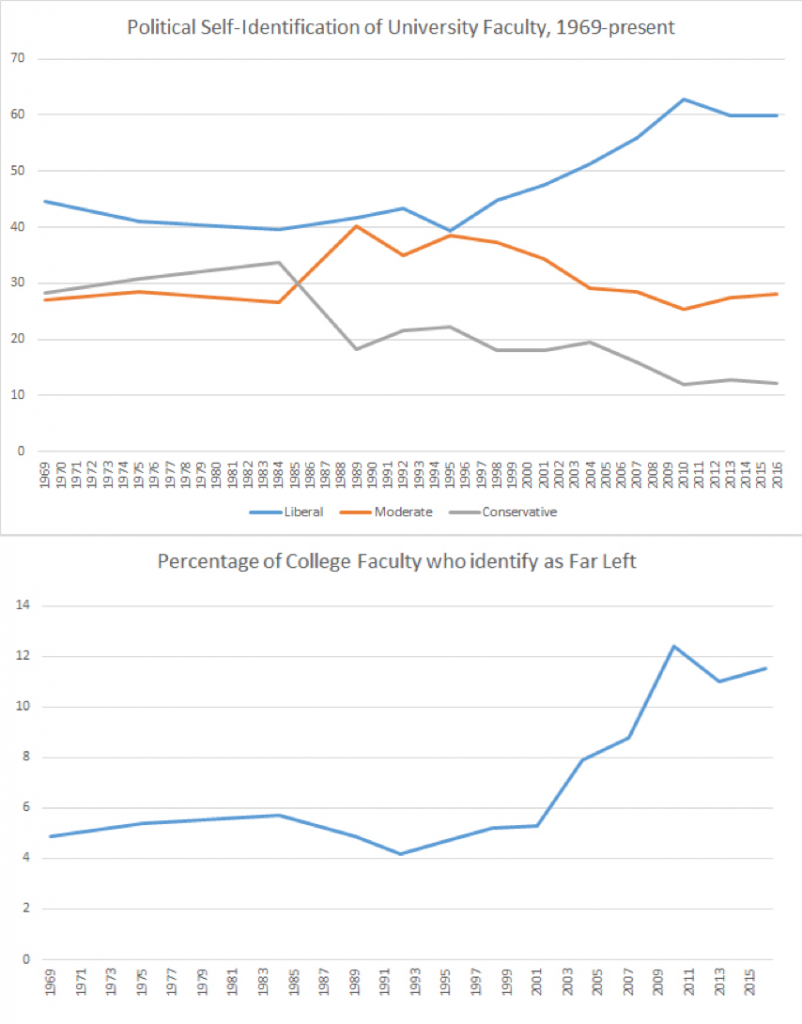
The clearest measure of this leftward shift may be seen in faculty
political identification over time. If conservative philanthropy
actually exerted transformative power over the academy, we could
reasonably expect to see a measurable increase in the number of faculty
who self-identify on the political right. Instead, the opposite has
happened.
University faculty have always leaned to the left of the general
public, although from the 1960s until the late 1990s self-identified
left-liberals consistently made up a stable plurality of about 40 to 45
percent. A sharp leftward shift began around 2000, and left-liberals
currently make up an astounding 60 percent of all university faculty. Sources:
Carnegie Foundation Survey of Higher Education (1969-1984), Higher
Education Research Institute Faculty Survey (1989-present).Faculty growth on the political left comes at the direct expense of
conservatives, who dropped from 22 percent of the academy as recently as
1995 to only 12 percent today. Furthermore, faculty who identify as
“far left”—a category that usually includes Marxists, socialists, and
derivative ideologies in Critical Theory—provided the main impetus of
this shift. Far leftists more than doubled in number during this same
period, going from a small minority of only 4 percent to 12 percent
today—or parity with the total number of conservatives of any stripe.
If any rightward “transformation” of academia happened in this
period, as Walsh’s analysis contends, it was so thoroughly subsumed by a
larger and simultaneous leftward faculty shift that it does not even
register in the data.
A more careful proponent of the rightward transformation thesis might
respond at this point that faculty ideology alone does not fully
capture the effects of conservative influence on campus. Rather, market
ideology or “neoliberalism” has taken root in university administration,
due to right-wing philanthropy filling in the gaps from public
budgetary cuts, or so the theory goes.
Jason Brennan and I investigated this thesis in our book Cracks in the Ivory Tower
by asking a simple question: If neoliberalism has taken over university
administration, or the university system at large, who and where are
the neoliberals? When did they first appear, and can we track their
purported acquisition of power or influence over time? These questions
may seem obvious from a social scientific perspective, yet in the world
of argument-by-declamation that characterizes much of the higher
education literature, nobody appears to have ever tested the claim.
Turning to administrative ranks, we quickly find several indicators
of a leftward shift that has paralleled the faculty. Although polling
data on administrator ideology only recently became available, a 2018 survey of student-facing administrators—typically
the lower-level ranks of student affairs and university life
personnel—found that 71 percent identified on the political left.
Conservatives comprised only 6 percent, indicating that this segment of
university administration sits even further to the left than the faculty
at large.
While proponents of the conservative transformation thesis might
point out that this survey did not extend to executive-level
administrators such as presidents and provosts, the bulk of university
“administrative bloat” in the past four decades has actually occurred in
the same lower-level ranks of student-facing administration. Between
1976 and 2011, executive level university administrators added about
150,000 new personnel to their ranks. Non-executive administrators
swelled by over 630,000 in the same period, with the largest categories
coming from student affairs and services. In total, these lower-level
university administrators currently outnumber full-time faculty and, by
every available indicator, they sit to the political left of even the
ideologically skewed professoriate.
When we try to measure the purported rightward transformation, the
speculated academic embrace of free-market ideology, the troublesome
“neoliberals,” and the accompanying influence of conservative donors are
nowhere to be found.
Instead, scholars such as Walsh and others who write in the same
genre display a habit of focusing upon the exceptions that prove the
rule. They cherry-pick foundations such as Olin, Walgreen, and Koch, or
organizations such as the Federalist Society, and elevate them to the
center of higher education philanthropy, when in fact these funders and
their perspectives constitute tiny and shrinking intellectual minorities
in an overwhelmingly left-leaning higher education system.
Even among academic disciplines that the right has supposedly
targeted—economics and law—conservative and libertarian perspectives
still remain distinct minorities.
Economics textbooks place a much heavier emphasis
on pro-intervention “market failure theory” than on deregulation or
critiques of political shortcomings. Faculty hiring patterns at top law
schools display clear evidence of favoritism
to progressive applicants, whereas comparably credentialed
conservatives and libertarians tend to place at much lower ranked
institutions."