Saturday, March 7, 2015

Alan Reynolds Suggests That Middle Class Incomes Have Not Been Stagnating

See The Mumbo-Jumbo of ‘Middle-Class Economics’: The statistics used to claim that average incomes have stagnated since 1980 also show stagnation since 1968.
"NPR displayed the same bottom 90% data and stretched it even further, claiming that “after 1980, only the top 1% saw their incomes rise.”"

"Amazingly, these same statistics also show there has been no increase for the “bottom” 90% since 1968."

"This is totally inconsistent with the data the Bureau of Economic Analysis uses to calculate GDP. For example, real personal consumption per person has tripled since 1968 and doubled since 1980, according to the BEA."

"Measured in 2013 dollars, after-tax median income rose briskly from $46,998 in 1983 to $70,393 in 2008 but remained below that 2008 peak in 2011. The sizable increase before 2008 is partly because the average of all federal taxes paid by the middle fifth has almost been cut in half since 1981—from 19.2% that year to 17.7% in 1989, 16.5% in 2000, 13.6% in 2003 and 11.2% in 2011.

Census Bureau estimates of median “money income,” on the other hand, do not account for taxes, so they miss a major source of improved living standards. They also exclude realized capital gains, public and private health insurance, food stamps and other in-kind benefits. Even so, the Census Bureau’s flawed estimate of median income rose 13.7% from 1984 to 2007 before falling 8% from 2007 to 2013."

"The Piketty and Saez data are crucially flawed. The total income reported on individual tax returns, which is the basis of their estimates, is substantially less than any official measure of total income, and the difference keeps getting wider. In their original 2003 study, Messrs. Piketty and Saez mentioned one rapidly expanding source of missing income—disappearing dividends in tax-return data."

"The same is true of interest and capital gains accumulating inside such tax-free savings accounts. These have grown to nearly $20 trillion"

"Messrs. Piketty and Saez shrink the total income numbers further by subtracting all transfer payments"

"The Piketty-Saez measure [of total income] excluded 24% of NIPA [National Income and Product Accounts] ‘personal income’ in 1970, but it excluded 37% of ‘personal income’ in 2008.” It excluded 40% of personal income by 2011."

"Piketty and Saez estimate that in 2013 the “other 90 percent”—meaning all incomes smaller than $114,290—had an average income of only $32,341. That number is not remotely credible."

"According to the CBO, that $32,341 would have been below the $34,000 needed to escape from the poorest fifth of two-person households in 2011, when half of all households earned more than $75,200 before taxes."

"average income for the middle fifth was $72,641 in 2013, and half of us earned more than $51,939."

"the Piketty-Saez average of all incomes below the top 10% is far lower than any official estimate of incomes among the middle fifth of the income distribution."

Maybe Real Wages Have Been Rising

From Scott Sumner of Money Illusion.
"Paul Krugman has a column discussing the plight of America’s workers:
The point is that extreme inequality and the falling fortunes of America’s workers are a choice, not a destiny imposed by the gods of the market. And we can change that choice if we want to.
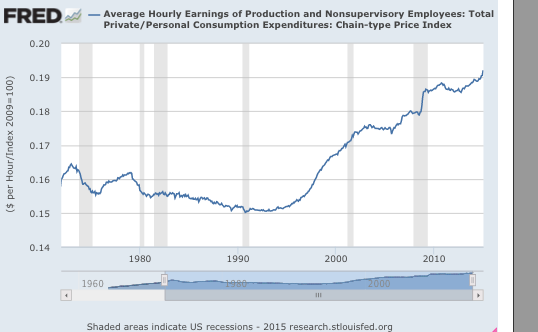
We all know that workers have done very poorly in recent decades, but exactly how do we know this?  Michael Darda sent me an email pointing out that real wages have been rising since about 1994 (ironically when NAFTA was enacted), after falling during previous decades.  Here’s a graph showing hourly real wages, where I use the wage series excluding the higher paid managers.  I presume that’s the series people are discussing. I use the PCE price index, which the Fed seems to think is best (I find all price indices to be equally arbitrary).

Screen Shot 2015-03-04 at 12.51.33 PM

Obviously I must have made some sort of mistake.  Which data series are the Democrats using to get so hysterical about real wages in America?

PS.  Or maybe I misunderstood the complaint.  Maybe the left thinks average real wages are fine and that inequality is the problem.  In that case workers making more than average (more than $20.80/hour) should see their wages cut while those making less than average should see their pay increase.  Good luck with that platform, given that a sizable chunk of low wage workers are non-voting teens and immigrants."

http://research.stlouisfed.org/fred2/graph/?g=ozZ


Graph: Average Hourly Earnings of Production and Nonsupervisory Employees: Total Private/Consumer Price Index for All Urban Consumers: All Items


Friday, March 6, 2015

Cash for Clunkers, EMR Edition

From Jeffrey Miron of Cato. 
"Since 2009, the federal government has spent about $30 billion to encourage the adoption of Electronic Medical Records. So how is that working out? This story from NPR sheds some light:
Technology entrepreneur Jonathan Bush says he was recently watching a patient move from a hospital to a nursing home. The patient’s information was in an electronic medical record, or EMR. And getting the patient’s records from the hospital to the nursing home, Bush says, wasn’t exactly drag and drop.
“These two guys then type—I kid you not—the printout from the brand new EMR into their EMR, so that their fax server can fax it to the bloody nursing home,” Bush says.
In an era when most industries easily share big, complicated digital files, health care still leans hard on paper printouts and fax machines. The American taxpayer has funded the installation of electronic records systems in hospitals and doctors’ offices—to the tune of$30 billion since 2009. While those systems are supposed to make health care better and more efficient, most of them can’t talk to each other. 
Bush lays a lot of blame for that at the feet of this federal financing.
“I called it the ‘Cash for Clunkers’ bill,” he says. “It gave $30 billion to buy the very pre-internet systems that all of the doctors and hospitals had already looked at and rejected,” he says. “And the vendors of those systems were about to die. And then they got put on life support by this bill that pays you billions of dollars, and didn’t get you any coordination of information!”
The story illustrates a classic difference betwen interventionists and libertarians. Interventionists think, “EMRs are good, so we should subsidize or mandate them.” Libertarians think, “EMRs appear to be good; if so, the market will adopt them on its own.”

The federal government’s response is truly disheartening. According to Dr. Karen DeSalvo, acting assistant secretary for health at the U.S. Department of Health and Human Services,
“The time of letting a thousand flowers bloom, and having a set of standards that are quite variable, should come to an end… We should be working off the same set of standards.”
It is plausible that a common standard will facilitate communication between different medical providers, but the question is how we get there: via the “wisdom” of government or the wisdom of the market. The EMR saga suggests a clear answer."

Krugman, Labor Unions, and Employment

From Cafe Hayek.
"Here’s another passage from Paul Krugman’s recent anti-economics column on Wal-Mart, minimum wages, and the supposed inapplicability of standard supply-and-demand analysis to labor markets:
Specifically, this view implies that any attempt to push up wages will either fail or have bad consequences. Setting a minimum wage, it’s claimed, will reduce employment and create a labor surplus, the same way attempts to put floors under the prices of agricultural commodities used to lead to butter mountains, wine lakes and so on. Pressuring employers to pay more, or encouraging workers to organize into unions, will have the same effect.
But labor economists have long questioned this view…
… a questioning that Krugman, judging from this column of his, clearly believes to be appropriate.
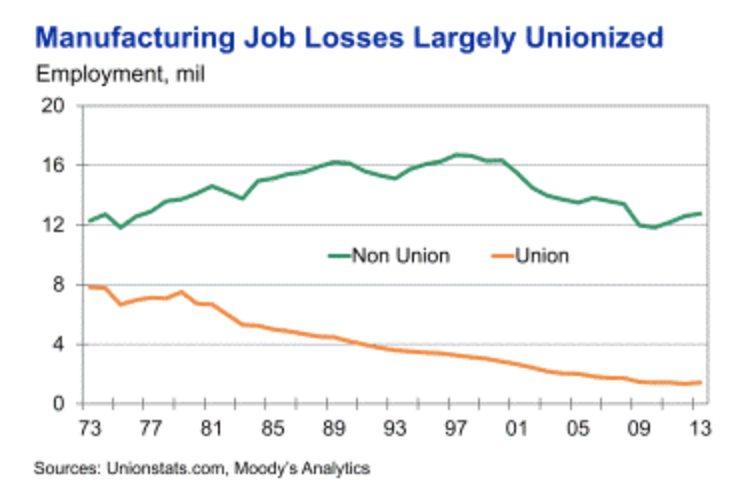
Bob Murphy has done good work exposing Krugman’s deep inconsistency on this issue.  (See also David Henderson – and the comments, especially the one by Charley Hooper, in David’s post.)  But inconsistent or not, here’s some evidence that Krugman is mistaken to suppose that, because labor markets (as he correctly says) are conditioned by “social forces and political power,” such forces and power cause labor markets to operate in ways that differ from the ways predicted by standard supply-and-demand analysis:

Screen Shot 2015-03-06 at 12.27.12 PM
 
This graph (which you can click on to enlarge) is from this recent blog post by Adam Ozimek.  (HT Tyler Cowen)  (See also this earlier, related post by Adam.)  While not proof positive – few such proofs are available in any science whose subject matter is empirical reality – these data are strong evidence in support of the standard economics conclusion that artificially raising firms’ costs of employing some kinds of workers causes firms over time to employ fewer such workers than they would otherwise have employed.

It appears that the social forces and political power that affect the market for labor do not do so in ways that render inapplicable the laws of supply and demand.

Note, too, from Adam’s posts that at least some respected labor economists – e.g., Richard Freeman (no libertarian he!) – don’t follow the script that Krugman says they follow.
….
Again, no sensible economist denies that labor markets differ in many ways from other markets.  But each of these differences – including those that involve “social forces and political power” – can be captured quite well in standard supply-and-demand analysis.  Doing so is the sort of work that good economists routinely do.  Supply-and-demand analysis applies whenever potential buyers encounter potential sellers – and no one is a potential or actual buyer of a good or service that isn’t scarce, which practically means that no one is a seller of a good or service that isn’t scarce.  And scarcity is never made to miraculously disappear by social forces or by political power.  Because supply-and-demand analysis captures so well the allocation of scarce things, the fact that the scarce thing directly exchanged in labor markets is the labor-time of human beings in no way makes this analysis inapplicable.

Remember, all exchange is of things or abilities owned – things or abilities created, produced, or procured – by human beings.  That labor markets coordinate the direct exchange of labor time – rather than the indirect exchange of labor time through the exchange of goods and services that labor, usually along with other inputs, produces – does nothing to make supply-and-demand analysis less applicable.  The sellers of asparagus in the asparagus market are no less human than are the sellers of labor time in the labor market.  And there is absolutely no reason to suppose that social forces, political power, or all the wishful thinking of people who dislike economic reality somehow make the buyers of labor time unable or unwilling to buy less of a certain kind of labor time if the costs to those buyers of buying that kind of labor time rises."

Thursday, March 5, 2015

Broad spectrum of economists supports renewal of Trade Promotion Authority

From Greg Mankiw.
"Dear Mr. Speaker, Mr. Leader, Madam Pelosi, and Senator Reid:

International trade is fundamentally good for the U.S. economy, beneficial to American families over time, and consonant with our domestic priorities. That is why we support the renewal of Trade Promotion Authority (TPA) to make it possible for the United States to reach international agreements with our economic partners in Asia through the Trans-Pacific Partnership (TPP) and in Europe through the Transatlantic Trade and Investment Partnership (TTIP). Trade Promotion Authority provides for an up or down vote on these agreements, without amendments, and thereby encourages our trade partners to put their best offers on the table.
Expanded trade through these agreements will contribute to higher incomes and stronger productivity growth over time in both the United States and other countries.  U.S. businesses will enjoy improved access to overseas markets, while the greater variety of choices and lower prices trade brings will allow household budgets to go further to the benefit of American families.
Trade is beneficial for our society as a whole, but the benefits are unevenly distributed and some people are negatively affected by increased global competition.  The economy-wide benefits resulting from increased trade provide resources to make progress on important social goals, including helping those who are adversely affected.
Increased global economic engagement will enhance U.S. global leadership in line with our values. Indeed, trade agreements signed under both Democratic and Republican Presidents have included provisions to combat corruption and to strengthen environment and labor standards.
It is not desirable for trade agreements to include provisions aimed at so-called currency manipulation. This is because monetary policy affects the value of currencies.  Attempts to penalize countries for supposedly manipulating exchange rates would thus impose constraints on U.S. monetary policy, to the detriment of all Americans.
We believe that agreements to foster greater international trade are in our national economic and security interests, and support a renewal of Trade Promotion Authority.
Alan Greenspan

Charles L. Schultze

Martin Feldstein

Michael J. Boskin

Laura D’Andrea Tyson

Martin N. Baily

R. Glenn Hubbard

N. Gregory Mankiw

Harvey S. Rosen

Ben S. Bernanke

Edward P. Lazear

Christina D. Romer

Austan D. Goolsbee

Alan B. Krueger
The letter writers were chairs of the President’s Council of Economic Advisers under Presidents Gerald Ford, Jimmy Carter, Ronald Reagan, George H.W. Bush, William J. Clinton, George W. Bush, and Barack Obama."

Market-Tested Innovation

From Cafe Hayek. Excerpt:
"The title of this post comes from Deirdre McCloskey.  It’s the term Deirdre uses to describe the proximate source of the vast riches enjoyed daily by ordinarily people in modern market-oriented societies.  Innovation is the act or process of coming up with a new, creative idea.  And innovations are market-tested if their success or failure is determined through a process of voluntary choices: no one is forced to purchase, to use, or to fund an innovation; no one is prevented from purchasing, using, or funding an innovation; everyone who wishes to use his or her own resources to act innovatively, or to fund an innovation, is free to do so.

Under such rules (along, of course, with basic laws of property, contract, and tort) – and in a culture that honors bourgeois virtues and applauds innovators – there will be lots of entrepreneurs striving to earn profit (and respect) by creating new goods and services.  These entrepreneurs will compete with each other, as well as with producers of older, established goods and services.  The goods and services that yield profits today for their producers will be the ones that consumers, spending their own money and only their own money, today choose above all others.  No finer, more objective, or more accurate test is available for determining how scarce resources should be used.

Tomorrow, of course, entrepreneurs will introduce newer products and newer production processes.  Some of these, tested by market competition, will succeed.  Others will fail.  Some older goods and services, once profitable to produce, will become unprofitable to produce.  Resources, including human labor, will shift from these older to the newer lines of production.

And so it goes in a free, prosperous, and growing market economy, day-in and day-out; year-in, year-out; decade-in, decade-out.  Such an economy is controlled or guided by no one, yet it serves everyone remarkable well – if, though, with the requirement that everyone abide by the rules of the game.  These rules are those listed above.  These rules imply that no one has a right to any one else’s property – a rule that, in turn, implies that no producer has a right either to prevent other producers (even those in foreign countries) from competing for the patronage of her customers, or to obstruct her customers from shifting their expenditures away from her product offerings.

One happy result of the now two-hundred-plus years of market-tested innovation in large parts of the world is the princely, historically off-the-charts-high standard of living enjoyed even by those middle-class people in countries such as the United States and France who mistakenly think themselves to be the unfortunate victims of capitalist oppression – fantastically rich people who read (about) Thomas Piketty’s book and then moan that some small number of other people are even more fantastically rich than they are.
…
I remember back in the late 1970s or early 1980s when I first noticed that still water began to be offered for sale in single-sized bottles.  I was convinced that this product would fail.  ”Who would pay for still water in single-sized bottles when still water can be gotten for free out of water fountains and water coolers or at zero marginal cost out of faucets at home?” I reasoned.  Whether I reasoned rightly or wrongly, my prediction proved wrong.  Reason, you see, is a wonderful and necessary tool, but also one of limited power.  My reason could not reveal to me the preferences of millions of other people.  My reason could not reveal to me the ambitions and the creativity of entrepreneurs.  My reason could not reveal to me the details of an open-ended future in which people are free to spend their money – as consumers, as producers, and as investors – as they wish.

If I were a government planner in the 1970s or early 1980s – a planner with the highest integrity and most intense desire to serve my fellow citizens – I would have counseled against directing society’s scarce resources into the production and distribution of single-sized bottled still water.  My reason would have assured me of the prudence and correctness of my decision.  And if I were such a government planner whose diktat would have been heeded, no one would ever have learned that my decision stunk.  Being prohibited by the state from being offered to consumers, still water bottled in single-sized servings would never have had the chance to grow into the multi-billion dollar industry that it is today.  That innovation passed the market test."

Wednesday, March 4, 2015

Are California Droughts Caused By Global Warming? Maybe Not Because We Have Seen Temperature Spikes Before

See California Outliers by Patrick J. Michaels of Cato.
"Today’s Washington Post story by Darryl Fears on California drought frequency in a warming world compelled me to take a look at the Golden State’s temperature history. In my 2011 book Climate Coup,  I showed that the alarm over California warming was rather odd, as most of the changes had taken place thirty years previously.  
That was then, and this is now. But what about history?

Here are California temperatures, for the last 38 years, beginning in 1976.  That’s the year of “The Great Pacific Climate Shift,” a sudden and lasting change in both the surface and oceanic circulation patterns.  2014 is by far the warmest year in the California record, as is obvious:


Several things stand out. There’s obviously no warming through 2011 (when Climate Coup was published).  But the pop between 2013 and 2014 is pretty impressive, no?

Fast-backward to 1934. J.B. Kincer had just published the first systematic temperature analysis from locations around the planet, in the 1933 Monthly Weather Review paper titled “Is our Climate Changing?” The paper clearly demonstrated global warming, and people were starting to talk about the influence of increasing atmospheric carbon dioxide on surface temperature. The only thing that was different back then is that we didn’t have computers to simulate what should have been happening. But if we did, I suspect that Darryl Fears’ progenitors would have written a pretty similar story.

Why? Take a look at the 38-year period (the same length as in the above figure) 1896-1934:


What’s different here? Nothing. Also worth noting is the difference in mean temperature between the two periods, providing very strong evidence for the step-change in California temperature that occurred with the Great Pacific Climate Shift in 1976.

Armed with a computer model in 1935, one could probably have written the exact same story 80 years ago, prompted by the very similar outlier temperatures of 1934 and 2014."