Monday, November 30, 2020

The Inauthenticity Behind Black Lives Matter

Insisting on the prevalence of ‘systemic racism’ is a way of defending a victim-focused racial identity.

By Shelby Steele. Excerpt:

"This was America’s post-confession bargain between the races—innocence on the white hand, development on the black. It defined the old order with which those convention speakers seemed to break. But there is a problem with these mandates: To achieve their ends, they both need blacks to be victims. Whites need blacks they can save to prove their innocence of racism. Blacks must put themselves forward as victims the better to make their case for entitlements.

This is a corruption because it makes black suffering into a moral power to be wielded, rather than a condition to be overcome. This is the power that blacks discovered in the ’60s. It gained us a War on Poverty, affirmative action, school busing, public housing and so on. But it also seduced us into turning our identity into a virtual cult of victimization—as if our persecution was our eternal flame, the deepest truth of who we are, a tragic fate we trade on. After all, in an indifferent world, it may feel better to be the victim of a great historical injustice than a person left out of history when that injustice recedes.

Yet there is an elephant in the room. It is simply that we blacks aren’t much victimized any more. Today we are free to build a life that won’t be stunted by racial persecution. Today we are far more likely to encounter racial preferences than racial discrimination. Moreover, we live in a society that generally shows us goodwill—a society that has isolated racism as its most unforgivable sin.

This lack of victimization amounts to an “absence of malice” that profoundly threatens the victim-focused black identity. Who are we without the malice of racism? Can we be black without being victims? The great diminishment (not eradication) of racism since the ’60s means that our victim-focused identity has become an anachronism. Well suited for the past, it strains for relevance in the present.

Thus, for many blacks today—especially the young—there is a feeling of inauthenticity, that one is only thinly black because one isn’t racially persecuted. “Systemic racism” is a term that tries to recover authenticity for a less and less convincing black identity. This racism is really more compensatory than systemic. It was invented to make up for the increasing absence of the real thing."

Sunday, November 29, 2020

Trump’s Gift to Joe Biden

His new drug price rule will hurt the innovation that has produced Covid vaccines.

WSJ editorial. Excerpt:

"The Department of Health and Human Services on Friday finalized a “most-favored nation” rule requiring drug makers to give Medicare the lowest price they charge comparable developed countries. This means the feds will refuse to pay more for medicines than government-run health systems in Europe. Didn’t Mr. Trump campaign against socialism?

While Medicare pays more for medicines than most countries, Americans also get earlier access to more life-saving treatments. According to the Galen Institute, 96% of new cancer therapies are available in the U.S. compared to 73% in Germany, 66% in France and 54% in Japan. Mr. Trump’s penny-pinching will result in fewer breakthrough treatments.

Most drugs fail in clinical trials, including some 97% of oncology treatments. The rare successes finance research and development into new medicines. It doesn’t take a brain surgeon to understand that drug makers will spend less on new medicines if government cuts their return on investment.

HHS is rushing out the rule without seeking public comment under its authority to test new payment models to reduce federal spending and improve patient care. Such tests typically are voluntary and involve a small patient or hospital population. The most-favored nation rule will be imposed by fiat nationwide."

Forgive Student Loans, but Only a Little

The most distressed borrowers didn’t get degrees and owe less than $5,000.

By Beth Akers of The Manhattan Institute.

"Student-loan cancellation may be an appealing idea, but it would enrich the privileged and leave behind—or perhaps even drain money from—the truly needy. Progressive calls for President-elect Joe Biden to forgive student debt in his first 100 days of office should be ignored in lieu of a more moderate proposal: forgiveness capped at $5,000 of debt.

Workers with a college degree are the highest paid in the economy and the last to get laid off during a downturn. Sure, having debt is worse than not having debt. But because of the large financial returns to postsecondary education, folks with debt and a degree are often better off than those who have neither. It’s clear in the data: Borrowers with the largest balances are the least likely to default. That’s because they’ve often invested in professional or graduate degrees that lead to careers with high earning potential.

Borrowers who owe less than $5,000 are the most likely to default. Many in this category started a degree but didn’t finish, and thus aren’t enjoying the higher earnings afforded by a degree."

"That brings us back to my proposal, a $5,000 student-loan jubilee in the form of a one-time tax credit. That would ensure that most borrowers who are truly up a creek can escape debt and move on with their lives."

Saturday, November 28, 2020

The media have quoted Covid statistics with a consistent absence of context, distorting the danger

By DAntony Davies& James R. Harrigan. Davies is a professor of economics at Duquesne University. Harrigan is Managing Director of the Center for Philosophy of Freedom at the University of Arizona. 

"There are lies, damned lies, and statistics. While this warning is never terribly far from the political surface, it should be axiomatic whenever anyone starts talking about Covid data. It has been years since a common pool of data has been so thoroughly mishandled by all sides, and this is sure to continue at least until a vaccine has been developed and delivered.

The surest sign that someone is playing fast and loose with statistics in order to push a particular point of view is the absence of context. And regardless of one’s position on the need for Covid lockdowns, one thing is clear: since the outset, the media have quoted Covid statistics with a consistent absence of context. The result has been to turn people who believe Covid is a significant danger into quivering cowards, and to cause people who believe Covid isn’t all that dangerous to dismiss the warnings entirely.

All the way back in March, when we were just realizing what we were up against, the media defaulted to the case fatality rate – the number of deaths out of confirmed cases. The World Health Organization estimated this would be over 3 percent. Some outlets were reporting case fatality rates above 10 percent. By comparison, the case fatality rate for the common flu is a mere fraction of a percent

On its face, a high case fatality rate leaves the uninformed reader thinking that the odds of dying from Covid are astronomical compared to the common flu. But in March very few people were being tested. To get tested for Covid, one generally had to be sick enough to be hospitalized. Those for whom symptoms were light or even nonexistent didn’t get tested. 

The result is that the reported Covid fatality rate was biased upward – early estimates had Covid more than 100 times deadlier than the flu. But, at this point, the whole exercise was like asking what fraction of the female population is in labor by surveying women in a maternity ward. That statistics were frightening, but without the necessary context, they were also meaningless.

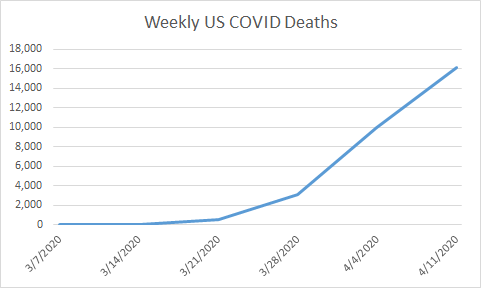
By early April, the media was feeding people daily reports on mounting Covid deaths. Gaudy numbers with lots of zeros framed every screen, and they drew the same significant attention that massive death tolls always bring. The missing context here: The number of people who died on a typical day before Covid. 

At the April peak, more than 2,400 Americans were dying daily from Covid. But, before Covid, 7,800 Americans died daily. And that’s comparing the peak daily Covid deaths to average daily deaths in 2019. The average daily US Covid deaths since the outbreak occurred is around 870, or 10 percent of the number of deaths we would expect in the normal course of events. The number is concerning, but bodies were not piling up in the streets as many breathlessly predicted. 

The lack of context led people to believe that thousands of deaths per day was something out of the ordinary. More people were dying to be sure, but to understand what that meant would have required people to understand how many Americans die each day in the normal course of events. The American people generally have little idea, and the media doesn’t help matters. It is the fantastic, after all, that drives media behavior.

By mid-April, pictures of exponential growth were everywhere. But exponential growth is typical. Every disease outbreak shows exponential growth at the outset. And every disease outbreak shows a peak and decline following that exponential growth. Without context, one could take the growth to mean that we’d all be infected, and likely dead, in short order.

By May, Covid deaths were falling, apparently depriving the media of a story. But increased testing meant that more cases were being discovered, so the media shifted from breathlessly reporting daily deaths to breathlessly reporting daily infections. For their purposes, one was as good as the other.

But as was the case in March and April, context also mattered in May. There was no discussion of what “case” meant. A case could be anything from someone on a ventilator to someone showing no symptoms at all. Early data indicated that around 80 percent of Covid cases didn’t require hospitalization. The lack of context left the impression that each additional case was one more person on death’s door. 

Making matters worse, the increase in testing introduced a confound. By definition, the more people we test, the more cases we’ll find. What matters isn’t the number of new cases we find, but the number of new cases we find as a fraction of the number of new tests we conduct. Without the context of the number of new tests conducted, there is no way to know whether we are finding more cases because more people are getting infected, or we’re finding more cases because we’re doing more testing. 

In fact, in May and June, although the number of new Covid cases steadily rose, the percentage of tests coming back positive declined, indicating that the rising case numbers were due less to increased cases than to increased testing. And while the media says (correctly) that the number of daily cases in November is setting records, they do not report that this is largely due to increased testing. The fraction of tests that are coming back positive, while rising, is on par with what the US experienced in mid May.

We can blame this persistent lack of context on a perfect storm of politicians seeking to be “doing something,” media seeking to sell advertising, and people paying enough attention to be scared, but not enough to understand. 

From the beginning, politicians were caught between a rock and a hard place. Locking people and businesses down meant possibly saving lives from Covid, but it also meant losing lives and livelihoods to unemployment, poverty, depression, suicide, and domestic violence. Politicians had to choose wisely. Influencing their decisions was the fact that the ramifications of choosing incorrectly weren’t evenly weighted. 

If the disease were virulent and politicians failed to lock down the American people, it would be clear that the politicians had erred and the people would hold them accountable for the many deaths that would ensue. But if the disease were mild and politicians unnecessarily locked down the country, it would not be at all clear that the politicians had erred. They could always say that the disease would have been devastating had they not locked everyone and everything down. That relatively few people died was actually a sign that the politicians had done the right thing.

Whether right or wrong, the better option for the politicians was to lock down. But the people would not tolerate a lockdown if they believed that the virus was a mild threat. For the politicians to be able to execute what, for them, was the safer strategy, the people had to believe that were it not for the lockdowns, millions of Americans would die. One way to convince people of this is to present them with data taken out of context. 

Meanwhile, the media, ever on the lookout for ways to attract more eyeballs, had a stronger incentive to present the data in the worst possible light than to present context that made the data appear less scary.

While all of this may sound like an elaborate conspiracy, it isn’t. No one conspired to achieve this outcome. Politicians, people, and the media simply responded to the incentives in front of them. The outcome we got was entirely predictable.

And what will happen next is entirely predictable as well. Infections, we are told, are on the rise again.

Expect to see the politicians saying exactly the sorts of things they said in March and April. Expect the media to play the role of enabler once again. The only difference will be the response they get from the American people, which is the one group that seems to have a collective memory that reaches all the way back to March. They suffered the lies and the damned lies they were served. The same bungled use of statistics won’t work on them again.

There is no question that Covid is a serious disease, and that every life lost is cause for concern. But each one of us faces very real risks every day from all manner of things. What’s important is that we address each risk with commensurate care. That the media has consistently reported on Covid without appropriate context suggests that historians will look back on 2020 less for its outbreak of Covid than for its outbreak of hysteria."

Quarantine May Negatively Affect Kids’ Immune Systems

By Donna L. Farber and Thomas Connors. Dr. Farber is a professor of immunology and surgery at Columbia University Vagelos College of Physicians and Surgeons, where Dr. Connors is an assistant professor of pediatrics. Excerpts:

"During the Covid-19 pandemic, the world is unwittingly conducting what amounts to the largest immunological experiment in history on our own children. We have been keeping children inside, relentlessly sanitizing their living spaces and their hands and largely isolating them. In doing so, we have prevented large numbers of them from becoming infected or transmitting the virus. But in the course of social distancing to mitigate the spread, we may also be unintentionally inhibiting the proper development of children’s immune systems."

"While the immune system is influenced by multiple factors, including genetics and everyday exposures to family members and pets, the long term effects of removing the social system that brings children in contact with other people, places and things remains uncharted territory. However, there is now substantial evidence that antigen exposure during the formative period of childhood is important not only for protection but also for reducing the incidence of allergies, asthma and inflammatory diseases. A well-known theory, called the “hygiene hypothesis,” proposes that the increased incidence of allergies and other immune disorders involving inappropriate immune reactions across industrialized societies is a result of the move away from agrarian society toward a highly sanitized urban setting.

Failing to train our immune systems properly can have serious consequences. When laboratory mice raised in nearly sterile conditions were housed together in the same cage with pet mice raised in standard conditions, some of the laboratory mice succumbed to pathogens that the pet mice were able to fight off. Additional studies of the microbiome — the bacteria that normally inhabit our intestines and other sites — have shown that mice raised in germ-free conditions or in the presence of antibiotics had reduced and altered immune responses to many types of pathogens. These studies suggest that for establishing a healthy immune system, the more diverse and frequent the encounters with antigens, the better.

Clinical trials have already demonstrated the effect of antigen exposure or avoidance in early childhood on subsequent immune responses. Introduction of peanuts to infants resulted in reduced incidence of peanut allergy, while avoidance had the opposite effect of promoting unwanted, severe allergic immune responses to peanuts. These findings further suggest that exposure during the formative years is critical for developing an immune system that responds appropriately to pathogens while tolerating harmless antigens."


David Horowitz on systemic racism

From Mark Perry.

"David Horowitz’s essay “Fighting Words” featured today on the Power Line Blog:

“Systemic racism” is an assertion made reflexively by Democrats that is never accompanied by evidence. For good reason. Systemic racism has been outlawed in America since the Civil Rights Act of 1964. If there were actual instances of systemic racism in 2020, there would be lawsuits – plenty of them. Even making the racist assumption, which the Identity Politics crowd does make, that all white people are white supremacists by dint of their skin color, there are tens of thousands of black lawyers, prosecutors, district attorneys, attorneys general, and elected officials who would be filing lawsuits over a practice that is illegal. You never hear of massive lawsuits over systemic racism, because “systemic racism” is a myth. The myth lives because it is an indispensable weapon wielded by Democrats to advance their anti-democratic agendas and quests for power.

Corollary: “Systemic labor market sexism” is an assertion made reflexively by Democrats that is never accompanied by evidence (e.g., President Obama’s four-Pinocchio claim in a 2012 campaign ad that “women being paid 77 cents on the dollar for doing the same work as men isn’t just unfair, it hurts families”). For good reason. Systemic labor market sexism has been outlawed in America since the Equal Pay Act of 1963. If there were actual instances of systemic labor market sexism in 2020, there would be lawsuits – plenty of them. Even making the sexist assumption, which the Identity Politics crowd does make, that thousands of employers are sexist, there are hundreds of thousands of female lawyers, prosecutors, district attorneys, attorneys general, and elected officials who would be filing lawsuits over a practice that is illegal. You never hear of massive lawsuits over systemic labor market sexism, because “systemic labor market sexism” is a myth. The myth lives because it is an indispensable weapon wielded by Democrats to advance their anti-democratic agendas and quests for power."

Black Americans are the most successful group of people of African descent in the world

By Alyssa Ahlgren of Alpha News in Minnesota.

"Contrary to the idea of a racially decrepit America, black Americans are the most successful group of people of African descent in the world. More black families in the United States live in the middle and upper classes than in the low-income bracket. Nigerian Americans have an average income of $5,000 more than the nation’s annual average."