Thursday, January 4, 2018

Tim Hortons heirs cut paid breaks and worker benefits after minimum wage hike

By Aaron Saltzman of the CBC. Excerpt:
"Employees at an Ontario Tim Hortons owned by the children of the chain's founders say they have been told to sign a document acknowledging they are losing paid breaks, paid benefits, and other incentives as a result of the province's minimum wage hike.

"I feel that we are getting the raw end of the stick," said one front line employee who asked to remain anonymous out of fear of losing their job.

The franchise is located in Cobourg, Ont., about 115 kilometres east of Toronto. The owners are Ron Joyce Jr. and Jeri-Lynn Horton-Joyce, the son and daughter of the chain's co-founders, Ron Joyce and the late Tim Horton, respectively. Employees say they are married.

In the document, copies of which were obtained by CBC News, Ron Joyce Jr. Enterprises wrote:

Letter cutting paid breaks

A picture of the document outlining cuts to paid breaks due to Ontario's minimum wage hike employees at Tim Hortons say they were told to sign.

"Breaks will no longer be paid. A 9 hour shift will be paid for 8 hours and 20 minutes."

"These changes are due to the increase of wages to $14.00 minimum wage on January 1, 2018, then $15.00 per hour on January 1, 2019, as well as the lack of assistance and financial help from our Head Office and from the Government."

The letter is signed "Sincerely, Jeri, Ron and Lisa."

Non-union employees in Ontario are covered by the Employment Standards Act

The Tim Hortons location on Division Street in Cobourg, Ont. Employees got a letter outlining increased benefits costs and cutting paid breaks due to the province's minimum wage hike. (James Pickersgill)

The act doesn't require employers to give employees coffee breaks or any other kind of break other than eating periods.

Meal breaks are unpaid unless the employee's employment contract requires payment."

Also, see this from The Faces of $15.

"TRI-CITIES, Wash. — Washingtonians making less than $11.50 an hour are getting a raise Monday, Jan. 1.
That's because the state minimum wage is going up from $11 in 2017 to $11.50 for 2018.
Bookworm Tri-Cities owner Cindy Bitzer said the mandatory wage hike is going to cut into the money she uses to keep her small-business profitable.
Her bookstore is 44 years old and she said it's developed quite a loyal clientele over the years.
"What's better than buying a book that you don't have to pay full price for? I mean you can't get better than that," Bitzer said.
Bitzer said she'll be relying on book lovers like these to survive this, and future, wage hikes.
The schedule published by Washington State's Department of Labor and Industries shows the minimum wage going up to $12 in 2019, then jumping to $13.50 in 2020.
"You always want your employees to be happy," Bitzer said. "But other than that, I don't see anything positive from it."
To keep her books out of the red, Blitzer will be trimming those happy employees' hours back, pick up the slack on her own time.
"I personally have to be here more often," Bitzer said. "I don't want to do that but its the only thing that we can try to do to try and get back on track where we need to be."
Because Bookworm Tri-Cities pricing is based on a percentage of what each book's publisher sells the book for, she said her prices are staying put.
"There's really no way for me to raise my prices based on how we've done business for the last almost 44 years," she said.
Bitzer said it's similar for folks like her all over the country.
"Everybody that voted for this didn't realize the consequences for the small businesses and what it does to us," she said.
She plans to power through, that there's no room for fear.
"If I was scared I think it would tank quick," Bitzer said. "I think it would go under. We've been around this long, I'm hoping that the community will keep supporting us and realize that we're here and we wanna give them their next favorite book."
Bitzer said the tier system of gradually increasing the minimum wage is better than it hitting all at once, but that it's still going to hurt if folks don't get out there and use the extra money at small businesses."

Green Mythology and the High Price of European Electricity

By Euan Mearns. Excerpt:
"The price of residential electricity in the EU is correlated with the level of renewable energy installed on a per capita basis. The data shows that more renewables leads to higher electricity bills. The notion that renewable energy is cheap is one of five Green energy myths discussed.
A few weeks ago Willis Eschenbach posting at WUWT and Jonathan Drake posting at Paul Homewood produced a chart showing a relationship between European residential electricity prices and the installed renewable energy (RE = wind + solar) per capita for a number of European countries that I have reproduced below. I thought this was one of the most interesting charts I’d seen for a while and wanted to write a post on it, but Dave Rutledge posting at Judith Curry beat me to it.
So why do I think this is important and why do we need another post? Well, the notion that RE is cheap is one of a number of Green energy myths that has become engrained in the public psyche. President Obama evidently believes that renewable electricity is cheap and expanding RE supplies was part of the medicine recommended by the IMF / EU to cure Greece’s economic woes. I have been told many times by those who make their living peddling renewable hardware that RE has brought down European electricity prices. I’m afraid there is little evidence to support that notion in Figure 1. So where does the truth lie?
Figure 1 The Y-axis shows residential electricity prices for the second half of 2014 from Eurostat. The X-axis installed wind + solar capacity for 2014 as reported in the 2015 BP statistical review normalised to W per capita using population data for 2014 as reported by the UN.

There will most certainly be more than one variable at work in determining electricity prices in the various countries. However, it is impossible to escape the conclusion that countries with highest level of renewable penetration have the highest residential electricity prices and that it is highly likely that these high prices are caused by, to a greater or lesser extent, the high level of RE penetration. These and related data are discussed in greater detail in the second half of this post.

Green Mythology

The notion that renewable electricity is cheap is one of a number of Green Myths that have been woven into a gigantic Green lie that is undermining our society, our welfare, our institutions and the way that we think about and rationalise problems.  Exposing this Green lie is part of the core raison d’ĂȘtre of Energy Matters. Green mythology is a theme that I will return to in the months ahead. Below is a very brief summary of some prominent Green energy myths. If readers want to add to the list, feel free to do so in the comments. A ubiquitous feature of Green myths is that all have a grain of truth running through them. In Green mythology, this grain of truth becomes elevated to the whole truth and used to make false arguments either in favour of renewable energy (RE) or against the alternatives."

Wednesday, January 3, 2018

The San Antonio Express-News Printed An Article By Me

Is giving back the best approach?

ESPN writer Michael C. Wright writer recently reported a comment by Spurs coach Gregg Popovich on why it is important to give back to the community: “Because we’re rich as hell and we don’t need it all, and other people need it. Then, you’re an (expletive) if you don’t give it. Pretty simple.”

Yes, many people are in great need, and I think most of us want to see the lives of the less fortunate improved. Popovich raises the question of what people need and the best way to help them get it.
If some people cannot afford adequate food or housing, giving money will help them. But what might happen if you did something else with your money?

You could just leave it at the bank, which can then lend it to new businesses or to established ones.
If they expand their output, it could lead to more jobs, which will help those in need. As Ronald Reagan used to say, the best social program is a job.

Or, if you are rich, you can spend your money on goods you enjoy. This, too, can create jobs.
The big question is, what is the best approach for lifting people? And if it includes charity, what is the optimal amount?

But we would do well to remember that wealth is created by entrepreneurs. If it weren’t for them, we would not have much wealth to redistribute.

Think of all the great products that even the rich could not afford before the Industrial Revolution. They are largely the result of entrepreneurs starting businesses and creating goods to improve the lives of millions.

So when people like Popovich say the rich need to give back, let’s remember that they may be rich because of what they created through entrepreneurship. In fact, entrepreneurs may get only a small fraction of the value they create.

Economic historian Deirdre N. McCloskey wrote in a Cato Institute report that “the economist William Nordhaus has calculated that the inventors and entrepreneurs nowadays earn in profit only 2 percent of the social value of their inventions.” The other 98 percent goes to the rest of us.

William McBride of the Tax Foundation reported that the share of entrepreneurs on the Forbes 400 list of the wealthiest Americans was 69 percent in 2011. So many wealthy people, by being entrepreneurial, have already given much to their communities.

Do they need to “give back” also? Perhaps not. Giving back implies they took more than they should have, as if there is some fixed pile of wealth they greedily took too much of.

If a person has to give back to their community, as Popovich suggests, what does that mean? Did they charge too much for their products? Did they pay too little to their suppliers, including the workers?
Not likely in our competitive, dynamic economy. But that entrepreneurial dynamism has declined as inequality has grown in the last few decades.

We need to remove regulatory roadblocks for entrepreneurs, including things like so many occupational license requirements.

If Popovich enters politics, as some have hinted, I hope he has some ideas on how to grow the economy and not just redistribute wealth and income.

Tuesday, January 2, 2018

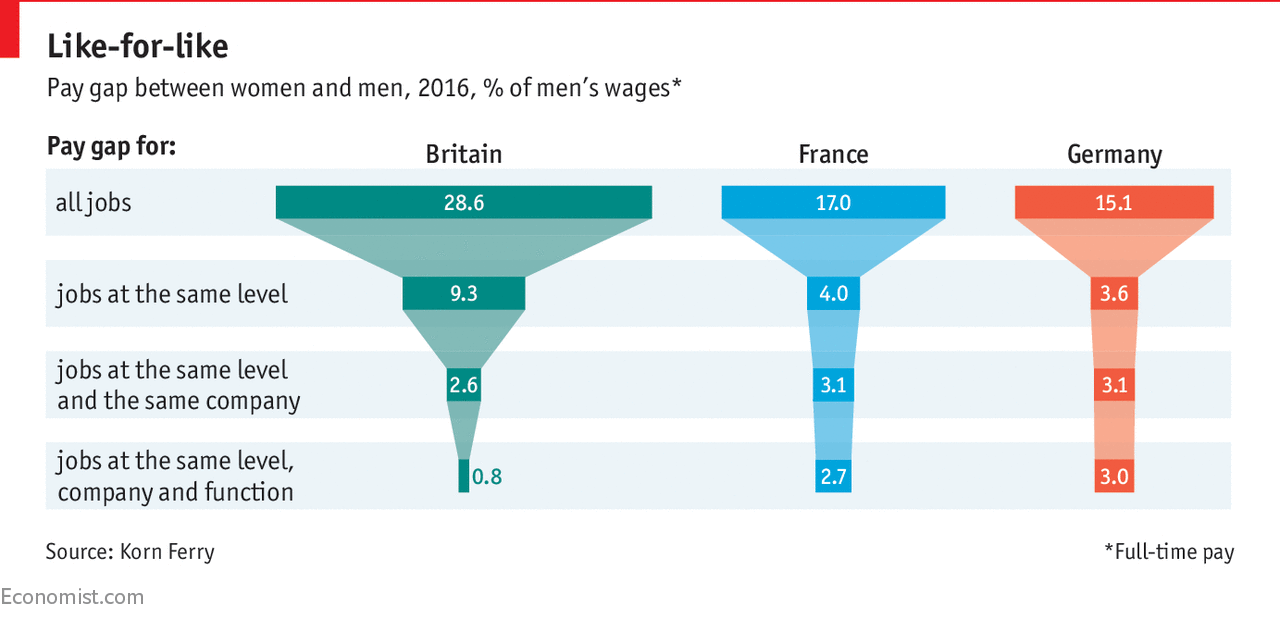
Are women paid less than men for the same work?

When all job differences are accounted for, the pay gap almost disappears

From the Economist.
"According to data for 8.7m employees worldwide gathered by Korn Ferry, a consultancy, women in Britain make just 1% less than men who have the same function and level at the same employer. In most European countries, the discrepancy is similarly small. These numbers do not show that the labour market is free of sex discrimination. However, they do suggest that the main problem today is not unequal pay for equal work, but whatever it is that leads women to be in lower-ranking jobs at lower-paying organisations."

The smaller wage and income penalties to parents from working in family friendly firms and jobs come at the expense of their occupational progression, especially among mothers, impeding their ability to climb career ladders

Parenthood, Family Friendly Firms, and the Gender Gaps in Early Work Careers by V. Joseph Hotz, Per Johansson, Arizo Karimi.

NBER Working Paper No. 24173
Issued in December 2017
NBER Program(s):Children, Labor Studies
 
"We consider the role that firm attributes play in accounting for the divergence in the careers of women and men, with the onset of parenthood. We exploit a matched employer-employee data set from Sweden that provides a rich set of firm and worker attributes. We index firms by their “family friendliness” and analyze the effect of firm family friendliness on the career gap between mothers and fathers. We find that women disproportionately sort into family friendly firms after first birth and that the wage penalty to motherhood is diminished by being assigned to a more family friendly firm or job. We also find that working in a more family friendly firm or job diminishes the parenthood penalty to labor earnings and makes it easier for mothers to work more hours. At the same time, the smaller wage and income penalties to parents from working in family friendly firms and jobs come at the expense of their occupational progression, especially among mothers, impeding their ability to climb career ladders. Finally, we find that family friendly jobs are more easily substitutable for one another. This latter finding suggests that family friendly firms are able to accommodate the family responsibilities of their workers while still managing to keep their costs low. Our findings also suggest that paid parental leave with job protection – which are features of the Swedish context – may not be sufficient to achieve the balancing of career and family responsibilities, but that the way firms and jobs are structured can play a crucial role in facilitating this balance."

Monday, January 1, 2018

Following Virginia’s deregulation in 2012, the number of beauty shops in Virginia counties grew 7 percent more than the number in neighboring counties in bordering states

See Untangling Hair Braider Deregulation in Virginia by Edward J. Timmons and Catherine Konieczny.
"Occupational licensing laws make it illegal for an individual to work in an occupation before meeting minimum standards for entry. Workers whose occupations are subject to licensing range from physicians and dentists to cosmetologists and barbers. Though some licensing proponents claim that licensing improves the quality of services delivered to consumers, this argument is weak for certain occupations. In fact, occupational licensing may limit employment opportunities in a labor market already experiencing a dwindling participation rate.

Edward J. Timmons and Catherine Konieczny investigate the effects of licensing hair braiders in Virginia. Virginia removed licensing requirements for hair braiders in 2012. The study uses this regulatory change to compare counties in Virginia with bordering counties in North Carolina, West Virginia, and Kentucky in order to estimate whether removing licensing requirements had a significant impact on the number of salons, the number of salon employees, or the wages of those employees. This comparison provides a one-of-a-kind examination of the impact of Virginia’s deregulation of hair braider licensing on economic outcomes.

Key Findings

  • Following Virginia’s deregulation in 2012, the number of beauty shops in Virginia counties grew 7 percent more than the number in neighboring counties in bordering states.
  • Expensive occupational licenses significantly impact enterprising proprietors, who are prevented from opening new establishments.
  • Evidence suggests that deregulation created more opportunities for smaller owner-operated beauty salons in Virginia, because it was associated with a more than 8 percent increase in proprietor density.
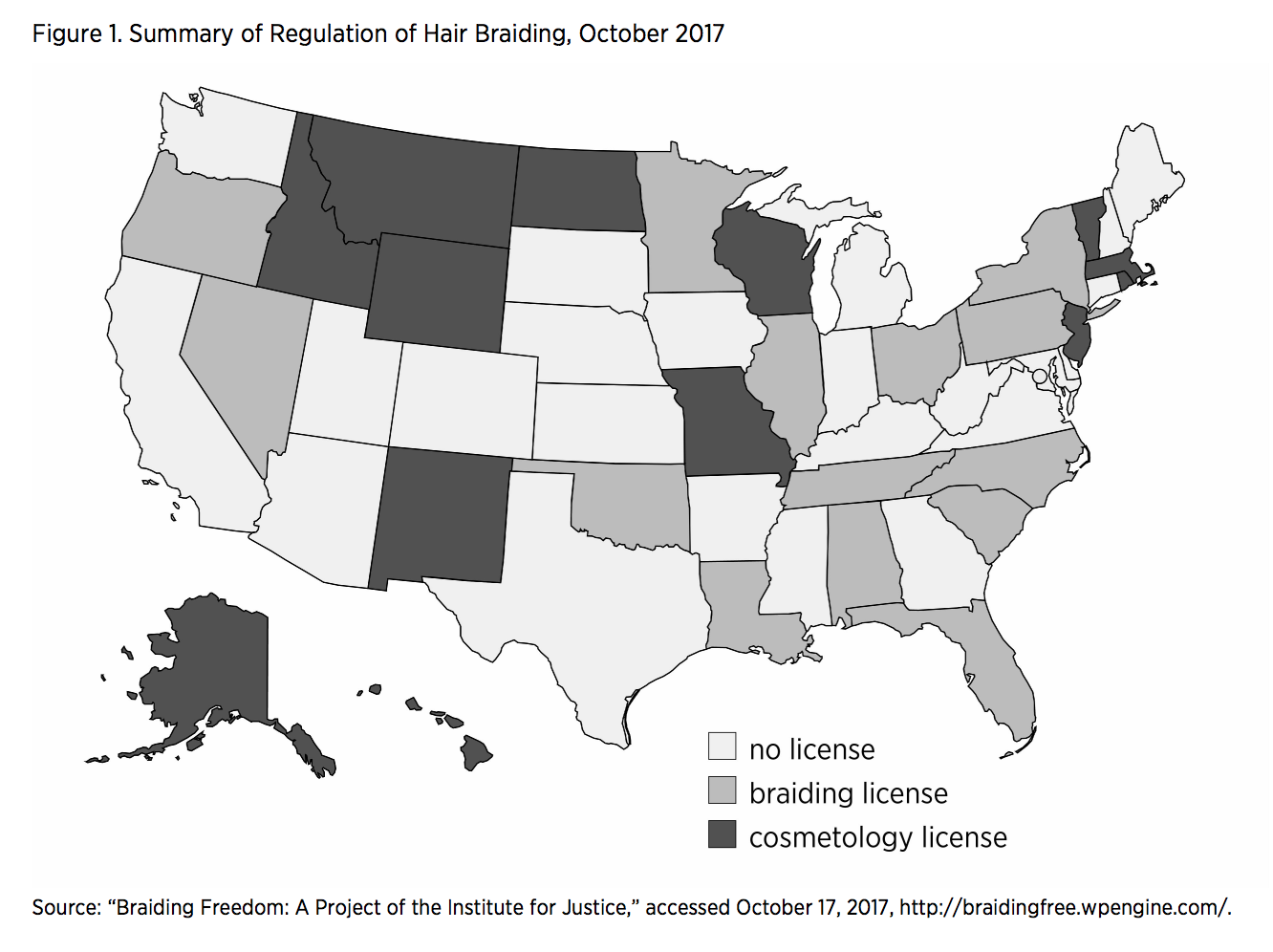
As shown in figure 1, thirteen states require aspiring hair braiders to obtain a cosmetology license. Fourteen states have specific hair braiding licenses that are generally less burdensome than the requirements for cosmetologist licensing in the state. Though there are debates about the unique risks of hair braiding for consumers, cosmetology training addresses neither those risks nor the unique skills involved in hair braiding.

Hair Braiding Risks Are Overblown

A recent study performed by the Institute for Justice (IJ) explores whether hair braiding presents risks to consumers. After reviewing the data for nine states and Washington, DC, from 2006 to 2012, IJ finds that
  • only 95 complaints were filed against hair braiders (meaning approximately 1 percent of licensed hair braiders received complaints), and
  • all but one of these complaints were filed by competing cosmetologists, not by consumers.
IJ’s study also finds large differences in the number of hair braiders in Mississippi and in Louisiana. Mississippi, which has no licensing requirement for hair braiders, had 1,200 hair braiders in 2012. Louisiana, which has a licensing requirement for hair braiders, had only 32 hair braiders.
The results of the IJ study further reinforce the finding that hair braider deregulation has enhanced economic opportunity for hair braiders in Virginia.

Conclusion

As policymakers in the rest of the country reconsider hair braider regulation, these results provide very clear guidance. Not regulating the hair braiding profession is superior to imposing burdensome regulation, such as requiring a cosmetology license (as in West Virginia) or a separate hair braider license (as in North Carolina)."

How Regulation Subsidizes Big Finance

By Brink Lindsey and Steven M. Teles of ProMarket. Excerpt:
"But instead of correcting any market failures that leads to excessive risk taking, regulatory policy actually makes matters worse. Specifically, the government’s efforts to reduce the harm caused when financial firms fail ends up subsidizing the heavy reliance on debt that makes firm failure more likely.

The main explicit subsidies consist of (1) the Federal Reserve System’s discount window, established in 1913, through which the Fed can act as a “lender of last resort” and supply emergency liquidity to distressed banks; and (2) federal deposit insurance, first instituted in 1933, through which covered depositors are held harmless in the event of a bank failure. Both these policies are justified on the grounds of preventing and containing bank runsa particularly serious problem in the United States because historical limits on branch banking rendered US banks underdiversified and consequently crisis-prone.

Yet even as they reduced the risks of contagion and financial meltdown, these policies simultaneously reduced the risks of high leverage. Access to the discount window made banks less vulnerable to liquidity shocks and thus made it safer for them to borrow more. Deposit insurance, because it has never been priced in an actuarially sound manner, acts to subsidize heavy reliance on deposits to fund banking operations. Insured depositors are rationally indifferent to the financial soundness of the banks they patronize, as they will get their money no matter what. Accordingly, they do not demand higher interest rates from undercapitalized banks to compensate them for the risk of insolvency. It is no surprise, then, that the creation of a formal safety net for banks led to higher levels of indebtedness.

In addition to these explicit subsidies, an implicit subsidy created by a string of ad hoc bailouts has further incentivized financial institutions to ramp up their leverage. Continental Illinois in 1984, the Latin American debt crisis of the 1980s, the peso crisis of 1994, the Asian financial crisis of 1997-1998, Long Term Capital Management in 1998, and of course the financial crisis of 2007-2009—again and again the US government has intervened with emergency assistance to prop up American financial institutions deemed too big or too important to fail. This implicit safety net has extended far beyond the traditional banks covered by deposit insurance to include investment banks, the government-sponsored enterprises Fannie Mae and Freddie Mac, hedge funds, money market mutual funds, and insurance companies. As a result, creditors of those financial institutions have been spared the consequences of their misplaced trust. Given the expectation that bailouts will again be forthcoming the next time a crisis hits, the riskiness of lending to highly leveraged institutions is much lower than it otherwise would be—and thus the interest rates that those institutions pay to their nominally uninsured creditors are kept artificially low.

The perverse incentives created by deposit insurance and bailouts are known as “moral hazard”—an expression that comes from the insurance industry to describe the reduced motivation to guard against risks that have been insured against. How moral hazard operates in the financial sector, though, is widely misunderstood. The common picture is that, if moral hazard is present, it must mean that financial sector executives are consciously making business decisions with an attitude of “heads I win, tails you lose.” In other words, they deliberately make investments they know are risky because they understand that they will make big profits if the investments pay off—and if they don’t, well that’s the government’s problem.

It’s clear enough that such thinking is fairly uncommon. Yes, when a financial institution is already insolvent or close to it, executives may try “hail Mary” investments because they face no downside risk—their equity stakes have already been wiped out so they are effectively making one-way bets. Such behavior was seen during the savings-and-loan crisis, as “regulatory forbearance” allowed thrifts with negative net worth to stay in business and attempt to recoup their losses with increasingly desperate gambles. This is precisely the pattern of behavior that Charles Keating notoriously engaged in back in the 1980s, and which the “Keating Five” senators helped to protect.

In the recent housing bubble, though, many of the most disastrous decisions were made by people with plenty to lose. Huge fortunes and sky-high incomes were on the line, and few could be complacent about the prospect of losing them. Far from seeing themselves as reckless, the unwitting architects of the financial crisis were highly confident that they were managing risks expertly and were shocked when the facts proved otherwise. Accordingly, it would seem that moral hazard wasn’t a major factor in explaining what went wrong.

But in fact moral hazard was absolutely central to the story, and it is at the heart of why the financial sector remains a disaster waiting to happen. The main effect of moral hazard, though, isn’t on the incentives facing the executives of financial institutions. Rather, the main effect is on depositors and other creditors. Because their risk of loss has been artificially reduced by the formal and informal safety net created by government, they do not respond as normal market actors would to the heightened risk of insolvency created by extreme leverage. Because they do not bear the risk, they do not demand higher interest rates to compensate for that risk. Financial institutions can keep piling up more and more debt without market consequences, with the result that those institutions and the financial system as a whole grow increasingly fragile and disaster-prone. Sooner or later, a relatively minor reversal of fortune will suffice to spell catastrophe because almost all margin for error has been eliminated.

The system as currently constituted is especially vulnerable to insidious, slow-fuse risks lurking in the tails of probability distributions. The economist Tyler Cowen has characterized the problem as a strategy of “going short on volatility”—in other words, “betting against big, unexpected moves in market prices.” This strategy can appear to work well for many years, as by definition the contingencies being bet against are rare events. During these good times investors earn above average returns, amped up by leverage. Complacency sets in, as backward-looking risk management systems assure everyone that all is well. These systems, for all their mathematical sophistication, rest on a highly dubious and dangerous proposition—namely, that just because something never occurred in the relatively recent past for which data are available, it will never happen in the future. Eventually, though, a blue moon or a black swan appears in the sky, and all those highly leveraged bets now generate losses big enough to threaten the whole system with collapse."