By Peter C. Earle & Thomas Savidge. They are both Research Fellows at the American Institute for Economic Research. Excerpts:
"While the BEA publishes
a measurement titled “Value Added by Private Industries (VAPI),” it
does not get nearly as much attention as it deserves. The most recent
data show that VAPI contributes
to just under 89 percent of all economic growth. Despite this, GDP is
still the more prominent metric, in part because the BEA treats
government spending as a value added to the economy."
"VAPI includes private outputs that are purchased by government (i.e. a
defense contractor) while GDPP (Gross Domestic Private Product) treats those purchases as part of
“Government Consumption and Gross Investment.”"
"A cursory glance at the BEA’s description of government assumes
that all levels of government “contribute to the nation’s economy when
they provide services to the public and when they invest in capital.
They also provide social benefits, such as Social Security and Medicare,
to households.”
The description also notes that the government gets its revenue
taxes, transfers, and fines, as well as rent and royalties. It fails to
mention, however, that government receipts come at a cost. That cost,
what economists call opportunity cost, is the next-highest valued use of that money.
We can see this effect reflected in the BEA’s own data. When
examining the growth of government and the private sector both before
and after 2000 in our analysis published
last year, government growth (both federal as well as state and local)
outpaced that of the private sector. Below is an updated analysis of
last year’s findings. Note that the same still holds true: Government
outpaces the growth of the private sector, especially state and local
governments.

Source: United States Bureau of Economic Analysis, Department of
Commerce. Table 1.1.6 Real Gross Domestic Product, Chained Dollars,
Authors’ Calculations.

Source: United States Bureau of Economic Analysis, Department of
Commerce. Table 1.1.6 Real Gross Domestic Product, Chained Dollars,
Authors’ Calculations.
Furthermore, we find that the private sector has grown 33 percent slower
per year since the start of the new millennium. It is also important to
remember that transfer payments, such as Social Security or
unemployment insurance, are excluded from GDP estimates of government
spending because those transfers are counted toward private spending.
Furthermore, we find that the private sector has grown 33 percent slower
per year since the start of the new millennium. It is also important to
remember that transfer payments, such as Social Security or
unemployment insurance, are excluded from GDP estimates of government
spending because those transfers are counted toward private spending.
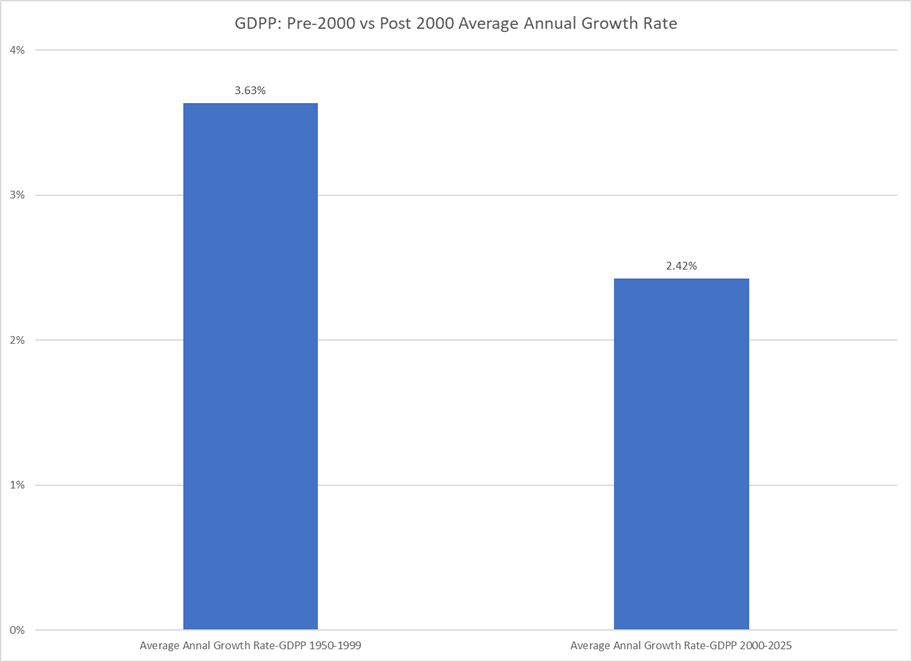
Source: United States Bureau of Economic Analysis, Department of
Commerce. Table 1.1.6 Real Gross Domestic Product, Chained Dollars,
Authors’ Calculations.
A recent review
of the academic literature on government stimulus in the economy finds
that government stimulus makes, at best, modest, short-term
contributions to economic activity. In the long-term, however, the
review finds that government stimulus effects “often diminish or turn
negative due to reduced private investment and consumption, emphasizing
the role of anticipatory effects and private-sector responses.”
Economists, both past and present, have argued that calculating
government contributions to the economy is more complicated than
official GDP calculations claim. Economist Patrick Newman notes Nobel Prize-Winning Economist Simon Kuznets’s own objections
that government was treated as “an ultimate consumer” on par with
private consumers regardless of whether private citizens valued
government consumption and investment. Newman takes Kuznets’s concerns
further and argues that such positive treatment of government in
economic growth calculations opened the door to the flawed views of
Modern Monetary Theory.
Alternatively, economists Vincent Geloso and Chandler S. Reilly examine
government consumption and investment minus defense spending, called
“Defense-Adjusted National Accounts”. The result is a much lower level
of GDP, but the clear lesson “that wars do not improve living standards.” These challenges to the status quo
of economic growth calculations help, in the words of Geloso and
Reilly, “bridge the gap between official economic data and the
perceptions of the American public.”"
