Evaluating the free market by comparing it to the alternatives (We don't need more regulations, We don't need more price controls, No Socialism in the courtroom, Hey, White House, leave us all alone)
Saturday, November 15, 2025
Is the Arctic Ice about to Disappear?
Despite what we might read in the newspaper, we will likely have ice in the Arctic for a long time.
"Summary:
This article challenges the alarmist forecasts of a soon-to-be ice-free
Arctic, citing previous failed attempts to predict the Arctic’s future.
It acknowledges the gradual decline in Arctic ice but maintains that
the region will likely have ice for a long time.
In 2009, the BBC ran a reporting piece on the Arctic featuring the esteemed polar scientist Peter Wadhams of Cambridge University. The Catlin Arctic Survey,
a project set out to answer vital scientific questions about sea ice in
the Arctic, had just returned with its findings. Its central purpose
had been to gather evidence on how long a warming planet could sustain
an all-year ice cover at its northern pole: How long did the Arctic ice
cover have left?
The
results, said Wadhams, who has studied the Arctic since the 1970s, were
terrifying. The survey supported the “new consensus view that the rapid
melting of sea ice will turn this frozen landscape into an open ocean
within twenty years” and that “much of that decrease will be happening
within ten years.” The old view in the scientific literature and
publications by the Intergovernmental Panel on Climate Change (IPCC) was that an extreme event like an ice-free Arctic could happen around mid-century at the earliest.
Three years later, Wadhams predicted that
an ice-free Arctic would occur in 2015 or 2016, describing the climate
events of these northern latitudes as a “global disaster.” The scientific article that prompted the infamous disaster-peddling journalist Nafeez Ahmed to run a full Q&A with Wadhams in The Guardian suggested
the Arctic ice would melt “within 30 years,” but somewhere between
scientific publication and newspaper reporting, the prediction got
shifted by an order of magnitude.
In 2016, The Guardian ran another weekend long-form piece with Wadhams as his fascinating and comprehensive book, A Farewell to Ice: A Report From the Arctic, was hitting the shelves. Although Wadhams repeats his warnings of an imminent ice-free Arctic in
the book, he is more balanced, suggesting that the prediction game of
when an ice-free Arctic may or may not happen takes away from the more
important point:
The
dismal failure of most models to reproduce the present state of the
Arctic ice in summer. The debate over exactly when the September Arctic
will become ice-free has distracted attention from the more important
issue, which is how fast, and in what manner, the Arctic sea ice will
retreat at all seasons of the year.
While
long term trends show a decline in Arctic ice, Wadhams’ stark
predictions didn’t come true—in 2016 or in any other year since. In
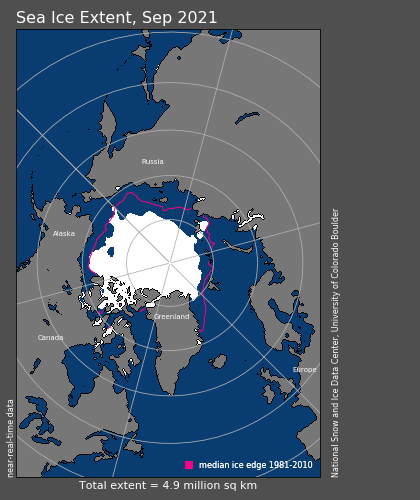
fact, the September lows of the Arctic sea ice extent in 2021, per NASA data, was one-sixth above what it was when Wadhams uttered these fateful words in 2016.
The interview had Wadhams double down on his remarks in response to a
direct question about his previous predictions. He said that the
historical trend was clear and that by 2016 or 2017, the “central Arctic
will be ice-free. You will be able to cross over the north pole by
ship.” Five years later, that still wasn’t true, according to the maps
published by the National Snow and Ice Data Center at the University of Colorado, Boulder.
Yet,
he’s not alone in making these stark predictions about Arctic ice. In
2007, Professor Wiesław Masłowski of the Naval Post Graduate School in
Monterey, California, projected that the Arctic would be ice-free by 2013, based on state-of-the-art modeling and 50 years’ worth of data. In an Annual Review of Earth and Planetary Sciences article in 2012, Masłowski and three coauthors updated this figure to “2016 ±3 years.” Those years came and went, yet still there was no ice-free Arctic.
More recently, Harvard professor James Anderson said in 2018 that the chance of any permanent ice left in the Arctic by 2022 was “essentially zero.” When the observations come in later this year, we’ll find out, but it’s not looking promising for Anderson’s prediction.
My
purpose above is not to take pot-shots at failed predictions or minimize
the threat of climate change: the future is difficult to predict, and
the Earth’s climate system is ridiculously complicated. The danger that
these climate scientists give voice to is real and important; the
reality is just nowhere near as bad as they say. Wadhams’ polar research
has been invaluable to what we know about this remote part of
the planet: the ice cover is gradually shrinking, as is the thickness
of that ice. As it shrinks, it reflects less of the sun’s incoming rays,
exposes the ocean below it to much more heating, and threatens to
release methane plumes long stored at the ocean floor.
However,
even some of the brightest scientists get carried away by their own
research and overestimate its importance. When thrust before journalists
on the hunt for juicy quotes, it’s no secret that the state of the
scientific literature—let alone their own research findings—might get a
bit polished. Exaggerated.
While a
more resilient Arctic is bad for the predictions of Wadhams, Masłowski,
and Anderson, it’s actually good news for a climate area drenched in
pessimism. In January 2022, sea ice in the Arctic was at its largest extent in over a decade—but strangely, the NASA press release reported it under the heading “NASA Finds 2022 Arctic Winter Sea Ice 10th-lowest on Record.”
Contrary
to what we might learn from casually browsing the newspaper headlines,
we will likely continue to have ice in the Arctic for a long time.
What
failed past predictions by reputable scientists and institutions tell us
is that we don’t understand these complex systems as well as we would
like to. That means that the next prediction, perhaps of an even more
dire nature, ought to be taken with a whole jar of salt.
The world has an unfathomable and mind-boggling amount of ice. Something like one-eighth of all the Earth’s land is covered by it—some of which, like the ice sheets at Greenland and Antarctica, are kilometers thick.
There’s
a strange piece of selection going on in media reporting about the
climate, where, because the climate is chaotic and highly volatile,
there is always a “record” or “anomaly” observed in some domain, somewhere on the planet. If it’s not the Brazilianforest fires or global deforestation that I have written about before, it’s the disaster we don’t hear about or heat records in Siberia. Somebody, somewhere, has a climate story.
As if to prove my point: as I’m writing this, news broke about a New-York-sized ice shelf in east Antarctica that crashed into the sea after “a freakish warm spell.” The National Geographic coverage
featured the following quote: “[the Conger ice shelf] had been slowly
disintegrating for years but then collapsed quickly, as winds rose and
temperatures spiked.” Buried two-thirds down the AP press release was
the confession that both of the scientists interviewed for this article
thought that the recent weather pattern in Antarctica “is probably just a
random weather event and not a sign of climate change.” Predictably,
the news coverage was anything but as balanced as those scientists’ statements.
Usually,
the climate stories about ice in Antarctica that are reported in the
alarm-prone Western media are events on the opposite side of the
continent—calvings or changes in the Pine Island Glacier or Thwaites
Glacier (the latter more often called “the Doomsday Glacier”).
News of a big and terrible event occurred, not where the scientists had
said it would and feared it would, but where few eyes were looking.
Events like those create the impression of a constant stream of emergencies followed by even worse emergencies—even though many climate indicators are hovering around long-term trends and the planet is more livable than ever before.
The
task of scientists is to critically investigate their findings and
report them accurately—not exaggerate them, or pick the most extreme
interpretations, or peddle outrageous predictions to the public. As
physicist Steven Koonin observes in his recent book on climate science, Unsettled: What Climate Science Tells Us, What It Doesn’t, and Why It Matters,
“it is the height of hubris for a scientist even to consider
deliberately misinforming policy discussions in service of what they
believe to be ethical.”"
No comments:
Post a Comment
Note: Only a member of this blog may post a comment.


No comments:
Post a Comment
Note: Only a member of this blog may post a comment.