Evaluating the free market by comparing it to the alternatives (We don't need more regulations, We don't need more price controls, No Socialism in the courtroom, Hey, White House, leave us all alone)
Wednesday, August 13, 2025
The Climate Conversation is Changing: A round-up of recent commentary and science
"Many of the reactions to the DOE CWG have exposed pathologies
of gatekeepers in the scientific community. For instance, climate
scientist Kerry Emanuel2
(who helped to push me out from 538 back in the day) criticizes the CWG
report for focusing on U.S. hurricane landfalls and not discussing the
Caribbean, and in the process shares some blatant misinformation:
Given
that the Caribbean region had a high population density (and associated
newspaper accounts) going back to the early 19th century, they could
have looked at ALL Atlantic landfalls, not just the U.S. Had they done
so, they would have discovered a clear upward trend.
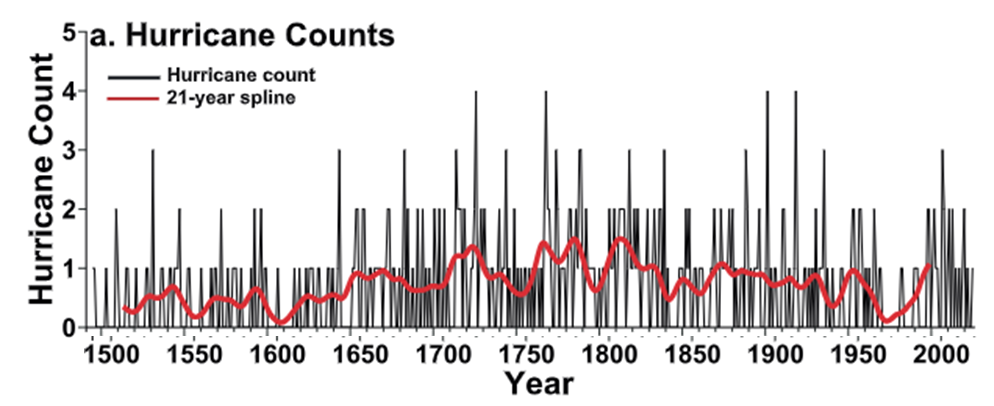
OK then, let’s look at that data. Chenoweth and Howard (2023)
complied a time series of hurricane landfalls in the Caribbean from
1494. They found no upwards trend and a big surprise (emphasis added):
The
central and eastern Caribbean Sea region has the longest continuous
record of hurricane impacts anywhere in the world, extending back to
1494 CE Hurricane numbers and intensity in this region vary with the
warm and cold phases of El Niño-Southern Oscillation. Hurricane frequency was lowest in the 20th century and stands out in the 529-year record for both length and duration"
"Peer-reviewed Research you Won’t See in the Media
Prescribed
burns in the western United States significantly reduces both extreme
wildfire risk and air pollution. While there are many good arguments for accelerating the decarbonization of the economy,
modulating forest fire risk is not high among them. Two new papers
quantify the effects of prescribed burns on fires and air pollution:
We
find that locations ”treated” with low severity fire see an immediate
92% reduction in the probability of very high severity wildfires in the
same location, with detectable reductions in high-severity fire risk
lasting up to a decade and detectable up to 5 km from the treated
locations. We estimate that the future benefits of low-severity fuel
“treatments”, in terms of reduced smoke from severe fires, substantially
outweigh the costs of the smoke produced in the initial treatment fires
. . .
Adaptation
outpaces changes in extreme heat in Europe. Most studies projecting
future impacts of increasing heat waves ignore or downplay the role of
adaptation. In the real world, adaptation works, as quantified in a new
paper that looks at heat in Europe 2000 to 2022:
During
the analyzed period, Europe outpaced climate change, with the capacity
to tolerate an additional 1°C rise every 17.9 years [95% CI 15.3–22.7]. .
. Additionally, increasing economic output, likely driven by
infrastructural improvements, especially greater affordability of air
conditioning, enabled tolerating each additional 1°C due to a per capita
GDP increase of 19.7 thousand euros . . .
A
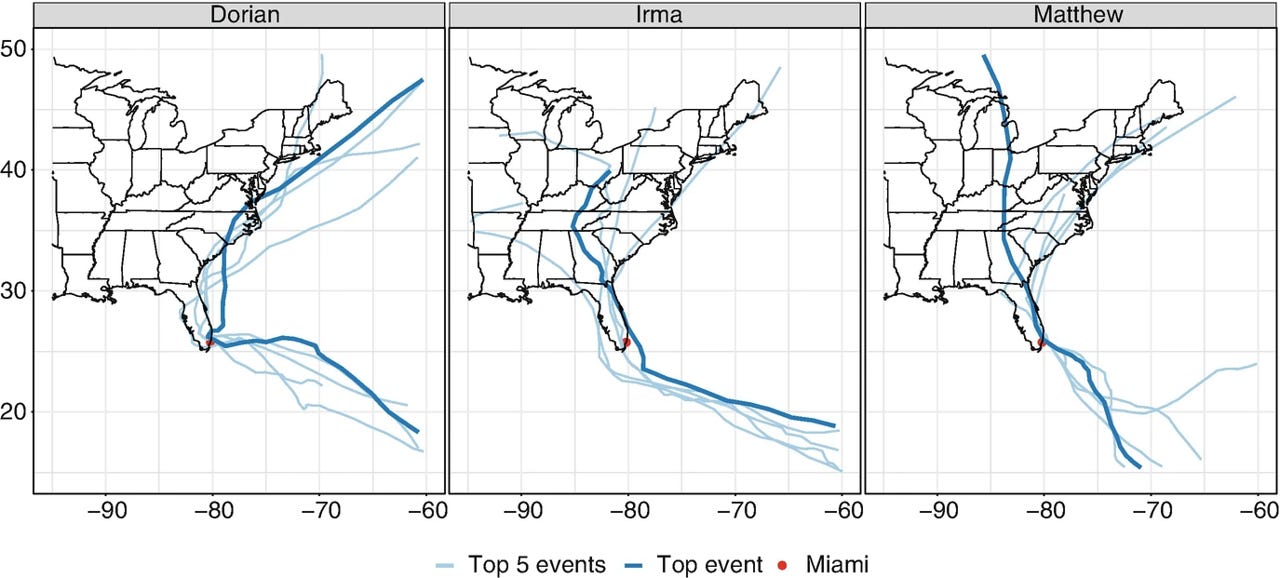
counterfactual analysis of hurricanes Matthew (2016), Irma (2017), and
Dorian (2019) finds that under a worst-case alternative track for each
storm, insured damages would have been $1.2 trillion, $525 billion, and
$250 billion respectively. These are massive numbers and suggest that the U.S. has not seen anything close to a worst case hurricane landfall.
“The
top five downward counterfactuals by gross industry loss for each
historical hurricane (light blue) and the top overall loss event (dark
blue). The location of the City of Miami is marked in red.” Source: Rye and Boyd 2022.
In
the worst-case counterfactuals, insured losses are nearly 300 times the
reported loss for Hurricane Matthew, 25 times higher for Hurricane
Irma, and over 250 times higher for Hurricane Dorian.
Europe
has experienced several significant drought events in the 21st century.
A long-term climate record shows that they are well within the bounds
of natural variability.
By using long-term
hydrological and meteorological observations, as well as paleoclimate
reconstructions, here we show that central Europe has experienced much
longer and severe droughts during the Spörer Minimum (~AD 1400–1480) and
Dalton Minimum (~AD 1770–1840), than the ones observed during the 21st
century. These two megadroughts appear to be linked with a cold state of
the North Atlantic Ocean and enhanced winter atmospheric blocking
activity over the British Isles and western part of Europe, concurrent
with reduced solar forcing and explosive volcanism. Moreover, we show
that the recent drought events (e.g., 2003, 2015, and 2018), are within
the range of natural variability and they are not unprecedented over the
last millennium.

No comments:
Post a Comment
Note: Only a member of this blog may post a comment.