Friday, December 27, 2024

Why Don’t EU Firms Innovate? The Hidden Costs of Failure

From The Conversable Economist. Excerpt:

"A simple-minded view of a business trying to innovate might go like this: You spend some money, hire some workers, give it a try–and if it fails to produce revenue, you take your losses, close the books, and shut it down. But what if the act of shutting something down imposes additional future costs? In that situation, a business may become reluctant to innovate, because of the higher costs for failure.

Yann Coatanlem and Oliver Coste argue that this dynamic can help to explain the lack of innovation among European technology firms in “Cost of Failure and Competitiveness in Disruptive Innovation” (Institute for Economic Policymaking at Bocconi University, Policy Brief, September 2024.

They write: “It is now widely understood that the R&D intensity gap of the European Union against the United States is driven by tech sectors: the United States private R&D in tech is now 6 time higher than in the EU.” They argue that Europe’s employment protection laws are a major factor driving this difference.

The details of employment protection laws vary across European countries, but in general, they make it harder to fire workers and often require that fired workers be paid for several months after firing. (OECD data comparing employment protection across countries is available here.) When a firm is faced with such laws, it reacts over time by finding ways to hire outside contract workers not covered by these laws, engaging in additional outsourcing and offshoring, and also investing in physical capital to reduce the need for future hiring.

If a firm is in a mature industry, where it is making money and its employment levels are not going to vary substantially over time, then employment protection laws may have only a moderate effect. But a new high-tech firm is a riskier proposition. It may involve hiring a substantial number of workers now, but given the uncertainty it faces, there is a realistic change that it will also need to fire those people. The authors note: “In a seminal paper, Gilles Saint-Paul has shown that high firing costs tend to direct R&D investment towards mature products rather than new ones. In an open economy, countries with high levels of employment protection tend to specialize in well established industries and leave innovation of new products to countries with less employment protection.”

How much higher are these firing costs in a country with substantial employment protection legislation? “Leveraging a combination of financial analysis, empirical observations, and limited existing literature, we estimate that restructuring costs (that include much more than severance packages) are approximately 10 times higher in countries with high labor protection, such as in Western Europe, than in countries with low labor protection such as in the United States.” It’s not just monetary costs, either: “In many European countries, such as Germany, France, Italy, the Netherlands, Sweden, and the UK, large companies must engage in extensive negotiations with trade unions and works councils. These discussions cover the scope, motivations, timing, team selection for redundancies, severance pay, and in some cases, employee retraining or support for finding new jobs.”

The resulting cost gaps show up in firm behavior.

The recent wave of tech layoffs illustrates key structural differences between the European and American models. For instance, in the U.S., Microsoft laid off 10,000 employees in January 2023, with severance costs totaling $800 million, or $80,000 per employee, equivalent to 5.9 months of median compensation. Similar figures were observed for Meta (4.2 months), 38 Google (7.5 months), and Twitter (3 months). What stands out in the American model is the agility of corporate decision-making. The rapid success of ChatGPT triggered immediate responses: Microsoft streamlined its workforce, invested $10 billion in OpenAI, and more in its own AI infrastructure. Meta paused its metaverse efforts, laid off 20,000 employees within months, and boosted its AI investments, spending a whopping $37 billion on computing infrastructure in 2024. Similarly, Google, facing challenges in search, halted major projects, laid off 12,000 employees, and accelerated on AI by ramping up its R&D investments to $43bn in 2023, including hiring tens of thousands of engineers with AI background. In Europe, the three tech leaders – Nokia, SAP, and Ericsson – also announced restructuring plans. Nokia, the largest European tech investor, presented a headcount reduction of up to 14,000 employees. Despite a sharp 21% sales decline last year necessitating immediate action, regulatory constraints in Germany, France, and Finland mean it won’t complete the restructuring until 2026. Similarly, SAP, Europe’s software leader, announced 8,000 layoffs, provisioning over 18 months of compensation globally, with more than three years required in Europe."

More Foreign Investment, Less Tariffs and Subsidies

By Tad DeHaven of Cato.

"Greenfield investment occurs when a foreign company establishes (or expands) a business in the US. Most foreign direct investment (FDI) in the US are acquisitions. However, the “US affiliates of foreign multinationals spend hundreds of billions of dollars per year in the United States on research and development and capital expenditures, with the biggest shares going to manufacturing.” In short, we should welcome it

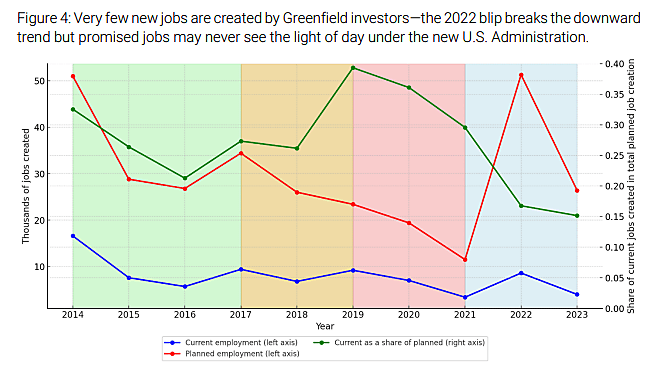
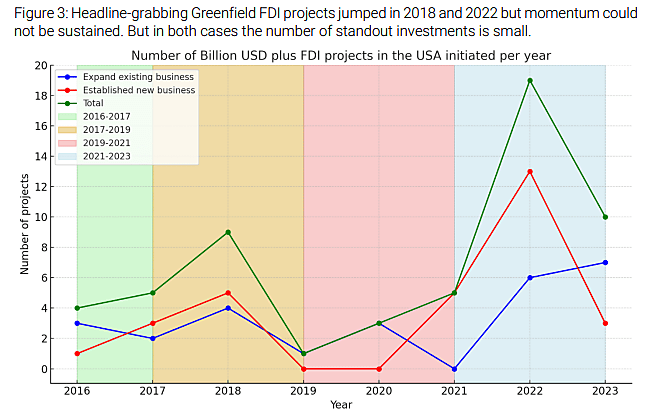
According to a new report from Global Trade Alert, however, neither the Trump tariff-driven approach to attracting greenfield investment to the US nor the subsidy-driven approach preferred by the Biden administration bore results beyond an initial “sugar high.” 

Greenfield FDI projects

Job creation, a stated aim of the presidents’ policies, trended south under both administrations. 

https://www.cato.org/commentary/last-refuge-politician

The report also looks at the degree to which import tariffs motivated foreign investment into US manufacturing (“tariff-jumping”). Only two of the eight manufacturing sectors show that imports may have been replaced with more foreign investment, which “cast doubt on the effectiveness of both Trump (sticks) and Biden (carrots-and-sticks) approaches to reviving US manufacturing in part by repatriating production from abroad.” 

FDI tariff-jumping

Circling back to FDI via acquisitions, Japanese Nippon Steel’s proposal to acquire US Steel for $14.9 billion, which would come with $2.7 billion in badly needed investment in American steel facilities, has been on the ropes thanks to opposition from the Biden administration. President-elect Trump is also opposed to the deal. The opposition from the presidents comes despite reports that 90 percent of US Steel employees favor the deal. 

Scott Lincicome has a detailed breakdown of the Nippon-US Steel matter. The main takeaway is that the Biden administration and Trump want the public to believe their opposition is based on national security concerns and “protecting workers.” The truth is they’ve both chosen to support union bosses at the expense of said workers and the economy in general. 

Tariffs and taxpayer subsidies did not make the American economy the world’s most successful. Instead, the US’s success stems from cultural, economic, and institutional strengths that foster innovation and entrepreneurship. Sure, we could (and need to) do better by improving our relatively favorable regulatory environment and getting our fiscal house in order. But nationalist trade and industrial policies are counterproductive—as is stopping allies from investing here to placate union leaders."


DOJ Jumps the Shark

By Clark Neily of Cato.

"Imagine you were operating a shark-diving charter boat in Florida and came across a long fishing line that you believed to be the work of poachers. You haul in the line, release a number of fish, and take the rig back to the marina after notifying state officials.

If it turns out you were mistaken and had actually stumbled onto a bona fide research project, would it be fair to charge you with “stealing” the line you hauled in and left on the dock? The US Department of Justice thought so and pursued felony charges against the two boat operators, John Moore and Tanner Mansell, for theft of property within the “special maritime jurisdiction” of the United States.

A jury reluctantly convicted Moore and Mansell after deliberating for longer than the entire trial took, sending out seven (!) notes to the judge, and nearly deadlocking. The Eleventh Circuit reluctantly affirmed, with Judge Barbara Lagoa—herself a former federal prosecutor—castigating the Assistant United States Attorney by name in her concurrence for “taking a page out of Inspector Javert’s playbook.” She noted that Moore and Mansell “never sought to derive any benefit from their conduct” and have been branded as lifelong felons “for having violated a statute that no reasonable person would understand to prohibit the conduct they engaged in.”

Yesterday, Cato filed an amicus brief urging the court to grant en banc review and reverse the convictions. The brief explains that for centuries, the greatest protection against unjust convictions and punishments was the institution of jury independence, including so-called “jury nullification.” But because modern judges have effectively nullified the power to nullify, it is all the more important that other defendant-protecting doctrines—such as the rule of lenity—be applied robustly. 

Because the jury instructions in this case reflected a broad conception of the word “steal” rather than a narrow one, Moore and Mansell are entitled to a new trial with a properly instructed jury."

Thursday, December 26, 2024

The consumer cost of creating each new job due to quotas on Japanese cars in the 1980s was $334,000

From Don Boudreaux. I think this is per year.

"from page 32 of Jin W. Lee’s May 1987 Master’s thesis in economics at Virginia Tech – a thesis, directed by the late David Meiselman, titled “The Cost of the Voluntary Export Restraint of Japanese Automobile Exports to the United States“:

The estimates show that the VER cost U.S. consumers an additional $1.0 billion in 1981, $2.7 billion in 1982, $2.6 billion in 1983, and $3.4 billion in 1984, for a combined total of $9.7 billion during 1981 — 1984….

The consumer cost of creating each new job was $334,000.

DBx: Using the Personal Consumption Expenditures Price Index to convert 1987 dollars into 2024 dollars, this latter figure is $780,450.

Only economically uninformed protectionists think that such a waste of resources increases the prosperity of the masses of the nation."

The New FDA and the Regulation of Laboratory Developed Tests

By Alex Tabarrok

"The FDA under President Trump and new FDA head Martin Makary should rapidly reverse the FDA’s powergrab on laboratory developed tests. To recap, laboratory developed tests (LDTs) are the kind your doctor orders, they are a service not a product and are not sold directly to patients. Congress has never given the FDA the authority to regulate LDTs. Indeed, in 2015, Paul Clement, the former US Solicitor General under George W. Bush, and Laurence Tribe, a leading liberal constitutional lawyer, wrote an article that rejected the FDA’s claims writing that the “FDA’s assertion of authority over laboratory-developed testing services is clearly foreclosed by the FDA’s own authorizing statute” and “by the broader statutory context.”

Moreover, in addition to legal reasons there are sound public policy reasons to reject FDA regulation of LDTs. Lab developed tests have never been FDA regulated, except briefly during the pandemic when the FDA used the declaration of emergency to issue so-called “guidance documents” saying that any SARS-COV-II test had to be pre-approved by the FDA. Thus, the FDA reversed the logic of emergency. In ordinary times, pre-approval was not necessary but when speed was of the essence it became necessary to get FDA pre-approval. The FDA’s pre-approval process slowed down testing in the United States and it wasn’t until after the FDA lifted its restrictions in March that tests from the big labs became available.

In a remarkably prescient passage, Clement and Tribe (2015, p. 18) had warned of exactly this kind of delay:

The FDA approval process is protracted and not designed for the rapid clearance of tests. Many clinical laboratories track world trends regarding infectious diseases ranging from SARS to H1N1 and Avian Influenza. In these fast-moving, life-or-death situations, awaiting the development of manufactured test kits and the completion of FDA’s clearance procedures could entail potentially catastrophic delays, with disastrous consequences for patient care.

We are seeing the same kind of FDA-caused delay for tests for bird-flu.

Moreover, unlike some of the proposals associated with incoming HHS head Robert Kennedy, reversing the FDA on lab-developed tests has significant support from a wide-variety of experts. Here, for example, is the American Hospital Association:

…we strongly believe that the FDA should not apply its device regulations to hospital and health system LDTs. These tests are not devices; rather, they are diagnostic tools developed and used in the context of patient care. As such, regulating them using the device regulatory framework would have an unquestionably negative impact on patients’ access to essential testing. It would also disrupt medical innovation in a field demonstrating tremendous benefits to patients and providers.

The Trump administration has a number of options:

…the LDT Final Rule was promulgated in time to escape Congressional Review Act scrutiny; however, the executive branch and a Republican-controlled Congress have other tools to limit or vitiate FDA’s authority. These include, in no particular order:

The U.S. Department of Health and Human Services (HHS) could revoke the LDT Final Rule. The recission of a rule is treated the same as the promulgation of a new rule. If HHS revokes the final rule, the cases will likely be dismissed as moot. The timing of such action is uncertain at this time.

FDA could extend or revise its policies of enforcement discretion. LDTs are currently subject to FDA’s phaseout policy which has five stages, the last of which begins in May 2028. Specific categories of IVDs will continue under an enforcement discretion policy indefinitely as described in the preamble to the final rule. HHS could quickly issue such a revised policy or policies without prior public comment if it determines such policy meets the threshold in 21 CFR 10.115(g)(2).

Congress could act. With a Republican-controlled House and Senate to start the new Trump administration, there is a chance that efforts to legislate the regulation of LDTs could be reignited. Based on prior congressional efforts, it is likely that such legislation would place LDTs under control by CMS and CLIA, rather than require LDTs to comply with FDA requirements.

HHS could let the litigation continue. The new administration may view the U.S. District Court for the Eastern District of Texas to be sympathetic to the Plaintiffs’ arguments and therefore proceed unabridged assuming the final rule will be struck-down, if that is indeed the deregulatory objective of the new administration.

The U.S. Department of Justice (DOJ) could act concerning the litigation. DOJ options are constrained by ethics rules but DOJ could request to amend its filings, pause the case pending rule-making proceedings, or take other actions intended to stall or moot the litigation in a deregulatory fashion."

Extreme iceberg calving events are statistically unexceptional and they are not necessarily a consequence of climate change

By Emma J. MacKie, Joanna Millstein, and Katherine A. Serafin.

"Abstract Massive calving events result in significant instantaneous ice loss from Antarctica. The rarity and stochastic nature of these extreme events makes it difficult to understand their physical drivers, temporal trends, and future likelihood. To address this challenge, we turn to extreme value theory to investigate past trends in annual maxima iceberg area and assess the likelihood of high‐magnitude calving events. We use 47 years of iceberg size from satellite observations. Our analysis reveals no upward trend in the surface area of the largest annual iceberg over this time frame. This finding suggests that extreme calving events such as the recent 2017 Larsen C iceberg, A68, are statistically unexceptional and that extreme calving events are not necessarily a consequence of climate change. Nevertheless, it is statistically possible for Antarctica to experience a calving event up to several times greater than any in the observational record. 

"Plain Language Summary In Antarctica, massive icebergs are a consequence of calving, where blocks of ice detach from the continent's ice shelf. The calving of these massive icebergs is a rare occurrence with unpredictable variability, making it a difficult process to understand and statistically model. Here, we study calving using a statistical method called extreme value theory (EVT), which is specifically designed to model the nature of extreme events. We use EVT to statistically analyze the largest Antarctic calving events over the past 47 years; these calving events have been recorded in satellite observations. Our results show that the risk of experiencing a major calving event has not increased over the last 47 years, which suggests that climate change is not necessarily responsible for the calving of these large icebergs. However, it is statistically possible that Antarctica could generate bigger icebergs than any previously recorded. The methods used in this study could be combined with other data sets or physical information to enhance calving models that scientists use to make predictions about ice shelves."

Monday, December 23, 2024

California’s EV Mandate on Trial

The Supreme Court takes up a challenge to the EPA’s damaging emissions waiver for the Golden State

WSJ editorial

"What fortuitous timing. As the Biden Administration prepares to green-light an extension of California’s electric-vehicle mandate, the Supreme Court on Friday agreed to hear a challenge to the rule (Diamond Alternative Energy LLC v. EPA).

The Clean Air Act bars states from regulating vehicle emissions, but it allows the Environmental Protection Agency to grant California a waiver to enforce its own rules “to meet compelling and extraordinary conditions.” Congress created the California carve-out because its geography and climate can exacerbate smog.

Unlike tailpipe pollutants such as NOx and particulate matter—the intended targets of the Clean Air Act—CO2 is ubiquitous and doesn’t cause asthma or other respiratory ailments. Because the climate effects of greenhouse gases are global, California has no more compelling reason to regulate vehicle CO2 emissions than any other state.

The Obama Administration nonetheless granted California a waiver for its CO2 standards and EV quotas, which the Trump team revoked, only for the Biden EPA to reinstate it through next year. The Administration is expected in its final days to renew California’s waiver through 2035, when all new cars sold in the state (and other states that have adopted its mandates) must be “zero emission.” Sorry, no hybrids allowed.

Most auto makers are falling well short of California’s EV quotas. Many are buying compliance credits from Tesla, though some have also struck deals with the California Air Resources Board for regulatory flexibility in return for not supporting a rollback of its waiver authority. Although auto makers gripe about California’s EV mandate, they’re afraid to sue their regulators.

Not so refiners and gas stations, which are challenging the EPA’s California waiver. A D.C. Circuit Court of Appeals panel dismissed their suit on grounds that the plaintiffs lacked standing. To sue in federal courts, plaintiffs must demonstrate a concrete injury as a result of a defendant’s actions that can be redressed by courts.

The express purpose of California’s EV mandate is to reduce gasoline consumption, which would hurt gas stations and refiners. But the D.C. Circuit quibbled that the plaintiffs hadn’t submitted evidence, such as affidavits from auto makers, showing that the waiver would reduce gas-powered car production. Say what?

Enter the Supreme Court, which on Friday agreed to review the D.C. Circuit ruling. If the Justices rule that the plaintiffs have standing, the D.C. Circuit would have to address the merits—i.e., whether the EPA can let California regulate auto CO2 emissions—which will be all the more important if Mr. Biden extends California’s waiver through 2035.

While Donald Trump has pledged to revoke California’s waiver, the Golden State sued him last time he did. So courts may have to decide the issue, as the U.S. auto trade group noted in a memo to “interested parties” last week. “Achieving [California’s] mandates will take a miracle” and “depress economic activity, increase costs and limit vehicle choice,” the group stressed.

How about auto makers tell that truth to the Justices?"