"The Financial Times is one of my favorite newspapers, with lots of good columnists. Rana Foroohar is my least favorite FT columnist. Her columns often attack neoliberalism by citing lots of economic problems that are in fact caused by counterproductive government regulations.
Foroohar recently posted a brief review of a book entitled, The Death of Public School. The first two sentences contain four important errors—can you spot them?Education used to be a way to get ahead in America. But the defunding of public schools and the rise of private education is increasing, rather than reducing the wealth divide.
1. When I was young, blue color workers often made as much as college professors. My first job as a professor (in 1981) paid $19,300. At the time, there were UAW autoworkers at Michigan plants earning more than that. The obsession with getting into the top schools was much less pronounced in the 20th century, as the education/income gradient was much flatter than today. Thus, the first sentence in Foroohar’s review gets things exactly backward. Education is now a much more important way to get ahead than in earlier decades.
2. Not only have American public schools not been “defunded,” spending on public education has risen over time, even in real terms (and as a share of GDP). Spending in the US is high when compared to other developed countries. Spending is especially high in poor neighborhoods in some of our biggest cities. The quality of education at a given school depends largely on whether the students at that school come from families that emphasize education, not dollars spent. So Foroohar’s second claim is incorrect.
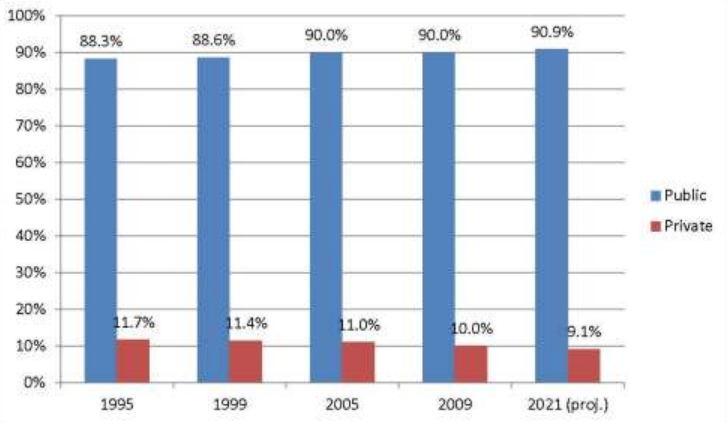
3. There is no “rise of private education” in the US. The Huffington Post reports that:Proportion of U.S. Students in Private Schools is 10 Percent and Declining
Here’s the graph they provide:
4. And since private education is not on the rise, it hardly seems likely that the rise of private education is increasing the wealth gap.
Well meaning people can have different interpretations of recent trends. But any discussion of those trends should be based on rigorous facts, not lazy clichés."
Friday, June 23, 2023
Is education no longer a way to get ahead in because of the defunding of public schools and the rise of private education that is increasing, rather than reducing the wealth divide

Tuesday, June 20, 2023
Canadian Wildfires Came From Rotten Luck, Not Climate Change
Extreme weather results from a combination of random factors in a complicated system
By Clifford Mass. He is a professor of atmosphere sciences at the University of Washington. Excerpts:
"Headlines suggested that the primary culprit was climate change, but these claims are inconsistent with peer-reviewed science, the observational record and our growing understanding of the meteorology associated with wildfire events."
"An unusual atmospheric circulation resulted in wildfire ignition and rapid growth, with an intense low-pressure area pushing undiluted smoke into the New York area. Global warming was only a minor player in this event.
The recent wildfires occurred in the boreal forests of northern Quebec. Fire isn’t rare in that region. The ecology of these forests relies on fire for the release of seeds and forest health. Many of the major boreal fires occur during a narrow temporal window from mid-April through early June, just after the winter snow has melted and before grasses and other small plants grow, reducing flammability. During this short window, the dead vegetation from the previous year can dry out sufficiently to burn if there is an ignition source such as lightning or errant human activity."
"Many of the great Quebec fires have occurred during the spring"
"Large boreal forest fires during the spring in Canada are neither unusual nor a sign of climate change."
"The weather prior to the warm spell wasn’t unusually dry, with the Canadian drought monitor showing normal moisture conditions and temperatures near or below normal."
"It was the perfect storm for smoke in New York, with several independent elements occurring in exactly the right sequence. It’s difficult to find any plausible evidence for a significant climate-change connection to the recent New York smoke event. The preceding weather conditions over Quebec for the months prior to the wildfire event were near normal. There is no evidence that the strong high pressure over southern Canada that produced the warming was associated with climate change"
"there is a deep literature in the peer-reviewed research that demonstrates no amplification of high- and low-pressure areas with a warming planet."
"The number of wildfires in Quebec is decreasing; there is no upward trend in area burned, which would be expected if global warming was dominant."
Why America Isn’t Ready for the EV Takeover
Software glitches, inaccurate range estimates and clunky charging options all limit adoption
By Christopher Mims. Excerpts:
"The way the Environmental Protection Agency tests electric vehicles can yield results that differ significantly from the actual range of the vehicle under real-world driving conditions, according to a recent paper on the subject"
"All kinds of conditions—from speed to changes in elevation—can have a big impact on how much energy a vehicle uses. In some contexts, like stop-and-go driving in a city, an EV can exceed its rated range. In others, like very cold weather, EVs can suffer a big drop in range—as much as 30%, according to another recent study."
"most drivers don’t learn this until they’ve had significant experience with an EV."
"While America has more fast chargers than ever, for those on road trips, or with longer commutes, the convenience of not having to stop frequently to recharge is neutralized when parking lots, hotels and restaurants don’t have charging stations.
The Biden administration has committed $7.5 billion to increasing the number of chargers in the U.S."
"These efforts still don’t address the paucity of chargers in places people are already stopping for long stretches."
"EV fans are fond of saying that their vehicles are more reliable, and require less maintenance, than conventional autos, because they have far fewer moving parts. This is true, but they can also be more complicated in terms of the nature and amount of software they contain.
At one point on my trip, the Lucid Air I was driving refused to connect with my iPhone through Apple CarPlay, forcing me to ditch the safer hands-free mode of navigation I’d been relying on, and navigate with Waze on my phone. The only solution I found was restarting the car’s infotainment system—and unlike your phone or laptop, there’s no button to accomplish this. It took me a half-hour of fiddling to figure out that changing user profiles would force the Android Automotive software running on the car to restart, which solved my connectivity issue.
"But wait, how is it that my iPhone was connected to an Android system on this vehicle?
The short answer is that cars have become computers—or really, smartphones—on wheels. This means that some of the computers in our vehicle have become a battleground between Apple, Google and automakers themselves."
"Just as PCs run Windows, Macs run MacOS, and iPhones and Android phones run on iOS and Android, those big displays in new EVs need their own operating systems. Typically, these are separate from the systems in a car that absolutely can’t fail under any circumstances—like the drive-by-wire system that connects the steering wheel to the wheels—but in some ways they’re no less important."
"As Tesla has demonstrated, a car that can gain new abilities with a software update can become more useful over time, just like our phones. But this also opens up new security vulnerabilities, and has exposed the fact that many traditional automakers just aren’t that well equipped to create software for vehicles, says Mohit Sharma, a research analyst at Counterpoint Research who studies the automotive industry."
"when I arrived at a street charging station in Montreal, and discovered that I’d have to download an app and prepay for the electricity I wanted to use. Cell service was dodgy, and I had to find a better signal to download the app. Had I been unable to find a decent signal, I would have been out of luck. (Even once I downloaded the app, the first station I connected to didn’t work—another issue that sometimes comes up at charging stations.)"
"things that should be convenient—payments, reliable chargers—are still beset by the kinds of first-generation design issues that feel like they should have been worked out already."
Monday, June 19, 2023
Bidenomics and Its Contradictions
Competition with China has reinforced President Biden’s commitment to industrial policy, but his vision for government intervention carries risks for the U.S. economy and allies
By Greg Ip. Excerpts:
"One policy they don’t consider a part of Biden’s industrial strategy is new restrictions on the export of semiconductor technology to China. Sullivan said in April that such restrictions are solely aimed at national security"
"basic economics tells us that capital and labor are finite, so they need to be allocated in a way that maximizes productivity and growth. Experience has shown, painfully, that governments are much worse at this than markets. Market failures exist, of course, such as pollution or military vulnerability, but they are exceptions.
Bidenomics accepts the value of markets but sees market failure all around, in everything from regional, racial and gender inequities to the lack of rural high-speed internet and affordable child care.
When market failure is so broadly defined, there is effectively no limiting principle on government intervention. And indeed, Biden and other leading Democrats have argued for special treatment for countless products and industries with only the most tenuous connection to military or economic security, such as the drywall and lumber used in infrastructure.
Ro Khanna, a progressive who represents Silicon Valley in Congress, wants the sort of subsidies now directed to semiconductors to go also to aluminum, steel, paper, microelectronics, auto parts and climate technology. “America needs to be able to make basic things here. I would go to factory town after factory town and see what we can do to revitalize that place,” he said in April.
But the U.S. doesn’t have the capacity to supply everything it now imports. Diverting workers to make things that can be imported more cheaply raises costs and takes scarce workers away from industries that might be more productive. Industrial policy “does not create jobs; it merely shifts jobs from one place to another,” wrote Adam Posen, president of the Peterson Institute for International Economics, in a recent critique. “As for idle workers with the right skills,” he continued, “they don’t really exist.”
Unlike solar panels, semiconductors are critical to both civilian industry and military defense, and even many neoliberals support subsidies to reduce U.S. dependence on China, Taiwan and South Korea. But in keeping with Bidenomics’ broad definition of market failure, the Commerce Department has said the subsidies are contingent on the willingness of recipients to meet a range of other administration goals: to offer child care, pay union-scale wages, hire unionized workers, refrain from buying back stock or investing in China, and share profits with the federal government. Saddling industrial policy with so many ancillary goals dilutes its impact.
The foreign and domestic arms of Bidenomics are also at odds with each other, despite Sullivan’s insistence that they are complementary. While seeking solidarity with like-minded partners against Russia and China, the buy-American policies of the Biden administration discriminate against those same partners.
Biden credits last year’s Inflation Reduction Act for a boom in newly announced electric-vehicle and battery factories in the U.S., but other countries have complained because the law’s most generous subsidies go only to vehicles assembled in North America. “The U.S.A. is our partner of shared values, but at the same time there is an enormously protectionist economic policy,” German finance minister Christian Lindner told a German newspaper."
"Unlike Donald Trump, Biden isn’t seeking to tear up existing free trade agreements or to raise tariffs. But neither is he interested in new trade agreements or lowering tariffs. His Indo-Pacific Economic Framework seeks cooperation with allies in the region on labor conditions, climate policy, tax compliance and corruption, but it doesn’t offer increased access to the U.S. market in return, as the TPP, its rejected predecessor, did. To foreign trade partners, it’s an underwhelming proposition. Instead of a carrot and stick, “it’s a stick and a stick,” one Indonesian official said.
So what’s the alternative to Bidenomics? By itself, more generous access to the American market won’t win over more Asian countries to the side of the U.S. in confronting China. But like the Cold War, the contest with China will be a long game. Without “a proactive trade strategy with the region, the U.S. absence creates a vacuum that makes China the only game in town, and the U.S. loses influence,” said Doug Irwin, a trade policy historian at Dartmouth College."
"Even if the U.S. stays out of TPP, there are ample other ways to deepen trade ties. Rahm Emanuel, who served under both Bill Clinton and Obama and is now the U.S. ambassador to Japan, has argued for exporting Alaskan liquefied natural gas to Japan, though that runs counter to Biden’s long-run climate goals. Asian countries “want our military leadership, our diplomatic leadership and our economic leadership,” Mr. Emanuel said in an interview.
Indeed, that’s a Cold War lesson that Bidenomics has failed to learn. Until very recently, U.S. presidents thought that trade and investment, by binding other countries more closely to the U.S., helped to sustain the U.S.-led international order. “Our maintenance of Western political unity depends in equally large measure upon the degree of Western economic unity,” President John F. Kennedy said in 1962, asking Congress for expanded authority to negotiate trade agreements."
The Great Covid Business Migration
WSJ editorial. Excerpts:
"The bureau examined trends in single-establishment business migration since the early 1990s using data from its quarterly census on employment and wages. It found that while migration fell during the 2001 and 2007-2009 economic downturns as business activity generally slowed, moves accelerated during the Covid lockdowns.
BLS counted 6,384 businesses in 2021 that had moved across state lines during the prior year, up from 5,524 in 2020 and 3,677 in 2010. Net migration to the South and from the Northeast doubled between 2020 and 2021. After gaining businesses from other states for most of the last three decades, the West lost a net 175 in 2021—mostly from California.
New York led in net business out-migration (487), followed by California (456), Illinois (208), Maryland (50) and Pennsylvania (33). Florida (399), North Carolina (148), Nevada (103), Texas (103) and Tennessee (92) drew the most businesses from other states. All besides North Carolina have no income tax."
"Another new study this week from SmartAsset estimated that an individual earning $200,000 in Manhattan would save $64,567 in taxes and the cost of living by moving to Miami, while someone making $650,000 would come out ahead by $195,076. Higher earners in San Francisco would save about 25% of their income by moving to Miami."
"One result is turmoil in commercial real estate in New York City, San Francisco and Chicago. Another is persistent higher unemployment in California (4.5%), Illinois (4.2%) and New York (4%), compared to a national average of 3.7% and 2.6% in Florida. Unemployment in New York City is three times higher than in Miami."
Sunday, June 18, 2023
Adam Smith’s Solution to Poverty
By Rainer Zitelmann. Excerpts:
"A famous passage from “The Wealth of Nations”: “No society can surely be flourishing and happy, of which the far greater part of the members are poor and miserable. It is but equity, besides, that they who feed, clothe, and lodge the whole body of the people, should have such a share of the produce of so much of their own labor as to be themselves tolerably well fed, clothed, and lodged.”
Today, these words are sometimes misinterpreted to claim that Smith advocated government-led redistribution of wealth. That wasn’t his intention, and he certainly wasn’t calling for social revolution. Poverty, according to Smith, wasn’t preordained, and above all, he didn’t trust government. He points out that only economic growth can raise living standards. Continuous economic growth is the only way to raise wages, and a stagnant economy leads to falling wages. Elsewhere he writes that famines are the result of government price controls."
"Smith was right about the effects of economic growth, as the past few decades have confirmed. In recent years, the decline in poverty has accelerated at a pace unmatched in any previous period of human history. In 1981 the absolute poverty rate, which the World Bank currently defines as living on less than $1.90 a day, was 42.7%. By 2000, it had fallen to 27.8%, and today it is less than 9%.
Smith predicted that only an expansion of markets could lead to increased prosperity. This is precisely what has happened since the fall of socialist planned economies. In China, the introduction of private property and market reforms reduced the share of people living in extreme poverty from 88% in 1981 to less than 1% today. Free-market economist Zhang Weiying of Peking University says, “China’s rapid economic development over the past four decades is a victory of Adam Smith’s concept of the market.” Contrary to prevailing interpretations in the West, Mr. Zhang says economic growth and declining poverty in China weren’t “because of the state, but in spite of the state,” caused by the introduction of private property."
"he warned in a [1755] lecture: “Man is generally considered by statesmen and projectors as the materials of a sort of political mechanics. Projectors disturb nature in the course of her operations in human affairs; and it requires no more than to let her alone, and give her fair play in the pursuit of her ends, that she may establish her own designs. . . . All governments which thwart this natural course, which force things into another channel, or which endeavour to arrest the progress of society at a particular point, are unnatural, and to support themselves are obliged to be oppressive and tyrannical.”"
Charter Schools: New Evidence of Student Success
A nationwide Stanford study shows huge learning gains over union schools
WSJ editorial. Excerpts:
"Stanford’s Center for Research on Education Outcomes (Credo) report is the third in a series (2009, 2013, 2023) tracking charter-school outcomes over 15 years. The study is one of the largest ever conducted, covering over two million charter students in 29 states, New York City and Washington, D.C., and a control group in traditional public schools."
"Most charter schools “produce superior student gains despite enrolling a more challenging student population.” In reading and math, “charter schools provide their students with stronger learning when compared to the traditional public schools.” The nationwide gains for charter students were six days in math and 16 days in reading."
"In New York, charter students were 75 days ahead in reading and 73 days in math compared with traditional public-school peers. In Illinois they were 40 days ahead in reading and 48 in math. In Washington state, 26 days ahead in reading and 39 in math."
"Credo’s first study in 2009 found that charters didn’t yield better student outcomes—and has long been cited by charter opponents. Teachers unions often claim charters and choice programs betray public education because they cherry-pick children and fail to serve those in greatest need. Credo’s results should also end that discussion."
"black and Hispanic students had some of the largest gains and that they “advance more than their TPS peers by large margins in math and reading.” Ditto for children in poverty."
"Around 15% of charters underperform their local public school, but lackluster charters are closed, unlike failing union schools."