Monday, December 4, 2023

Elizabeth Warren Has an ObamaCare Epiphany

The Senator complains about the industry consolidation and price increases caused by the healthcare law

WSJ editorial.

"It took 13 years, but Elizabeth Warren is at long last acknowledging that ObamaCare has increased healthcare prices and industry consolidation. Who would have believed it? Government price controls and profit caps have resulted in unintended consequences.

The Massachusetts Senator and Republican Sen. Mike Braun of Indiana this week wrote a letter to the Health and Human Services Department inspector general complaining that the nation’s largest health insurers are dodging ObamaCare’s medical loss ratio (MLR). The result, they say, is higher costs for patients.

The MLR is a de facto cap on profits. It requires that insurers spend at least 80% or 85% of premium dollars on medical claims. Democrats claimed the rule would make health spending more transparent and reduce insurer spending on overhead. “Consumers will receive more value for their premium dollar,” the Obama HHS said.

Instead, as we’ve been pointing out for years, the rule has spurred insurers to merge with or acquire pharmacy benefit managers (PBMs), retail and specialty pharmacies, and healthcare providers. This has made healthcare spending less transparent since insurers can shift profits to their affiliates by increasing reimbursements.

The Senators cite a Journal news story in September that found insurers were paying affiliated specialty pharmacies more than 20 times for generic drugs what manufacturers charged. Patients can get slammed by hefty out-of-pocket cost for these drugs if they have high deductibles or co-insurance requirements.

“Even worse,” the Senators write, “insurers can use their PBMs to steer patients to their own pharmacies, while disadvantaging competing pharmacies with lower reimbursements and predatory fees.” In a 2017 editorial we highlighted complaints that CVS’s PBM was paying independent pharmacies less than the wholesale drug cost while billing Medicaid for significantly more.

The Senators complain that insurers have evaded the MLR by vertically integrating with other companies in the healthcare supply chain. “

, United Health, and CVS Aetna each own or are affiliated with the country’s three largest PBMs,” they write. Insurers are also increasingly buying providers. CVS this year acquired primary care provider Oak Street Health.

“Just a year after the MLR requirement was put in place,

formed Optum, which now includes a PBM and a specialty pharmacy, as well as over 70,000 physicians,” the Senators write. Coincidence? “Today, UnitedHealth Group sends 25 percent of its medical claim revenue to its Optum subsidiaries—in other words, to itself.”

They correctly point out that an insurance conglomerate can inflate medical payments to affiliates to comply with the MLR “while keeping more money for itself.” Market competition would normally act as a check on premiums and profits. However, by driving industry consolidation, ObamaCare has reduced healthcare competition and increased costs.

Hospitals have acquired independent physician practices to gain more leverage with vertically integrated insurers, allowing them to bill more for services. Independent pharmacies have closed or been sold to the giants. It’s no surprise, then, that health premiums have risen on average about 20% faster since 2011 when the MLR took effect than in the five preceding years.

ObamaCare’s market distortions are spurring a bipartisan movement in Congress to regulate PBMs. It’s a familiar story: Big government intervention creates incentives and raises costs that help big business, and then politicians demand more government intervention to fix the distortions they caused."

Sunday, December 3, 2023

‘Net Zero’ Fails the Cost-Benefit Test

As COP28 opens, two new studies show that extravagant climate promises are far more wasteful than useful.

By Bjorn Lomborg. Excerpts:

"A new special issue of the journal Climate Change Economics contains two ground-breaking economic analyses of policies to hold global temperatures to 1.5 degrees and its practical political interpretation, mandates to reach net zero, usually by 2050. Though more than 130 countries, including most of the globe’s big emitters, have passed or are considering laws mandating net-zero carbon emissions, there’s been no comprehensive cost-benefit evaluation of that policy—until now.

One of the Climate Change Economics papers is authored by Richard Tol, one of the world’s most-cited climate economists. He calculates the benefits of climate policy using a meta-analysis of 39 papers with 61 published estimates of total climate change damage in economic terms. Across all this, Mr. Tol finds that if the world meets its 1.5 degree promise, it would prevent a less than 0.5% loss in annual global domestic product by 2050 and a 3.1% loss by 2100.

If that sounds underwhelming, blame one-sided reporting on climate issues. While headlines tend to focus on stories of violent climate catastrophes and modeled worst case scenarios, the data reveal a far less frightening picture. Despite a drumbeat of stories this summer about rising heat deaths, higher temperatures also prevent cold deaths, and so far in much greater number. Globally, the result has been fewer overall temperature-related fatalities. Writ large, the damage the world experiences each year from climate-related disasters is shrinking, both as expressed in fraction of GDP and lives lost."

"the costs, which Mr. Tol’s analysis shows are substantial. Based on the latest cost estimates of emission reductions from the United Nations climate panel, he finds that fully delivering on the 1.5-degree Paris promise will cost 4.5% of global GDP each year by midcentury and 5.5% by 2100. This means that likely climate policy costs will be much higher than the likely benefits for every year throughout this century and into the next."

"He unrealistically assumes governments will implement policies that meet these temperature targets at the lowest possible cost, such as a globally uniform, increasing carbon tax. In real life, climate policy has been needlessly expensive, with a plethora of inefficient, disconnected measures such as electric-vehicle subsidies. Studies show that the policies actually being enacted to curb carbon emissions will cost more than twice the theoretical expense Mr. Tol outlines.

This is borne out in the second Climate Change Economics study. The peer-reviewed paper from MIT economists identifies the cost of holding the temperature’s rise below 1.5 degrees as well as that of achieving net zero globally by 2050. The researchers find that these Paris policies would cost 8% to 18% of annual GDP by 2050 and 11% to 13% annually by 2100."

"initial carbon cuts are cheap and prevent the most damaging temperature rise—but net zero doesn’t. Averaged across the century, delivering the Paris climate promises would create benefits worth $4.5 trillion (in 2023 dollars) annually. That’s dramatically smaller than the $27 trillion annual cost that Paris promises would incur"

"each dollar spent will avoid less than 17 cents of climate damage."

"A study by a researcher for the Copenhagen Consensus shows that competitive government investment in green R&D would be 66 times as effective as Paris policies, while costing between 1% and 10% as much."

DeSantis vs. Newsom: a Scorecard

Here’s a cheat sheet to keep track of Thursday’s debate between the Florida and California governors.

WSJ editorial

"Gavin Newsom and Ron DeSantis are set to square off Thursday evening in a Fox News debate, and it should be instructive. Besides offering voters a look of the alternatives to Joe Biden and Donald Trump, the showdown between the California and Florida governors could provide a revealing policy contrast.

Sacramento has rushed to the left in recent decades while Tallahassee has moved to the right. Since winning election in 2018, Messrs. Newsom and DeSantis have advanced sharply different policies on Covid lockdowns, taxes, school choice and climate regulation, among other things. In case you’ll be keeping track at home, here is a scorecard of policy results.

Employment. Since January 2019, employment has increased by 1,031,030 in Florida while declining by 85,438 in California. Amid Mr. Newsom’s prolonged Covid lockdowns, businesses and workers moved to places with a lower tax burden and cost of living. Florida’s population is 22.2 million and rising, while California’s is 39 million and falling.

Unemployment. Despite a shrinking labor force, California’s 4.8% jobless rate is the second highest in the country and nearly twice as high as Florida’s (2.8%). California has paid $48.7 billion in unemployment benefits since January 2019—nine times as much as Florida. One reason for the disparity: Fewer Californians are starting businesses.

Business formation. Florida has received 2.7 million new business applications since January 2019—one for every eight residents—compared to 2.3 million for California, or about one for every 18 residents. Small businesses in California pay a top income-tax rate of 13.3% compared to zero in Florida, contributing to the Golden State’s more onerous business burden.

Personal income. Business and worker earnings have increased by an annual compounded 7.7% (in current dollars) in Florida since the first quarter of 2019 compared to 5% in California. Had California’s earnings grown at the same rate as Florida’s, the Golden State would be about $255 billion richer and collect tens of billions of dollars in more tax revenue.

Population migration. Between July 2019 and July 2022—the latest available Census Bureau data—1,044,494 Californians left for other states while 737,433 people on net moved to Florida. According to the latest IRS data, California lost $55.7 billion in adjusted gross income between 2019 and 2021 from population migration while Florida gained $80.6 billion.

• Energy prices. Electricity prices are twice as high in California as in Florida owing to green energy mandates. Californians also pay about $1.80 more per gallon for gasoline on average than Floridians because of higher taxes and climate regulation. Gas prices have increased about 70 cents more per gallon under Mr. Newsom than Mr. DeSantis.

Taxes and spending. State and local taxes in California add up to $10,167 per capita versus $5,406 in Florida. Higher taxes drive more spending. California spent about $14,755 per capita (including federal dollars) in 2021 compared to $8,816 in Florida.

Pensions. Public-worker pension payments were $51.2 billion in California last year versus $7.3 billion in Florida. To fund growing pension bills, Californians will have to pay even higher taxes. Each Californian is on the hook for about $18,500 in unfunded pension obligations compared to $5,200 for each Floridian.

Medicaid. California spends $129.2 billion annually on Medicaid—more than four times as much as Florida ($39.7 billion). California has expanded Medicaid coverage to illegal immigrants under the ages of 26 and over 50. Next year all undocumented immigrants in California will be eligible for Medicaid.

Homelessness. The federal government counted 171,521 homeless in California last year versus 25,959 in Florida. California’s Prop. 47—which was backed by Mr. Newsom—has effectively decriminalized drug use, making it harder to force addicts on the street into treatment.

Deficit. Despite its higher taxes, California boasted a $31.5 billion budget shortfall in May while Florida ran a $17.7 billion surplus. Personal income tax collections in California for the current fiscal year that started in July are running about $20 billion below Sacramento’s projections, auguring another large deficit.

Student learning. California spends about 45% more per pupil on K-12 education than Florida, but its student test scores are significantly lower, according to the National Assessment of Educational Progress. Only 30% of fourth-graders in California rated proficient in math last year compared to 41% in Florida. California’s prolonged pandemic school shutdowns magnified learning loss.

Our guess is that Mr. Newsom won’t want to talk about much of this and will instead spend most of his time flogging abortion and Donald Trump. But that will be revealing too."

Saturday, December 2, 2023

Wall Street Journal reports consumer frustrations with over-regulated appliances

By Ben Lieberman of CEI.

"2023 is turning into the year of bad appliance regulations. Since January, CEI has submitted comments critical of proposed Department of Energy (DOE) efficiency standards for dishwashers, washing machines, stoves, and water heaters. Meanwhile, earlier rules for air conditioners, furnaces, and light bulbs took effect this year.

All threaten higher prices and reduced product performance, but perhaps worst of all are the proposals to tighten the already-strict energy and water use limits for dishwashers and washing machines. A November 24 Wall Street Journal article by Austen Hufford, “Why Does My ‘Efficient’ Dishwasher Take a Zillion Minutes for a Load?”, documents the struggles many consumers face from these standards as well as the lengths some must now go to get their dishes and clothes clean.

The most noticeable defect is the big increase in the time it takes to do a load of dishes. The article cites data compiled by CEI showing cycle times rising from 70 minutes in 1983 – before the multiple rounds of successively tighter dishwasher standards took effect – to 160 minutes this year. Even DOE admits that its regulations are the culprit, noting that “[t]o help compensate for the negative impact on cleaning performance associated with decreasing water use and water temperature, manufacturers will typically increase the cycle time.”  

Adding to the inconvenience, consumers also report having to rinse the dishes before and/or after running them in the dishwasher to get them sufficiently clean, or running them twice.  Apparently, efficiency with regard to homeowners’ time is not a consideration when setting efficiency regulations.

For washing machines, the current regulations mandate so little water be used that homeowners have had to take matters into their own hands to get their clothes clean. The article describes how some consumers have learned to dump extra water into their machines mid-cycle, while others risk voiding the warranty by tinkering with their washers to increase the flow.

Rather than consider a fix to these problems, DOE is doubling down by proposing even tighter requirements for dishwashers and washing machines that are likely to make things worse. As with so much irrational policy coming from Washington, these proposed rules are justified in part by the claimed climate benefits from a further ratcheting down of energy and water limits.   

The only good news is that Congress is fighting back. A new dishwasher or washing machine regulation would likely be subject to a resolution of disapproval under the Congressional Review Act. However, any such action by Congress would need to be signed into law by a president who is very unlikely to reject a rule his own bureaucrats came up with – and who has shown little flexibility on any measure the administration claims will help save the planet from climate change. Nonetheless Congressional action could at least set the stage for a future rejection of these bad dishwasher and washing machine rules – and along with them the whole DOE regulatory program that targets all home appliances."

Joe Biden and Jobs

By Dan Mitchell.

"It’s very hard to give Joe Biden a good grade for economic policy after examining issues such as subsidies, inflation, protectionism, household income, fiscal policy, red tape, employment, and poverty.

So I was surprised last night when Governor Gavin Newsom of California said Biden deserved high marks. And his main piece of evidence was that Biden supposedly created millions and millions of new jobs.

Politicians don’t create jobs, of course, but let’s ignore that bit of rhetorical sloppiness. And let’s also ignore the absurdity of a politician trying to take credit for the economy’s bounce-back from the pandemic.

Instead, let’s dispassionately analyze the job market’s performance during Biden’s time in office

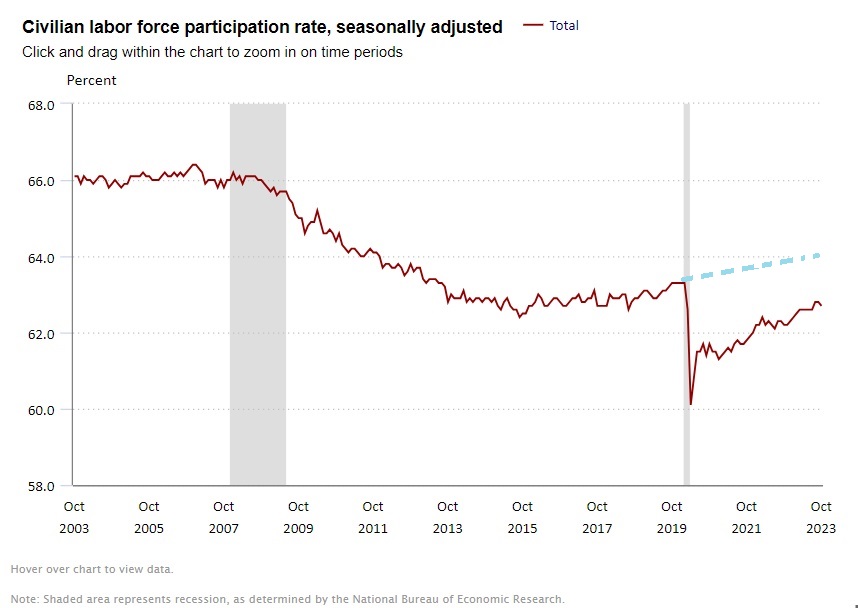
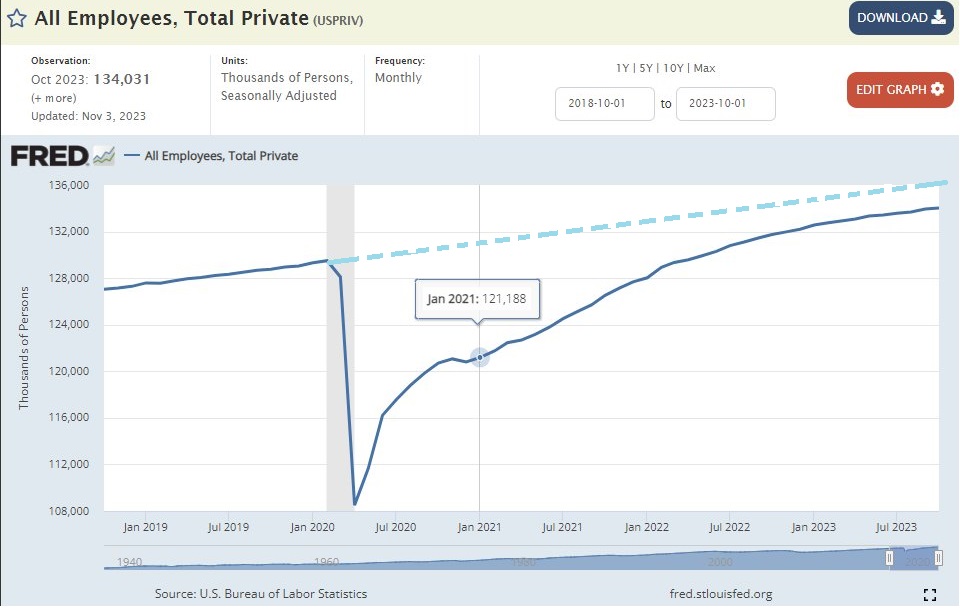
Looking at the St. Louis Federal Reserve Bank’s data, the good news (from the Biden-Newsom perspective) is that there has been a big increase in employment since January of 2021.

But there’s also bad news. If you extrapolate based on the job market’s performance before the pandemic – which I did with the dashed line – you can see that the economy is still lagging.

To be sure, this data is not evidence that Biden’s policies have prevented the economy and job market from fully recovering.

But the numbers also show that it is silly to assert that the president has overseen some sort of employment miracle. Or even that he’s done a good job.

Biden’s track record on employment looks even more suspect when you review the Labor Department’s data on job market participation. I’ve created a dashed trend line and once again we see that that economy is lagging its pre-pandemic performance. In this case, the lag is even greater.

These numbers are very revealing. After all, it is not exactly great news if the unemployment rate is low merely because workers have given up and dropped out.

Which seems to be one of Biden’s big legacies, especially when you compare the United States to other industrialized nations."

Friday, December 1, 2023

Junk Fees in Rental Housing Are a Distraction

By Vanessa Brown Calder of Cato.

"So‐​called junk fees have become a popular topic this year, and rental housing is a particular area of interest as US markets struggle with affordability challenges. The White House selected rental housing as the focus for fee crackdowns over the summer, and a recent hearing on Competition and Consumer Rights in the Housing Market described junk fees as an affordability issue increasing costs for low‐​income renters, which may prevent them from moving to a new home.

According to the White House, junk fees in rental housing include repeated application fees and convenience fees, like fees to pay rent online or for mail sorting and trash collection, which result in a “serious burden on renters.” Other critics have suggested that fees for internet use or pet rent also qualify as “junk” and argue that these fees “confuse or deceive” consumers and take advantage of market power.

But are these fees meaningful, or are they a distraction from genuine housing issues? To begin with, the economic logic for junk fees also applies to fees in rental housing. For example, rental fees are small compared to the total amount spent on housing by renters. Whereas rental application fees typically cost between $25-$100, the national median rent is over $2,000 monthly. Application fees usually cover the costs of doing a credit or background check for a potential tenant and sometimes the time and labor associated with application processing—in other words, genuine business costs.

Moreover, attempting to control so‐​called junk fees, including rental application fees, late payment fees, pet fees, parking fees, or internet fees, would likely lead total rents to adjust upward. In this case, regulating junk fees would mean consumers are subject to a higher base rent and would be required to subsidize the preferences and behaviors of other tenants even though they intend to pay rent on time, do not have a pet, are not planning to drive or park a car, etc. In this way, eliminating junk fees would reduce tenant choice so tenants cannot opt out of services they do not require. Counterintuitively, regulating junk fees would reduce affordability for some tenants.

If regulating fees wouldn’t lower overall rents, could regulating fees at least improve transparency? Regulation requiring landlords to provide would‐​be tenants with a singular, up‐​front price counterintuitively introduces new opaqueness, as consumers may not have access to information regarding the component parts of their rent. Moreover, in a market economy, there are incentives for businesses and entrepreneurs to provide the transparency that consumers desire. Even the Biden administration’s fact sheet notes that Zillow, Apart​ments​.com, and Afford​able​Hous​ing​.com plan to provide consumers with total, upfront cost information on rental properties.

Although regulating junk fees is unlikely to reduce costs or meaningfully improve transparency, policymakers could improve housing prices more meaningfully by prioritizing other reforms. An influential study from 2003 found that zoning regulations pushed up the cost of apartments by around 50 percent in Manhattan, San Francisco, and San Jose. Notably, zoning frequently limits development to large homes on large lots, with more expensive materials and other features that are best absorbed by owners rather than renters. Zoning largely prohibits building apartments, duplexes, fourplexes, townhomes, and condos that comprise much of the rental market.

Other policies also increase the cost of rent by limiting housing supply or increasing costs, and federal lawmakers could remedy these issues. For instance, transferring just 0.1 percent of federal lands to states could result in almost 3 million new homes, eliminating or substantially reducing the housing “shortage” in fifteen Western states.

Meanwhile, reforming federal trade policy could reduce the cost of housing construction inputs, between 1.4 percent for kitchen cabinets to 22.4 percent for vinyl flooring.

Getting serious about these issues would make the most significant difference for renters. Unfortunately, in the broader scheme of things, so‐​called junk fees are more of a distraction than a solution to affordability problems."

The Reputation of Karl Marx and the Soviet Revolution of 1917

From Timothy Taylor, The Conversable Economist.

"Karl Marx (1818-1883) remains one of the most highly cited authors in academic literature, 140 years after his death. But when did his writing become especially prominent? During his lifetime or after? And how has his prominence trended in recent decades?

Philip Magness and Michael Makovi discuss the history and offer some measurements of how often Marx is cited in “The Mainstreaming of Marx: Measuring the Effect of the Russian Revolution on Karl Marx’s Influence” (Journal of Political Economy, June 2023).

Marx is not cited much by economists. The authors quote the 1925 comment of John Maynard Keynes that Marx’s Capital is “an obsolete economic textbook . . . without interest or application for the modern world.” However, Marx has become immensely popular in other fields:

A century later, Marx enjoys an immense scholarly stature—albeit almost entirely outside of economics. His critiques of capitalism are taught as foundational texts in sociology, political theory, philosophy, and literary criticism, and his socioeconomic doctrines of alienation, class consciousness, and historical materialism exert heavy influence through the academically fashionable analytical frameworks of critical theory, postcolonial theory, and cultural studies.

One 2013 paper estimated that Marx was the most-cited author in history. Looking at college syllabuses (and leaving aside textbooks), Marx remains among the most-assigned authors, rivaled only by Plato, and far ahead of John Stuart Mill, Adam Smith, Martin Luther King Jr., Jean-Jacques Rousseau, John Rawls, and others.

I will not try here to unpack just why economists in general have been dismissive of Marx’s work since the 19th century, although Magness and Makovi go into that topic in some detail. Instead, I focus on the evidence they compile from Google’s Ngram Viewer, which measures how often an author or a term is used in printed books over time. For comparison, they compare citations to Marx with the average of a group of other socialist writers from the 19th century, weighted so that their citations match those of Marx in the lead-up to 1917. This “synthetic Marx” group is mostly made up of mostly Frederick Lassalle, Johanne-Karl Rodbertus, and Oscar Wilde (who wrote a prominent 1891 essay called “The Soul of Man under Socialism”). Here’s a figure, with the solid line showing citations to Marx and the dashed line showing citations to “synthetic Marx.”

The fact that the two lines track each other before 1917 isn’t a surprise: “synthetic Marx” was constructed to track Marx before that date. What’s interesting is the divergence around 1917, when citations to Marx rise dramatically, and then keep rising. The authors write (citations and footnotes omitted):

The Bolshevik political ascendance drew widespread attention to Marx’s system particularly as the Western press sought to contextualize the revolution. … For many observers abroad, Marx became a clue to understanding the “Bolshevik threat” … Lenin’s political rise simultaneously enabled a sizable boost to the academic study of Marx’s doctrines. In 1919, the Soviet state created the Marx Engels Institute … Working with the newly established Frankfurt Institute of Social Research (the “Frankfurt School”), the Marx-Engels Institute published 12 volumes of the Marx-Engels-Gesamtausgabe (“MEGA1”) in German.

The Soviet state became the primary translator of Marx’s works through the government-funded Progress Publishers, founded in 1931. Marx played a similarly prominent role in Soviet propaganda through artwork and statuary, dating to Lenin’s personal direction . Indeed, Lenin initiated the practice of pilgrimage to Marx’s grave in 1903 and personally supervised the first of several unsuccessful Soviet attempts to have his remains relocated to Moscow in 1918. While other factors certainly shaped Marx’s reception in the mid-twentieth century, including the diaspora of the German-speaking academic Left in the face of Nazi persecution, the catalyzing event in the elevation of Marx’s intellectual stature appears to be the Russian Revolution. …

We hypothesize that the Soviet embrace of Marx not only elevated Marx absolutely but also crowded out other socialist traditions. Several of these competing thinkers linger in relative obscurity today, despite being closely matched contemporaries of Marx in the eyes of late-nineteenth-century socialists.

All of my professional life, it has been common for me to hear people argue that while they are a Marxist, they are not therefore a Stalinist, a Leninist, or a supporter of the politics, economics, and philosophies of Soviet Russia. At some level, this is all fair enough: blaming Marx for events that happened decades after his death seems unfair, as silly as blaming, say, Adam Smith (died in 1790) for modern capitalism. But on the other side, those who choose Marx as the avatar for their socioeconomic doctrines do bear some responsibility for their emphasis on Marx, who was uplifted by a considerable publicity effort from Soviet Russia, rather than choosing to fly the banner of his socialist contemporaries like Lassalle (who favored social-democratic labor reform in Germany and was denounced by Marx in anti-Semitic terms) or Rodbertus (who may well have originated the “surplus value” concept used by Marx). As Magness and Makovi put it:

While much of the discussion surrounding the bicentennial of Marx’s birth sought to differentiate consideration of his modern relevance from the totalitarian track record of twentieth-century communism, the elevation of Marx’s stature provided by the Russian Revolution illustrates that the two cannot be easily separated. It is insufficient to portray Soviet communism as an aberration from true Marxist doctrine, as the intellectual mainstreaming of Marxist theory is intimately intertwined with the political establishment of the Soviet Union. In assessing how this historical link shapes current interpretations of Marx, one must grapple with the implications of Marxism’s early twentieth-century intellectual ascendance as a Soviet political project."