Evaluating the free market by comparing it to the alternatives (We don't need more regulations, We don't need more price controls, No Socialism in the courtroom, Hey, White House, leave us all alone)
"the economy’s biggest problem isn’t demand, it is supply. Most
Americans have money; they are just constrained in how they spend it
because of pandemic-related business restrictions or fears.
Advocates say hard-working Americans deserve a bigger check. That
misses the point of stimulus: by definition, most hard-working Americans
have a paycheck. In fact, aggregate wages and salaries were just 0.4%
lower in November than before the pandemic. Thanks to past stimulus,
total income was actually 2% higher. It will be 13% higher once the new
stimulus kicks in.
Yes, the economy is in bad shape. Total employment stands 9.8
million lower than in February. But leisure and hospitality accounts for
a third of that deficit, and those jobs are unlikely to return until
much of the population is vaccinated. How much the proposed $1,400
stimulus checks might accelerate the jobs recovery is debatable, given
the healthy state of most consumers’ finances. The Congressional Budget
Office estimates 60% of last spring’s $1,200 stimulus checks will eventually translate into higher economic output, and that might be an overestimate; one study found more than 80% of recipients either saved the money or used it to pay down debt."
"2.3 million more people were below the poverty line
in November than February. About 2 million more mortgages are now
delinquent than before the pandemic, according to Black Knight, a
mortgage data provider."
"This hardship is overwhelmingly the result of people who lost work because of the pandemic"
"Because the pandemic fell hardest on low-paid workers, replacing their
lost income isn’t that expensive. Returning the 10% poorest households
to their February level of income would take $1.5 billion a month"
"Thanks mostly to a $600 bonus under the Cares Act, 75% of recipients earned more on UI than they did in their regular job"
"With the smaller, $300 bonus in the latest stimulus, roughly half will earn more"
"To get that back to 75% for 11 weeks could be done for about $20 billion"
"That would still leave gaps, for example revenue-strapped state and
local governments. Helping them isn’t that big a lift: Their planned
spending cuts this fiscal year come to $52 billion, a fraction of what
Democrats wanted for a stimulus."
"As for the financial risks, we live in a world of probabilities, not
certainties. While the probability of a nasty rise in inflation or
interest rates is low, adding indiscriminately to the national debt
leaves the country more exposed should they materialize—as
low-probability outcomes sometimes do."
"The new Covid-19 relief plan for small businesses that President Trump
signed this week doesn’t address some weaknesses in the original
stimulus legislation that allowed companies with checkered histories to
get billions of dollars in payments."
"Nearly 1,500 companies that received about $2 billion in PPP loans have
faced allegations of violating government regulations or of criminal
conduct, according to a Wall Street Journal analysis of loan recipients
and news sources.
Another 432 firms laid off workers after getting approved for nearly $1 billion in loans""The original PPP program
skipped the typical lender due-diligence to speed money to struggling
businesses. Issues such as violating regulations would likely have been
disclosed under typical loans."
"The new legislation doesn’t address how the government will verify
revenue declines or whether companies facing litigation or that have
violated government regulations should be eligible."
"On Dec. 16 the top-rankedJournal of the American Medical Association (JAMA) published a headline-grabbing article about the risks that Covid poses to young people. The article and an accompanying New York Times piece
by its authors strongly implied that people under the age of 45 face a
high risk from the disease and, furthermore, this risk is understated by
official statistics.
This claim runs counter to the CDC’s own estimated Infection Fatality Ratios
by age group, which suggest that the two youngest demographic groups
(0-20 and 21-49) face a mortality risk that is lower than seasonal
influenza. Covid fatalities increase dramatically with age, and persons
over 70 face a pronounced risk. However young people face comparatively
low risk. Indeed, CDC data show
that persons under the age of 40 account for less than 2% of Covid
fatalities despite also making up half of all known cases to date.
The JAMA study, however, contends that Covid deaths for persons under
age 45 are severely underreported. To reach this conclusion they turn
to excess death statistics for March through July 2020, as recently
released by the CDC. They compare these figures to excess death
estimates from the same months in 2018 to establish a baseline. Since
opioid overdoses typically rank as a leading killer among this
demographic, they use 2018 opioid deaths as a point of comparison. As
the authors then assert:
“Deaths due to COVID-19 exceeded
2018 unintentional opioid deaths during 1 month in 2020 in HHS Region 2
(April), HHS region 6 (July), and HHS region 9 (July), and either
exceeded (HHS Region 6) or were similar to (HHS Regions 2 and 9)
unintentional opioid deaths during the entire study period.”
By implication, Covid has overtaken opioid overdoses as a leading
killer among the young, thereby illustrating its risk to this age group.
The national news media predictably bit at the story, and produced a flurry of articles announcing that young people face a higher Covid risk than conventionally thought. CBS News,
for example, declared that “Young adults may think their age group
isn’t at risk from COVID-19, but new research suggests that idea is
dangerously mistaken.”
The JAMA study however contained a little-noticed caveat in a single sentence at the end of the article:
“Additionally, although COVID-19
deaths exceeded unintentional opioid deaths in 2018 in some areas, it is
possible that simultaneous increases in opioid deaths may have occurred
during the pandemic period, making it less clear which of these 2
diseases represents the current leading cause of death among younger
adults in areas experiencing COVID-19 surges.”
The concession itself is stunning. If opioid overdose deaths are up
compared to their 2018 baseline, they could explain the surge in excess
deaths among young people rather than the speculated undercounting of
Covid fatalities.
Opioid and other substance abuse problems have a well-documented connection to mental despair and economic downturns
alike. The lockdown policies that have plagued the United States since
the spring have unleashed their own mental health pandemic, in addition
to destroying the national employment sector. It’s not unreasonable to
conclude that younger people are among the hardest hit by these dual
lockdown punches.
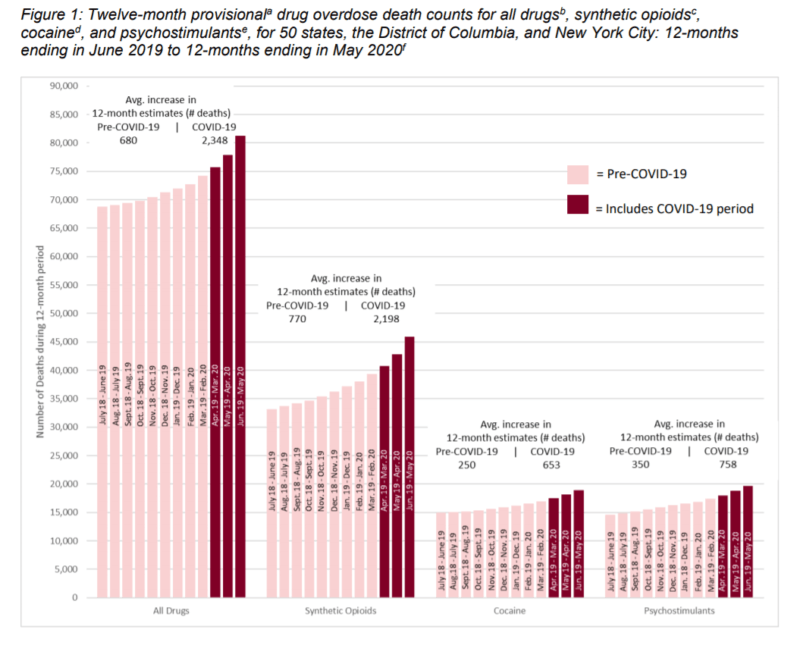
On December 18, just two days after the JAMA study came out, the Centers for Disease Control released preliminary data
that strongly suggest the alternative explanation is correct. Substance
abuse deaths including opioid overdoses have dramatically increased
since the 2018 numbers that the JAMA article used as its baseline.
Furthermore, those already-increasing overdose deaths dramatically
accelerated after the start of the lockdowns. The new CDC study shows
this uptick across all measured categories of substance abuse deaths for
April through June, the only months for which records are available as
of this writing. In all likelihood, this pattern will continue when data
are eventually made available for the summer and fall of 2020.
Although the CDC statistics do not break down these numbers by age,
it is reasonable to assume that they heavily overlap with younger
demographics in keeping with historical patterns from the ongoing
problem of substance abuse. An unprecedented spike in overdose deaths,
as well as other depression-related ailments such as suicides that were
brought on by the lockdowns, accordingly emerge as the more plausible
candidate for the excess death spike among young people compared to
previous years.
Curiously, the authors of the JAMA article did not explore this
alternative hypothesis in any depth beyond the single-sentence
acknowledgement at the end of their article. Perhaps more revealing, the
editors of the JAMA did not insist on any further investigation of this
obvious and crucial complication to attributing excess deaths among the
young to Covid itself.
Like so many instances before, another top medical journal has now
contributed to the widespread dissemination of incomplete and misleading
scientific inferences. Our news media then predictably seized on the
same faulty conclusions and shoehorned them into a political narrative
that confirmed their own pro-lockdown ideological commitments.
Meanwhile, the larger story of the substance abuse deaths that arise
not from Covid but from the lockdown policies that they advocate gets
lost amid the press’s hectoring of young people with exaggerated claims
about the severity of pandemic deaths within their demographic."
"I was going to write a long blog post on the new strain but Zeynep Tufekci has written an excellent piece for The Atlantic. I will quote from it and add a few points.
One of the big virtues of mRNA vaccines is that much like switching a
bottling plant from Sprite to 7-Up we could tweak the formula and
produce a new vaccine using exactly the same manufacturing plants.
Moreover, Marks and Hahn at the FDA have said that the FDA would not require new clinical trials
for safety and efficacy just smaller, shorter trials for immune
response (similarly we don’t do new large-scale clinical trials for
every iteration of the flu vaccine.) Thus, if we needed it, we could
modify mRNA vaccines (not other types) for a new variant in say 8-12
weeks. As Zeynep notes, however, the vaccines are very likely to work
well for the new variant. It’s nice to know, however, that we do have
some flexibility.
The real worry is not that the vaccines won’t work but that we won’t
get them into arms fast enough. We were already going too slow but in a
race against the new more transmissible variant we are looking like
tortoises.
A more transmissible variant of COVID-19 is a potential
catastrophe in and of itself. If anything, given the stage in the
pandemic we are at, a more transmissible variant is in some ways much
more dangerous than a more severe variant. That’s because higher
transmissibility subjects us to a more contagious virus spreading with
exponential growth, whereas the risk from increased severity would have
increased in a linear manner, affecting only those infected.
Here’s a key example from epidemiologist Adam Kucharski:
As
an example, suppose current R=1.1, infection fatality risk is 0.8%,
generation time is 6 days, and 10k people infected (plausible for many
European cities recently). So we’d expect 10000 x 1.1^5 x 0.8% = 129
eventual new fatalities after a month of spread. What happens if
fatality risk increases by 50%? By above, we’d expect 10000 x 1.1^5 x
(0.8% x 1.5) = 193 new fatalities.
Now
suppose transmissibility increases by 50%. By above, we’d expect 10000 x
(1.1 x 1.5)^5 x 0.8% = 978 eventual new fatalities after a month of
spread.
…the
key message: an increase in something that grows exponentially (i.e.
transmission) can have far more effect than the same proportional
increase in something that just scales an outcome (i.e. severity).
I argued that the FDA should have approved the Pfizer vaccine, on a revocable basis, as soon as the data
on the safety and efficacy of its vaccine were made available around
Nov. 20. But the FDA scheduled it’s meeting of experts for weeks later
and didn’t approve until Dec. 11, even as thousands of people were dying
daily. We
could have been weeks ahead of where we are today. Now the
epidemiologists are telling us that weeks are critical. As Zeynep notes holding back second doses looks like a clear mistake and the balance of the evidence also suggests we should move to first doses first:
All this means that the speed of the vaccine rollout is of enormous importance.
…Meanwhile, the United States was reportedly planning to hold back half the vaccine
it has in freezers as a hedge against supply-chain issues, and some
states may be slowed down by murky prioritization plans. Scott
Gottlieb—the former FDA chief and a current board member of Pfizer—has
argued that the U.S. should also go ahead with vaccinating as many
people as possible right now and trust that the supply chain will be
there for the booster. Researchers in Canada—where
some provinces decided to vaccinate now as much as possible without
holding half in reserve, and will administer the booster with future
supplies—estimate that this type of front-loading can help “avert
between 34 and 42 per cent more symptomatic coronavirus infections,
compared with a strategy of keeping half the shipments in reserve.”
(Note that this strategy, which is different from the one the United
Kingdom just announced
it will adopt in prioritizing the first dose, does not even necessarily
involve explicitly changing booster timing protocols in order to
maximize vaccination now; it just means not waiting to get shots into
arms when the vaccines are currently available.) These were already
important conversations to have, but given the threat posed by this new
variant, they are even more urgent.
Perhaps most critically, the FDA should approve the AstraZeneca vaccine
if not as part of Operation Warp Speed then on a right to try basis. We
need every weapon in the arsenal. How many times must we learn not to
play with exponential matches?"
"Many people are horrified by the prospects of introducing the profit motive into health care. Thus they oppose paying kidney donors,
even though it would save tens of thousands of lives. They oppose price
gouging on masks or vaccines, even though it would save many lives.
They oppose challenge studies for vaccines, even though it would have
brought us a vaccine much sooner, thus saving many lives.
Instead, we end up with a government controlled health care regime,
where decisions are made by slow and cumbersome bureaucracies.
In a libertarian society, the pandemic might already be essentially
over. That’s not to say that libertarianism is necessarily precisely
“optimal”, as indeed there is a market failure aspect to
pandemics, due to the external effects of infection. Yet despite the
theoretical case for government intervention, in reality it does much
more harm than good.
Critics of libertarianism make the following errors:
1. Ignoring the Lucas Critique: They assume that
behavior in a highly regulated society is similar to what it would be in
a libertarian society. When interviewed, several Swedes indicated that
they didn’t see any need for masks because the Swedish government told
them they were not needed. People don’t behave like sheep in a
libertarian society; they learn to be responsible for their own
decisions. Before FDIC, people took an active interest in the safety of
the banks where they deposited their hard earned money. Now nobody cares
how recklessly their bank lends out their money—it’s all insured. And
yet I see opponents of abolishing FDIC argue that people are not able to
ascertain whether banks are safe.
2. People underestimate the pervasiveness of government regulation:
Occasionally one encounters progressives describing America’s socialist
health care system as a free market system, which is absurd. Or
they’ll say “There was nothing to prevent health care firm X from doing
what you suggest.” Yes there was; health care providers are so enmeshed
in our over-regulated system that they have almost no ability to engage
in creative problem solving. Suppose a vaccine company pursues an
ambitious plan to speed vaccine development. They ask participants to
sign as waver promising not to sue if things go bad. How would that
contract hold up in court?
3. Externalities cut both ways: Progressives like to talk about externalities as a market failure.
They also like to suggest that selling vaccines to the highest bidder
is an abhorrent idea. But you can’t have it both ways. The externality
aspect of pandemics means that a program that vaccinates people more
rapidly also helps those who are not yet vaccinated. In other words,
when it comes to pandemics, “externality” is just another word for
“trickle-down theory”. A free market regime that uses the profit motive
to vaccinate 20 million people in December is superior to a
bureaucratic regime that vaccinates 5 million people in December, even if the free market allocation is in some sense “unfair”.
4. Cultural norms also matter in a libertarian society:
Just as people put up phony arguments against utilitarianism by
positing abhorrent policies that supposedly increase aggregate utility
but actually make society more unhappy, progressives make phony
arguments against libertarianism by ignoring the fact that our ethical
instincts would still exist in a libertarian society. Bill Gates
doesn’t stop donating tens of billions of dollars for the provision of
health care to the world’s poor just because we deregulate. Catholic
hospitals don’t suddenly ignore ethical considerations just because we
deregulate. Society is still there, with all its instincts and norms.
We don’t all become Gordon Gekko; indeed people are “nicer” in
capitalist countries than in communist countries. What we get through
deregulation is competition; if some of our institutions are creating
roadblocks then other institutions (or even foreign countries) will
provide services to those willing to pay. To attract progressives, maybe
we should start calling competition “diversity”.
5. Bureaucrats use cost/benefit analysis, for themselves:
Yes, bureaucrats weigh costs and benefits. They consider the cost to
their career in letting a bad product out prematurely and the cost to
their career of a “better safe than sorry” long delay in testing a new
product. Unfortunately the outcome that is best for the individual
bureaucrat is almost never the outcome that is optimal for society as a
whole.
This twitter thread discusses how the US government botched the vaccine rollout. And this Alex Tabarrok post discusses how the Canadians do it better. (Tyler Cowen
makes a similar point.) Our government also botched testing, masks,
challenge studies, etc. And now tens of thousands are dying as a
result. Socialism kills."
"They implicitly threw away markets in favor of central planning.
An advance market commitment for Covid-19 should combine
“push” and “pull” incentives. The “pull” incentive is the commitment to
buy 300 million courses of vaccine at a per-person price of $100, for
vaccines produced within a specified time frame. If multiple vaccines
are developed, the A.M.C. fund will have authority to choose products to
purchase based on efficacy, the availability of sufficient vaccine for
timely vaccination or suitability for different population groups. So
firms compete to serve the first 300 million people with the most
attractive vaccines, and the “pull” component provides strong incentives
for both speed and quality.
Here’s the problem: Once the companies produce the vaccine and sell
it to the government, what assures that the vaccine will be distributed
well and quickly? I wrote about this earlier this month in David R.
Henderson, “Vaccines’ Last Hurdle: Central Planners,” Defining Ideas, December 4, 2020.
Essentially what we have is government as monopsonist: monopoly buyer
buying something valuable and then distributing this valuable item at a
zero price. From what I can gather from reading about Pfizer, it has
done its job admirably. But central planning, rather than markets and
pricing, is being used to distribute the vaccine.
This isn’t the fault of Athey et al. And it’s conceivable that they
had zero impact on Operation Warp Speed so the mess-up might not be
their fault. But they hoped to affect the outcome. So, given the huge stakes, it would have been nice, in a longer than usual NY Times
op/ed, for the authors, all talented economists, to spend at least a
paragraph making clear that the drug companies should be free to sell
the drug. They might have wanted to advocate a price cap of, say, $100,
but a price of $100 gives better incentives than a price of $0."
"Boris Johnson's fondness for the
metaphor of the US cavalry riding to the rescue is risky: ask General
Custer. With the vaccine cavalry in sight, and just when we thought we
had earned a Christmas break, the virus has ambushed us with a strain that seems more contagious, and which is rapidly coming to dominate the epidemic in south-east England.
It is now a race between the virus and the vaccine as to which can get into your bloodstream first.
Lockdown sceptics are suspicious. Nervtag, the sinister-sounding "new
and emerging respiratory virus threats advisory group", is dominated by
people on public salaries holding the extreme view that all Covid risks
must be considered and most economic, social, mental and physical
effects of lockdown pretty well ignored, and they have clearly been
itching to call off Christmas.
But that does not mean the new B117 strain is a myth or its danger is
exaggerated. Britain does 50 times more genome sequencing of viruses
than most other countries which means that we are cursed with knowing
more about these mutations but not necessarily being able to do anything
about them. Most mutations, thankfully, make little difference.
This one, however, is different because an unprecedented 14
sense-changing substitutions and three deletions in the virus's genomic
recipe, rather than accumulating gradually, appeared all together for
the first time in a patient in Kent on Sept 20.
The explosive growth of this strain, and the fact that eight of the
mutations are in the spike gene (the key that opens the locks on a cell)
implies that they make the virus more contagious.
This number of changes would normally take months to emerge at the
rate the virus typically evolves: it is less prone to random mutation
than an influenza virus. What caused such a burst of evolution within
perhaps a single body?
Here the story gets alarming. According to analysis by Andrew Rambaut
at Edinburgh University and colleagues for the Covid-19 Genomics
Consortium UK, such high rates of mutation have happened in people with
suppressed immune systems who get a Covid infection that persists for
months and are treated with "convalescent plasma" - essentially blood
extracted from those who have recovered from Covid.
In a person with a deficient immune system, a large population of
viruses can proliferate, mutate and diversify, and then the treatment
selects a new strain from among this diversity.
Essentially, the virus has a crash course in evolution. If so, this
casts doubt on the wisdom of convalescent-plasma treatment, pitting the
possibility that it might save a life against the possibility that it
might help the virus become more infectious or lethal.
There is fortunately no evidence the B117 strain is more virulent,
immune to one of the vaccines or can re-infect people who have
recovered, though the last of these cannot be ruled out.
Viruses will always evolve to be more contagious if they can, but
respiratory viruses also often evolve towards being less virulent. Each
virus is striving to grab market share for its descendants. The best way
of achieving this is to print as many copies of itself as possible
while in a human body, yet not make that person so ill that they meet
fewer people.
Where the sceptics have a point is that it is a worrying possibility
that lockdowns could prevent this natural attenuation of the virus. They
keep the virus spreading mainly in hospitals and care homes among the
very ill, preventing the eclipse of lethal strains at the hands of
milder ones.
If so, and it's only a possibility, then not only do lockdowns fail to wipe out the disease, they may be prolonging our agony.